NETWORK PROTOCOLS
 Introduction
 history
 What is network protocols
 Requirements of protocols
 Functions of protocols
 Types of protocols
 Benefits of protocols
 conclusion
 Computers use network protocols to
communicate in computer networks. There are
many network protocols in existence; TCP/IP
is a family of network protocols that are used
for the Internet.
 A network protocol is a standard written
down on a piece of paper (or, more precisely,
with a text editor in a computer). The
standards that are used for the Internet are
called Requests For Comment (RFC).
 The Internet base protocols and systems were
mainly devised in the 1970s and 1980s.
 TCP/IP describes a protocol which will work
on any sort of computer and operating system
for transportation of data across the internet
between different systems
 TCP/IP has proven to be remarkably robust,
but is very basic.
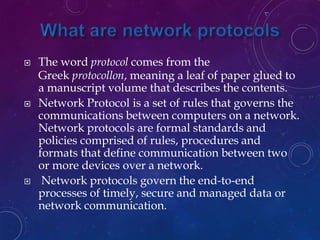
 The word protocol comes from the
Greek protocollon, meaning a leaf of paper glued to
a manuscript volume that describes the contents.
 Network Protocol is a set of rules that governs the
communications between computers on a network.
Network protocols are formal standards and
policies comprised of rules, procedures and
formats that define communication between two
or more devices over a network.
 Network protocols govern the end-to-end
processes of timely, secure and managed data or
network communication.
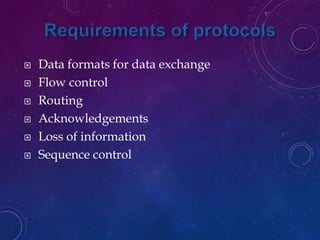
 Data formats for data exchange
 Flow control
 Routing
 Acknowledgements
 Loss of information
 Sequence control
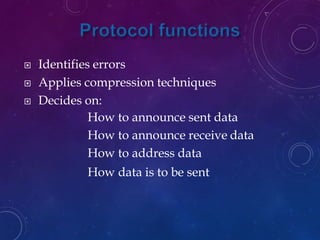
 Identifies errors
 Applies compression techniques
 Decides on:
How to announce sent data
How to announce receive data
How to address data
How data is to be sent
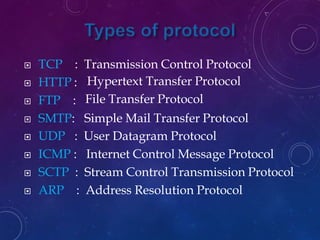
 TCP : Transmission Control Protocol
 HTTP :
 FTP :
 SMTP:
Hypertext Transfer Protocol
File Transfer Protocol
Simple Mail Transfer Protocol
 UDP : User Datagram Protocol
 ICMP : Internet Control Message Protocol
 SCTP : Stream Control Transmission Protocol
 ARP : Address Resolution Protocol
 TCP/IP:
TCP/IP is a set of rules (protocols) governing
communications among all computers on the Internet.
TCP/IP was developed in 1978 and driven by Bob
Kahn and Vint Cerf.
TCP/IP is a combination of two separate protocols:
Transmission Control Protocol (TCP) and Internet
Protocol (IP).
The Transmission Control Protocol is responsible for
ensuring the reliable transmission of data across
Internet-connected networks.
TCP checks packets for errors and submits requests for
re-transmissions if any are found.
HTTP:
The Hypertext Transfer Protocol (HTTP) is
an application protocol for distributed,
collaborative, hypermedia information
systems.HTTP is the foundation of data
communication for the World Wide Web.
Development of HTTP was initiated by Tim
Berners-Lee at CERN in 1989
HTTP is an application layer protocol designed
within the framework of the Internet protocol
suite.
 FTP:
 File Transfer Protocol (FTP) is a standard
Internet protocol for transmitting files between
computers on the Internet over TCP/IP
connections.
 FTP is a client-server protocol that relies on two
communication channels between client and
server: a command channel for controlling the
conversation and a data channel for
transmitting file content.
SMTP:
 Simple Mail Transfer Protocol is used to transport
mail. Simple Mail Transport Protocol is used on
the internet, it is not a transport layer protocol but
is an application layer protocol.
UDP:
 An unreliable connection less protocol used to
control the management of application level
services between computers. It is used for
transport by some applications which must
provide their own reliability.
 ICMP:
 Internet control message protocol provides
management and error reporting to help
manage the process of sending data between
computers. (Management).
 ARP:
 Address Resolution Protocol enables the
packaging of IP data into ethernet packages. It
is the system and messaging protocol that is
used to find the ethernet (hardware) address
from a specific IP number.
 POP:
 POP stands for Post Office Protocol. It is
generally used to support a single client. There
are several versions of POP but the POP 3 is the
current standard.
 POP is an application layer internet standard
protocol.
 POP does not allow search facility.
 It is not suitable for accessing non mail data.
Some important benefits are;
 They provide the path to increase the network
connections
 Enhance the speed of the connection,
 Enhance the data transmission rate and
provide easy working to the users
 Computer Networks and Protocols have
forever changed the way humans will work,
play, and communicate.
 New protocols and standards will emerge, new
applications will be conceived, and our lives
will be further changed and enhanced.

Protocols of network in computer science

  • 1.
  • 2.
     Introduction  history What is network protocols  Requirements of protocols  Functions of protocols  Types of protocols  Benefits of protocols  conclusion
  • 3.
     Computers usenetwork protocols to communicate in computer networks. There are many network protocols in existence; TCP/IP is a family of network protocols that are used for the Internet.  A network protocol is a standard written down on a piece of paper (or, more precisely, with a text editor in a computer). The standards that are used for the Internet are called Requests For Comment (RFC).
  • 4.
     The Internetbase protocols and systems were mainly devised in the 1970s and 1980s.  TCP/IP describes a protocol which will work on any sort of computer and operating system for transportation of data across the internet between different systems  TCP/IP has proven to be remarkably robust, but is very basic.
  • 5.
     The wordprotocol comes from the Greek protocollon, meaning a leaf of paper glued to a manuscript volume that describes the contents.  Network Protocol is a set of rules that governs the communications between computers on a network. Network protocols are formal standards and policies comprised of rules, procedures and formats that define communication between two or more devices over a network.  Network protocols govern the end-to-end processes of timely, secure and managed data or network communication.
  • 6.
     Data formatsfor data exchange  Flow control  Routing  Acknowledgements  Loss of information  Sequence control
  • 7.
     Identifies errors Applies compression techniques  Decides on: How to announce sent data How to announce receive data How to address data How data is to be sent
  • 8.
     TCP :Transmission Control Protocol  HTTP :  FTP :  SMTP: Hypertext Transfer Protocol File Transfer Protocol Simple Mail Transfer Protocol  UDP : User Datagram Protocol  ICMP : Internet Control Message Protocol  SCTP : Stream Control Transmission Protocol  ARP : Address Resolution Protocol
  • 9.
     TCP/IP: TCP/IP isa set of rules (protocols) governing communications among all computers on the Internet. TCP/IP was developed in 1978 and driven by Bob Kahn and Vint Cerf. TCP/IP is a combination of two separate protocols: Transmission Control Protocol (TCP) and Internet Protocol (IP). The Transmission Control Protocol is responsible for ensuring the reliable transmission of data across Internet-connected networks. TCP checks packets for errors and submits requests for re-transmissions if any are found.
  • 10.
    HTTP: The Hypertext TransferProtocol (HTTP) is an application protocol for distributed, collaborative, hypermedia information systems.HTTP is the foundation of data communication for the World Wide Web. Development of HTTP was initiated by Tim Berners-Lee at CERN in 1989 HTTP is an application layer protocol designed within the framework of the Internet protocol suite.
  • 11.
     FTP:  FileTransfer Protocol (FTP) is a standard Internet protocol for transmitting files between computers on the Internet over TCP/IP connections.  FTP is a client-server protocol that relies on two communication channels between client and server: a command channel for controlling the conversation and a data channel for transmitting file content.
  • 12.
    SMTP:  Simple MailTransfer Protocol is used to transport mail. Simple Mail Transport Protocol is used on the internet, it is not a transport layer protocol but is an application layer protocol. UDP:  An unreliable connection less protocol used to control the management of application level services between computers. It is used for transport by some applications which must provide their own reliability.
  • 13.
     ICMP:  Internetcontrol message protocol provides management and error reporting to help manage the process of sending data between computers. (Management).  ARP:  Address Resolution Protocol enables the packaging of IP data into ethernet packages. It is the system and messaging protocol that is used to find the ethernet (hardware) address from a specific IP number.
  • 14.
     POP:  POPstands for Post Office Protocol. It is generally used to support a single client. There are several versions of POP but the POP 3 is the current standard.  POP is an application layer internet standard protocol.  POP does not allow search facility.  It is not suitable for accessing non mail data.
  • 15.
    Some important benefitsare;  They provide the path to increase the network connections  Enhance the speed of the connection,  Enhance the data transmission rate and provide easy working to the users
  • 16.
     Computer Networksand Protocols have forever changed the way humans will work, play, and communicate.  New protocols and standards will emerge, new applications will be conceived, and our lives will be further changed and enhanced.