Rain Gardens
                                       Capturing
                                       and Using the
                                       Rains of the
                                       Great Plains

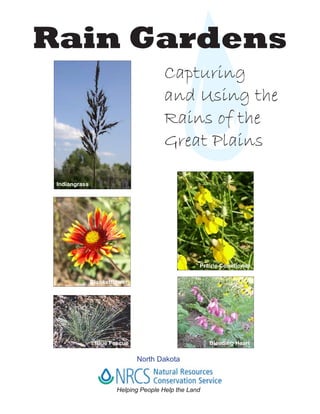
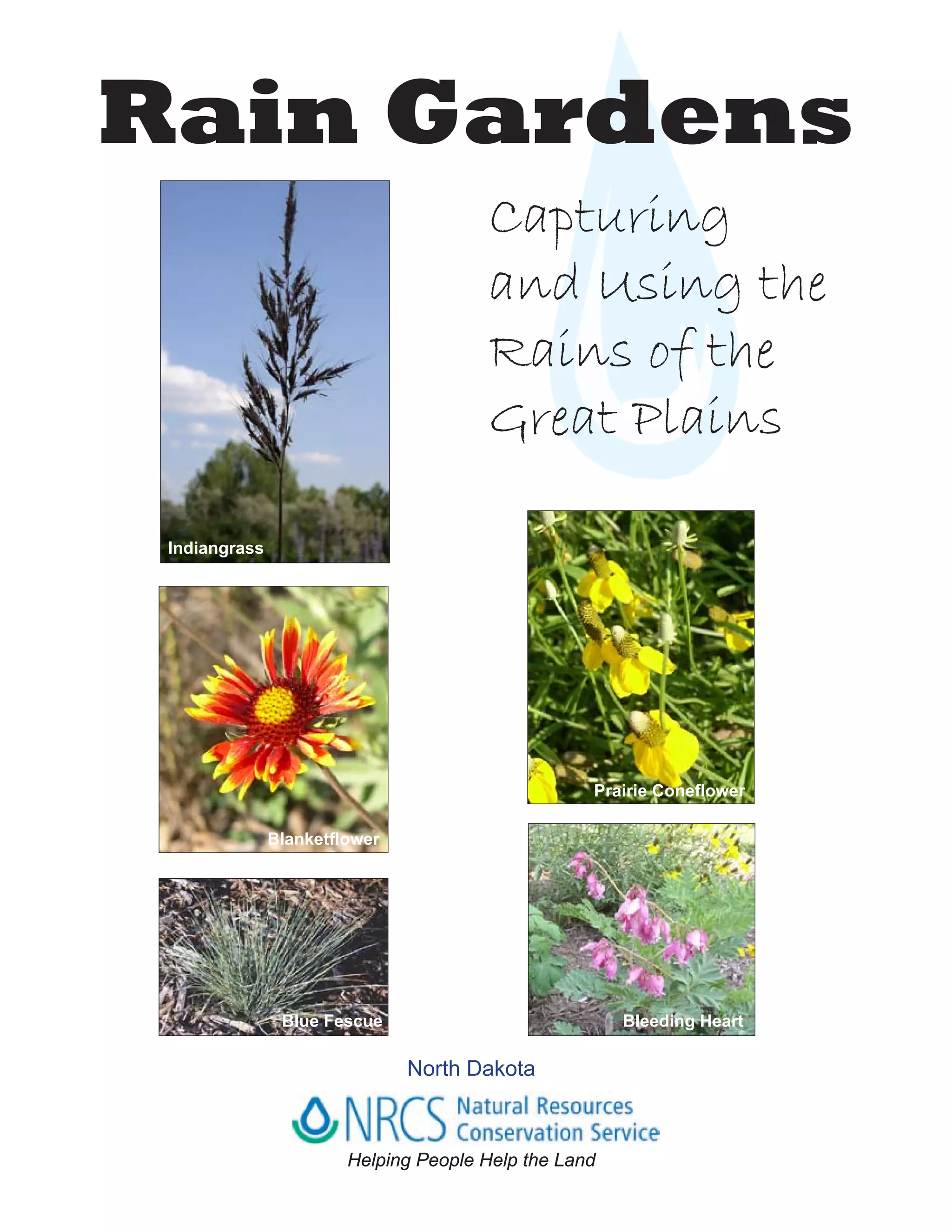
 Indiangrass


                                                   Prairie Coneflower

               Blanketflower


                Blue Fescue                            Bleeding Heart

                               North Dakota


                        Helping People Help the Land
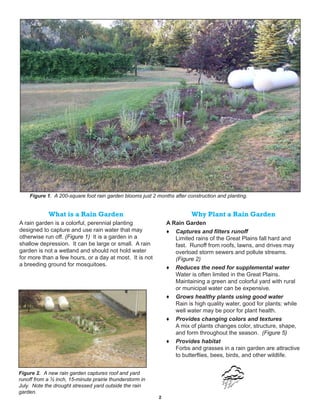
Figure 1. A 200-square foot rain garden blooms just 2 months after construction and planting.


             What is a Rain Garden                                       Why Plant a Rain Garden
A rain garden is a colorful, perennial planting                A Rain Garden
designed to capture and use rain water that may                ♦ Captures and filters runoff
otherwise run off. (Figure 1) It is a garden in a                 Limited rains of the Great Plains fall hard and
shallow depression. It can be large or small. A rain              fast. Runoff from roofs, lawns, and drives may
garden is not a wetland and should not hold water                 overload storm sewers and pollute streams.
for more than a few hours, or a day at most. It is not            (Figure 2)
a breeding ground for mosquitoes.
                                                               ♦ Reduces the need for supplemental water
                                                                  Water is often limited in the Great Plains.
                                                                  Maintaining a green and colorful yard with rural
                                                                  or municipal water can be expensive.
                                                               ♦ Grows healthy plants using good water
                                                                  Rain is high quality water, good for plants; while
                                                                  well water may be poor for plant health.
                                                               ♦ Provides changing colors and textures
                                                                  A mix of plants changes color, structure, shape,
                                                                  and form throughout the season. (Figure 5)
                                                               ♦ Provides habitat
                                                                  Forbs and grasses in a rain garden are attractive
                                                                  to butterflies, bees, birds, and other wildlife.


Figure 2. A new rain garden captures roof and yard
runoff from a ½ inch, 15-minute prairie thunderstorm in
July. Note the drought stressed yard outside the rain
garden.
                                                           2
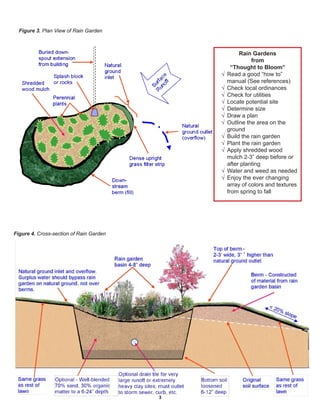
Figure 3. Plan View of Rain Garden


                                                      Rain Gardens
                                                           from
                                                   “Thought to Bloom”
                                             √   Read a good “how to”
                                                 manual (See references)
                                             √   Check local ordinances
                                             √   Check for utilities
                                             √   Locate potential site
                                             √   Determine size
                                             √   Draw a plan
                                             √   Outline the area on the
                                                 ground
                                             √   Build the rain garden
                                             √   Plant the rain garden
                                             √   Apply shredded wood
                                                 mulch 2-3” deep before or
                                                 after planting
                                             √   Water and weed as needed
                                             √   Enjoy the ever changing
                                                 array of colors and textures
                                                 from spring to fall


Figure 4. Cross-section of Rain Garden


                                         3
Where to Establish a Rain Garden                                   How to Plant a Rain Garden
Locate a rain garden to intercept runoff from roofs,          Use potted or bare root plants rather than seeds.
yards, drives, or streets. (Figure 2) It should not be        Plant from April to September. Place the more
built within 10 feet of foundation walls or on poorly         water tolerant species near the bottom, and drought
drained sites. A rain garden should not be built over         tolerant near the edges. Plant spacing will vary
buried utilities or where mature plants could obstruct        depending upon species and desired appearance.
overhead utilities or drivers’ vision. Do not construct       Generally, 15-18 inches between plants is adequate.
a rain garden where prohibited by local ordinances or         Consider mature size when spacing plants.
where subject to disturbance.

         How to Build a Rain Garden
Most rain gardens can be constructed with equipment
available to homeowners such as shovels, rakes, and
rototillers. A small rain garden of simple design can
be built in a day.
 • Do your homework first. Many design manuals are
   available, online and at public offices. Several are
   listed in the reference section of this publication.
 • Locate a proper site.
 • Calculate square footage draining to the rain
   garden (from roof, yard, drive, etc.).
 • Mark outline of rain garden. Rain garden area
   should equal about 10% of the drainage area.
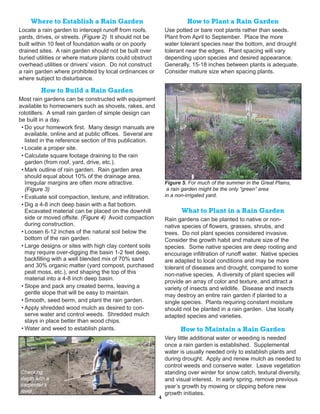
   Irregular margins are often more attractive.               Figure 5. For much of the summer in the Great Plains,
   (Figure 3)                                                  a rain garden might be the only “green” area
 • Evaluate soil compaction, texture, and infiltration.       in a non-irrigated yard.
 • Dig a 4-8 inch deep basin with a flat bottom.
   Excavated material can be placed on the downhill                  What to Plant in a Rain Garden
   side or moved offsite. (Figure 4) Avoid compaction         Rain gardens can be planted to native or non-
   during construction.                                       native species of flowers, grasses, shrubs, and
 • Loosen 6-12 inches of the natural soil below the           trees. Do not plant species considered invasive.
   bottom of the rain garden.                                 Consider the growth habit and mature size of the
 • Large designs or sites with high clay content soils        species. Some native species are deep rooting and
   may require over-digging the basin 1-2 feet deep,          encourage infiltration of runoff water. Native species
   backfilling with a well blended mix of 70% sand            are adapted to local conditions and may be more
   and 30% organic matter (yard compost, purchased            tolerant of diseases and drought, compared to some
   peat moss, etc.), and shaping the top of this              non-native species. A diversity of plant species will
   material into a 4-8 inch deep basin.
                                                              provide an array of color and texture, and attract a
 • Slope and pack any created berms, leaving a                variety of insects and wildlife. Disease and insects
   gentle slope that will be easy to maintain.                may destroy an entire rain garden if planted to a
 • Smooth, seed berm, and plant the rain garden.              single species. Plants requiring constant moisture
 • Apply shredded wood mulch as desired to con-               should not be planted in a rain garden. Use locally
   serve water and control weeds. Shredded mulch              adapted species and varieties.
   stays in place better than wood chips.
 • Water and weed to establish plants.                              How to Maintain a Rain Garden
                                                              Very little additional water or weeding is needed
                                                              once a rain garden is established. Supplemental
                                                              water is usually needed only to establish plants and
                                                              during drought. Apply and renew mulch as needed to
                                                              control weeds and conserve water. Leave vegetation
Checking                                                      standing over winter for snow catch, textural diversity,
depth with a                                                  and visual interest. In early spring, remove previous
carpenter’s                                                   year’s growth by mowing or clipping before new
level                                                         growth initiates.
                                                          4
For more information, contact:
      • USDA Natural Resources Conservation Service
      • Soil and Water Conservation Districts
      • Land Grant Universities and Cooperative Extension Service
      • Local Greenhouses and Nurseries

               References and Additional Reading*

      “Living Landscapes in North Dakota: A GUIDE TO
      NATIVE PLANTSCAPING”
      Available at North Dakota NRCS offices. Booklet contains
      detailed information on site evaluation, planning, and
      establishment of native plants. Adapted forbs, grasses, trees,
      and shrubs are listed and described.

      “Rain Gardens - A how-to manual for homeowners”
      http://www.dnr.wisconsin.gov/org/water/wm/dsfm/shore/docu-
      ments/rgmanual.pdf
      This is an easy to follow manual that shows homeowners how
      to plan, install, and maintain a rain garden.

      “Rain Gardens, Rice Creek Watershed District”
      http://ricecreek.org/bluethumb/raingardens
      This Minnesota web site has information on creating and
      planting rain gardens and more. A very effective plant selector
      tool is part of this site.

      Maplewood, Minnesota “Rain Water Gardens”
      http://tinyurl.com/2yvxxa
      The rain garden program at Maplewood is explained. Pictures
      and designs of many different garden types are included.
      Links within the document give complete details from design
      through maintenance.
      *Note: When using these references, select only plant
      species adapted to your location.


                  Buried pipes and cables can kill
        Check with a utility location service or electric, gas, phone,
       or cable suppliers to locate buried utilities that may be affect-
        ed by construction. Some buried utilities are quite shallow
       and easily severed by a hand shovel, causing death or injury.
                      CHECK BEFORE DIGGING!


       By: Craig Stange, Forester, Ecological Sciences Staff
       Nancy Jensen, Agronomist, Plant Materials Center
       USDA-NRCS, Bismarck, North Dakota

                                  April 2007


All programs and services are offered on a nondiscriminatory basis.
                                       5

ND: Bismarck: Rain Garden Information Guide

  • 1.
    Rain Gardens Capturing and Using the Rains of the Great Plains Indiangrass Prairie Coneflower Blanketflower Blue Fescue Bleeding Heart North Dakota Helping People Help the Land
  • 2.
    Figure 1. A200-square foot rain garden blooms just 2 months after construction and planting. What is a Rain Garden Why Plant a Rain Garden A rain garden is a colorful, perennial planting A Rain Garden designed to capture and use rain water that may ♦ Captures and filters runoff otherwise run off. (Figure 1) It is a garden in a Limited rains of the Great Plains fall hard and shallow depression. It can be large or small. A rain fast. Runoff from roofs, lawns, and drives may garden is not a wetland and should not hold water overload storm sewers and pollute streams. for more than a few hours, or a day at most. It is not (Figure 2) a breeding ground for mosquitoes. ♦ Reduces the need for supplemental water Water is often limited in the Great Plains. Maintaining a green and colorful yard with rural or municipal water can be expensive. ♦ Grows healthy plants using good water Rain is high quality water, good for plants; while well water may be poor for plant health. ♦ Provides changing colors and textures A mix of plants changes color, structure, shape, and form throughout the season. (Figure 5) ♦ Provides habitat Forbs and grasses in a rain garden are attractive to butterflies, bees, birds, and other wildlife. Figure 2. A new rain garden captures roof and yard runoff from a ½ inch, 15-minute prairie thunderstorm in July. Note the drought stressed yard outside the rain garden. 2
  • 3.
    Figure 3. PlanView of Rain Garden Rain Gardens from “Thought to Bloom” √ Read a good “how to” manual (See references) √ Check local ordinances √ Check for utilities √ Locate potential site √ Determine size √ Draw a plan √ Outline the area on the ground √ Build the rain garden √ Plant the rain garden √ Apply shredded wood mulch 2-3” deep before or after planting √ Water and weed as needed √ Enjoy the ever changing array of colors and textures from spring to fall Figure 4. Cross-section of Rain Garden 3
  • 4.
    Where to Establisha Rain Garden How to Plant a Rain Garden Locate a rain garden to intercept runoff from roofs, Use potted or bare root plants rather than seeds. yards, drives, or streets. (Figure 2) It should not be Plant from April to September. Place the more built within 10 feet of foundation walls or on poorly water tolerant species near the bottom, and drought drained sites. A rain garden should not be built over tolerant near the edges. Plant spacing will vary buried utilities or where mature plants could obstruct depending upon species and desired appearance. overhead utilities or drivers’ vision. Do not construct Generally, 15-18 inches between plants is adequate. a rain garden where prohibited by local ordinances or Consider mature size when spacing plants. where subject to disturbance. How to Build a Rain Garden Most rain gardens can be constructed with equipment available to homeowners such as shovels, rakes, and rototillers. A small rain garden of simple design can be built in a day. • Do your homework first. Many design manuals are available, online and at public offices. Several are listed in the reference section of this publication. • Locate a proper site. • Calculate square footage draining to the rain garden (from roof, yard, drive, etc.). • Mark outline of rain garden. Rain garden area should equal about 10% of the drainage area. Irregular margins are often more attractive. Figure 5. For much of the summer in the Great Plains, (Figure 3) a rain garden might be the only “green” area • Evaluate soil compaction, texture, and infiltration. in a non-irrigated yard. • Dig a 4-8 inch deep basin with a flat bottom. Excavated material can be placed on the downhill What to Plant in a Rain Garden side or moved offsite. (Figure 4) Avoid compaction Rain gardens can be planted to native or non- during construction. native species of flowers, grasses, shrubs, and • Loosen 6-12 inches of the natural soil below the trees. Do not plant species considered invasive. bottom of the rain garden. Consider the growth habit and mature size of the • Large designs or sites with high clay content soils species. Some native species are deep rooting and may require over-digging the basin 1-2 feet deep, encourage infiltration of runoff water. Native species backfilling with a well blended mix of 70% sand are adapted to local conditions and may be more and 30% organic matter (yard compost, purchased tolerant of diseases and drought, compared to some peat moss, etc.), and shaping the top of this non-native species. A diversity of plant species will material into a 4-8 inch deep basin. provide an array of color and texture, and attract a • Slope and pack any created berms, leaving a variety of insects and wildlife. Disease and insects gentle slope that will be easy to maintain. may destroy an entire rain garden if planted to a • Smooth, seed berm, and plant the rain garden. single species. Plants requiring constant moisture • Apply shredded wood mulch as desired to con- should not be planted in a rain garden. Use locally serve water and control weeds. Shredded mulch adapted species and varieties. stays in place better than wood chips. • Water and weed to establish plants. How to Maintain a Rain Garden Very little additional water or weeding is needed once a rain garden is established. Supplemental water is usually needed only to establish plants and during drought. Apply and renew mulch as needed to control weeds and conserve water. Leave vegetation Checking standing over winter for snow catch, textural diversity, depth with a and visual interest. In early spring, remove previous carpenter’s year’s growth by mowing or clipping before new level growth initiates. 4
  • 5.
    For more information,contact: • USDA Natural Resources Conservation Service • Soil and Water Conservation Districts • Land Grant Universities and Cooperative Extension Service • Local Greenhouses and Nurseries References and Additional Reading* “Living Landscapes in North Dakota: A GUIDE TO NATIVE PLANTSCAPING” Available at North Dakota NRCS offices. Booklet contains detailed information on site evaluation, planning, and establishment of native plants. Adapted forbs, grasses, trees, and shrubs are listed and described. “Rain Gardens - A how-to manual for homeowners” http://www.dnr.wisconsin.gov/org/water/wm/dsfm/shore/docu- ments/rgmanual.pdf This is an easy to follow manual that shows homeowners how to plan, install, and maintain a rain garden. “Rain Gardens, Rice Creek Watershed District” http://ricecreek.org/bluethumb/raingardens This Minnesota web site has information on creating and planting rain gardens and more. A very effective plant selector tool is part of this site. Maplewood, Minnesota “Rain Water Gardens” http://tinyurl.com/2yvxxa The rain garden program at Maplewood is explained. Pictures and designs of many different garden types are included. Links within the document give complete details from design through maintenance. *Note: When using these references, select only plant species adapted to your location. Buried pipes and cables can kill Check with a utility location service or electric, gas, phone, or cable suppliers to locate buried utilities that may be affect- ed by construction. Some buried utilities are quite shallow and easily severed by a hand shovel, causing death or injury. CHECK BEFORE DIGGING! By: Craig Stange, Forester, Ecological Sciences Staff Nancy Jensen, Agronomist, Plant Materials Center USDA-NRCS, Bismarck, North Dakota April 2007 All programs and services are offered on a nondiscriminatory basis. 5