University of
Education
Snt Department
Township Campus,
Names Roll no.
Faiza Batool 04
Ayesha Ismail 09
Zaira Akbar 18
Iqra Ishaq 27
Nimra Ishtiaq 48
Topic:
Terrarium
BS Botany 5th semester (2015-2019)
In Charge:
Ma’am Asma
TERRARIUM
What is Meant by Terrarium?
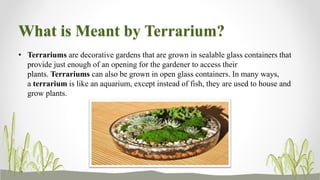
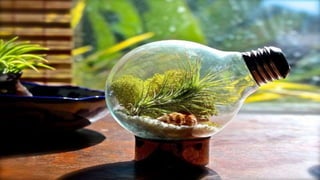
• Terrariums are decorative gardens that are grown in sealable glass containers that
provide just enough of an opening for the gardener to access their
plants. Terrariums can also be grown in open glass containers. In many ways,
a terrarium is like an aquarium, except instead of fish, they are used to house and
grow plants.
How does Terrariums work?
• A terrarium is a closed environment, and can actually be used to illustrate how an
ecosystem works.
• Inside a terrarium’s walls, many different natural processes may be observed:
i. Photosynthesis
ii. Respiration
iii. The water cycle.
• The water in the terrarium is constantly recycled, passing from liquid form to gas and
back again.
• As the moisture in the air condenses on the glass walls, it returns to the soil and is
absorbed by the plants’ roots.
Types of Terrarium:
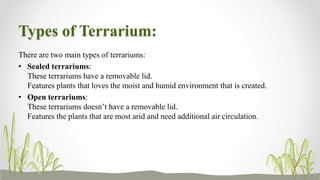
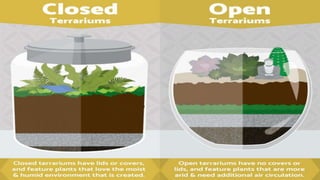
There are two main types of terrariums:
• Sealed terrariums:
These terrariums have a removable lid.
Features plants that loves the moist and humid environment that is created.
• Open terrariums:
These terrariums doesn’t have a removable lid.
Features the plants that are most arid and need additional air circulation.
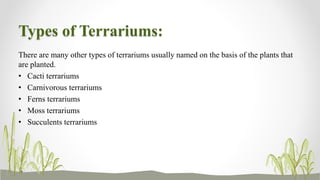
Types of Terrariums:
There are many other types of terrariums usually named on the basis of the plants that
are planted.
• Cacti terrariums
• Carnivorous terrariums
• Ferns terrariums
• Moss terrariums
• Succulents terrariums
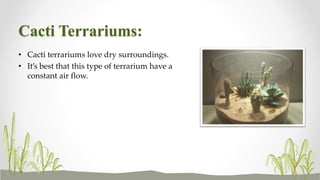
Cacti Terrariums:
• Cacti terrariums love dry surroundings.
• It’s best that this type of terrarium have a
constant air flow.
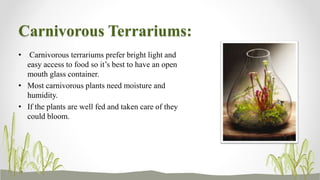
Carnivorous Terrariums:
• Carnivorous terrariums prefer bright light and
easy access to food so it’s best to have an open
mouth glass container.
• Most carnivorous plants need moisture and
humidity.
• If the plants are well fed and taken care of they
could bloom.
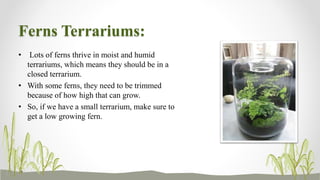
Ferns Terrariums:
• Lots of ferns thrive in moist and humid
terrariums, which means they should be in a
closed terrarium.
• With some ferns, they need to be trimmed
because of how high that can grow.
• So, if we have a small terrarium, make sure to
get a low growing fern.
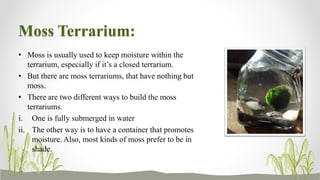
Moss Terrarium:
• Moss is usually used to keep moisture within the
terrarium, especially if it’s a closed terrarium.
• But there are moss terrariums, that have nothing but
moss.
• There are two different ways to build the moss
terrariums.
i. One is fully submerged in water
ii. The other way is to have a container that promotes
moisture. Also, most kinds of moss prefer to be in
shade.
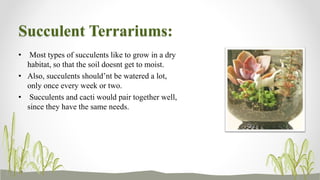
Succulent Terrariums:
• Most types of succulents like to grow in a dry
habitat, so that the soil doesnt get to moist.
• Also, succulents should’nt be watered a lot,
only once every week or two.
• Succulents and cacti would pair together well,
since they have the same needs.
Benefits of Terrarium:
There are quite a few benefits of terrariums, such as:
• They help grow plants that would be difficult to grow in dry air.
• They provide a confined space for a garden – a “mini garden”.
• You can use artificial light, such as LED or fluorescent very efficiently.
• Terrariums don’t need to be watered often.
Do Terrariums Need Sunlight?
• Most need either direct or indirect light but artificial light may also be used. There
are three types of light you can provide for your terrarium.
i. Direct sunlight
ii. Indirect sunlight
iii. Artificial light
• It is recommended to use fluorescent or LED bulbs. Avoid incandescent bulbs.
• If you choose to place your terrarium in direct sunlight, you may want to remove the
lid on a closed terrarium because it might get too hot for the plants with the lid on.
Supplies, That Need to Make a Terrarium:
• A clear glass vessel
• Small pebbles
• Succulent and cactus potting soil
• Succulents and cacti in various shapes and sizes
• White sand
• A spoon
• Long tweezers for putting materials into vessel
Description About Materials:
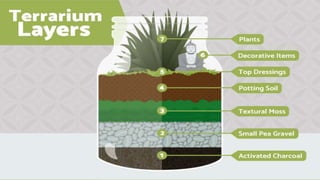
• Activated charcoal:
This is the base layer of your terrarium, and it helps with drainage and maintenance.
Activated charcoal is found at the pet or aquarium supply store, and absorbs
chemicals, toxins, and odors in the soil, water, and air that can build up inside your
terrarium over time, damaging your plants.
• Gravel:
You can use gravel instead of the activated charcoal, but you’ll need to be a little
more on top of your terrarium’s maintenance to avoid rotting and odors if you do.
You can simply use gravel as an additional decorative layer, which is part of the fun
in creating terrariums. Look for pea gravel, colored aquarium gravel, small river
rocks, or smooth moon pebbles. Smaller gravels can also be used as topdressings in
your terrarium to cover the soil.
• Soil:
Choose a soil that is recommended for the plants you are using, as ferns and cacti
have different requirements.
• Moss:
Different colored mosses, available in the floral section of your craft store, are
textural additions to your terrarium. They can be used to separate the soil from the
gravel, as a stunning decorative layer, or as a topdressing for the more moisture-
loving plants like ferns. Avoid using moss around arid plants like cacti and
succulents.
• Tools:
While there are standard tools for terrarium building that can be purchased in a kit,
you can also use items found around your home. Chopsticks are great for adding and
moving materials through the narrow neck of a wine bottle, tweezers are good for
handling spiny cacti, and long-handled teaspoons mimic a miniature shovel or trowel
when manipulating materials.
• Decorative items:
These are the items that make your terrarium come to life. Look for tiny statuary
(zombies, fairy garden accessories), gnarled driftwood, seashells – anything that
makes you smile, expresses your personality.
• Place near sunlight:
Find a well-lit, sheltered location inside your home.
• Keep clean:
Be gone, dirty glass – simply shoot water on the inside walls to wash off residual
soil.
Choosing Your Container:
• Terrariums come in many different and creative shapes and sizes.
• Most terrariums are made from a clear glass jar with a wide mouth.
• However, a plastic 2-L bottle can also be used by cutting it in half, and sliding the top
half over the bottom half to cover.
• It is important to consider that the wider the opening of your container, the easier it
will be to place the plants.
Choosing Your Plants:
Typically, foliage plants and plants that grow slowly work best – avoid fast growing plants.
For example:
• Ferns – Maidenhair, Birds nest, Button ferns
• Carnivorous plants – Venus fly traps, Pitcher plants, Sundew plants
• Dwarf palms
• Airplants – Tillandsia
• Succulents- cacti, Hawthornia, Echeveria, Crassula, etc.
• Peperomia
Procedure:
• Start with a medium-sized, clear glass open-top container. You can use anything that
strikes your fancy—a vase, a cleaned-out pasta jar, a fish bowl, or a special terrarium
bowl.
• Fill the bottom of the vessel with a 1 1/2-inch layer of small rocks to collect the water
drainage.
• Add a layer of potting soil made for succulents and cacti. It should be deep enough
for the plants to root to, about 2 1/2 inches.
• Remove the largest plant from its container and dust excess soil off the roots. Using
the end of a spoon, make a hole in the soil big enough for the roots and nestle the
plant inside, tamping the soil down firmly to hold it in place. Plan for approximately
1 plant per inch of container diameter.
Procedure:
• Continue planting the rest of the succulents, working from largest to smallest. It’s
easiest to start at the back of the container and work your way forward.
• Once the plants are arranged, add about a 1/4-inch layer of white sand around the
plants.
• Finish with some landscaping. Place a few additional pebbles here and there to
complete the look.
Water The Terrariums or Not?
• We should water but not as frequently as typical indoor plants.
• The types of plants found in terrariums tend to be hardy plants that don’t require
frequent watering.
• Also, the greenhouse-like structure of terrariums recycles water instead of
evaporating water into the ambient air with normal indoor plants.
• Open terrariums benefit from being watered every 3-6 weeks.
• Rather than watering on a schedule, check the soil to see if and how much water your
plants need.
Care for a Terrarium:
• Terrariums are low maintenance for the most part but we do have some suggestions
to keep your terrarium long lasting and healthy.
• If we choose to grow ferns, trim leaves to prevent them from overgrowing.
• We should remove yellow and brown leaves from any plants in our terrarium. This is
typically a sign of disease or pest.
• If we have an open terrarium, monitor for pests such as gnats or mealy bugs.
• If we have closed terrarium, we may remove the lid every now and then to let in
some fresh air.
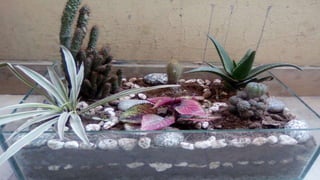
Plants that we have used:
• Lycoris radiate (spider lilly)
• Echinopsis eyriesii
• Perilla frutescens
• Aloe barbadensis (Aloe vera)
• Mammillaria spinosissima (Pin cushion cactus)
• Cereus miller
REFERENCES:
• https://www.fix.com/blog/terrariums/
• https://www.britannica.com/science/terrarium
• https://www.ambius.com/blog/ultimate-guide-to-terrariums/
• https://teentravelinggo.wordpress.com/2014/07/29/terrariums-different-
kinds-of-terrariums-and-what-their-needs-are/
Terrarium

Terrarium

  • 1.
    University of Education Snt Department TownshipCampus, Names Roll no. Faiza Batool 04 Ayesha Ismail 09 Zaira Akbar 18 Iqra Ishaq 27 Nimra Ishtiaq 48 Topic: Terrarium BS Botany 5th semester (2015-2019) In Charge: Ma’am Asma
  • 2.
  • 3.
    What is Meantby Terrarium? • Terrariums are decorative gardens that are grown in sealable glass containers that provide just enough of an opening for the gardener to access their plants. Terrariums can also be grown in open glass containers. In many ways, a terrarium is like an aquarium, except instead of fish, they are used to house and grow plants.
  • 4.
    How does Terrariumswork? • A terrarium is a closed environment, and can actually be used to illustrate how an ecosystem works. • Inside a terrarium’s walls, many different natural processes may be observed: i. Photosynthesis ii. Respiration iii. The water cycle. • The water in the terrarium is constantly recycled, passing from liquid form to gas and back again. • As the moisture in the air condenses on the glass walls, it returns to the soil and is absorbed by the plants’ roots.
  • 5.
    Types of Terrarium: Thereare two main types of terrariums: • Sealed terrariums: These terrariums have a removable lid. Features plants that loves the moist and humid environment that is created. • Open terrariums: These terrariums doesn’t have a removable lid. Features the plants that are most arid and need additional air circulation.
  • 7.
    Types of Terrariums: Thereare many other types of terrariums usually named on the basis of the plants that are planted. • Cacti terrariums • Carnivorous terrariums • Ferns terrariums • Moss terrariums • Succulents terrariums
  • 8.
    Cacti Terrariums: • Cactiterrariums love dry surroundings. • It’s best that this type of terrarium have a constant air flow.
  • 9.
    Carnivorous Terrariums: • Carnivorousterrariums prefer bright light and easy access to food so it’s best to have an open mouth glass container. • Most carnivorous plants need moisture and humidity. • If the plants are well fed and taken care of they could bloom.
  • 10.
    Ferns Terrariums: • Lotsof ferns thrive in moist and humid terrariums, which means they should be in a closed terrarium. • With some ferns, they need to be trimmed because of how high that can grow. • So, if we have a small terrarium, make sure to get a low growing fern.
  • 11.
    Moss Terrarium: • Mossis usually used to keep moisture within the terrarium, especially if it’s a closed terrarium. • But there are moss terrariums, that have nothing but moss. • There are two different ways to build the moss terrariums. i. One is fully submerged in water ii. The other way is to have a container that promotes moisture. Also, most kinds of moss prefer to be in shade.
  • 12.
    Succulent Terrariums: • Mosttypes of succulents like to grow in a dry habitat, so that the soil doesnt get to moist. • Also, succulents should’nt be watered a lot, only once every week or two. • Succulents and cacti would pair together well, since they have the same needs.
  • 13.
    Benefits of Terrarium: Thereare quite a few benefits of terrariums, such as: • They help grow plants that would be difficult to grow in dry air. • They provide a confined space for a garden – a “mini garden”. • You can use artificial light, such as LED or fluorescent very efficiently. • Terrariums don’t need to be watered often.
  • 14.
    Do Terrariums NeedSunlight? • Most need either direct or indirect light but artificial light may also be used. There are three types of light you can provide for your terrarium. i. Direct sunlight ii. Indirect sunlight iii. Artificial light • It is recommended to use fluorescent or LED bulbs. Avoid incandescent bulbs. • If you choose to place your terrarium in direct sunlight, you may want to remove the lid on a closed terrarium because it might get too hot for the plants with the lid on.
  • 15.
    Supplies, That Needto Make a Terrarium: • A clear glass vessel • Small pebbles • Succulent and cactus potting soil • Succulents and cacti in various shapes and sizes • White sand • A spoon • Long tweezers for putting materials into vessel
  • 16.
    Description About Materials: •Activated charcoal: This is the base layer of your terrarium, and it helps with drainage and maintenance. Activated charcoal is found at the pet or aquarium supply store, and absorbs chemicals, toxins, and odors in the soil, water, and air that can build up inside your terrarium over time, damaging your plants. • Gravel: You can use gravel instead of the activated charcoal, but you’ll need to be a little more on top of your terrarium’s maintenance to avoid rotting and odors if you do. You can simply use gravel as an additional decorative layer, which is part of the fun in creating terrariums. Look for pea gravel, colored aquarium gravel, small river rocks, or smooth moon pebbles. Smaller gravels can also be used as topdressings in your terrarium to cover the soil.
  • 17.
    • Soil: Choose asoil that is recommended for the plants you are using, as ferns and cacti have different requirements. • Moss: Different colored mosses, available in the floral section of your craft store, are textural additions to your terrarium. They can be used to separate the soil from the gravel, as a stunning decorative layer, or as a topdressing for the more moisture- loving plants like ferns. Avoid using moss around arid plants like cacti and succulents. • Tools: While there are standard tools for terrarium building that can be purchased in a kit, you can also use items found around your home. Chopsticks are great for adding and moving materials through the narrow neck of a wine bottle, tweezers are good for handling spiny cacti, and long-handled teaspoons mimic a miniature shovel or trowel when manipulating materials.
  • 18.
    • Decorative items: Theseare the items that make your terrarium come to life. Look for tiny statuary (zombies, fairy garden accessories), gnarled driftwood, seashells – anything that makes you smile, expresses your personality. • Place near sunlight: Find a well-lit, sheltered location inside your home. • Keep clean: Be gone, dirty glass – simply shoot water on the inside walls to wash off residual soil.
  • 20.
    Choosing Your Container: •Terrariums come in many different and creative shapes and sizes. • Most terrariums are made from a clear glass jar with a wide mouth. • However, a plastic 2-L bottle can also be used by cutting it in half, and sliding the top half over the bottom half to cover. • It is important to consider that the wider the opening of your container, the easier it will be to place the plants.
  • 21.
    Choosing Your Plants: Typically,foliage plants and plants that grow slowly work best – avoid fast growing plants. For example: • Ferns – Maidenhair, Birds nest, Button ferns • Carnivorous plants – Venus fly traps, Pitcher plants, Sundew plants • Dwarf palms • Airplants – Tillandsia • Succulents- cacti, Hawthornia, Echeveria, Crassula, etc. • Peperomia
  • 22.
    Procedure: • Start witha medium-sized, clear glass open-top container. You can use anything that strikes your fancy—a vase, a cleaned-out pasta jar, a fish bowl, or a special terrarium bowl. • Fill the bottom of the vessel with a 1 1/2-inch layer of small rocks to collect the water drainage. • Add a layer of potting soil made for succulents and cacti. It should be deep enough for the plants to root to, about 2 1/2 inches. • Remove the largest plant from its container and dust excess soil off the roots. Using the end of a spoon, make a hole in the soil big enough for the roots and nestle the plant inside, tamping the soil down firmly to hold it in place. Plan for approximately 1 plant per inch of container diameter.
  • 23.
    Procedure: • Continue plantingthe rest of the succulents, working from largest to smallest. It’s easiest to start at the back of the container and work your way forward. • Once the plants are arranged, add about a 1/4-inch layer of white sand around the plants. • Finish with some landscaping. Place a few additional pebbles here and there to complete the look.
  • 25.
    Water The Terrariumsor Not? • We should water but not as frequently as typical indoor plants. • The types of plants found in terrariums tend to be hardy plants that don’t require frequent watering. • Also, the greenhouse-like structure of terrariums recycles water instead of evaporating water into the ambient air with normal indoor plants. • Open terrariums benefit from being watered every 3-6 weeks. • Rather than watering on a schedule, check the soil to see if and how much water your plants need.
  • 26.
    Care for aTerrarium: • Terrariums are low maintenance for the most part but we do have some suggestions to keep your terrarium long lasting and healthy. • If we choose to grow ferns, trim leaves to prevent them from overgrowing. • We should remove yellow and brown leaves from any plants in our terrarium. This is typically a sign of disease or pest. • If we have an open terrarium, monitor for pests such as gnats or mealy bugs. • If we have closed terrarium, we may remove the lid every now and then to let in some fresh air.
  • 27.
    Plants that wehave used: • Lycoris radiate (spider lilly) • Echinopsis eyriesii • Perilla frutescens • Aloe barbadensis (Aloe vera) • Mammillaria spinosissima (Pin cushion cactus) • Cereus miller
  • 29.
    REFERENCES: • https://www.fix.com/blog/terrariums/ • https://www.britannica.com/science/terrarium •https://www.ambius.com/blog/ultimate-guide-to-terrariums/ • https://teentravelinggo.wordpress.com/2014/07/29/terrariums-different- kinds-of-terrariums-and-what-their-needs-are/