This presentation was created to provide property owners
with an overview of rain garden construction that can be
used to reduce the nonpoint source pollution coming from
their property.
The design guides in this presentation represent general
guidelines for rain garden construction. To be eligible for
the stormwater utility credit, rain gardens must be designed
according to the standards of the Georgia Stormwater
Management Manual and certified by a professional
engineer.
As with any construction, property owners should contact
Athens-Clarke County to determine permitting requirements
and address any other issues that may occur.
Build Your
Own Rain
Garden

         Rose Mary Seymour
   Engineering Extension Specialist
        CAES-Griffin Campus
   Ag Pollution Prevention Program
    Sponsored by P2AD of Georgia
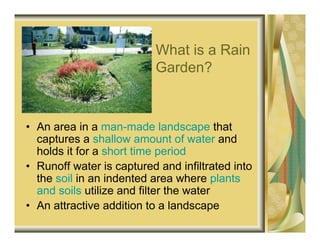
What is a Rain
                          Garden?


• An area in a man-made landscape that
  captures a shallow amount of water and
  holds it for a short time period
• Runoff water is captured and infiltrated into
  the soil in an indented area where plants
  and soils utilize and filter the water
• An attractive addition to a landscape
Purpose of a Rain Garden

• Captures runoff from impervious
  areas such as roofs, driveways,
  patios
• Reduce runoff leaving landscape to
  become stormwater
• Ponding should last no more than 48
  hours after rain stops
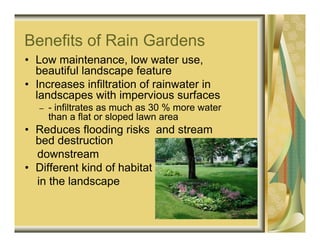
Benefits of Rain Gardens
• Low maintenance, low water use,
  beautiful landscape feature
• Increases infiltration of rainwater in
  landscapes with impervious surfaces
  –   - infiltrates as much as 30 % more water
      than a flat or sloped lawn area
• Reduces flooding risks and stream
  bed destruction
  downstream
• Different kind of habitat
  in the landscape
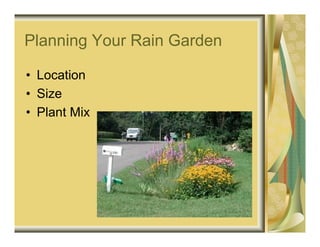
Planning Your Rain Garden

• Location
• Size
• Plant Mix
Location of the Rain Garden

• At least 10 ft from a building
  foundation
• Near patio, driveways roads
• Area that water will naturally move to
  –low area
• Easy viewing from inside
• Fitting into the rest of the landscape
Locations to Avoid

• Next to a building foundation
• Over a septic system
• Where water stands for long periods
  already
  –   High seasonal water table area
• Inside the dripline of any large trees
• Slopes greater 12%
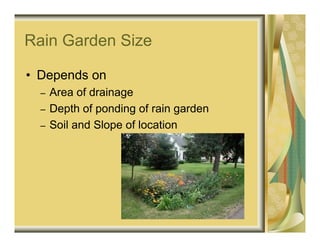
Rain Garden Size

• Depends on
  –   Area of drainage
  –   Depth of ponding of rain garden
  –   Soil and Slope of location
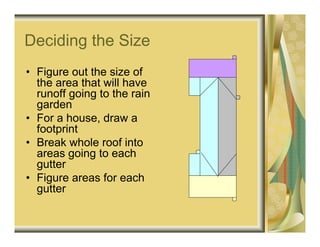
Deciding the Size
• Figure out the size of
  the area that will have
  runoff going to the rain
  garden
• For a house, draw a
  footprint
• Break whole roof into
  areas going to each
  gutter
• Figure areas for each
  gutter
Soil Testing
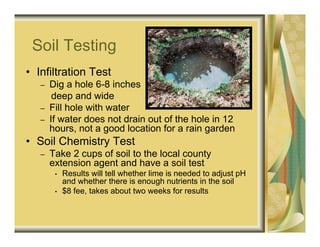
• Infiltration Test
   –   Dig a hole 6-8 inches
        deep and wide
   –   Fill hole with water
   –   If water does not drain out of the hole in 12
       hours, not a good location for a rain garden
• Soil Chemistry Test
   –   Take 2 cups of soil to the local county
       extension agent and have a soil test
        •   Results will tell whether lime is needed to adjust pH
            and whether there is enough nutrients in the soil
        •   $8 fee, takes about two weeks for results
Problem Soils

• If soils are high in clay or have been
  compacted during development, they
  may not have the capacity to infiltrate
  well
• The rain garden area soil can be
  removed and replaced with a better
  draining soil
Problem Soils

• Ideal rain garden soil mix – 50-60%
  sand, 20-30% topsoil, 20-30%
  compost
  –   No more than 10% of mix should be clay
• Be careful of the nutrient content of
  composts…lower nutrient
  concentrations is better for the rain
  garden soil
Deciding the Size
• Sandy soils – 5-8% of runoff area
• Clay soils – 10-15% of runoff area
• Example – Area = 1800 sq.ft
  –   Sandy soil - .06 X 1800 = 108 sq.ft
  –   Clay soil - .12 X 1800 = 216 sq.ft
• If the area of the rain garden needs to
  be > 300 sq ft, consider making two
  smaller ones or bring in the earth
  moving equipment
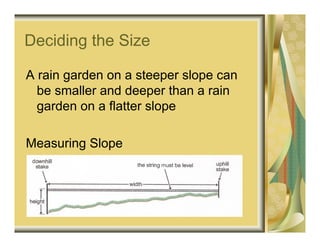
Deciding the Size

A rain garden on a steeper slope can
  be smaller and deeper than a rain
  garden on a flatter slope

Measuring Slope
Installing the Rain Garden
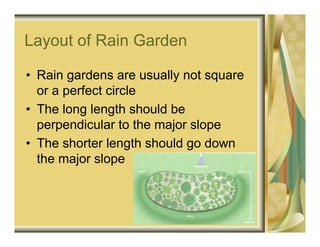
Layout of Rain Garden

• Rain gardens are usually not square
  or a perfect circle
• The long length should be
  perpendicular to the major slope
• The shorter length should go down
  the major slope
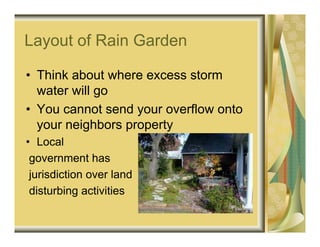
Layout of Rain Garden

• Think about where excess storm
  water will go
• You cannot send your overflow onto
  your neighbors property
• Local
 government has
 jurisdiction over land
 disturbing activities
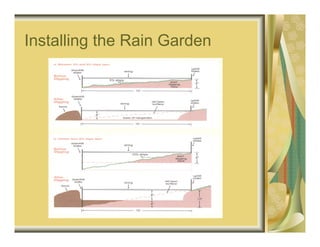
Installing the Rain Garden
• Pointers
   – Bottom of the rain garden should be level
   – Top of berm should be about the same elevation as the
     uphill edge of the rain garden
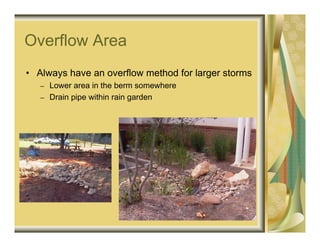
Overflow Area
• Always have an overflow method for larger storms
   – Lower area in the berm somewhere
   – Drain pipe within rain garden
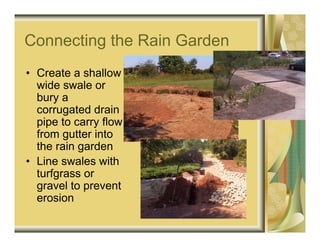
Connecting the Rain Garden
• Create a shallow
  wide swale or
  bury a
  corrugated drain
  pipe to carry flow
  from gutter into
  the rain garden
• Line swales with
  turfgrass or
  gravel to prevent
  erosion
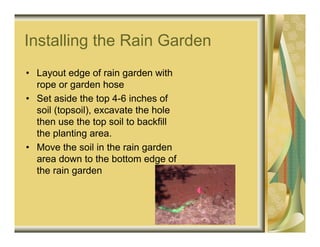
Installing the Rain Garden
• Layout edge of rain garden with
  rope or garden hose
• Set aside the top 4-6 inches of
  soil (topsoil), excavate the hole
  then use the top soil to backfill
  the planting area.
• Move the soil in the rain garden
  area down to the bottom edge of
  the rain garden
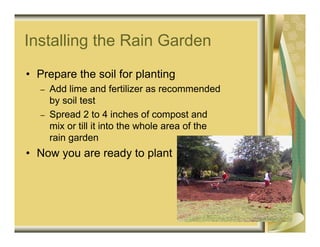
Installing the Rain Garden
• Prepare the soil for planting
   –   Add lime and fertilizer as recommended
       by soil test
   –   Spread 2 to 4 inches of compost and
       mix or till it into the whole area of the
       rain garden
• Now you are ready to plant
Plants
• A wide variety of plants in both size texture
  and color makes for an interesting rain
  garden
• Rain gardens can be designed to attract
  butterflies and birds with the right plant
  choices
• Mix trees, shrubs, perennials, ornamental
  grasses and turfgrasses
• Plants must be wet and drought tolerant
   –   Really tough plants
Trees for Rain Gardens
•   Red Maple      •   Sweetbay Magnolia
•   River Birch    •   Dahoon Holly
•   Crape Myrtle   •   Winter King Hawthorn
•   Black Gum      •   Sugar Hackberry
•   Bald Cypress   •   Fringetree
•   Green Ash      •   Gingko
•   Willow Oak     •   Persimmon
•   Serviceberry   •   Loblolly Pine
•   Hornbeam
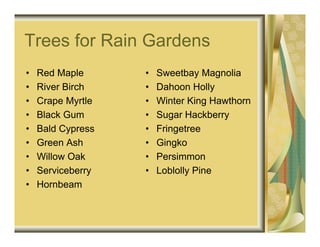
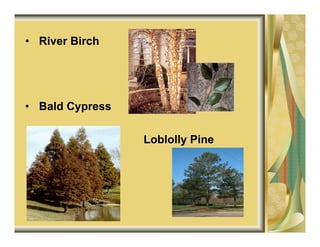
• River Birch


• Bald Cypress

                 Loblolly Pine
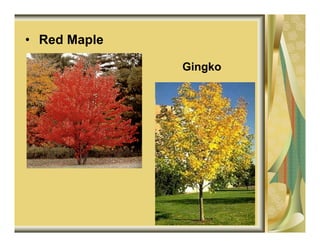
• Red Maple

              Gingko
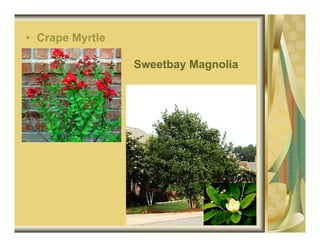
• Crape Myrtle

                 Sweetbay Magnolia
Black Gum
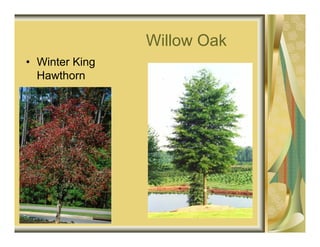
Willow Oak
• Winter King
  Hawthorn
Shrubs for Rain Gardens
• Winterberry   • American
• Arrowwood       Beautyberry
• Buttonbush    • Bottlebrush
• Summersweet     Buckeye
  Clethra       • Inkberry
• Wax Myrtle    • Oakleaf Hydrangea
• Chokeberry    • Virginia Sweetspire
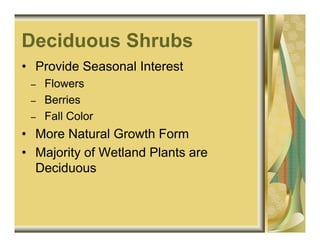
Deciduous Shrubs
• Provide Seasonal Interest
 –   Flowers
 –   Berries
 –   Fall Color
• More Natural Growth Form
• Majority of Wetland Plants are
  Deciduous
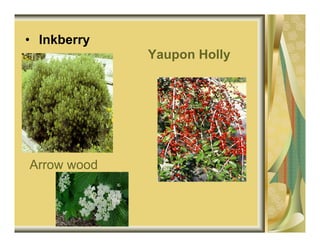
• Inkberry
             Yaupon Holly


Arrow wood
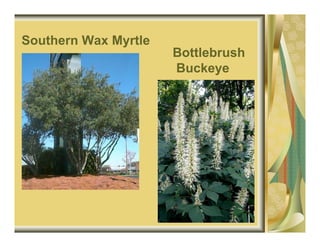
Southern Wax Myrtle
                      Bottlebrush
                      Buckeye
Oakleaf Hydrangea


    American
    Beauty Berry
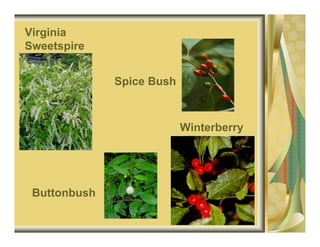
Virginia
Sweetspire


              Spice Bush


                           Winterberry


 Buttonbush
Herbaceous Plants for Rain
Gardens
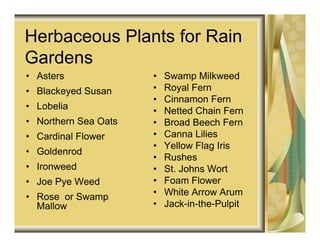
• Asters              •   Swamp Milkweed
• Blackeyed Susan     •   Royal Fern
                      •   Cinnamon Fern
• Lobelia             •   Netted Chain Fern
• Northern Sea Oats   •   Broad Beech Fern
• Cardinal Flower     •   Canna Lilies
                      •   Yellow Flag Iris
• Goldenrod
                      •   Rushes
• Ironweed            •   St. Johns Wort
• Joe Pye Weed        •   Foam Flower
• Rose or Swamp       •   White Arrow Arum
  Mallow              •   Jack-in-the-Pulpit
Herbaceous Plants for Rain
Gardens- Groundcovers
• Shuttleworth      • Zoysia
  ginger            • Liriope
• Partridge berry   • Mondograss
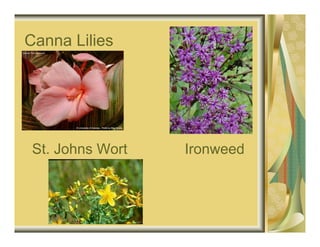
Canna Lilies


 St. Johns Wort   Ironweed
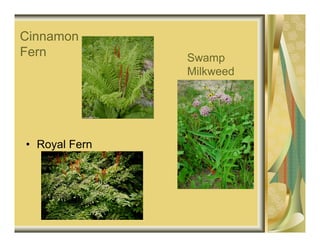
Cinnamon
Fern           Swamp
               Milkweed


• Royal Fern
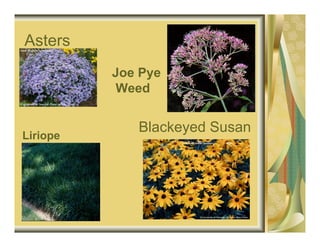
Asters
          Joe Pye
           Weed


             Blackeyed Susan
Liriope
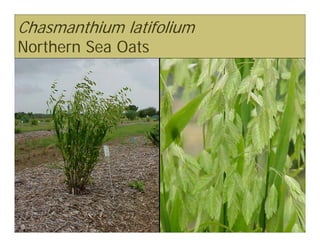
Chasmanthium latifolium
Northern Sea Oats
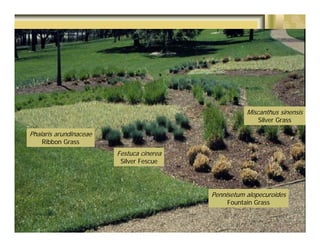
Miscanthus sinensis
                                                         Silver Grass

Phalaris arundinaceae
    Ribbon Grass
                        Festuca cinerea
                         Silver Fescue


                                          Pennisetum alopecuroides
                                               Fountain Grass
Plants to Avoid


• Those Susceptible to Root Rots
 –   Most coniferous shrubs
 –   Azaleas
 –   Indian Hawthorn
 –   Camelias
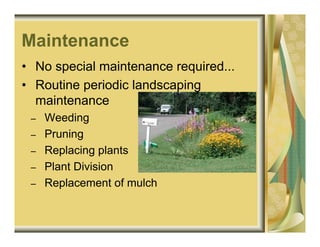
Maintenance
• No special maintenance required...
• Routine periodic landscaping
  maintenance
 –   Weeding
 –   Pruning
 –   Replacing plants
 –   Plant Division
 –   Replacement of mulch
Credits
•  Photos of Completed Rain Garden Examples courtesy of
   City of Maplewood
   http://www.ci.maplewood.mn.us/index.asp?Type=B_BASIC&
   SEC={F2C03470-D6B5-4572-98F0-F79819643C2A}
• Plant photos from Vegetation for Bioretention Areas, Allen
   Caldwell, CED, NC State CES or from Todd Hurt, GCES,
   Cherokee County and Gary Wade, GCES, Horticulture
   Specialist
• Rain Gardens A How-to Manual for Homeowners University
   of Wisconsin Extension Pub #GWQ037
http://clean-water.uwex.edu/pubs/raingarden/rgmanual.pdf
• Intro Picture - Rain Gardens of West Michigan
   www.raingardens.org
GCES Recommended Resources
• A Compilation of Low Maintenance Plants for
   Georgia Landscapes
http://pubs.caes.uga.edu/caespubs/Agriculture/horticult
   ure/H-91-009.htm
• Environmentally Friendly Landscape Practices
http://pubs.caes.uga.edu/caespubs/Agriculture/horticult
   ure/H-00-060.htm
• Landscape Plants for Georgia
http://pubs.caes.uga.edu/caespubs/pubcd/B625.htm
• Soil Preparation and Planting Procedures for
   Ornamental Plants in the Landscape
http://www.ces.uga.edu/pubcd/B932-w.htm
• Soil Testing for Home and Gardens
http://pubs.caes.uga.edu/caespubs/pubs/PDF/L387.pdf
Questions and
  Thoughts
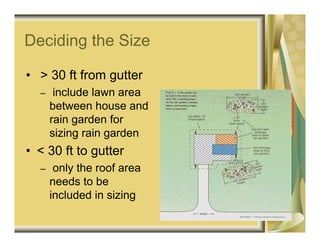
Deciding the Size

• > 30 ft from gutter
  –    include lawn area
      between house and
      rain garden for
      sizing rain garden
• < 30 ft to gutter
  –    only the roof area
      needs to be
      included in sizing

Georgia Rain Garden Manual

  • 1.
    This presentation wascreated to provide property owners with an overview of rain garden construction that can be used to reduce the nonpoint source pollution coming from their property. The design guides in this presentation represent general guidelines for rain garden construction. To be eligible for the stormwater utility credit, rain gardens must be designed according to the standards of the Georgia Stormwater Management Manual and certified by a professional engineer. As with any construction, property owners should contact Athens-Clarke County to determine permitting requirements and address any other issues that may occur.
  • 2.
    Build Your Own Rain Garden Rose Mary Seymour Engineering Extension Specialist CAES-Griffin Campus Ag Pollution Prevention Program Sponsored by P2AD of Georgia
  • 3.
    What is aRain Garden? • An area in a man-made landscape that captures a shallow amount of water and holds it for a short time period • Runoff water is captured and infiltrated into the soil in an indented area where plants and soils utilize and filter the water • An attractive addition to a landscape
  • 4.
    Purpose of aRain Garden • Captures runoff from impervious areas such as roofs, driveways, patios • Reduce runoff leaving landscape to become stormwater • Ponding should last no more than 48 hours after rain stops
  • 5.
    Benefits of RainGardens • Low maintenance, low water use, beautiful landscape feature • Increases infiltration of rainwater in landscapes with impervious surfaces – - infiltrates as much as 30 % more water than a flat or sloped lawn area • Reduces flooding risks and stream bed destruction downstream • Different kind of habitat in the landscape
  • 6.
    Planning Your RainGarden • Location • Size • Plant Mix
  • 7.
    Location of theRain Garden • At least 10 ft from a building foundation • Near patio, driveways roads • Area that water will naturally move to –low area • Easy viewing from inside • Fitting into the rest of the landscape
  • 8.
    Locations to Avoid •Next to a building foundation • Over a septic system • Where water stands for long periods already – High seasonal water table area • Inside the dripline of any large trees • Slopes greater 12%
  • 9.
    Rain Garden Size •Depends on – Area of drainage – Depth of ponding of rain garden – Soil and Slope of location
  • 10.
    Deciding the Size •Figure out the size of the area that will have runoff going to the rain garden • For a house, draw a footprint • Break whole roof into areas going to each gutter • Figure areas for each gutter
  • 11.
    Soil Testing • InfiltrationTest – Dig a hole 6-8 inches deep and wide – Fill hole with water – If water does not drain out of the hole in 12 hours, not a good location for a rain garden • Soil Chemistry Test – Take 2 cups of soil to the local county extension agent and have a soil test • Results will tell whether lime is needed to adjust pH and whether there is enough nutrients in the soil • $8 fee, takes about two weeks for results
  • 12.
    Problem Soils • Ifsoils are high in clay or have been compacted during development, they may not have the capacity to infiltrate well • The rain garden area soil can be removed and replaced with a better draining soil
  • 13.
    Problem Soils • Idealrain garden soil mix – 50-60% sand, 20-30% topsoil, 20-30% compost – No more than 10% of mix should be clay • Be careful of the nutrient content of composts…lower nutrient concentrations is better for the rain garden soil
  • 14.
    Deciding the Size •Sandy soils – 5-8% of runoff area • Clay soils – 10-15% of runoff area • Example – Area = 1800 sq.ft – Sandy soil - .06 X 1800 = 108 sq.ft – Clay soil - .12 X 1800 = 216 sq.ft • If the area of the rain garden needs to be > 300 sq ft, consider making two smaller ones or bring in the earth moving equipment
  • 15.
    Deciding the Size Arain garden on a steeper slope can be smaller and deeper than a rain garden on a flatter slope Measuring Slope
  • 16.
  • 17.
    Layout of RainGarden • Rain gardens are usually not square or a perfect circle • The long length should be perpendicular to the major slope • The shorter length should go down the major slope
  • 18.
    Layout of RainGarden • Think about where excess storm water will go • You cannot send your overflow onto your neighbors property • Local government has jurisdiction over land disturbing activities
  • 19.
    Installing the RainGarden • Pointers – Bottom of the rain garden should be level – Top of berm should be about the same elevation as the uphill edge of the rain garden
  • 20.
    Overflow Area • Alwayshave an overflow method for larger storms – Lower area in the berm somewhere – Drain pipe within rain garden
  • 21.
    Connecting the RainGarden • Create a shallow wide swale or bury a corrugated drain pipe to carry flow from gutter into the rain garden • Line swales with turfgrass or gravel to prevent erosion
  • 22.
    Installing the RainGarden • Layout edge of rain garden with rope or garden hose • Set aside the top 4-6 inches of soil (topsoil), excavate the hole then use the top soil to backfill the planting area. • Move the soil in the rain garden area down to the bottom edge of the rain garden
  • 23.
    Installing the RainGarden • Prepare the soil for planting – Add lime and fertilizer as recommended by soil test – Spread 2 to 4 inches of compost and mix or till it into the whole area of the rain garden • Now you are ready to plant
  • 24.
    Plants • A widevariety of plants in both size texture and color makes for an interesting rain garden • Rain gardens can be designed to attract butterflies and birds with the right plant choices • Mix trees, shrubs, perennials, ornamental grasses and turfgrasses • Plants must be wet and drought tolerant – Really tough plants
  • 25.
    Trees for RainGardens • Red Maple • Sweetbay Magnolia • River Birch • Dahoon Holly • Crape Myrtle • Winter King Hawthorn • Black Gum • Sugar Hackberry • Bald Cypress • Fringetree • Green Ash • Gingko • Willow Oak • Persimmon • Serviceberry • Loblolly Pine • Hornbeam
  • 26.
    • River Birch •Bald Cypress Loblolly Pine
  • 27.
  • 28.
    • Crape Myrtle Sweetbay Magnolia
  • 29.
  • 30.
  • 31.
    Shrubs for RainGardens • Winterberry • American • Arrowwood Beautyberry • Buttonbush • Bottlebrush • Summersweet Buckeye Clethra • Inkberry • Wax Myrtle • Oakleaf Hydrangea • Chokeberry • Virginia Sweetspire
  • 32.
    Deciduous Shrubs • ProvideSeasonal Interest – Flowers – Berries – Fall Color • More Natural Growth Form • Majority of Wetland Plants are Deciduous
  • 33.
    • Inkberry Yaupon Holly Arrow wood
  • 34.
    Southern Wax Myrtle Bottlebrush Buckeye
  • 35.
    Oakleaf Hydrangea American Beauty Berry
  • 36.
    Virginia Sweetspire Spice Bush Winterberry Buttonbush
  • 37.
    Herbaceous Plants forRain Gardens • Asters • Swamp Milkweed • Blackeyed Susan • Royal Fern • Cinnamon Fern • Lobelia • Netted Chain Fern • Northern Sea Oats • Broad Beech Fern • Cardinal Flower • Canna Lilies • Yellow Flag Iris • Goldenrod • Rushes • Ironweed • St. Johns Wort • Joe Pye Weed • Foam Flower • Rose or Swamp • White Arrow Arum Mallow • Jack-in-the-Pulpit
  • 38.
    Herbaceous Plants forRain Gardens- Groundcovers • Shuttleworth • Zoysia ginger • Liriope • Partridge berry • Mondograss
  • 39.
    Canna Lilies St.Johns Wort Ironweed
  • 40.
    Cinnamon Fern Swamp Milkweed • Royal Fern
  • 41.
    Asters Joe Pye Weed Blackeyed Susan Liriope
  • 42.
  • 43.
    Miscanthus sinensis Silver Grass Phalaris arundinaceae Ribbon Grass Festuca cinerea Silver Fescue Pennisetum alopecuroides Fountain Grass
  • 44.
    Plants to Avoid •Those Susceptible to Root Rots – Most coniferous shrubs – Azaleas – Indian Hawthorn – Camelias
  • 45.
    Maintenance • No specialmaintenance required... • Routine periodic landscaping maintenance – Weeding – Pruning – Replacing plants – Plant Division – Replacement of mulch
  • 46.
    Credits • Photosof Completed Rain Garden Examples courtesy of City of Maplewood http://www.ci.maplewood.mn.us/index.asp?Type=B_BASIC& SEC={F2C03470-D6B5-4572-98F0-F79819643C2A} • Plant photos from Vegetation for Bioretention Areas, Allen Caldwell, CED, NC State CES or from Todd Hurt, GCES, Cherokee County and Gary Wade, GCES, Horticulture Specialist • Rain Gardens A How-to Manual for Homeowners University of Wisconsin Extension Pub #GWQ037 http://clean-water.uwex.edu/pubs/raingarden/rgmanual.pdf • Intro Picture - Rain Gardens of West Michigan www.raingardens.org
  • 47.
    GCES Recommended Resources •A Compilation of Low Maintenance Plants for Georgia Landscapes http://pubs.caes.uga.edu/caespubs/Agriculture/horticult ure/H-91-009.htm • Environmentally Friendly Landscape Practices http://pubs.caes.uga.edu/caespubs/Agriculture/horticult ure/H-00-060.htm • Landscape Plants for Georgia http://pubs.caes.uga.edu/caespubs/pubcd/B625.htm • Soil Preparation and Planting Procedures for Ornamental Plants in the Landscape http://www.ces.uga.edu/pubcd/B932-w.htm • Soil Testing for Home and Gardens http://pubs.caes.uga.edu/caespubs/pubs/PDF/L387.pdf
  • 48.
  • 49.
    Deciding the Size •> 30 ft from gutter – include lawn area between house and rain garden for sizing rain garden • < 30 ft to gutter – only the roof area needs to be included in sizing