Hépatite B

     Fabien Zoulim
Département d’hépatologie
 & INSERM U871, Lyon
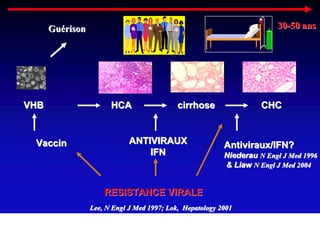
Guérison                                                          30-50 ans


VHB                    HCA                  cirrhose                CHC


 Vaccin                      ANTIVIRAUX                   Antiviraux/IFN?
                                 IFN                      Niederau N Engl J Med 1996
                                                          & Liaw N Engl J Med 2004


                     RESISTANCE VIRALE
                 Lee, N Engl J Med 1997; Lok, Hepatology 2001
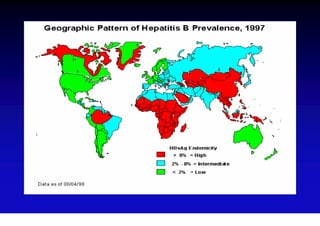
EPIDEMIOLOGIE DE L’HÉPATITE B
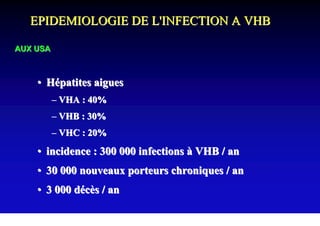
EPIDEMIOLOGIE DE L'INFECTION A VHB

AUX USA


    • Hépatites aigues
          – VHA : 40%
          – VHB : 30%
          – VHC : 20%
    • incidence : 300 000 infections à VHB / an
    • 30 000 nouveaux porteurs chroniques / an
    • 3 000 décès / an
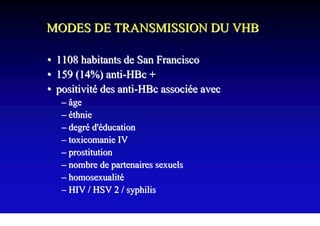
MODES DE TRANSMISSION DU VHB

•   1108 habitants de San Francisco
•   159 (14%) anti-HBc +
•   positivité des anti-HBc associée avec
     – âge
     – éthnie
     – degré d'éducation
     – toxicomanie IV
     – prostitution
     – nombre de partenaires sexuels
     – homosexualité
     – HIV / HSV 2 / syphilis
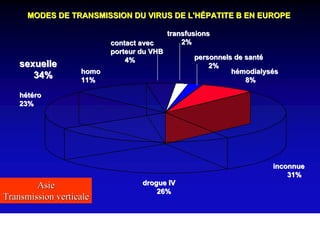
MODES DE TRANSMISSION DU VIRUS DE L'HÉPATITE B EN EUROPE

                                           transfusions
                          contact avec         2%
                          porteur du VHB
                              4%                  personnels de santé
    sexuelle                                          2%
                   homo                                     hémodialysés
       34%         11%                                          8%

    hétéro
    23%


                                                                      inconnue
                                                                          31%
        Asie                      drogue IV
                                      26%
Transmission verticale
Déclaration obligatoire
       de l’hépatite B en France :
 résultats des 12 premiers mois de notification


Denise Antona, E Delarocque-Astagneau, D Lévy-Bruhl
        département des maladies infectieuses
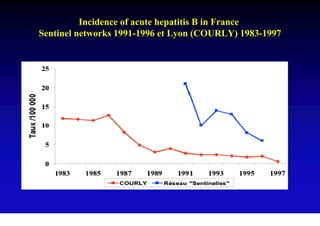
Incidence of acute hepatitis B in France
Sentinel networks 1991-1996 et Lyon (COURLY) 1983-1997
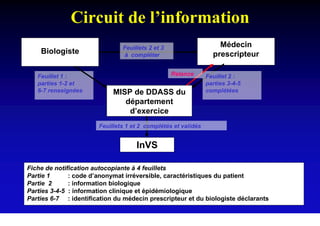
Circuit de l’information
                               Feuillets 2 et 3                    Médecin
    Biologiste                 à compléter                       prescripteur

   Feuillet 1 :                                   Relance      Feuillet 2 :
   parties 1-2 et                                              parties 3-4-5
   6-7 renseignées          MISP de DDASS du                   complétées
                               département
                                d’exercice
                       Feuillets 1 et 2 complétés et validés


                                    InVS

Fiche de notification autocopiante à 4 feuillets
Partie 1      : code d’anonymat irréversible, caractéristiques du patient
Partie 2      : information biologique
Parties 3-4-5 : information clinique et épidémiologique
Parties 6-7 : identification du médecin prescripteur et du biologiste déclarants
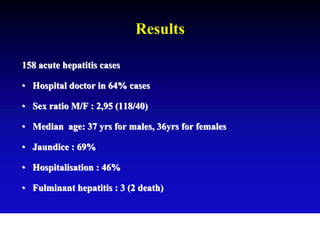
Results

158 acute hepatitis cases

• Hospital doctor in 64% cases

• Sex ratio M/F : 2,95 (118/40)

• Median age: 37 yrs for males, 36yrs for females

• Jaundice : 69%

• Hospitalisation : 46%

• Fulminant hepatitis : 3 (2 death)
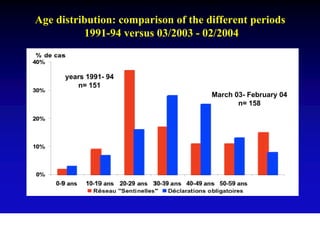
Age distribution: comparison of the different periods
          1991-94 versus 03/2003 - 02/2004


      years 1991- 94
         n= 151
                                     March 03- February 04
                                            n= 158
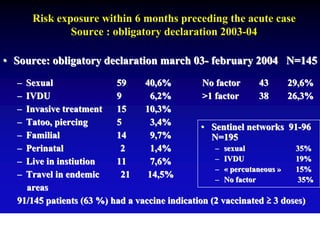
Risk exposure within 6 months preceding the acute case
              Source : obligatory declaration 2003-04

• Source: obligatory declaration march 03- february 2004 N=145
  – Sexual                59     40,6%          No factor      43     29,6%
  – IVDU                  9        6,2%         >1 factor      38     26,3%
  – Invasive treatment    15     10,3%
  – Tatoo, piercing       5        3,4%
                                                • Sentinel networks 91-96
  – Familial              14       9,7%           N=195
  – Perinatal              2       1,4%            – sexual             35%
  – Live in instiution    11       7,6%            – IVDU               19%
                                                   – « percutaneous »   15%
  – Travel in endemic      21     14,5%
                                                   – No factor          35%
    areas
  91/145 patients (63 %) had a vaccine indication (2 vaccinated ≥ 3 doses)
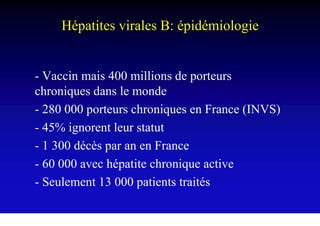
Hépatites virales B: épidémiologie


- Vaccin mais 400 millions de porteurs
chroniques dans le monde
- 280 000 porteurs chroniques en France (INVS)
- 45% ignorent leur statut
- 1 300 décès par an en France
- 60 000 avec hépatite chronique active
- Seulement 13 000 patients traités
VIROLOGIE
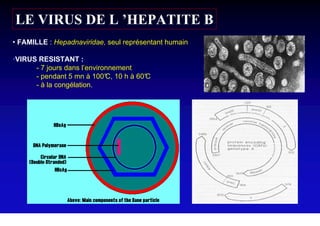
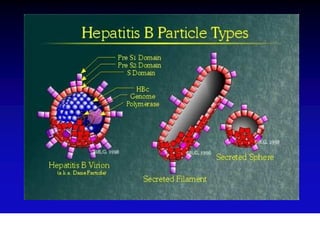
LE VIRUS DE L ’HEPATITE B
• FAMILLE : Hepadnaviridae, seul représentant humain

•VIRUS RESISTANT :
      - 7 jours dans l’environnement
      - pendant 5 mn à 100° 10 h à 60°
                             C,      C
      - à la congélation.
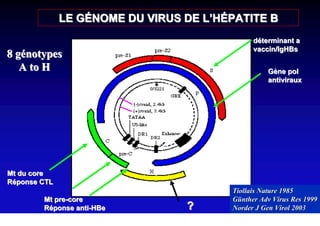
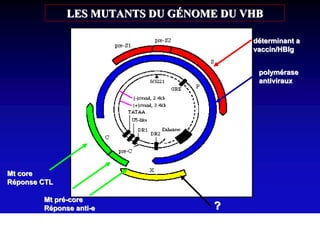
LE GÉNOME DU VIRUS DE L’HÉPATITE B
                                              déterminant a
                                              vaccin/IgHBs
8 génotypes
   A to H                                         Gène pol
                                                  antiviraux


Mt du core
Réponse CTL
                                        Tiollais Nature 1985
        Mt pre-core                     Günther Adv Virus Res 1999
        Réponse anti-HBe         ?      Norder J Gen Virol 2003
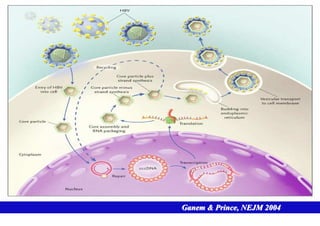
Ganem & Prince, NEJM 2004
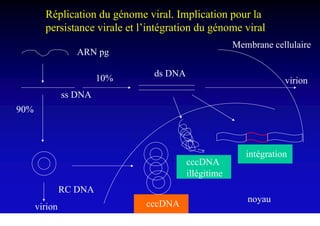
Réplication du génome viral. Implication pour la
        persistance virale et l’intégration du génome viral
                                                       Membrane cellulaire
                  ARN pg

                                 ds DNA
                        10%                                         virion
               ss DNA
90%


                                                          intégration
                                          cccDNA
                                          illégitime
               RC DNA
                                                          noyau
      virion                   cccDNA
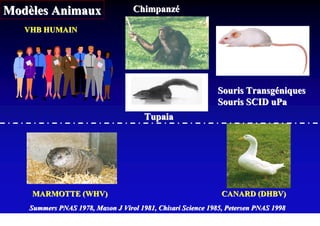
Modèles Animaux                    Chimpanzé

   VHB HUMAIN


                                                              Souris Transgéniques
                                                              Souris SCID uPa
                                       Tupaia


    MARMOTTE (WHV)                                             CANARD (DHBV)
    Summers PNAS 1978, Mason J Virol 1981, Chisari Science 1985, Petersen PNAS 1998
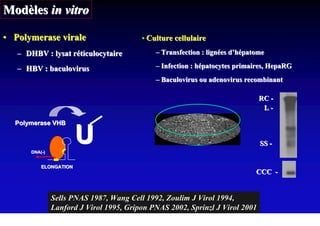
Modèles in vitro

• Polymerase virale                       • Culture cellulaire
   – DHBV : lysat réticulocytaire             – Transfection : lignées d’hépatome

   – HBV : baculovirus                        – Infection : hépatocytes primaires, HepaRG
                                              – Baculovirus ou adenovirus recombinant

                                                                               RC -
                                                                                L-

  Polymerase VHB


       DNA(-)
       DNA(
                        U                                                      SS -


           ELONGATION
                                                                              CCC -


                Sells PNAS 1987, Wang Cell 1992, Zoulim J Virol 1994,
                Lanford J Virol 1995, Gripon PNAS 2002, Sprinzl J Virol 2001
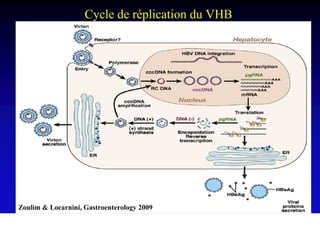
Cycle de réplication du VHB


Zoulim & Locarnini, Gastroenterology 2009
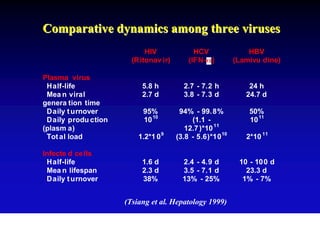
Comparative dynamics among three viruses
                           HIV              HCV               HBV
                       (Ritonav ir)       (IFN- )         (Lamivu dine)

Plasma virus
 Half-life                5.8 h         2.7 - 7.2 h           24 h
 Mea n viral              2.7 d         3.8 - 7.3 d          24.7 d
genera tion time
 Daily t urnover          95%          94% - 99. 8%           50%
 Daily produ ction        10 10            (1.1 -             10 11
(plasm a)                                12.7 )*10 11
 Tot al load             1.2*1 0 9    (3.8 - 5.6)*10 10      2*10 11

Infecte d ce lls
 Half-life                1.6 d         2.4 - 4.9 d        10 - 10 0 d
 Mea n lifespan           2.3 d         3.5 - 7.1 d          23.3 d
 Daily t urnover          38%           13% - 25%           1% - 7%


                     (Tsiang et al. Hepatology 1999)
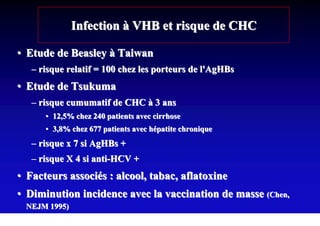
Infection à VHB et risque de CHC

• Etude de Beasley à Taiwan
   – risque relatif = 100 chez les porteurs de l'AgHBs
• Etude de Tsukuma
   – risque cumumatif de CHC à 3 ans
      • 12,5% chez 240 patients avec cirrhose
      • 3,8% chez 677 patients avec hépatite chronique
   – risque x 7 si AgHBs +
   – risque X 4 si anti-HCV +
• Facteurs associés : alcool, tabac, aflatoxine
• Diminution incidence avec la vaccination de masse (Chen,
 NEJM 1995)
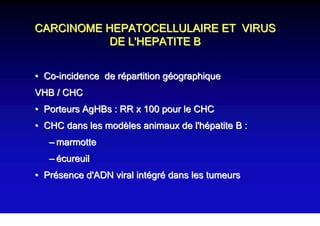
CARCINOME HEPATOCELLULAIRE ET VIRUS
           DE L'HEPATITE B


• Co-incidence de répartition géographique
VHB / CHC
• Porteurs AgHBs : RR x 100 pour le CHC
• CHC dans les modèles animaux de l'hépatite B :
   – marmotte
   – écureuil
• Présence d'ADN viral intégré dans les tumeurs
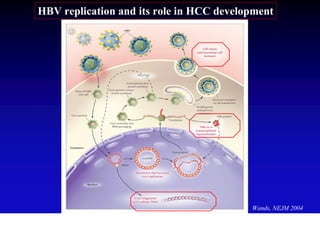
HBV replication and its role in HCC development


                                          Wands, NEJM 2004
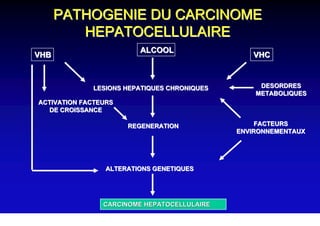
PATHOGENIE DU CARCINOME
         HEPATOCELLULAIRE
                         ALCOOL
VHB                                             VHC


             LESIONS HEPATIQUES CHRONIQUES        DESORDRES
                                                 METABOLIQUES
ACTIVATION FACTEURS
  DE CROISSANCE

                      REGENERATION                FACTEURS
                                             ENVIRONNEMENTAUX


                 ALTERATIONS GENETIQUES


                CARCINOME HEPATOCELLULAIRE
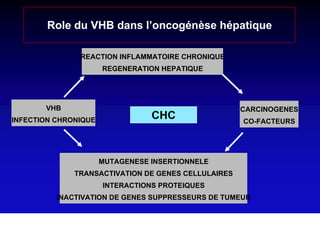
Role du VHB dans l’oncogénèse hépatique

               REACTION INFLAMMATOIRE CHRONIQUE
                      REGENERATION HEPATIQUE


       VHB                                           CARCINOGENES
INFECTION CHRONIQUE              CHC                 CO-FACTEURS


                      MUTAGENESE INSERTIONNELE
              TRANSACTIVATION DE GENES CELLULAIRES
                      INTERACTIONS PROTEIQUES
          INACTIVATION DE GENES SUPPRESSEURS DE TUMEUR
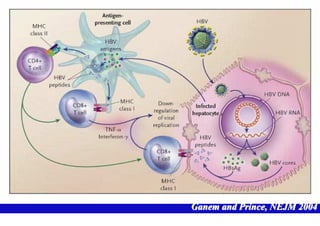
PHYSIOPATHOLOGIE /
IMMUNOPATHOLOGIE
Ganem and Prince, NEJM 2004
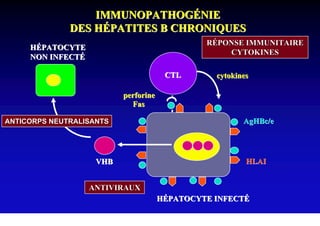
IMMUNOPATHOGÉNIE
              DES HÉPATITES B CHRONIQUES
                                               RÉPONSE IMMUNITAIRE
     HÉPATOCYTE
                                                   CYTOKINES
     NON INFECTÉ

                                       CTL       cytokines

                          perforine
                            Fas

ANTICORPS NEUTRALISANTS                                 AgHBc/e


                    VHB                                  HLAI


                   ANTIVIRAUX
                                      HÉPATOCYTE INFECTÉ
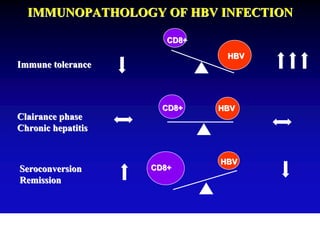
IMMUNOPATHOLOGY OF HBV INFECTION

                       CD8+
                               HBV
Immune tolerance


                      CD8+    HBV
Clairance phase
Chronic hepatitis


                              HBV
Seroconversion      CD8+
Remission
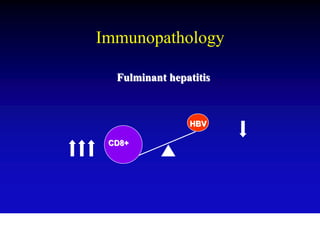
Immunopathology

  Fulminant hepatitis


                HBV

 CD8+
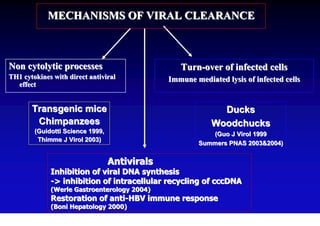
MECHANISMS OF VIRAL CLEARANCE


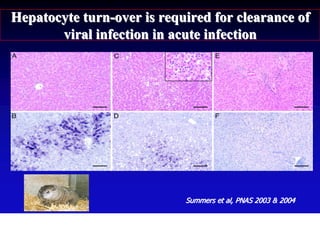
Non cytolytic processes                           Turn-over of infected cells
TH1 cytokines with direct antiviral            Immune mediated lysis of infected cells
  effect


       Transgenic mice                                       Ducks
        Chimpanzees                                        Woodchucks
        (Guidotti Science 1999,                           (Guo J Virol 1999
         Thimme J Virol 2003)
                                                       Summers PNAS 2003&2004)


                                  Antivirals
             Inhibition of viral DNA synthesis
             -> inhibition of intracellular recycling of cccDNA
             (Werle Gastroenterology 2004)
             Restoration of anti-HBV immune response
             (Boni Hepatology 2000)
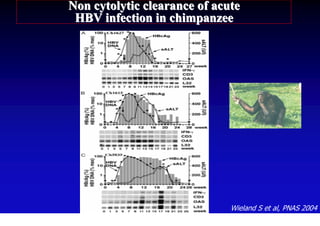
Non cytolytic clearance of acute
 HBV infection in chimpanzee


                              Wieland S et al, PNAS 2004
Hepatocyte turn-over is required for clearance of
       viral infection in acute infection


                            Summers et al, PNAS 2003 & 2004
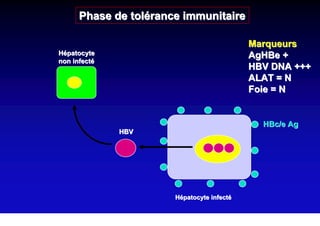
Phase de tolérance immunitaire

                                            Marqueurs
Hépatocyte                                  AgHBe +
non infecté
                                            HBV DNA +++
                                            ALAT = N
                                            Foie = N


                                              HBc/e Ag
              HBV


                       Hépatocyte infecté
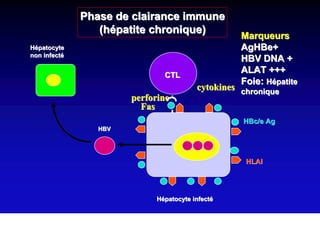
Phase de clairance immune
                 (hépatite chronique)
                                                   Marqueurs
Hépatocyte                                         AgHBe+
non infecté
                                                   HBV DNA +
                               CTL
                                                   ALAT +++
                                                   Foie: Hépatite
                                         cytokines chronique
                       perforine
                         Fas
                                                   HBc/e Ag
                 HBV


                                                    HLAI


                             Hépatocyte infecté
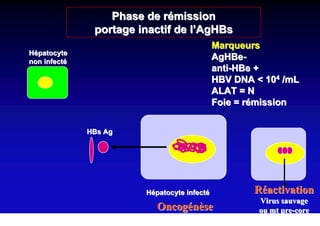
Phase de rémission
               portage inactif de l’AgHBs
                                             Marqueurs
Hépatocyte
non infecté
                                             AgHBe-
                                             anti-HBe +
                                             HBV DNA < 104 /mL
                                             ALAT = N
                                             Foie = rémission


              HBs Ag


                        Hépatocyte infecté           Réactivation
                                                      Virus sauvage
                           Oncogénèse                 ou mt pre-core
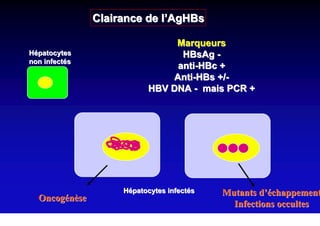
Clairance de l’AgHBs

                               Marqueurs
Hépatocytes                     HBsAg -
non infectés
                               anti-HBc +
                              Anti-HBs +/-
                          HBV DNA - mais PCR +


                    Hépatocytes infectés   Mutants d’échappement
  Oncogénèse
                                             Infections occultes
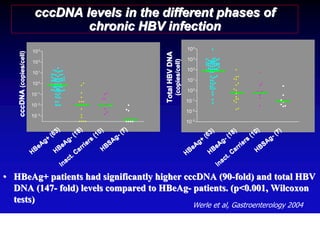
cccDNA levels in the different phases of
                                   chronic HBV infection
                          10 3                                                                             10 4
   cccDNA (copies/cell)


                                                                           Total HBV DNA
                                                                                                           10 3


                                                                                           (copies/cell)
                          10 2
                               1                                                                           10 2
                          10
                               0
                                                                                                           10 1
                          10
                               -1
                                                                                                           10 0
                          10
                               -2
                                                                                                           10 -1
                          10
                                                                                                           10 -2
                               -3
                          10
                                                                                                           10 -3
                                       )        )           )          )                                                                    )          )
                                     63      18          10          (7                                                3)    18)         10          (7
                                    (       (           (          -                                                (6    -(            (          -
                              g +       g-           rs          Ag                                            g +       g           rs          Ag
                            eA       eA           rie         BS                                                     eA            ie
                                   B            r           H                                                eA     B            rr           BS
                          HB      H
                                          .  Ca                                                            HB      H        .C
                                                                                                                               a          H
                                        ct                                                                                 t
                                      a                                                                                 ac
                                    In                                                                                In

• HBeAg+ patients had significantly higher cccDNA (90-fold) and total HBV
  DNA (147- fold) levels compared to HBeAg- patients. (p<0.001, Wilcoxon
  tests)
                                                                                                              Werle et al, Gastroenterology 2004
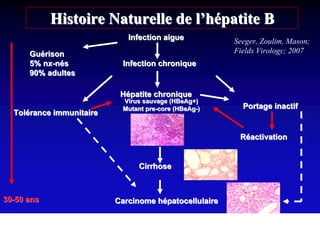
HISTOIRE NATURELLE ET
 VIROLOGIE CLINIQUE
Histoire Naturelle de l’hépatite B
                             Infection aigue           Seeger, Zoulim, Mason;
      Guérison                                         Fields Virology; 2007
      5% nx-nés             Infection chronique
      90% adultes

                           Hépatite chronique
                           Virus sauvage (HBeAg+)
                           Mutant pre-core (HBeAg-)      Portage inactif
  Tolérance immunitaire


                                                        Réactivation


                                Cirrhose


30-50 ans                 Carcinome hépatocellulaire
MARQUEURS SEROLOGIQUES

• Système AgHBe /anti-HBe
  – distinction virus sauvage / virus muté AgHBe
   négatif

• Virémie
  – détection quantitative de l'ADN viral
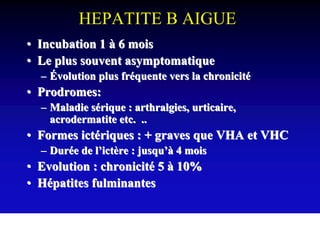
HEPATITE B AIGUE
• Incubation 1 à 6 mois
• Le plus souvent asymptomatique
    – Évolution plus fréquente vers la chronicité
• Prodromes:
    – Maladie sérique : arthralgies, urticaire,
      acrodermatite etc. ..
• Formes ictériques : + graves que VHA et VHC
    – Durée de l’ictère : jusqu’à 4 mois
•   Evolution : chronicité 5 à 10%
•   Hépatites fulminantes
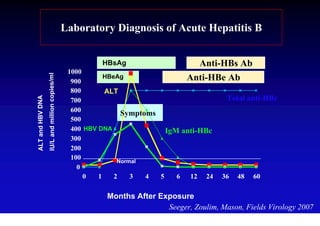
Laboratory Diagnosis of Acute Hepatitis B


                                                        HBsAg                      Anti-HBs Ab
                                                1000
                  IU/L and million copies/ml


                                                 900
                                                           HBeAg                Anti-HBe Ab
                                                 800       ALT
ALT and HBV DNA


                                                 700                                    Total anti-HBc
                                                 600
                                                                Symptoms
                                                 500
                                                 400 HBV DNA               IgM anti-HBc
                                                 300
                                                 200
                                                 100           Normal
                                                   0
                                                     0   1    2    3  4  5    6 12 24 36 48 60

                                                          Months After Exposure
                                                                         Seeger, Zoulim, Mason, Fields Virology 2007
HEPATITE B PROLONGEE
• Définition
  – Persistance réplication virale à la 8ème
    semaine d’évolution :
  – AgHBe + ou ADN-VHB +
• Evolution
  – Chronicité : 8 cas / 10
• Traitement : IFN
  – Guérison : 7 à 8 cas / 10
INFECTIONS CHRONIQUES A VHB
            FORMES CLINIQUES
• virus sauvage
  – tolérance immunitaire
  – rupture de tolérance -> lésions hépatocytaires : HCA
  – séroconversion anti-HBe spontanée (portage inactif) :
    5-10% /an
  – > diminution significative réplication virale
  – > amélioration signes histologiques
• virus muté pré-C (-)
  – sélection au moment de la séroconversion anti-HBe
  – dépend du génotype viral
  – immunopathologie ?
  – sévérité de l'hépatopathie : controversée
  – association au CHC
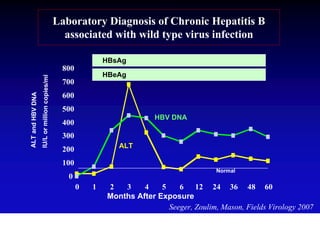
Laboratory Diagnosis of Chronic Hepatitis B
                                                associated with wild type virus infection

                                                             HBsAg
                                               800
                                                             HBeAg
                  IU/L or million copies/ml


                                               700
ALT and HBV DNA


                                               600
                                               500
                                                                          HBV DNA
                                               400
                                               300
                                                                ALT
                                               200
                                               100
                                                                                            Normal
                                                 0
                                                     0   1   2   3    4    5    6 12 24 36 48 60
                                                             Months After Exposure
                                                                             Seeger, Zoulim, Mason, Fields Virology 2007
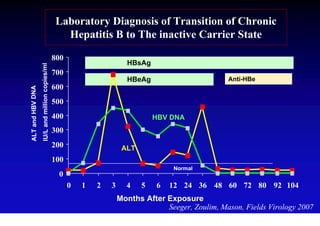
Laboratory Diagnosis of Transition of Chronic
                                                 Hepatitis B to The inactive Carrier State

                                               800
                                                                       HBsAg         ``
                  IU/L and million copies/ml


                                               700
                                                                       HBeAg                        Anti-HBe
                                               600
ALT and HBV DNA


                                               500
                                               400                              HBV DNA
                                               300
                                               200                    ALT
                                               100
                                                                                     Normal
                                                0
                                                     0   1   2   3     4    5   6   12 24 36 48 60 72 80 92 104
                                                                     Months After Exposure
                                                                                  Seeger, Zoulim, Mason, Fields Virology 2007
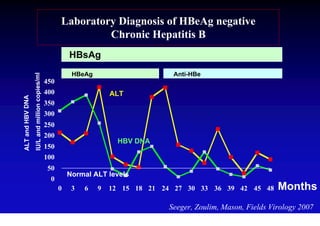
Laboratory Diagnosis of HBeAg negative
                                                              Chronic Hepatitis B
                                                         HBsAg
                                                          HBeAg                     Anti-HBe
                  IU/L and million copies/ml


                                               450
                                               400                    ALT
ALT and HBV DNA


                                               350
                                               300
                                               250
                                               200
                                                                        HBV DNA
                                               150
                                               100
                                                50
                                                         Normal ALT levels
                                                 0
                                                     0    3   6   9   12 15 18 21 24 27 30 33 36 39 42 45 48       Months
                                                                                   Seeger, Zoulim, Mason, Fields Virology 2007
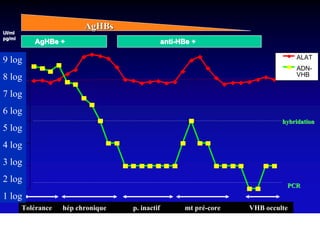
AgHBs
UI/ml
UI/
pg/ml
pg/
             AgHBe +                              anti-HBe +
  1000                                                                              ALAT
9 log
                                                                                    ADN-
8 log
   100                                                                              VHB


7 log
        10
6 log
        1                                                                      hybridation
5 log
4 log
   0,1

3 log
  0,01
2 log
                                                                                PCR
 0,001
1 log
         Tolérance   hép chronique   p. inactif         mt pré-core   VHB occulte
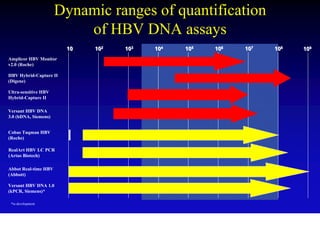
Dynamic ranges of quantification
                          of HBV DNA assays
                        10   102   103   104   105   106   107   108   109
Amplicor HBV Monitor
v2.0 (Roche)

HBV Hybrid-Capture II
(Digene)

Ultra-sensitive HBV
Hybrid-Capture II

Versant HBV DNA
3.0 (bDNA, Siemens)


Cobas Taqman HBV
(Roche)

RealArt HBV LC PCR
(Artus Biotech)

Abbot Real-time HBV
(Abbott)

Versant HBV DNA 1.0
(kPCR, Siemens)*

 *in development
Formes cliniques
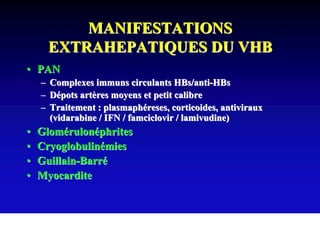
MANIFESTATIONS
      EXTRAHEPATIQUES DU VHB
• PAN
    – Complexes immuns circulants HBs/anti-HBs
    – Dépots artères moyens et petit calibre
    – Traitement : plasmaphéreses, corticoides, antiviraux
      (vidarabine / IFN / famciclovir / lamivudine)
•   Glomérulonéphrites
•   Cryoglobulinémies
•   Guillain-Barré
•   Myocardite
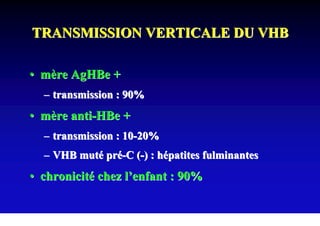
TRANSMISSION VERTICALE DU VHB

• mère AgHBe +
  – transmission : 90%
• mère anti-HBe +
  – transmission : 10-20%
  – VHB muté pré-C (-) : hépatites fulminantes
• chronicité chez l’enfant : 90%
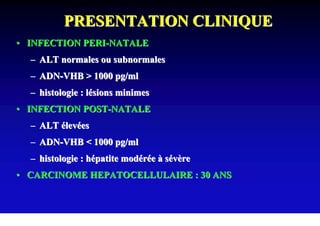
PRESENTATION CLINIQUE
• INFECTION PERI-NATALE
  – ALT normales ou subnormales
  – ADN-VHB > 1000 pg/ml
  – histologie : lésions minimes
• INFECTION POST-NATALE
  – ALT élevées
  – ADN-VHB < 1000 pg/ml
  – histologie : hépatite modérée à sévère
• CARCINOME HEPATOCELLULAIRE : 30 ANS
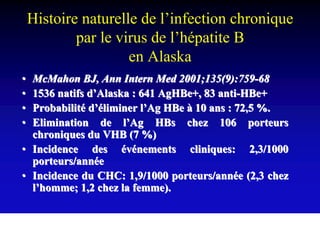
Histoire naturelle de l’infection chronique
            par le virus de l’hépatite B
                     en Alaska
• McMahon BJ, Ann Intern Med 2001;135(9):759-68
• 1536 natifs d’Alaska : 641 AgHBe+, 83 anti-HBe+
• Probabilité d’éliminer l’Ag HBe à 10 ans : 72,5 %.
• Elimination de l’Ag HBs chez 106 porteurs
  chroniques du VHB (7 %)
• Incidence des événements cliniques: 2,3/1000
  porteurs/année
• Incidence du CHC: 1,9/1000 porteurs/année (2,3 chez
  l’homme; 1,2 chez la femme).
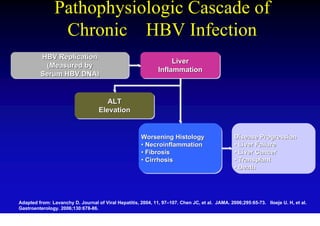
Pathophysiologic Cascade of
                 Chronic HBV Infection
         HBV Replication
          HBV Replication                                          Liver
                                                                   Liver
           (Measured by
           (Measured by                                       Inflammation
                                                              Inflammation
         Serum HBV DNA)
         Serum HBV DNA)


                                      ALT
                                      ALT
                                   Elevation
                                   Elevation


                                                      Worsening Histology
                                                      Worsening Histology                       Disease Progression
                                                                                                Disease Progression
                                                      • Necroinflammation
                                                      • Necroinflammation                       • Liver Failure
                                                                                                • Liver Failure
                                                      • Fibrosis
                                                      • Fibrosis                                • Liver Cancer
                                                                                                • Liver Cancer
                                                      • Cirrhosis
                                                      • Cirrhosis                               • Transplant
                                                                                                • Transplant
                                                                                                • Death
                                                                                                • Death


Adapted from: Lavanchy D. Journal of Viral Hepatitis, 2004, 11, 97–107. Chen JC, et al. JAMA. 2006;295:65-73. Iloeje U. H, et al.
Gastroenterology. 2006;130:678-86.
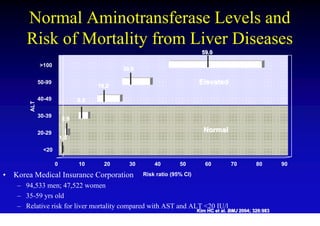
Normal Aminotransferase Levels and
        Risk of Mortality from Liver Diseases
                                                                              59.0

               >100
                                               30.0

               50-99
                                        19.2
                                                                            Elevated

               40-49              9.5
         ALT


               30-39
                            2.9

               20-29                                                          Normal
                           1.0

                 <20

                       0          10      20     30       40        50         60         70         80       90

•   Korea Medical Insurance Corporation               Risk ratio (95% CI)

     – 94,533 men; 47,522 women
     – 35-59 yrs old
     – Relative risk for liver mortality compared with AST and ALT <20 IU/l
                                                                            Kim HC et al. BMJ 2004; 328:983
                                                                                      al.     2004;
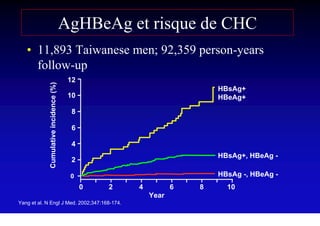
AgHBeAg et risque de CHC
   • 11,893 Taiwanese men; 92,359 person-years
     follow-up
                                         12
             Cumulative incidence (%)


                                                                         HBsAg+
                                         10                              HBeAg+

                                          8

                                          6

                                          4
                                                                         HBsAg+, HBeAg -
                                          2

                                         0                               HBsAg -, HBeAg -
                                              0   2   4          6   8     10
                                                          Year
Yang et al. N Engl J Med. 2002;347:168-174.
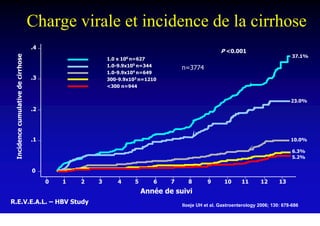
Charge virale et incidence de la cirrhose
                                    .4
                                                                                                    P <0.001
 Incidence cumulative de cirrhose


                                                                                                                                    37.1%
                                                         1.0 x 10⁶ n=627
                                                         1.0-9.9x10⁵ n=344
                                                                                   n=3774
                                                         1.0-9.9x10⁴ n=649
                                    .3                   300-9.9x10³ n=1210
                                                         <300 n=944


                                                                                                                                   23.0%
                                    .2


                                    .1                                                                                             10.0%

                                                                                                                                    6.3%
                                                                                                                                    5.2%

                                    0
                                         0   1   2   3      4      5      6    7     8        9      10      11       12      13
                                                                       Année de suivi
R.E.V.E.A.L. – HBV Study                                                           Iloeje UH et al. Gastroenterology 2006; 130: 678-686
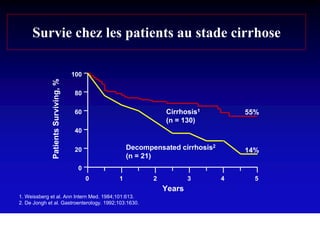
Survie chez les patients au stade cirrhose

                                      100
              Patients Surviving, %


                                      80

                                      60                       Cirrhosis1          55%
                                                               (n = 130)
                                       40


                                      20            Decompensated cirrhosis2       14%
                                                    (n = 21)
                                       0
                                            0   1          2           3       4     5
                                                               Years
1. Weissberg et al. Ann Intern Med. 1984;101:613.
2. De Jongh et al. Gastroenterology. 1992;103:1630.
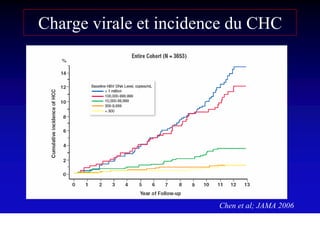
Charge virale et incidence du CHC


                        Chen et al; JAMA 2006
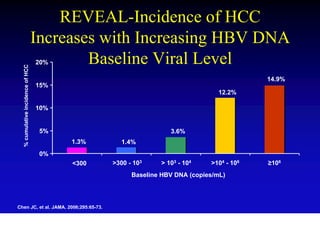
REVEAL-Incidence of HCC
                                  Increases with Increasing HBV DNA
                                  20%     Baseline Viral Level
  % cumulative incidence of HCC


                                                                                         14.9%
                                  15%
                                                                              12.2%

                                  10%


                                   5%                           3.6%
                                        1.3%      1.4%
                                   0%
                                        <300   >300 - 103    > 103 - 104    >104 - 106   ≥106
                                                     Baseline HBV DNA (copies/mL)


Chen JC, et al. JAMA. 2006;295:65-73.
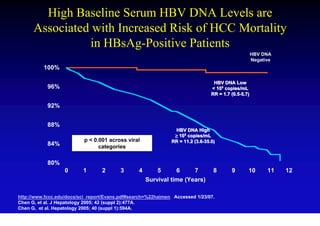
High Baseline Serum HBV DNA Levels are
      Associated with Increased Risk of HCC Mortality
                in HBsAg-Positive Patients
                                                                                                      HBV DNA
                                                                                                      Negative
          100%

                                                                                  HBV DNA Low
            96%                                                                  < 105 copies/mL
                                                                                       copies/
                                                                                 RR = 1.7 (0.5-5.7)
                                                                                          (0.5-5.7)

            92%


            88%
                                                                HBV DNA High
                                                                ≥ 105 copies/mL
                                                                      copies/
                           p < 0.001 across viral              RR = 11.2 (3.6-35.0)
                                                                         (3.6-35.0)
            84%                  categories

            80%
                   0      1       2       3      4       5       6       7        8       9       10        11   12
                                                     Survival time (Years)

http://www.fccc.edu/docs/sci_report/Evans.pdf#search=%22haimen. Accessed 1/23/07.
Chen G, et al. J Hepatology 2005; 42 (suppl 2):477A.
Chen G, et al. Hepatology 2005; 40 (suppl 1):594A.
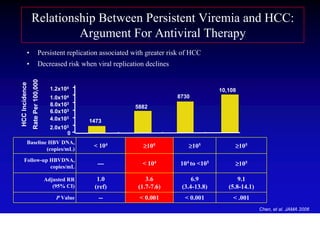
Relationship Between Persistent Viremia and HCC:
                         Argument For Antiviral Therapy
           •                Persistent replication associated with greater risk of HCC
           •                Decreased risk when viral replication declines
                Rate Per 100,000
HCC Incidence


                                     1.2x10⁴                                                10,108
                                     1.0x10⁴                                 8730
                                     8.0x10³                  5882
                                     6.0x10³
                                     4.0x10³     1473
                                     2.0x10³
                                           0
           Baseline HBV DNA,
                   (copies/mL)
                                                  < 104          ≥105            ≥105            ≥105

     Follow-up HBVDNA,
               copies/mL
                                                   ---           < 104        104 to <105        ≥105

                                   Adjusted RR     1.0            3.6              6.9             9.1
                                      (95% CI)    (ref)        (1.7-7.6)       (3.4-13.8)      (5.8-14.1)
                                       P Value      --          < 0.001         < 0.001          < .001
                                                                                                            Chen, et al. JAMA 2006
Impact Clinique de la Variabilité
       du Génome Viral
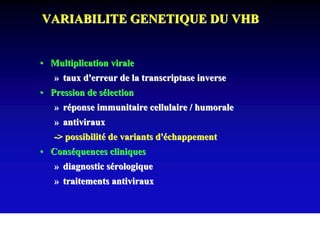
VARIABILITE GENETIQUE DU VHB


• Multiplication virale
   » taux d'erreur de la transcriptase inverse
• Pression de sélection
   » réponse immunitaire cellulaire / humorale
   » antiviraux
   -> possibilité de variants d'échappement
• Conséquences cliniques
   » diagnostic sérologique
   » traitements antiviraux
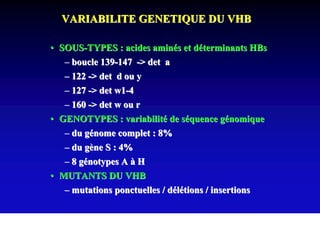
VARIABILITE GENETIQUE DU VHB

• SOUS-TYPES : acides aminés et déterminants HBs
   – boucle 139-147 -> det a
   – 122 -> det d ou y
   – 127 -> det w1-4
   – 160 -> det w ou r
• GENOTYPES : variabilité de séquence génomique
   – du génome complet : 8%
   – du gène S : 4%
   – 8 génotypes A à H
• MUTANTS DU VHB
   – mutations ponctuelles / délétions / insertions
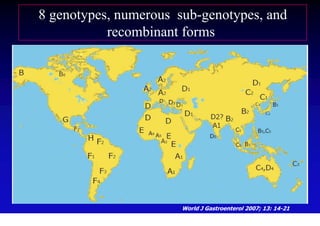
8 genotypes, numerous sub-genotypes, and
           recombinant forms

   B6


                      D1


                       World J Gastroenterol 2007; 13: 14-21
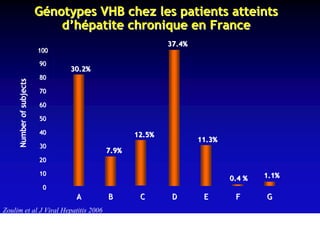
Génotypes VHB chez les patients atteints
                              d’hépatite chronique en France
                                                       37.4%
                          100

                          90
                                30.2%
                          80
     Number of subjects


                          70

                          60

                          50

                          40                   12.5%
                                                               11.3%
                          30
                                        7.9%
                          20

                          10                                                   1.1%
                                                                       0.4 %
                           0
                                 A      B       C       D       E       F      G
Zoulim et al J Viral Hepatitis 2006
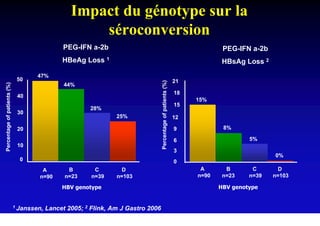
Impact du génotype sur la
                                                      séroconversion
                                               PEG-IFN a-2b                                                                  PEG-IFN a-2b
                                               HBeAg Loss 1                                                                  HBsAg Loss 2
                                     47%
                              50                                                                                21


                                                                                   Percentage of patients (%)
Percentage of patients (%)


                                                44%
                                                                                                                18
                              40
                                                                                                                     15%
                                                                                                                15
                                                        28%
                              30
                                                                 25%                                            12

                              20                                                                                9            8%

                                                                                                                6                    5%
                              10
                                                                                                                3
                                                                                                                                            0%
                               0                                                                                0
                                      A          B        C        D                                                  A       B       C       D
                                     n=90       n=23     n=39    n=103                                               n=90    n=23    n=39   n=103

                                               HBV genotype                                                                 HBV genotype


                             1 Janssen,   Lancet 2005; 2 Flink, Am J Gastro 2006
LES MUTANTS DU GÉNOME DU VHB

                                        déterminant a
                                        vaccin/HBIg


                                         polymérase
                                         antiviraux


Mt core
Réponse CTL

        Mt pré-core
        Réponse anti-e            ?
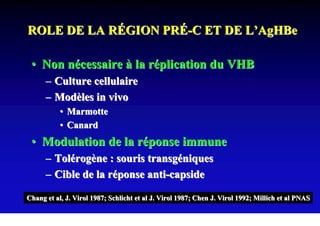
ROLE DE LA RÉGION PRÉ-C ET DE L’AgHBe

 • Non nécessaire à la réplication du VHB
      – Culture cellulaire
      – Modèles in vivo
           • Marmotte
           • Canard
 • Modulation de la réponse immune
      – Tolérogène : souris transgéniques
      – Cible de la réponse anti-capside

Chang et al, J. Virol 1987; Schlicht et al J. Virol 1987; Chen J. Virol 1992; Millich et al PNAS
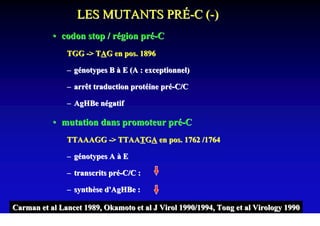
LES MUTANTS PRÉ-C (-)
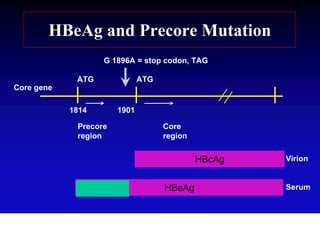
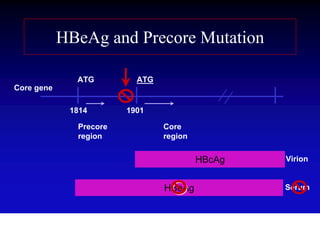
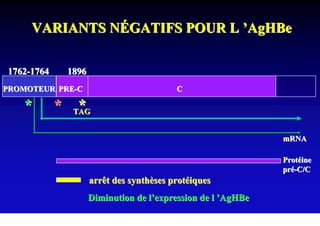
           • codon stop / région pré-C
               TGG -> TAG en pos. 1896

               – génotypes B à E (A : exceptionnel)

               – arrêt traduction protéine pré-C/C

               – AgHBe négatif

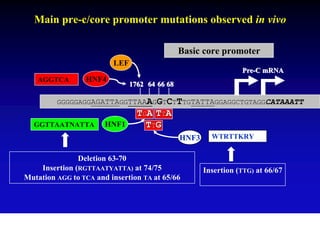
           • mutation dans promoteur pré-C
               TTAAAGG -> TTAATGA en pos. 1762 /1764

               – génotypes A à E

               – transcrits pré-C/C :

               – synthèse d'AgHBe :

Carman et al Lancet 1989, Okamoto et al J Virol 1990/1994, Tong et al Virology 1990
HBeAg and Precore Mutation
                   G 1896A = stop codon, TAG

             ATG              ATG
Core gene

            1814       1901

             Precore                Core
             region                 region


                                             HBcAg   Virion


                                    HBeAg            Serum
HBeAg and Precore Mutation

              ATG         ATG
Core gene

             1814       1901

              Precore           Core
              region            region


                                         HBcAg   Virion


                                HBeAg            Serum
VARIANTS NÉGATIFS POUR L ’AgHBe

1762-1764       1896
PROMOTEUR PRE-C                             C

   *        *     *
                 TAG


                                                                mRNA

                                                                Protéine
                                                                pré-C/C
                       arrêt des synthèses protéiques
                       Diminution de l’expression de l ’AgHBe
Main pre-c/core promoter mutations observed in vivo

                                                Basic core promoter
                         LEF
                                                                  Pre-C mRNA
   AGGTCA        HNF4
                                1762 64 66 68

         GGGGGAGGAGATTAGGTTAAAGGTCTTTGTATTAGGAGGCTGTAGGCATAAATT
                                  TGA TTA
  GGTTAATNATTA         HNF1         TTG
                                                HNF3     WTRTTKRY


               Deletion 63-70
    Insertion (RGTTAATYATTA) at 74/75                  Insertion (TTG) at 66/67
Mutation AGG to TCA and insertion TA at 65/66
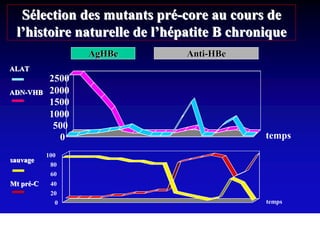
Sélection des mutants pré-core au cours de
 l’histoire naturelle de l’hépatite B chronique
                  AgHBe      Anti-HBe
ALAT
           2500
ADN-VHB    2000
           1500
           1000
            500
             0                             temps
           100
sauvage
            80
            60
Mt pré-C    40
            20
             0                             temps
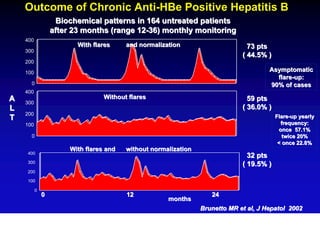
Outcome of Chronic Anti-HBe Positive Hepatitis B
                   Biochemical patterns in 164 untreated patients
                  after 23 months (range 12-36) monthly monitoring
    400
                         With flares     and normalization                      73 pts
    300
                                                                              ( 44.5% )
    200

    100
                                                                                       Asymptomatic
                                                                                         flare-up:
      0                                                                                90% of cases
    400
A                                 Without flares                                59 pts
    300
L                                                                             ( 36.0% )
    200                                                                                   Flare-up yearly
T
    100                                                                                     frequency:
                                                                                           once 57.1%
      0                                                                                      twice 20%
                                                                                           < once 22.8%
                       With flares and   without normalization
    400
                                                                                32 pts
    300
                                                                              ( 19.5% )
    200

    100

          0
              0                          12                         24
                                                      months
                                                                 Brunetto MR et al, J Hepatol 2002
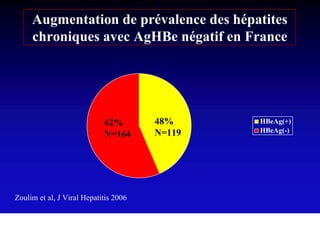
Augmentation de prévalence des hépatites
     chroniques avec AgHBe négatif en France


                            62%        48%     HBeAg(+)
                                       N=119   HBeAg(-)
                            N=164


Zoulim et al, J Viral Hepatitis 2006
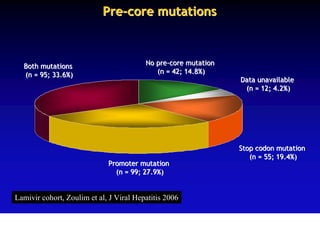
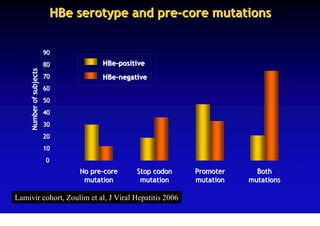
Pre-core mutations


  Both mutations                         No pre-core mutation
  (n = 95; 33.6%)                           (n = 42; 14.8%)
                                                                Data unavailable
                                                                 (n = 12; 4.2%)


                                                                Stop codon mutation
                                                                   (n = 55; 19.4%)
                             Promoter mutation
                               (n = 99; 27.9%)


Lamivir cohort, Zoulim et al, J Viral Hepatitis 2006
HBe serotype and pre-core mutations

                          90
                          80         HBe-positive
     Number of subjects


                          70         HBe-negative
                          60
                          50
                          40
                          30
                          20
                          10
                          0
                               No pre-core    Stop codon   Promoter     Both
                                mutation       mutation    mutation   mutations

Lamivir cohort, Zoulim et al, J Viral Hepatitis 2006
MUTANTS PRÉ-C ET SÉVÉRITÉ HISTOLOGIQUE
           LA CONTROVERSE
    • Italie
       – Cirrhose plus fréquente
             • Bonino Gastroenterology 1986, Fattovich Hepatology 1988
    • France
       – Activité idem / cirrhose plus fréquente
             • Zarski et al, J Hepatol 1993
             • Grandjacques et al, J Hepatol 2000
             • Zoulim et al, J Viral Hepatitis 2006
    • Asie
       – Mt promoteur : activité histologique et fibrose plus importante
       – Mt pré-C : activité histologique moins importante
             • Lindh et al, J Infect Dis 1999
       – Rémission histologique
             • Chan et al, Hepatology 1999
    • Afrique
       – Mt promoteur : plus fréquents dans le CHC
             • Baptista et al, Hepatology 1999
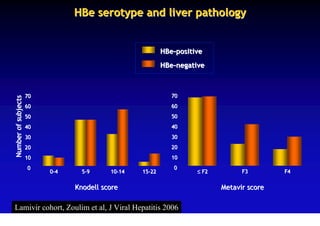
HBe serotype and liver pathology


                                                          HBe-positive
                                                          HBe-negative


                     70                                      70
Number of subjects


                     60                                      60
                     50                                      50
                     40                                      40
                     30                                      30
                     20                                      20
                     10                                      10
                     0                                       0
                          0-4     5-9     10-14   15-22             ≤ F2         F3        F4

                                Knodell score                              Metavir score

Lamivir cohort, Zoulim et al, J Viral Hepatitis 2006
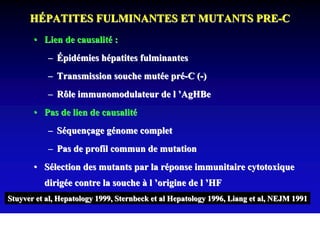
HÉPATITES FULMINANTES ET MUTANTS PRE-C
       • Lien de causalité :
           – Épidémies hépatites fulminantes
           – Transmission souche mutée pré-C (-)
           – Rôle immunomodulateur de l ’AgHBe
       • Pas de lien de causalité
           – Séquençage génome complet
           – Pas de profil commun de mutation
       • Sélection des mutants par la réponse immunitaire cytotoxique
          dirigée contre la souche à l ’origine de l ’HF
Stuyver et al, Hepatology 1999, Sternbeck et al Hepatology 1996, Liang et al, NEJM 1991
DIAGNOSTICS DIFFICILES

    I. Porteur inactif
    II. Exacerbation
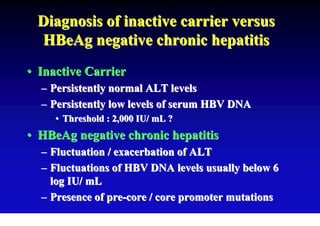
Diagnosis of inactive carrier versus
 HBeAg negative chronic hepatitis
• Inactive Carrier
  – Persistently normal ALT levels
  – Persistently low levels of serum HBV DNA
     • Threshold : 2,000 IU/ mL ?
• HBeAg negative chronic hepatitis
  – Fluctuation / exacerbation of ALT
  – Fluctuations of HBV DNA levels usually below 6
    log IU/ mL
  – Presence of pre-core / core promoter mutations
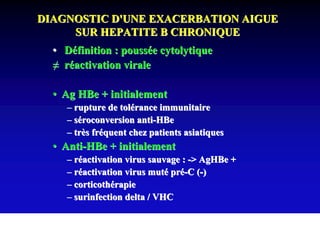
DIAGNOSTIC D'UNE EXACERBATION AIGUE
     SUR HEPATITE B CHRONIQUE
  • Définition : poussée cytolytique
  ≠ réactivation virale

  • Ag HBe + initialement
     – rupture de tolérance immunitaire
     – séroconversion anti-HBe
     – très fréquent chez patients asiatiques
  • Anti-HBe + initialement
     – réactivation virus sauvage : -> AgHBe +
     – réactivation virus muté pré-C (-)
     – corticothérapie
     – surinfection delta / VHC
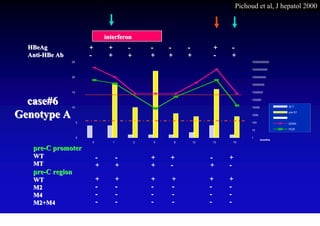
Pichoud et al, J hepatol 2000


                                 interferon
  HBeAg                  +        +           -       -   -       -        +    -
  Anti-HBe Ab            -        +           +       +   +       +        -    +
                25                                                                       10000000000

                                                                                         1000000000

                20                                                                       100000000

                                                                                         10000000

                15                                                                       1000000


  case#6        10
                                                                                         100000

                                                                                         10000            ALT


Genotype A                                                                               1000
                                                                                                          pre-S1


                     5                                                                   100              bDNA

                                                                                         10               PCR


                     0                                                                   1
                                                                                                 months
                         0            1           2   5       9       12   13   16

   pre-C promoter
   WT                        -            -           +   +                -    +
   MT                        +            +           +   -                +    -
   pre-C region
   WT                        +            +           +   +                +    +
   M2                        -            -           -   -                -    -
   M4                        -            -           -   -                -    -
   M2+M4                     -            -           -   -                -    -
PreS2
                                                                                      PreS1


                                                                                                    Pol                    S


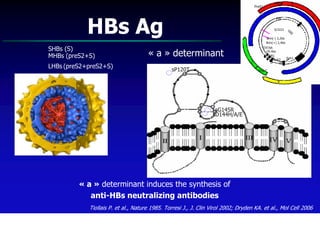
            HBs Ag                                                                                 0/3221


                                                                                                              GR
                                                                                                                E
                                                                                              Brin(-) 3,2kb
                                                                                              Brin(+) 2,4kb

SHBs (S)                                                                                  TATAA

MHBs (preS2+S)                       « a » determinant                                      U5-like
                                                                                             DR1
                                                                                                  Enh2   Enh1
                                                                                  C                  DR2
LHBs (preS2+preS2+S)                               S-S
                                               sP120T                                   Pré-C


                                                                                                     X


                                                     137  S- S
                                                   138           149
                                        107      S-S     S-S      147
                                                   139             sG145R
                                                                  sD144H/A/E
                                        99                       NH2                                S-S


                                                                                                                    COOH


         « a » determinant induces the synthesis of
            anti-HBs neutralizing antibodies
            Tiollais P. et al., Nature 1985. Torresi J., J. Clin Virol 2002; Dryden KA. et al., Mol Cell 2006
Variants de l'Ag HBs


• échappement à la réponse humorale anti-HBs

   – naturelle

   – vaccination (transmission mère-enfant)

   – immunoprophylaxie (transplantation hépatique)

• infection active malgré Ac anti-HBs

• sérologie AgHBs faussement négative

á Risques : transmission virale + infections occultes
VARIANTS DE L'AgHBs

• Mutations ponctuelles dans le déterminant a de
 l'AgHBs (124-147)
   – aa 145 : Gly -> Arg
   – aa 126 : Ile -> Ser / Thr -> Asn
• transmission mère-enfant malgré la serovaccination
 (3%)
• infection du greffon hépatique malgré
 Immunoglobulines anti-HBs
• hépatites chroniques avec anti-HBc et anti-HBs +
Occult HBV Infection (OBI)

Presence of HBV DNA in the liver (± serum) of
individuals testing HBsAg negative by currently
               available assays


                              Raimondo et al, J Hepatol 2008
How to Detect Occult HBV Infection


     Currently there is no standardized
  diagnostic assay for occult HBV infection
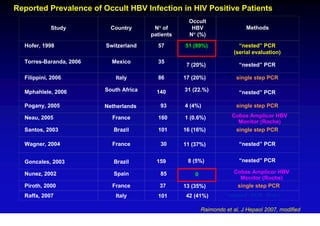
Reported Prevalence of Occult HBV Infection in HIV Positive Patients
                                                     Occult
            Study          Country       N° of        HBV                   Methods
                                        patients     N° (%)

  Hofer, 1998            Switzerland      57       51 (89%)              “nested” PCR
                                                                       (serial evaluation)
  Torres-Baranda, 2006     Mexico         35
                                                    7 (20%)               “nested” PCR

  Filippini, 2006           Italy         86       17 (20%)             single step PCR

  Mphahlele, 2006        South Africa     140      31 (22.%)              “nested” PCR

  Pogany, 2005           Netherlands       93      4 (4%)               single step PCR

  Neau, 2005               France         160      1 (0.6%)            Cobas Amplicor HBV
                                                                         Monitor (Roche)
  Santos, 2003              Brazil        101      16 (16%)             single step PCR

  Wagner, 2004             France          30      11 (37%)               “nested” PCR


  Goncales, 2003            Brazil        159       8 (5%)                “nested” PCR

  Nunez, 2002               Spain          85          0                Cobas Amplicor HBV
                                                                          Monitor (Roche)
  Piroth, 2000             France          37      13 (35%)              single step PCR
  Raffa, 2007               Italy         101      42 (41%)         “nested” PCR (liver)

                                                           Raimondo et al, J Hepaol 2007, modified
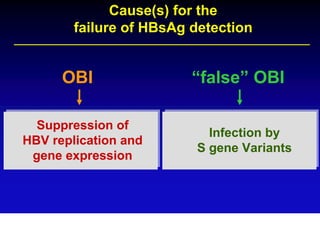
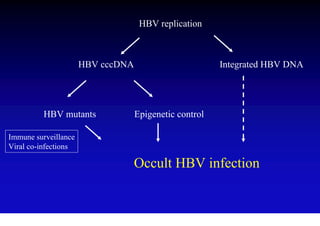
Cause(s) for the
        failure of HBsAg detection


      OBI                “false” OBI

  Suppression of
                           Infection by
HBV replication and
                         S gene Variants
 gene expression
HBV replication


                      HBV cccDNA                        Integrated HBV DNA


          HBV mutants              Epigenetic control

Immune surveillance
Viral co-infections

                                   Occult HBV infection
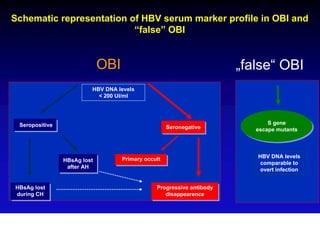
Schematic representation of HBV serum marker profile in OBI and
                          “false” OBI


                             OBI                                      „false“ OBI
                         HBV DNA levels
                           < 200 UI/ml


 Seropositive                                                                S gene
                                                                             S gene
 Seropositive                                       Seronegative
                                                    Seronegative         escape mutants
                                                                         escape mutants


                                   Primary occult                        HBV DNA levels
                HBsAg lost
                HBsAg lost         Primary occult
                                                                          comparable to
                 after AH
                 after AH                                                 overt infection


HBsAg lost
HBsAg lost                                     Progressive antibody
                                               Progressive antibody
during CH
 during CH                                        disappearence
                                                  disappearence
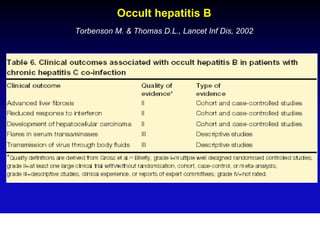
Occult hepatitis B
Torbenson M. & Thomas D.L., Lancet Inf Dis, 2002
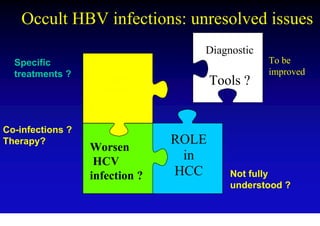
Occult HBV infections: unresolved issues
                                   Diagnostic
  Specific                                       To be
  treatments ?                                   improved
                      High             Tools ?
                   prevalence


Co-infections ?
Therapy?                        ROLE
                  Worsen
                   HCV           in
                  infection ?   HCC       Not fully
                                          understood ?
Antiviraux
   Persistance virale
Resistance aux antiviraux
Monitoring des traitements
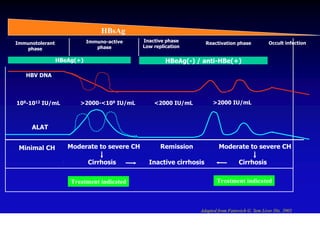
HBsAg
Immunotolerant              Immuno-active   Inactive phase                                      Occult infection
                                                                   Reactivation phase
   phase                       phase        Low replication

                 HBeAg(+)                            HBeAg(-) / anti-HBe(+)

   HBV DNA


109-1012 IU/mL          >2000-<109 IU/mL        <2000 IU/mL          >2000 IU/mL


     ALAT


 Minimal CH         Moderate to severe CH          Remission            Moderate to severe CH

                            Cirrhosis         Inactive cirrhosis                 Cirrhosis


                     Treatment indicated                               Treatment indicated


                                                               Adapted from Fattovich G. Sem Liver Dis. 2003
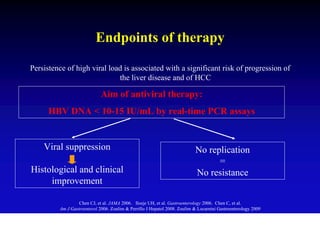
Endpoints of therapy

Persistence of high viral load is associated with a significant risk of progression of
                             the liver disease and of HCC

                             Aim of antiviral therapy:
      HBV DNA < 10-15 IU/mL by real-time PCR assays


    Viral suppression                                                      No replication
                                                                                 =
Histological and clinical                                                  No resistance
     improvement

                  Chen CJ, et al. JAMA 2006. Iloeje UH, et al. Gastroenterology 2006. Chen C, et al.
         Am J Gastroenterol 2006. Zoulim & Perrillo J Hepatol 2008. Zoulim & Locarnini Gastroenterology 2009
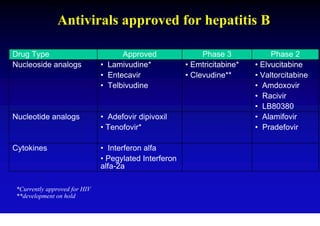
Antivirals approved for hepatitis B

Drug Type                            Approved                Phase 3            Phase 2
Nucleoside analogs             • Lamivudine*            • Emtricitabine*   • Elvucitabine
                               • Entecavir              • Clevudine**      • Valtorcitabine
                               • Telbivudine                               • Amdoxovir
                                                                           • Racivir
                                                                           • LB80380
Nucleotide analogs             • Adefovir dipivoxil                        • Alamifovir
                               • Tenofovir*                                • Pradefovir

Cytokines                      • Interferon alfa
                               • Pegylated Interferon
                               alfa-2a

 *Currently approved for HIV
 **development on hold
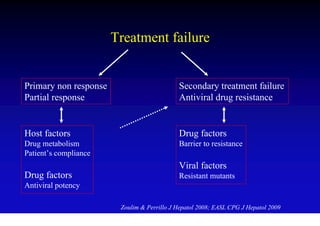
Treatment failure


Primary non response                        Secondary treatment failure
Partial response                            Antiviral drug resistance


Host factors                                Drug factors
Drug metabolism                             Barrier to resistance
Patient’s compliance
                                            Viral factors
Drug factors                                Resistant mutants
Antiviral potency

                        Zoulim & Perrillo J Hepatol 2008; EASL CPG J Hepatol 2009
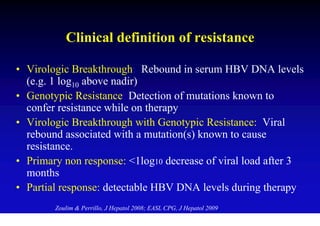
Clinical definition of resistance

• Virologic Breakthrough: Rebound in serum HBV DNA levels
  (e.g. 1 log10 above nadir)
• Genotypic Resistance: Detection of mutations known to
  confer resistance while on therapy
• Virologic Breakthrough with Genotypic Resistance: Viral
  rebound associated with a mutation(s) known to cause
  resistance.
• Primary non response: <1log10 decrease of viral load after 3
  months
• Partial response: detectable HBV DNA levels during therapy
        Zoulim & Perrillo, J Hepatol 2008; EASL CPG, J Hepatol 2009
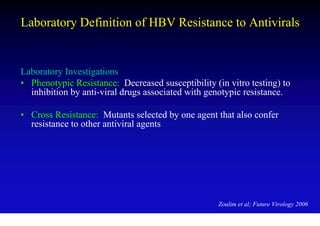
Laboratory Definition of HBV Resistance to Antivirals


Laboratory Investigations
• Phenotypic Resistance: Decreased susceptibility (in vitro testing) to
  inhibition by anti-viral drugs associated with genotypic resistance.

• Cross Resistance: Mutants selected by one agent that also confer
  resistance to other antiviral agents


                                                    Zoulim et al; Future Virology 2006
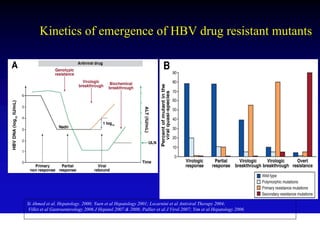
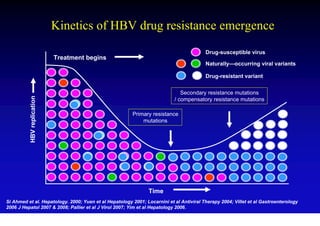
Kinetics of emergence of HBV drug resistant mutants


Si Ahmed et al. Hepatology. 2000; Yuen et al Hepatology 2001; Locarnini et al Antiviral Therapy 2004;
Villet et al Gastroenterology 2006 J Hepatol 2007 & 2008; Pallier et al J Virol 2007; Yim et al Hepatology 2006.
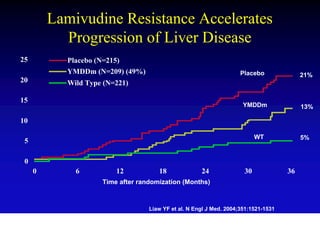
Lamivudine Resistance Accelerates
           Progression of Liver Disease
25         Placebo (N=215)
           YMDDm (N=209) (49%)                                       Placebo              21%
20         Wild Type (N=221)

15
                                                                      YMDDm               13%

10

                                                                           WT             5%
 5

 0
     0       6           12           18              24              30             36
                     Time after randomization (Months)


                                   Liaw YF et al. N Engl J Med. 2004;351:1521-1531
Biochemical and Histologic
              Correlates of HBV Resistance
  • Rise in ALT levels
        – Mild ALT elevations in most cases
        – ALT flares with acute exacerbations and liver failure:
          especially patients with liver cirrhosis and/or pre-core
          mutant infection

  • Progression of liver disease
        – Progressive worsening of liver histology
        – Clinical deterioration, liver decompensation, HCC
          development
Lai et al Clin Infect Dis 2003; 36: 687-696; Dienstag et al Gastroenterology 2003;124:105-117 ; Lok et al Gastroenterology
2003; 125 : 1714-1722; Hadziyannis et al Hepatology 2000;32:847-851; Si Ahmed et al Hepatology 2000; Zoulim et al J Viral
Hepatitis 2006;13:278-288 ; Fung et al J Hepatol 2005;43:937-943; Liaw et al NEJM 2004;351:1521-1531.
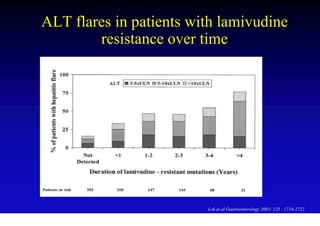
ALT flares in patients with lamivudine
        resistance over time


                         Lok et al Gastroenterology 2003; 125 : 1714-1722
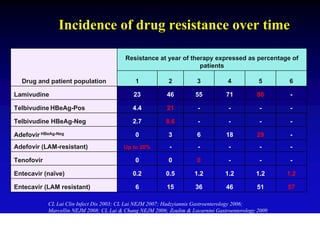
Incidence of drug resistance over time

                                          Resistance at year of therapy expressed as percentage of
                                                                   patients

  Drug and patient population                 1            2           3           4           5      6

Lamivudine                                   23            46         55          71          80       -

Telbivudine HBeAg-Pos                        4.4           21          -           -           -       -

Telbivudine HBeAg-Neg                        2.7          8.6          -           -           -       -

Adefovir HBeAg-Neg                            0            3           6          18          29       -
Adefovir (LAM-resistant)                  Up to 20%         -          -           -           -       -

Tenofovir                                     0            0           0           -           -       -

Entecavir (naïve)                            0.2          0.5         1.2         1.2         1.2     1.2

Entecavir (LAM resistant)                     6            15         36          46          51      57

            CL Lai Clin Infect Dis 2003; CL Lai NEJM 2007; Hadzyiannis Gastroenterology 2006;
            Marcellin NEJM 2008; CL Lai & Chang NEJM 2006; Zoulim & Locarnini Gastroenterology 2009
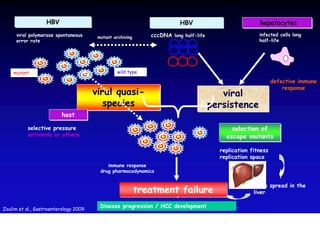
Zoulim & Locarnini, Gastroenterology, 2009
HBV
                   HBV                                                     HBV
                                                                           HBV                         hepatocytes
                                                                                                       hepatocytes
     viral polymerase spontaneous                             cccDNA long half-life                    infected cells long
                                        mutant archiving
     error rate                                                                                        half-life


    mutant                                       wild type

                                                                                                              defective immune
                                                                                                                  response
                                       viral quasi-                                      viral
                                          species                                     persistence
                          host
                          host
          selective pressure                                                                selection of
                                                                                            selection of
          antivirals or others                                                            escape mutants
                                                                                          escape mutants

                                                                                        replication fitness
                                                                                        replication space
                                            immune response
                                         drug pharmacodynamics


                                                                                                     Virus spread in the
                                                           treatment failure                         liver
                                                                       +

Zoulim et al., Gastroenterology 2009
                                         Disease progression / HCC development
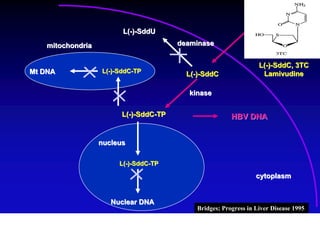
L(-)-SddU

   mitochondria                        deaminase


                                                                  L(-)-SddC, 3TC
Mt DNA            L(-)-SddC-TP           L(-)-SddC                 Lamivudine

                                         kinase

                        L(-)-SddC-TP                    HBV DNA


                  nucleus

                       L(-)-SddC-TP
                                                                 cytoplasm


                     Nuclear DNA
                                            Bridges; Progress in Liver Disease 1995
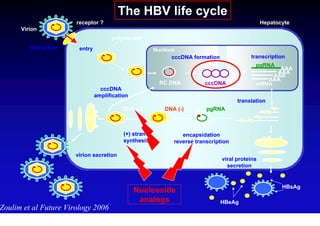
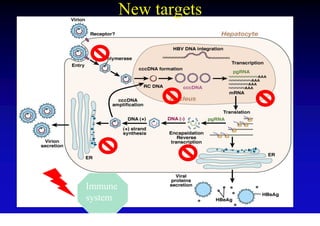
The HBV life cycle
                       receptor ?                                                                 Hepatocyte
      Virion
                                      polymerase
         interaction    entry                           Nucleus
                                                              cccDNA formation              transcription
                                                                                              pgRNA
                                                                                                     AAA
                                                                                                    AAA
                                                                                                   AAA
                                                                                                 AAA
                                                          RC DNA         cccDNA               mRNA
                                  cccDNA
                                amplification
                                                                                       translation
                                          DNA (+)          DNA (-)        pgRNA
                           ER

                                           (+) strand            encapsidation
                                           synthesis          reverse transcription                ER

                       virion secretion
                                                                                 viral proteins
                                                                                   secretion


                                                                                                         HBsAg
                                                Nucleoside
                                                 analogs                         HBeAg
Zoulim et al Future Virology 2006
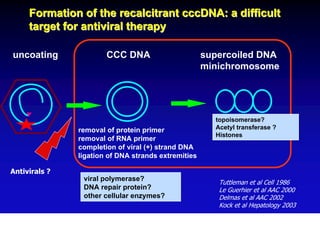
Formation of the recalcitrant cccDNA: a difficult
     target for antiviral therapy

uncoating              CCC DNA                       supercoiled DNA
                                                     minichromosome


                                                       topoisomerase?
               removal of protein primer               Acetyl transferase ?
                                                       Histones
               removal of RNA primer
               completion of viral (+) strand DNA
               ligation of DNA strands extremities

Antivirals ?
                viral polymerase?
                                                        Tuttleman et al Cell 1986
                DNA repair protein?                     Le Guerhier et al AAC 2000
                other cellular enzymes?                 Delmas et al AAC 2002
                                                        Kock et al Hepatology 2003
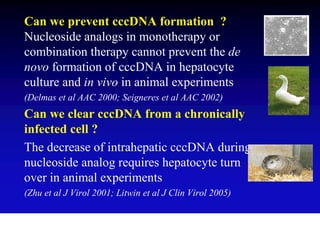
Can we prevent cccDNA formation ?
Nucleoside analogs in monotherapy or
combination therapy cannot prevent the de
novo formation of cccDNA in hepatocyte
culture and in vivo in animal experiments
(Delmas et al AAC 2000; Seigneres et al AAC 2002)
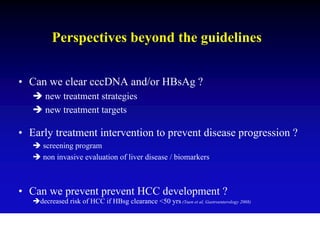
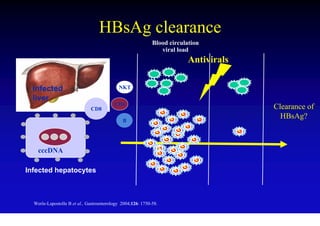
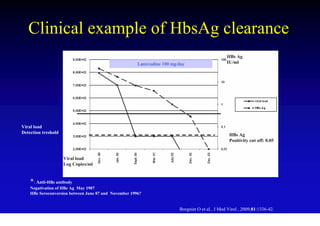
Can we clear cccDNA from a chronically
infected cell ?
The decrease of intrahepatic cccDNA during
nucleoside analog requires hepatocyte turn
over in animal experiments
(Zhu et al J Virol 2001; Litwin et al J Clin Virol 2005)
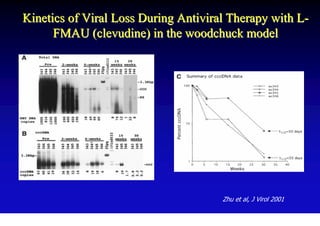
Kinetics of Viral Loss During Antiviral Therapy with L-
      FMAU (clevudine) in the woodchuck model


                                      Zhu et al, J Virol 2001
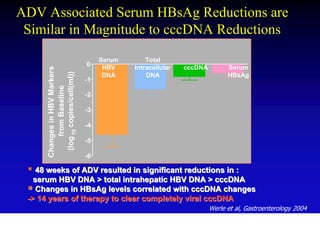
ADV Associated Serum HBsAg Reductions are
 Similar in Magnitude to cccDNA Reductions
                                       Serum       Total
                                  0     HBV    Intracellular   cccDNA         Serum
      Changes in HBV Markers

       (log 10 copies/cell(ml))
                                        DNA        DNA                        HBsAg
                                  -1
           from Baseline


                                  -2

                                  -3

                                  -4

                                  -5

                                  -6

   48 weeks of ADV resulted in significant reductions in :
   serum HBV DNA > total intrahepatic HBV DNA > cccDNA
    Changes in HBsAg levels correlated with cccDNA changes
 -> 14 years of therapy to clear completely viral cccDNA
                                                                        Werle et al, Gastroenterology 2004
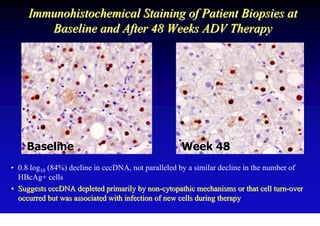
Immunohistochemical Staining of Patient Biopsies at
        Baseline and After 48 Weeks ADV Therapy


    Baseline                                       Week 48
• 0.8 log10 (84%) decline in cccDNA, not paralleled by a similar decline in the number of
  HBcAg+ cells
• Suggests cccDNA depleted primarily by non-cytopathic mechanisms or that cell turn-over
  occurred but was associated with infection of new cells during therapy
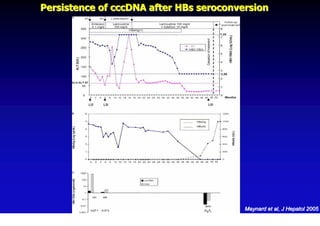
Persistence of cccDNA after HBs seroconversion


                                         Maynard et al, J Hepatol 2005
Clearance of viral infection versus selection of
                escape mutants
The most important factors to consider:
§ The rate of immune killing of infected hepatocytes
§ The rate of replication and spread of mutant virus in the
   chronically infected liver (I.e. fitness of the virus: the rate of
   spread to uninfected hepatocytes)
§ Small changes in these factors may have profound effect on
   whether treatment response is durable or subject to rapid
   rebound (Litwin et al J Clin Virol 2005)
§ These factors may be subject to therapeutic intervention
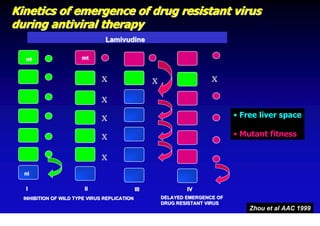
Kinetics of emergence of drug resistant virus
during antiviral therapy
                                Lamivudine

  wt                   mt


                              X                     X                   X

                              X

                              X                                                • Free liver space

                              X                                                • Mutant fitness

                              X
  ni

  I                     II                    III               IV
  INHIBITION OF WILD TYPE VIRUS REPLICATION             DELAYED EMERGENCE OF
                                                        DRUG RESISTANT VIRUS
                                                                                   Zhou et al AAC 1999
Kinetics of HBV drug resistance emergence
                                                                                         Drug-susceptible virus
                            Treatment begins
                                                                                         Naturally—occurring viral variants

                                                                                         Drug-resistant variant


                                                                              Secondary resistance mutations
          HBV replication


                                                                           / compensatory resistance mutations

                                                        Primary resistance
                                                            mutations


                                                               Time
Si Ahmed et al. Hepatology. 2000; Yuen et al Hepatology 2001; Locarnini et al Antiviral Therapy 2004; Villet et al Gastroenterology
2006 J Hepatol 2007 & 2008; Pallier et al J Virol 2007; Yim et al Hepatology 2006.
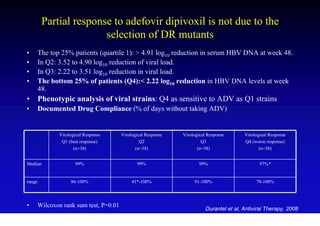
Partial response to adefovir dipivoxil is not due to the
                        selection of DR mutants
•       The top 25% patients (quartile 1): > 4.91 log10 reduction in serum HBV DNA at week 48.
•       In Q2: 3.52 to 4.90 log10 reduction of viral load.
•       In Q3: 2.22 to 3.51 log10 reduction in viral load.
•       The bottom 25% of patients (Q4):< 2.22 log10 reduction in HBV DNA levels at week
        48.
•       Phenotypic analysis of viral strains: Q4 as sensitive to ADV as Q1 strains
•       Documented Drug Compliance (% of days without taking ADV)


               Virological Response      Virological Response   Virological Response       Virological Response
                Q1 (best response)                Q2                     Q3                Q4 (worse response)
                      (n=38)                    (n=38)                 (n=38)                     (n=38)


Median                99%                       99%                    99%                        97% a


range               86-100%                   41*-100%               91-100%                    70-100%


•       Wilcoxon rank sum test, P=0.01
                                                                           Durantel et al, Antiviral Therapy, 2008
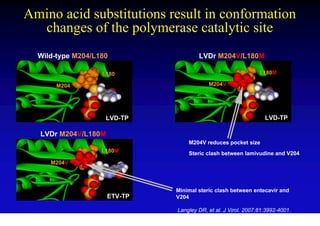
Amino acid substitutions result in conformation
  changes of the polymerase catalytic site
  Wild-type M204/L180                 LVDr M204V/L180M

                   L180                                        L180M

       M204                               M204V


                    LVD-TP                                       LVD-TP

  LVDr M204V/L180M
                                  M204V reduces pocket size
                   L180M          Steric clash between lamivudine and V204
     M204V


                              Minimal steric clash between entecavir and
                     ETV-TP   V204

                              Langley DR, et al. J Virol. 2007;81:3992-4001.
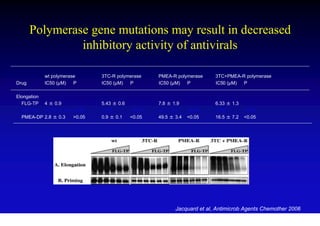
Polymerase gene mutations may result in decreased
                inhibitory activity of antivirals

          wt polymerase      3TC-R polymerase     PMEA-R polymerase     3TC+PMEA-R polymerase
Drug      IC50 (µM)   P      IC50 (µM)  P         IC50 (µM)  P          IC50 (µM) P

Elongation
  FLG-TP 4 ± 0.9             5.43 ± 0.6           7.8 ± 1.9             6.33 ± 1.3
  3TC-TP 10.75 ± 4.8 <0.05   >100         <0.05   14 ± 5.7     <0.05    >100         <0.05
  PMEA-DP 2.8 ± 0.3  >0.05   0.9 ± 0.1    <0.05   49.5 ± 3.4   <0.05    16.5 ± 7.2   <0.05


                                                         Jacquard et al, Antimicrob Agents Chemother 2006
Definition of fitness

• A parameter that quantifies the adaptation of an
  organism or a virus to a given environment

• For a virus, ability to produce infectious progeny
  relative to a reference viral clone, in a defined
  environment


                            Esteban Domingo, In Fields Virology 2007
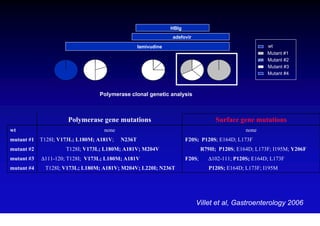
HBIg
                                                               adefovir

                                                  lamivudine                                           wt
                                                                                                       Mutant #1
                                                                                                       Mutant #2
                                                                                                       Mutant #3
                                                                                                       Mutant #4


                                 Polymerase clonal genetic analysis


                      Polymerase gene mutations                                    Surface gene mutations
wt                                 none                                                       none
mutant #1   T128I; V173L; L180M; A181V;   N236T                       F20S; P120S; E164D; L173F
mutant #2            T128I; V173L; L180M; A181V; M204V                        R79H; P120S; E164D; L173F; I195M; Y206F
mutant #3   ∆111-120; T128I; V173L; L180M; A181V                      F20S;     ∆102-111; P120S; E164D; L173F
mutant #4    T128I; V173L; L180M; A181V; M204V; L220I; N236T                     P120S; E164D; L173F; I195M


                                                                          Villet et al, Gastroenterology 2006
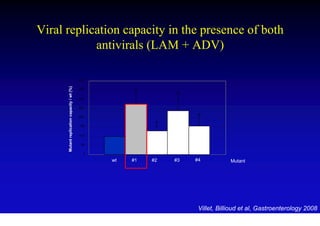
Viral replication capacity in the presence of both
            antivirals (LAM + ADV)

                                             400
      Mutant replication capacity / wt (%)


                                             350


                                             300

                                             250

                                             200

                                             150


                                             100

                                              50

                                               0

                                                   wt   #1   #2   #3   #4           Mutant


                                                                        Villet, Billioud et al, Gastroenterology 2008
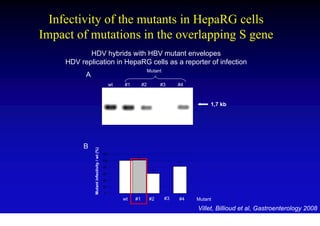
Infectivity of the mutants in HepaRG cells
Impact of mutations in the overlapping S gene
            HDV hybrids with HBV mutant envelopes
     HDV replication in HepaRG cells as a reporter of infection
                                                                       Mutant
           A
                                                   wt   #1        #2        #3       #4


                                                                                               1,7 kb


          B
               Mutant infectivity / wt (%)


                                             120

                                             100

                                             80

                                             60

                                             40

                                             20

                                              0
                                                        wt   #1        #2       #3   #4   Mutant

                                                                                          Villet, Billioud et al, Gastroenterology 2008
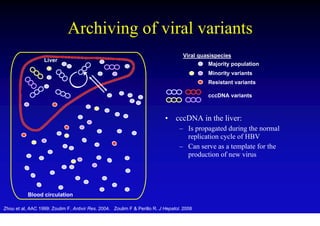
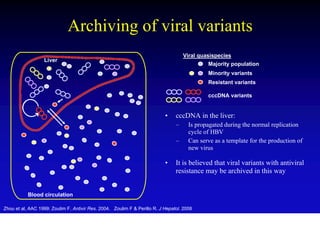
Archiving of viral variants
                                                                                   Viral quasispecies
                  Liver
                                                                                            Majority population
                                                                                            Minority variants
                                                                                            Resistant variants

                                                                                            cccDNA variants


                                                                           •    cccDNA in the liver:
                                                                                  – Is propagated during the normal
                                                                                    replication cycle of HBV
                                                                                  – Can serve as a template for the
                                                                                    production of new virus


           Blood circulation

Zhou et al, AAC 1999; Zoulim F. Antivir Res. 2004. Zoulim F & Perillo R. J Hepatol. 2008
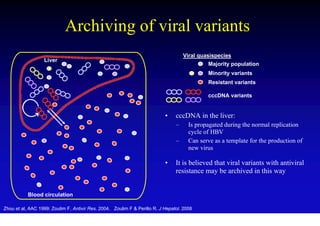
Archiving of viral variants
                                                                                    Viral quasispecies
                  Liver
                                                                                             Majority population
                                                                                             Minority variants
                                                                                             Resistant variants

                                                                                             cccDNA variants


                                                                           •    cccDNA in the liver:
                                                                                –     Is propagated during the normal replication
                                                                                      cycle of HBV
                                                                                –     Can serve as a template for the production of
                                                                                      new virus

                                                                           •    It is believed that viral variants with antiviral
                                                                                resistance may be archived in this way


           Blood circulation

Zhou et al, AAC 1999; Zoulim F. Antivir Res. 2004. Zoulim F & Perillo R. J Hepatol. 2008
Archiving of viral variants
                                                                                    Viral quasispecies
                  Liver
                                                                                             Majority population
                                                                                             Minority variants
                                                                                             Resistant variants

                                                                                             cccDNA variants


                                                                           •    cccDNA in the liver:
                                                                                –     Is propagated during the normal replication
                                                                                      cycle of HBV
                                                                                –     Can serve as a template for the production of
                                                                                      new virus

                                                                           •    It is believed that viral variants with antiviral
                                                                                resistance may be archived in this way


           Blood circulation

Zhou et al, AAC 1999; Zoulim F. Antivir Res. 2004. Zoulim F & Perillo R. J Hepatol. 2008
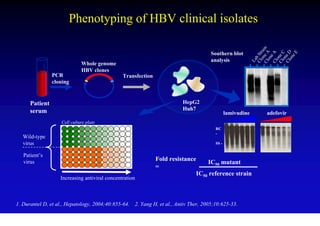
Phenotyping of HBV clinical isolates


                                                                                                           Cl ne A in
                                                                                                             o ra
                                                                                     Southern blot


                                                                                                           Cl e D
                                                                                                           Cl e C

                                                                                                                eE
                                                                                                           Cl A
                                                                                                           Cl b St

                                                                                                               e


                                                                                                             on
                                                                                                             on
                                                                                                             on
                                                                                                             on
                                                                                     analysis


                                                                                                            La
                             Whole genome
                             HBV clones
                PCR                            Transfection
                cloning


      Patient                                                            HepG2
      serum                                                              Huh7
                                                                                              lamivudine      adefovir
                   Cell culture plate
                                                                                       RC
                                                                                       -
   Wild-type
   virus                                                                               SS -


   Patient’s
                                                              Fold resistance
   virus                                                                          IC50 mutant
                                                              =
                                                                             IC50 reference strain
                   Increasing antiviral concentration


1. Durantel D, et al., Hepatology, 2004;40:855-64. 2. Yang H, et al., Antiv Ther, 2005;10:625-33.
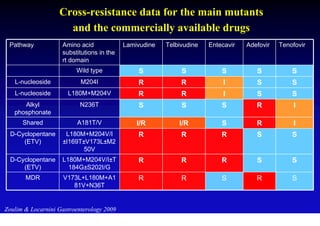
Cross-resistance data for the main mutants
                     and the commercially available drugs
 Pathway            Amino acid             Lamivudine   Telbivudine   Entecavir   Adefovir   Tenofovir
                    substitutions in the
                    rt domain
                         Wild type             S             S            S          S           S
   L-nucleoside            M204I               R             R             I         S           S
   L-nucleoside       L180M+M204V              R             R             I         S           S
      Alkyl                N236T               S             S            S          R            I
   phosphonate
      Shared              A181T/V              I/R          I/R           S          R            I
  D-Cyclopentane     L180M+M204V/I             R             R            R          S           S
      (ETV)         ±I169T±V173L±M2
                          50V
  D-Cyclopentane    L180M+M204V/I±T            R             R            R          S           S
      (ETV)           184G±S202I/G
       MDR           V173L+L180M+A1            R             R            S          R           S
                        81V+N36T


Zoulim & Locarnini Gastroenterology 2009
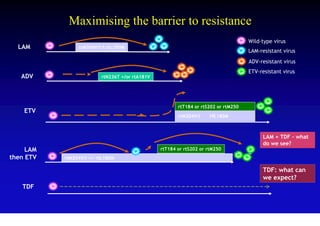
Maximising the barrier to resistance
                                                                                     Wild-type virus
  LAM           rtM204V/I ± rtL180M
                                                                                     LAM-resistant virus
                                                                                     ADV-resistant virus
                                                                                     ETV-resistant virus
   ADV                    rtN236T +/or rtA181V


                                                        rtT184 or rtS202 or rtM250
    ETV
                                                        rtM204V/I    +/-
                                                                     rtL180M


                                                                                          LAM + TDF – what
                                                                                          do we see?
     LAM                                         rtT184 or rtS202 or rtM250
then ETV   rtM204V/I +/- rtL180M

                                                                                          TDF: what can
                                                                                          we expect?
   TDF
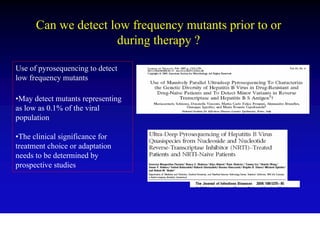
Can we detect low frequency mutants prior to or
                     during therapy ?

Use of pyrosequencing to detect
low frequency mutants

•May detect mutants representing
as low as 0.1% of the viral
population

•The clinical significance for
treatment choice or adaptation
needs to be determined by
prospective studies
Important factors involved in selection of
                   MDR mutants
• Use of inadequate sequential monotherapies and inadequate treatment
  adaptation
• Incomplete viral suppression
   – > Persistent replication in the presence of antiviral pressure

• Use of drugs sharing cross-resistance characteristics
   – One mutation may confer resistance to several drugs
   – > Persistent replication

• Accumulation of mutations
• Wide replication space (liver transplantation)
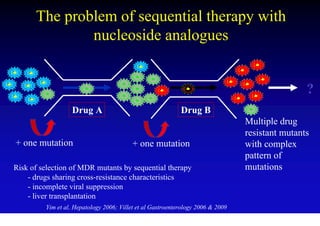
The problem of sequential therapy with
              nucleoside analogues


                                                                                                          ?
                    Drug A                                         Drug B
                                                                                          Multiple drug
                                                                                          resistant mutants
+ one mutation                                + one mutation                              with complex
                                                                                          pattern of
Risk of selection of MDR mutants by sequential therapy                                    mutations
    - drugs sharing cross-resistance characteristics
    - incomplete viral suppression
    - liver transplantation
         Yim et al, Hepatologyal. J Hepatol. 2008;48:S2-19.Gastroenterology 2006 & 2009
                       Zoulim F, et
                                    2006; Villet et al
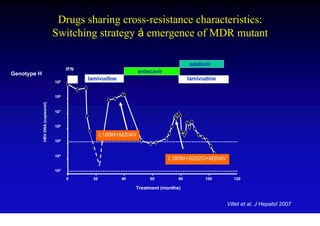
Drugs sharing cross-resistance characteristics:
                                   Switching strategy á emergence of MDR mutant

                                                                                       adefovir
                                         IFN
Genotype H                                                         entecavir
                                               lamivudine                              lamivudine
                                   109


                                   108
             HBV DNA (copies/ml)


                                   107


                                   106

                                                     L180M+M204V
                                   105


                                   104
                                                                               L180M+S202G+M204V

                                   103

                                         0      20          40         60         80         100       120

                                                                 Treatment (months)


                                                                                                    Villet et al, J Hepatol 2007
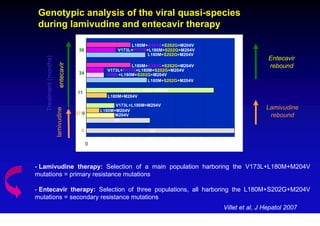
Genotypic analysis of the viral quasi-species
 during lamivudine and entecavir therapy

                                                             L180M+A181G+S202G+M204V
                                        36              V173L+P177S+L180M+S202G+M204V
                                                                    L180M+S202G+M204V
   Treatment (months)
                           entecavir                                                                              Entecavir
                                                              L180M+A181G+S202G+M204V                             rebound
                                                    V173L+P177S+L180M+S202G+M204V
                                        34          I169L+L180M+S202G+M204V
                                                                    L180M+S202G+M204V
                                        1
                                                          V173L+L180M+M204V
                                       11
                                                    L180M+M204V

                                                        V173L+L180M+M204V
                                                                                                                 Lamivudine
                        lamivudine


                                                  L180M+M204V
                                       27/0             M204V                                                     rebound
                                                       wt

                                         0                            wt


                                              0        20          40           60          80     100
                                                            % clones in the quasi-species


- Lamivudine therapy: Selection of a main population harboring the V173L+L180M+M204V
mutations = primary resistance mutations

- Entecavir therapy: Selection of three populations, all harboring the L180M+S202G+M204V
mutations = secondary resistance mutations
                                                                                                 Villet et al, J Hepatol 2007
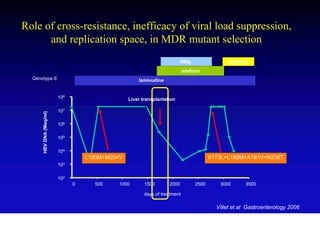
Role of cross-resistance, inefficacy of viral load suppression,
      and replication space, in MDR mutant selection
                                                                         HBIg                 tenofovir
                                                                            adefovir
  Genotype E                                         lamivudine


                         108                     Liver transplantation

                         107
      HBV DNA (Meq/ml)


                         106

                         105

                         104
                                   L180M+M204V                                          V173L+L180M+A181V+N236T
                         103

                         102
                               0     500     1000       1500       2000          2500      3000      3500

                                                        days of treatment

                                                                                          Villet et al Gastroenterology 2006
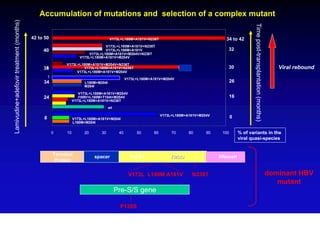
Lamivudine+adefovir treatment (months)      Accumulation of mutations and selection of a complex mutant


                                                                                                                                                              Time post-transplantation (months)
                                         42 to 50                                  V173L+L180M+A181V+N236T                                  34 to 42
                                                                                V173L+L180M+A181V+N236T
                                              40                                V173L+L180M+A181V                                            32
                                                                        V173L+L180M+A181V+M204V+N236T
                                                                   V173L+L180M+A181V+M204V
                                                           V173L+L180M+A181V+M204V+N236T
                                              38
                                               1                   V173L+L180M+A181V+N236T                                                   30                                                       Viral rebound
                                                                V173L+L180M+A181V+M204V
                                                  1                                           V173L+L180M+A181V+M204V
                                              34                     L180M+M204I                                                                 26
                                                                     M204I

                                                                   V173L+L180M+A181V+M204V
                                              24                   I169V+L180M+T184I+M204V                                                       16
                                                                V173L+L180M+A181V+N236T
                                                                                   wt

                                                                                                                V173L+L180M+A181V+M204V
                                              8                 V173L+L180M+A181V+M204I                                                          0
                                                                L180M+M204I

                                                      0    10        20       30         40        50      60        70      80      90    100        % of variants in the
                                                                                                                                                      viral quasi-species


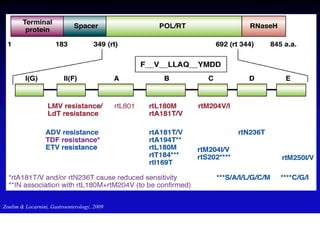
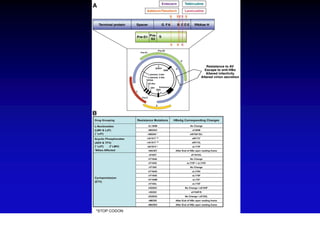
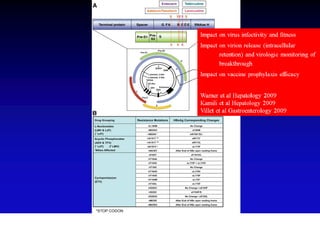
                                                      Terminal            spacer                Pol/RT                                    RNaseH
                                                                                                                    YMDD
                                                       Protein


                                                                                               V173L L180M A181V              N236T                                                                dominant HBV
                                                                                                                                                                                                      mutant
                                                                                        Pre-S/S gene

                                                                                         P120S
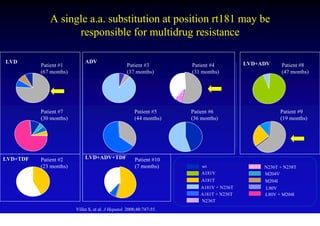
A single a.a. substitution at position rt181 may be
                   responsible for multidrug resistance

LVD                         ADV                                                          LVD+ADV
          Patient #1                               Patient #3         Patient #4                      Patient #8
          (67 months)                              (37 months)        (31 months)                     (47 months)


          Patient #7                                   Patient #5     Patient #6                      Patient #9
          (30 months)                                  (44 months)    (36 months)                     (19 months)


LVD+TDF   Patient #2        LVD+ADV+TDF                Patient #10
          (23 months)                                  (7 months)         wt                  N236T + N238T
                                                                          A181V               M204V
                                                                          A181T               M204I
                                                                         A181V + N236T        L80V
                                                                         A181T + N236T        L80V + M204I
                                                                         N236T
                        Villet S, et al. J Hepatol. 2008;48:747-55.
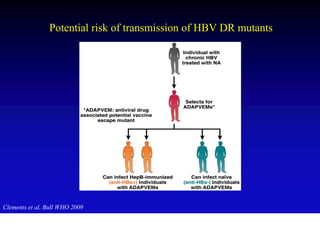
Potential risk of transmission of HBV DR mutants


Clements et al, Bull WHO 2009
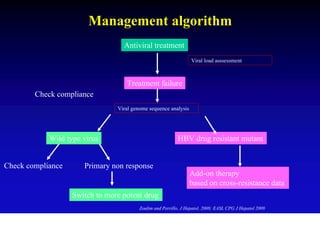
Management algorithm
                                  Antiviral treatment
                                                                  Viral load asssessment


                                   Treatment failure
        Check compliance
                                Viral genome sequence analysis


            Wild type virus                                HBV drug resistant mutant


Check compliance      Primary non response
                                                                 Add-on therapy
                                                                 based on cross-resistance data
                   Switch to more potent drug
                                         Zoulim and Perrillo, J Hepatol, 2008; EASL CPG J Hepatol 2009
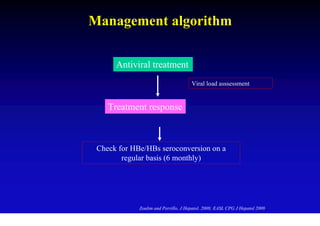
Management algorithm

      Antiviral treatment
                                      Viral load asssessment


    Treatment response


 Check for HBe/HBs seroconversion on a
        regular basis (6 monthly)


             Zoulim and Perrillo, J Hepatol, 2008; EASL CPG J Hepatol 2009
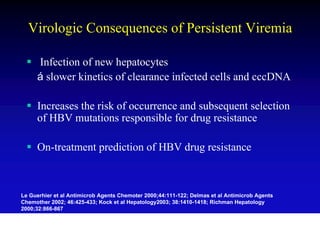
Virologic Consequences of Persistent Viremia

     Infection of new hepatocytes
     á slower kinetics of clearance infected cells and cccDNA

     Increases the risk of occurrence and subsequent selection
     of HBV mutations responsible for drug resistance

     On-treatment prediction of HBV drug resistance


Le Guerhier et al Antimicrob Agents Chemoter 2000;44:111-122; Delmas et al Antimicrob Agents
Chemother 2002; 46:425-433; Kock et al Hepatology2003; 38:1410-1418; Richman Hepatology
2000;32:866-867
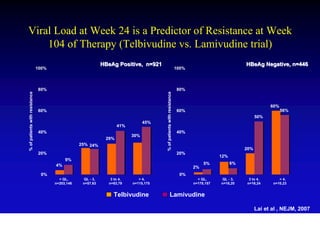
Viral Load at Week 24 is a Predictor of Resistance at Week
    104 of Therapy (Telbivudine vs. Lamivudine trial)
                                                              HBeAg Positive, n=921                                                                  HBeAg Negative, n=446
                                100%                                                                                   100%


                                80%                                                                                    80%
% of patients with resistance


                                                                                       % of patients with resistance
                                                                                                                                                                 60%
                                60%                                                                                    60%                                             56%
                                                                                                                                                           50%
                                                                                 45%
                                                                     41%
                                40%                                                                                    40%
                                                                           30%
                                                               29%
                                                   25% 24%
                                                                                                                                                     20%
                                20%                                                                                    20%
                                                                                                                                          12%
                                            9%
                                       4%                                                                                          5%           6%
                                                                                                                              2%
                                 0%                                                                                     0%
                                         < QL,      QL - 3,      3 to 4,      > 4,                                              < QL,      QL - 3,    3 to 4,        > 4,
                                       n=203,146    n=57,63     n=83,79    n=115,175                                          n=178,157   n=18,20    n=16,24      n=10,23


                                                                  Telbivudine                        Lamivudine

                                                                                                                                                           Lai et al , NEJM, 2007
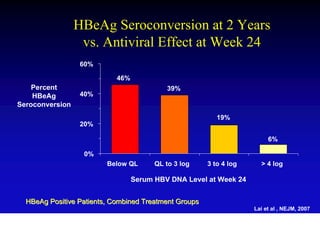
HBeAg Seroconversion at 2 Years
                  vs. Antiviral Effect at Week 24
                  60%

                            46%
    Percent                                39%
    HBeAg         40%
Seroconversion
                                                          19%
                  20%

                                                                         6%

                  0%
                         Below QL       QL to 3 log    3 to 4 log     > 4 log

                                  Serum HBV DNA Level at Week 24


  HBeAg Positive Patients, Combined Treatment Groups
                                                                    Lai et al , NEJM, 2007
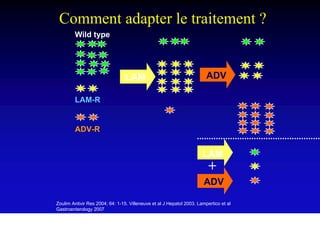
Comment adapter le traitement ?
        Wild type


                                 LAM                                    ADV

        LAM-R


         ADV-R


                                                                      LAM
                                                                         +
                                                                       ADV

Zoulim Antivir Res 2004; 64: 1-15. Villeneuve et al J Hepatol 2003. Lampertico et al
Gastroenterology 2007
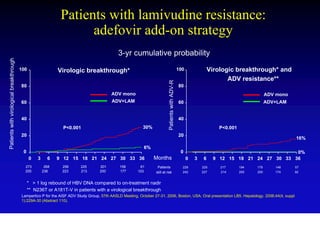
Patients with lamivudine resistance:
                                                                     adefovir add-on strategy
                                                                                             3-yr cumulative probability
Patients with virological breakthrough


                                         100                  Virologic breakthrough*                                                             100                Virologic breakthrough* and
                                                                                                                                                                            ADV resistance**


                                                                                                                            Patients with ADV-R
                                         80                                                                                                       80
                                                                                         ADV mono                                                                                              ADV mono
                                         60                                              ADV+LAM                                                  60                                           ADV+LAM


                                         40                                                                                                       40
                                                                P<0.001                                   30%                                                            P<0.001
                                         20                                                                                                       20
                                                                                                                                                                                                          16%
                                                                                                           6%
                                          0                                                                                                        0                                             0%
                                               0   3     6    9 12 15 18 21 24 27 30 33 36                      Months                                  0   3    6    9 12 15 18 21 24 27 30 33 36
                                           273          268    256       225       201        158        61        Patients                         229         225      217       194   179      146     57
                                           255         238     223       213       200        177       103       still at risk                     242         227      214       205   200      174     92


                                              * > 1 log rebound of HBV DNA compared to on-treatment nadir
                                              ** N236T or A181T-V in patients with a virological breakthrough
                                         Lampertico P for the AISF ADV Study Group, 57th AASLD Meeting, October 27-31, 2006, Boston, USA. Oral presentation LB5. Hepatology. 2006;44(4, suppl
                                         1):229A-30 (Abstract 110).
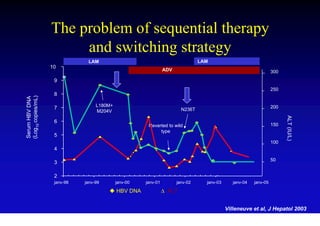
The problem of sequential therapy
                         and switching strategy
                                LAM                                              LAM
                    10
                                                                 ADV                                                300
                     9
                                                                                                                    250
                     8
(Log10 copies/mL)
Serum HBV DNA


                                    L180M+                                                                          200
                     7                                                   N236T
                                    M204V


                                                                                                                          ALT (IU/L)
                     6
                                                        Reverted to wild                                            150
                                                             type
                     5
                                                                                                                    100
                     4

                                                                                                                    50
                     3

                     2
                     janv-98   janv-99       janv-00   janv-01         janv-02     janv-03      janv-04   janv-05

                                             HBV DNA             ∆ ALT


                                                                                             Villeneuve et al, J Hepatol 2003
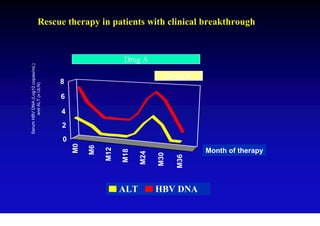
Rescue therapy in patients with clinical breakthrough


                                                      Drug A
Serum HBV DNA (Log10 copies/mL)


                                                                        Drug B
                                  8
        and ALT (x ULN)


                                  6

                                  4
                                  2
                                  0
                                      M0

                                           M6


                                                                                 ALT of therapy
                                                M12


                                                                                 Month
                                                      M18

                                                            M24

                                                                  M30

                                                                          M36
                                                      ALT         HBV DNA
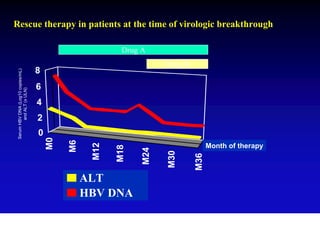
Rescue therapy in patients at the time of virologic breakthrough

                                                         Drug A
                                                                    Drug B
                                   8
 Serum HBV DNA (Log10 copies/mL)


                                   6
         and ALT (x ULN)


                                   4
                                   2
                                   0
                                       M0

                                            M6


                                                                                    ALT
                                                  M12


                                                                                   Month of therapy
                                                        M18

                                                              M24

                                                                    M30


                                                                             M36
                                                 ALT
                                                 HBV DNA
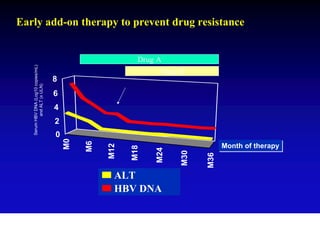
Early add-on therapy to prevent drug resistance


                                                           Drug A
   Serum HBV DNA (Log10 copies/mL)


                                                                Drug B
                                     8
           and ALT (x ULN)


                                     6
                                     4
                                     2
                                     0
                                         M0

                                              M6


                                                                                 ALT of therapy
                                                                                 Month of therapy
                                                   M12


                                                                                 Month
                                                         M18


                                                               M24


                                                                     M30


                                                                           M36
                                                     ALT
                                                     HBV DNA
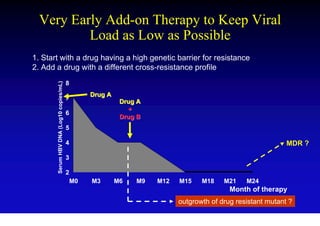
Very Early Add-on Therapy to Keep Viral
          Load as Low as Possible
1. Start with a drug having a high genetic barrier for resistance
2. Add a drug with a different cross-resistance profile
                                         8
       Serum HBV DNA (Log10 copies/mL)


                                                  Drug A
                                         7
                                                            Drug A
                                                              +
                                         6
                                                            Drug B
                                         5

                                         4                                                                   MDR ?
                                         3

                                         2
                                             M0   M3       M6   M9   M12   M15    M18    M21    M24
                                                                                           Month of therapy
                                                                           outgrowth of drug resistant mutant ?
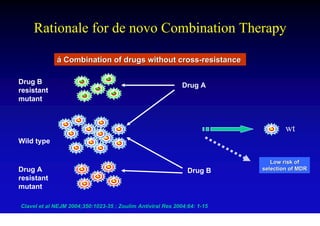
Rationale for de novo Combination Therapy

             á Combination of drugs without cross-resistance

Drug B                                                       Drug A
resistant
mutant


                                                                                  wt
Wild type

                                                                             Low risk of
Drug A                                                         Drug B     selection of MDR
resistant
mutant

Clavel et al NEJM 2004;350:1023-35 ; Zoulim Antiviral Res 2004;64: 1-15
De novo combination therapy to prevent drug resistance

                                                          Drug A
                                                          Drug B
   Serum HBV DNA (Log10 copies/mL)


                                     8
           and ALT (x ULN)


                                     6
                                     4
                                     2
                                     0
                                         M0

                                              M6


                                                                                 ALT of therapy
                                                                                 Month of therapy
                                                   M12


                                                                                 Month
                                                         M18


                                                               M24


                                                                     M30


                                                                           M36
                                                     ALT
                                                     HBV DNA
Preventing L-Nucleosides Resistance
     with de novo Combination Therapy
                                       100
        Incidence of resistance* (%)


                                              Marcellin 1         Lau 2            Lai 3                 Sung 4          Lau 5
                                        80


                                        60


                                        40                  34%

                                                                           21%                        20%
                                             18%
                                        20                         11%           12%
                                                                                           5%                2%
                                                   1%                                                                    0% 0%
                                         0
                                             LAM   LAM      LAM      LAM   LAM    LAM      LdT      LAM       LAM        FTC     FTC
                                                   +Peg             +Peg          +LdT                       +ADV                +ADV
    * After 1- year therapy

1 Marcellin et al. N Engl J Med 2004; 351: 1206-17                         3 Lai et al. Hepatology 2003;38:262A
2 Lau et al. Hepatology 2004;40:171A                                       4 Sung et al. J Hepatol 2003 ;38 (suppl 2):25-26
                                                                           5 Lau et al. Hepatology 2004:40:666A
Perspectives / Prevention of drug resistance
• First line therapy
   – Use of antivirals with high antiviral potency and high barrier to
     resistance
   – Combination therapy with complementary drugs to increase the
     barrier to resistance
• Second line treatment
   – Add-on strategies with complementary drugs preferred to
     sequential monotherapies
   – Early treatment adaptation to prevent accumulation of
     mutations
   – Choice always based on cross-resistance data
Perspectives beyond the guidelines


• Can we clear cccDNA and/or HBsAg ?
      new treatment strategies
      new treatment targets

• Early treatment intervention to prevent disease progression ?
     screening program
     non invasive evaluation of liver disease / biomarkers


• Can we prevent prevent HCC development ?
    decreased risk of HCC if HBsg clearance <50 yrs (Yuen et al, Gastroenterology 2008)
HBsAg clearance
                                                             Blood circulation
                                                                viral load
                                                                          Antivirals


  Infected                                  NKT

  liver
                                          CD4
                              CD8                                                      Clearance of
                                              B
                                                                                         HBsAg?


    cccDNA

Infected hepatocytes


  Werle-Lapostolle B et al., Gastroenterology 2004;126: 1750-58.
Clinical example of HbsAg clearance
                                                                          *    *                 HBs Ag
                                                       Lamivudine 100 mg/day                     IU/ml


Viral load
Detection treshold
                                                                                                  HBs Ag
                                                                                                  Positivity cut off: 0.05


                     Viral load
                     Log Copies/ml


    *: Anti-HBs antibody
    Negativation of HBe Ag May 1987
    HBe Seroconversion between June 87 and November 1996?


                                                                         Borgniet O et al., J Med Virol , 2009;81:1336-42.
New targets


Immune
system
Conclusions 1
• Maladie fréquente et grave
   – 300 000 porteurs chroniques en france
   – 1ère cause de cancer du foie dans le monde
   – 1300 décès par an en France
• Maladie méconnue
   –   Souvent asymptomatique, ou symptomes non spécifiques
   –   Seulement 60 000 personnes connaissent leur maladie
   –   13 000 sont traitées
• Persistance virale
   – Pas d’éradication du génome viral
   – Surveillance prolongée, possibilité de réactivations
Conclusions 2

• Différentes formes d’hépatites en fonction de
  l’interaction virus / réponse immunitaire
  – Portage asymptomatique / hépatite chronique / cirrhose /
    cancer du foie
• Impact de la variabilité du génome viral
  - Role dans la persistance virale et la résistance aux antiviraux
  - Echappement diagnostique
• Nécessité d’un dépistage et traitement précoce des
  formes chroniques
• Prévention par la vaccination !!!

Zoulim Hbv EpidéMio Marqueurs

  • 1.
    Hépatite B Fabien Zoulim Département d’hépatologie & INSERM U871, Lyon
  • 2.
    Guérison 30-50 ans VHB HCA cirrhose CHC Vaccin ANTIVIRAUX Antiviraux/IFN? IFN Niederau N Engl J Med 1996 & Liaw N Engl J Med 2004 RESISTANCE VIRALE Lee, N Engl J Med 1997; Lok, Hepatology 2001
  • 3.
  • 5.
    EPIDEMIOLOGIE DE L'INFECTIONA VHB AUX USA • Hépatites aigues – VHA : 40% – VHB : 30% – VHC : 20% • incidence : 300 000 infections à VHB / an • 30 000 nouveaux porteurs chroniques / an • 3 000 décès / an
  • 6.
    MODES DE TRANSMISSIONDU VHB • 1108 habitants de San Francisco • 159 (14%) anti-HBc + • positivité des anti-HBc associée avec – âge – éthnie – degré d'éducation – toxicomanie IV – prostitution – nombre de partenaires sexuels – homosexualité – HIV / HSV 2 / syphilis
  • 7.
    MODES DE TRANSMISSIONDU VIRUS DE L'HÉPATITE B EN EUROPE transfusions contact avec 2% porteur du VHB 4% personnels de santé sexuelle 2% homo hémodialysés 34% 11% 8% hétéro 23% inconnue 31% Asie drogue IV 26% Transmission verticale
  • 8.
    Déclaration obligatoire de l’hépatite B en France : résultats des 12 premiers mois de notification Denise Antona, E Delarocque-Astagneau, D Lévy-Bruhl département des maladies infectieuses
  • 9.
    Incidence of acutehepatitis B in France Sentinel networks 1991-1996 et Lyon (COURLY) 1983-1997
  • 10.
    Circuit de l’information Feuillets 2 et 3 Médecin Biologiste à compléter prescripteur Feuillet 1 : Relance Feuillet 2 : parties 1-2 et parties 3-4-5 6-7 renseignées MISP de DDASS du complétées département d’exercice Feuillets 1 et 2 complétés et validés InVS Fiche de notification autocopiante à 4 feuillets Partie 1 : code d’anonymat irréversible, caractéristiques du patient Partie 2 : information biologique Parties 3-4-5 : information clinique et épidémiologique Parties 6-7 : identification du médecin prescripteur et du biologiste déclarants
  • 11.
    Results 158 acute hepatitiscases • Hospital doctor in 64% cases • Sex ratio M/F : 2,95 (118/40) • Median age: 37 yrs for males, 36yrs for females • Jaundice : 69% • Hospitalisation : 46% • Fulminant hepatitis : 3 (2 death)
  • 12.
    Age distribution: comparisonof the different periods 1991-94 versus 03/2003 - 02/2004 years 1991- 94 n= 151 March 03- February 04 n= 158
  • 13.
    Risk exposure within6 months preceding the acute case Source : obligatory declaration 2003-04 • Source: obligatory declaration march 03- february 2004 N=145 – Sexual 59 40,6% No factor 43 29,6% – IVDU 9 6,2% >1 factor 38 26,3% – Invasive treatment 15 10,3% – Tatoo, piercing 5 3,4% • Sentinel networks 91-96 – Familial 14 9,7% N=195 – Perinatal 2 1,4% – sexual 35% – Live in instiution 11 7,6% – IVDU 19% – « percutaneous » 15% – Travel in endemic 21 14,5% – No factor 35% areas 91/145 patients (63 %) had a vaccine indication (2 vaccinated ≥ 3 doses)
  • 14.
    Hépatites virales B:épidémiologie - Vaccin mais 400 millions de porteurs chroniques dans le monde - 280 000 porteurs chroniques en France (INVS) - 45% ignorent leur statut - 1 300 décès par an en France - 60 000 avec hépatite chronique active - Seulement 13 000 patients traités
  • 15.
  • 16.
    LE VIRUS DEL ’HEPATITE B • FAMILLE : Hepadnaviridae, seul représentant humain •VIRUS RESISTANT : - 7 jours dans l’environnement - pendant 5 mn à 100° 10 h à 60° C, C - à la congélation.
  • 18.
    LE GÉNOME DUVIRUS DE L’HÉPATITE B déterminant a vaccin/IgHBs 8 génotypes A to H Gène pol antiviraux Mt du core Réponse CTL Tiollais Nature 1985 Mt pre-core Günther Adv Virus Res 1999 Réponse anti-HBe ? Norder J Gen Virol 2003
  • 19.
    Ganem & Prince,NEJM 2004
  • 20.
    Réplication du génomeviral. Implication pour la persistance virale et l’intégration du génome viral Membrane cellulaire ARN pg ds DNA 10% virion ss DNA 90% intégration cccDNA illégitime RC DNA noyau virion cccDNA
  • 21.
    Modèles Animaux Chimpanzé VHB HUMAIN Souris Transgéniques Souris SCID uPa Tupaia MARMOTTE (WHV) CANARD (DHBV) Summers PNAS 1978, Mason J Virol 1981, Chisari Science 1985, Petersen PNAS 1998
  • 22.
    Modèles in vitro •Polymerase virale • Culture cellulaire – DHBV : lysat réticulocytaire – Transfection : lignées d’hépatome – HBV : baculovirus – Infection : hépatocytes primaires, HepaRG – Baculovirus ou adenovirus recombinant RC - L- Polymerase VHB DNA(-) DNA( U SS - ELONGATION CCC - Sells PNAS 1987, Wang Cell 1992, Zoulim J Virol 1994, Lanford J Virol 1995, Gripon PNAS 2002, Sprinzl J Virol 2001
  • 23.
    Cycle de réplicationdu VHB Zoulim & Locarnini, Gastroenterology 2009
  • 24.
    Comparative dynamics amongthree viruses HIV HCV HBV (Ritonav ir) (IFN- ) (Lamivu dine) Plasma virus Half-life 5.8 h 2.7 - 7.2 h 24 h Mea n viral 2.7 d 3.8 - 7.3 d 24.7 d genera tion time Daily t urnover 95% 94% - 99. 8% 50% Daily produ ction 10 10 (1.1 - 10 11 (plasm a) 12.7 )*10 11 Tot al load 1.2*1 0 9 (3.8 - 5.6)*10 10 2*10 11 Infecte d ce lls Half-life 1.6 d 2.4 - 4.9 d 10 - 10 0 d Mea n lifespan 2.3 d 3.5 - 7.1 d 23.3 d Daily t urnover 38% 13% - 25% 1% - 7% (Tsiang et al. Hepatology 1999)
  • 25.
    Infection à VHBet risque de CHC • Etude de Beasley à Taiwan – risque relatif = 100 chez les porteurs de l'AgHBs • Etude de Tsukuma – risque cumumatif de CHC à 3 ans • 12,5% chez 240 patients avec cirrhose • 3,8% chez 677 patients avec hépatite chronique – risque x 7 si AgHBs + – risque X 4 si anti-HCV + • Facteurs associés : alcool, tabac, aflatoxine • Diminution incidence avec la vaccination de masse (Chen, NEJM 1995)
  • 26.
    CARCINOME HEPATOCELLULAIRE ETVIRUS DE L'HEPATITE B • Co-incidence de répartition géographique VHB / CHC • Porteurs AgHBs : RR x 100 pour le CHC • CHC dans les modèles animaux de l'hépatite B : – marmotte – écureuil • Présence d'ADN viral intégré dans les tumeurs
  • 27.
    HBV replication andits role in HCC development Wands, NEJM 2004
  • 28.
    PATHOGENIE DU CARCINOME HEPATOCELLULAIRE ALCOOL VHB VHC LESIONS HEPATIQUES CHRONIQUES DESORDRES METABOLIQUES ACTIVATION FACTEURS DE CROISSANCE REGENERATION FACTEURS ENVIRONNEMENTAUX ALTERATIONS GENETIQUES CARCINOME HEPATOCELLULAIRE
  • 29.
    Role du VHBdans l’oncogénèse hépatique REACTION INFLAMMATOIRE CHRONIQUE REGENERATION HEPATIQUE VHB CARCINOGENES INFECTION CHRONIQUE CHC CO-FACTEURS MUTAGENESE INSERTIONNELE TRANSACTIVATION DE GENES CELLULAIRES INTERACTIONS PROTEIQUES INACTIVATION DE GENES SUPPRESSEURS DE TUMEUR
  • 30.
  • 31.
  • 32.
    IMMUNOPATHOGÉNIE DES HÉPATITES B CHRONIQUES RÉPONSE IMMUNITAIRE HÉPATOCYTE CYTOKINES NON INFECTÉ CTL cytokines perforine Fas ANTICORPS NEUTRALISANTS AgHBc/e VHB HLAI ANTIVIRAUX HÉPATOCYTE INFECTÉ
  • 33.
    IMMUNOPATHOLOGY OF HBVINFECTION CD8+ HBV Immune tolerance CD8+ HBV Clairance phase Chronic hepatitis HBV Seroconversion CD8+ Remission
  • 34.
    Immunopathology Fulminanthepatitis HBV CD8+
  • 35.
    MECHANISMS OF VIRALCLEARANCE Non cytolytic processes Turn-over of infected cells TH1 cytokines with direct antiviral Immune mediated lysis of infected cells effect Transgenic mice Ducks Chimpanzees Woodchucks (Guidotti Science 1999, (Guo J Virol 1999 Thimme J Virol 2003) Summers PNAS 2003&2004) Antivirals Inhibition of viral DNA synthesis -> inhibition of intracellular recycling of cccDNA (Werle Gastroenterology 2004) Restoration of anti-HBV immune response (Boni Hepatology 2000)
  • 36.
    Non cytolytic clearanceof acute HBV infection in chimpanzee Wieland S et al, PNAS 2004
  • 37.
    Hepatocyte turn-over isrequired for clearance of viral infection in acute infection Summers et al, PNAS 2003 & 2004
  • 38.
    Phase de toléranceimmunitaire Marqueurs Hépatocyte AgHBe + non infecté HBV DNA +++ ALAT = N Foie = N HBc/e Ag HBV Hépatocyte infecté
  • 39.
    Phase de clairanceimmune (hépatite chronique) Marqueurs Hépatocyte AgHBe+ non infecté HBV DNA + CTL ALAT +++ Foie: Hépatite cytokines chronique perforine Fas HBc/e Ag HBV HLAI Hépatocyte infecté
  • 40.
    Phase de rémission portage inactif de l’AgHBs Marqueurs Hépatocyte non infecté AgHBe- anti-HBe + HBV DNA < 104 /mL ALAT = N Foie = rémission HBs Ag Hépatocyte infecté Réactivation Virus sauvage Oncogénèse ou mt pre-core
  • 41.
    Clairance de l’AgHBs Marqueurs Hépatocytes HBsAg - non infectés anti-HBc + Anti-HBs +/- HBV DNA - mais PCR + Hépatocytes infectés Mutants d’échappement Oncogénèse Infections occultes
  • 42.
    cccDNA levels inthe different phases of chronic HBV infection 10 3 10 4 cccDNA (copies/cell) Total HBV DNA 10 3 (copies/cell) 10 2 1 10 2 10 0 10 1 10 -1 10 0 10 -2 10 -1 10 10 -2 -3 10 10 -3 ) ) ) ) ) ) 63 18 10 (7 3) 18) 10 (7 ( ( ( - (6 -( ( - g + g- rs Ag g + g rs Ag eA eA rie BS eA ie B r H eA B rr BS HB H . Ca HB H .C a H ct t a ac In In • HBeAg+ patients had significantly higher cccDNA (90-fold) and total HBV DNA (147- fold) levels compared to HBeAg- patients. (p<0.001, Wilcoxon tests) Werle et al, Gastroenterology 2004
  • 43.
    HISTOIRE NATURELLE ET VIROLOGIE CLINIQUE
  • 44.
    Histoire Naturelle del’hépatite B Infection aigue Seeger, Zoulim, Mason; Guérison Fields Virology; 2007 5% nx-nés Infection chronique 90% adultes Hépatite chronique Virus sauvage (HBeAg+) Mutant pre-core (HBeAg-) Portage inactif Tolérance immunitaire Réactivation Cirrhose 30-50 ans Carcinome hépatocellulaire
  • 45.
    MARQUEURS SEROLOGIQUES • SystèmeAgHBe /anti-HBe – distinction virus sauvage / virus muté AgHBe négatif • Virémie – détection quantitative de l'ADN viral
  • 46.
    HEPATITE B AIGUE •Incubation 1 à 6 mois • Le plus souvent asymptomatique – Évolution plus fréquente vers la chronicité • Prodromes: – Maladie sérique : arthralgies, urticaire, acrodermatite etc. .. • Formes ictériques : + graves que VHA et VHC – Durée de l’ictère : jusqu’à 4 mois • Evolution : chronicité 5 à 10% • Hépatites fulminantes
  • 47.
    Laboratory Diagnosis ofAcute Hepatitis B HBsAg Anti-HBs Ab 1000 IU/L and million copies/ml 900 HBeAg Anti-HBe Ab 800 ALT ALT and HBV DNA 700 Total anti-HBc 600 Symptoms 500 400 HBV DNA IgM anti-HBc 300 200 100 Normal 0 0 1 2 3 4 5 6 12 24 36 48 60 Months After Exposure Seeger, Zoulim, Mason, Fields Virology 2007
  • 48.
    HEPATITE B PROLONGEE •Définition – Persistance réplication virale à la 8ème semaine d’évolution : – AgHBe + ou ADN-VHB + • Evolution – Chronicité : 8 cas / 10 • Traitement : IFN – Guérison : 7 à 8 cas / 10
  • 49.
    INFECTIONS CHRONIQUES AVHB FORMES CLINIQUES • virus sauvage – tolérance immunitaire – rupture de tolérance -> lésions hépatocytaires : HCA – séroconversion anti-HBe spontanée (portage inactif) : 5-10% /an – > diminution significative réplication virale – > amélioration signes histologiques • virus muté pré-C (-) – sélection au moment de la séroconversion anti-HBe – dépend du génotype viral – immunopathologie ? – sévérité de l'hépatopathie : controversée – association au CHC
  • 50.
    Laboratory Diagnosis ofChronic Hepatitis B associated with wild type virus infection HBsAg 800 HBeAg IU/L or million copies/ml 700 ALT and HBV DNA 600 500 HBV DNA 400 300 ALT 200 100 Normal 0 0 1 2 3 4 5 6 12 24 36 48 60 Months After Exposure Seeger, Zoulim, Mason, Fields Virology 2007
  • 51.
    Laboratory Diagnosis ofTransition of Chronic Hepatitis B to The inactive Carrier State 800 HBsAg `` IU/L and million copies/ml 700 HBeAg Anti-HBe 600 ALT and HBV DNA 500 400 HBV DNA 300 200 ALT 100 Normal 0 0 1 2 3 4 5 6 12 24 36 48 60 72 80 92 104 Months After Exposure Seeger, Zoulim, Mason, Fields Virology 2007
  • 52.
    Laboratory Diagnosis ofHBeAg negative Chronic Hepatitis B HBsAg HBeAg Anti-HBe IU/L and million copies/ml 450 400 ALT ALT and HBV DNA 350 300 250 200 HBV DNA 150 100 50 Normal ALT levels 0 0 3 6 9 12 15 18 21 24 27 30 33 36 39 42 45 48 Months Seeger, Zoulim, Mason, Fields Virology 2007
  • 53.
    AgHBs UI/ml UI/ pg/ml pg/ AgHBe + anti-HBe + 1000 ALAT 9 log ADN- 8 log 100 VHB 7 log 10 6 log 1 hybridation 5 log 4 log 0,1 3 log 0,01 2 log PCR 0,001 1 log Tolérance hép chronique p. inactif mt pré-core VHB occulte
  • 54.
    Dynamic ranges ofquantification of HBV DNA assays 10 102 103 104 105 106 107 108 109 Amplicor HBV Monitor v2.0 (Roche) HBV Hybrid-Capture II (Digene) Ultra-sensitive HBV Hybrid-Capture II Versant HBV DNA 3.0 (bDNA, Siemens) Cobas Taqman HBV (Roche) RealArt HBV LC PCR (Artus Biotech) Abbot Real-time HBV (Abbott) Versant HBV DNA 1.0 (kPCR, Siemens)* *in development
  • 55.
  • 56.
    MANIFESTATIONS EXTRAHEPATIQUES DU VHB • PAN – Complexes immuns circulants HBs/anti-HBs – Dépots artères moyens et petit calibre – Traitement : plasmaphéreses, corticoides, antiviraux (vidarabine / IFN / famciclovir / lamivudine) • Glomérulonéphrites • Cryoglobulinémies • Guillain-Barré • Myocardite
  • 57.
    TRANSMISSION VERTICALE DUVHB • mère AgHBe + – transmission : 90% • mère anti-HBe + – transmission : 10-20% – VHB muté pré-C (-) : hépatites fulminantes • chronicité chez l’enfant : 90%
  • 58.
    PRESENTATION CLINIQUE • INFECTIONPERI-NATALE – ALT normales ou subnormales – ADN-VHB > 1000 pg/ml – histologie : lésions minimes • INFECTION POST-NATALE – ALT élevées – ADN-VHB < 1000 pg/ml – histologie : hépatite modérée à sévère • CARCINOME HEPATOCELLULAIRE : 30 ANS
  • 59.
    Histoire naturelle del’infection chronique par le virus de l’hépatite B en Alaska • McMahon BJ, Ann Intern Med 2001;135(9):759-68 • 1536 natifs d’Alaska : 641 AgHBe+, 83 anti-HBe+ • Probabilité d’éliminer l’Ag HBe à 10 ans : 72,5 %. • Elimination de l’Ag HBs chez 106 porteurs chroniques du VHB (7 %) • Incidence des événements cliniques: 2,3/1000 porteurs/année • Incidence du CHC: 1,9/1000 porteurs/année (2,3 chez l’homme; 1,2 chez la femme).
  • 60.
    Pathophysiologic Cascade of Chronic HBV Infection HBV Replication HBV Replication Liver Liver (Measured by (Measured by Inflammation Inflammation Serum HBV DNA) Serum HBV DNA) ALT ALT Elevation Elevation Worsening Histology Worsening Histology Disease Progression Disease Progression • Necroinflammation • Necroinflammation • Liver Failure • Liver Failure • Fibrosis • Fibrosis • Liver Cancer • Liver Cancer • Cirrhosis • Cirrhosis • Transplant • Transplant • Death • Death Adapted from: Lavanchy D. Journal of Viral Hepatitis, 2004, 11, 97–107. Chen JC, et al. JAMA. 2006;295:65-73. Iloeje U. H, et al. Gastroenterology. 2006;130:678-86.
  • 61.
    Normal Aminotransferase Levelsand Risk of Mortality from Liver Diseases 59.0 >100 30.0 50-99 19.2 Elevated 40-49 9.5 ALT 30-39 2.9 20-29 Normal 1.0 <20 0 10 20 30 40 50 60 70 80 90 • Korea Medical Insurance Corporation Risk ratio (95% CI) – 94,533 men; 47,522 women – 35-59 yrs old – Relative risk for liver mortality compared with AST and ALT <20 IU/l Kim HC et al. BMJ 2004; 328:983 al. 2004;
  • 62.
    AgHBeAg et risquede CHC • 11,893 Taiwanese men; 92,359 person-years follow-up 12 Cumulative incidence (%) HBsAg+ 10 HBeAg+ 8 6 4 HBsAg+, HBeAg - 2 0 HBsAg -, HBeAg - 0 2 4 6 8 10 Year Yang et al. N Engl J Med. 2002;347:168-174.
  • 63.
    Charge virale etincidence de la cirrhose .4 P <0.001 Incidence cumulative de cirrhose 37.1% 1.0 x 10⁶ n=627 1.0-9.9x10⁵ n=344 n=3774 1.0-9.9x10⁴ n=649 .3 300-9.9x10³ n=1210 <300 n=944 23.0% .2 .1 10.0% 6.3% 5.2% 0 0 1 2 3 4 5 6 7 8 9 10 11 12 13 Année de suivi R.E.V.E.A.L. – HBV Study Iloeje UH et al. Gastroenterology 2006; 130: 678-686
  • 64.
    Survie chez lespatients au stade cirrhose 100 Patients Surviving, % 80 60 Cirrhosis1 55% (n = 130) 40 20 Decompensated cirrhosis2 14% (n = 21) 0 0 1 2 3 4 5 Years 1. Weissberg et al. Ann Intern Med. 1984;101:613. 2. De Jongh et al. Gastroenterology. 1992;103:1630.
  • 65.
    Charge virale etincidence du CHC Chen et al; JAMA 2006
  • 66.
    REVEAL-Incidence of HCC Increases with Increasing HBV DNA 20% Baseline Viral Level % cumulative incidence of HCC 14.9% 15% 12.2% 10% 5% 3.6% 1.3% 1.4% 0% <300 >300 - 103 > 103 - 104 >104 - 106 ≥106 Baseline HBV DNA (copies/mL) Chen JC, et al. JAMA. 2006;295:65-73.
  • 67.
    High Baseline SerumHBV DNA Levels are Associated with Increased Risk of HCC Mortality in HBsAg-Positive Patients HBV DNA Negative 100% HBV DNA Low 96% < 105 copies/mL copies/ RR = 1.7 (0.5-5.7) (0.5-5.7) 92% 88% HBV DNA High ≥ 105 copies/mL copies/ p < 0.001 across viral RR = 11.2 (3.6-35.0) (3.6-35.0) 84% categories 80% 0 1 2 3 4 5 6 7 8 9 10 11 12 Survival time (Years) http://www.fccc.edu/docs/sci_report/Evans.pdf#search=%22haimen. Accessed 1/23/07. Chen G, et al. J Hepatology 2005; 42 (suppl 2):477A. Chen G, et al. Hepatology 2005; 40 (suppl 1):594A.
  • 68.
    Relationship Between PersistentViremia and HCC: Argument For Antiviral Therapy • Persistent replication associated with greater risk of HCC • Decreased risk when viral replication declines Rate Per 100,000 HCC Incidence 1.2x10⁴ 10,108 1.0x10⁴ 8730 8.0x10³ 5882 6.0x10³ 4.0x10³ 1473 2.0x10³ 0 Baseline HBV DNA, (copies/mL) < 104 ≥105 ≥105 ≥105 Follow-up HBVDNA, copies/mL --- < 104 104 to <105 ≥105 Adjusted RR 1.0 3.6 6.9 9.1 (95% CI) (ref) (1.7-7.6) (3.4-13.8) (5.8-14.1) P Value -- < 0.001 < 0.001 < .001 Chen, et al. JAMA 2006
  • 69.
    Impact Clinique dela Variabilité du Génome Viral
  • 70.
    VARIABILITE GENETIQUE DUVHB • Multiplication virale » taux d'erreur de la transcriptase inverse • Pression de sélection » réponse immunitaire cellulaire / humorale » antiviraux -> possibilité de variants d'échappement • Conséquences cliniques » diagnostic sérologique » traitements antiviraux
  • 71.
    VARIABILITE GENETIQUE DUVHB • SOUS-TYPES : acides aminés et déterminants HBs – boucle 139-147 -> det a – 122 -> det d ou y – 127 -> det w1-4 – 160 -> det w ou r • GENOTYPES : variabilité de séquence génomique – du génome complet : 8% – du gène S : 4% – 8 génotypes A à H • MUTANTS DU VHB – mutations ponctuelles / délétions / insertions
  • 72.
    8 genotypes, numeroussub-genotypes, and recombinant forms B6 D1 World J Gastroenterol 2007; 13: 14-21
  • 73.
    Génotypes VHB chezles patients atteints d’hépatite chronique en France 37.4% 100 90 30.2% 80 Number of subjects 70 60 50 40 12.5% 11.3% 30 7.9% 20 10 1.1% 0.4 % 0 A B C D E F G Zoulim et al J Viral Hepatitis 2006
  • 74.
    Impact du génotypesur la séroconversion PEG-IFN a-2b PEG-IFN a-2b HBeAg Loss 1 HBsAg Loss 2 47% 50 21 Percentage of patients (%) Percentage of patients (%) 44% 18 40 15% 15 28% 30 25% 12 20 9 8% 6 5% 10 3 0% 0 0 A B C D A B C D n=90 n=23 n=39 n=103 n=90 n=23 n=39 n=103 HBV genotype HBV genotype 1 Janssen, Lancet 2005; 2 Flink, Am J Gastro 2006
  • 75.
    LES MUTANTS DUGÉNOME DU VHB déterminant a vaccin/HBIg polymérase antiviraux Mt core Réponse CTL Mt pré-core Réponse anti-e ?
  • 76.
    ROLE DE LARÉGION PRÉ-C ET DE L’AgHBe • Non nécessaire à la réplication du VHB – Culture cellulaire – Modèles in vivo • Marmotte • Canard • Modulation de la réponse immune – Tolérogène : souris transgéniques – Cible de la réponse anti-capside Chang et al, J. Virol 1987; Schlicht et al J. Virol 1987; Chen J. Virol 1992; Millich et al PNAS
  • 77.
    LES MUTANTS PRÉ-C(-) • codon stop / région pré-C TGG -> TAG en pos. 1896 – génotypes B à E (A : exceptionnel) – arrêt traduction protéine pré-C/C – AgHBe négatif • mutation dans promoteur pré-C TTAAAGG -> TTAATGA en pos. 1762 /1764 – génotypes A à E – transcrits pré-C/C : – synthèse d'AgHBe : Carman et al Lancet 1989, Okamoto et al J Virol 1990/1994, Tong et al Virology 1990
  • 78.
    HBeAg and PrecoreMutation G 1896A = stop codon, TAG ATG ATG Core gene 1814 1901 Precore Core region region HBcAg Virion HBeAg Serum
  • 79.
    HBeAg and PrecoreMutation ATG ATG Core gene 1814 1901 Precore Core region region HBcAg Virion HBeAg Serum
  • 80.
    VARIANTS NÉGATIFS POURL ’AgHBe 1762-1764 1896 PROMOTEUR PRE-C C * * * TAG mRNA Protéine pré-C/C arrêt des synthèses protéiques Diminution de l’expression de l ’AgHBe
  • 81.
    Main pre-c/core promotermutations observed in vivo Basic core promoter LEF Pre-C mRNA AGGTCA HNF4 1762 64 66 68 GGGGGAGGAGATTAGGTTAAAGGTCTTTGTATTAGGAGGCTGTAGGCATAAATT TGA TTA GGTTAATNATTA HNF1 TTG HNF3 WTRTTKRY Deletion 63-70 Insertion (RGTTAATYATTA) at 74/75 Insertion (TTG) at 66/67 Mutation AGG to TCA and insertion TA at 65/66
  • 82.
    Sélection des mutantspré-core au cours de l’histoire naturelle de l’hépatite B chronique AgHBe Anti-HBe ALAT 2500 ADN-VHB 2000 1500 1000 500 0 temps 100 sauvage 80 60 Mt pré-C 40 20 0 temps
  • 83.
    Outcome of ChronicAnti-HBe Positive Hepatitis B Biochemical patterns in 164 untreated patients after 23 months (range 12-36) monthly monitoring 400 With flares and normalization 73 pts 300 ( 44.5% ) 200 100 Asymptomatic flare-up: 0 90% of cases 400 A Without flares 59 pts 300 L ( 36.0% ) 200 Flare-up yearly T 100 frequency: once 57.1% 0 twice 20% < once 22.8% With flares and without normalization 400 32 pts 300 ( 19.5% ) 200 100 0 0 12 24 months Brunetto MR et al, J Hepatol 2002
  • 84.
    Augmentation de prévalencedes hépatites chroniques avec AgHBe négatif en France 62% 48% HBeAg(+) N=119 HBeAg(-) N=164 Zoulim et al, J Viral Hepatitis 2006
  • 85.
    Pre-core mutations Both mutations No pre-core mutation (n = 95; 33.6%) (n = 42; 14.8%) Data unavailable (n = 12; 4.2%) Stop codon mutation (n = 55; 19.4%) Promoter mutation (n = 99; 27.9%) Lamivir cohort, Zoulim et al, J Viral Hepatitis 2006
  • 86.
    HBe serotype andpre-core mutations 90 80 HBe-positive Number of subjects 70 HBe-negative 60 50 40 30 20 10 0 No pre-core Stop codon Promoter Both mutation mutation mutation mutations Lamivir cohort, Zoulim et al, J Viral Hepatitis 2006
  • 87.
    MUTANTS PRÉ-C ETSÉVÉRITÉ HISTOLOGIQUE LA CONTROVERSE • Italie – Cirrhose plus fréquente • Bonino Gastroenterology 1986, Fattovich Hepatology 1988 • France – Activité idem / cirrhose plus fréquente • Zarski et al, J Hepatol 1993 • Grandjacques et al, J Hepatol 2000 • Zoulim et al, J Viral Hepatitis 2006 • Asie – Mt promoteur : activité histologique et fibrose plus importante – Mt pré-C : activité histologique moins importante • Lindh et al, J Infect Dis 1999 – Rémission histologique • Chan et al, Hepatology 1999 • Afrique – Mt promoteur : plus fréquents dans le CHC • Baptista et al, Hepatology 1999
  • 88.
    HBe serotype andliver pathology HBe-positive HBe-negative 70 70 Number of subjects 60 60 50 50 40 40 30 30 20 20 10 10 0 0 0-4 5-9 10-14 15-22 ≤ F2 F3 F4 Knodell score Metavir score Lamivir cohort, Zoulim et al, J Viral Hepatitis 2006
  • 89.
    HÉPATITES FULMINANTES ETMUTANTS PRE-C • Lien de causalité : – Épidémies hépatites fulminantes – Transmission souche mutée pré-C (-) – Rôle immunomodulateur de l ’AgHBe • Pas de lien de causalité – Séquençage génome complet – Pas de profil commun de mutation • Sélection des mutants par la réponse immunitaire cytotoxique dirigée contre la souche à l ’origine de l ’HF Stuyver et al, Hepatology 1999, Sternbeck et al Hepatology 1996, Liang et al, NEJM 1991
  • 90.
    DIAGNOSTICS DIFFICILES I. Porteur inactif II. Exacerbation
  • 91.
    Diagnosis of inactivecarrier versus HBeAg negative chronic hepatitis • Inactive Carrier – Persistently normal ALT levels – Persistently low levels of serum HBV DNA • Threshold : 2,000 IU/ mL ? • HBeAg negative chronic hepatitis – Fluctuation / exacerbation of ALT – Fluctuations of HBV DNA levels usually below 6 log IU/ mL – Presence of pre-core / core promoter mutations
  • 92.
    DIAGNOSTIC D'UNE EXACERBATIONAIGUE SUR HEPATITE B CHRONIQUE • Définition : poussée cytolytique ≠ réactivation virale • Ag HBe + initialement – rupture de tolérance immunitaire – séroconversion anti-HBe – très fréquent chez patients asiatiques • Anti-HBe + initialement – réactivation virus sauvage : -> AgHBe + – réactivation virus muté pré-C (-) – corticothérapie – surinfection delta / VHC
  • 93.
    Pichoud et al,J hepatol 2000 interferon HBeAg + + - - - - + - Anti-HBe Ab - + + + + + - + 25 10000000000 1000000000 20 100000000 10000000 15 1000000 case#6 10 100000 10000 ALT Genotype A 1000 pre-S1 5 100 bDNA 10 PCR 0 1 months 0 1 2 5 9 12 13 16 pre-C promoter WT - - + + - + MT + + + - + - pre-C region WT + + + + + + M2 - - - - - - M4 - - - - - - M2+M4 - - - - - -
  • 94.
    PreS2 PreS1 Pol S HBs Ag 0/3221 GR E Brin(-) 3,2kb Brin(+) 2,4kb SHBs (S) TATAA MHBs (preS2+S) « a » determinant U5-like DR1 Enh2 Enh1 C DR2 LHBs (preS2+preS2+S) S-S sP120T Pré-C X 137 S- S 138 149 107 S-S S-S 147 139 sG145R sD144H/A/E 99 NH2 S-S COOH « a » determinant induces the synthesis of anti-HBs neutralizing antibodies Tiollais P. et al., Nature 1985. Torresi J., J. Clin Virol 2002; Dryden KA. et al., Mol Cell 2006
  • 95.
    Variants de l'AgHBs • échappement à la réponse humorale anti-HBs – naturelle – vaccination (transmission mère-enfant) – immunoprophylaxie (transplantation hépatique) • infection active malgré Ac anti-HBs • sérologie AgHBs faussement négative á Risques : transmission virale + infections occultes
  • 96.
    VARIANTS DE L'AgHBs •Mutations ponctuelles dans le déterminant a de l'AgHBs (124-147) – aa 145 : Gly -> Arg – aa 126 : Ile -> Ser / Thr -> Asn • transmission mère-enfant malgré la serovaccination (3%) • infection du greffon hépatique malgré Immunoglobulines anti-HBs • hépatites chroniques avec anti-HBc et anti-HBs +
  • 97.
    Occult HBV Infection(OBI) Presence of HBV DNA in the liver (± serum) of individuals testing HBsAg negative by currently available assays Raimondo et al, J Hepatol 2008
  • 98.
    How to DetectOccult HBV Infection Currently there is no standardized diagnostic assay for occult HBV infection
  • 99.
    Reported Prevalence ofOccult HBV Infection in HIV Positive Patients Occult Study Country N° of HBV Methods patients N° (%) Hofer, 1998 Switzerland 57 51 (89%) “nested” PCR (serial evaluation) Torres-Baranda, 2006 Mexico 35 7 (20%) “nested” PCR Filippini, 2006 Italy 86 17 (20%) single step PCR Mphahlele, 2006 South Africa 140 31 (22.%) “nested” PCR Pogany, 2005 Netherlands 93 4 (4%) single step PCR Neau, 2005 France 160 1 (0.6%) Cobas Amplicor HBV Monitor (Roche) Santos, 2003 Brazil 101 16 (16%) single step PCR Wagner, 2004 France 30 11 (37%) “nested” PCR Goncales, 2003 Brazil 159 8 (5%) “nested” PCR Nunez, 2002 Spain 85 0 Cobas Amplicor HBV Monitor (Roche) Piroth, 2000 France 37 13 (35%) single step PCR Raffa, 2007 Italy 101 42 (41%) “nested” PCR (liver) Raimondo et al, J Hepaol 2007, modified
  • 100.
    Cause(s) for the failure of HBsAg detection OBI “false” OBI Suppression of Infection by HBV replication and S gene Variants gene expression
  • 101.
    HBV replication HBV cccDNA Integrated HBV DNA HBV mutants Epigenetic control Immune surveillance Viral co-infections Occult HBV infection
  • 102.
    Schematic representation ofHBV serum marker profile in OBI and “false” OBI OBI „false“ OBI HBV DNA levels < 200 UI/ml Seropositive S gene S gene Seropositive Seronegative Seronegative escape mutants escape mutants Primary occult HBV DNA levels HBsAg lost HBsAg lost Primary occult comparable to after AH after AH overt infection HBsAg lost HBsAg lost Progressive antibody Progressive antibody during CH during CH disappearence disappearence
  • 103.
    Occult hepatitis B TorbensonM. & Thomas D.L., Lancet Inf Dis, 2002
  • 104.
    Occult HBV infections:unresolved issues Diagnostic Specific To be treatments ? improved High Tools ? prevalence Co-infections ? Therapy? ROLE Worsen HCV in infection ? HCC Not fully understood ?
  • 105.
    Antiviraux Persistance virale Resistance aux antiviraux Monitoring des traitements
  • 106.
    HBsAg Immunotolerant Immuno-active Inactive phase Occult infection Reactivation phase phase phase Low replication HBeAg(+) HBeAg(-) / anti-HBe(+) HBV DNA 109-1012 IU/mL >2000-<109 IU/mL <2000 IU/mL >2000 IU/mL ALAT Minimal CH Moderate to severe CH Remission Moderate to severe CH Cirrhosis Inactive cirrhosis Cirrhosis Treatment indicated Treatment indicated Adapted from Fattovich G. Sem Liver Dis. 2003
  • 107.
    Endpoints of therapy Persistenceof high viral load is associated with a significant risk of progression of the liver disease and of HCC Aim of antiviral therapy: HBV DNA < 10-15 IU/mL by real-time PCR assays Viral suppression No replication = Histological and clinical No resistance improvement Chen CJ, et al. JAMA 2006. Iloeje UH, et al. Gastroenterology 2006. Chen C, et al. Am J Gastroenterol 2006. Zoulim & Perrillo J Hepatol 2008. Zoulim & Locarnini Gastroenterology 2009
  • 108.
    Antivirals approved forhepatitis B Drug Type Approved Phase 3 Phase 2 Nucleoside analogs • Lamivudine* • Emtricitabine* • Elvucitabine • Entecavir • Clevudine** • Valtorcitabine • Telbivudine • Amdoxovir • Racivir • LB80380 Nucleotide analogs • Adefovir dipivoxil • Alamifovir • Tenofovir* • Pradefovir Cytokines • Interferon alfa • Pegylated Interferon alfa-2a *Currently approved for HIV **development on hold
  • 109.
    Treatment failure Primary nonresponse Secondary treatment failure Partial response Antiviral drug resistance Host factors Drug factors Drug metabolism Barrier to resistance Patient’s compliance Viral factors Drug factors Resistant mutants Antiviral potency Zoulim & Perrillo J Hepatol 2008; EASL CPG J Hepatol 2009
  • 110.
    Clinical definition ofresistance • Virologic Breakthrough: Rebound in serum HBV DNA levels (e.g. 1 log10 above nadir) • Genotypic Resistance: Detection of mutations known to confer resistance while on therapy • Virologic Breakthrough with Genotypic Resistance: Viral rebound associated with a mutation(s) known to cause resistance. • Primary non response: <1log10 decrease of viral load after 3 months • Partial response: detectable HBV DNA levels during therapy Zoulim & Perrillo, J Hepatol 2008; EASL CPG, J Hepatol 2009
  • 111.
    Laboratory Definition ofHBV Resistance to Antivirals Laboratory Investigations • Phenotypic Resistance: Decreased susceptibility (in vitro testing) to inhibition by anti-viral drugs associated with genotypic resistance. • Cross Resistance: Mutants selected by one agent that also confer resistance to other antiviral agents Zoulim et al; Future Virology 2006
  • 112.
    Kinetics of emergenceof HBV drug resistant mutants Si Ahmed et al. Hepatology. 2000; Yuen et al Hepatology 2001; Locarnini et al Antiviral Therapy 2004; Villet et al Gastroenterology 2006 J Hepatol 2007 & 2008; Pallier et al J Virol 2007; Yim et al Hepatology 2006.
  • 113.
    Lamivudine Resistance Accelerates Progression of Liver Disease 25 Placebo (N=215) YMDDm (N=209) (49%) Placebo 21% 20 Wild Type (N=221) 15 YMDDm 13% 10 WT 5% 5 0 0 6 12 18 24 30 36 Time after randomization (Months) Liaw YF et al. N Engl J Med. 2004;351:1521-1531
  • 114.
    Biochemical and Histologic Correlates of HBV Resistance • Rise in ALT levels – Mild ALT elevations in most cases – ALT flares with acute exacerbations and liver failure: especially patients with liver cirrhosis and/or pre-core mutant infection • Progression of liver disease – Progressive worsening of liver histology – Clinical deterioration, liver decompensation, HCC development Lai et al Clin Infect Dis 2003; 36: 687-696; Dienstag et al Gastroenterology 2003;124:105-117 ; Lok et al Gastroenterology 2003; 125 : 1714-1722; Hadziyannis et al Hepatology 2000;32:847-851; Si Ahmed et al Hepatology 2000; Zoulim et al J Viral Hepatitis 2006;13:278-288 ; Fung et al J Hepatol 2005;43:937-943; Liaw et al NEJM 2004;351:1521-1531.
  • 115.
    ALT flares inpatients with lamivudine resistance over time Lok et al Gastroenterology 2003; 125 : 1714-1722
  • 116.
    Incidence of drugresistance over time Resistance at year of therapy expressed as percentage of patients Drug and patient population 1 2 3 4 5 6 Lamivudine 23 46 55 71 80 - Telbivudine HBeAg-Pos 4.4 21 - - - - Telbivudine HBeAg-Neg 2.7 8.6 - - - - Adefovir HBeAg-Neg 0 3 6 18 29 - Adefovir (LAM-resistant) Up to 20% - - - - - Tenofovir 0 0 0 - - - Entecavir (naïve) 0.2 0.5 1.2 1.2 1.2 1.2 Entecavir (LAM resistant) 6 15 36 46 51 57 CL Lai Clin Infect Dis 2003; CL Lai NEJM 2007; Hadzyiannis Gastroenterology 2006; Marcellin NEJM 2008; CL Lai & Chang NEJM 2006; Zoulim & Locarnini Gastroenterology 2009
  • 117.
    Zoulim & Locarnini,Gastroenterology, 2009
  • 118.
    HBV HBV HBV HBV hepatocytes hepatocytes viral polymerase spontaneous cccDNA long half-life infected cells long mutant archiving error rate half-life mutant wild type defective immune response viral quasi- viral species persistence host host selective pressure selection of selection of antivirals or others escape mutants escape mutants replication fitness replication space immune response drug pharmacodynamics Virus spread in the treatment failure liver + Zoulim et al., Gastroenterology 2009 Disease progression / HCC development
  • 119.
    L(-)-SddU mitochondria deaminase L(-)-SddC, 3TC Mt DNA L(-)-SddC-TP L(-)-SddC Lamivudine kinase L(-)-SddC-TP HBV DNA nucleus L(-)-SddC-TP cytoplasm Nuclear DNA Bridges; Progress in Liver Disease 1995
  • 120.
    The HBV lifecycle receptor ? Hepatocyte Virion polymerase interaction entry Nucleus cccDNA formation transcription pgRNA AAA AAA AAA AAA RC DNA cccDNA mRNA cccDNA amplification translation DNA (+) DNA (-) pgRNA ER (+) strand encapsidation synthesis reverse transcription ER virion secretion viral proteins secretion HBsAg Nucleoside analogs HBeAg Zoulim et al Future Virology 2006
  • 121.
    Formation of therecalcitrant cccDNA: a difficult target for antiviral therapy uncoating CCC DNA supercoiled DNA minichromosome topoisomerase? removal of protein primer Acetyl transferase ? Histones removal of RNA primer completion of viral (+) strand DNA ligation of DNA strands extremities Antivirals ? viral polymerase? Tuttleman et al Cell 1986 DNA repair protein? Le Guerhier et al AAC 2000 other cellular enzymes? Delmas et al AAC 2002 Kock et al Hepatology 2003
  • 122.
    Can we preventcccDNA formation ? Nucleoside analogs in monotherapy or combination therapy cannot prevent the de novo formation of cccDNA in hepatocyte culture and in vivo in animal experiments (Delmas et al AAC 2000; Seigneres et al AAC 2002) Can we clear cccDNA from a chronically infected cell ? The decrease of intrahepatic cccDNA during nucleoside analog requires hepatocyte turn over in animal experiments (Zhu et al J Virol 2001; Litwin et al J Clin Virol 2005)
  • 123.
    Kinetics of ViralLoss During Antiviral Therapy with L- FMAU (clevudine) in the woodchuck model Zhu et al, J Virol 2001
  • 124.
    ADV Associated SerumHBsAg Reductions are Similar in Magnitude to cccDNA Reductions Serum Total 0 HBV Intracellular cccDNA Serum Changes in HBV Markers (log 10 copies/cell(ml)) DNA DNA HBsAg -1 from Baseline -2 -3 -4 -5 -6 48 weeks of ADV resulted in significant reductions in : serum HBV DNA > total intrahepatic HBV DNA > cccDNA Changes in HBsAg levels correlated with cccDNA changes -> 14 years of therapy to clear completely viral cccDNA Werle et al, Gastroenterology 2004
  • 125.
    Immunohistochemical Staining ofPatient Biopsies at Baseline and After 48 Weeks ADV Therapy Baseline Week 48 • 0.8 log10 (84%) decline in cccDNA, not paralleled by a similar decline in the number of HBcAg+ cells • Suggests cccDNA depleted primarily by non-cytopathic mechanisms or that cell turn-over occurred but was associated with infection of new cells during therapy
  • 126.
    Persistence of cccDNAafter HBs seroconversion Maynard et al, J Hepatol 2005
  • 127.
    Clearance of viralinfection versus selection of escape mutants The most important factors to consider: § The rate of immune killing of infected hepatocytes § The rate of replication and spread of mutant virus in the chronically infected liver (I.e. fitness of the virus: the rate of spread to uninfected hepatocytes) § Small changes in these factors may have profound effect on whether treatment response is durable or subject to rapid rebound (Litwin et al J Clin Virol 2005) § These factors may be subject to therapeutic intervention
  • 128.
    Kinetics of emergenceof drug resistant virus during antiviral therapy Lamivudine wt mt X X X X X • Free liver space X • Mutant fitness X ni I II III IV INHIBITION OF WILD TYPE VIRUS REPLICATION DELAYED EMERGENCE OF DRUG RESISTANT VIRUS Zhou et al AAC 1999
  • 129.
    Kinetics of HBVdrug resistance emergence Drug-susceptible virus Treatment begins Naturally—occurring viral variants Drug-resistant variant Secondary resistance mutations HBV replication / compensatory resistance mutations Primary resistance mutations Time Si Ahmed et al. Hepatology. 2000; Yuen et al Hepatology 2001; Locarnini et al Antiviral Therapy 2004; Villet et al Gastroenterology 2006 J Hepatol 2007 & 2008; Pallier et al J Virol 2007; Yim et al Hepatology 2006.
  • 130.
    Partial response toadefovir dipivoxil is not due to the selection of DR mutants • The top 25% patients (quartile 1): > 4.91 log10 reduction in serum HBV DNA at week 48. • In Q2: 3.52 to 4.90 log10 reduction of viral load. • In Q3: 2.22 to 3.51 log10 reduction in viral load. • The bottom 25% of patients (Q4):< 2.22 log10 reduction in HBV DNA levels at week 48. • Phenotypic analysis of viral strains: Q4 as sensitive to ADV as Q1 strains • Documented Drug Compliance (% of days without taking ADV) Virological Response Virological Response Virological Response Virological Response Q1 (best response) Q2 Q3 Q4 (worse response) (n=38) (n=38) (n=38) (n=38) Median 99% 99% 99% 97% a range 86-100% 41*-100% 91-100% 70-100% • Wilcoxon rank sum test, P=0.01 Durantel et al, Antiviral Therapy, 2008
  • 131.
    Amino acid substitutionsresult in conformation changes of the polymerase catalytic site Wild-type M204/L180 LVDr M204V/L180M L180 L180M M204 M204V LVD-TP LVD-TP LVDr M204V/L180M M204V reduces pocket size L180M Steric clash between lamivudine and V204 M204V Minimal steric clash between entecavir and ETV-TP V204 Langley DR, et al. J Virol. 2007;81:3992-4001.
  • 132.
    Polymerase gene mutationsmay result in decreased inhibitory activity of antivirals wt polymerase 3TC-R polymerase PMEA-R polymerase 3TC+PMEA-R polymerase Drug IC50 (µM) P IC50 (µM) P IC50 (µM) P IC50 (µM) P Elongation FLG-TP 4 ± 0.9 5.43 ± 0.6 7.8 ± 1.9 6.33 ± 1.3 3TC-TP 10.75 ± 4.8 <0.05 >100 <0.05 14 ± 5.7 <0.05 >100 <0.05 PMEA-DP 2.8 ± 0.3 >0.05 0.9 ± 0.1 <0.05 49.5 ± 3.4 <0.05 16.5 ± 7.2 <0.05 Jacquard et al, Antimicrob Agents Chemother 2006
  • 133.
    Definition of fitness •A parameter that quantifies the adaptation of an organism or a virus to a given environment • For a virus, ability to produce infectious progeny relative to a reference viral clone, in a defined environment Esteban Domingo, In Fields Virology 2007
  • 134.
    HBIg adefovir lamivudine wt Mutant #1 Mutant #2 Mutant #3 Mutant #4 Polymerase clonal genetic analysis Polymerase gene mutations Surface gene mutations wt none none mutant #1 T128I; V173L; L180M; A181V; N236T F20S; P120S; E164D; L173F mutant #2 T128I; V173L; L180M; A181V; M204V R79H; P120S; E164D; L173F; I195M; Y206F mutant #3 ∆111-120; T128I; V173L; L180M; A181V F20S; ∆102-111; P120S; E164D; L173F mutant #4 T128I; V173L; L180M; A181V; M204V; L220I; N236T P120S; E164D; L173F; I195M Villet et al, Gastroenterology 2006
  • 135.
    Viral replication capacityin the presence of both antivirals (LAM + ADV) 400 Mutant replication capacity / wt (%) 350 300 250 200 150 100 50 0 wt #1 #2 #3 #4 Mutant Villet, Billioud et al, Gastroenterology 2008
  • 136.
    Infectivity of themutants in HepaRG cells Impact of mutations in the overlapping S gene HDV hybrids with HBV mutant envelopes HDV replication in HepaRG cells as a reporter of infection Mutant A wt #1 #2 #3 #4 1,7 kb B Mutant infectivity / wt (%) 120 100 80 60 40 20 0 wt #1 #2 #3 #4 Mutant Villet, Billioud et al, Gastroenterology 2008
  • 137.
    Archiving of viralvariants Viral quasispecies Liver Majority population Minority variants Resistant variants cccDNA variants • cccDNA in the liver: – Is propagated during the normal replication cycle of HBV – Can serve as a template for the production of new virus Blood circulation Zhou et al, AAC 1999; Zoulim F. Antivir Res. 2004. Zoulim F & Perillo R. J Hepatol. 2008
  • 138.
    Archiving of viralvariants Viral quasispecies Liver Majority population Minority variants Resistant variants cccDNA variants • cccDNA in the liver: – Is propagated during the normal replication cycle of HBV – Can serve as a template for the production of new virus • It is believed that viral variants with antiviral resistance may be archived in this way Blood circulation Zhou et al, AAC 1999; Zoulim F. Antivir Res. 2004. Zoulim F & Perillo R. J Hepatol. 2008
  • 139.
    Archiving of viralvariants Viral quasispecies Liver Majority population Minority variants Resistant variants cccDNA variants • cccDNA in the liver: – Is propagated during the normal replication cycle of HBV – Can serve as a template for the production of new virus • It is believed that viral variants with antiviral resistance may be archived in this way Blood circulation Zhou et al, AAC 1999; Zoulim F. Antivir Res. 2004. Zoulim F & Perillo R. J Hepatol. 2008
  • 140.
    Phenotyping of HBVclinical isolates Cl ne A in o ra Southern blot Cl e D Cl e C eE Cl A Cl b St e on on on on analysis La Whole genome HBV clones PCR Transfection cloning Patient HepG2 serum Huh7 lamivudine adefovir Cell culture plate RC - Wild-type virus SS - Patient’s Fold resistance virus IC50 mutant = IC50 reference strain Increasing antiviral concentration 1. Durantel D, et al., Hepatology, 2004;40:855-64. 2. Yang H, et al., Antiv Ther, 2005;10:625-33.
  • 141.
    Cross-resistance data forthe main mutants and the commercially available drugs Pathway Amino acid Lamivudine Telbivudine Entecavir Adefovir Tenofovir substitutions in the rt domain Wild type S S S S S L-nucleoside M204I R R I S S L-nucleoside L180M+M204V R R I S S Alkyl N236T S S S R I phosphonate Shared A181T/V I/R I/R S R I D-Cyclopentane L180M+M204V/I R R R S S (ETV) ±I169T±V173L±M2 50V D-Cyclopentane L180M+M204V/I±T R R R S S (ETV) 184G±S202I/G MDR V173L+L180M+A1 R R S R S 81V+N36T Zoulim & Locarnini Gastroenterology 2009
  • 142.
    Maximising the barrierto resistance Wild-type virus LAM rtM204V/I ± rtL180M LAM-resistant virus ADV-resistant virus ETV-resistant virus ADV rtN236T +/or rtA181V rtT184 or rtS202 or rtM250 ETV rtM204V/I +/- rtL180M LAM + TDF – what do we see? LAM rtT184 or rtS202 or rtM250 then ETV rtM204V/I +/- rtL180M TDF: what can we expect? TDF
  • 143.
    Can we detectlow frequency mutants prior to or during therapy ? Use of pyrosequencing to detect low frequency mutants •May detect mutants representing as low as 0.1% of the viral population •The clinical significance for treatment choice or adaptation needs to be determined by prospective studies
  • 144.
    Important factors involvedin selection of MDR mutants • Use of inadequate sequential monotherapies and inadequate treatment adaptation • Incomplete viral suppression – > Persistent replication in the presence of antiviral pressure • Use of drugs sharing cross-resistance characteristics – One mutation may confer resistance to several drugs – > Persistent replication • Accumulation of mutations • Wide replication space (liver transplantation)
  • 145.
    The problem ofsequential therapy with nucleoside analogues ? Drug A Drug B Multiple drug resistant mutants + one mutation + one mutation with complex pattern of Risk of selection of MDR mutants by sequential therapy mutations - drugs sharing cross-resistance characteristics - incomplete viral suppression - liver transplantation Yim et al, Hepatologyal. J Hepatol. 2008;48:S2-19.Gastroenterology 2006 & 2009 Zoulim F, et 2006; Villet et al
  • 146.
    Drugs sharing cross-resistancecharacteristics: Switching strategy á emergence of MDR mutant adefovir IFN Genotype H entecavir lamivudine lamivudine 109 108 HBV DNA (copies/ml) 107 106 L180M+M204V 105 104 L180M+S202G+M204V 103 0 20 40 60 80 100 120 Treatment (months) Villet et al, J Hepatol 2007
  • 147.
    Genotypic analysis ofthe viral quasi-species during lamivudine and entecavir therapy L180M+A181G+S202G+M204V 36 V173L+P177S+L180M+S202G+M204V L180M+S202G+M204V Treatment (months) entecavir Entecavir L180M+A181G+S202G+M204V rebound V173L+P177S+L180M+S202G+M204V 34 I169L+L180M+S202G+M204V L180M+S202G+M204V 1 V173L+L180M+M204V 11 L180M+M204V V173L+L180M+M204V Lamivudine lamivudine L180M+M204V 27/0 M204V rebound wt 0 wt 0 20 40 60 80 100 % clones in the quasi-species - Lamivudine therapy: Selection of a main population harboring the V173L+L180M+M204V mutations = primary resistance mutations - Entecavir therapy: Selection of three populations, all harboring the L180M+S202G+M204V mutations = secondary resistance mutations Villet et al, J Hepatol 2007
  • 148.
    Role of cross-resistance,inefficacy of viral load suppression, and replication space, in MDR mutant selection HBIg tenofovir adefovir Genotype E lamivudine 108 Liver transplantation 107 HBV DNA (Meq/ml) 106 105 104 L180M+M204V V173L+L180M+A181V+N236T 103 102 0 500 1000 1500 2000 2500 3000 3500 days of treatment Villet et al Gastroenterology 2006
  • 149.
    Lamivudine+adefovir treatment (months) Accumulation of mutations and selection of a complex mutant Time post-transplantation (months) 42 to 50 V173L+L180M+A181V+N236T 34 to 42 V173L+L180M+A181V+N236T 40 V173L+L180M+A181V 32 V173L+L180M+A181V+M204V+N236T V173L+L180M+A181V+M204V V173L+L180M+A181V+M204V+N236T 38 1 V173L+L180M+A181V+N236T 30 Viral rebound V173L+L180M+A181V+M204V 1 V173L+L180M+A181V+M204V 34 L180M+M204I 26 M204I V173L+L180M+A181V+M204V 24 I169V+L180M+T184I+M204V 16 V173L+L180M+A181V+N236T wt V173L+L180M+A181V+M204V 8 V173L+L180M+A181V+M204I 0 L180M+M204I 0 10 20 30 40 50 60 70 80 90 100 % of variants in the viral quasi-species Terminal spacer Pol/RT RNaseH YMDD Protein V173L L180M A181V N236T dominant HBV mutant Pre-S/S gene P120S
  • 150.
    A single a.a.substitution at position rt181 may be responsible for multidrug resistance LVD ADV LVD+ADV Patient #1 Patient #3 Patient #4 Patient #8 (67 months) (37 months) (31 months) (47 months) Patient #7 Patient #5 Patient #6 Patient #9 (30 months) (44 months) (36 months) (19 months) LVD+TDF Patient #2 LVD+ADV+TDF Patient #10 (23 months) (7 months) wt N236T + N238T A181V M204V A181T M204I A181V + N236T L80V A181T + N236T L80V + M204I N236T Villet S, et al. J Hepatol. 2008;48:747-55.
  • 153.
    Potential risk oftransmission of HBV DR mutants Clements et al, Bull WHO 2009
  • 154.
    Management algorithm Antiviral treatment Viral load asssessment Treatment failure Check compliance Viral genome sequence analysis Wild type virus HBV drug resistant mutant Check compliance Primary non response Add-on therapy based on cross-resistance data Switch to more potent drug Zoulim and Perrillo, J Hepatol, 2008; EASL CPG J Hepatol 2009
  • 155.
    Management algorithm Antiviral treatment Viral load asssessment Treatment response Check for HBe/HBs seroconversion on a regular basis (6 monthly) Zoulim and Perrillo, J Hepatol, 2008; EASL CPG J Hepatol 2009
  • 156.
    Virologic Consequences ofPersistent Viremia Infection of new hepatocytes á slower kinetics of clearance infected cells and cccDNA Increases the risk of occurrence and subsequent selection of HBV mutations responsible for drug resistance On-treatment prediction of HBV drug resistance Le Guerhier et al Antimicrob Agents Chemoter 2000;44:111-122; Delmas et al Antimicrob Agents Chemother 2002; 46:425-433; Kock et al Hepatology2003; 38:1410-1418; Richman Hepatology 2000;32:866-867
  • 157.
    Viral Load atWeek 24 is a Predictor of Resistance at Week 104 of Therapy (Telbivudine vs. Lamivudine trial) HBeAg Positive, n=921 HBeAg Negative, n=446 100% 100% 80% 80% % of patients with resistance % of patients with resistance 60% 60% 60% 56% 50% 45% 41% 40% 40% 30% 29% 25% 24% 20% 20% 20% 12% 9% 4% 5% 6% 2% 0% 0% < QL, QL - 3, 3 to 4, > 4, < QL, QL - 3, 3 to 4, > 4, n=203,146 n=57,63 n=83,79 n=115,175 n=178,157 n=18,20 n=16,24 n=10,23 Telbivudine Lamivudine Lai et al , NEJM, 2007
  • 158.
    HBeAg Seroconversion at2 Years vs. Antiviral Effect at Week 24 60% 46% Percent 39% HBeAg 40% Seroconversion 19% 20% 6% 0% Below QL QL to 3 log 3 to 4 log > 4 log Serum HBV DNA Level at Week 24 HBeAg Positive Patients, Combined Treatment Groups Lai et al , NEJM, 2007
  • 159.
    Comment adapter letraitement ? Wild type LAM ADV LAM-R ADV-R LAM + ADV Zoulim Antivir Res 2004; 64: 1-15. Villeneuve et al J Hepatol 2003. Lampertico et al Gastroenterology 2007
  • 160.
    Patients with lamivudineresistance: adefovir add-on strategy 3-yr cumulative probability Patients with virological breakthrough 100 Virologic breakthrough* 100 Virologic breakthrough* and ADV resistance** Patients with ADV-R 80 80 ADV mono ADV mono 60 ADV+LAM 60 ADV+LAM 40 40 P<0.001 30% P<0.001 20 20 16% 6% 0 0 0% 0 3 6 9 12 15 18 21 24 27 30 33 36 Months 0 3 6 9 12 15 18 21 24 27 30 33 36 273 268 256 225 201 158 61 Patients 229 225 217 194 179 146 57 255 238 223 213 200 177 103 still at risk 242 227 214 205 200 174 92 * > 1 log rebound of HBV DNA compared to on-treatment nadir ** N236T or A181T-V in patients with a virological breakthrough Lampertico P for the AISF ADV Study Group, 57th AASLD Meeting, October 27-31, 2006, Boston, USA. Oral presentation LB5. Hepatology. 2006;44(4, suppl 1):229A-30 (Abstract 110).
  • 161.
    The problem ofsequential therapy and switching strategy LAM LAM 10 ADV 300 9 250 8 (Log10 copies/mL) Serum HBV DNA L180M+ 200 7 N236T M204V ALT (IU/L) 6 Reverted to wild 150 type 5 100 4 50 3 2 janv-98 janv-99 janv-00 janv-01 janv-02 janv-03 janv-04 janv-05 HBV DNA ∆ ALT Villeneuve et al, J Hepatol 2003
  • 162.
    Rescue therapy inpatients with clinical breakthrough Drug A Serum HBV DNA (Log10 copies/mL) Drug B 8 and ALT (x ULN) 6 4 2 0 M0 M6 ALT of therapy M12 Month M18 M24 M30 M36 ALT HBV DNA
  • 163.
    Rescue therapy inpatients at the time of virologic breakthrough Drug A Drug B 8 Serum HBV DNA (Log10 copies/mL) 6 and ALT (x ULN) 4 2 0 M0 M6 ALT M12 Month of therapy M18 M24 M30 M36 ALT HBV DNA
  • 164.
    Early add-on therapyto prevent drug resistance Drug A Serum HBV DNA (Log10 copies/mL) Drug B 8 and ALT (x ULN) 6 4 2 0 M0 M6 ALT of therapy Month of therapy M12 Month M18 M24 M30 M36 ALT HBV DNA
  • 165.
    Very Early Add-onTherapy to Keep Viral Load as Low as Possible 1. Start with a drug having a high genetic barrier for resistance 2. Add a drug with a different cross-resistance profile 8 Serum HBV DNA (Log10 copies/mL) Drug A 7 Drug A + 6 Drug B 5 4 MDR ? 3 2 M0 M3 M6 M9 M12 M15 M18 M21 M24 Month of therapy outgrowth of drug resistant mutant ?
  • 166.
    Rationale for denovo Combination Therapy á Combination of drugs without cross-resistance Drug B Drug A resistant mutant wt Wild type Low risk of Drug A Drug B selection of MDR resistant mutant Clavel et al NEJM 2004;350:1023-35 ; Zoulim Antiviral Res 2004;64: 1-15
  • 167.
    De novo combinationtherapy to prevent drug resistance Drug A Drug B Serum HBV DNA (Log10 copies/mL) 8 and ALT (x ULN) 6 4 2 0 M0 M6 ALT of therapy Month of therapy M12 Month M18 M24 M30 M36 ALT HBV DNA
  • 168.
    Preventing L-Nucleosides Resistance with de novo Combination Therapy 100 Incidence of resistance* (%) Marcellin 1 Lau 2 Lai 3 Sung 4 Lau 5 80 60 40 34% 21% 20% 18% 20 11% 12% 5% 2% 1% 0% 0% 0 LAM LAM LAM LAM LAM LAM LdT LAM LAM FTC FTC +Peg +Peg +LdT +ADV +ADV * After 1- year therapy 1 Marcellin et al. N Engl J Med 2004; 351: 1206-17 3 Lai et al. Hepatology 2003;38:262A 2 Lau et al. Hepatology 2004;40:171A 4 Sung et al. J Hepatol 2003 ;38 (suppl 2):25-26 5 Lau et al. Hepatology 2004:40:666A
  • 169.
    Perspectives / Preventionof drug resistance • First line therapy – Use of antivirals with high antiviral potency and high barrier to resistance – Combination therapy with complementary drugs to increase the barrier to resistance • Second line treatment – Add-on strategies with complementary drugs preferred to sequential monotherapies – Early treatment adaptation to prevent accumulation of mutations – Choice always based on cross-resistance data
  • 170.
    Perspectives beyond theguidelines • Can we clear cccDNA and/or HBsAg ? new treatment strategies new treatment targets • Early treatment intervention to prevent disease progression ? screening program non invasive evaluation of liver disease / biomarkers • Can we prevent prevent HCC development ? decreased risk of HCC if HBsg clearance <50 yrs (Yuen et al, Gastroenterology 2008)
  • 171.
    HBsAg clearance Blood circulation viral load Antivirals Infected NKT liver CD4 CD8 Clearance of B HBsAg? cccDNA Infected hepatocytes Werle-Lapostolle B et al., Gastroenterology 2004;126: 1750-58.
  • 172.
    Clinical example ofHbsAg clearance * * HBs Ag Lamivudine 100 mg/day IU/ml Viral load Detection treshold HBs Ag Positivity cut off: 0.05 Viral load Log Copies/ml *: Anti-HBs antibody Negativation of HBe Ag May 1987 HBe Seroconversion between June 87 and November 1996? Borgniet O et al., J Med Virol , 2009;81:1336-42.
  • 173.
  • 174.
    Conclusions 1 • Maladiefréquente et grave – 300 000 porteurs chroniques en france – 1ère cause de cancer du foie dans le monde – 1300 décès par an en France • Maladie méconnue – Souvent asymptomatique, ou symptomes non spécifiques – Seulement 60 000 personnes connaissent leur maladie – 13 000 sont traitées • Persistance virale – Pas d’éradication du génome viral – Surveillance prolongée, possibilité de réactivations
  • 175.
    Conclusions 2 • Différentesformes d’hépatites en fonction de l’interaction virus / réponse immunitaire – Portage asymptomatique / hépatite chronique / cirrhose / cancer du foie • Impact de la variabilité du génome viral - Role dans la persistance virale et la résistance aux antiviraux - Echappement diagnostique • Nécessité d’un dépistage et traitement précoce des formes chroniques • Prévention par la vaccination !!!