Hepatitis B virus

         Dr. K. G. Maharjan
           Liver unit, Bir hospital
Introduction
• Hepatitis is an inflammation of the liver.
• It is usually caused by viral & non viral infections also
  due to toxins (alcohol) & drugs (mostly ATT)
• In our setup it maybe due to bacterial infection but
  may be an autoimmune response as well.
• It is characterized by anorexia , jaundice, abdominal
  pain, liver enlargement and sometimes fever.
• Others , usually bacterial infections leading to HV&IVC
  thrombophlebitis, metabolic cause (Wilson disease)
• Congestive causes like ( HVOO,IVC disease , CHF)
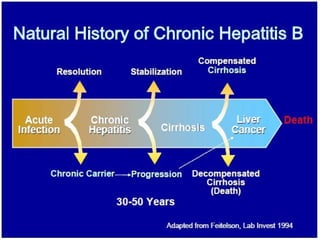
• HBV can lead to cirrhosis and liver cancer.
Introduction
• Hepatitis is an inflammation of the liver.
• It is usually caused by viral & non viral infections also
  due to toxins (alcohol) & drugs (mostly ATT)
• In our setup it maybe due to bacterial infection but
  may be an autoimmune response as well.
• It is characterized by anorexia , jaundice, abdominal
  pain, liver enlargement and sometimes fever.
• Others , usually bacterial infections leading to HV&IVC
  thrombophlebitis, metabolic cause (Wilson disease)
• Congestive causes like ( HVOO,IVC disease , CHF)
• HBV can lead to cirrhosis and liver cancer.
Viral hepatitis
• The different types of viral hepatitis A,E,(virus
  transmitted through the faces of an infected
  person.
• Hepatitis B,C,D are serum hepatitis
• Hepatitis F,G, cryptogenic ( caused by a virus
  as not identified)
• More hepatitis viruses are less common
  yellow fever, epstien barr virus(EBV),
  cytomegalovirus(CMV),
Hepatitis B virus
• HBV is a serious disease ,can cause lifelong
  infection , liver cirrhosis ,liver cancer , and
  liver failure ,death.
• HBV is 100 times more infectious than HIV and
  10 times more infectious than HCV.
• HBV is a blood borne transmitted ( body fluids
  , semen, saliva,vaginal fluid (high titers in the
  blood and lower titer in body fluids)
Hepatitis B virus introductions
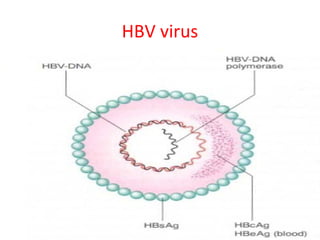
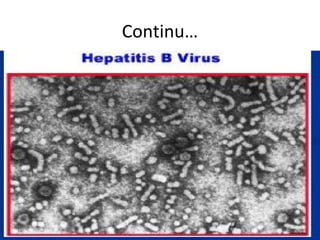
• HBV is a 42 nm,double-shelled DNA virus of
  the class Hepadnaviridae.
• The outer surface membrane contains HBV
  surface antigen (HBsAg) which also circulates
  in blood as 22 nm spherical and tubular
  particles.
HBV virus
Continu…
• The inner core of the virus contains HBV core
  antigen (HBcAg) (HBeAg)
• HBV is a single molecule of partially double –
  stranded DNA, and DNA- dependent DNA
  polymerase.
Continu…
Risk groups
•   1, I/V drug users Health workers
•   2, Multiple sex partners
•   3,Homosexuals
•   4,Infant born to HBV infected mothers
•   5,Hemodialysis patients
•   6, Areas with high rates of HBV infections
•   7,Tatooing
HBV transmitted
• HBV is transmitted by the exchange of blood
  & body fluids ,eg . Blood, semen, breast milk
  ,saliva and vaginal secretor fluids , tears.
Epidemiology
•   Globally
•   50 million new cases per year
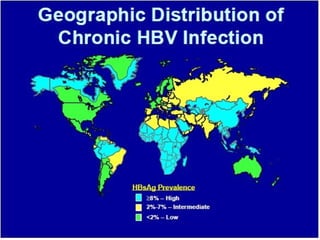
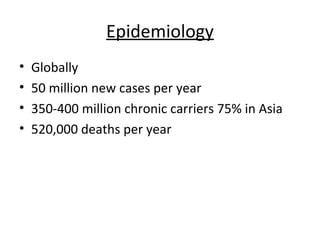
•   350-400 million chronic carriers 75% in Asia
•   520,000 deaths per year
Epidemiology in Nepal
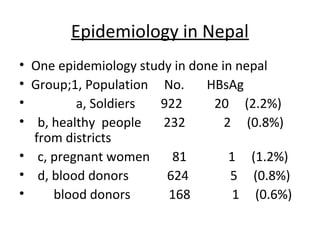
• One epidemiology study in done in nepal
• Group;1, Population No.     HBsAg
•        a, Soldiers  922      20 (2.2%)
• b, healthy people    232        2 (0.8%)
  from districts
• c, pregnant women     81         1 (1.2%)
• d, blood donors      624         5 (0.8%)
•    blood donors       168         1 (0.6%)
Continu…….
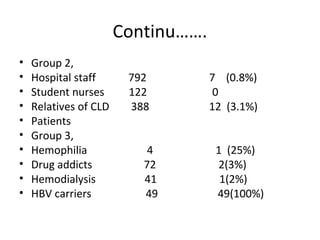
•   Group 2,
•   Hospital staff      792         7 (0.8%)
•   Student nurses      122          0
•   Relatives of CLD    388         12 (3.1%)
•   Patients
•   Group 3,
•   Hemophilia             4         1 (25%)
•   Drug addicts          72         2(3%)
•   Hemodialysis          41          1(2%)
•   HBV carriers          49         49(100%)
Continu…
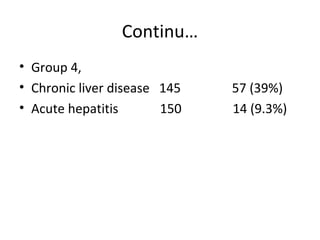
• Group 4,
• Chronic liver disease 145   57 (39%)
• Acute hepatitis       150   14 (9.3%)
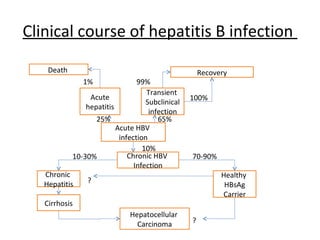
Clinical course of hepatitis B infection

    Death                                             Recovery
               1%                99%
                                    Transient
                 Acute                            100%
                                    Subclinical
                hepatitis
                                     infection
                   25%                  65%
                          Acute HBV
                           infection
                                   10%
            10-30%            Chronic HBV         70-90%
                                Infection
   Chronic                                                  Healthy
   Hepatitis    ?
                                                             HBsAg
                                                            Carrier
   Cirrhosis
                              Hepatocellular
                                Carcinoma         ?
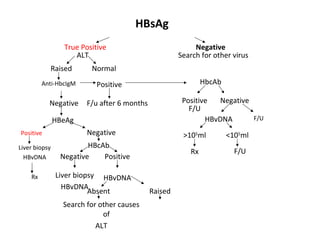
HBsAg
                 True Positive                             Negative
                    ALT                               Search for other virus
           Raised        Normal
         Anti-HbcIgM       Positive                           HbcAb

           Negative     F/u after 6 months             Positive   Negative
                                                         F/U
               HBeAg                                          HBvDNA       F/U

Positive                Negative                       >105ml         <105ml
Liver biopsy            HBcAb
                                                         Rx             F/U
  HBvDNA        Negative    Positive

    Rx         Liver biopsy HBvDNA
                 HBvDNA
                         Absent              Raised
                 Search for other causes
                             of
                           ALT
Infection
• Acute hepatitis B develops in approximately 30% to
  50% of adults at the time of initial infection and is
  characterized by anorexia, nausea , vomiting and
  jaundice.
• SGPT raises 2 ½ times
• The risk of progression to chronic infection varies
  with age , being highest among young children and
  infants (30%-90%) and lowest among adolescents
  and adults (2%-6%).
• Rates of progression to cirrhosis and HCC vary
  according to age at acquisition of chronic
  infections ,HBeAg status , co infection with
  HGV,HIV,HCV, and alcohol abuse.
Clinical features
• The first serologic marker to appear following
  acute infection is HBsAg, which can be
  detected as early as 1 or 2 weeks and as late
  as 11 or 12 weeks (mode 30-60 days) after
  exposure to HBV
• HBeAg is generally detectable in patients with
  acute infections, the presence of HBeAg in
  serum correlates with higher titers of HBV and
  greater infectivity.
Continu….
• A diagnosis of acute HBV infection can be
  made on the basis of the detection of IgM
  class antibody to HBV core antigen (IgM ,anti-
  HBc) in serum ,It is generally detectable at the
  time of clinical onset.
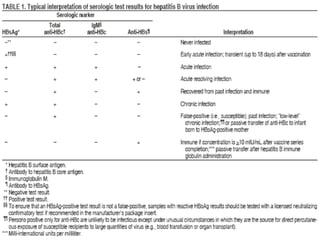
Serological markers ; HBV
• HBsAg: Marker of infection,presence
  >6months=chronic
• HBeAg: active viral replication,
• Anti-HBsAg: indicates recovery and /or
  immunity (after vaccine)
• Anti-Hbe: inactive viral replication
• Anti-HBc: infection or immunity
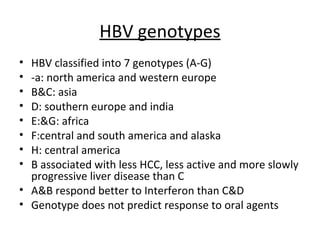
HBV genotypes
• HBV classified into 7 genotypes (A-G)
• -a: north america and western europe
• B&C: asia
• D: southern europe and india
• E:&G: africa
• F:central and south america and alaska
• H: central america
• B associated with less HCC, less active and more slowly
  progressive liver disease than C
• A&B respond better to Interferon than C&D
• Genotype does not predict response to oral agents
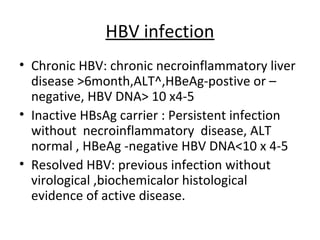
HBV infection
• Chronic HBV: chronic necroinflammatory liver
  disease >6month,ALT^,HBeAg-postive or –
  negative, HBV DNA> 10 x4-5
• Inactive HBsAg carrier : Persistent infection
  without necroinflammatory disease, ALT
  normal , HBeAg -negative HBV DNA<10 x 4-5
• Resolved HBV: previous infection without
  virological ,biochemicalor histological
  evidence of active disease.
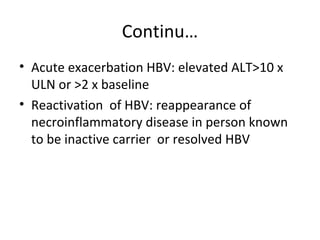
Continu…
• Acute exacerbation HBV: elevated ALT>10 x
  ULN or >2 x baseline
• Reactivation of HBV: reappearance of
  necroinflammatory disease in person known
  to be inactive carrier or resolved HBV
Liver histology ≥


        Phases of chronic HBV
• Immunotolerant phase: HBeAg- postive; HBV
  DNA high (10 x 5-10) ALT normal
                        -candidates for therapy.
Immunoactive phase: HBeAg-postive or HBeAg –
  negative,HBV DNA high (10 x4-10) ,ALT
  elevated, symptoms +/-
Non replicative phase :(inactive HBV carrier)
HBeAg –negative HBV DNA low(<10 x4 ) ALT
  normal, HBsAg may later become undectable.
Routine HBV carriers exam
• Follow-up interval 6 months : Tests : ALT and
  AST; AFP. USG,
• Inactive HBsAg carrier: If ALT/AST increase , re
  evaluate
• Chronic hepatitis B: CBC,LFT,HBeAg, anti-HBe
HBV infected mothers
• Hepatitis B immunoglobulin (HBIG 0.5 ml ,
  I/M to new born.
• Hepatitis B vaccination should have been
  given 12 hours of birth.
Post exposure prophylaxis
• 1, HBIG is required
• 2,the first dose of hepatitis B vaccine
  immediately, 0 – 1 – 6 months.
Hepatitis B vaccine
• The standard regimen for adult is 10-20mcg
  initially ( depending on the formulations ) .
• Schedules; 0 -1 -6 months.
• Alternative schedules have been approved
• 0 -1 -2 -12 months
• 0- 7 and 21 days ,plus 12 months
• Preferred site vaccine deltoid muscles
Treatment of chronic HBV
• Nucleoside/nucleotide analogues:
     - Entecavir : 0.5-1.0 mg/d
•    -Lamivudine : 100 mg/d
•    -Adefovir dipivoxil :10mg/d
•    -Tenoforvir : 300mg/d
• Interferon: interferon alfa-2b 5MU/d or 10MU tiw x 4
  months.
• Peginterferon alfa-2a (Pegasys) 180 mcg/week x 24-48
  weeks.
• Liver transplantation ( decompensated chronic HBV
  with cirrhosis.
Reference
•   Davidson principal and practice of medicine
•   C.M.D.T
•   Oxford hand book of medicine
•   Liver unit, Bir hospital
Thank you
Thank you

Dr kgm hep b

  • 1.
    Hepatitis B virus Dr. K. G. Maharjan Liver unit, Bir hospital
  • 2.
    Introduction • Hepatitis isan inflammation of the liver. • It is usually caused by viral & non viral infections also due to toxins (alcohol) & drugs (mostly ATT) • In our setup it maybe due to bacterial infection but may be an autoimmune response as well. • It is characterized by anorexia , jaundice, abdominal pain, liver enlargement and sometimes fever. • Others , usually bacterial infections leading to HV&IVC thrombophlebitis, metabolic cause (Wilson disease) • Congestive causes like ( HVOO,IVC disease , CHF) • HBV can lead to cirrhosis and liver cancer.
  • 3.
    Introduction • Hepatitis isan inflammation of the liver. • It is usually caused by viral & non viral infections also due to toxins (alcohol) & drugs (mostly ATT) • In our setup it maybe due to bacterial infection but may be an autoimmune response as well. • It is characterized by anorexia , jaundice, abdominal pain, liver enlargement and sometimes fever. • Others , usually bacterial infections leading to HV&IVC thrombophlebitis, metabolic cause (Wilson disease) • Congestive causes like ( HVOO,IVC disease , CHF) • HBV can lead to cirrhosis and liver cancer.
  • 4.
    Viral hepatitis • Thedifferent types of viral hepatitis A,E,(virus transmitted through the faces of an infected person. • Hepatitis B,C,D are serum hepatitis • Hepatitis F,G, cryptogenic ( caused by a virus as not identified) • More hepatitis viruses are less common yellow fever, epstien barr virus(EBV), cytomegalovirus(CMV),
  • 5.
    Hepatitis B virus •HBV is a serious disease ,can cause lifelong infection , liver cirrhosis ,liver cancer , and liver failure ,death. • HBV is 100 times more infectious than HIV and 10 times more infectious than HCV. • HBV is a blood borne transmitted ( body fluids , semen, saliva,vaginal fluid (high titers in the blood and lower titer in body fluids)
  • 6.
    Hepatitis B virusintroductions • HBV is a 42 nm,double-shelled DNA virus of the class Hepadnaviridae. • The outer surface membrane contains HBV surface antigen (HBsAg) which also circulates in blood as 22 nm spherical and tubular particles.
  • 7.
  • 8.
    Continu… • The innercore of the virus contains HBV core antigen (HBcAg) (HBeAg) • HBV is a single molecule of partially double – stranded DNA, and DNA- dependent DNA polymerase.
  • 9.
  • 10.
    Risk groups • 1, I/V drug users Health workers • 2, Multiple sex partners • 3,Homosexuals • 4,Infant born to HBV infected mothers • 5,Hemodialysis patients • 6, Areas with high rates of HBV infections • 7,Tatooing
  • 11.
    HBV transmitted • HBVis transmitted by the exchange of blood & body fluids ,eg . Blood, semen, breast milk ,saliva and vaginal secretor fluids , tears.
  • 13.
    Epidemiology • Globally • 50 million new cases per year • 350-400 million chronic carriers 75% in Asia • 520,000 deaths per year
  • 14.
    Epidemiology in Nepal •One epidemiology study in done in nepal • Group;1, Population No. HBsAg • a, Soldiers 922 20 (2.2%) • b, healthy people 232 2 (0.8%) from districts • c, pregnant women 81 1 (1.2%) • d, blood donors 624 5 (0.8%) • blood donors 168 1 (0.6%)
  • 15.
    Continu……. • Group 2, • Hospital staff 792 7 (0.8%) • Student nurses 122 0 • Relatives of CLD 388 12 (3.1%) • Patients • Group 3, • Hemophilia 4 1 (25%) • Drug addicts 72 2(3%) • Hemodialysis 41 1(2%) • HBV carriers 49 49(100%)
  • 16.
    Continu… • Group 4, •Chronic liver disease 145 57 (39%) • Acute hepatitis 150 14 (9.3%)
  • 18.
    Clinical course ofhepatitis B infection Death Recovery 1% 99% Transient Acute 100% Subclinical hepatitis infection 25% 65% Acute HBV infection 10% 10-30% Chronic HBV 70-90% Infection Chronic Healthy Hepatitis ? HBsAg Carrier Cirrhosis Hepatocellular Carcinoma ?
  • 19.
    HBsAg True Positive Negative ALT Search for other virus Raised Normal Anti-HbcIgM Positive HbcAb Negative F/u after 6 months Positive Negative F/U HBeAg HBvDNA F/U Positive Negative >105ml <105ml Liver biopsy HBcAb Rx F/U HBvDNA Negative Positive Rx Liver biopsy HBvDNA HBvDNA Absent Raised Search for other causes of ALT
  • 20.
    Infection • Acute hepatitisB develops in approximately 30% to 50% of adults at the time of initial infection and is characterized by anorexia, nausea , vomiting and jaundice. • SGPT raises 2 ½ times • The risk of progression to chronic infection varies with age , being highest among young children and infants (30%-90%) and lowest among adolescents and adults (2%-6%). • Rates of progression to cirrhosis and HCC vary according to age at acquisition of chronic infections ,HBeAg status , co infection with HGV,HIV,HCV, and alcohol abuse.
  • 21.
    Clinical features • Thefirst serologic marker to appear following acute infection is HBsAg, which can be detected as early as 1 or 2 weeks and as late as 11 or 12 weeks (mode 30-60 days) after exposure to HBV • HBeAg is generally detectable in patients with acute infections, the presence of HBeAg in serum correlates with higher titers of HBV and greater infectivity.
  • 22.
    Continu…. • A diagnosisof acute HBV infection can be made on the basis of the detection of IgM class antibody to HBV core antigen (IgM ,anti- HBc) in serum ,It is generally detectable at the time of clinical onset.
  • 23.
    Serological markers ;HBV • HBsAg: Marker of infection,presence >6months=chronic • HBeAg: active viral replication, • Anti-HBsAg: indicates recovery and /or immunity (after vaccine) • Anti-Hbe: inactive viral replication • Anti-HBc: infection or immunity
  • 25.
    HBV genotypes • HBVclassified into 7 genotypes (A-G) • -a: north america and western europe • B&C: asia • D: southern europe and india • E:&G: africa • F:central and south america and alaska • H: central america • B associated with less HCC, less active and more slowly progressive liver disease than C • A&B respond better to Interferon than C&D • Genotype does not predict response to oral agents
  • 26.
    HBV infection • ChronicHBV: chronic necroinflammatory liver disease >6month,ALT^,HBeAg-postive or – negative, HBV DNA> 10 x4-5 • Inactive HBsAg carrier : Persistent infection without necroinflammatory disease, ALT normal , HBeAg -negative HBV DNA<10 x 4-5 • Resolved HBV: previous infection without virological ,biochemicalor histological evidence of active disease.
  • 27.
    Continu… • Acute exacerbationHBV: elevated ALT>10 x ULN or >2 x baseline • Reactivation of HBV: reappearance of necroinflammatory disease in person known to be inactive carrier or resolved HBV
  • 28.
    Liver histology ≥ Phases of chronic HBV • Immunotolerant phase: HBeAg- postive; HBV DNA high (10 x 5-10) ALT normal -candidates for therapy. Immunoactive phase: HBeAg-postive or HBeAg – negative,HBV DNA high (10 x4-10) ,ALT elevated, symptoms +/- Non replicative phase :(inactive HBV carrier) HBeAg –negative HBV DNA low(<10 x4 ) ALT normal, HBsAg may later become undectable.
  • 29.
    Routine HBV carriersexam • Follow-up interval 6 months : Tests : ALT and AST; AFP. USG, • Inactive HBsAg carrier: If ALT/AST increase , re evaluate • Chronic hepatitis B: CBC,LFT,HBeAg, anti-HBe
  • 30.
    HBV infected mothers •Hepatitis B immunoglobulin (HBIG 0.5 ml , I/M to new born. • Hepatitis B vaccination should have been given 12 hours of birth.
  • 31.
    Post exposure prophylaxis •1, HBIG is required • 2,the first dose of hepatitis B vaccine immediately, 0 – 1 – 6 months.
  • 32.
    Hepatitis B vaccine •The standard regimen for adult is 10-20mcg initially ( depending on the formulations ) . • Schedules; 0 -1 -6 months. • Alternative schedules have been approved • 0 -1 -2 -12 months • 0- 7 and 21 days ,plus 12 months • Preferred site vaccine deltoid muscles
  • 33.
    Treatment of chronicHBV • Nucleoside/nucleotide analogues: - Entecavir : 0.5-1.0 mg/d • -Lamivudine : 100 mg/d • -Adefovir dipivoxil :10mg/d • -Tenoforvir : 300mg/d • Interferon: interferon alfa-2b 5MU/d or 10MU tiw x 4 months. • Peginterferon alfa-2a (Pegasys) 180 mcg/week x 24-48 weeks. • Liver transplantation ( decompensated chronic HBV with cirrhosis.
  • 34.
    Reference • Davidson principal and practice of medicine • C.M.D.T • Oxford hand book of medicine • Liver unit, Bir hospital
  • 35.