C.H.B.
OPTIMAL PREVENTION
OF
POST–TRANSPLANTATION HBV RECURRENCE
Professor Didier SAMUEL
Centre Hépatobiliaire
Inserm Research Unit-Paris Sud 785
Hopital Paul Brousse
Université Paris Sud
Villejuif, France
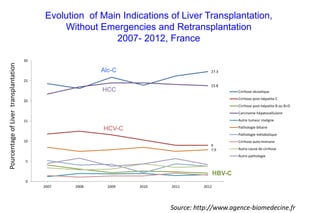
Evolution of Main Indications of Liver Transplantation,
Without Emergencies and Retransplantation
2007- 2012, France
Source: http://www.agence-biomedecine.fr
27.3
9
23.8
7.9
0
5
10
15
20
25
30
2007 2008 2009 2010 2011 2012
Cirrhose alcoolique
Cirrhose post-hépatite C
Cirrhose post-hépatite B ou B+D
Carcinome hépatocellulaire
Autre tumeur maligne
Pathologie biliaire
Pathologie métabolique
Cirrhose auto-immune
Autre cause de cirrhose
Autre pathologie
PourcentageofLivertransplantation
Alc-C
HCC
HCV-C
HBV-C
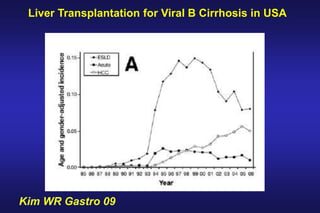
Liver Transplantation for Viral B Cirrhosis in USA
Kim WR Gastro 09
0.0% 0.1% 0.2% 0.1% 0.2% 0.6% 0.8% 1.0% 1.2% 1.0%
1.9%
5%
6% 5%
4%
5% 5% 5% 5% 5% 5% 6%
7% 7% 6%
7% 7% 6% 6%
7%
6% 6% 6%
12% 13% 13% 12%
10% 9% 9%
8% 8% 8% 8%
19%
20% 20%
19%
18% 18% 18%
17% 16%
17% 17%
19% 19%
20%
23%
26% 26%
29% 28%
27%
27%
25%
37%
35% 35%
34%
35% 35%
33%
34%
36% 36%
37%
0.0%
5.0%
10.0%
15.0%
20.0%
25.0%
30.0%
35.0%
40.0%
2003 2004 2005 2006 2007 2008 2009 2010 2011 2012 2013
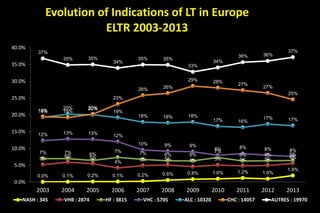
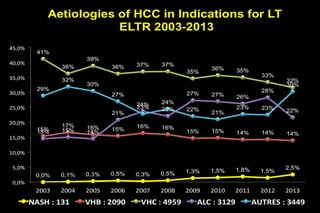
Evolution of Indications of LT in Europe
ELTR 2003-2013
NASH : 345 VHB : 2874 HF : 3815 VHC : 5705 ALC : 10320 CHC : 14057 AUTRES : 19970
C.H.B.
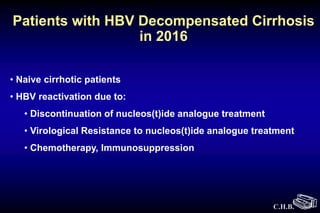
Patients with HBV Decompensated Cirrhosis
in 2016
• Naive cirrhotic patients
• HBV reactivation due to:
• Discontinuation of nucleos(t)ide analogue treatment
• Virological Resistance to nucleos(t)ide analogue treatment
• Chemotherapy, Immunosuppression
C.H.B.
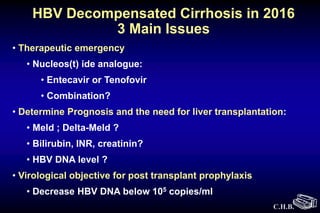
HBV Decompensated Cirrhosis in 2016
3 Main Issues
• Therapeutic emergency
• Nucleos(t) ide analogue:
• Entecavir or Tenofovir
• Combination?
• Determine Prognosis and the need for liver transplantation:
• Meld ; Delta-Meld ?
• Bilirubin, INR, creatinin?
• HBV DNA level ?
• Virological objective for post transplant prophylaxis
• Decrease HBV DNA below 105 copies/ml
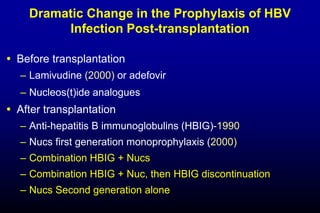
Dramatic Change in the Prophylaxis of HBV
Infection Post-transplantation
 Before transplantation
– Lamivudine (2000) or adefovir
– Nucleos(t)ide analogues
 After transplantation
– Anti-hepatitis B immunoglobulins (HBIG)-1990
– Nucs first generation monoprophylaxis (2000)
– Combination HBIG + Nucs
– Combination HBIG + Nuc, then HBIG discontinuation
– Nucs Second generation alone
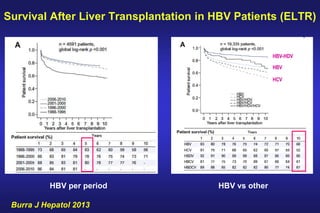
Burra J Hepatol 2013
Survival After Liver Transplantation in HBV Patients (ELTR)
HBV vs otherHBV per period
HBV-HDV
HBV
HCV
C.H.B.
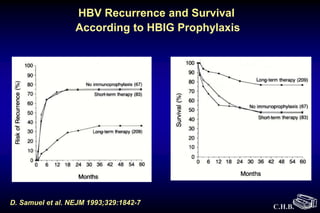
D. Samuel et al. NEJM 1993;329:1842-7
HBV Recurrence and Survival
According to HBIG Prophylaxis
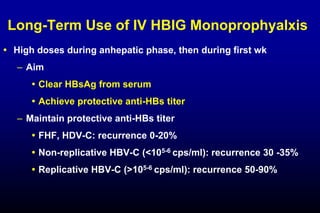
Long-Term Use of IV HBIG Monoprophyalxis
 High doses during anhepatic phase, then during first wk
– Aim
 Clear HBsAg from serum
 Achieve protective anti-HBs titer
– Maintain protective anti-HBs titer
 FHF, HDV-C: recurrence 0-20%
 Non-replicative HBV-C (<105-6 cps/ml): recurrence 30 -35%
 Replicative HBV-C (>105-6 cps/ml): recurrence 50-90%
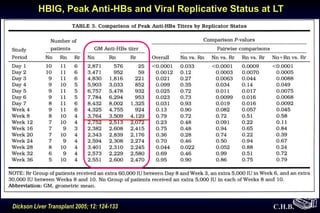
C.H.B.Dickson Liver Transplant 2005; 12: 124-133
HBIG, Peak Anti-HBs and Viral Replicative Status at LT
Monoprophylaxis With Nuc
Lamivudine
 Some patients remained HBsAg positive after liver transplant
 Progressive decline of HBsAg1
 Rate of HBV reinfection
– Related to HBV DNA level before liver transplant
– Related to treatment duration
– Increase with time post-transplant
 HBV reinfection due to YMDD HBV mutant
 Question of long-term compliance and risk of reinfection
1. Grellier L et al. Lancet. 1996;348:1212 [published correction in Lancet. 1997;349:364]
Monoprophylaxis With Nuc
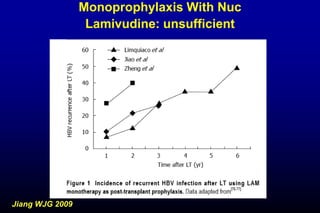
Lamivudine: unsufficient
Jiang WJG 2009
Monoprophylaxis With Nuc
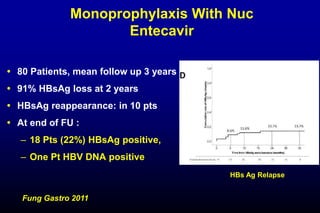
Entecavir
 80 Patients, mean follow up 3 years
 91% HBsAg loss at 2 years
 HBsAg reappearance: in 10 pts
 At end of FU :
– 18 Pts (22%) HBsAg positive,
– One Pt HBV DNA positive
Fung Gastro 2011
HBs Ag Relapse
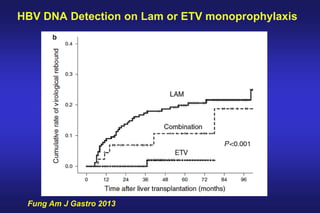
Fung Am J Gastro 2013
HBV DNA Detection on Lam or ETV monoprophylaxis
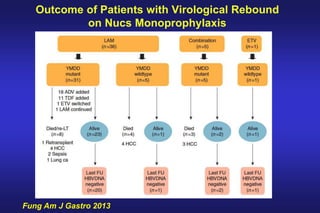
Fung Am J Gastro 2013
Outcome of Patients with Virological Rebound
on Nucs Monoprophylaxis
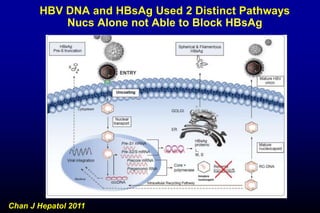
HBV DNA and HBsAg Used 2 Distinct Pathways
Nucs Alone not Able to Block HBsAg
Chan J Hepatol 2011
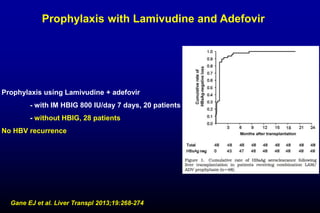
Prophylaxis using Lamivudine + adefovir
- with IM HBIG 800 IU/day 7 days, 20 patients
- without HBIG, 28 patients
No HBV recurrence
Prophylaxis with Lamivudine and Adefovir
Gane EJ et al. Liver Transpl 2013;19:268-274
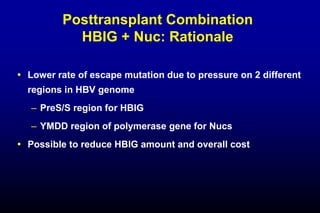
Posttransplant Combination
HBIG + Nuc: Rationale
 Lower rate of escape mutation due to pressure on 2 different
regions in HBV genome
– PreS/S region for HBIG
– YMDD region of polymerase gene for Nucs
 Possible to reduce HBIG amount and overall cost
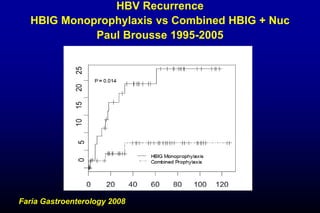
HBV Recurrence
HBIG Monoprophylaxis vs Combined HBIG + Nuc
Paul Brousse 1995-2005
Faria Gastroenterology 2008
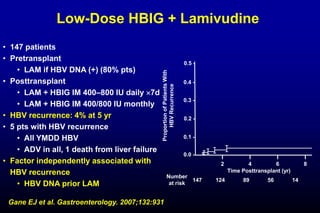
Low-Dose HBIG + Lamivudine
• 147 patients
• Pretransplant
• LAM if HBV DNA (+) (80% pts)
• Posttransplant
• LAM + HBIG IM 400–800 IU daily 7d
• LAM + HBIG IM 400/800 IU monthly
• HBV recurrence: 4% at 5 yr
• 5 pts with HBV recurrence
• All YMDD HBV
• ADV in all, 1 death from liver failure
• Factor independently associated with
HBV recurrence
• HBV DNA prior LAM
Gane EJ et al. Gastroenterology. 2007;132:931
0.5 -
0.4 -
0.3 -
0.2 -
0.1 -
0.0 - I
2
I
4
I
6
I
8ProportionofPatientsWith
HBVRecurrence
Number
at risk
147 124 89 56 14
Time Posttransplant (yr)
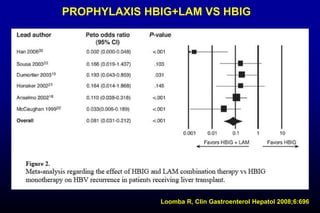
PROPHYLAXIS HBIG+LAM VS HBIG
Loomba R, Clin Gastroenterol Hepatol 2008;6:696
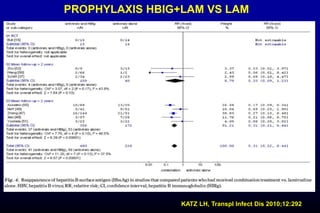
PROPHYLAXIS HBIG+LAM VS LAM
KATZ LH, Transpl Infect Dis 2010;12:292
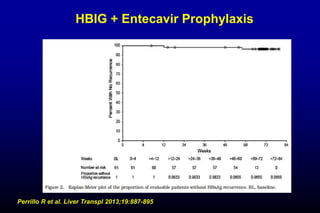
HBIG + Entecavir Prophylaxis
Perrillo R et al. Liver Transpl 2013;19:887-895
C.H.B.
Risk Factors of HBV Reinfection
Liver Transplantation
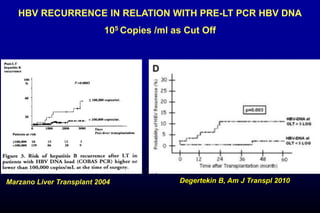
Marzano Liver Transplant 2004
HBV RECURRENCE IN RELATION WITH PRE-LT PCR HBV DNA
105 Copies /ml as Cut Off
Degertekin B, Am J Transpl 2010
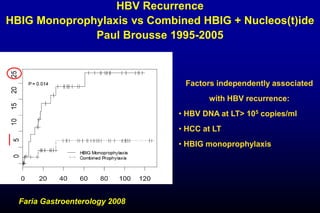
HBV Recurrence
HBIG Monoprophylaxis vs Combined HBIG + Nucleos(t)ide
Paul Brousse 1995-2005
Faria Gastroenterology 2008
Factors independently associated
with HBV recurrence:
• HBV DNA at LT> 105 copies/ml
• HCC at LT
• HBIG monoprophylaxis
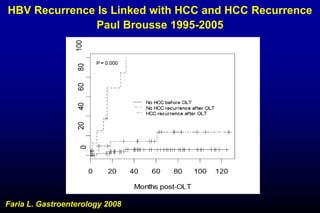
HBV Recurrence Is Linked with HCC and HCC Recurrence
Paul Brousse 1995-2005
Faria L. Gastroenterology 2008
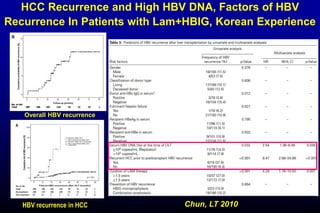
HCC Recurrence and High HBV DNA, Factors of HBV
Recurrence In Patients with Lam+HBIG, Korean Experience
Chun, LT 2010
Overall HBV recurrence
HBV recurrence in HCC
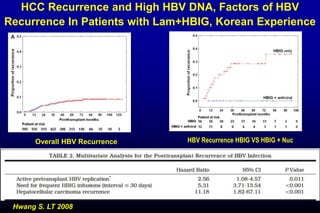
HCC Recurrence and High HBV DNA, Factors of HBV
Recurrence In Patients with Lam+HBIG, Korean Experience
Overall HBV Recurrence HBV Recurrence HBIG VS HBIG + Nuc
Hwang S. LT 2008
Place of HBIG in Combination Protocol?
 HBIG at start is essential
– Immediately makes HBsAg negative
– Protects graft from immediate reinfection
– Dose related to HBV DNA level at liver transplant
 At Medium term
 Lower doses can be used
 Anti-HBsAb Level of 50-100 IU protective
 IM monthly or SC/week HBIG as effective
 Possibility of discontinuation in favourable cases
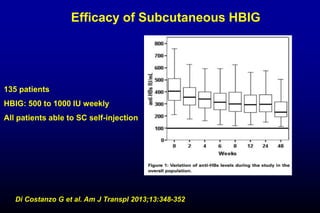
Efficacy of Subcutaneous HBIG
135 patients
HBIG: 500 to 1000 IU weekly
All patients able to SC self-injection
Di Costanzo G et al. Am J Transpl 2013;13:348-352
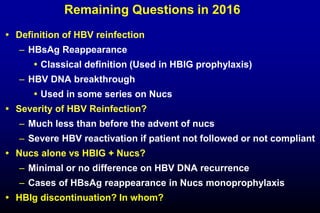
Remaining Questions in 2016
 Definition of HBV reinfection
– HBsAg Reappearance
 Classical definition (Used in HBIG prophylaxis)
– HBV DNA breakthrough
 Used in some series on Nucs
 Severity of HBV Reinfection?
– Much less than before the advent of nucs
– Severe HBV reactivation if patient not followed or not compliant
 Nucs alone vs HBIG + Nucs?
– Minimal or no difference on HBV DNA recurrence
– Cases of HBsAg reappearance in Nucs monoprophylaxis
 HBIg discontinuation? In whom?
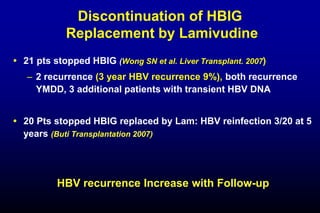
Discontinuation of HBIG
Replacement by Lamivudine
 21 pts stopped HBIG (Wong SN et al. Liver Transplant. 2007)
– 2 recurrence (3 year HBV recurrence 9%), both recurrence
YMDD, 3 additional patients with transient HBV DNA
 20 Pts stopped HBIG replaced by Lam: HBV reinfection 3/20 at 5
years (Buti Transplantation 2007)
HBV recurrence Increase with Follow-up
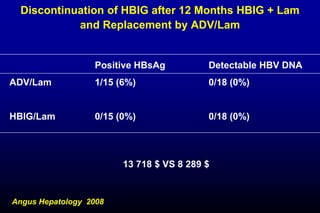
Discontinuation of HBIG after 12 Months HBIG + Lam
and Replacement by ADV/Lam
Angus Hepatology 2008
13 718 $ VS 8 289 $
Positive HBsAg Detectable HBV DNA
ADV/Lam 1/15 (6%) 0/18 (0%)
HBIG/Lam 0/15 (0%) 0/18 (0%)
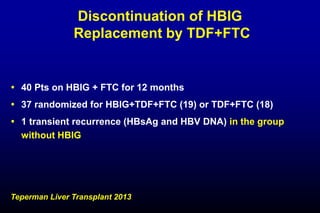
Discontinuation of HBIG
Replacement by TDF+FTC
 40 Pts on HBIG + FTC for 12 months
 37 randomized for HBIG+TDF+FTC (19) or TDF+FTC (18)
 1 transient recurrence (HBsAg and HBV DNA) in the group
without HBIG
Teperman Liver Transplant 2013
Vaccine After Transplantation
 Great discordance in results
– Good Results dependent of the adjuvant or Pre S vaccine
 ( none commercialised)
– Durability of response?
– Tolerance and reproducibility of results
– Response probably more frequent in FHB patients
(spontaneous seroconversion boosted by vaccine?)
 How to identify patients susceptible to respond to vaccine?
NOT READY TO REPLACE HBIG
Lenci I. J Hepatol 2011
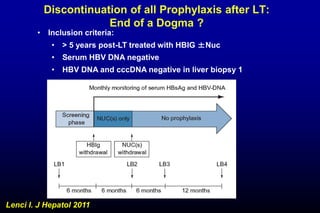
Discontinuation of all Prophylaxis after LT:
End of a Dogma ?
• Inclusion criteria:
• > 5 years post-LT treated with HBIG ±Nuc
• Serum HBV DNA negative
• HBV DNA and cccDNA negative in liver biopsy 1
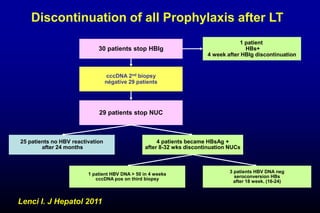
Discontinuation of all Prophylaxis after LT
30 patients stop HBIg
cccDNA 2nd biopsy
négative 29 patients
29 patients stop NUC
1 patient
HBs+
4 week after HBIg discontinuation
25 patients no HBV reactivation
after 24 months
4 patients became HBsAg +
after 8-32 wks discontinuation NUCs
1 patient HBV DNA > 50 in 4 weeks
cccDNA pos on third biopsy
3 patients HBV DNA neg
seroconversion HBs
after 18 week. (16-24)
Lenci I. J Hepatol 2011
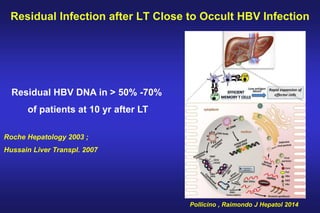
Residual Infection after LT Close to Occult HBV Infection
Pollicino , Raimondo J Hepatol 2014
Residual HBV DNA in > 50% -70%
of patients at 10 yr after LT
Roche Hepatology 2003 ;
Hussain Liver Transpl. 2007
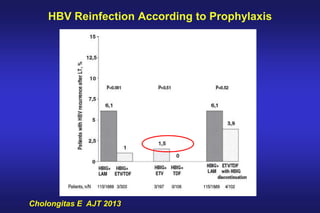
Cholongitas E AJT 2013
HBV Reinfection According to Prophylaxis
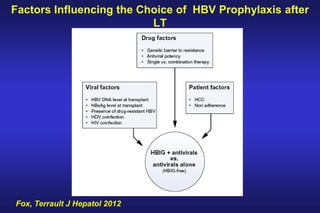
Fox, Terrault J Hepatol 2012
Factors Influencing the Choice of HBV Prophylaxis after
LT
Conclusion
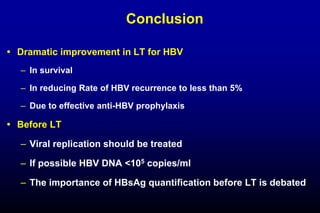
 Dramatic improvement in LT for HBV
– In survival
– In reducing Rate of HBV recurrence to less than 5%
– Due to effective anti-HBV prophylaxis
 Before LT
– Viral replication should be treated
– If possible HBV DNA <105 copies/ml
– The importance of HBsAg quantification before LT is debated
Conclusion
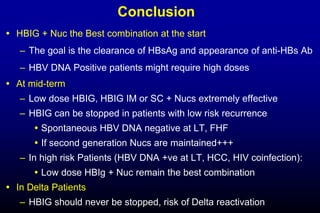
 HBIG + Nuc the Best combination at the start
– The goal is the clearance of HBsAg and appearance of anti-HBs Ab
– HBV DNA Positive patients might require high doses
 At mid-term
– Low dose HBIG, HBIG IM or SC + Nucs extremely effective
– HBIG can be stopped in patients with low risk recurrence
 Spontaneous HBV DNA negative at LT, FHF
 If second generation Nucs are maintained+++
– In high risk Patients (HBV DNA +ve at LT, HCC, HIV coinfection):
 Low dose HBIg + Nuc remain the best combination
 In Delta Patients
– HBIG should never be stopped, risk of Delta reactivation

Samuel1 hbv lt du16

  • 1.
    C.H.B. OPTIMAL PREVENTION OF POST–TRANSPLANTATION HBVRECURRENCE Professor Didier SAMUEL Centre Hépatobiliaire Inserm Research Unit-Paris Sud 785 Hopital Paul Brousse Université Paris Sud Villejuif, France
  • 2.
    Evolution of MainIndications of Liver Transplantation, Without Emergencies and Retransplantation 2007- 2012, France Source: http://www.agence-biomedecine.fr 27.3 9 23.8 7.9 0 5 10 15 20 25 30 2007 2008 2009 2010 2011 2012 Cirrhose alcoolique Cirrhose post-hépatite C Cirrhose post-hépatite B ou B+D Carcinome hépatocellulaire Autre tumeur maligne Pathologie biliaire Pathologie métabolique Cirrhose auto-immune Autre cause de cirrhose Autre pathologie PourcentageofLivertransplantation Alc-C HCC HCV-C HBV-C
  • 3.
    Liver Transplantation forViral B Cirrhosis in USA Kim WR Gastro 09
  • 4.
    0.0% 0.1% 0.2%0.1% 0.2% 0.6% 0.8% 1.0% 1.2% 1.0% 1.9% 5% 6% 5% 4% 5% 5% 5% 5% 5% 5% 6% 7% 7% 6% 7% 7% 6% 6% 7% 6% 6% 6% 12% 13% 13% 12% 10% 9% 9% 8% 8% 8% 8% 19% 20% 20% 19% 18% 18% 18% 17% 16% 17% 17% 19% 19% 20% 23% 26% 26% 29% 28% 27% 27% 25% 37% 35% 35% 34% 35% 35% 33% 34% 36% 36% 37% 0.0% 5.0% 10.0% 15.0% 20.0% 25.0% 30.0% 35.0% 40.0% 2003 2004 2005 2006 2007 2008 2009 2010 2011 2012 2013 Evolution of Indications of LT in Europe ELTR 2003-2013 NASH : 345 VHB : 2874 HF : 3815 VHC : 5705 ALC : 10320 CHC : 14057 AUTRES : 19970
  • 6.
    C.H.B. Patients with HBVDecompensated Cirrhosis in 2016 • Naive cirrhotic patients • HBV reactivation due to: • Discontinuation of nucleos(t)ide analogue treatment • Virological Resistance to nucleos(t)ide analogue treatment • Chemotherapy, Immunosuppression
  • 7.
    C.H.B. HBV Decompensated Cirrhosisin 2016 3 Main Issues • Therapeutic emergency • Nucleos(t) ide analogue: • Entecavir or Tenofovir • Combination? • Determine Prognosis and the need for liver transplantation: • Meld ; Delta-Meld ? • Bilirubin, INR, creatinin? • HBV DNA level ? • Virological objective for post transplant prophylaxis • Decrease HBV DNA below 105 copies/ml
  • 8.
    Dramatic Change inthe Prophylaxis of HBV Infection Post-transplantation  Before transplantation – Lamivudine (2000) or adefovir – Nucleos(t)ide analogues  After transplantation – Anti-hepatitis B immunoglobulins (HBIG)-1990 – Nucs first generation monoprophylaxis (2000) – Combination HBIG + Nucs – Combination HBIG + Nuc, then HBIG discontinuation – Nucs Second generation alone
  • 9.
    Burra J Hepatol2013 Survival After Liver Transplantation in HBV Patients (ELTR) HBV vs otherHBV per period HBV-HDV HBV HCV
  • 10.
    C.H.B. D. Samuel etal. NEJM 1993;329:1842-7 HBV Recurrence and Survival According to HBIG Prophylaxis
  • 11.
    Long-Term Use ofIV HBIG Monoprophyalxis  High doses during anhepatic phase, then during first wk – Aim  Clear HBsAg from serum  Achieve protective anti-HBs titer – Maintain protective anti-HBs titer  FHF, HDV-C: recurrence 0-20%  Non-replicative HBV-C (<105-6 cps/ml): recurrence 30 -35%  Replicative HBV-C (>105-6 cps/ml): recurrence 50-90%
  • 12.
    C.H.B.Dickson Liver Transplant2005; 12: 124-133 HBIG, Peak Anti-HBs and Viral Replicative Status at LT
  • 13.
    Monoprophylaxis With Nuc Lamivudine Some patients remained HBsAg positive after liver transplant  Progressive decline of HBsAg1  Rate of HBV reinfection – Related to HBV DNA level before liver transplant – Related to treatment duration – Increase with time post-transplant  HBV reinfection due to YMDD HBV mutant  Question of long-term compliance and risk of reinfection 1. Grellier L et al. Lancet. 1996;348:1212 [published correction in Lancet. 1997;349:364]
  • 14.
    Monoprophylaxis With Nuc Lamivudine:unsufficient Jiang WJG 2009
  • 15.
    Monoprophylaxis With Nuc Entecavir 80 Patients, mean follow up 3 years  91% HBsAg loss at 2 years  HBsAg reappearance: in 10 pts  At end of FU : – 18 Pts (22%) HBsAg positive, – One Pt HBV DNA positive Fung Gastro 2011 HBs Ag Relapse
  • 16.
    Fung Am JGastro 2013 HBV DNA Detection on Lam or ETV monoprophylaxis
  • 17.
    Fung Am JGastro 2013 Outcome of Patients with Virological Rebound on Nucs Monoprophylaxis
  • 18.
    HBV DNA andHBsAg Used 2 Distinct Pathways Nucs Alone not Able to Block HBsAg Chan J Hepatol 2011
  • 19.
    Prophylaxis using Lamivudine+ adefovir - with IM HBIG 800 IU/day 7 days, 20 patients - without HBIG, 28 patients No HBV recurrence Prophylaxis with Lamivudine and Adefovir Gane EJ et al. Liver Transpl 2013;19:268-274
  • 20.
    Posttransplant Combination HBIG +Nuc: Rationale  Lower rate of escape mutation due to pressure on 2 different regions in HBV genome – PreS/S region for HBIG – YMDD region of polymerase gene for Nucs  Possible to reduce HBIG amount and overall cost
  • 21.
    HBV Recurrence HBIG Monoprophylaxisvs Combined HBIG + Nuc Paul Brousse 1995-2005 Faria Gastroenterology 2008
  • 22.
    Low-Dose HBIG +Lamivudine • 147 patients • Pretransplant • LAM if HBV DNA (+) (80% pts) • Posttransplant • LAM + HBIG IM 400–800 IU daily 7d • LAM + HBIG IM 400/800 IU monthly • HBV recurrence: 4% at 5 yr • 5 pts with HBV recurrence • All YMDD HBV • ADV in all, 1 death from liver failure • Factor independently associated with HBV recurrence • HBV DNA prior LAM Gane EJ et al. Gastroenterology. 2007;132:931 0.5 - 0.4 - 0.3 - 0.2 - 0.1 - 0.0 - I 2 I 4 I 6 I 8ProportionofPatientsWith HBVRecurrence Number at risk 147 124 89 56 14 Time Posttransplant (yr)
  • 23.
    PROPHYLAXIS HBIG+LAM VSHBIG Loomba R, Clin Gastroenterol Hepatol 2008;6:696
  • 24.
    PROPHYLAXIS HBIG+LAM VSLAM KATZ LH, Transpl Infect Dis 2010;12:292
  • 25.
    HBIG + EntecavirProphylaxis Perrillo R et al. Liver Transpl 2013;19:887-895
  • 26.
    C.H.B. Risk Factors ofHBV Reinfection Liver Transplantation
  • 27.
    Marzano Liver Transplant2004 HBV RECURRENCE IN RELATION WITH PRE-LT PCR HBV DNA 105 Copies /ml as Cut Off Degertekin B, Am J Transpl 2010
  • 28.
    HBV Recurrence HBIG Monoprophylaxisvs Combined HBIG + Nucleos(t)ide Paul Brousse 1995-2005 Faria Gastroenterology 2008 Factors independently associated with HBV recurrence: • HBV DNA at LT> 105 copies/ml • HCC at LT • HBIG monoprophylaxis
  • 29.
    HBV Recurrence IsLinked with HCC and HCC Recurrence Paul Brousse 1995-2005 Faria L. Gastroenterology 2008
  • 30.
    HCC Recurrence andHigh HBV DNA, Factors of HBV Recurrence In Patients with Lam+HBIG, Korean Experience Chun, LT 2010 Overall HBV recurrence HBV recurrence in HCC
  • 31.
    HCC Recurrence andHigh HBV DNA, Factors of HBV Recurrence In Patients with Lam+HBIG, Korean Experience Overall HBV Recurrence HBV Recurrence HBIG VS HBIG + Nuc Hwang S. LT 2008
  • 32.
    Place of HBIGin Combination Protocol?  HBIG at start is essential – Immediately makes HBsAg negative – Protects graft from immediate reinfection – Dose related to HBV DNA level at liver transplant  At Medium term  Lower doses can be used  Anti-HBsAb Level of 50-100 IU protective  IM monthly or SC/week HBIG as effective  Possibility of discontinuation in favourable cases
  • 33.
    Efficacy of SubcutaneousHBIG 135 patients HBIG: 500 to 1000 IU weekly All patients able to SC self-injection Di Costanzo G et al. Am J Transpl 2013;13:348-352
  • 34.
    Remaining Questions in2016  Definition of HBV reinfection – HBsAg Reappearance  Classical definition (Used in HBIG prophylaxis) – HBV DNA breakthrough  Used in some series on Nucs  Severity of HBV Reinfection? – Much less than before the advent of nucs – Severe HBV reactivation if patient not followed or not compliant  Nucs alone vs HBIG + Nucs? – Minimal or no difference on HBV DNA recurrence – Cases of HBsAg reappearance in Nucs monoprophylaxis  HBIg discontinuation? In whom?
  • 35.
    Discontinuation of HBIG Replacementby Lamivudine  21 pts stopped HBIG (Wong SN et al. Liver Transplant. 2007) – 2 recurrence (3 year HBV recurrence 9%), both recurrence YMDD, 3 additional patients with transient HBV DNA  20 Pts stopped HBIG replaced by Lam: HBV reinfection 3/20 at 5 years (Buti Transplantation 2007) HBV recurrence Increase with Follow-up
  • 36.
    Discontinuation of HBIGafter 12 Months HBIG + Lam and Replacement by ADV/Lam Angus Hepatology 2008 13 718 $ VS 8 289 $ Positive HBsAg Detectable HBV DNA ADV/Lam 1/15 (6%) 0/18 (0%) HBIG/Lam 0/15 (0%) 0/18 (0%)
  • 37.
    Discontinuation of HBIG Replacementby TDF+FTC  40 Pts on HBIG + FTC for 12 months  37 randomized for HBIG+TDF+FTC (19) or TDF+FTC (18)  1 transient recurrence (HBsAg and HBV DNA) in the group without HBIG Teperman Liver Transplant 2013
  • 38.
    Vaccine After Transplantation Great discordance in results – Good Results dependent of the adjuvant or Pre S vaccine  ( none commercialised) – Durability of response? – Tolerance and reproducibility of results – Response probably more frequent in FHB patients (spontaneous seroconversion boosted by vaccine?)  How to identify patients susceptible to respond to vaccine? NOT READY TO REPLACE HBIG
  • 39.
    Lenci I. JHepatol 2011 Discontinuation of all Prophylaxis after LT: End of a Dogma ? • Inclusion criteria: • > 5 years post-LT treated with HBIG ±Nuc • Serum HBV DNA negative • HBV DNA and cccDNA negative in liver biopsy 1
  • 40.
    Discontinuation of allProphylaxis after LT 30 patients stop HBIg cccDNA 2nd biopsy négative 29 patients 29 patients stop NUC 1 patient HBs+ 4 week after HBIg discontinuation 25 patients no HBV reactivation after 24 months 4 patients became HBsAg + after 8-32 wks discontinuation NUCs 1 patient HBV DNA > 50 in 4 weeks cccDNA pos on third biopsy 3 patients HBV DNA neg seroconversion HBs after 18 week. (16-24) Lenci I. J Hepatol 2011
  • 41.
    Residual Infection afterLT Close to Occult HBV Infection Pollicino , Raimondo J Hepatol 2014 Residual HBV DNA in > 50% -70% of patients at 10 yr after LT Roche Hepatology 2003 ; Hussain Liver Transpl. 2007
  • 42.
    Cholongitas E AJT2013 HBV Reinfection According to Prophylaxis
  • 43.
    Fox, Terrault JHepatol 2012 Factors Influencing the Choice of HBV Prophylaxis after LT
  • 44.
    Conclusion  Dramatic improvementin LT for HBV – In survival – In reducing Rate of HBV recurrence to less than 5% – Due to effective anti-HBV prophylaxis  Before LT – Viral replication should be treated – If possible HBV DNA <105 copies/ml – The importance of HBsAg quantification before LT is debated
  • 45.
    Conclusion  HBIG +Nuc the Best combination at the start – The goal is the clearance of HBsAg and appearance of anti-HBs Ab – HBV DNA Positive patients might require high doses  At mid-term – Low dose HBIG, HBIG IM or SC + Nucs extremely effective – HBIG can be stopped in patients with low risk recurrence  Spontaneous HBV DNA negative at LT, FHF  If second generation Nucs are maintained+++ – In high risk Patients (HBV DNA +ve at LT, HCC, HIV coinfection):  Low dose HBIg + Nuc remain the best combination  In Delta Patients – HBIG should never be stopped, risk of Delta reactivation