Zero-knowledge proofs security, in practice
JP Aumasson


@veorq


CSO @ taurushq.com
NIZK arguments security, in practice
JP Aumasson


@veorq


CSO @ taurushq.com
This talk
Focus on zkSNARKs, a class of NIZK arguments


Fully succinct = O(1) proof size and O(circuit size) veri
fi
cation time


Based on my experience looking for bugs in systems using


Groth16, used in Zcash, Filecoin, and many others


Marlin, a universal zkSNARK, used in Aleo


Most of the content applies to other systems (Plonk, SONIC, etc.) and STARKs
3
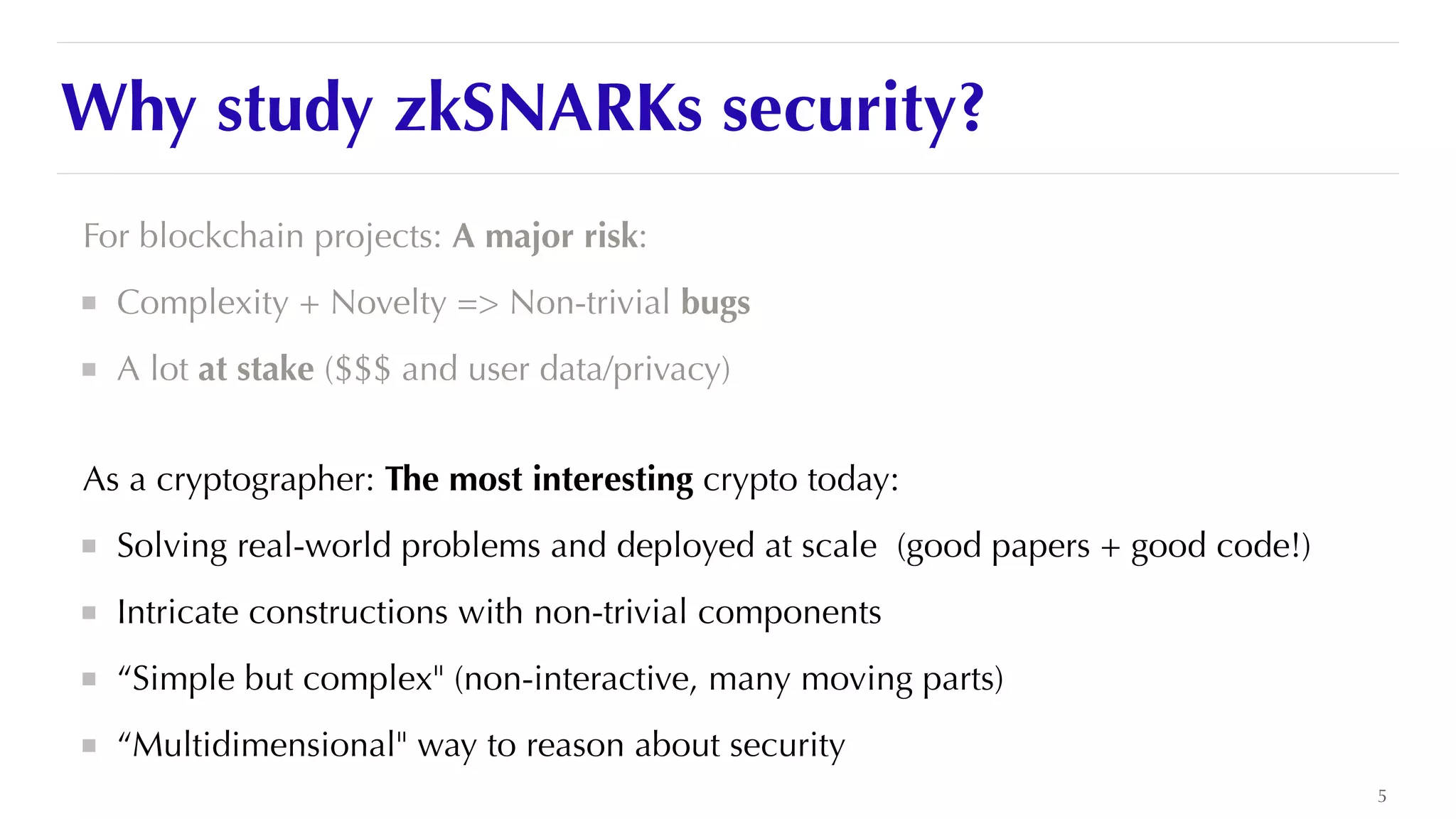
Why study zkSNARKs security?
For blockchain projects: A major risk:


Complexity + Novelty => Non-trivial bugs


A lot at stake ($$$ and user data/privacy)


4
Why study zkSNARKs security?
For blockchain projects: A major risk:


Complexity + Novelty => Non-trivial bugs


A lot at stake ($$$ and user data/privacy)


As a cryptographer: The most interesting crypto today:


Solving real-world problems and deployed at scale (good papers + good code!)


Intricate constructions with non-trivial components


“Simple but complex" (non-interactive, many moving parts)


“Multidimensional" way to reason about security
5
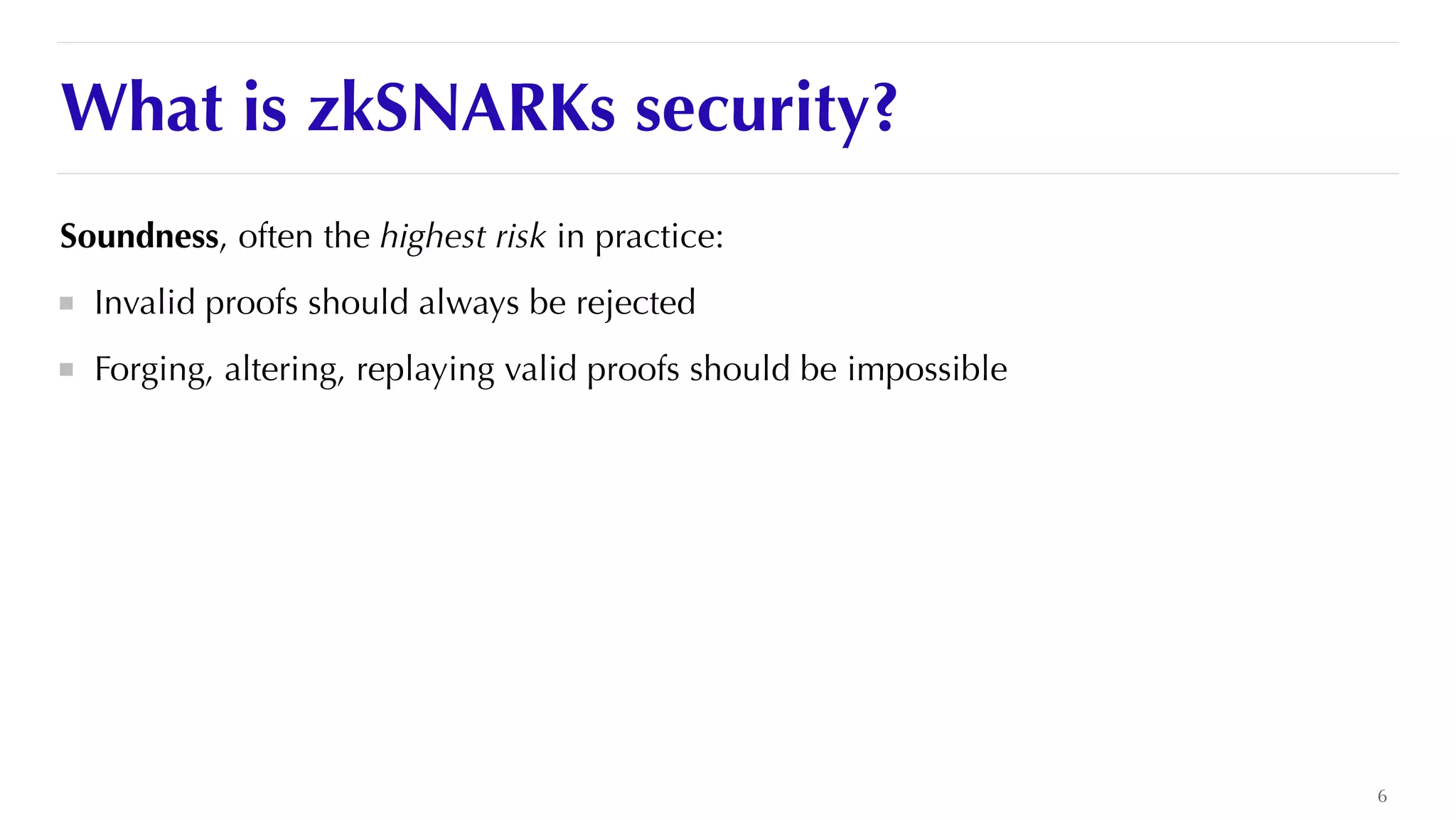
What is zkSNARKs security?
Soundness, often the highest risk in practice:


Invalid proofs should always be rejected


Forging, altering, replaying valid proofs should be impossible


6
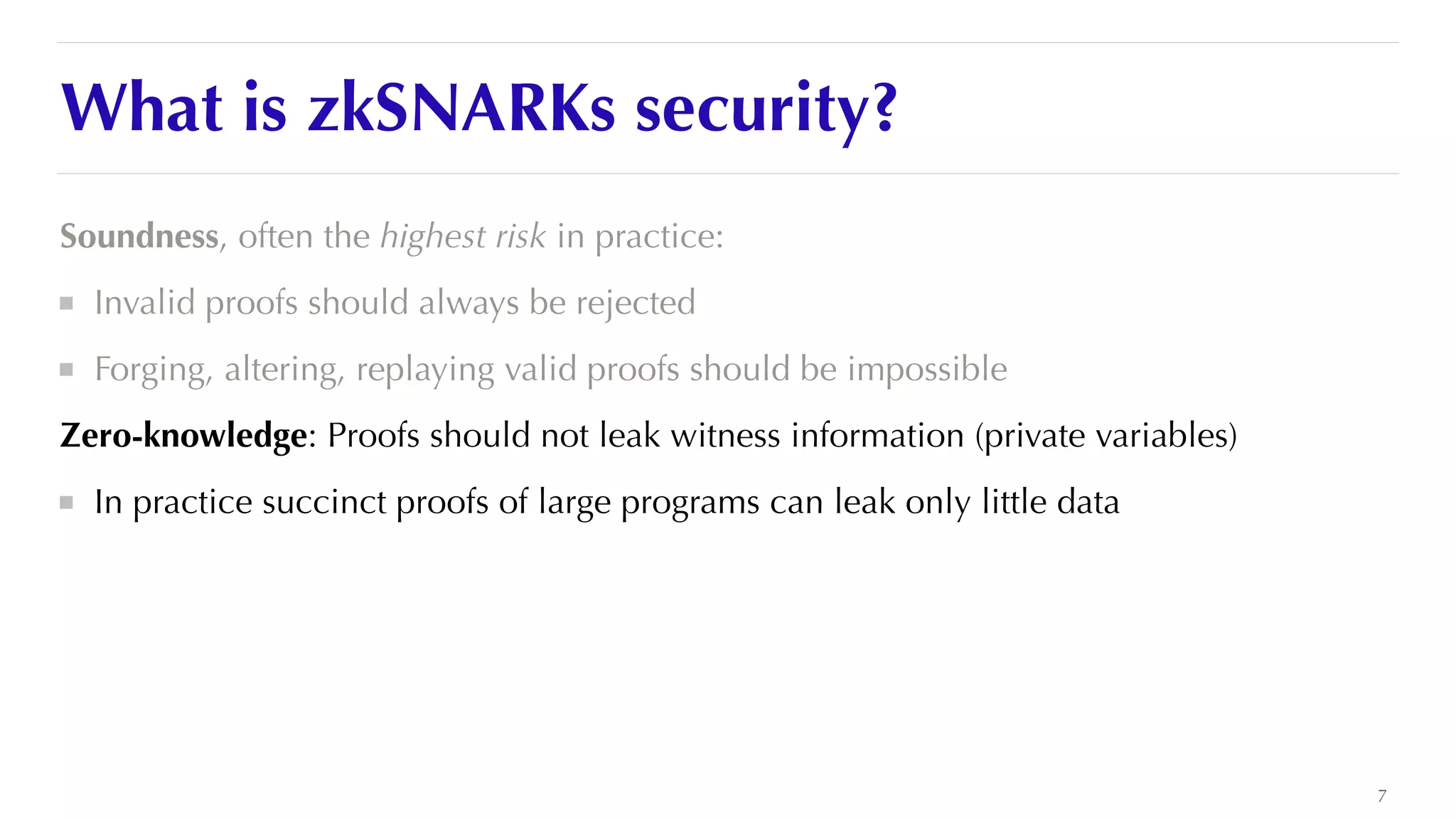
What is zkSNARKs security?
Soundness, often the highest risk in practice:


Invalid proofs should always be rejected


Forging, altering, replaying valid proofs should be impossible


Zero-knowledge: Proofs should not leak witness information (private variables)


In practice succinct proofs of large programs can leak only little data


7
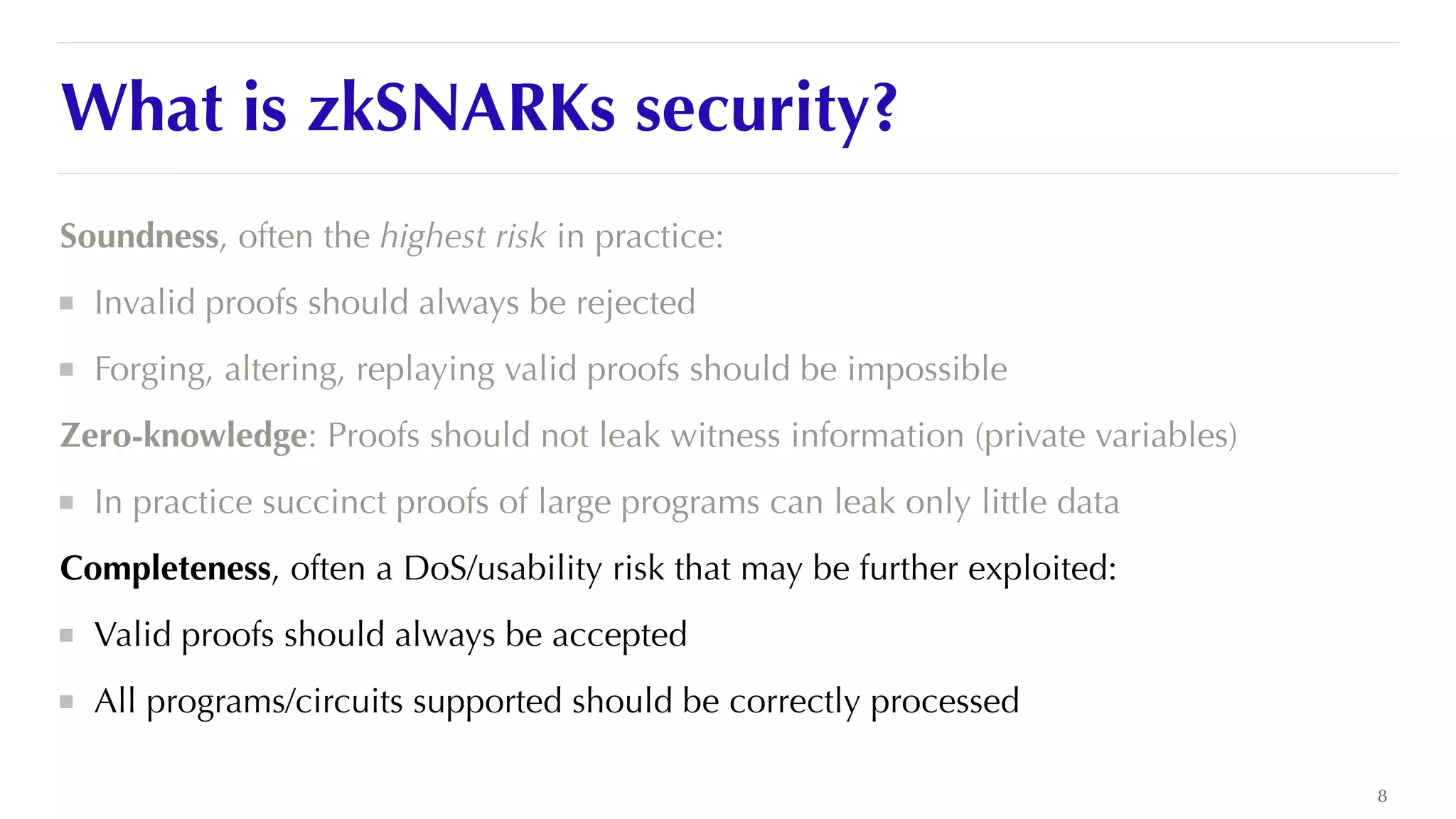
What is zkSNARKs security?
Soundness, often the highest risk in practice:


Invalid proofs should always be rejected


Forging, altering, replaying valid proofs should be impossible


Zero-knowledge: Proofs should not leak witness information (private variables)


In practice succinct proofs of large programs can leak only little data


Completeness, often a DoS/usability risk that may be further exploited:


Valid proofs should always be accepted


All programs/circuits supported should be correctly processed
8
Bug hunting challenges
Practical zkSNARKs are recent, thus auditors often have


Limited experience auditing ZKPs


Limited knowledge of the theory, of implementations’ tricks


Limited “checklist" of bugs and bug classes


Limited tooling and methodology


Most bugs found internally or by teams of similar projects


9
New crypto, new approach
More collaboration with the devs/designers (joint review sessions, Q&As, etc.)


More threat analysis, to understand the application’s unique/novel risks


Practical experience: writing PoCs, circuits, proof systems, etc.


Learn previous failures, for example from…


Public disclosures and exploits


Other audit reports


Issue trackers / PRs


Community
10
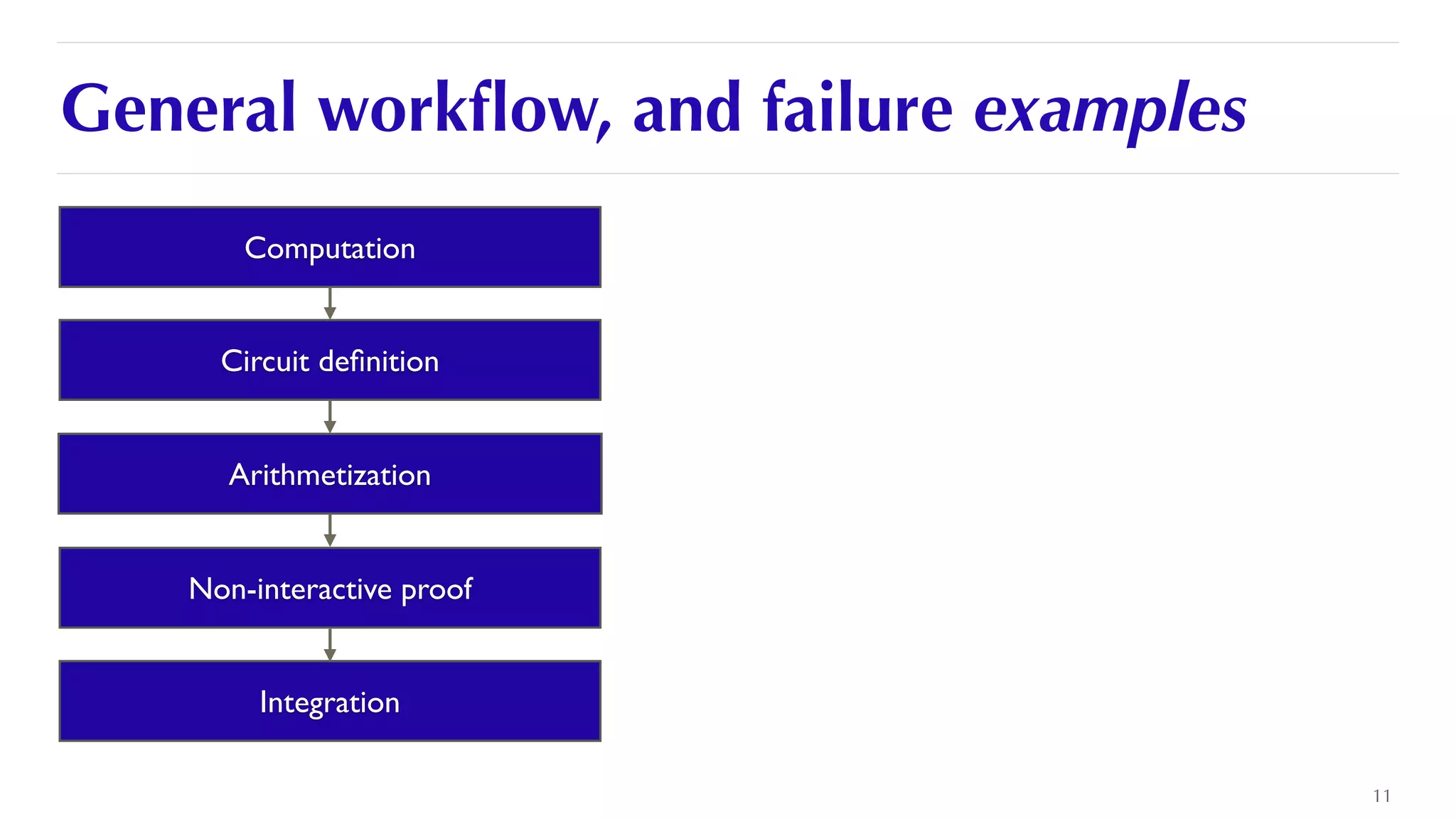
General work
fl
ow, and failure examples
11
Computation
Circuit de
fi
nition
Arithmetization
Non-interactive proof
Integration
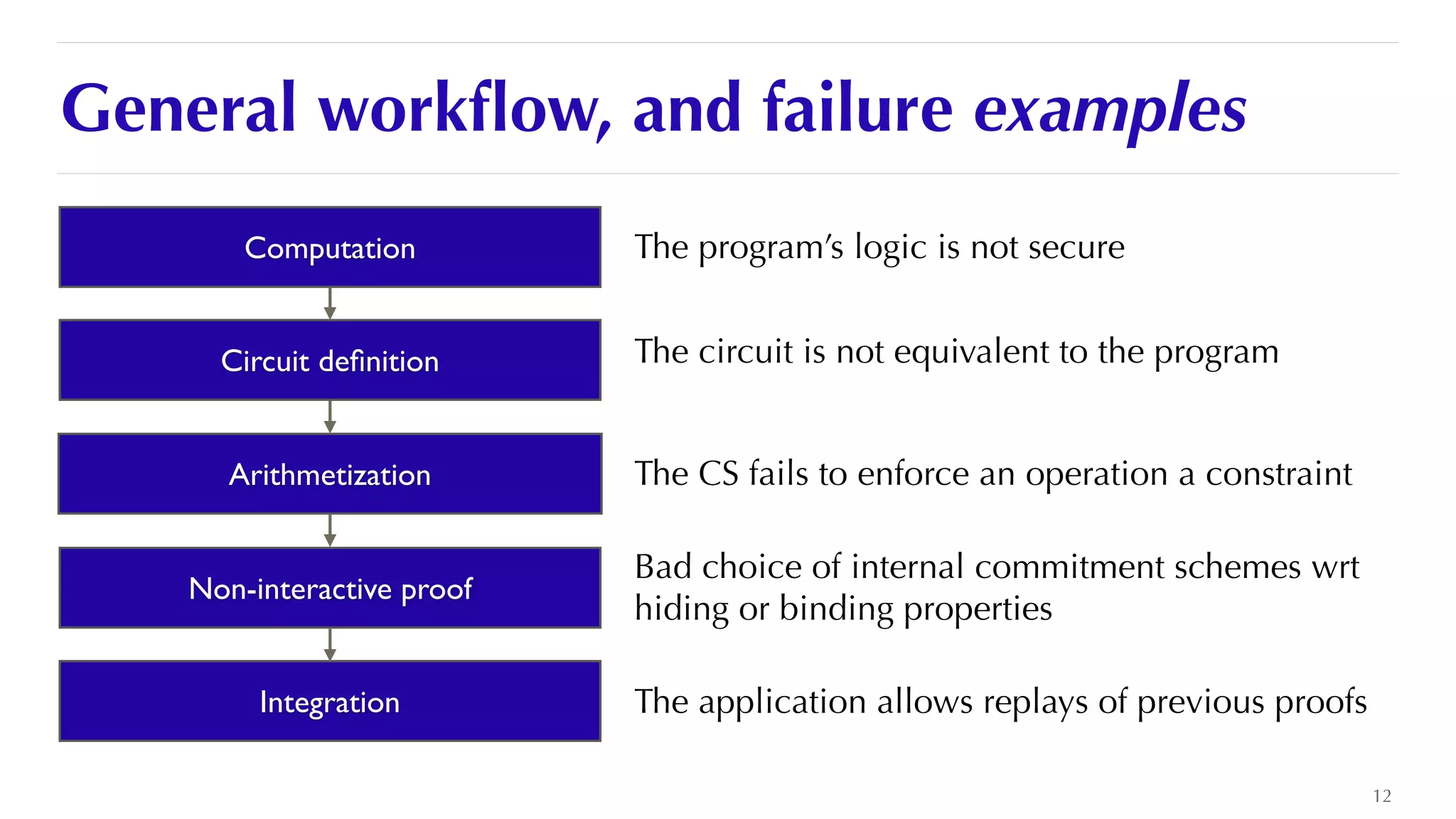
General work
fl
ow, and failure examples
12
Computation
Circuit de
fi
nition
Arithmetization
Non-interactive proof
Integration
The program’s logic is not secure
The circuit is not equivalent to the program
The CS fails to enforce an operation a constraint
Bad choice of internal commitment schemes wrt
hiding or binding properties
The application allows replays of previous proofs
How to break zkSNARKs security? (1/2)
Break soundness, for example by exploiting


Constraint system not effectively enforcing certain constraints


Insecure generation or protection of proving keys


13
How to break zkSNARKs security? (1/2)
Break soundness, for example by exploiting


Constraint system not effectively enforcing certain constraints


Insecure generation or protection of proving keys


Break zero-knowledge, for example by exploiting


Private data treated as public variables


Protocol-level “metadata attacks”


14
How to break zkSNARKs security? (1/2)
Break soundness, for example by exploiting


Constraint system not effectively enforcing certain constraints


Insecure generation or protection of proving keys


Break zero-knowledge, for example by exploiting


Private data treated as public variables


Protocol-level “metadata attacks”


Break completeness, for example by exploiting


Incorrect R1CS synthesis behaviour on edge cases (e.g. wrt number of private vars)


Gadget composition failure caused by type mismatch between gadget i/o values
15
How to break zkSNARKs security? (2/2)
Break (off-chain) software, via any bug leading to


Leakage of data, including via side channels, encodings (“ZK execution”)


Any form in insecure state (code execution, DoS)


Compromise the supply-chain, via


Trusted setup's code and execution


Build and release process integrity


Software dependencies
16
How to break zkSNARKs security? (2/2)
Break (off-chain) software, via any bug leading to


Leakage of data, including via side channels, encodings (“ZK execution”)


Any form in insecure state (code execution, DoS)


Compromise the supply-chain, via


Trusted setup's code and execution


Build and release process integrity


Software dependencies


Break (on-chain) software (incl. veri
fi
er) via smart contract bugs, logic
fl
aws, etc.
17
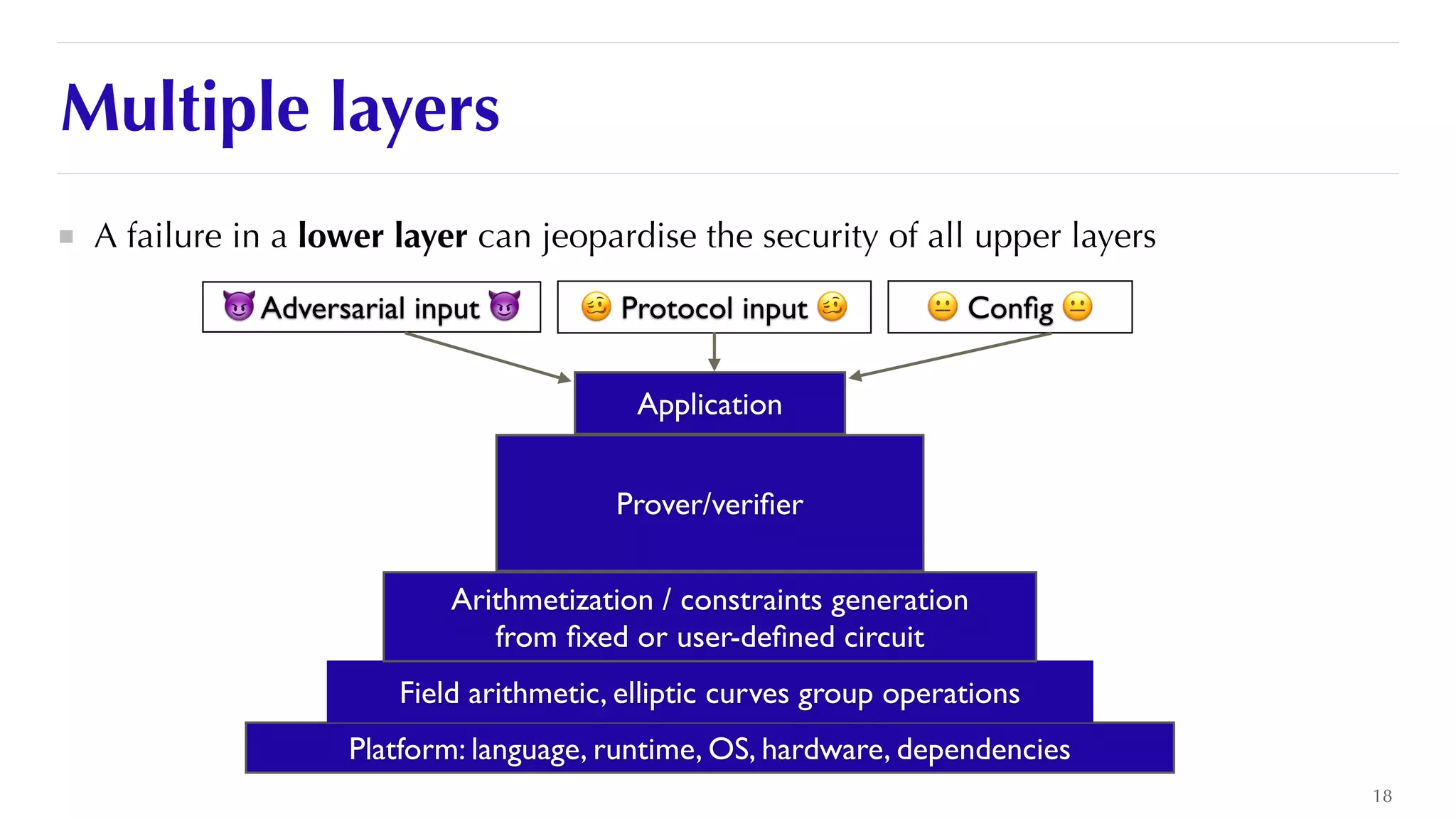
Multiple layers
18
A failure in a lower layer can jeopardise the security of all upper layers
Platform: language, runtime, OS, hardware, dependencies
Prover/veri
fi
er
Application
😈 Adversarial input 😈 🥴 Protocol input 🥴 😐 Con
fi
g 😐
Field arithmetic, elliptic curves group operations
Arithmetization / constraints generation


from
fi
xed or user-de
fi
ned circuit
Multiple layers
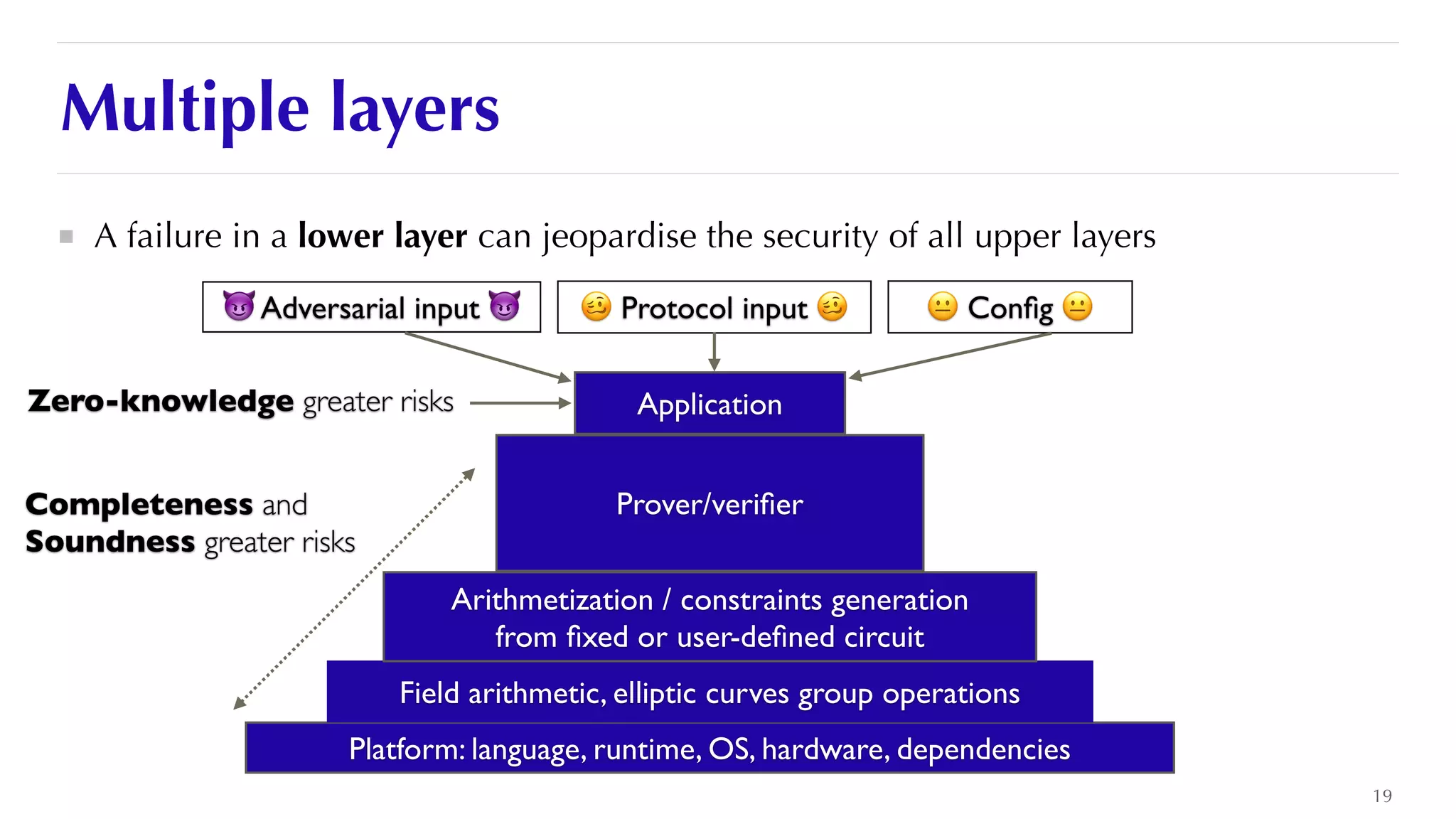
19
A failure in a lower layer can jeopardise the security of all upper layers
Platform: language, runtime, OS, hardware, dependencies
Prover/veri
fi
er
Application
😈 Adversarial input 😈 🥴 Protocol input 🥴 😐 Con
fi
g 😐
Zero-knowledge greater risks
Completeness and


Soundness greater risks
Field arithmetic, elliptic curves group operations
Arithmetization / constraints generation


from
fi
xed or user-de
fi
ned circuit
Multiple layers
20
Field arithmetic, elliptic curves group operations
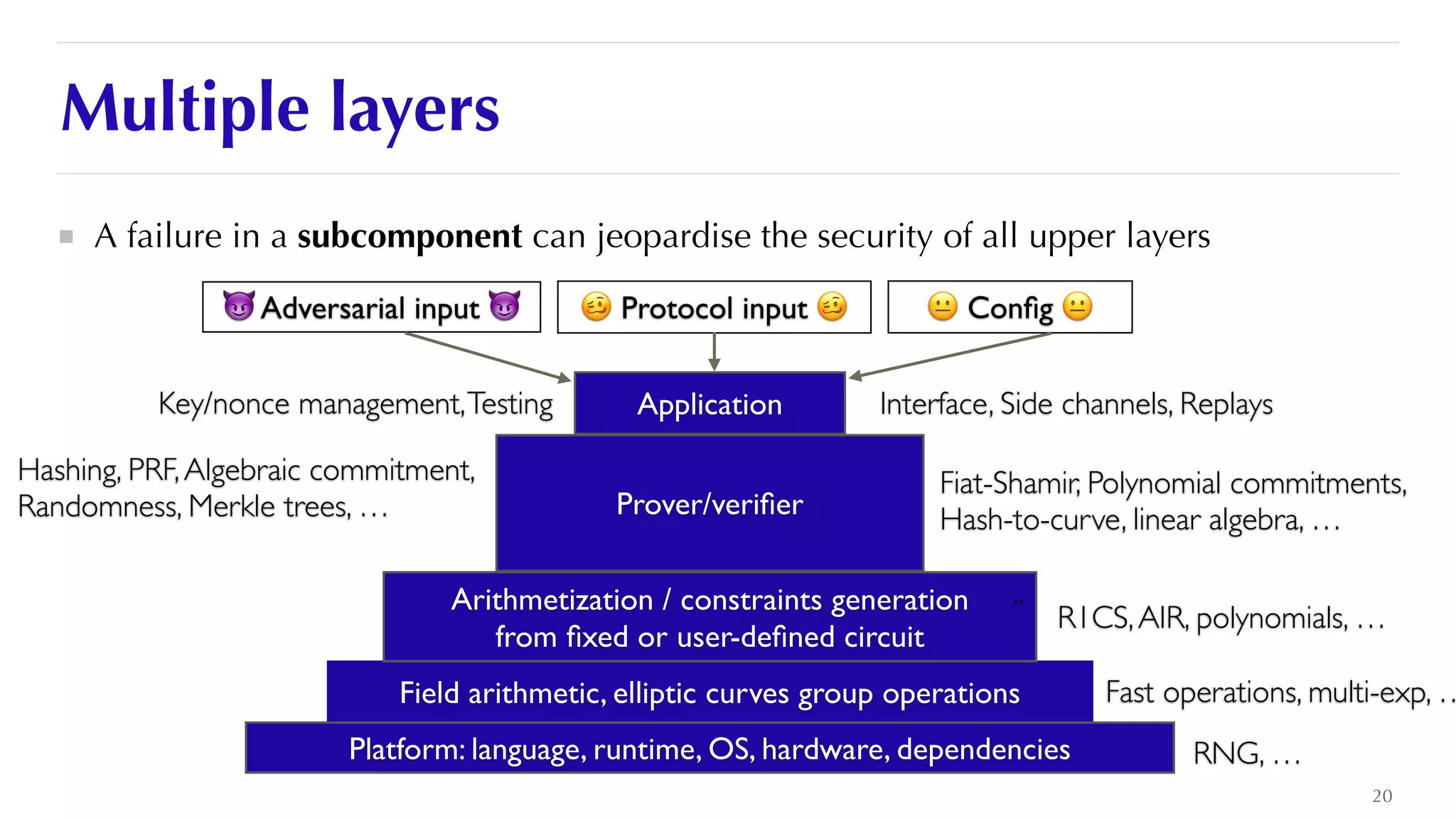
A failure in a subcomponent can jeopardise the security of all upper layers
Platform: language, runtime, OS, hardware, dependencies
Arithmetization / constraints generation


from
fi
xed or user-de
fi
ned circuit
Prover/veri
fi
er
Application
😈 Adversarial input 😈 🥴 Protocol input 🥴 😐 Con
fi
g 😐
Hashing, PRF,Algebraic commitment,
Randomness, Merkle trees, …
Fiat-Shamir, Polynomial commitments,
Hash-to-curve, linear algebra, …
Key/nonce management,Testing Interface, Side channels, Replays
Fast operations, multi-exp, …
R1CS,AIR, polynomials, …
RNG, …
..
Multiple layers
21
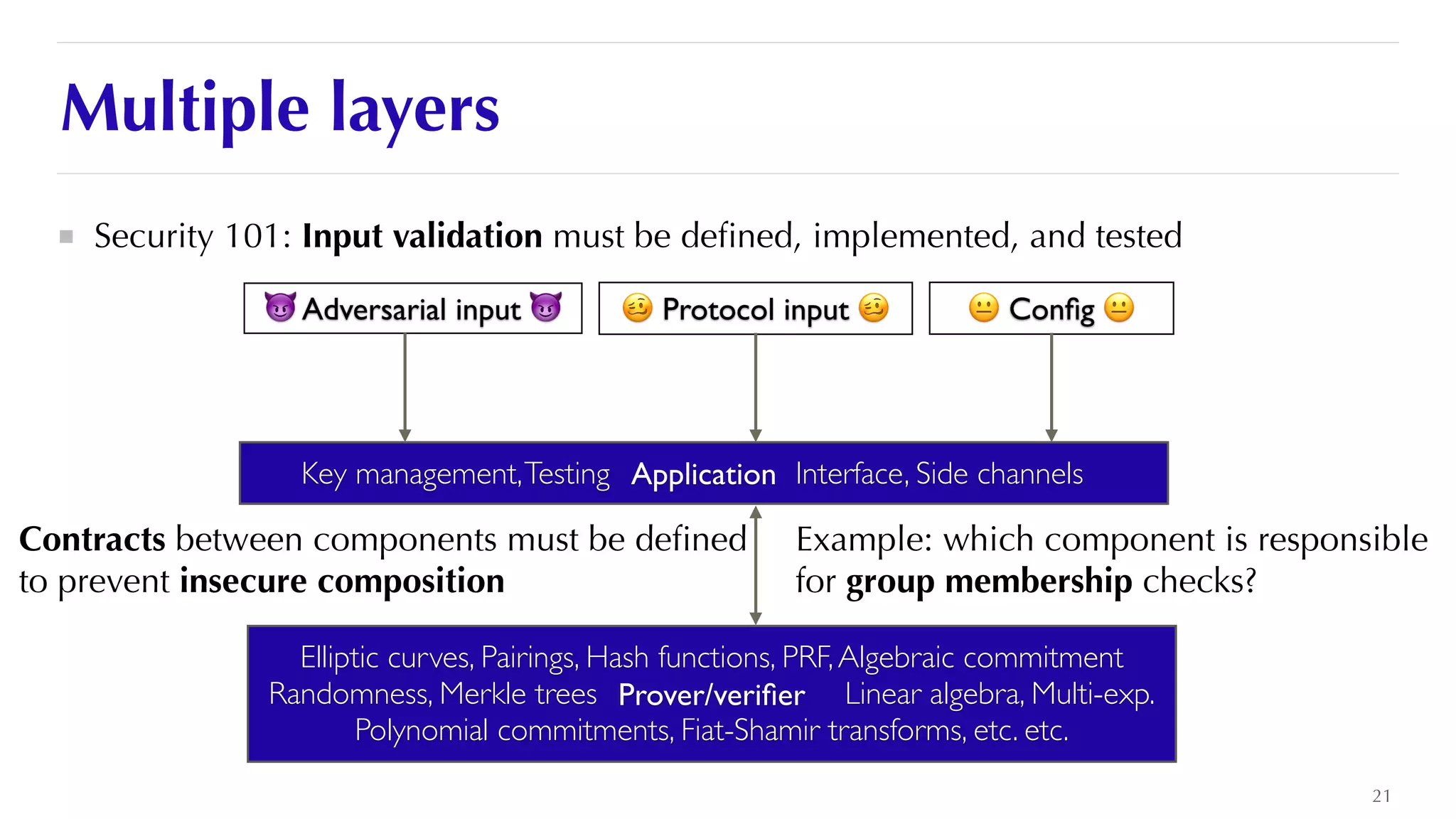
Security 101: Input validation must be de
fi
ned, implemented, and tested
Prover/veri
fi
er
Elliptic curves, Pairings, Hash functions, PRF,Algebraic commitment
Randomness, Merkle trees Linear algebra, Multi-exp.
Polynomial commitments, Fiat-Shamir transforms, etc. etc.
Application
Key management,Testing Interface, Side channels
😈 Adversarial input 😈 🥴 Protocol input 🥴 😐 Con
fi
g 😐
Contracts between components must be de
fi
ned
to prevent insecure composition
Example: which component is responsible


for group membership checks?
22
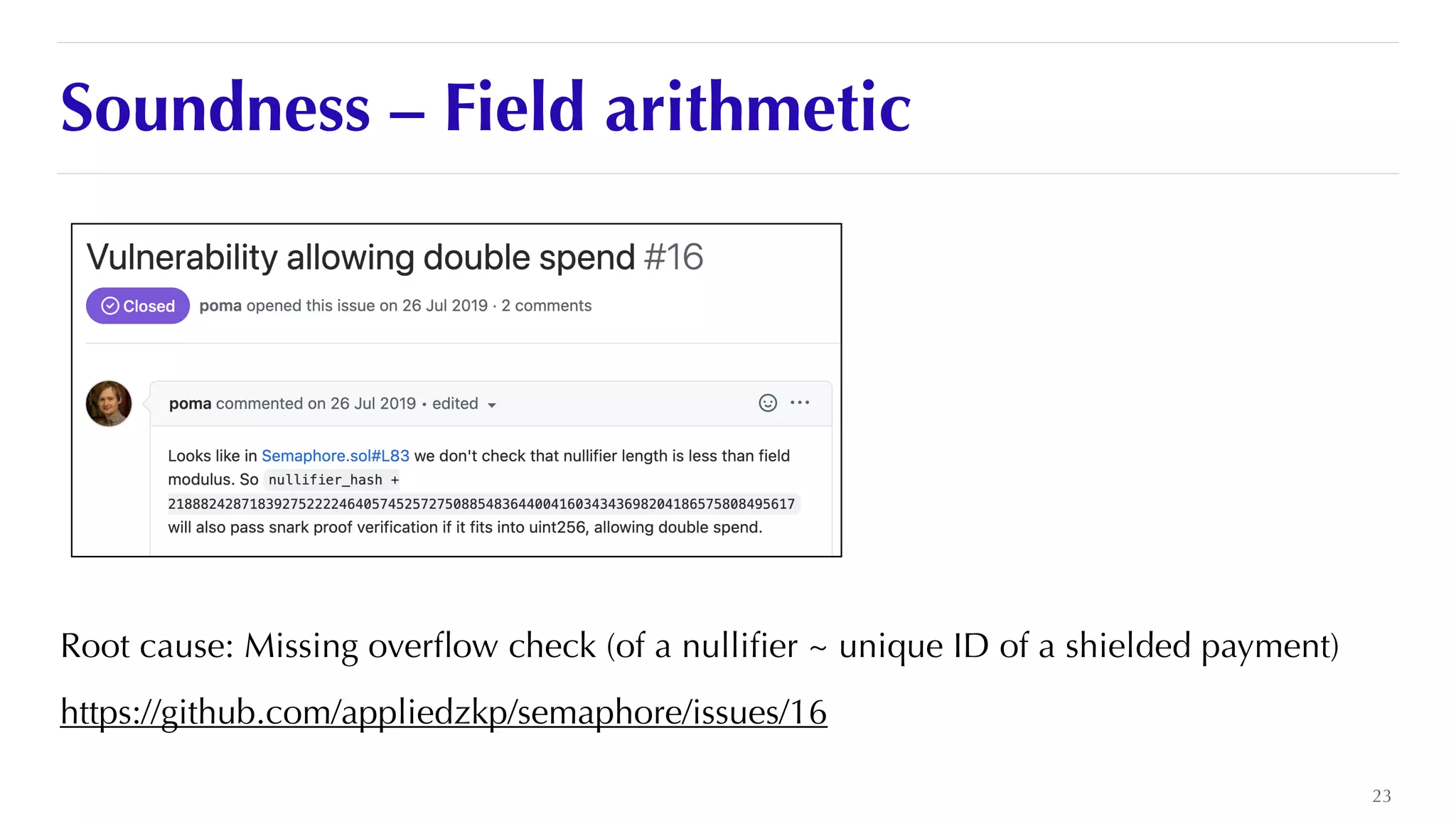
Soundness – Field arithmetic
Root cause: Missing over
fl
ow check (of a nulli
fi
er ~ unique ID of a shielded payment)


https://github.com/appliedzkp/semaphore/issues/16
23
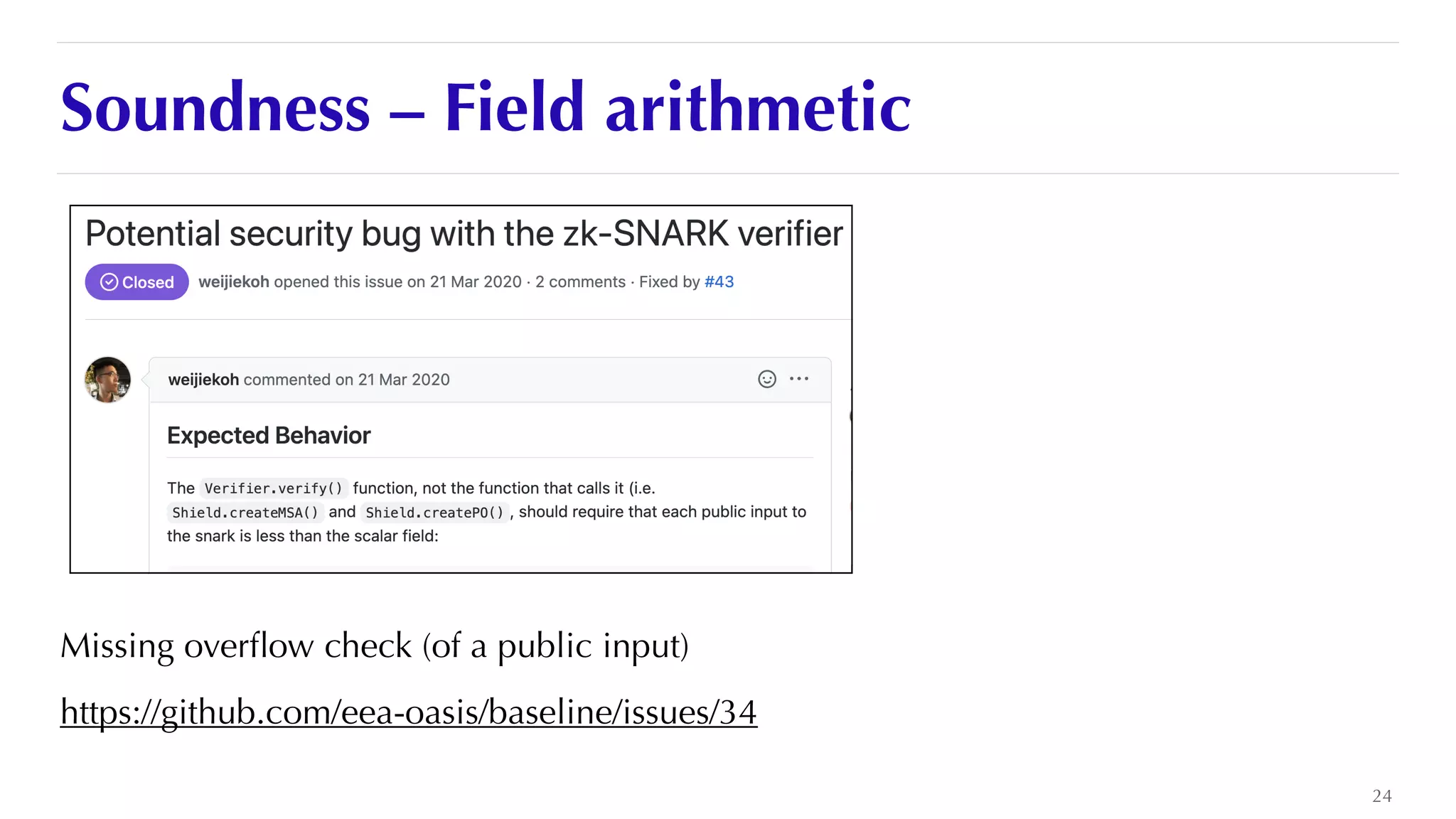
Soundness – Field arithmetic
Missing over
fl
ow check (of a public input)


https://github.com/eea-oasis/baseline/issues/34
24
Soundness – Field arithmetic
Missing over
fl
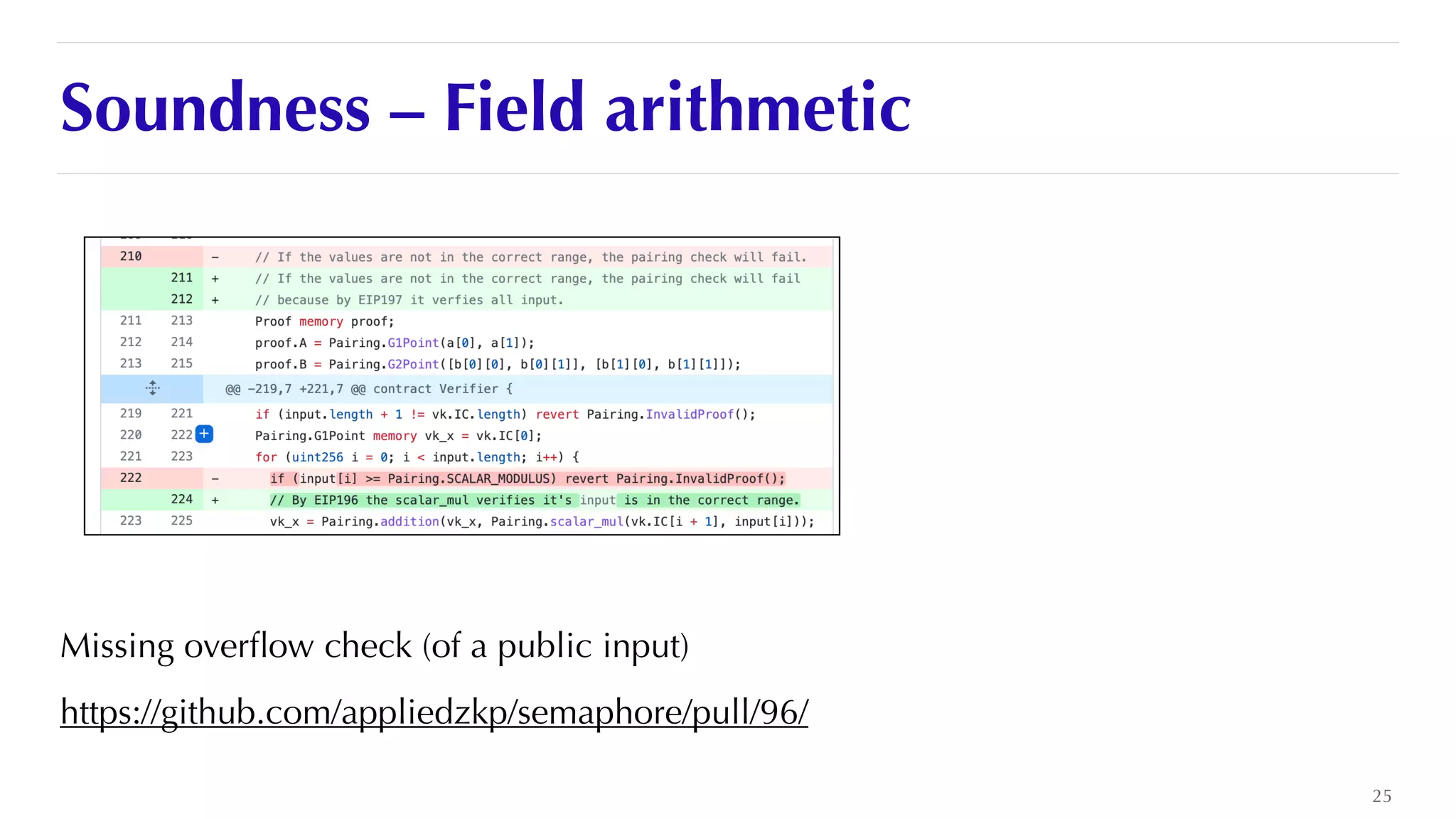
ow check (of a public input)


https://github.com/appliedzkp/semaphore/pull/96/
25
Soundness – R1CS
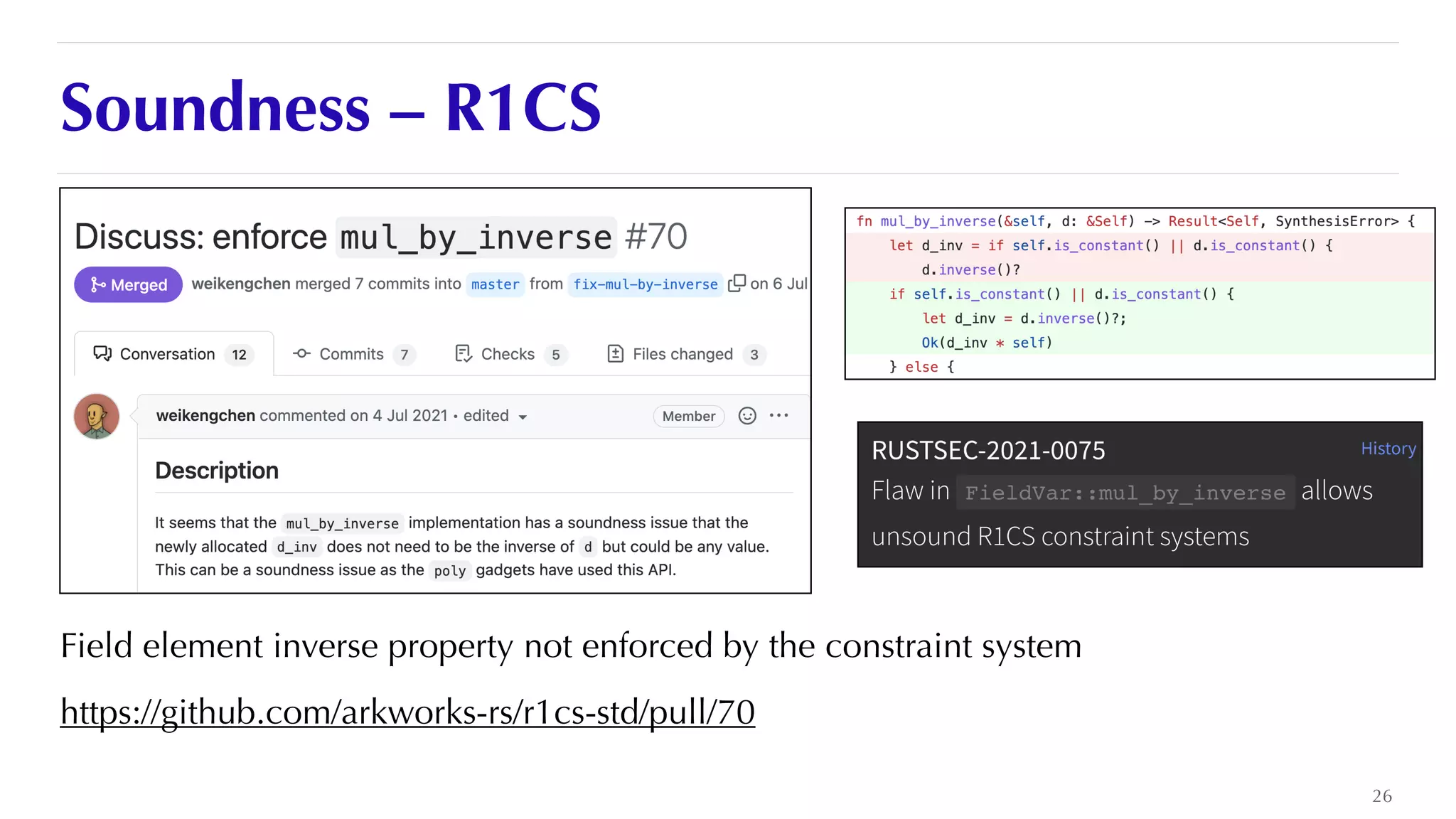
Field element inverse property not enforced by the constraint system


https://github.com/arkworks-rs/r1cs-std/pull/70
26
Soundness – Hash validation
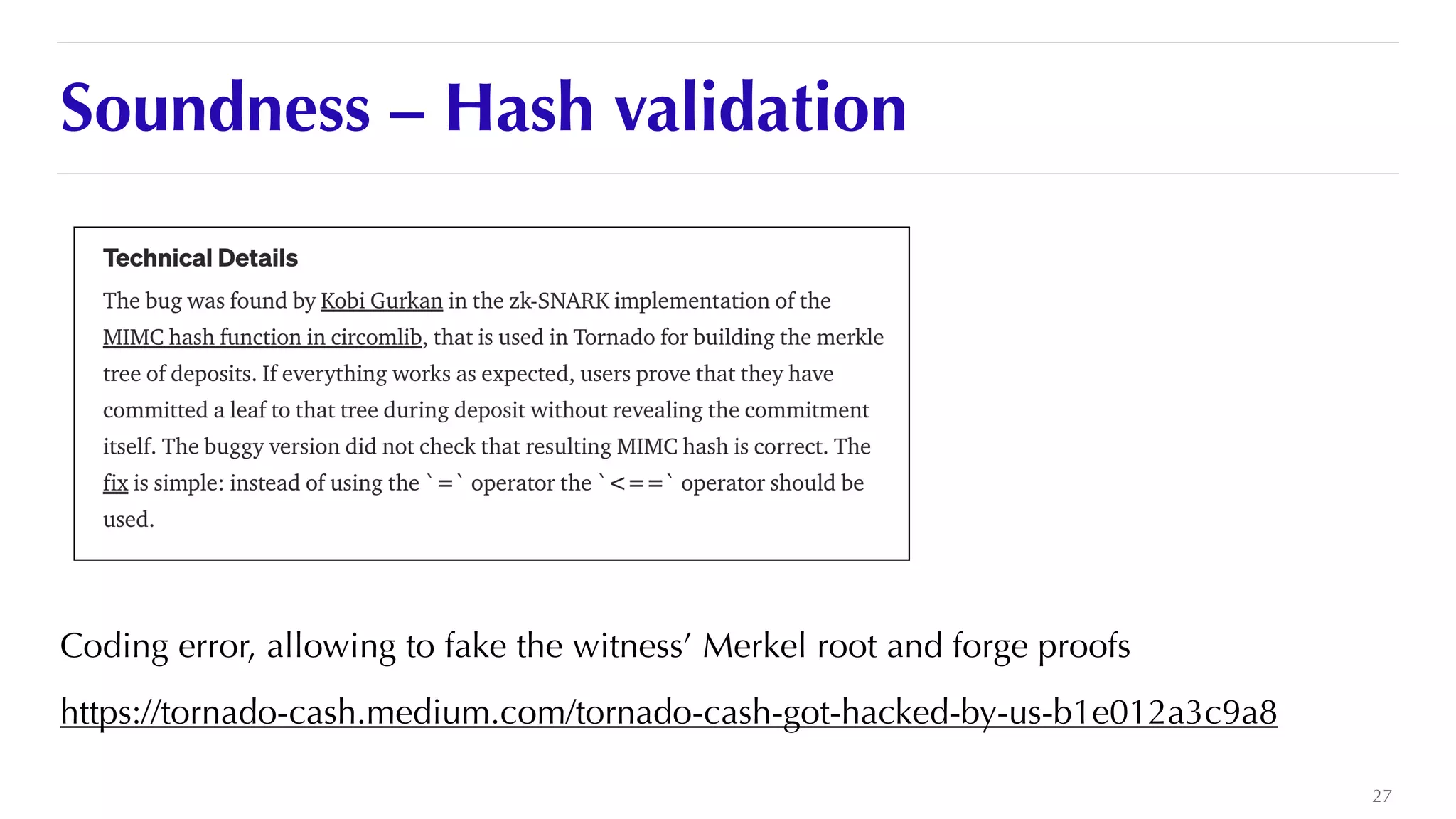
Coding error, allowing to fake the witness’ Merkel root and forge proofs


https://tornado-cash.medium.com/tornado-cash-got-hacked-by-us-b1e012a3c9a8
27
Soundness – Paper / Setup
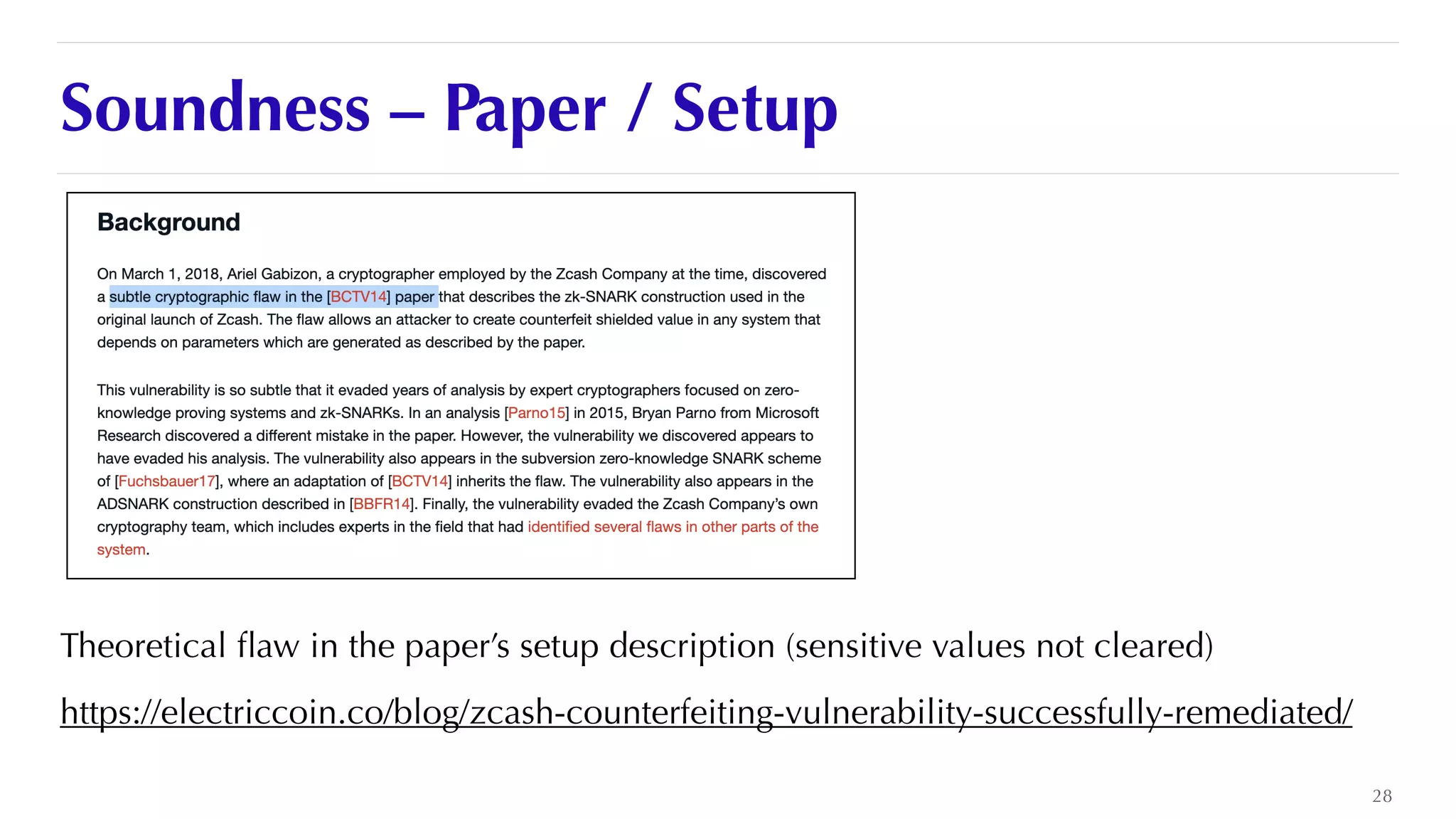
Theoretical
fl
aw in the paper’s setup description (sensitive values not cleared)


https://electriccoin.co/blog/zcash-counterfeiting-vulnerability-successfully-remediated/
28
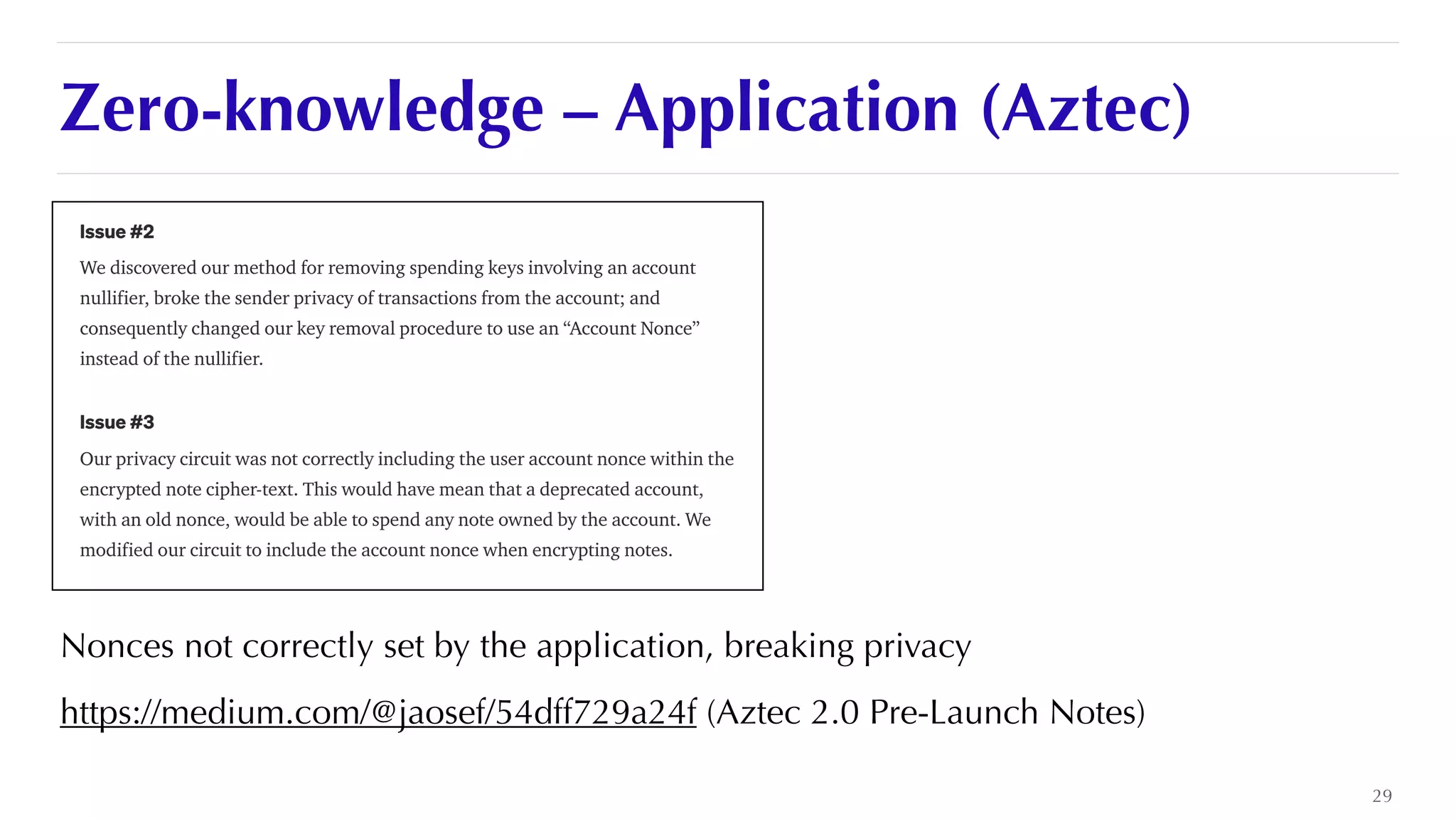
Zero-knowledge – Application (Aztec)
Nonces not correctly set by the application, breaking privacy


https://medium.com/@jaosef/54dff729a24f (Aztec 2.0 Pre-Launch Notes)
29
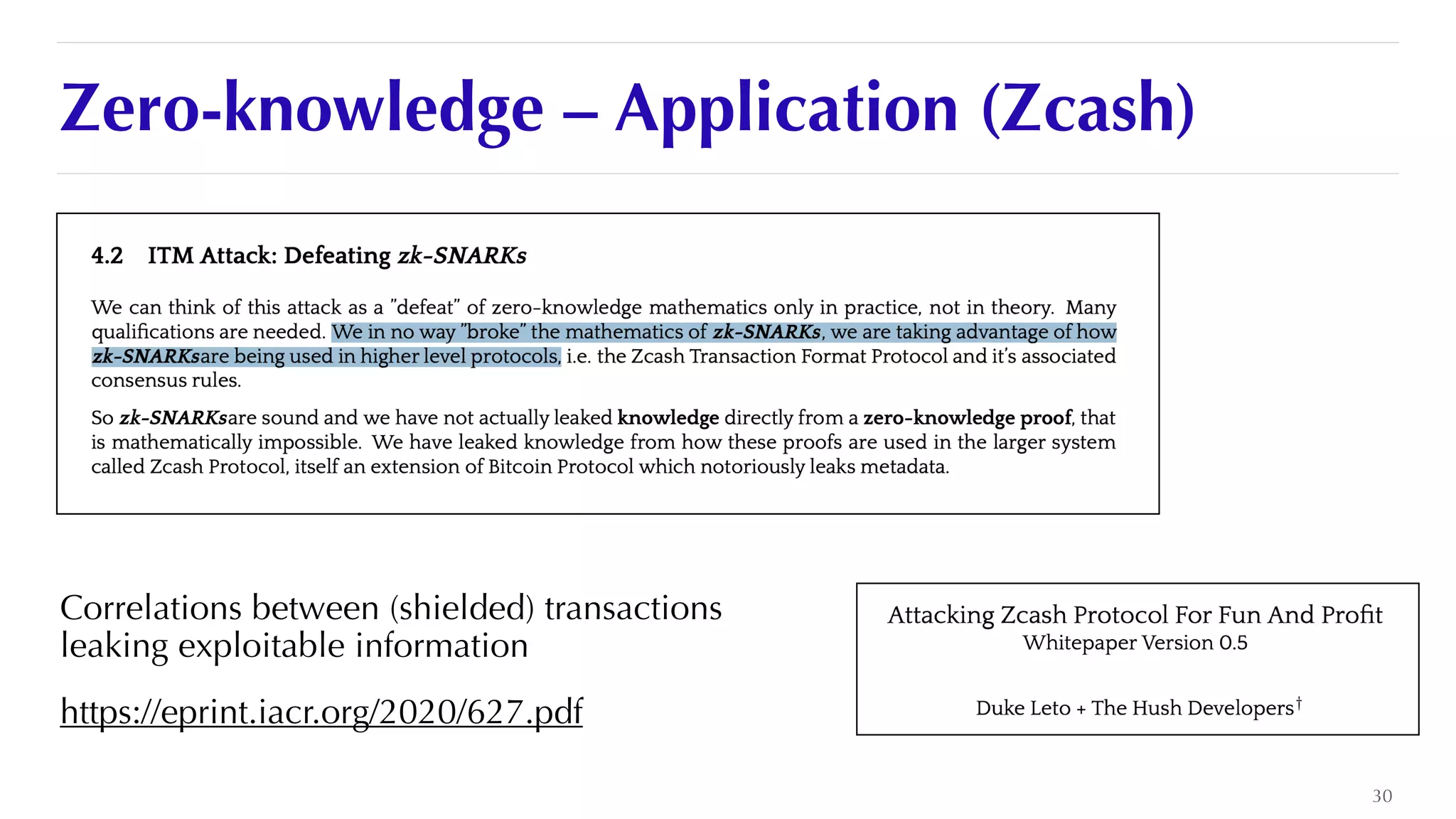
Zero-knowledge – Application (Zcash)
Correlations between (shielded) transactions


leaking exploitable information


https://eprint.iacr.org/2020/627.pdf
30
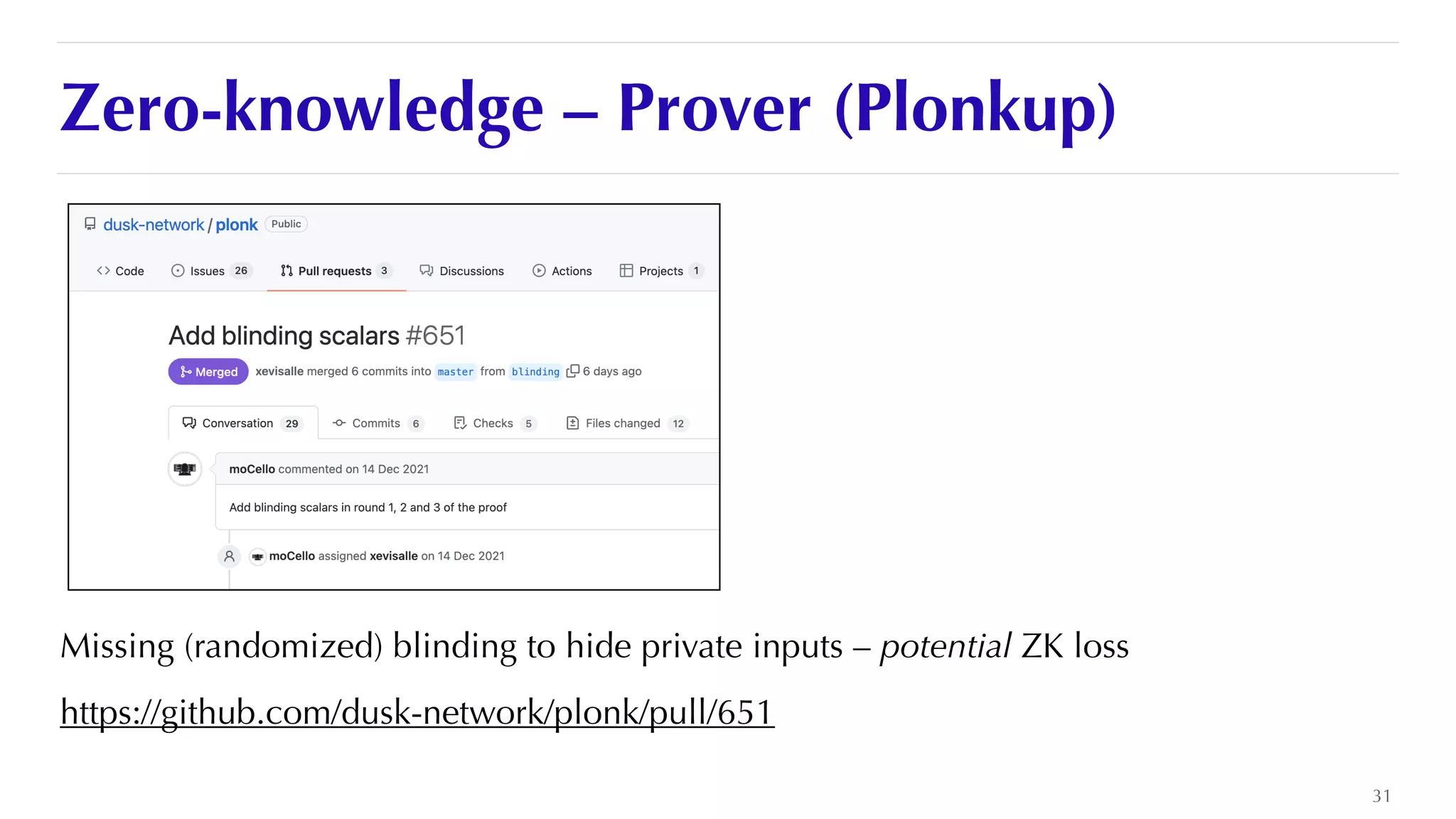
Zero-knowledge – Prover (Plonkup)
Missing (randomized) blinding to hide private inputs – potential ZK loss


https://github.com/dusk-network/plonk/pull/651
31
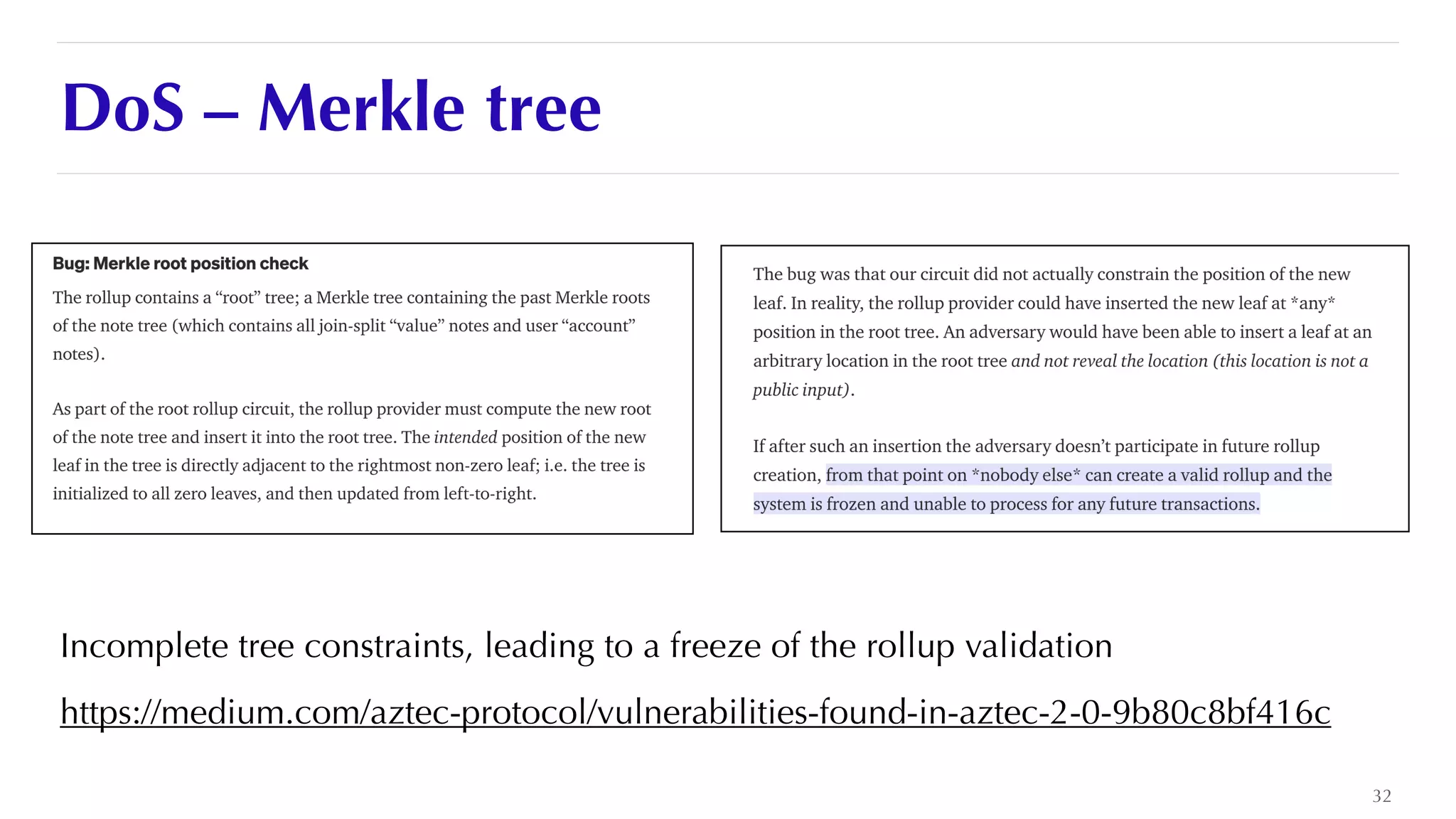
DoS – Merkle tree
Incomplete tree constraints, leading to a freeze of the rollup validation


https://medium.com/aztec-protocol/vulnerabilities-found-in-aztec-2-0-9b80c8bf416c
32
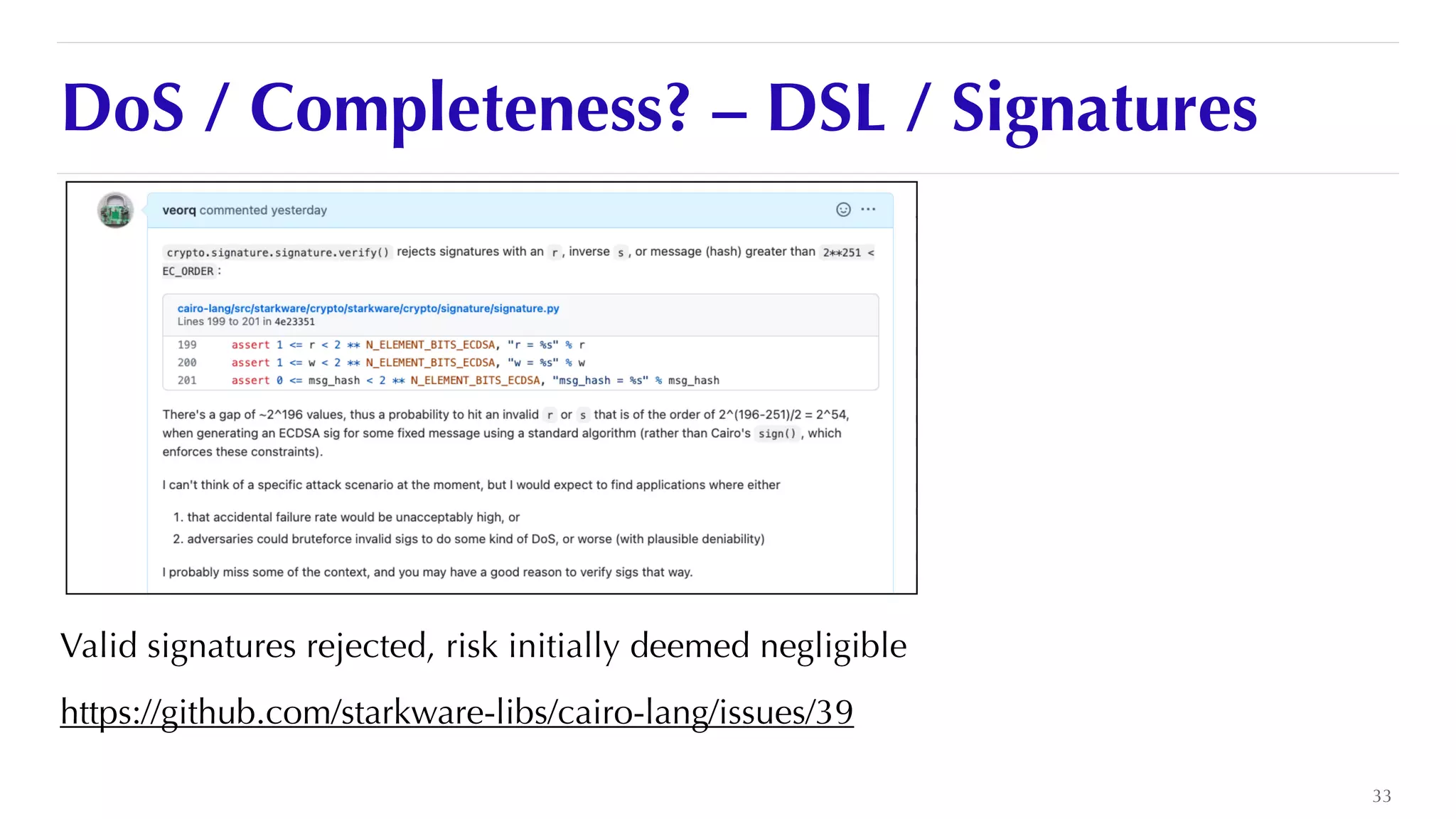
DoS / Completeness? – DSL / Signatures
Valid signatures rejected, risk initially deemed negligible


https://github.com/starkware-libs/cairo-lang/issues/39
33
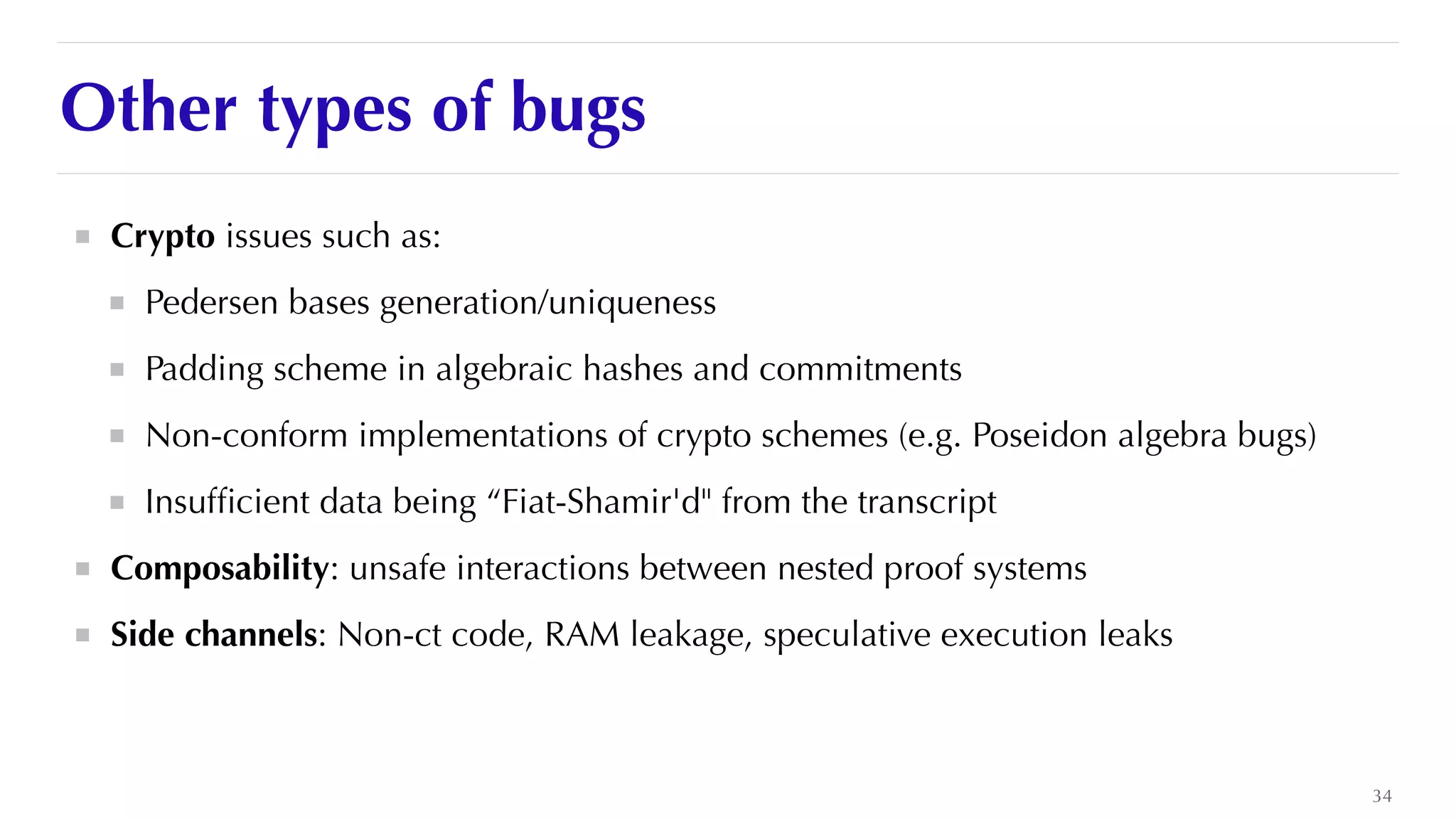
Other types of bugs
Crypto issues such as:


Pedersen bases generation/uniqueness


Padding scheme in algebraic hashes and commitments


Non-conform implementations of crypto schemes (e.g. Poseidon algebra bugs)


Insuf
fi
cient data being “Fiat-Shamir'd" from the transcript


Composability: unsafe interactions between nested proof systems


Side channels: Non-ct code, RAM leakage, speculative execution leaks
34
Conclusions
😌 Why not be too scared?


Robust code and frameworks (e.g. Rust projects such as arkworks and zkcrypto)


DSLs (Cairo, Leo, etc.) make it easier to write safe code


Relatively narrow attack surface in practice
35
Conclusions
😌 Why not be too scared?


Robust code and frameworks (e.g. Rust projects such as arkworks and zkcrypto)


DSLs (Cairo, Leo, etc.) make it easier to write safe code


Relatively narrow attack surface in practice


😱 Why be scared?


Few people understand zkSNARKs, even fewer can
fi
nd bugs


Lack of tooling (wrt testing, fuzzing, veri
fi
cation)


More ZKPs used => more $$$ at stake => greater RoI for vuln researchers
36
Thank you!
JP Aumasson


@veorq


CSO @ taurushq.com
Thanks to Aleo, Protocol Labs, Kobi Gurkan, Adrian Hamelink, Lúcás Meier, Mathilde Raynal

zkStudyClub: Zero-Knowledge Proofs Security, in Practice [JP Aumasson, Taurus]

  • 1.
    Zero-knowledge proofs security,in practice JP Aumasson @veorq CSO @ taurushq.com
  • 2.
    NIZK arguments security,in practice JP Aumasson @veorq CSO @ taurushq.com
  • 3.
    This talk Focus onzkSNARKs, a class of NIZK arguments Fully succinct = O(1) proof size and O(circuit size) veri fi cation time Based on my experience looking for bugs in systems using Groth16, used in Zcash, Filecoin, and many others Marlin, a universal zkSNARK, used in Aleo Most of the content applies to other systems (Plonk, SONIC, etc.) and STARKs 3
  • 4.
    Why study zkSNARKssecurity? For blockchain projects: A major risk: Complexity + Novelty => Non-trivial bugs A lot at stake ($$$ and user data/privacy) 4
  • 5.
    Why study zkSNARKssecurity? For blockchain projects: A major risk: Complexity + Novelty => Non-trivial bugs A lot at stake ($$$ and user data/privacy) As a cryptographer: The most interesting crypto today: Solving real-world problems and deployed at scale (good papers + good code!) Intricate constructions with non-trivial components “Simple but complex" (non-interactive, many moving parts) “Multidimensional" way to reason about security 5
  • 6.
    What is zkSNARKssecurity? Soundness, often the highest risk in practice: Invalid proofs should always be rejected Forging, altering, replaying valid proofs should be impossible 6
  • 7.
    What is zkSNARKssecurity? Soundness, often the highest risk in practice: Invalid proofs should always be rejected Forging, altering, replaying valid proofs should be impossible Zero-knowledge: Proofs should not leak witness information (private variables) In practice succinct proofs of large programs can leak only little data 7
  • 8.
    What is zkSNARKssecurity? Soundness, often the highest risk in practice: Invalid proofs should always be rejected Forging, altering, replaying valid proofs should be impossible Zero-knowledge: Proofs should not leak witness information (private variables) In practice succinct proofs of large programs can leak only little data Completeness, often a DoS/usability risk that may be further exploited: Valid proofs should always be accepted All programs/circuits supported should be correctly processed 8
  • 9.
    Bug hunting challenges PracticalzkSNARKs are recent, thus auditors often have Limited experience auditing ZKPs Limited knowledge of the theory, of implementations’ tricks Limited “checklist" of bugs and bug classes Limited tooling and methodology Most bugs found internally or by teams of similar projects 9
  • 10.
    New crypto, newapproach More collaboration with the devs/designers (joint review sessions, Q&As, etc.) More threat analysis, to understand the application’s unique/novel risks Practical experience: writing PoCs, circuits, proof systems, etc. Learn previous failures, for example from… Public disclosures and exploits Other audit reports Issue trackers / PRs Community 10
  • 11.
    General work fl ow, andfailure examples 11 Computation Circuit de fi nition Arithmetization Non-interactive proof Integration
  • 12.
    General work fl ow, andfailure examples 12 Computation Circuit de fi nition Arithmetization Non-interactive proof Integration The program’s logic is not secure The circuit is not equivalent to the program The CS fails to enforce an operation a constraint Bad choice of internal commitment schemes wrt hiding or binding properties The application allows replays of previous proofs
  • 13.
    How to breakzkSNARKs security? (1/2) Break soundness, for example by exploiting Constraint system not effectively enforcing certain constraints Insecure generation or protection of proving keys 13
  • 14.
    How to breakzkSNARKs security? (1/2) Break soundness, for example by exploiting Constraint system not effectively enforcing certain constraints Insecure generation or protection of proving keys Break zero-knowledge, for example by exploiting Private data treated as public variables Protocol-level “metadata attacks” 14
  • 15.
    How to breakzkSNARKs security? (1/2) Break soundness, for example by exploiting Constraint system not effectively enforcing certain constraints Insecure generation or protection of proving keys Break zero-knowledge, for example by exploiting Private data treated as public variables Protocol-level “metadata attacks” Break completeness, for example by exploiting Incorrect R1CS synthesis behaviour on edge cases (e.g. wrt number of private vars) Gadget composition failure caused by type mismatch between gadget i/o values 15
  • 16.
    How to breakzkSNARKs security? (2/2) Break (off-chain) software, via any bug leading to Leakage of data, including via side channels, encodings (“ZK execution”) Any form in insecure state (code execution, DoS) Compromise the supply-chain, via Trusted setup's code and execution Build and release process integrity Software dependencies 16
  • 17.
    How to breakzkSNARKs security? (2/2) Break (off-chain) software, via any bug leading to Leakage of data, including via side channels, encodings (“ZK execution”) Any form in insecure state (code execution, DoS) Compromise the supply-chain, via Trusted setup's code and execution Build and release process integrity Software dependencies Break (on-chain) software (incl. veri fi er) via smart contract bugs, logic fl aws, etc. 17
  • 18.
    Multiple layers 18 A failurein a lower layer can jeopardise the security of all upper layers Platform: language, runtime, OS, hardware, dependencies Prover/veri fi er Application 😈 Adversarial input 😈 🥴 Protocol input 🥴 😐 Con fi g 😐 Field arithmetic, elliptic curves group operations Arithmetization / constraints generation 
 from fi xed or user-de fi ned circuit
  • 19.
    Multiple layers 19 A failurein a lower layer can jeopardise the security of all upper layers Platform: language, runtime, OS, hardware, dependencies Prover/veri fi er Application 😈 Adversarial input 😈 🥴 Protocol input 🥴 😐 Con fi g 😐 Zero-knowledge greater risks Completeness and 
 Soundness greater risks Field arithmetic, elliptic curves group operations Arithmetization / constraints generation 
 from fi xed or user-de fi ned circuit
  • 20.
    Multiple layers 20 Field arithmetic,elliptic curves group operations A failure in a subcomponent can jeopardise the security of all upper layers Platform: language, runtime, OS, hardware, dependencies Arithmetization / constraints generation 
 from fi xed or user-de fi ned circuit Prover/veri fi er Application 😈 Adversarial input 😈 🥴 Protocol input 🥴 😐 Con fi g 😐 Hashing, PRF,Algebraic commitment, Randomness, Merkle trees, … Fiat-Shamir, Polynomial commitments, Hash-to-curve, linear algebra, … Key/nonce management,Testing Interface, Side channels, Replays Fast operations, multi-exp, … R1CS,AIR, polynomials, … RNG, … ..
  • 21.
    Multiple layers 21 Security 101:Input validation must be de fi ned, implemented, and tested Prover/veri fi er Elliptic curves, Pairings, Hash functions, PRF,Algebraic commitment Randomness, Merkle trees Linear algebra, Multi-exp. Polynomial commitments, Fiat-Shamir transforms, etc. etc. Application Key management,Testing Interface, Side channels 😈 Adversarial input 😈 🥴 Protocol input 🥴 😐 Con fi g 😐 Contracts between components must be de fi ned to prevent insecure composition Example: which component is responsible 
 for group membership checks?
  • 22.
  • 23.
    Soundness – Fieldarithmetic Root cause: Missing over fl ow check (of a nulli fi er ~ unique ID of a shielded payment) https://github.com/appliedzkp/semaphore/issues/16 23
  • 24.
    Soundness – Fieldarithmetic Missing over fl ow check (of a public input) https://github.com/eea-oasis/baseline/issues/34 24
  • 25.
    Soundness – Fieldarithmetic Missing over fl ow check (of a public input) https://github.com/appliedzkp/semaphore/pull/96/ 25
  • 26.
    Soundness – R1CS Fieldelement inverse property not enforced by the constraint system https://github.com/arkworks-rs/r1cs-std/pull/70 26
  • 27.
    Soundness – Hashvalidation Coding error, allowing to fake the witness’ Merkel root and forge proofs https://tornado-cash.medium.com/tornado-cash-got-hacked-by-us-b1e012a3c9a8 27
  • 28.
    Soundness – Paper/ Setup Theoretical fl aw in the paper’s setup description (sensitive values not cleared) https://electriccoin.co/blog/zcash-counterfeiting-vulnerability-successfully-remediated/ 28
  • 29.
    Zero-knowledge – Application(Aztec) Nonces not correctly set by the application, breaking privacy https://medium.com/@jaosef/54dff729a24f (Aztec 2.0 Pre-Launch Notes) 29
  • 30.
    Zero-knowledge – Application(Zcash) Correlations between (shielded) transactions 
 leaking exploitable information https://eprint.iacr.org/2020/627.pdf 30
  • 31.
    Zero-knowledge – Prover(Plonkup) Missing (randomized) blinding to hide private inputs – potential ZK loss https://github.com/dusk-network/plonk/pull/651 31
  • 32.
    DoS – Merkletree Incomplete tree constraints, leading to a freeze of the rollup validation https://medium.com/aztec-protocol/vulnerabilities-found-in-aztec-2-0-9b80c8bf416c 32
  • 33.
    DoS / Completeness?– DSL / Signatures Valid signatures rejected, risk initially deemed negligible https://github.com/starkware-libs/cairo-lang/issues/39 33
  • 34.
    Other types ofbugs Crypto issues such as: Pedersen bases generation/uniqueness Padding scheme in algebraic hashes and commitments Non-conform implementations of crypto schemes (e.g. Poseidon algebra bugs) Insuf fi cient data being “Fiat-Shamir'd" from the transcript Composability: unsafe interactions between nested proof systems Side channels: Non-ct code, RAM leakage, speculative execution leaks 34
  • 35.
    Conclusions 😌 Why notbe too scared? Robust code and frameworks (e.g. Rust projects such as arkworks and zkcrypto) DSLs (Cairo, Leo, etc.) make it easier to write safe code Relatively narrow attack surface in practice 35
  • 36.
    Conclusions 😌 Why notbe too scared? Robust code and frameworks (e.g. Rust projects such as arkworks and zkcrypto) DSLs (Cairo, Leo, etc.) make it easier to write safe code Relatively narrow attack surface in practice 😱 Why be scared? Few people understand zkSNARKs, even fewer can fi nd bugs Lack of tooling (wrt testing, fuzzing, veri fi cation) More ZKPs used => more $$$ at stake => greater RoI for vuln researchers 36
  • 37.
    Thank you! JP Aumasson @veorq CSO@ taurushq.com Thanks to Aleo, Protocol Labs, Kobi Gurkan, Adrian Hamelink, Lúcás Meier, Mathilde Raynal