09-12-2021 1
ZIKA VIRUS
EPIDEMIOLOGY AND CONTROL
09-12-2021 2
Dr Lakshmi Rajeev
Assistant Professor
Department Of Community Medicine
Introduction
•Mosquito borne Flavivirus
•First identified from Uganda in 1947
•Till 1952- disease specific to monkeys
•First in humans- Uganda and United Republic of Tanzania,1952
09-12-2021 3
Introduction (continued)
•Largest outbreak – 2015 -201633 countries
•Worst – Brazil -1.4 million cases
•WHO- Public Health Emergency of International
Concern (PHEIC) -1stFeb 2016
•86 countries/territories –till date
09-12-2021 4
Problem statement – India
•2016 – First 3 cases reported from Gujarat- routine surveillance
•Sep-Oct 2018- Biggest outbreak(157 cases)- Rajasthan
•Other states- Madhya Pradesh, Maharashtra, Uttar Pradesh
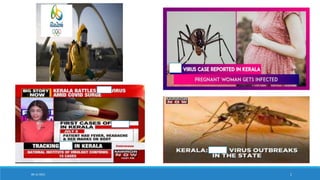
•2021- Kerala
09-12-2021 5
Problem Statement - Kerala
24 year old pregnant ,third trimester- Parassala,
Thiruvanathapuram
Fever ,headache and generalized rash -28/06/2021
ZIKV confirmed (RT-PCR)-08/07/21
13 hospital staffs/patients positive -10/07/21
Active and passive surveillance – 70 positives/590 samples
All resided/travelled to Thiruvanathapuram
09-12-2021 6
Agent
•Zika Virus
•Arbovirus- Flavivirus genus
•Single stranded RNA virus
•One serotype
09-12-2021 7
Vector
•Aedes aegypti (most common) A.albopictus
09-12-2021 8
Aedes aegypti
Day time biter
Highest bite rate- dawn and dusk
Highly domestic
Nervous feeder
Flight range -100m(short fliers)
Multiple cases & clustering of cases
Breeds- artificial water collections
Same vector responsible for ?
09-12-2021 9
Host factors
•Lack of herd immunity
•Pregnancy- Complications
09-12-2021 10
•Rain fall and humidity
•Frequency of bites increases with temperature
•Wide geographical distribution of vector
•High vector density
•International travel
09-12-2021 11
Environmental factors
Modes of transmission
•Bite of Aedes mosquito- most common
•Human to human
-Pregnant mother to foetus- intra uterine and perinatal
-Sexual contact
-Blood transfusion
-Organ transplantation
09-12-2021 12
Clinical features
•Incubation period- 3 to 14 days
•Only 1 in 4 infected people develop symptoms
•Symptoms- Fever, maculo-papular rash, conjunctivitis, muscle and
joint pain, malaise, headache
•Lasts for 2 to 7 days
•Viremia –3rd and 5th day of onset
•Severe forms of disease and fatalities are rare
09-12-2021 13
1. Pregnancy related– trans placental transmission
symptomatic/asymptomatic mothers
•Congenital Zika Syndrome
-Microcephaly
-Limb contractures
-Eye abnormalities
-Hearing loss
•Abortion/Still birth
•Preterm birth
Complications
9-12-2021 14
Complications (continued)
2. Neurological complications(rare)- older children and adults
• Guillain-Barre Syndrome(GBS)
• Neuropathy
• Myelitis
09-12-2021 15
Zika virus disease- Case definitions
•Suspected Zika virus disease
Acute onset of fever, maculo-papular rash, arthralgia in
those with history of travel to areas with ongoing
transmission during 2 weeks preceding onset of illness
•Confirmed Zika virus disease
Suspected case with positive laboratory results (RT-PCR)
09-12-2021 16
Differential diagnosis
•Dengue
•Chikungunya
•Leptospirosis
•Measles
•Rubella
•Parvovirus
•Scrub typhus
09-12-2021 17
Clinical features- Zika ,Dengue and Chikungunya
Features Zika Dengue Chikungunya
Fever ++ +++ +++
Rash +++ + ++
Conjunctivitis ++ - -
Arthralgia ++ + +++
Myalgia + ++ +
Headache + ++ ++
Hemorrhage - ++ -
Shock - + -
09-12-2021 18
Diagnosis
 Samples- Blood, urine, semen
• Nucleic acid testing-
RT-PCR- <7 days (serum)
7-20 days (urine)
• Serology
09-12-2021 19
Prevention and Control
I. Individual level
1. Management of general case
• Self limiting
• No specific antiviral or vaccine
• Symptomatic management
-Rest
-Plenty of oral fluids
-Management of fever and pain
• Isolation of cases under bed net
09-12-2021 20
Prevention and Control (continued)
2. Management in pregnant women
•Ongoing transmission- Lab testing
•Symptomatic pregnant females
-Early medical care
-Regular follow up ultrasound scan- microcephaly, developmental
abnormality
-Counselling – possible adverse effects, option for termination
09-12-2021 21
Prevention and Control (continued)
II. Family level
1. Source reduction
2. Use mosquito repellents
3. Wear light coloured full sleeve dress
4. Household screens- windows/doors
5. Bed nets-daytime - infants and children
09-12-2021 22
Prevention and Control (continued)
III. Community level
1. Source reduction- DRY DAY
09-12-2021 23
Day Place
Thursday JHI visits 50 houses –
Vector survey
Friday Schools
Saturday Offices, shops, other
establishments
Sunday Houses
Prevention and Control (continued)
2. Vector surveillance
Larval surveys
• House index
• Container index
• Breteau index
09-12-2021 24
Prevention and Control (continued)
3. Chemical control
a) Larvicide –Temephos
b) Adulticide –Only during outbreak
Integrated vector management
09-12-2021 25
Prevention and Control (continued)
IV. International airports and seaports
1. Quarantine and isolation facilities
2. Aircraft disinfection
3. WHO- IHR- Aedes aegypti index=0
(400 m)
09-12-2021 26
SUMMARY
•Arboviral disease- transmitted by Aedes mosquito
•1 in 4 symptomatic
•Symptoms include- Fever, rash, conjunctivitis, arthralgia, headache
•Mild- 2 to 7 days; few- complications
•Pregnant females and fetus at risk
•Symptomatic management
•Prevention- mosquito control
09-12-2021 27
09-12-2021 28
THANK YOU
https://www.slideshare.net/JazeelaMohamedSiddiq

Zika.pptx

  • 1.
  • 2.
    ZIKA VIRUS EPIDEMIOLOGY ANDCONTROL 09-12-2021 2 Dr Lakshmi Rajeev Assistant Professor Department Of Community Medicine
  • 3.
    Introduction •Mosquito borne Flavivirus •Firstidentified from Uganda in 1947 •Till 1952- disease specific to monkeys •First in humans- Uganda and United Republic of Tanzania,1952 09-12-2021 3
  • 4.
    Introduction (continued) •Largest outbreak– 2015 -201633 countries •Worst – Brazil -1.4 million cases •WHO- Public Health Emergency of International Concern (PHEIC) -1stFeb 2016 •86 countries/territories –till date 09-12-2021 4
  • 5.
    Problem statement –India •2016 – First 3 cases reported from Gujarat- routine surveillance •Sep-Oct 2018- Biggest outbreak(157 cases)- Rajasthan •Other states- Madhya Pradesh, Maharashtra, Uttar Pradesh •2021- Kerala 09-12-2021 5
  • 6.
    Problem Statement -Kerala 24 year old pregnant ,third trimester- Parassala, Thiruvanathapuram Fever ,headache and generalized rash -28/06/2021 ZIKV confirmed (RT-PCR)-08/07/21 13 hospital staffs/patients positive -10/07/21 Active and passive surveillance – 70 positives/590 samples All resided/travelled to Thiruvanathapuram 09-12-2021 6
  • 7.
    Agent •Zika Virus •Arbovirus- Flavivirusgenus •Single stranded RNA virus •One serotype 09-12-2021 7
  • 8.
    Vector •Aedes aegypti (mostcommon) A.albopictus 09-12-2021 8
  • 9.
    Aedes aegypti Day timebiter Highest bite rate- dawn and dusk Highly domestic Nervous feeder Flight range -100m(short fliers) Multiple cases & clustering of cases Breeds- artificial water collections Same vector responsible for ? 09-12-2021 9
  • 10.
    Host factors •Lack ofherd immunity •Pregnancy- Complications 09-12-2021 10
  • 11.
    •Rain fall andhumidity •Frequency of bites increases with temperature •Wide geographical distribution of vector •High vector density •International travel 09-12-2021 11 Environmental factors
  • 12.
    Modes of transmission •Biteof Aedes mosquito- most common •Human to human -Pregnant mother to foetus- intra uterine and perinatal -Sexual contact -Blood transfusion -Organ transplantation 09-12-2021 12
  • 13.
    Clinical features •Incubation period-3 to 14 days •Only 1 in 4 infected people develop symptoms •Symptoms- Fever, maculo-papular rash, conjunctivitis, muscle and joint pain, malaise, headache •Lasts for 2 to 7 days •Viremia –3rd and 5th day of onset •Severe forms of disease and fatalities are rare 09-12-2021 13
  • 14.
    1. Pregnancy related–trans placental transmission symptomatic/asymptomatic mothers •Congenital Zika Syndrome -Microcephaly -Limb contractures -Eye abnormalities -Hearing loss •Abortion/Still birth •Preterm birth Complications 9-12-2021 14
  • 15.
    Complications (continued) 2. Neurologicalcomplications(rare)- older children and adults • Guillain-Barre Syndrome(GBS) • Neuropathy • Myelitis 09-12-2021 15
  • 16.
    Zika virus disease-Case definitions •Suspected Zika virus disease Acute onset of fever, maculo-papular rash, arthralgia in those with history of travel to areas with ongoing transmission during 2 weeks preceding onset of illness •Confirmed Zika virus disease Suspected case with positive laboratory results (RT-PCR) 09-12-2021 16
  • 17.
  • 18.
    Clinical features- Zika,Dengue and Chikungunya Features Zika Dengue Chikungunya Fever ++ +++ +++ Rash +++ + ++ Conjunctivitis ++ - - Arthralgia ++ + +++ Myalgia + ++ + Headache + ++ ++ Hemorrhage - ++ - Shock - + - 09-12-2021 18
  • 19.
    Diagnosis  Samples- Blood,urine, semen • Nucleic acid testing- RT-PCR- <7 days (serum) 7-20 days (urine) • Serology 09-12-2021 19
  • 20.
    Prevention and Control I.Individual level 1. Management of general case • Self limiting • No specific antiviral or vaccine • Symptomatic management -Rest -Plenty of oral fluids -Management of fever and pain • Isolation of cases under bed net 09-12-2021 20
  • 21.
    Prevention and Control(continued) 2. Management in pregnant women •Ongoing transmission- Lab testing •Symptomatic pregnant females -Early medical care -Regular follow up ultrasound scan- microcephaly, developmental abnormality -Counselling – possible adverse effects, option for termination 09-12-2021 21
  • 22.
    Prevention and Control(continued) II. Family level 1. Source reduction 2. Use mosquito repellents 3. Wear light coloured full sleeve dress 4. Household screens- windows/doors 5. Bed nets-daytime - infants and children 09-12-2021 22
  • 23.
    Prevention and Control(continued) III. Community level 1. Source reduction- DRY DAY 09-12-2021 23 Day Place Thursday JHI visits 50 houses – Vector survey Friday Schools Saturday Offices, shops, other establishments Sunday Houses
  • 24.
    Prevention and Control(continued) 2. Vector surveillance Larval surveys • House index • Container index • Breteau index 09-12-2021 24
  • 25.
    Prevention and Control(continued) 3. Chemical control a) Larvicide –Temephos b) Adulticide –Only during outbreak Integrated vector management 09-12-2021 25
  • 26.
    Prevention and Control(continued) IV. International airports and seaports 1. Quarantine and isolation facilities 2. Aircraft disinfection 3. WHO- IHR- Aedes aegypti index=0 (400 m) 09-12-2021 26
  • 27.
    SUMMARY •Arboviral disease- transmittedby Aedes mosquito •1 in 4 symptomatic •Symptoms include- Fever, rash, conjunctivitis, arthralgia, headache •Mild- 2 to 7 days; few- complications •Pregnant females and fetus at risk •Symptomatic management •Prevention- mosquito control 09-12-2021 27
  • 28.

Editor's Notes

  • #4 Infection rate-73%, all age group affected, no severe dz/hospitalization/death
  • #5 PHEIC explain
  • #10 Dengue, JE, Yellow fever
  • #13 Breast feeding?
  • #14 Viremia can last upto a week, remains longer in semen than in blood But still we are very concerned about ----complications
  • #20 Zika IgM followed by Plaque Reduction Neutralization Test (PRNT)