Zero a Important
Discovery
Discovery Of Zero
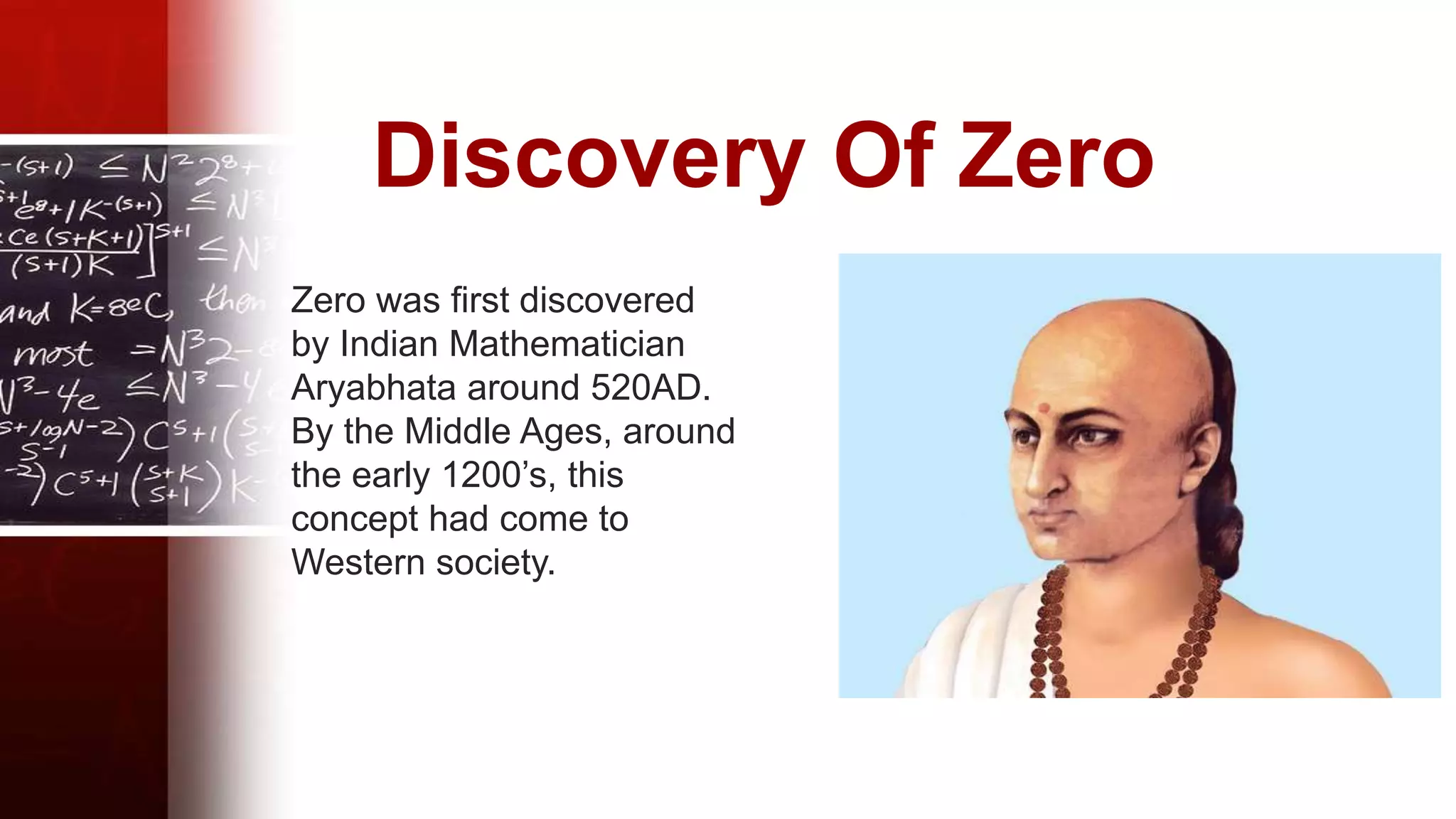
Zero was first discovered
by Indian Mathematician
Aryabhata around 520AD.
By the Middle Ages, around
the early 1200’s, this
concept had come to
Western society.
Before Zero
• Numbers were used for thousands of years before they
used zero
• Historical records show different path towards the concept
• Zero made appearances only to vanish again
• Mathematicians were searching for it ,yet did not recognize
its fundamental significance
Egyptians
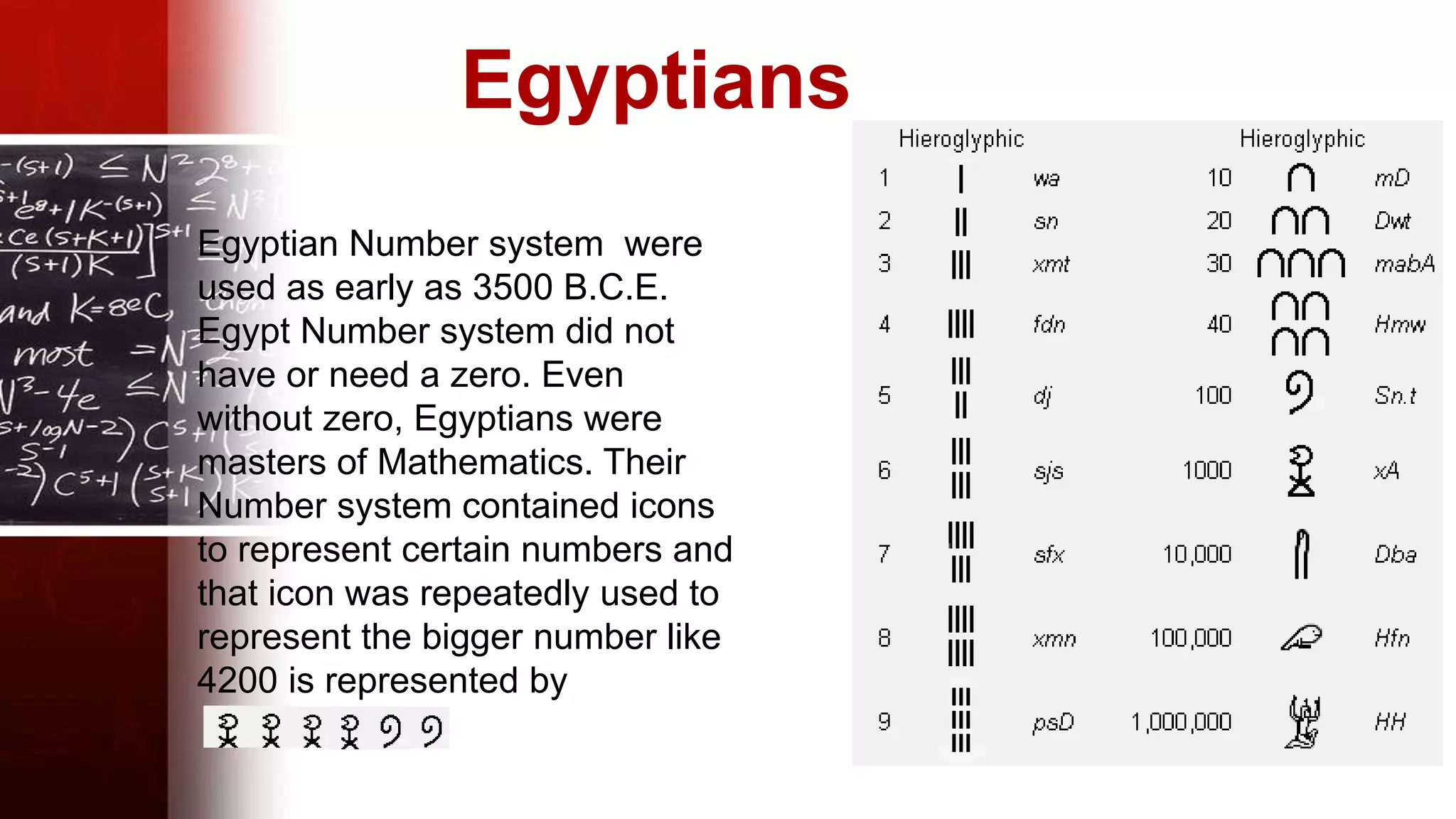
Egyptian Number system were
used as early as 3500 B.C.E.
Egypt Number system did not
have or need a zero. Even
without zero, Egyptians were
masters of Mathematics. Their
Number system contained icons
to represent certain numbers and
that icon was repeatedly used to
represent the bigger number like
4200 is represented by
Greeks
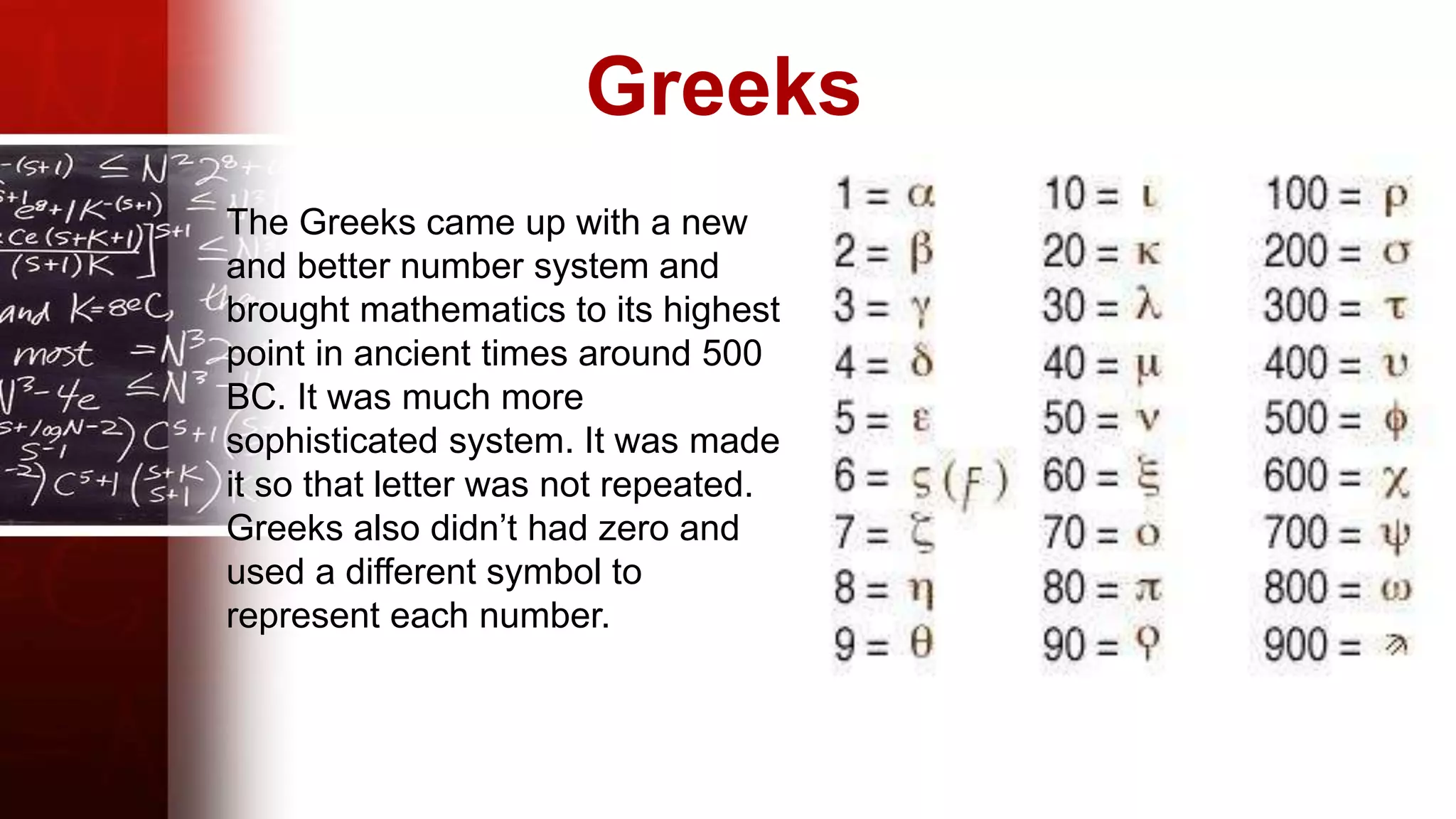
The Greeks came up with a new
and better number system and
brought mathematics to its highest
point in ancient times around 500
BC. It was much more
sophisticated system. It was made
it so that letter was not repeated.
Greeks also didn’t had zero and
used a different symbol to
represent each number.
Romans
The Romans also had a number system
and it is still used in modern life. It was
earlier less sophisticated than Egyptian’s
system. In Roman’s system they use
repeated number like 4505 requires 10
words to represent the number in Roman
number system MMMMCCCCCV.
Even these number systems were sophisticated without the
zero but still they weren’t advanced and people were lacking
arithmetic and accounting behind because of lack of zero. So
the India mathematician Aryabhata finded out the importance
and need of zero at first it was represented by a dot and was
called empty By 500 C.E., the Hindus use a small circle to
represent Zero!
This circle was recognized as a numeral
Invention of zero
• Arabic people recognized the value of the Hindu
system
• They adapted the numerals and computation
• Then spread the ideas in their travels
• The zero was named with the Arabic word sifz
• The actual word “zero” came from Italy
Hindu-Arabic Numerals
Europeans resisted Hindu-Arabic numerals
It seemed strange to them
The numerals, including zero, were not accepted
Florence, Italy, passed a law prohibiting the use of the
numerals
0 could be changed to look like 6 or 9
Slowly, the numbers became accepted
Zero Slowly got
accepted
Spreading The News
Leonardo of Pisa,
known as Fibonacci
• Born to a merchant family
living in North Africa
• Learned Hindu-Arabic
numerals from his Arabic
tutors
• He brought the news of zero
and new computational
methods to Europe in his
book
Importance of Zero
• It plays a central role in math.
i. As a additive identity
ii. in integers ,real nos. and other algebraic structures
iii. As a place holder in the place value system.
iv.It has been called a natural no and has a special role in measuring of
physical quantities.
• In the real-number system, 0 is the only number that is neither
negative nor positive.
It represents the boundary between the negative and the positive
numbers.
This property makes the natural starting point, or origin, on many
scales, as on the coordinate axes and on thermometers.
Zero is special
• If we add 0 to any number, the sum is the original
number
• Same is true for subtraction
• If you multiply any number by 0, the product is 0
• If you raise any nonzero number to the power of 0, the
resulting number is 1
• If you divide 0 by any nonzero, the quotient is 0
• Any number divided by 0 is undefined
Made By Anshul
Sawhney
Zero Importance for class 9

Zero Importance for class 9

  • 1.
  • 2.
    Discovery Of Zero Zerowas first discovered by Indian Mathematician Aryabhata around 520AD. By the Middle Ages, around the early 1200’s, this concept had come to Western society.
  • 3.
    Before Zero • Numberswere used for thousands of years before they used zero • Historical records show different path towards the concept • Zero made appearances only to vanish again • Mathematicians were searching for it ,yet did not recognize its fundamental significance
  • 4.
    Egyptians Egyptian Number systemwere used as early as 3500 B.C.E. Egypt Number system did not have or need a zero. Even without zero, Egyptians were masters of Mathematics. Their Number system contained icons to represent certain numbers and that icon was repeatedly used to represent the bigger number like 4200 is represented by
  • 5.
    Greeks The Greeks cameup with a new and better number system and brought mathematics to its highest point in ancient times around 500 BC. It was much more sophisticated system. It was made it so that letter was not repeated. Greeks also didn’t had zero and used a different symbol to represent each number.
  • 6.
    Romans The Romans alsohad a number system and it is still used in modern life. It was earlier less sophisticated than Egyptian’s system. In Roman’s system they use repeated number like 4505 requires 10 words to represent the number in Roman number system MMMMCCCCCV.
  • 7.
    Even these numbersystems were sophisticated without the zero but still they weren’t advanced and people were lacking arithmetic and accounting behind because of lack of zero. So the India mathematician Aryabhata finded out the importance and need of zero at first it was represented by a dot and was called empty By 500 C.E., the Hindus use a small circle to represent Zero! This circle was recognized as a numeral Invention of zero
  • 8.
    • Arabic peoplerecognized the value of the Hindu system • They adapted the numerals and computation • Then spread the ideas in their travels • The zero was named with the Arabic word sifz • The actual word “zero” came from Italy Hindu-Arabic Numerals
  • 9.
    Europeans resisted Hindu-Arabicnumerals It seemed strange to them The numerals, including zero, were not accepted Florence, Italy, passed a law prohibiting the use of the numerals 0 could be changed to look like 6 or 9 Slowly, the numbers became accepted Zero Slowly got accepted
  • 10.
    Spreading The News Leonardoof Pisa, known as Fibonacci • Born to a merchant family living in North Africa • Learned Hindu-Arabic numerals from his Arabic tutors • He brought the news of zero and new computational methods to Europe in his book
  • 11.
    Importance of Zero •It plays a central role in math. i. As a additive identity ii. in integers ,real nos. and other algebraic structures iii. As a place holder in the place value system. iv.It has been called a natural no and has a special role in measuring of physical quantities. • In the real-number system, 0 is the only number that is neither negative nor positive. It represents the boundary between the negative and the positive numbers. This property makes the natural starting point, or origin, on many scales, as on the coordinate axes and on thermometers.
  • 12.
    Zero is special •If we add 0 to any number, the sum is the original number • Same is true for subtraction • If you multiply any number by 0, the product is 0 • If you raise any nonzero number to the power of 0, the resulting number is 1 • If you divide 0 by any nonzero, the quotient is 0 • Any number divided by 0 is undefined
  • 13.