- Ancient Indian mathematicians made many significant contributions to areas like geometry, trigonometry, and the concept of zero. Mathematicians like Aryabhata, Brahmagupta, and Bhaskara II developed important theorems and discoveries in these fields.
- Indian mathematics originated from the construction of altars in the Vedic period. Early texts like the Sulba Sutras contained geometric concepts and theorems. Mathematicians like Baudhayana discovered the Pythagorean theorem centuries before Pythagoras.
- A key contribution was the development of the concept of zero and place-value systems by mathematicians like Aryabhata in the 5th-6th centuries AD. This
In this document
Powered by AI
Explores ancient Indian contributions to mathematics and geometry, focusing on the Vedic period and the Sulba Sutras.
Details the invention and significance of zero by Aryabhata and others, its historical acceptance and use in arithmetic.
Discusses ancient Indian concepts of infinity, contributions by Jain mathematicians, and Bhaskara II's theories related to infinity.
Highlights the development of trigonometry in India, including calculations involving the distance between Earth, Sun, and Moon.
Covers historical estimations of pi by Indian mathematicians, including Aryabhata and Madhava, and their contributions.
Reflects on the interconnectedness of mathematical ideas across cultures and the credit due to Indian mathematicians.
Lists sources and references used in the discussion of Indian mathematics and related topics.
Ancient Indian Mathematics
Indiafor centuries has been the home of grand discoveries predominantly in the area of
Mathematics and science. Researching the history of ancient India and their contribution to
the field of Mathematics has enhanced our understanding of the origins which was the
motive for exploring such a vast topic.
Knowing the importance of this project, collectively we gathered and brainstormed ideas
before individually setting out to grasping the unbelievable theories posed by Indian
mathematicians. Regular meetings in conjunction with punctuality enabled the group to
keep updated with the project while the instructions of the leader benefited the group.
The origin and inspiration for Indian mathematics is geometry. It initiated i n India in
construction of the altars meant for Vedic sacrifices. The Vedic period was a period of
history which occurred roughly during the 1700 BCE to 150 BCE. The Sulba sutras which are
known to be the appendices of Vetas are the only sources of knowledge of Indian
mathematics from the Vedic period. They are the manual of the construction of the altars of
worship. It had many suggestions which had a connection with the division of figures such as
triangles and circles. One of the suggestions is of circles being divided in any number of
equal parts by having
diameters (unknown,
2005).
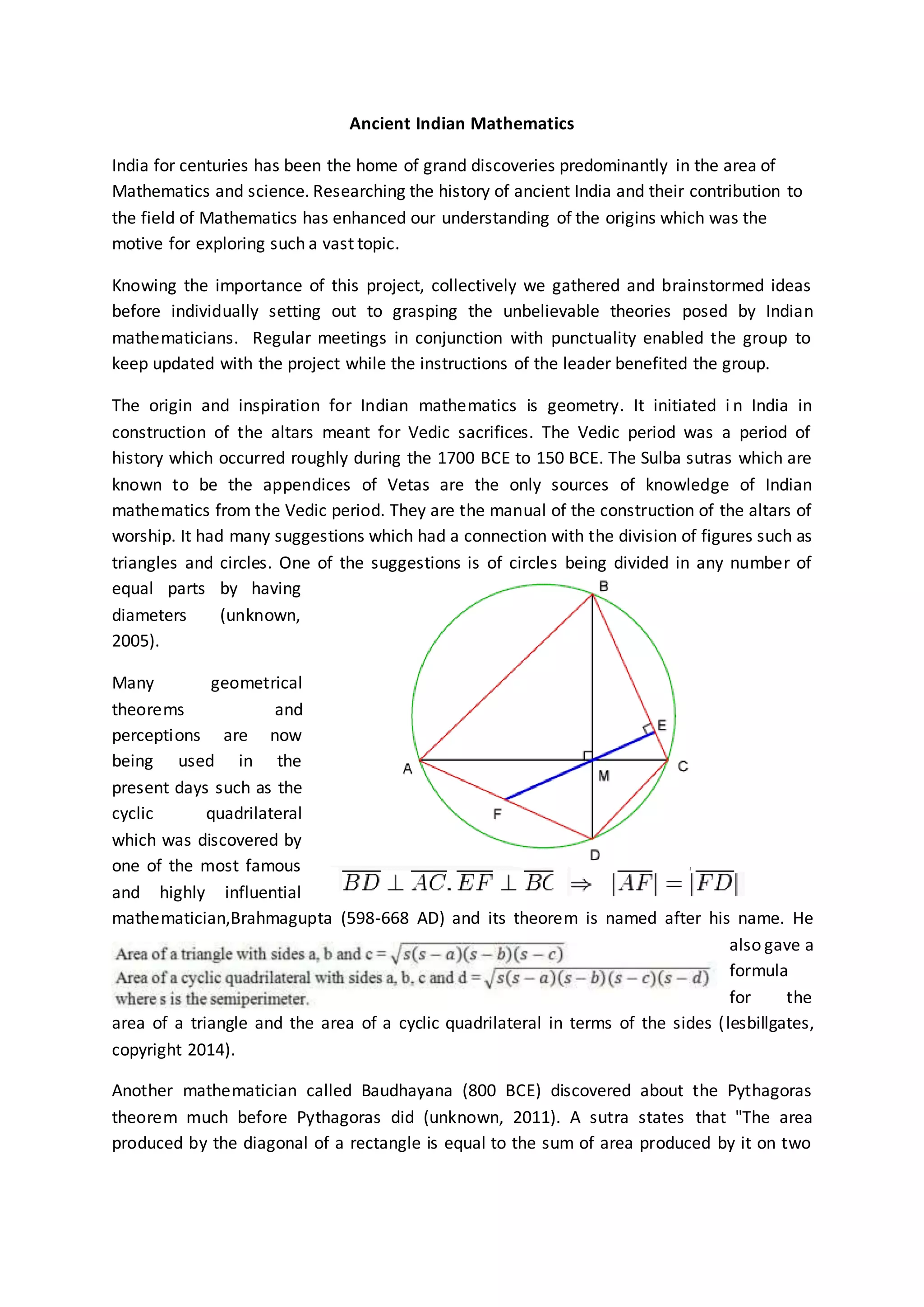
Many geometrical
theorems and
perceptions are now
being used in the
present days such as the
cyclic quadrilateral
which was discovered by
one of the most famous
and highly influential
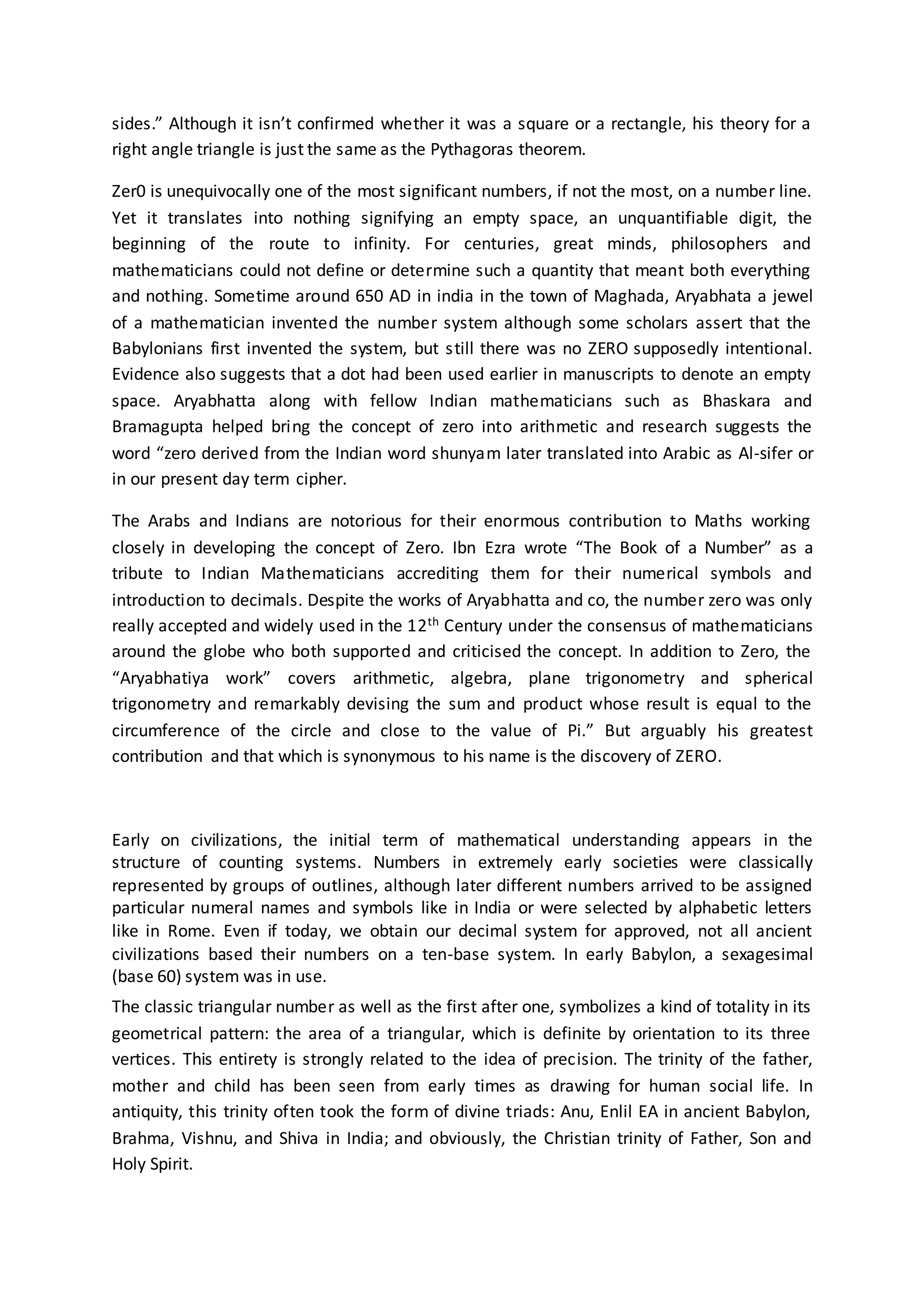
mathematician,Brahmagupta (598-668 AD) and its theorem is named after his name. He
also gave a
formula
for the
area of a triangle and the area of a cyclic quadrilateral in terms of the sides (lesbillgates,
copyright 2014).
Another mathematician called Baudhayana (800 BCE) discovered about the Pythagoras
theorem much before Pythagoras did (unknown, 2011). A sutra states that "The area
produced by the diagonal of a rectangle is equal to the sum of area produced by it on two
2.
sides.” Although itisn’t confirmed whether it was a square or a rectangle, his theory for a
right angle triangle is just the same as the Pythagoras theorem.
Zer0 is unequivocally one of the most significant numbers, if not the most, on a number line.
Yet it translates into nothing signifying an empty space, an unquantifiable digit, the
beginning of the route to infinity. For centuries, great minds, philosophers and
mathematicians could not define or determine such a quantity that meant both everything
and nothing. Sometime around 650 AD in india in the town of Maghada, Aryabhata a jewel
of a mathematician invented the number system although some scholars assert that the
Babylonians first invented the system, but still there was no ZERO supposedly intentional.
Evidence also suggests that a dot had been used earlier in manuscripts to denote an empty
space. Aryabhatta along with fellow Indian mathematicians such as Bhaskara and
Bramagupta helped bring the concept of zero into arithmetic and research suggests the
word “zero derived from the Indian word shunyam later translated into Arabic as Al-sifer or
in our present day term cipher.
The Arabs and Indians are notorious for their enormous contribution to Maths working
closely in developing the concept of Zero. Ibn Ezra wrote “The Book of a Number” as a
tribute to Indian Mathematicians accrediting them for their numerical symbols and
introduction to decimals. Despite the works of Aryabhatta and co, the number zero was only
really accepted and widely used in the 12th Century under the consensus of mathematicians
around the globe who both supported and criticised the concept. In addition to Zero, the
“Aryabhatiya work” covers arithmetic, algebra, plane trigonometry and spherical
trigonometry and remarkably devising the sum and product whose result is equal to the
circumference of the circle and close to the value of Pi.” But arguably his greatest
contribution and that which is synonymous to his name is the discovery of ZERO.
Early on civilizations, the initial term of mathematical understanding appears in the
structure of counting systems. Numbers in extremely early societies were classically
represented by groups of outlines, although later different numbers arrived to be assigned
particular numeral names and symbols like in India or were selected by alphabetic letters
like in Rome. Even if today, we obtain our decimal system for approved, not all ancient
civilizations based their numbers on a ten-base system. In early Babylon, a sexagesimal
(base 60) system was in use.
The classic triangular number as well as the first after one, symbolizes a kind of totality in its
geometrical pattern: the area of a triangular, which is definite by orientation to its three
vertices. This entirety is strongly related to the idea of precision. The trinity of the father,
mother and child has been seen from early times as drawing for human social life. In
antiquity, this trinity often took the form of divine triads: Anu, Enlil EA in ancient Babylon,
Brahma, Vishnu, and Shiva in India; and obviously, the Christian trinity of Father, Son and
Holy Spirit.
3.
There is noevidence of the written number structure of ancient India, however there are
fictional facts that numerical symbols did exist. Examples of written records are obtainable
only from about the time of Ashoka in the third century BCE. The numbers come into view in
various decrees of the king inscribed on pillars all over India. The classification used at this
occasion was varied. There was a ciphered base- 10 system with separate symbols for the
integers 1 through 9 and 10 through 90. For bigger integers, the system was a multiplicative
one comparable to that of the Chinese.
By 1800 BC, Indian mathematicians were considering the concept of infinity, indicating that
‘if you remove a part from infinity or add a part to infinity, what remains is infinity’. The
Jains were the first to consider infinity and to reject the proposal that all infinities were the
same. The Jaina mathematicians believed numbers to be of three types: enumerable,
innumerable and infinite. The Jains detected that there are different types of infinity. Jaina
mathematics went on to classify five different kinds of infinity: infinite in one direction,
infinite in two directions, infinite in area, infinite everywhere and perpetually infinite. Jaina
mathematics refers to mathematics prepared by those who follow the religion and
philosophy of Jainism.
Bhaskara II was the first to propose that any number divided by zero is equal to infinity
(n/0=∞) and the sum of any number and infinity also equals infinity. He noticed that
dividing one piece into a half you get 2 pieces, if you divide it into a third you get 3 pieces
and so on. As a result when you divide 1 into smaller and smaller fractions, you get more
and more pieces. So, ultimately when you divide a piece which is of zero size, you will have
infinitely many pieces therefore pointing out that 1 divided by zero is infinity. The concept
of infinity has many practical applications in cosmology and calculus. In calculus, it is used to
calculate limits of a function. Cosmologists are trying to figure out whether infinity exists in
our universe.
The golden Age of Indian mathematics extended from the 5th century to the 12th centuries
and many of its discoveries were also discovered in the several western countries after this
period. Trigonometry began to evolve from the early part of the golden Age (500s AD).
Indian contribution to mathematics in recent modern history has been given
acknowledgement.
The Indian Mathematician who produced definitions of sine, cosine and inverse sine was
‘Aryabhata’. He specified completed sine and inverse sine tables in intervals of 3.75° from 0°
to 90° accurate to 4 decimal places. Also he was the one who was able to first solve
solutions of simultaneous quadratic equations and produced the approximation value of π.
4.
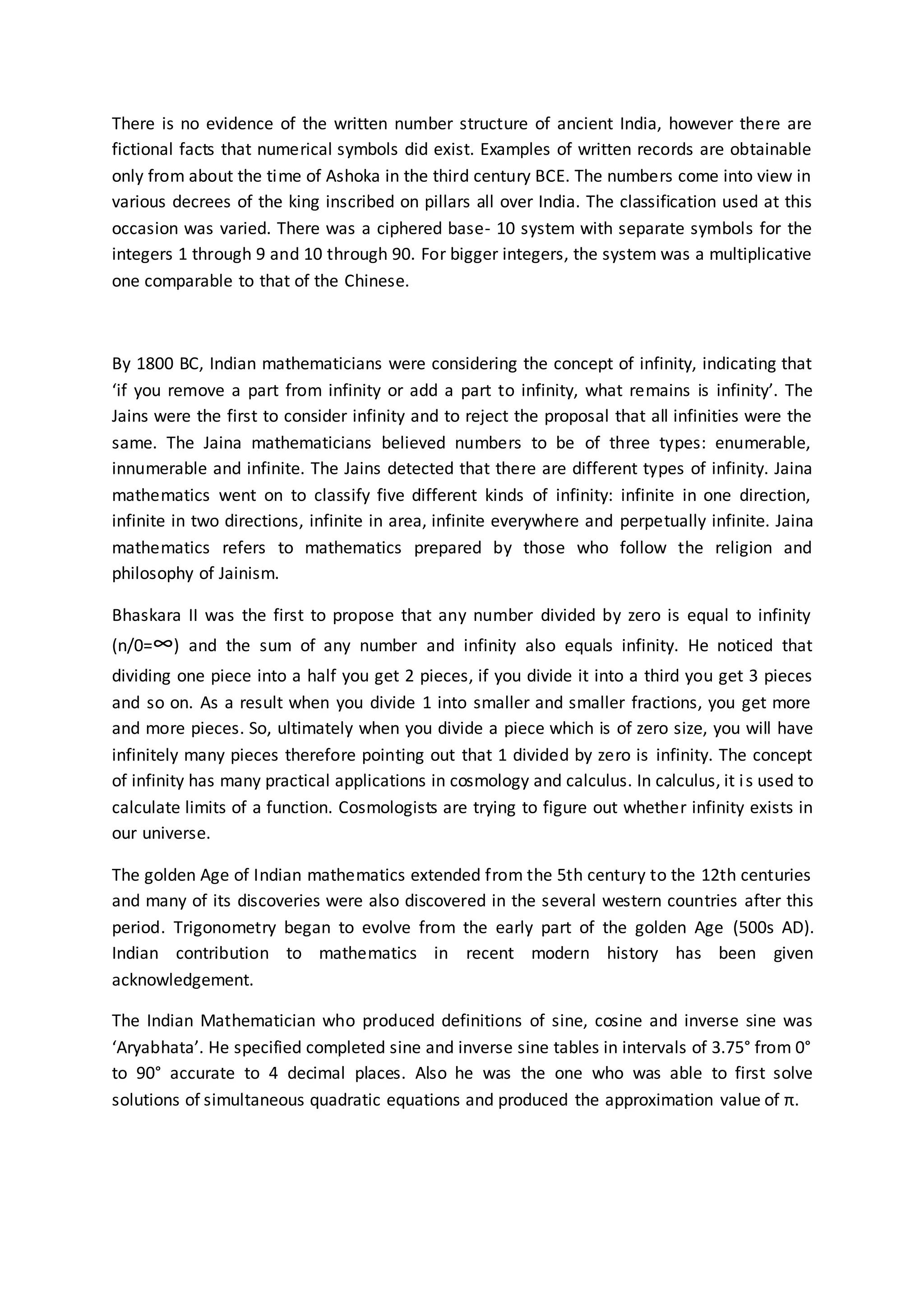
Indian astronomers usedtrigonometry tables to estimate the relative
distance of the Earth to the Sun and Moon
Indian Mathematicians made great advances in understanding the theory of trigonometry,
by linking geometry and numbers together were initially used by the Greeks. But it was the
Indian mathematicians who really began to use things such as the sine, cosine and tangent
functions (relating the angle of triangle to the lengths of its adjacent sides) to observe the
seas, survey the land and most importantly to calculate space.
Indian Mathematicians found an approximation to the distance of the Earth and the Sun; by
knowing that when the moon is half visible and is directly opposite to the Sun, it creates a
right angle triangle (moon, sun and earth). They calculated to a high degree of certainty that
the angle of the Sun was 1⁄7°. By using the sin tables they calculated that the ratio of the
sides of the triangle is 400:1 which means “that the Sun is 400 times further away from the
Earth than it is to the Moon”.
Pi, now a well-established number was not always known to the 12.1 trillion decimal places
it is today1. Primarily pi was just known to be a constant. It was said that the Indians were
the first to detect the relation between the circumference and diameter of a circle. 2 The
constant pi can be derived from any circle, the circumference over the diameter will always
equal pi. It was always thought that pi was irrational. The first proof was founded in 1761 by
Johaan Heinrich Lambert, however his theory was found to be too simple to be accepted for
such a complex problem. A more accepted proof was later found by Legendre in 1794 which
coincided with Lambert's proof. The sign π (a Greek symbol) was first used on its own by
WilliamJones in his Synopsis Palmariorum Matheseos. 30 years later the symbol became a
standard mathematical notation.
In c. 2000 BC the ratio of the value of pi was first estimated to roughly 3 by the Babylonians,
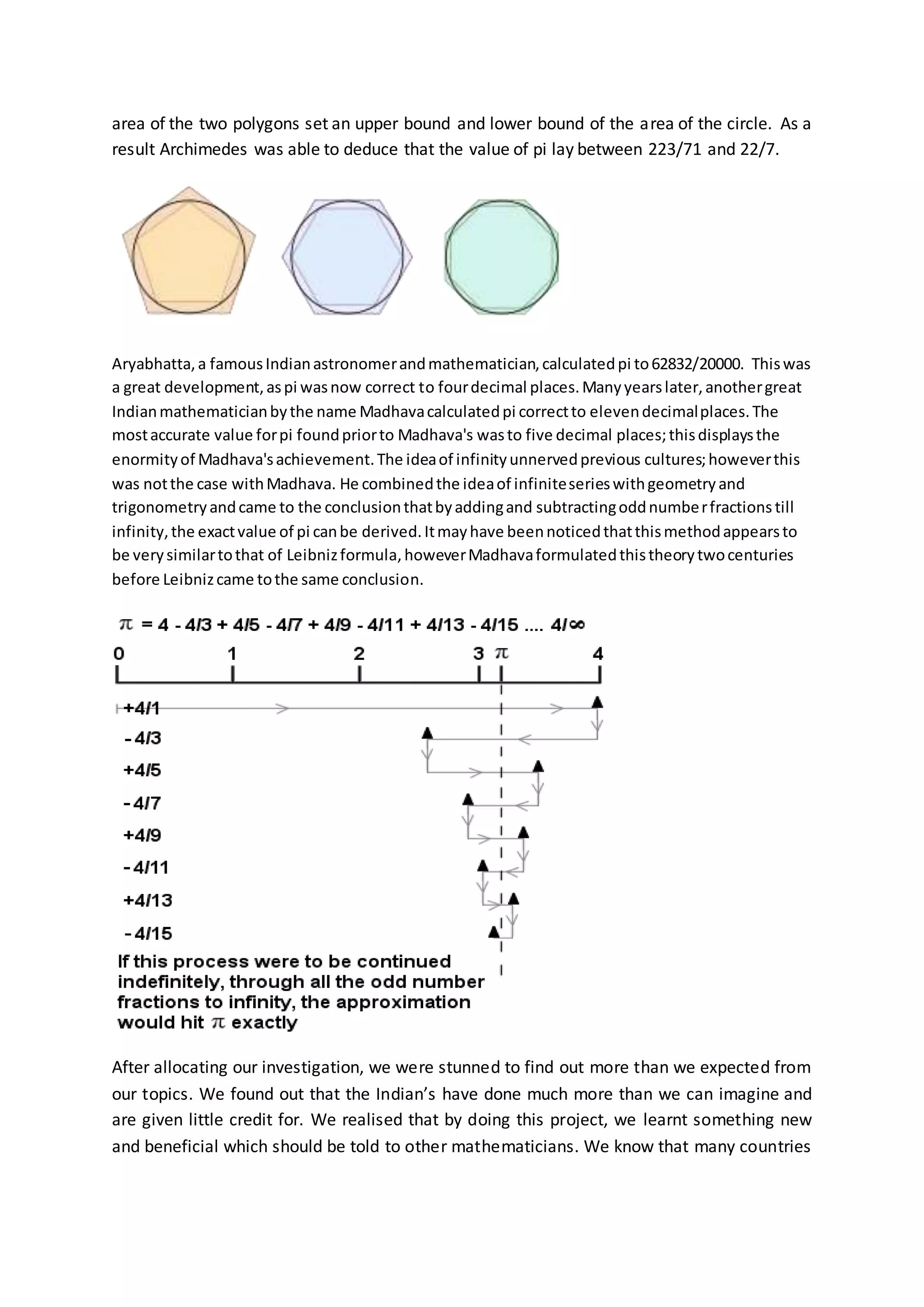
this was later revised 3.125. Archimedes was the first to evaluate a theoretical calculation
for the estimate of pi. This was achieved by approximating the area of two polygons, one of
which was inscribed within the circle, while the other had the circle inscribed within it. The
5.
area of thetwo polygons set an upper bound and lower bound of the area of the circle. As a
result Archimedes was able to deduce that the value of pi lay between 223/71 and 22/7.
Aryabhatta,a famousIndianastronomerandmathematician,calculatedpi to62832/20000. Thiswas
a great development,aspi wasnow correct to fourdecimal places.Manyyearslater,anothergreat
Indianmathematicianbythe name Madhavacalculatedpi correctto elevendecimalplaces.The
mostaccurate value forpi foundpriorto Madhava's wasto five decimal places;thisdisplaysthe
enormityof Madhava'sachievement.The ideaof infinityunnervedprevious cultures;howeverthis
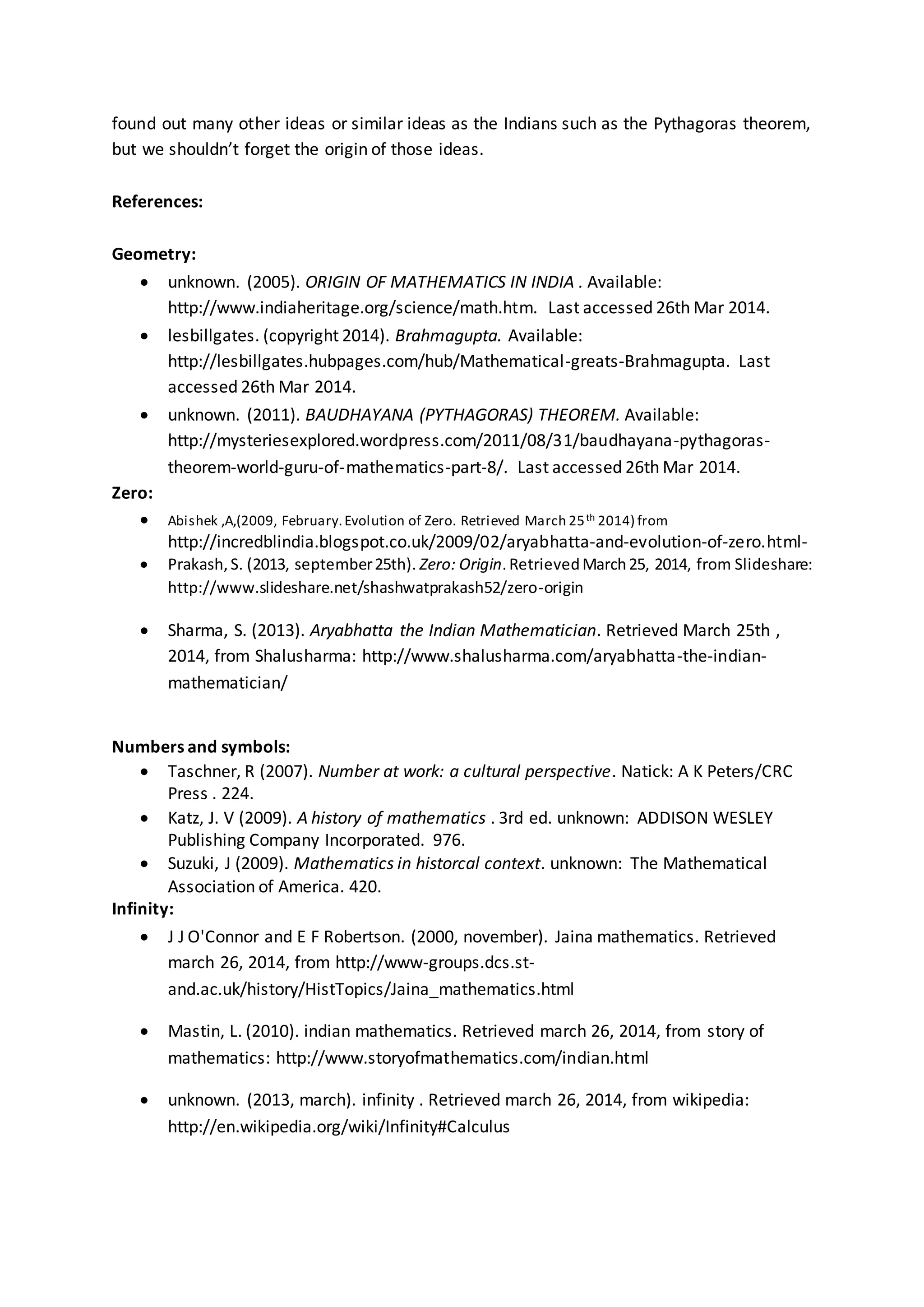
was notthe case withMadhava. He combinedthe ideaof infiniteserieswithgeometryand
trigonometryandcame to the conclusionthatbyaddingand subtractingoddnumberfractions till
infinity,the exactvalue of pi canbe derived.Itmayhave beennoticedthatthismethodappearsto
be verysimilartothat of Leibnizformula,howeverMadhavaformulatedthistheorytwocenturies
before Leibnizcame tothe same conclusion.
After allocating our investigation, we were stunned to find out more than we expected from
our topics. We found out that the Indian’s have done much more than we can imagine and
are given little credit for. We realised that by doing this project, we learnt something new
and beneficial which should be told to other mathematicians. We know that many countries
6.
found out manyother ideas or similar ideas as the Indians such as the Pythagoras theorem,
but we shouldn’t forget the origin of those ideas.
References:
Geometry:
unknown. (2005). ORIGIN OF MATHEMATICS IN INDIA . Available:
http://www.indiaheritage.org/science/math.htm. Last accessed 26th Mar 2014.
lesbillgates. (copyright 2014). Brahmagupta. Available:
http://lesbillgates.hubpages.com/hub/Mathematical-greats-Brahmagupta. Last
accessed 26th Mar 2014.
unknown. (2011). BAUDHAYANA (PYTHAGORAS) THEOREM. Available:
http://mysteriesexplored.wordpress.com/2011/08/31/baudhayana-pythagoras-
theorem-world-guru-of-mathematics-part-8/. Last accessed 26th Mar 2014.
Zero:
Abishek ,A,(2009, February.Evolution of Zero. Retrieved March 25th 2014) from
http://incredblindia.blogspot.co.uk/2009/02/aryabhatta-and-evolution-of-zero.html-
Prakash,S. (2013, september25th). Zero: Origin.RetrievedMarch25, 2014, from Slideshare:
http://www.slideshare.net/shashwatprakash52/zero-origin
Sharma, S. (2013). Aryabhatta the Indian Mathematician. Retrieved March 25th ,
2014, from Shalusharma: http://www.shalusharma.com/aryabhatta-the-indian-
mathematician/
Numbers and symbols:
Taschner, R (2007). Number at work: a cultural perspective. Natick: A K Peters/CRC
Press . 224.
Katz, J. V (2009). A history of mathematics . 3rd ed. unknown: ADDISON WESLEY
Publishing Company Incorporated. 976.
Suzuki, J (2009). Mathematics in historcal context. unknown: The Mathematical
Association of America. 420.
Infinity:
J J O'Connor and E F Robertson. (2000, november). Jaina mathematics. Retrieved
march 26, 2014, from http://www-groups.dcs.st-
and.ac.uk/history/HistTopics/Jaina_mathematics.html
Mastin, L. (2010). indian mathematics. Retrieved march 26, 2014, from story of
mathematics: http://www.storyofmathematics.com/indian.html
unknown. (2013, march). infinity . Retrieved march 26, 2014, from wikipedia:
http://en.wikipedia.org/wiki/Infinity#Calculus
7.
Trigonometry:
Unknown.(2014). Indianmathematiciansand discoveriesin trigonometry.RetrievedMarch
23rd, 2014, from BBC LearningZone:http://www.bbc.co.uk/learningzone/clips/indian-
mathematicians-and-discoveries-in-trigonometry/11267.html
Mastin, L. (2010). indian mathematics.Retrievedmarch26, 2014, from storyof
mathematics:http://www.storyofmathematics.com/indian.html
Unknown.(n.d.). Indian Mathematics .RetrievedMarch23, 2014, from Wikipedia:
http://en.wikipedia.org/w/index.php?title=Indian_mathematics&action=history
Rogers,L. (1997 - 2014 ). History of Trigonometry - Part3. RetrievedMarch24 , 2014, from
nrichenrichingmathematics:http://nrich.maths.org/6908
History of Pi:
howArrybhatta approximated thevalueof pi. (2011, August31). RetrievedMarch15, 2014,
fromIndicTruth: http://indictruth.blogspot.co.uk/2011/08/how-aryabhatta-approximated-
value-of-pi.html
Unknown,
( http://indictruth.blogspot.co.uk/2011/08/how-aryabhatta-approximated-value-of-pi.html
http://www-groups.dcs.st-and.ac.uk/history/HistTopics/Pi_chronology.html
http://www.ualr.edu/lasmoller/pi.html
http://www.exploratorium.edu/pi/history_of_pi/index.html
http://www.oracle.com/splash/thinkquest/down-189973.html
http://www.scientificamerican.com/article/what-is-pi-and-how-did-it/
http://www.britannica.com/EBchecked/topic/458986/pi
http://souravroy.com/2011/01/07/pi-in-indian-mathematics/
http://www.storyofmathematics.com/indian_madhava.html


![A Reviewer for Math History and Trivia [Not Updated]](https://cdn.slidesharecdn.com/ss_thumbnails/mathhistoryandtriviareviewer-240320201819-f1b01a44-thumbnail.jpg?width=640&height=640&fit=bounds)


