Story Of Pi
A Presentation By:-
Zamaan Khan Lodhi
Class IX A
Roll No.: 43
What is Pi?
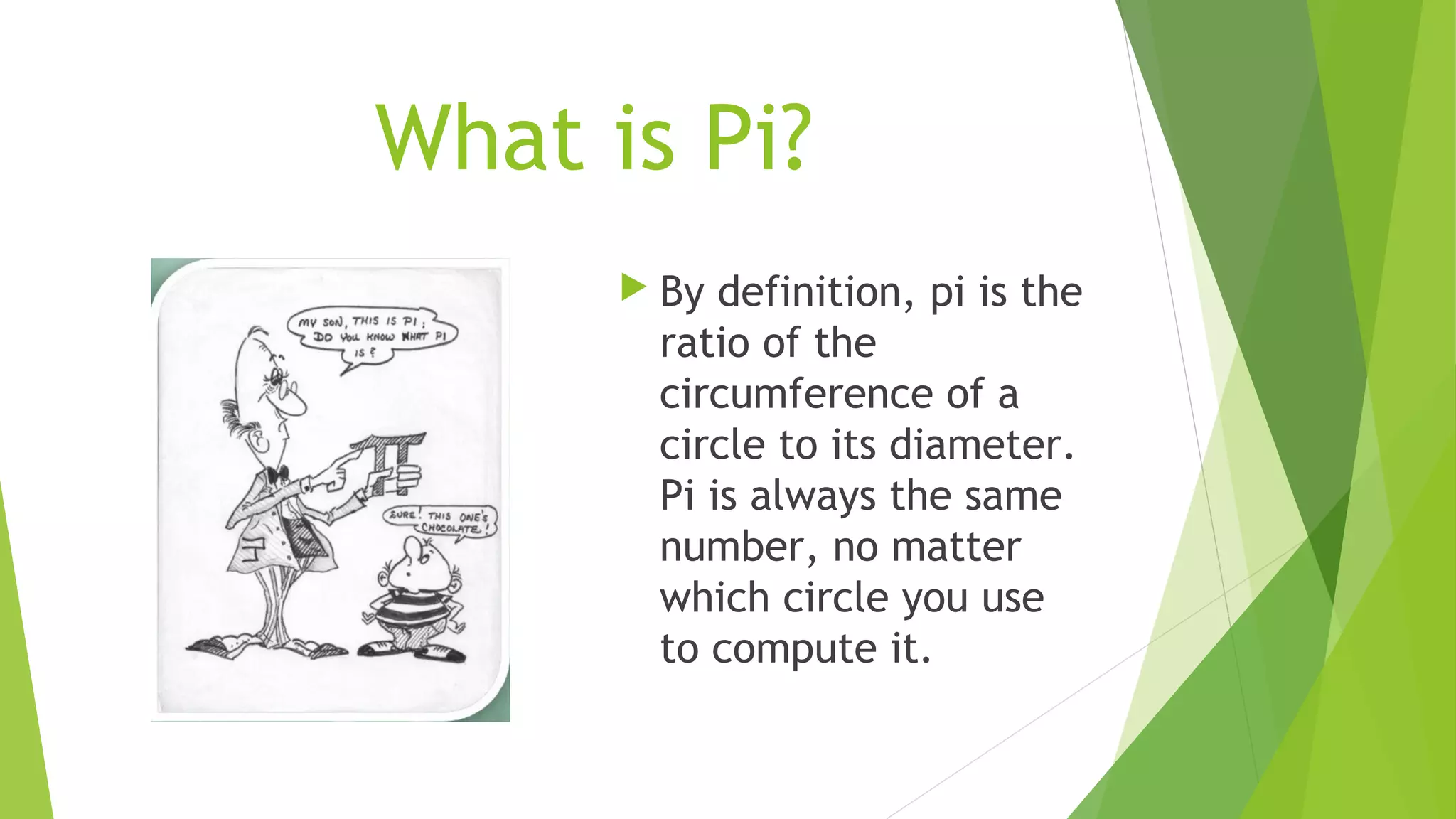
 By definition, pi is the
ratio of the
circumference of a
circle to its diameter.
Pi is always the same
number, no matter
which circle you use
to compute it.
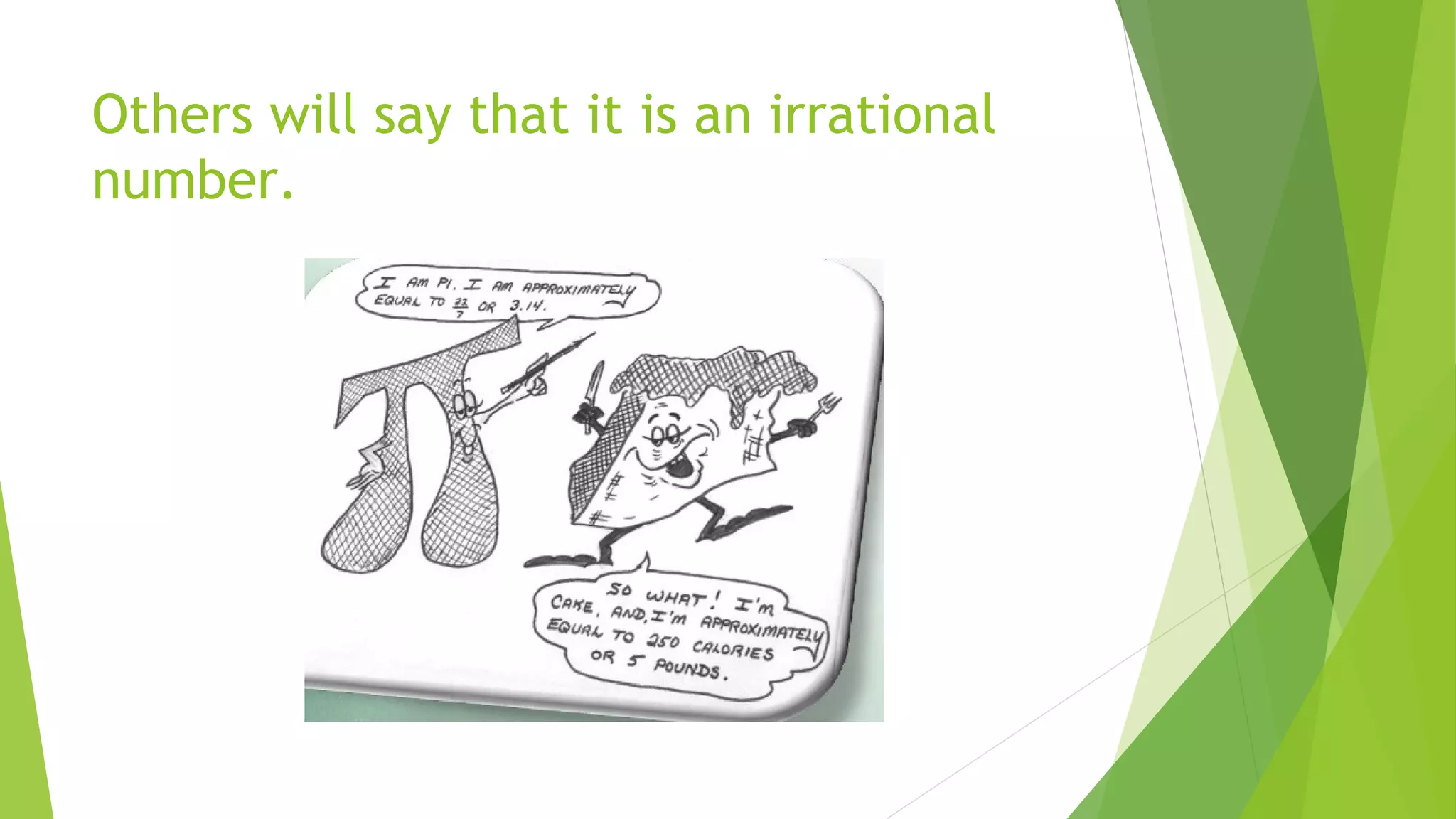
Others will say that it is an irrational
number.
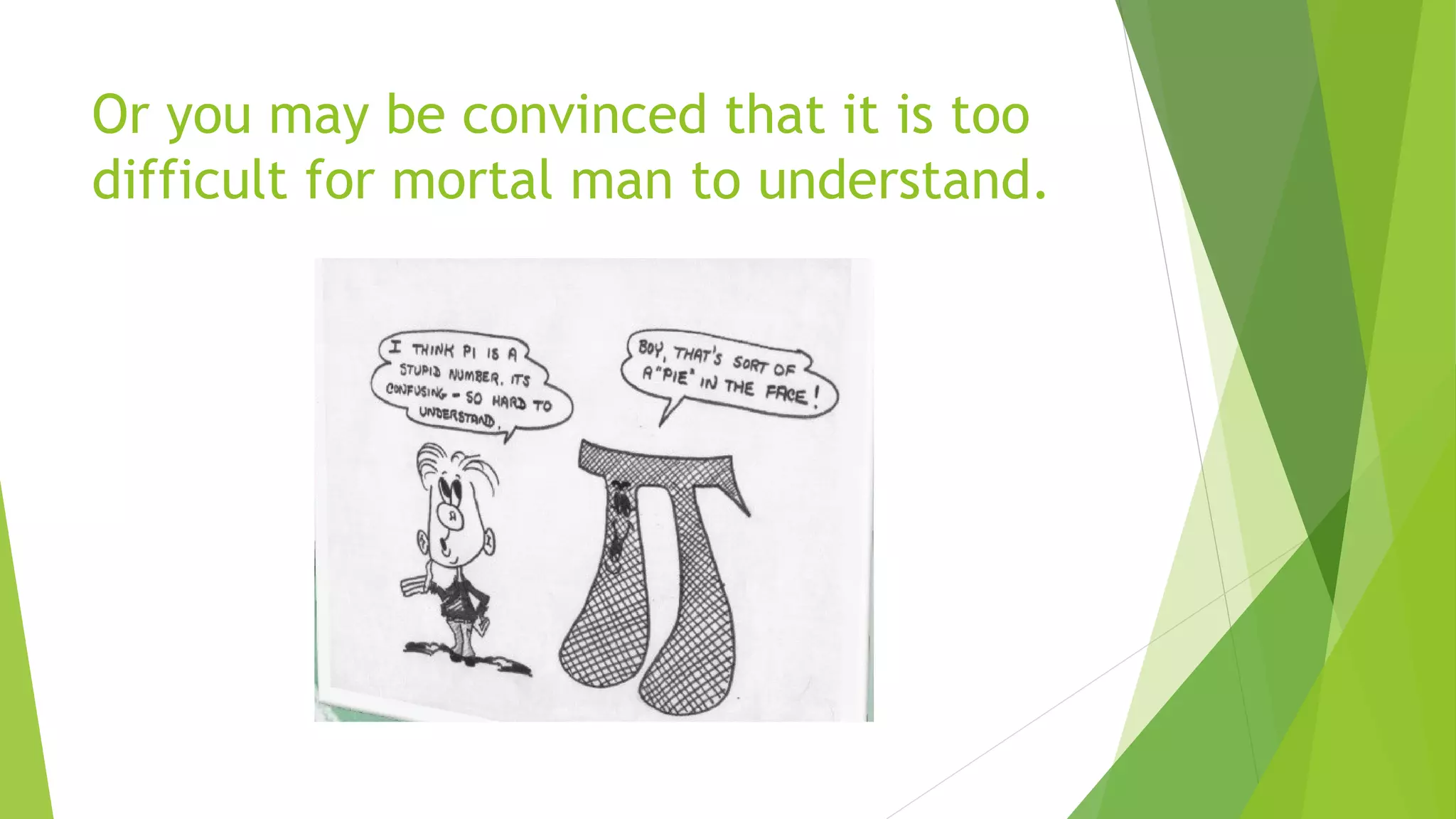
Or you may be convinced that it is too
difficult for mortal man to understand.
What’s the formula??
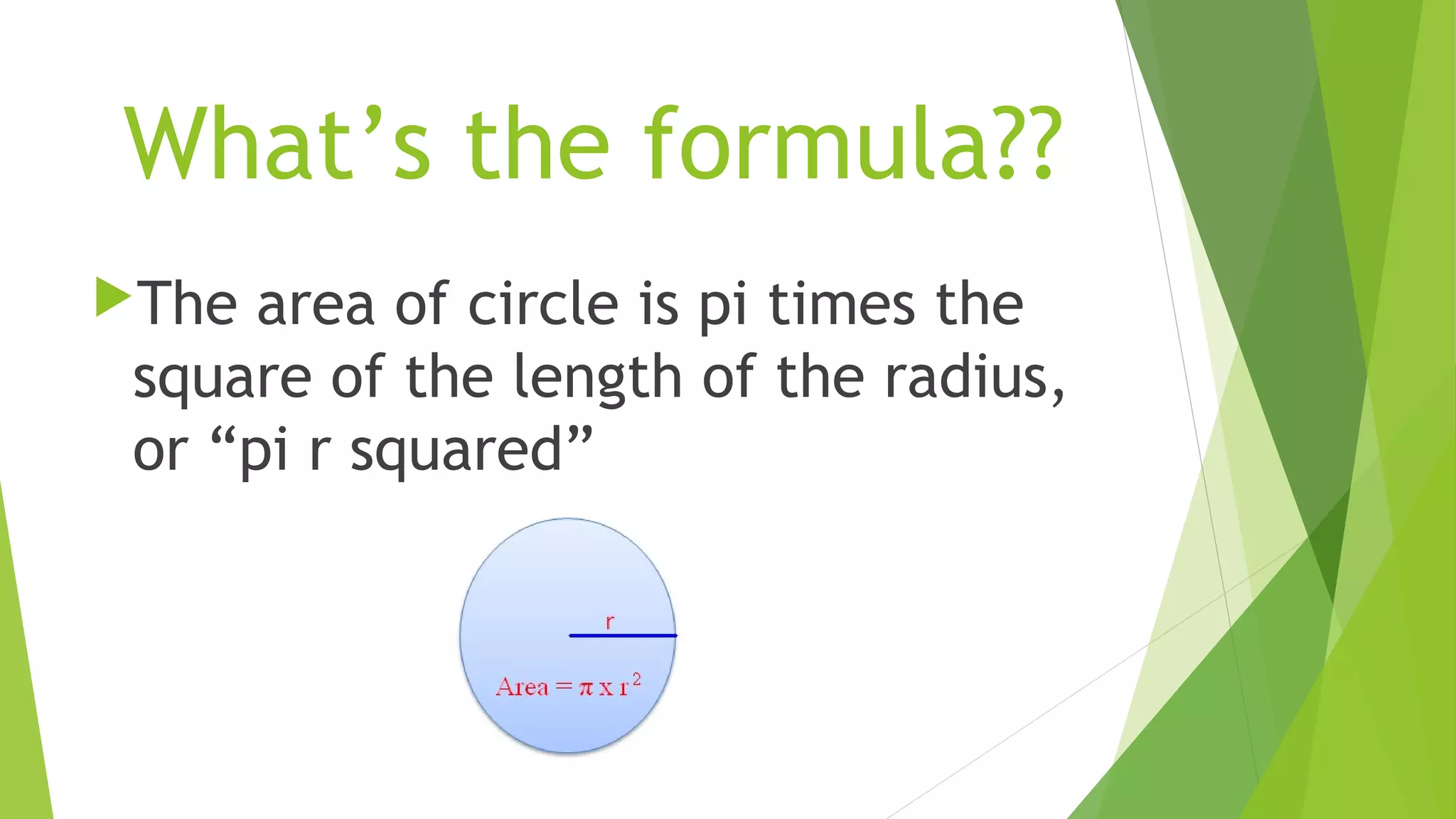
The area of circle is pi times the
square of the length of the radius,
or “pi r squared”
The History of Pi
 Pi is a very old number.
 We know that the Egyptians and the Babylonians knew
about the existence of the constant ratio pi, although they
didn’t know its value nearly as well as we do today.
 They had figured out that it was a little bigger than 3; the
Babylonians had an approximation of 3 1/8 (3.125), and
the Egyptians had an somewhat worse approximation of
3.160484, which was slightly less accurate and much
harder to work with.
 Modern day technology allows us to calculate pi to billions
of decimal places. 3.14 is usually all we need.
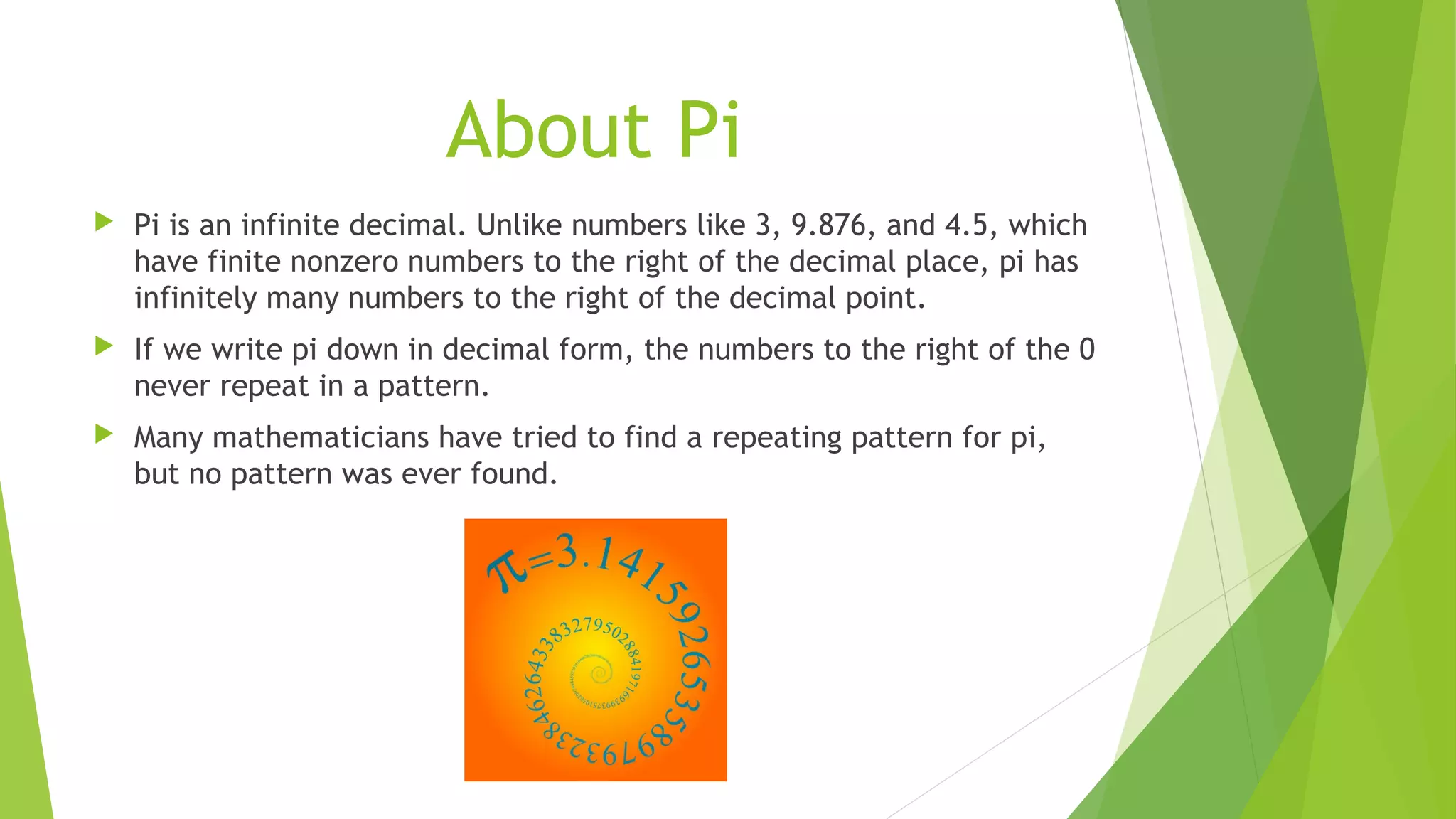
About Pi
 Pi is an infinite decimal. Unlike numbers like 3, 9.876, and 4.5, which
have finite nonzero numbers to the right of the decimal place, pi has
infinitely many numbers to the right of the decimal point.
 If we write pi down in decimal form, the numbers to the right of the 0
never repeat in a pattern.
 Many mathematicians have tried to find a repeating pattern for pi,
but no pattern was ever found.
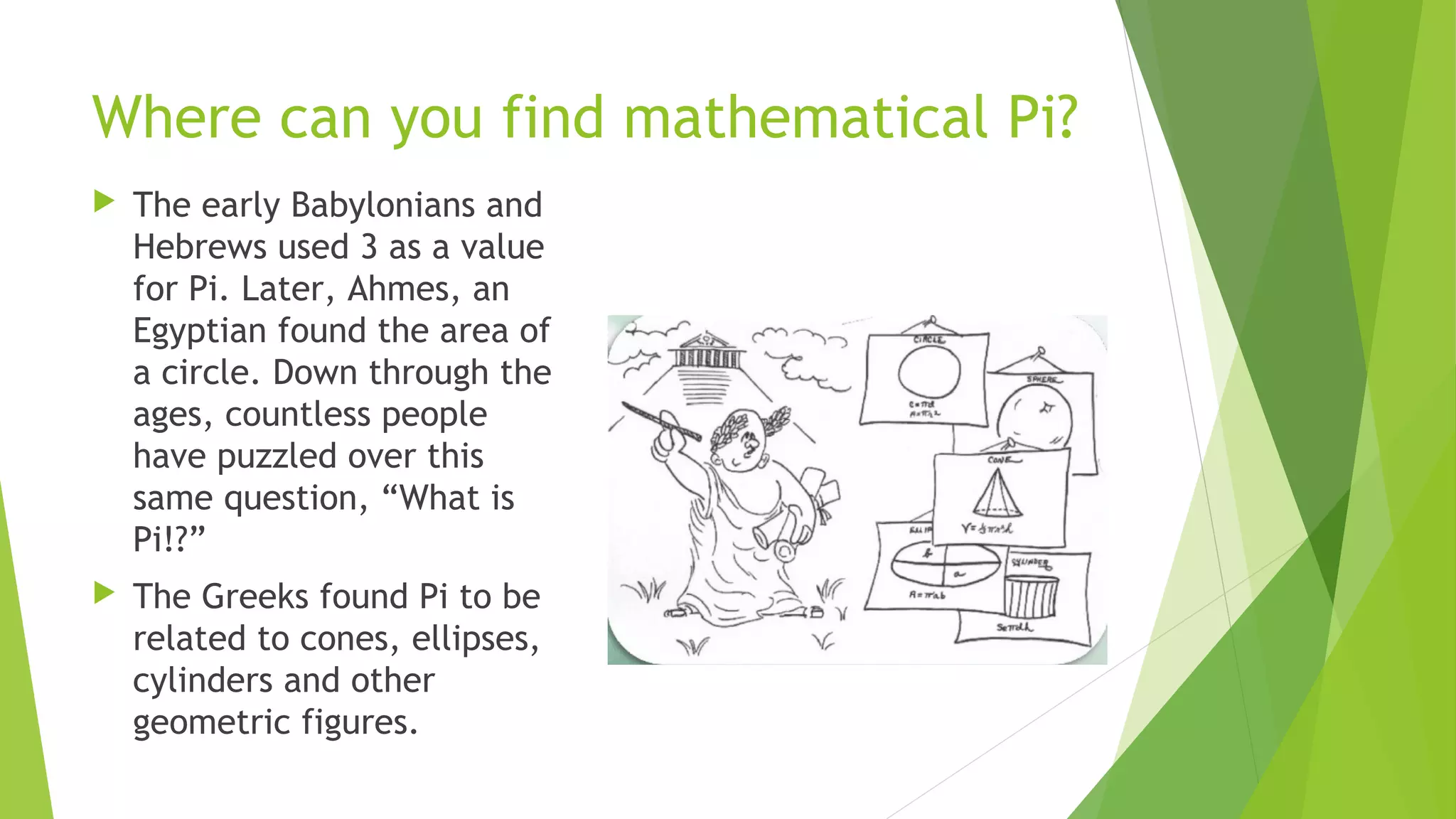
Where can you find mathematical Pi?
 The early Babylonians and
Hebrews used 3 as a value
for Pi. Later, Ahmes, an
Egyptian found the area of
a circle. Down through the
ages, countless people
have puzzled over this
same question, “What is
Pi!?”
 The Greeks found Pi to be
related to cones, ellipses,
cylinders and other
geometric figures.
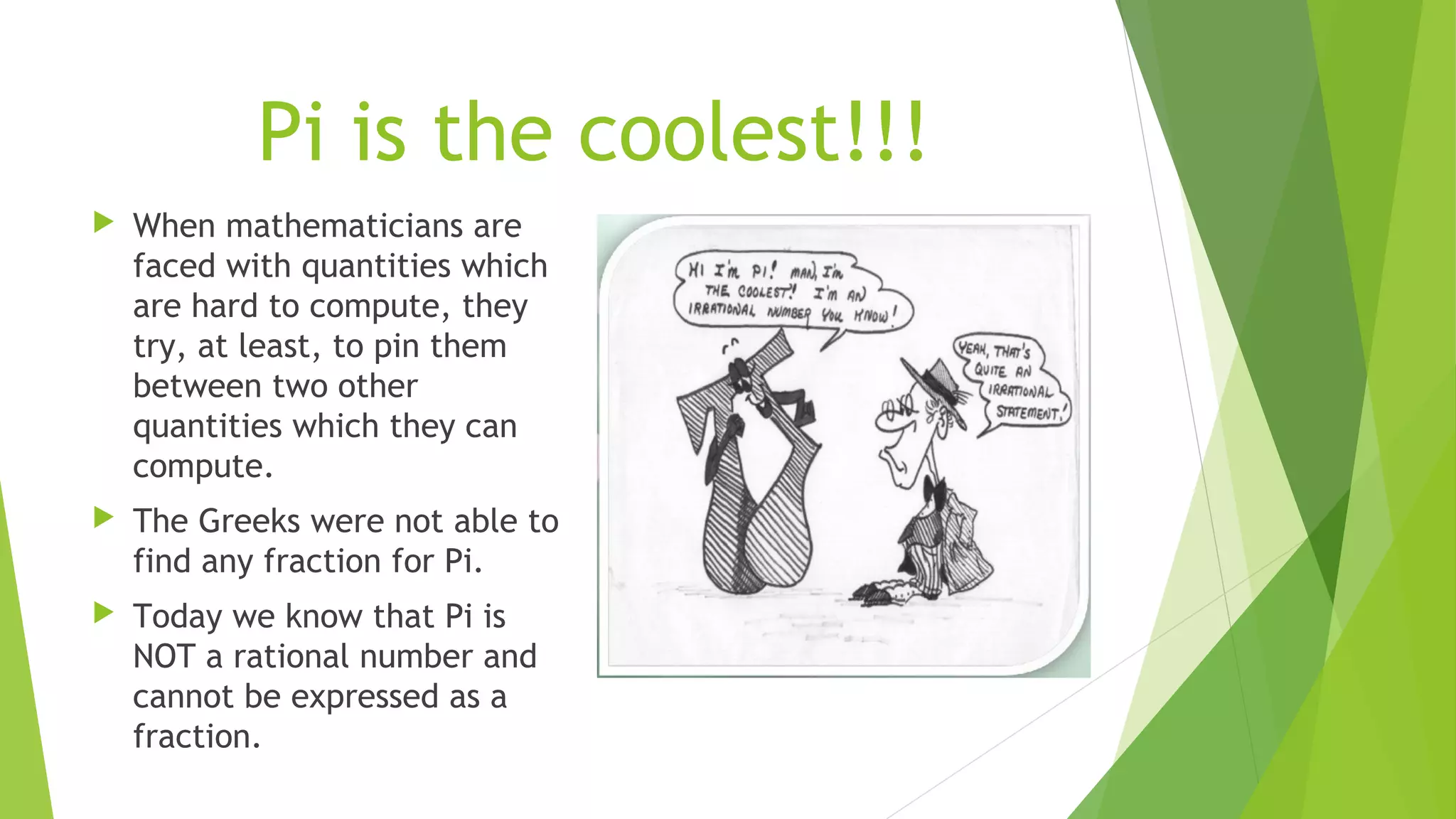
Pi is the coolest!!!
 When mathematicians are
faced with quantities which
are hard to compute, they
try, at least, to pin them
between two other
quantities which they can
compute.
 The Greeks were not able to
find any fraction for Pi.
 Today we know that Pi is
NOT a rational number and
cannot be expressed as a
fraction.
Analytical Geometry and Calculus
During the 17th
Century, analytical geometry and calculus
were developed, They had an immediate effect on Pi. Pi was
free from the circle! An ellipse has an formula for its area
which involves Pi; but this is also true for the Sphere,
Cycloid Arc, Hypocycloid, The Witch, and many other curves.
Anyone for Pi?
 Its curious how certain
topics in Mathematics
show up over and
over. In the late 1940s
two new mathematical
streams (electronic
computing and
statistics) put Pi on
the table again.
Digit Dancing
 The development of high
speed electronic
equipment provided a
means for rapid
computation. Inquiries
regarding the number of
Pi’s digits; not what the
numbers were
individually, but how they
behave statistically
provided the motive for
additional research.
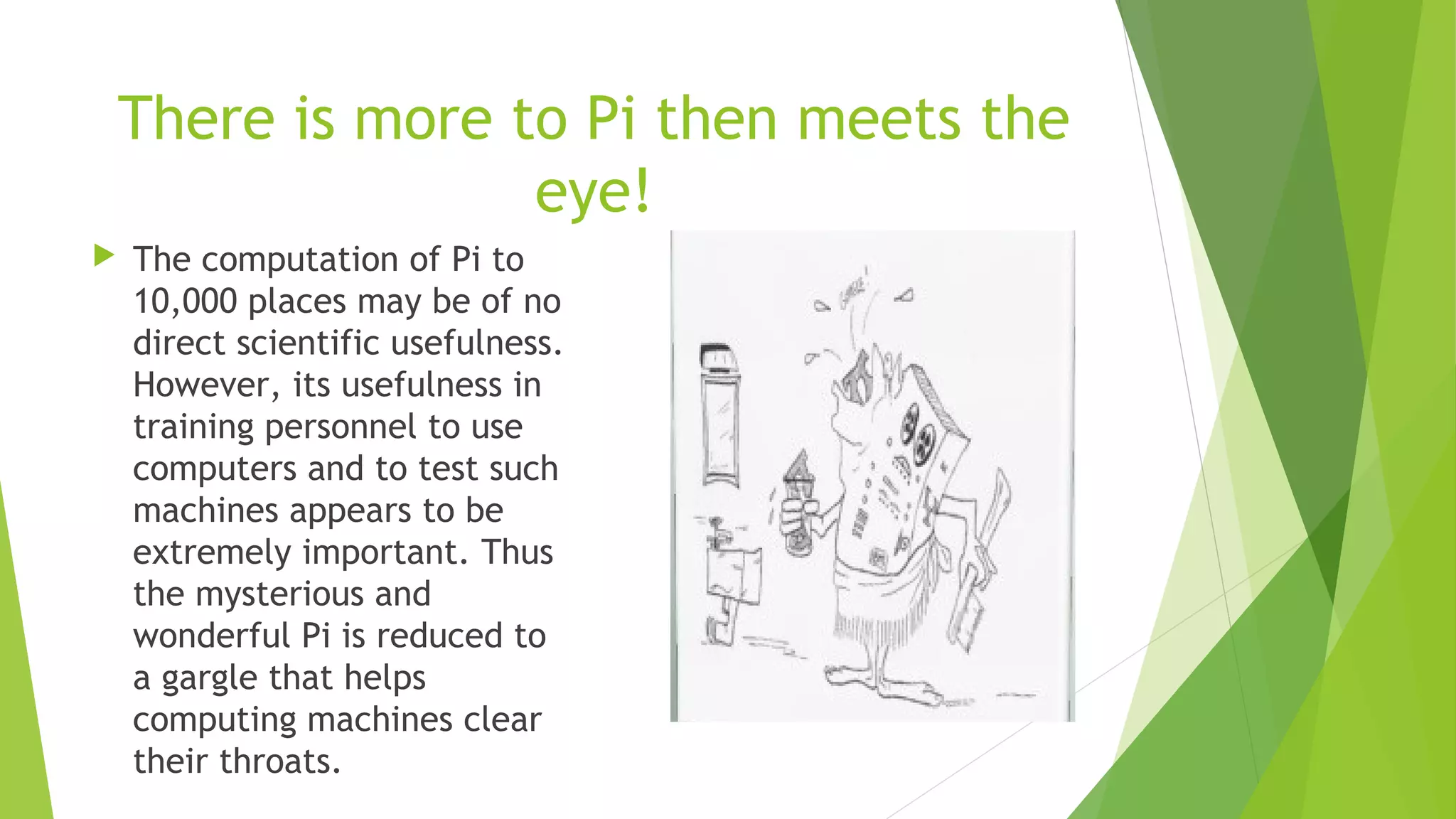
There is more to Pi then meets the
eye!
 The computation of Pi to
10,000 places may be of no
direct scientific usefulness.
However, its usefulness in
training personnel to use
computers and to test such
machines appears to be
extremely important. Thus
the mysterious and
wonderful Pi is reduced to
a gargle that helps
computing machines clear
their throats.
Pi You!!!Thank You!!!

Story of pi

  • 1.
    Story Of Pi APresentation By:- Zamaan Khan Lodhi Class IX A Roll No.: 43
  • 2.
    What is Pi? By definition, pi is the ratio of the circumference of a circle to its diameter. Pi is always the same number, no matter which circle you use to compute it.
  • 3.
    Others will saythat it is an irrational number.
  • 4.
    Or you maybe convinced that it is too difficult for mortal man to understand.
  • 5.
    What’s the formula?? Thearea of circle is pi times the square of the length of the radius, or “pi r squared”
  • 6.
    The History ofPi  Pi is a very old number.  We know that the Egyptians and the Babylonians knew about the existence of the constant ratio pi, although they didn’t know its value nearly as well as we do today.  They had figured out that it was a little bigger than 3; the Babylonians had an approximation of 3 1/8 (3.125), and the Egyptians had an somewhat worse approximation of 3.160484, which was slightly less accurate and much harder to work with.  Modern day technology allows us to calculate pi to billions of decimal places. 3.14 is usually all we need.
  • 7.
    About Pi  Piis an infinite decimal. Unlike numbers like 3, 9.876, and 4.5, which have finite nonzero numbers to the right of the decimal place, pi has infinitely many numbers to the right of the decimal point.  If we write pi down in decimal form, the numbers to the right of the 0 never repeat in a pattern.  Many mathematicians have tried to find a repeating pattern for pi, but no pattern was ever found.
  • 8.
    Where can youfind mathematical Pi?  The early Babylonians and Hebrews used 3 as a value for Pi. Later, Ahmes, an Egyptian found the area of a circle. Down through the ages, countless people have puzzled over this same question, “What is Pi!?”  The Greeks found Pi to be related to cones, ellipses, cylinders and other geometric figures.
  • 9.
    Pi is thecoolest!!!  When mathematicians are faced with quantities which are hard to compute, they try, at least, to pin them between two other quantities which they can compute.  The Greeks were not able to find any fraction for Pi.  Today we know that Pi is NOT a rational number and cannot be expressed as a fraction.
  • 10.
    Analytical Geometry andCalculus During the 17th Century, analytical geometry and calculus were developed, They had an immediate effect on Pi. Pi was free from the circle! An ellipse has an formula for its area which involves Pi; but this is also true for the Sphere, Cycloid Arc, Hypocycloid, The Witch, and many other curves.
  • 11.
    Anyone for Pi? Its curious how certain topics in Mathematics show up over and over. In the late 1940s two new mathematical streams (electronic computing and statistics) put Pi on the table again.
  • 12.
    Digit Dancing  Thedevelopment of high speed electronic equipment provided a means for rapid computation. Inquiries regarding the number of Pi’s digits; not what the numbers were individually, but how they behave statistically provided the motive for additional research.
  • 13.
    There is moreto Pi then meets the eye!  The computation of Pi to 10,000 places may be of no direct scientific usefulness. However, its usefulness in training personnel to use computers and to test such machines appears to be extremely important. Thus the mysterious and wonderful Pi is reduced to a gargle that helps computing machines clear their throats.
  • 14.