@crichardson
Migrating a monolith to
microservices? A dark energy,
dark matter perspective
Chris Richardson
Founder of Eventuate.io
Founder of the original CloudFoundry.com
Author of POJOs in Action and Microservices Patterns
@crichardson
chris@chrisrichardson.net
adopt.microservices.io
Copyright © 2022. Chris Richardson Consulting, Inc. All rights reserved
@crichardson
O
V
I
D
-
1
9
https://www.ft.com/content/f9356bdc-3102-11ea-a329-0bcf87a328f2
https://www.ft.com/content/3f498e64-1aa6-11ea-97df-cc63de1d73f4
https://techcrunch.com/2019/06/18/the-rise-of-the-gig-economy-helps-london-based-insurtech-zego-to-raise-42m/
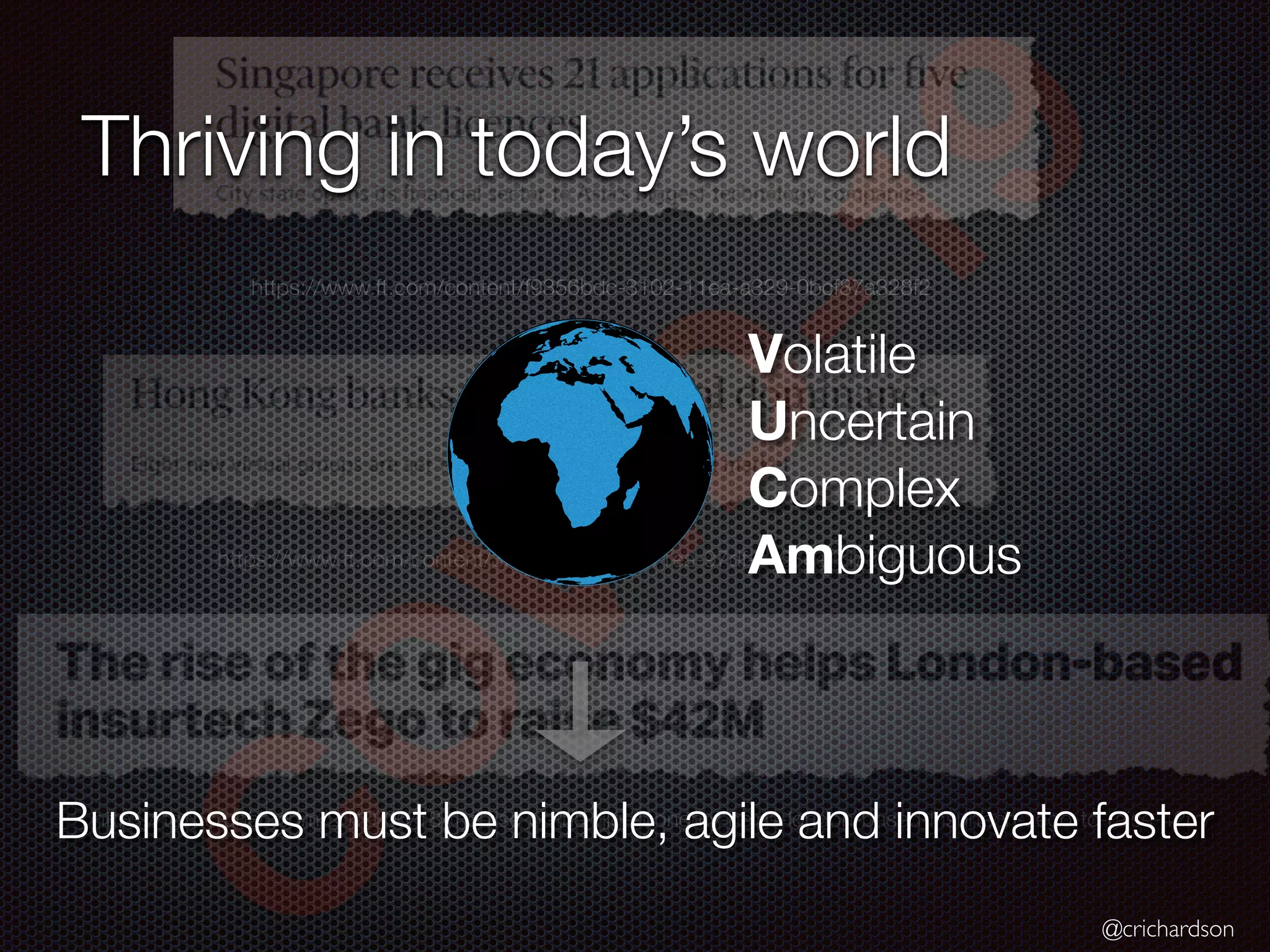
Thriving in today’s world
Businesses must be nimble, agile and innovate faster
Volatile
Uncertain
Complex
Ambiguous
@crichardson
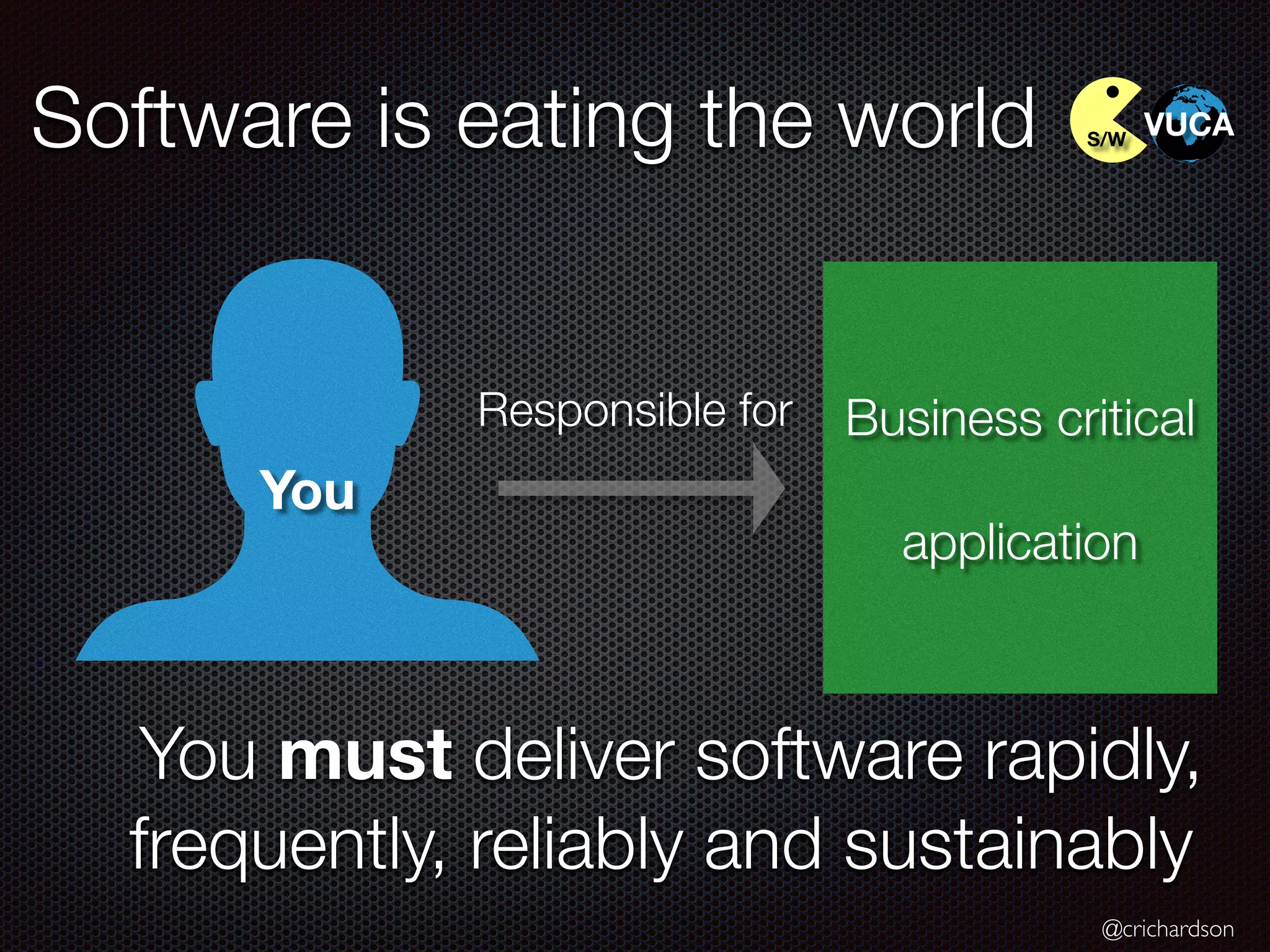
Software is eating the world
Business critical
application
You must deliver software rapidly,
frequently, reliably and sustainably
You
Responsible for
S/W
VUCA
@crichardson
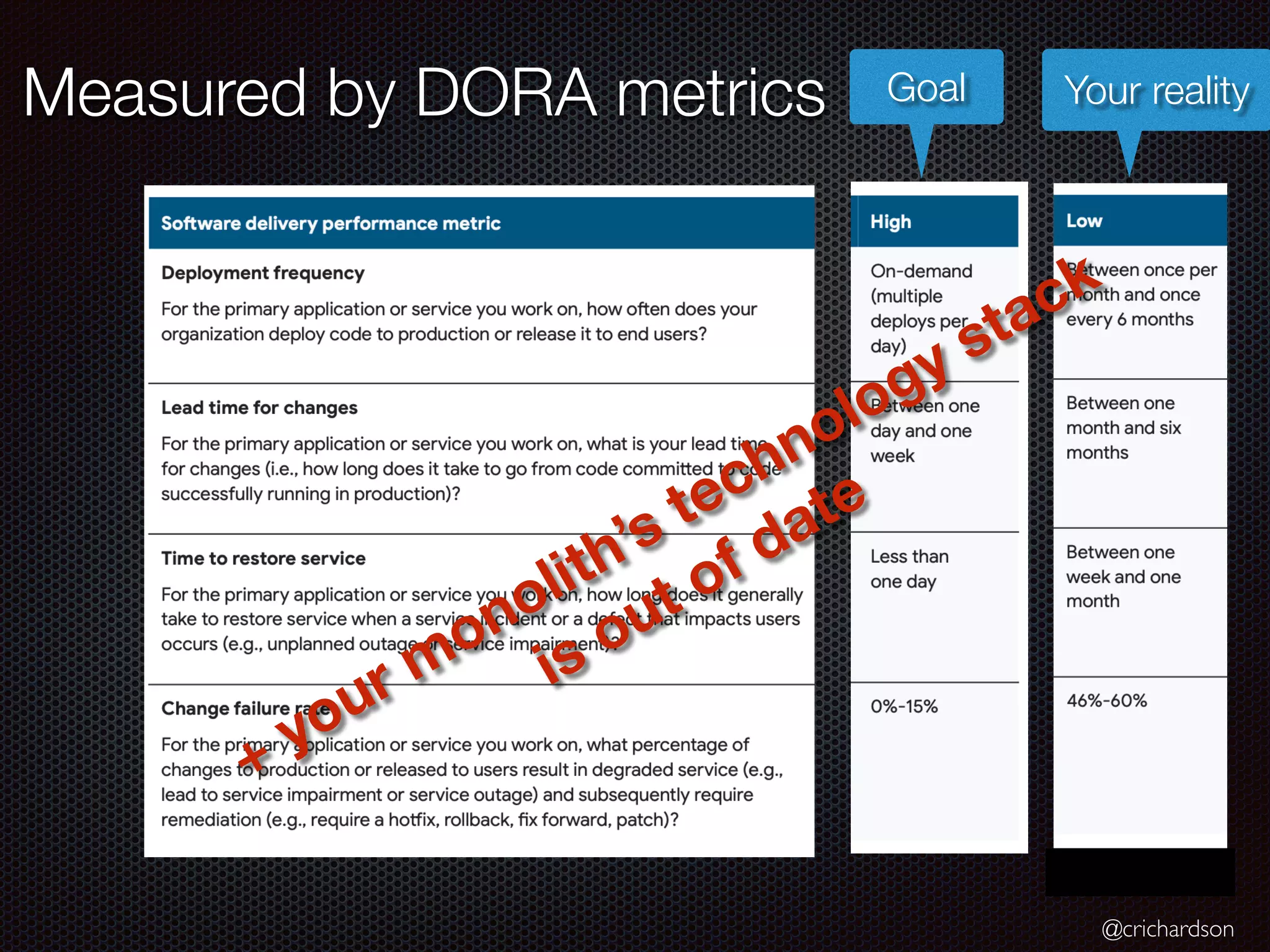
Goal Your reality
Measured by DORA metrics
+ your monolith’s technology stack
is out of date
@crichardson
Adopting the microservice
architecture will make
everything wonderful,
right?
Hint: it won’t
@crichardson
Presentation goal
Using the
dark energy and dark matter forces
to decide whether to refactor a
monolith to microservices
@crichardson
About Chris
http://adopt.microservices.io
Late 80s 2006 2008 2009
2012-
@crichardson
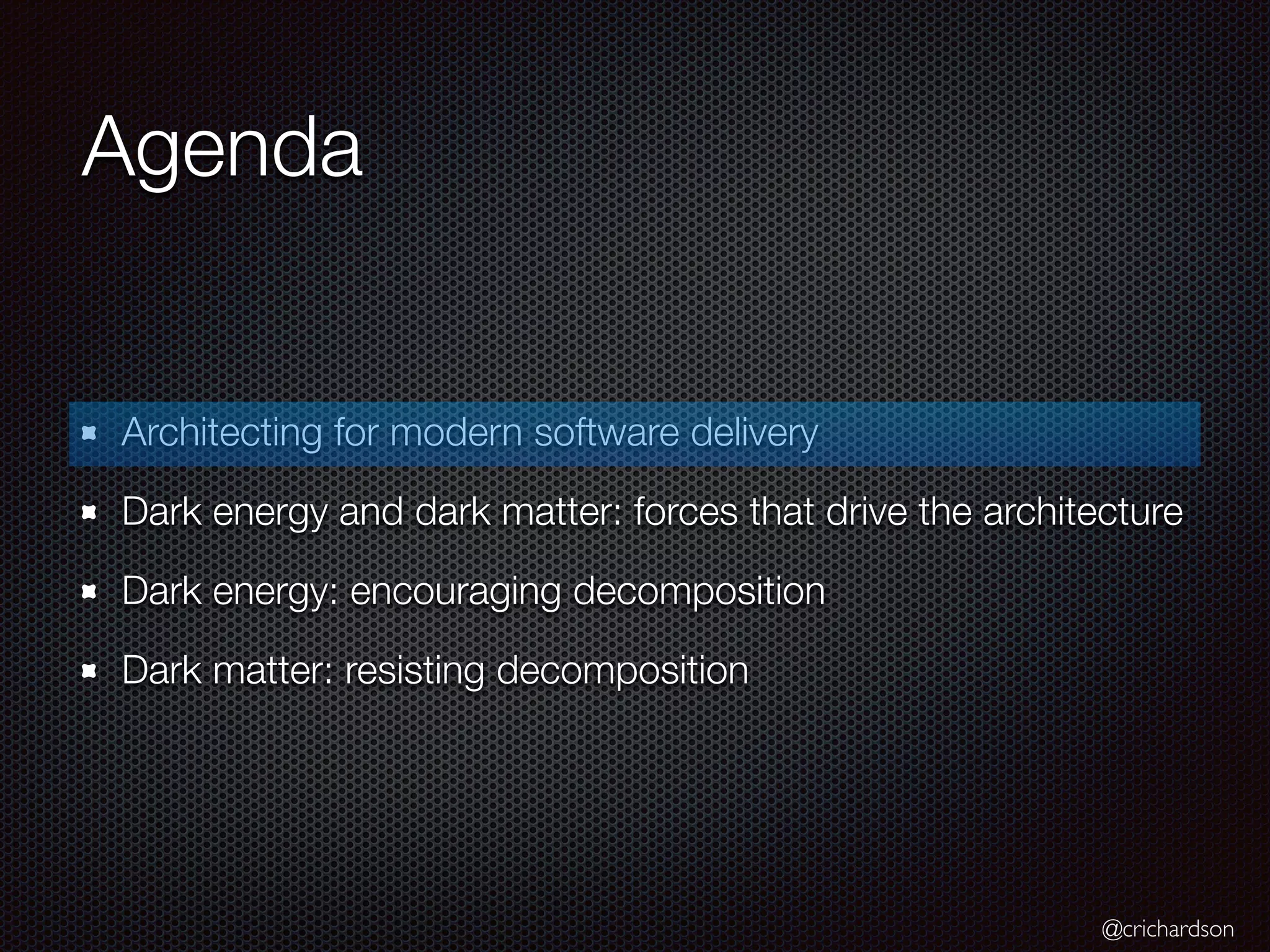
Agenda
Architecting for modern software delivery
Dark energy and dark matter: forces that drive the architecture
Dark energy: encouraging decomposition
Dark matter: resisting decomposition
@crichardson
O
V
I
D
-
1
9
https://www.ft.com/content/f9356bdc-3102-11ea-a329-0bcf87a328f2
https://www.ft.com/content/3f498e64-1aa6-11ea-97df-cc63de1d73f4
https://techcrunch.com/2019/06/18/the-rise-of-the-gig-economy-helps-london-based-insurtech-zego-to-raise-42m/
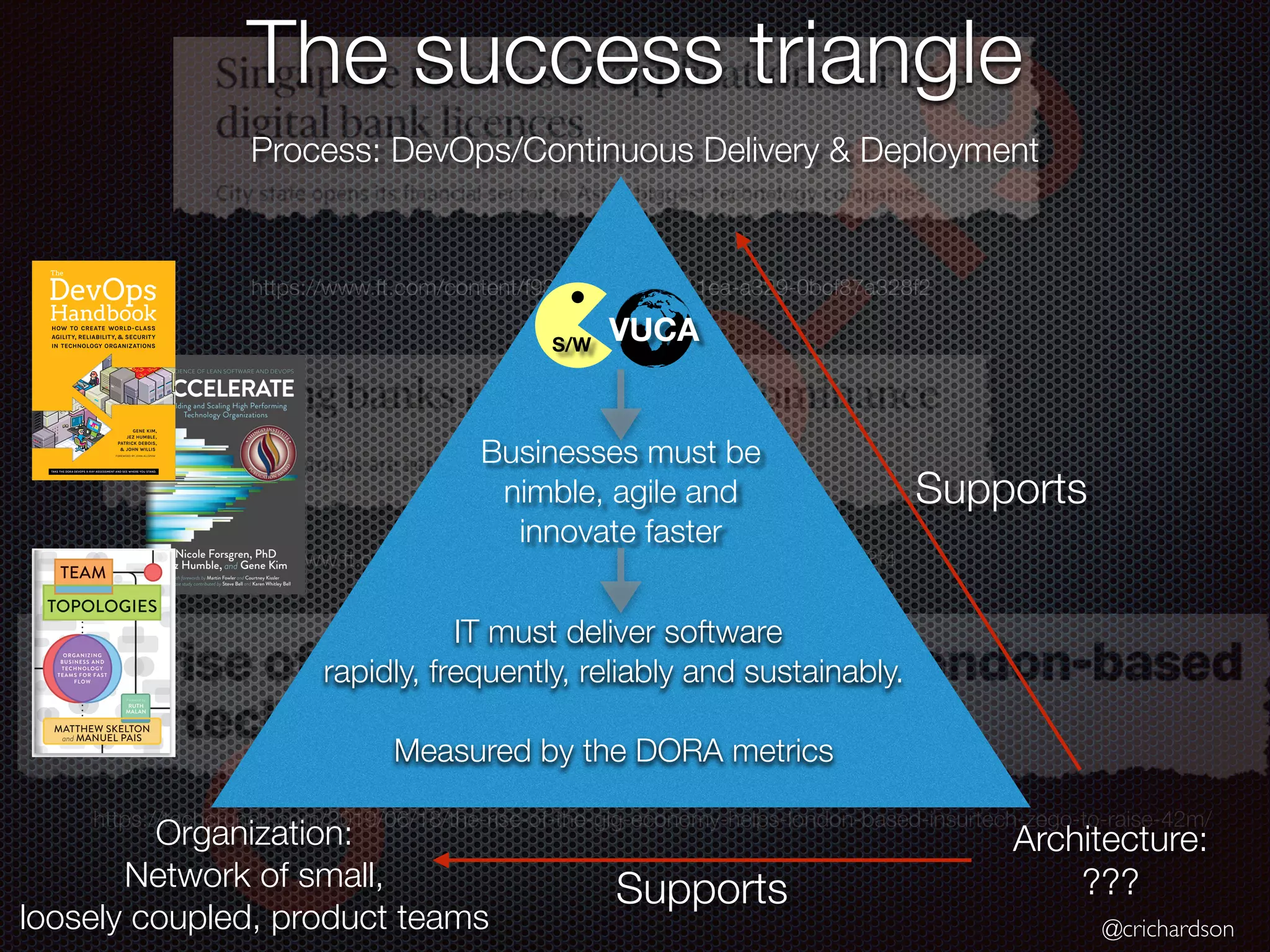
The success triangle
Process: DevOps/Continuous Delivery & Deployment
Organization:
Network of small,
loosely coupled, product teams
IT must deliver software
rapidly, frequently, reliably and sustainably.
Measured by the DORA metrics
Businesses must be
nimble, agile and
innovate faster
S/W
VUCA
Architecture:
???
Supports
Supports
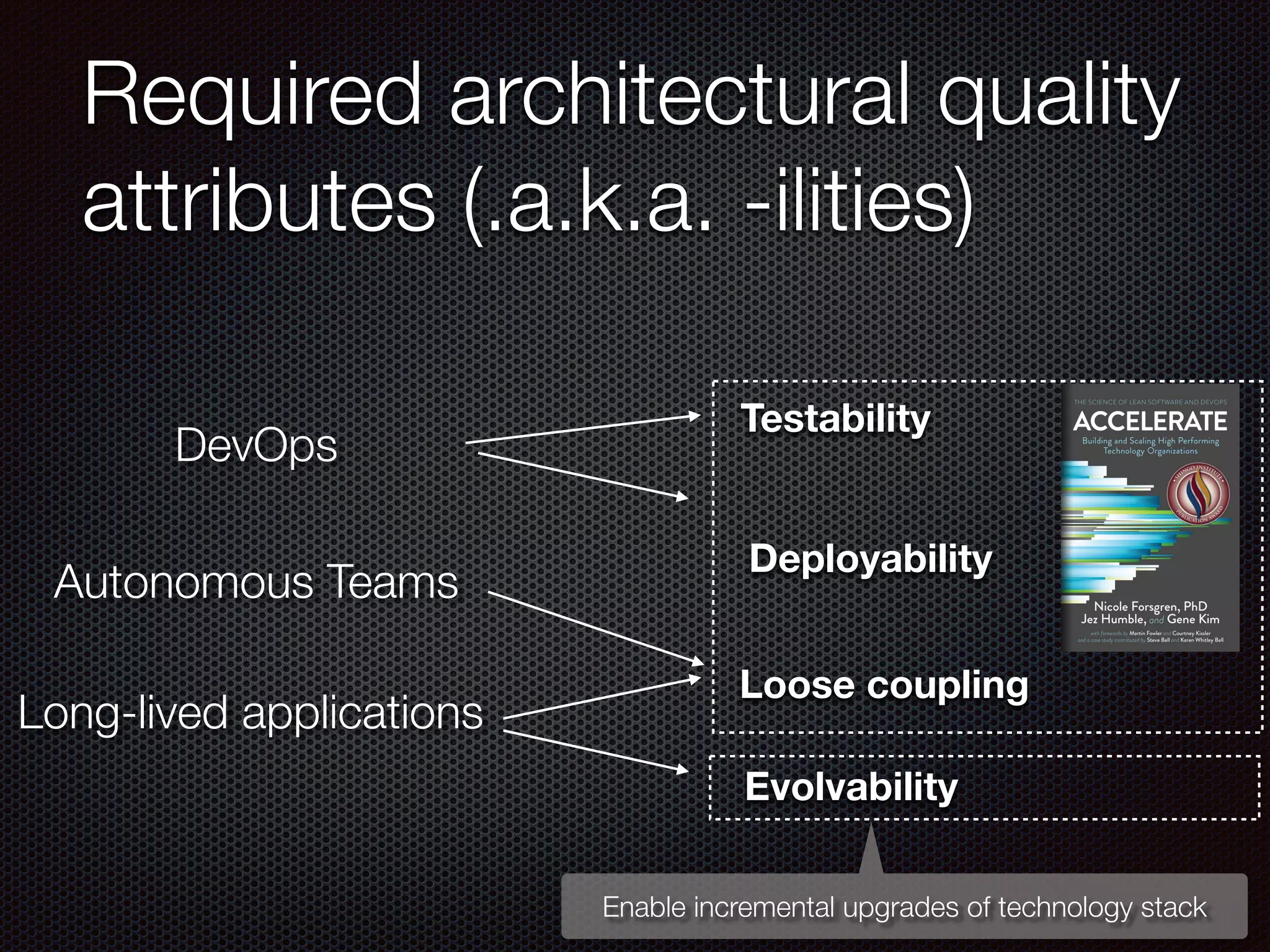
Required architectural quality
attributes (.a.k.a. -ilities)
DevOps
Autonomous Teams
Long-lived applications
Testability
Deployability
Loose coupling
Evolvability
Enable incremental upgrades of technology stack
@crichardson
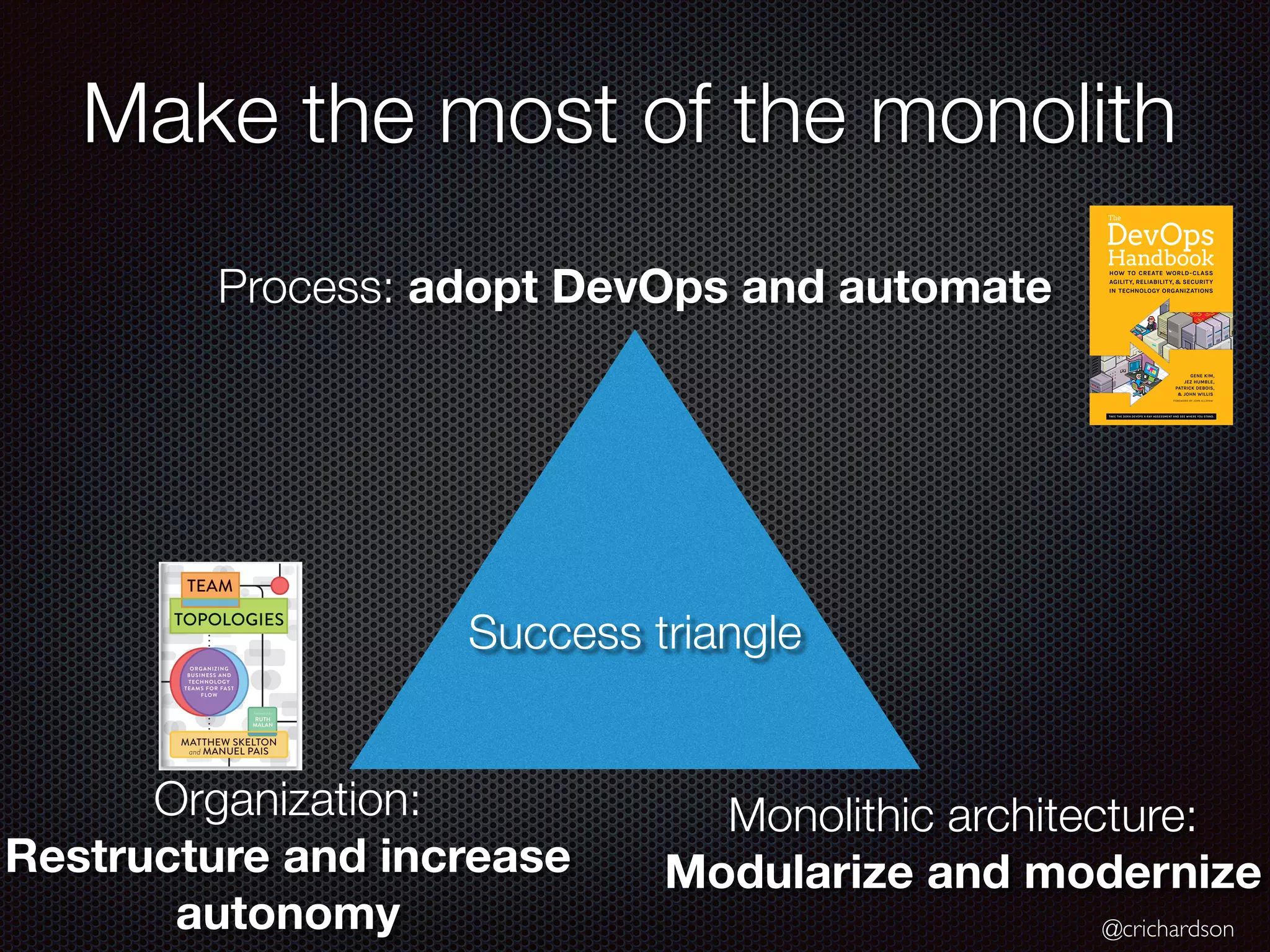
Make the most of the monolith
Process: adopt DevOps and automate
Organization:
Restructure and increase
autonomy
Monolithic architecture:
Modularize and modernize
Success triangle
@crichardson
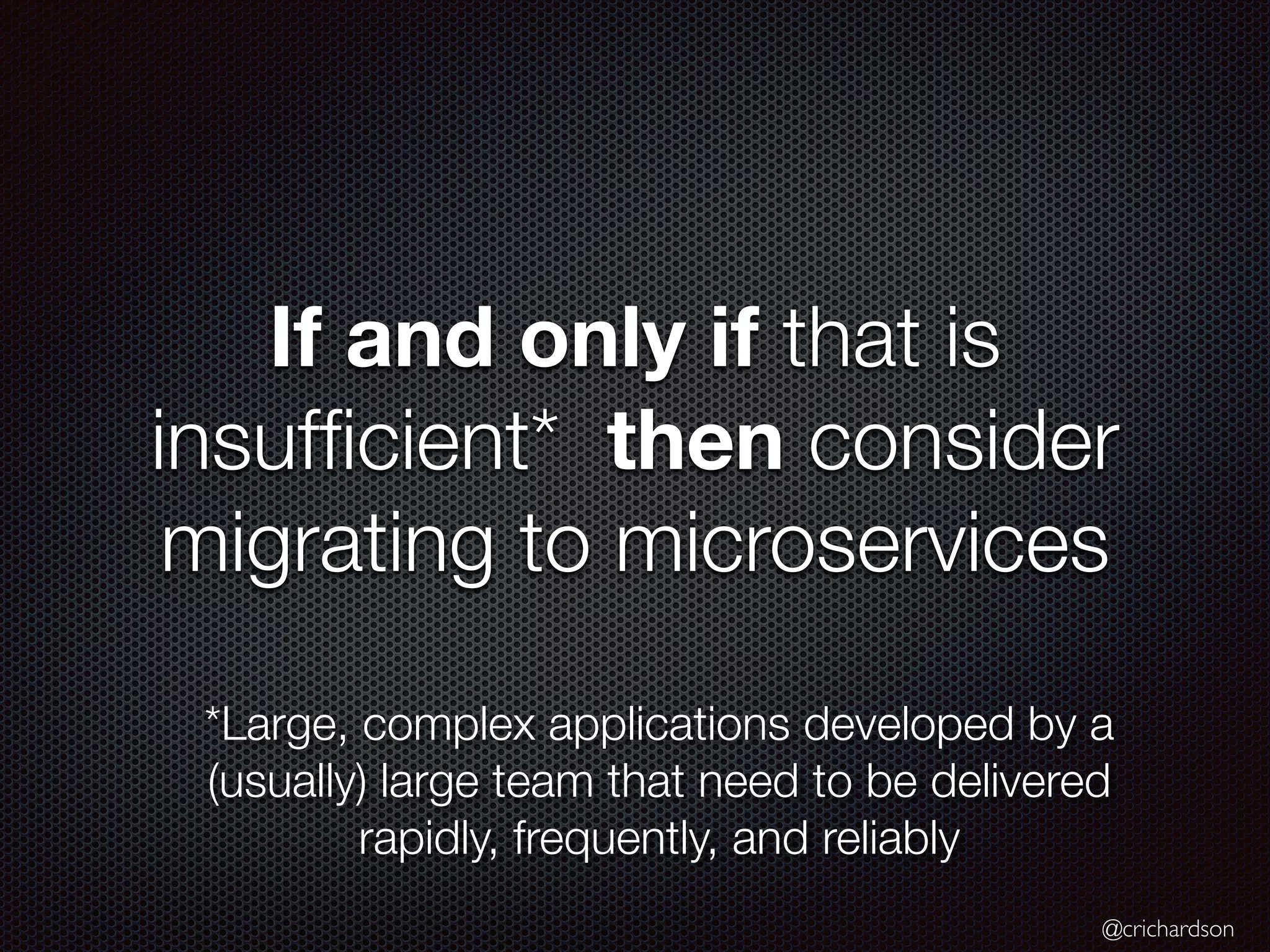
If and only if that is
insuf
fi
cient* then consider
migrating to microservices
*Large, complex applications developed by a
(usually) large team that need to be delivered
rapidly, frequently, and reliably
@crichardson
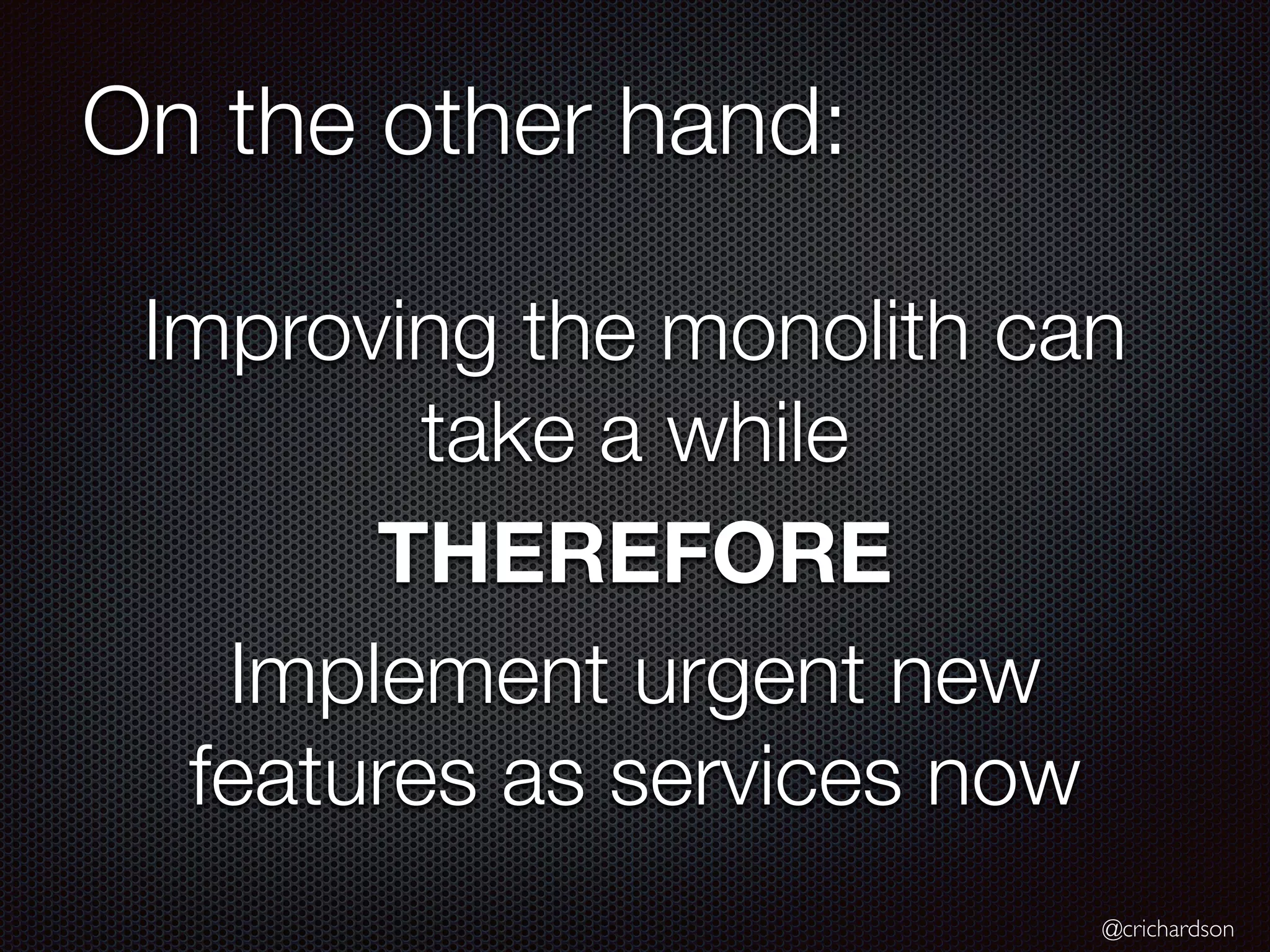
On the other hand:
Improving the monolith can
take a while
THEREFORE
Implement urgent new
features as services now
@crichardson
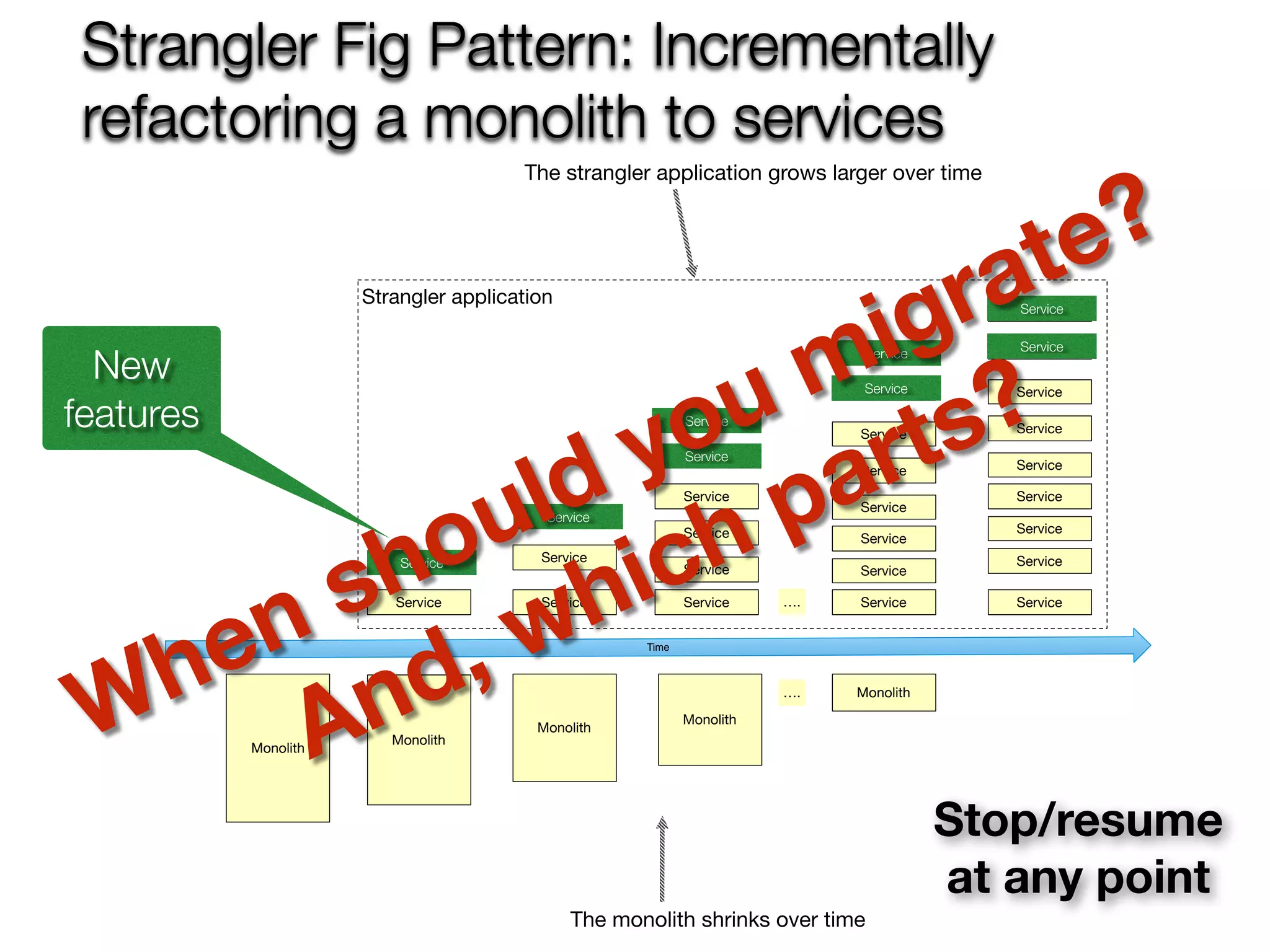
Strangler Fig Pattern: Incrementally
refactoring a monolith to services
Monolith
Time
Monolith
Service
Monolith
Service
Service
Monolith
Service
Service
Service
Service
…. Monolith
Service
Service
Service
Service
Service
Service
Service
Service
Service
Service
Service
Service
Service
Service
Service
Service
….
Strangler application
The strangler application grows larger over time
The monolith shrinks over time
Service
Service
Service
Service
Service
Service
Service
Service
New
features
Stop/resume
at any point
When should you migrate?
And, which parts?
@crichardson
Agenda
Architecting for modern software delivery
Dark energy and dark matter: forces that drive the architecture
Dark energy: encouraging decomposition
Dark matter: resisting decomposition
@crichardson
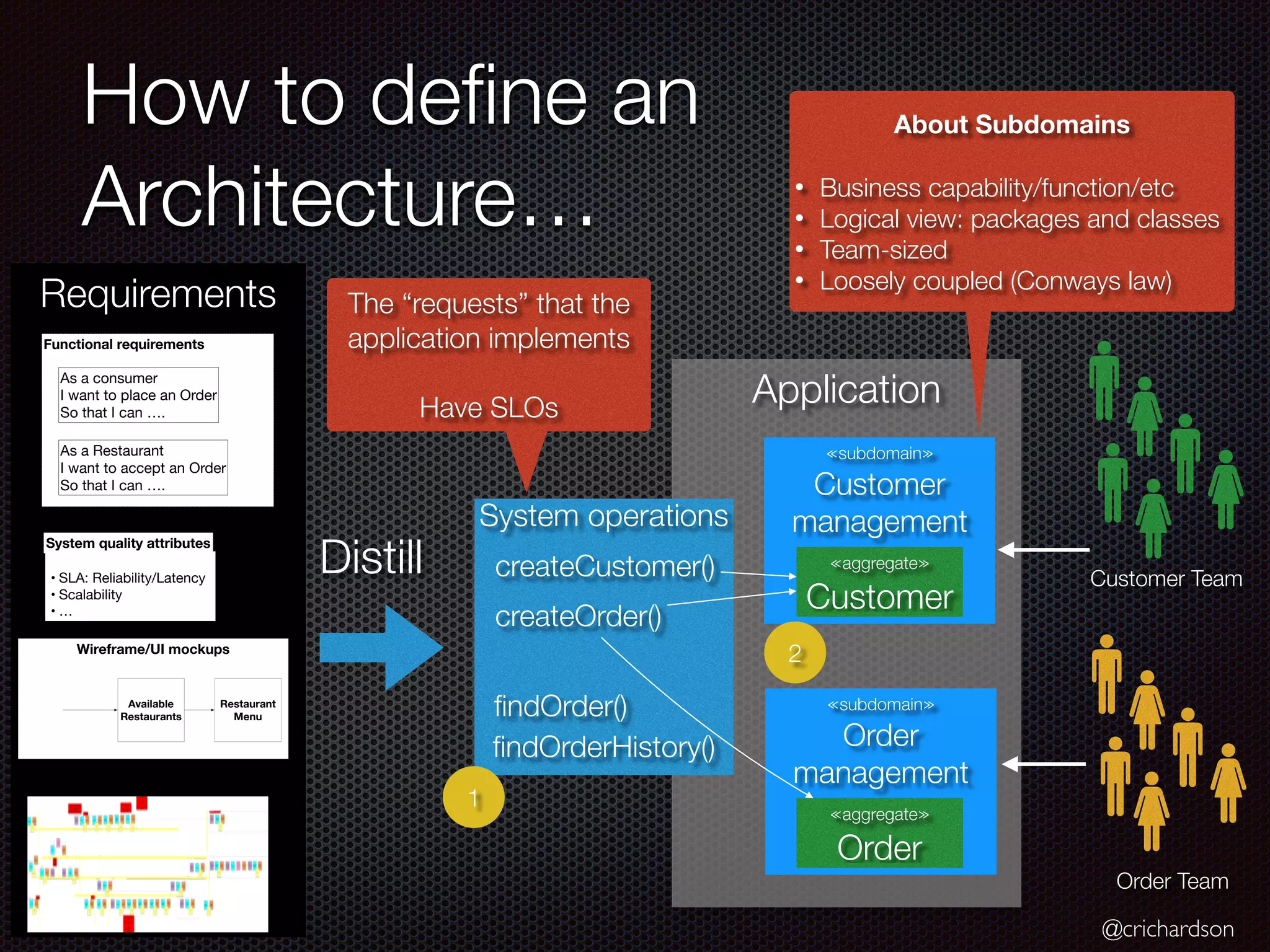
How to de
fi
ne an
Architecture…
Application
≪subdomain≫
Customer
management
≪aggregate≫
Customer
≪subdomain≫
Order
management
≪aggregate≫
Order
createCustomer()
createOrder()
fi
ndOrder()
fi
ndOrderHistory()
System operations
Distill
Requirements The “requests” that the
application implements
Have SLOs
Customer Team
Order Team
About Subdomains
• Business capability/function/etc
• Logical view: packages and classes
• Team-sized
• Loosely coupled (Conways law)
1
2
Functional requirements
As a consumer
I want to place an Order
So that I can ….
As a Restaurant
I want to accept an Order
So that I can ….
Event storming
Wireframe/UI mockups
Available
Restaurants
Restaurant
Menu
System quality attributes
• SLA: Reliability/Latency
• Scalability
• …
@crichardson
Kitchen Service
Delivery Service
Order Service
createOrder()
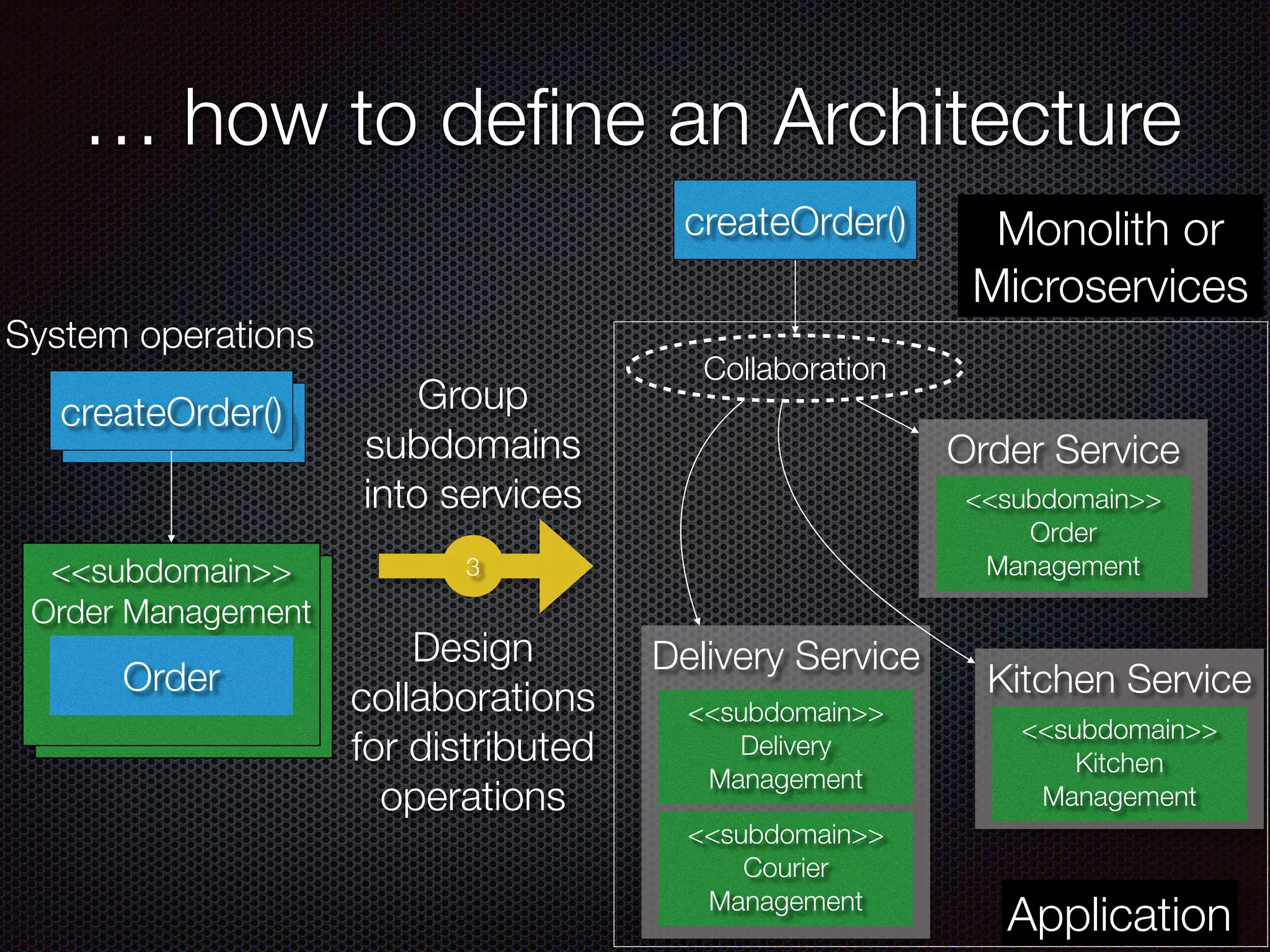
… how to de
fi
ne an Architecture
createOrder()
<<subdomain>>
Order Management
Order
System operations
<<subdomain>>
Order
Management
<<subdomain>>
Kitchen
Management
<<subdomain>>
Delivery
Management
<<subdomain>>
Courier
Management
Group
subdomains
into services
Application
Collaboration
Design
collaborations
for distributed
operations
createOrder()
3
Monolith or
Microservices
@crichardson
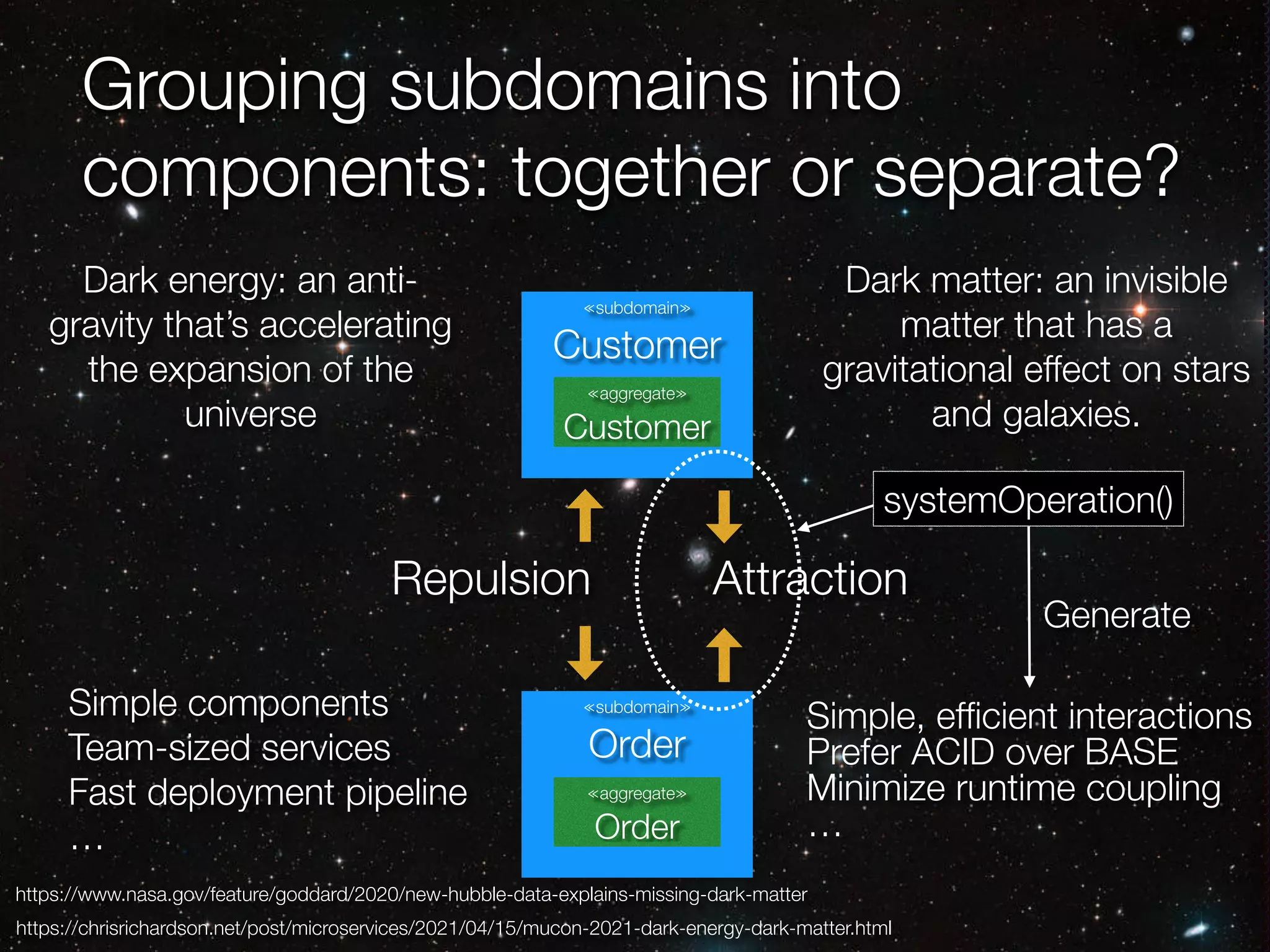
Grouping subdomains into
components: together or separate?
≪subdomain≫
Customer
≪aggregate≫
Customer
≪subdomain≫
Order
≪aggregate≫
Order
Attraction
Repulsion
Simple components
Team-sized services
Fast deployment pipeline
…
Dark energy: an anti-
gravity that’s accelerating
the expansion of the
universe
Dark matter: an invisible
matter that has a
gravitational effect on stars
and galaxies.
https://www.nasa.gov/feature/goddard/2020/new-hubble-data-explains-missing-dark-matter
Simple, ef
fi
cient interactions
Prefer ACID over BASE
Minimize runtime coupling
…
https://chrisrichardson.net/post/microservices/2021/04/15/mucon-2021-dark-energy-dark-matter.html
Generate
systemOperation()
@crichardson
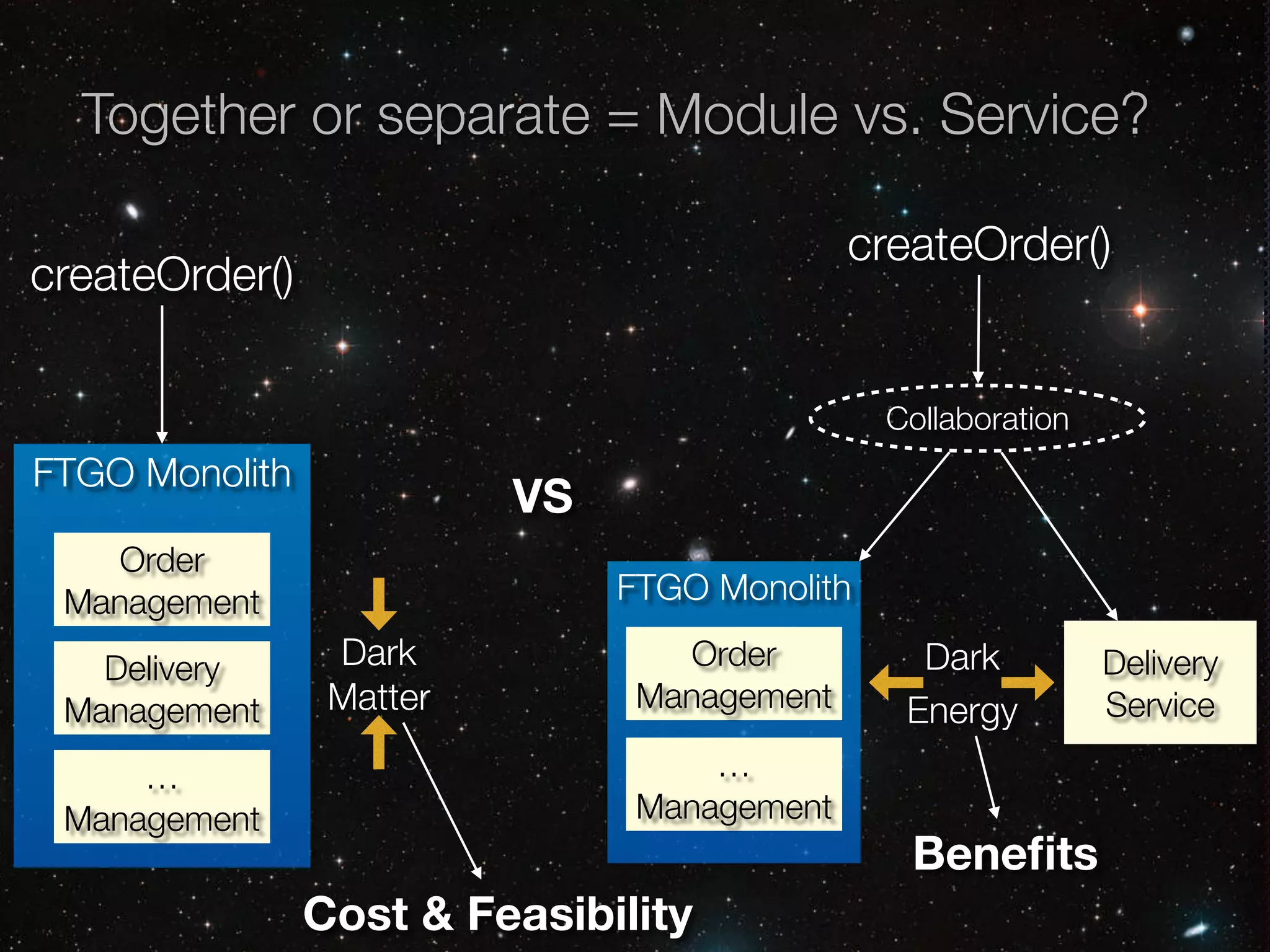
Together or separate = Module vs. Service?
FTGO Monolith
Delivery
Service
FTGO Monolith
Delivery
Management
createOrder()
VS
createOrder()
Collaboration
Order
Management
…
Management
Order
Management
…
Management
Dark
Energy
Dark
Matter
Bene
fi
ts
Cost & Feasibility
@crichardson
Agenda
Architecting for modern software delivery
Dark energy and dark matter: forces that drive the architecture
Dark energy: encouraging decomposition
Dark matter: resisting decomposition
@crichardson
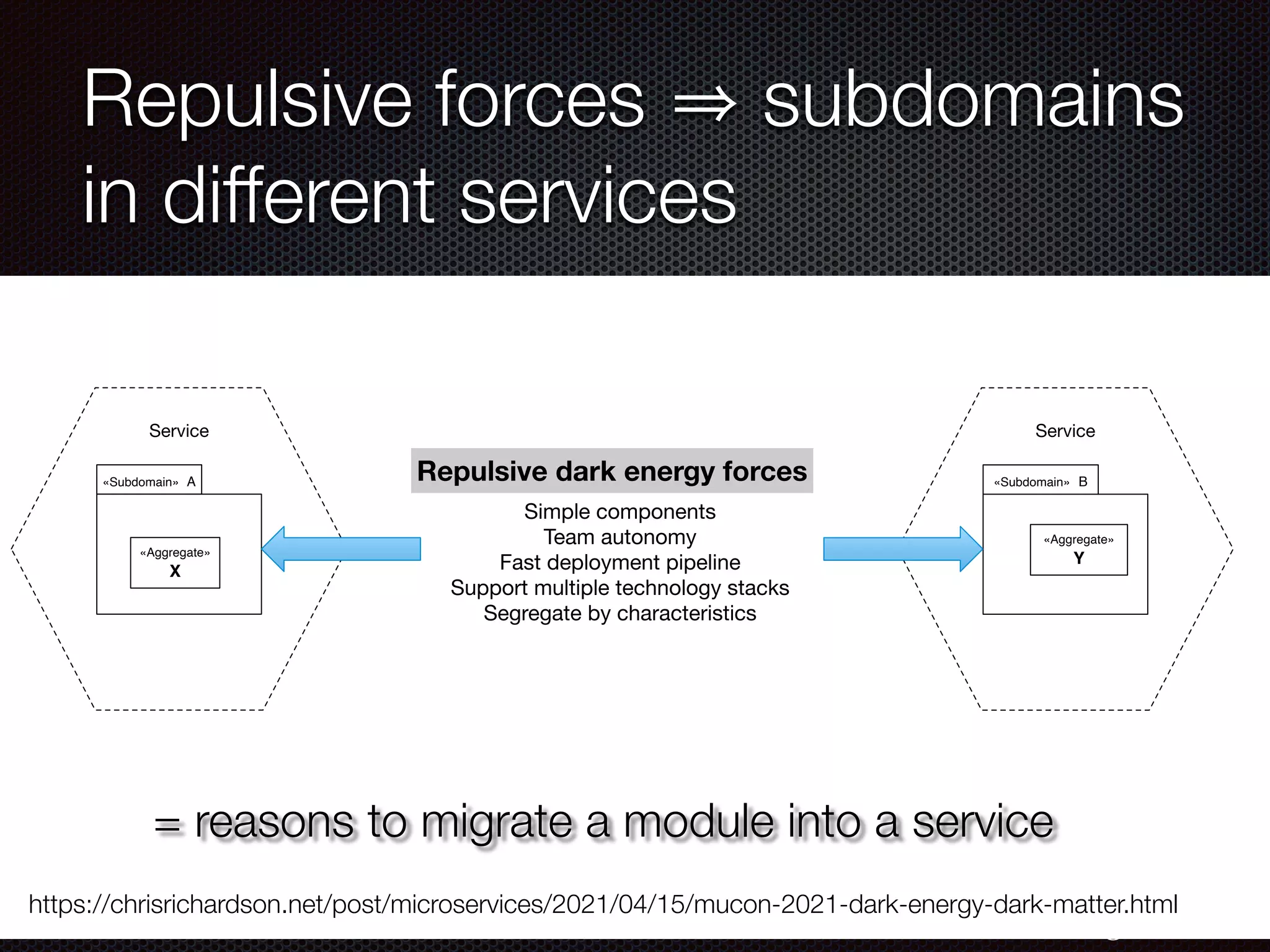
Repulsive forces subdomains
in different services
https://chrisrichardson.net/post/microservices/2021/04/15/mucon-2021-dark-energy-dark-matter.html
= reasons to migrate a module into a service
Service
Service
«Subdomain» A
«Aggregate»
X
«Subdomain» B
«Aggregate»
Y
Simple components
Team autonomy
Fast deployment pipeline
Support multiple technology stacks
Segregate by characteristics
Repulsive dark energy forces
@crichardson
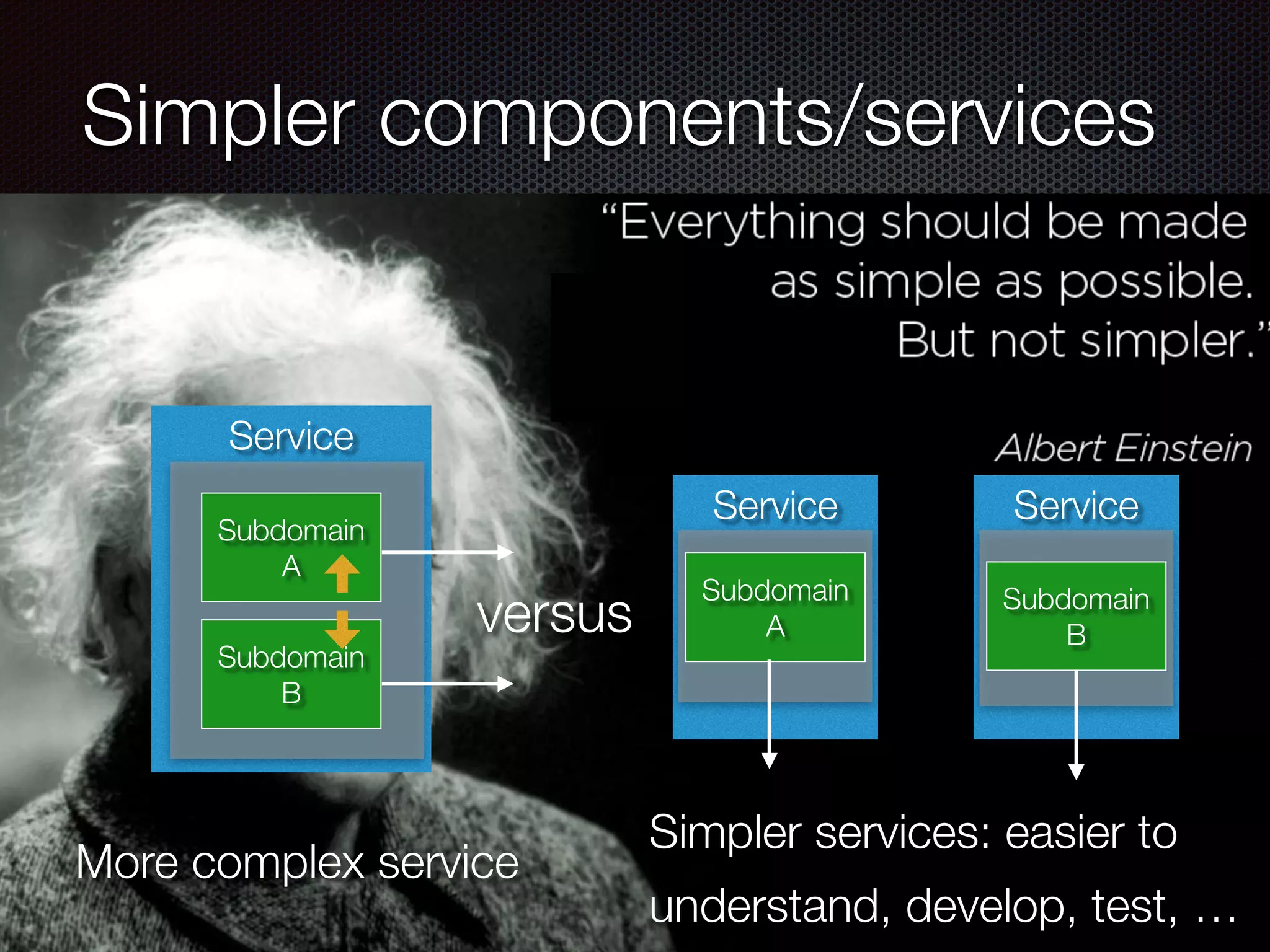
Simpler components/services
Service
Service
Service
Subdomain
A
Subdomain
A
Subdomain
B
Subdomain
B
More complex service
Simpler services: easier to
understand, develop, test, …
versus
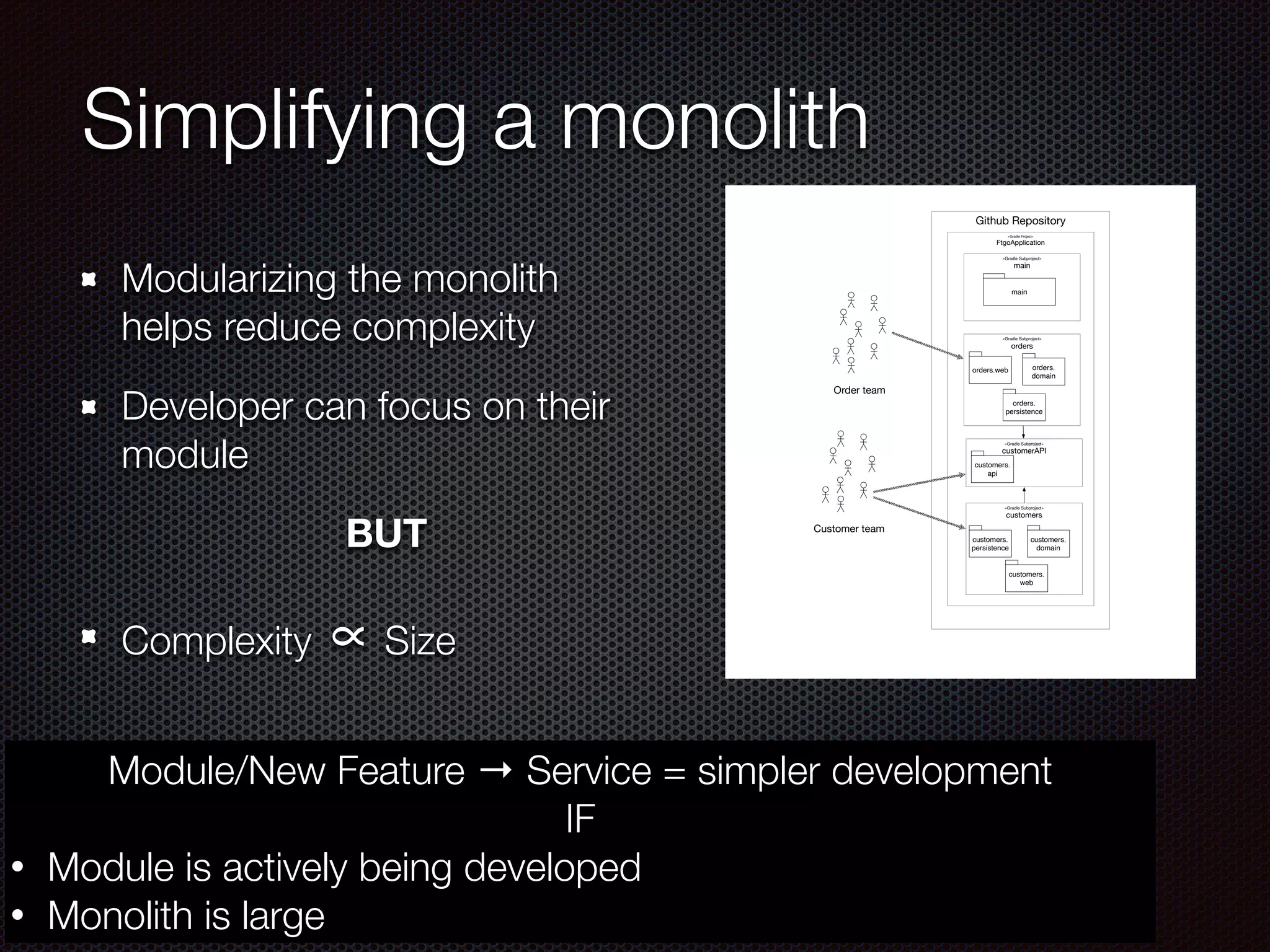
Simplifying a monolith
Modularizing the monolith
helps reduce complexity
Developer can focus on their
module
BUT
Complexity ∝Size
Github Repository
«Gradle Project»
FtgoApplication
«Gradle Subproject»
main
main
«Gradle Subproject»
orders
orders.web
«Gradle Subproject»
customerAPI
orders.
domain
«Gradle Subproject»
customers
customers.
persistence
orders.
persistence
Customer team
Order team
customers.
domain
customers.
web
customers.
api
Module/New Feature → Service = simpler development
IF
• Module is actively being developed
• Monolith is large
@crichardson
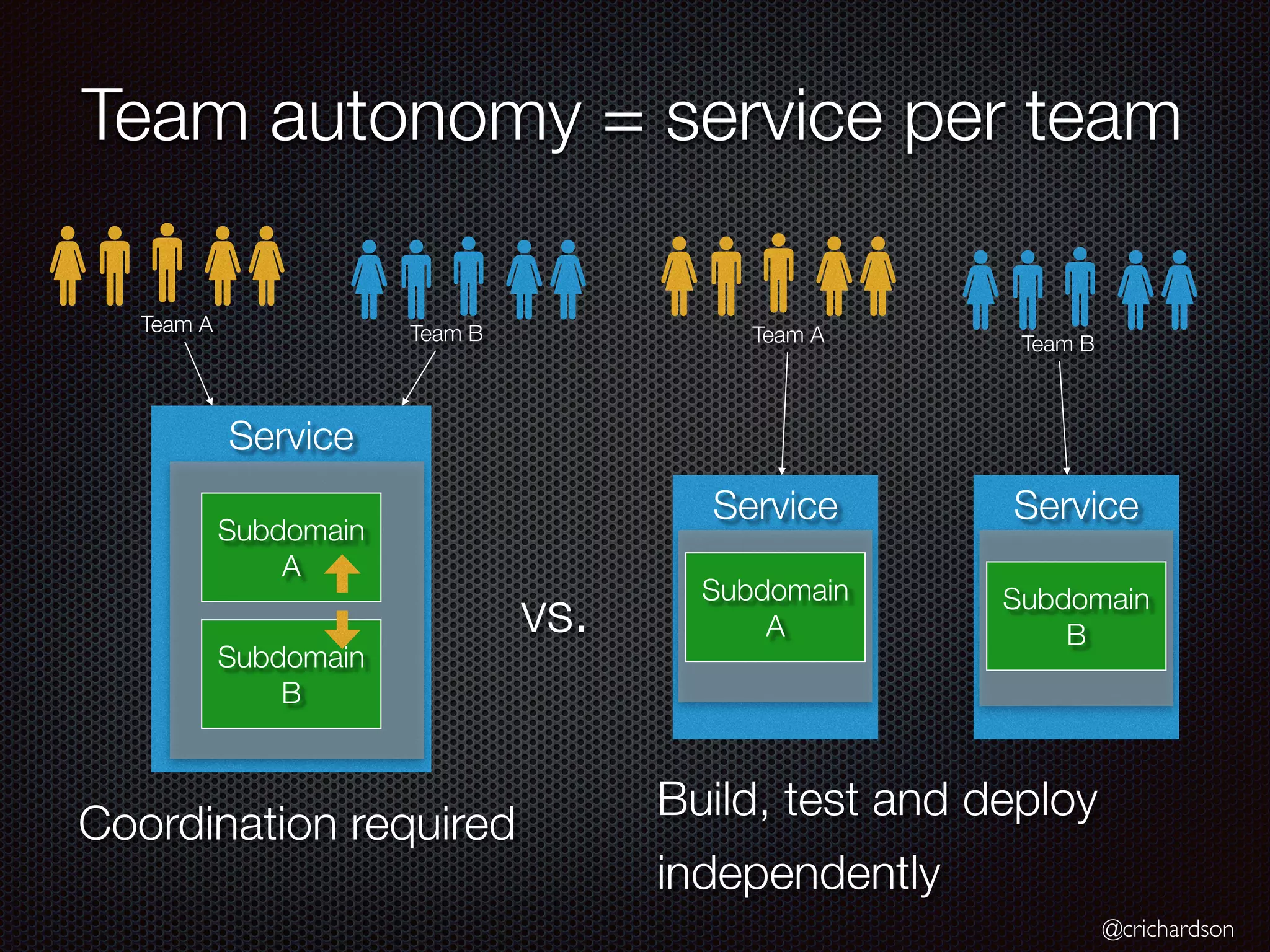
Team autonomy = service per team
Service
Service
Service
Subdomain
A
Subdomain
A
Subdomain
B
Subdomain
B
Coordination required
Build, test and deploy
independently
vs.
Team A Team B Team A Team B
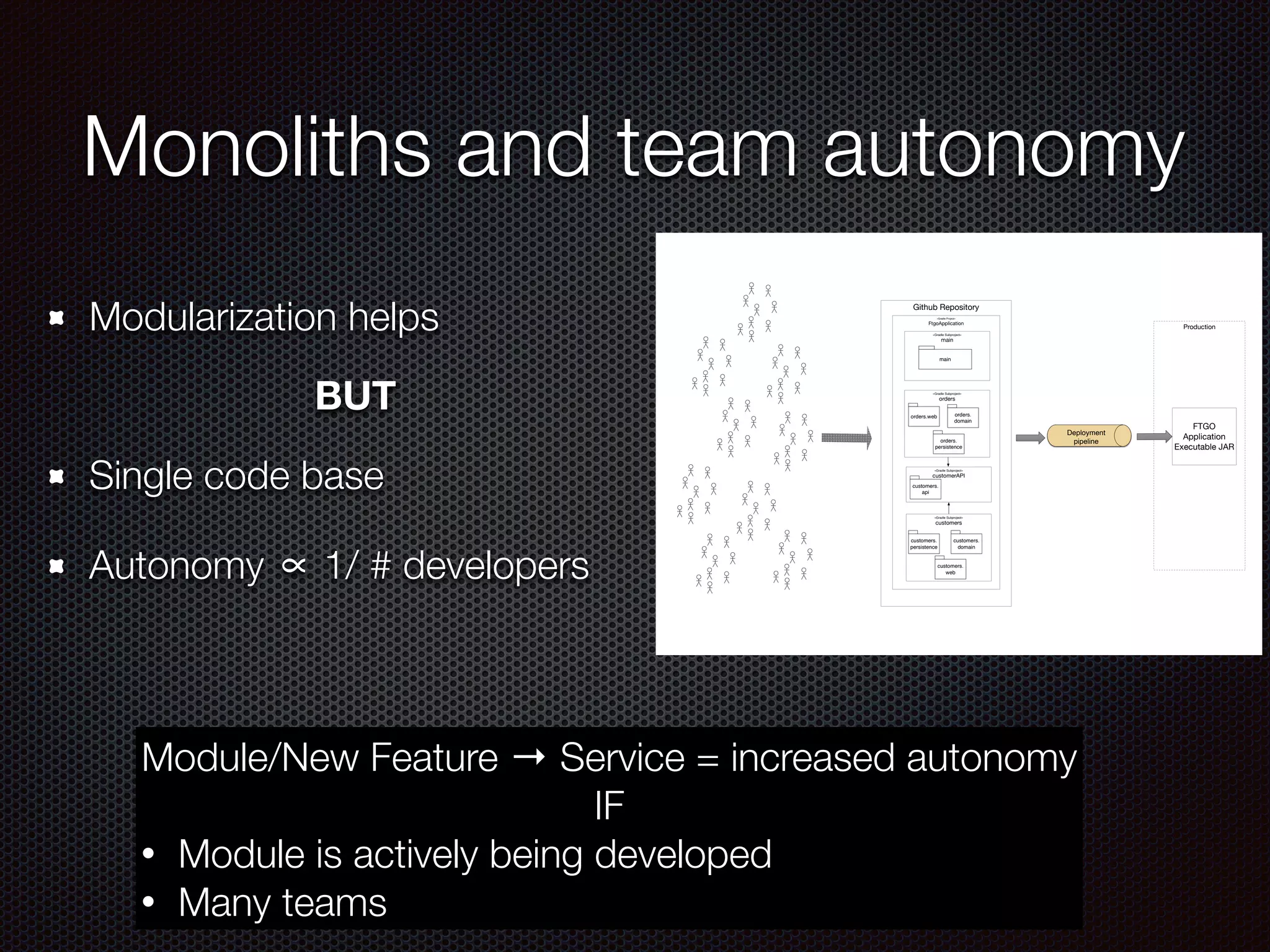
Monoliths and team autonomy
Modularization helps
BUT
Single code base
Autonomy ∝ 1/ # developers
Github Repository
«Gradle Project»
FtgoApplication
«Gradle Subproject»
main
main
«Gradle Subproject»
orders
orders.web
«Gradle Subproject»
customerAPI
orders.
domain
«Gradle Subproject»
customers
customers.
persistence
orders.
persistence
Deployment
pipeline
Production
FTGO
Application
Executable JAR
customers.
domain
customers.
web
customers.
api
Module/New Feature → Service = increased autonomy
IF
• Module is actively being developed
• Many teams
@crichardson
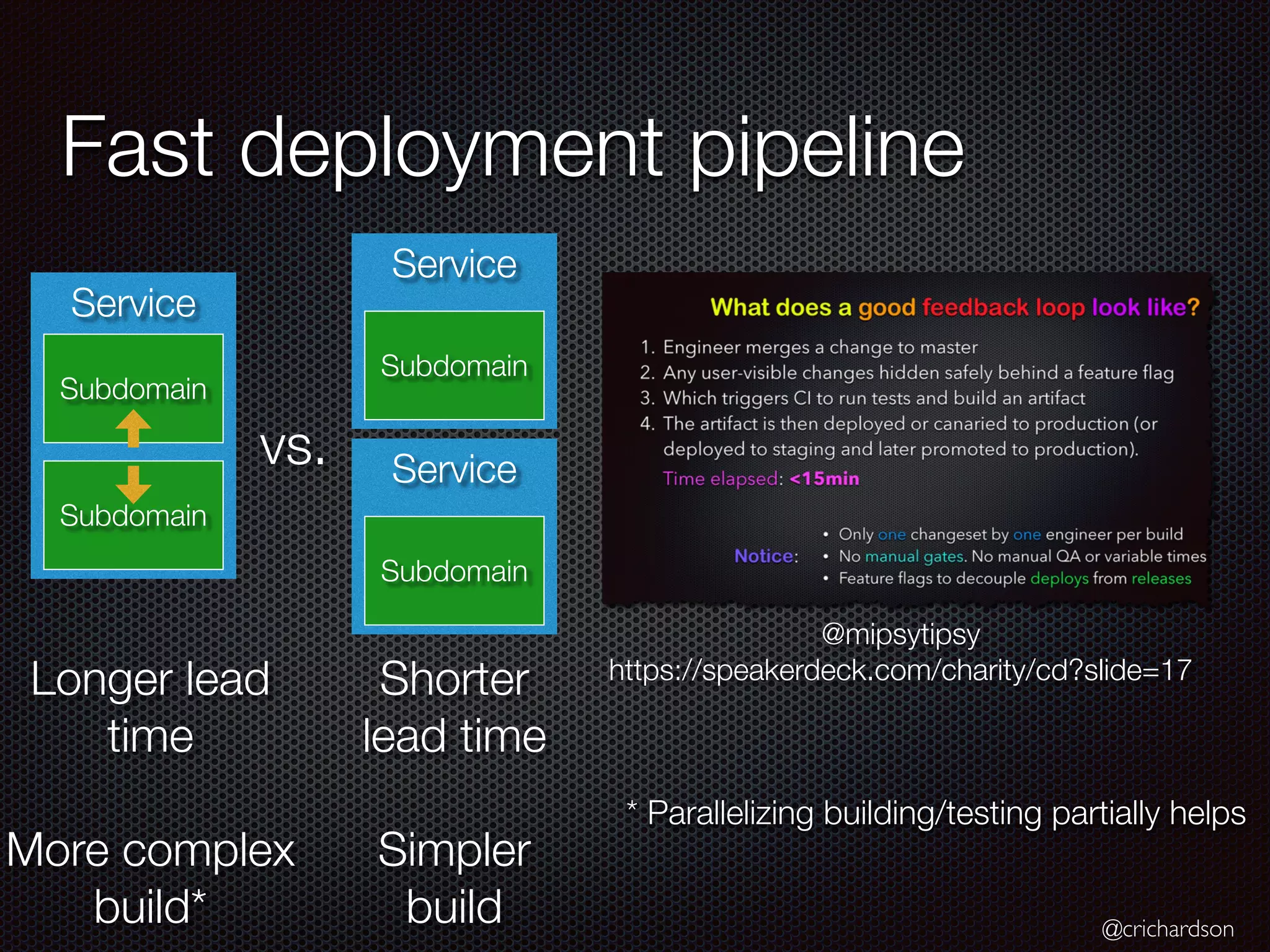
Fast deployment pipeline
@mipsytipsy
https://speakerdeck.com/charity/cd?slide=17
Service
Subdomain
Subdomain
Service
Subdomain
Shorter
lead time
Simpler
build
Longer lead
time
More complex
build*
* Parallelizing building/testing partially helps
Service
Subdomain
vs.
@crichardson
Optimizing a monolith’s deployment pipeline
$ git pull
$./gradlew test
$ git push
! [rejected] ….
Use merge queue
Accelerate build/test:
• Incremental testing through DIP and ISP
• Parallelization/clustered builds
• Selective test execution
BUT if the application/team keeps growing
Then eventually the deployment pipeline = bottleneck
Module/New Feature → Service = faster deployment pipeline
IF
• Module is actively being developed
• Monolith is large
• Many teams
@crichardson
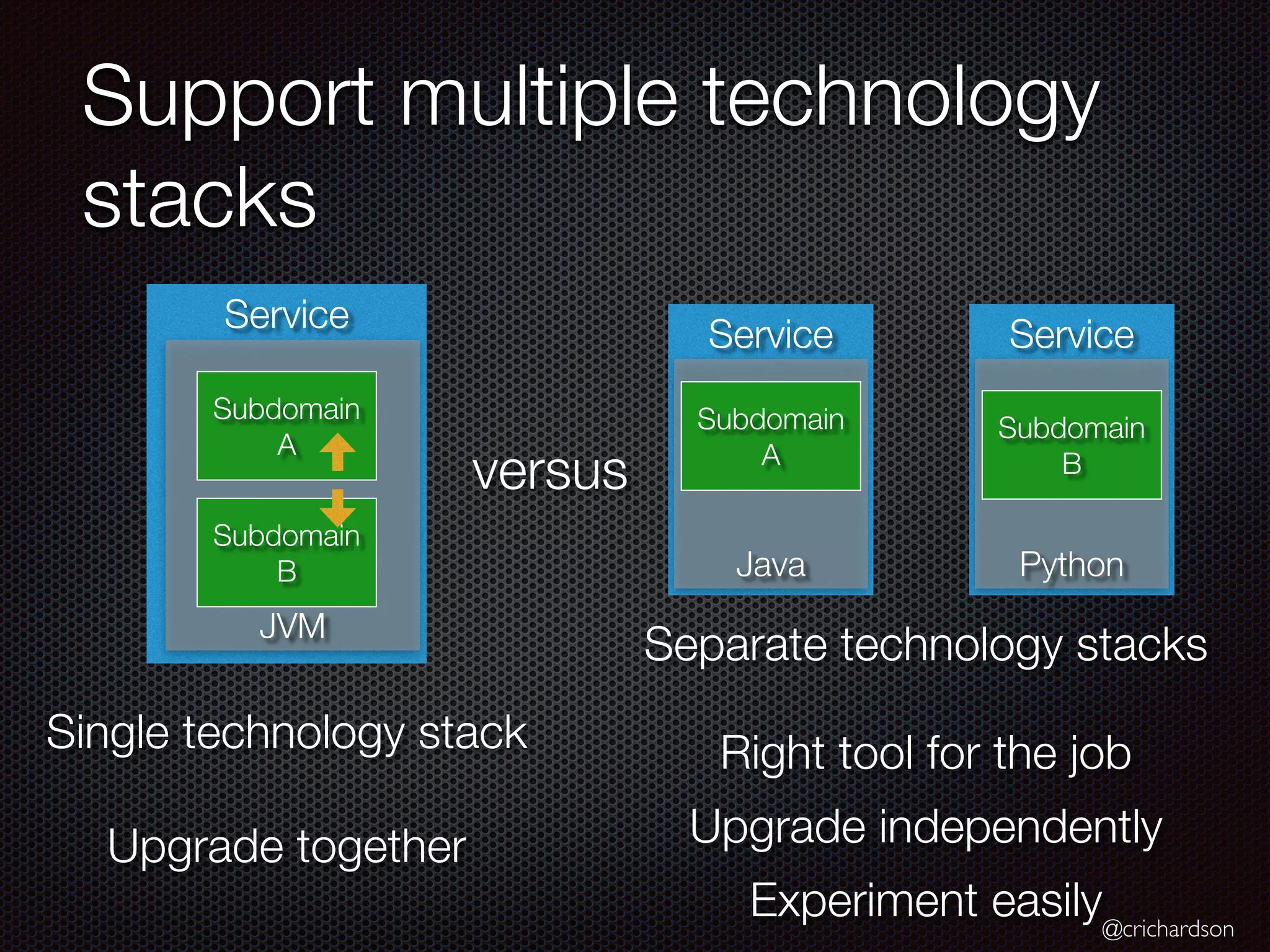
Support multiple technology
stacks
Service
Python
Service
Java
Service
JVM
Subdomain
A
Subdomain
A
Subdomain
B
Subdomain
B
Single technology stack
Upgrade together
Separate technology stacks
Right tool for the job
Upgrade independently
Experiment easily
versus
@crichardson
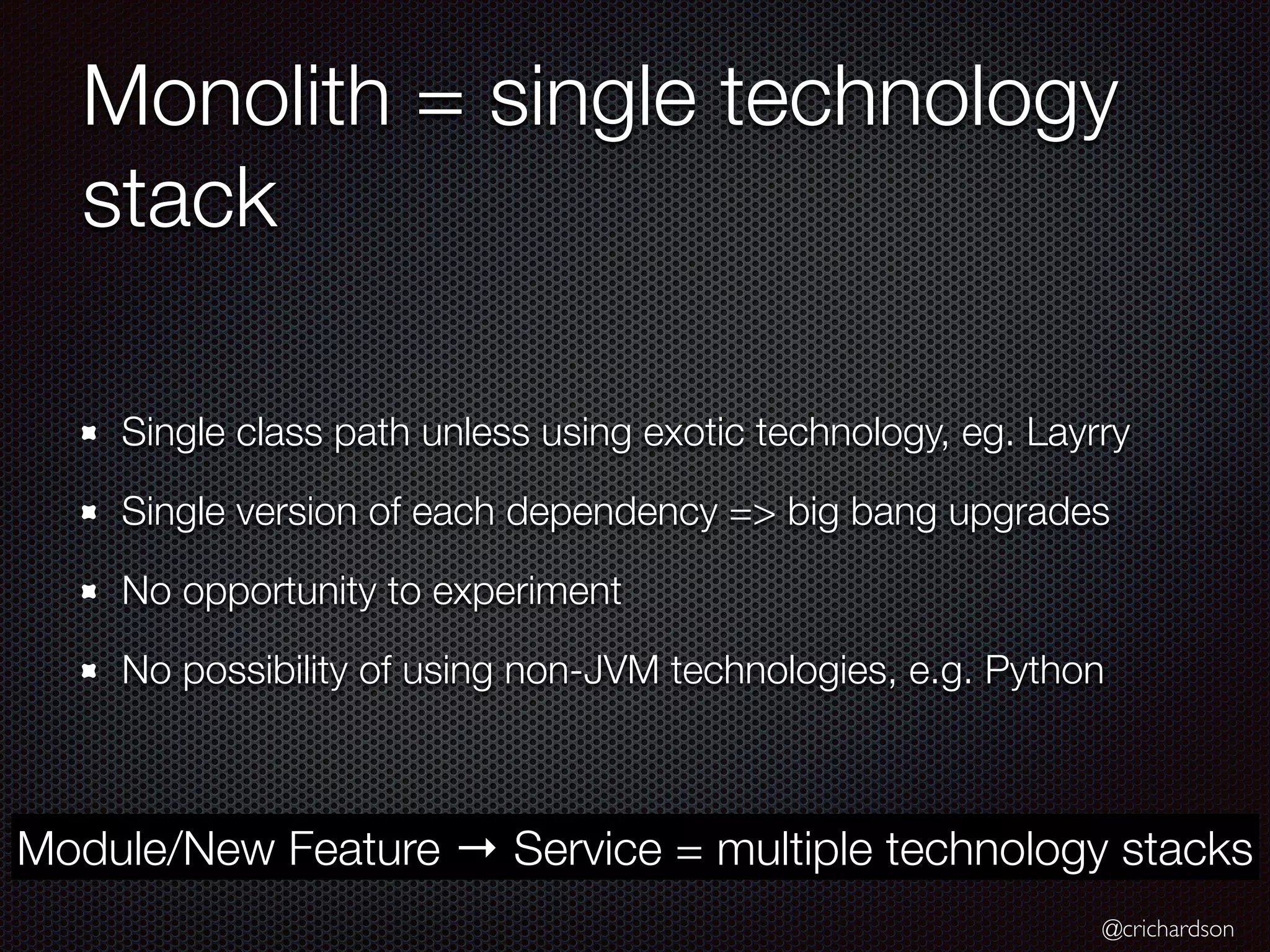
Monolith = single technology
stack
Single class path unless using exotic technology, eg. Layrry
Single version of each dependency => big bang upgrades
No opportunity to experiment
No possibility of using non-JVM technologies, e.g. Python
Module/New Feature → Service = multiple technology stacks
@crichardson
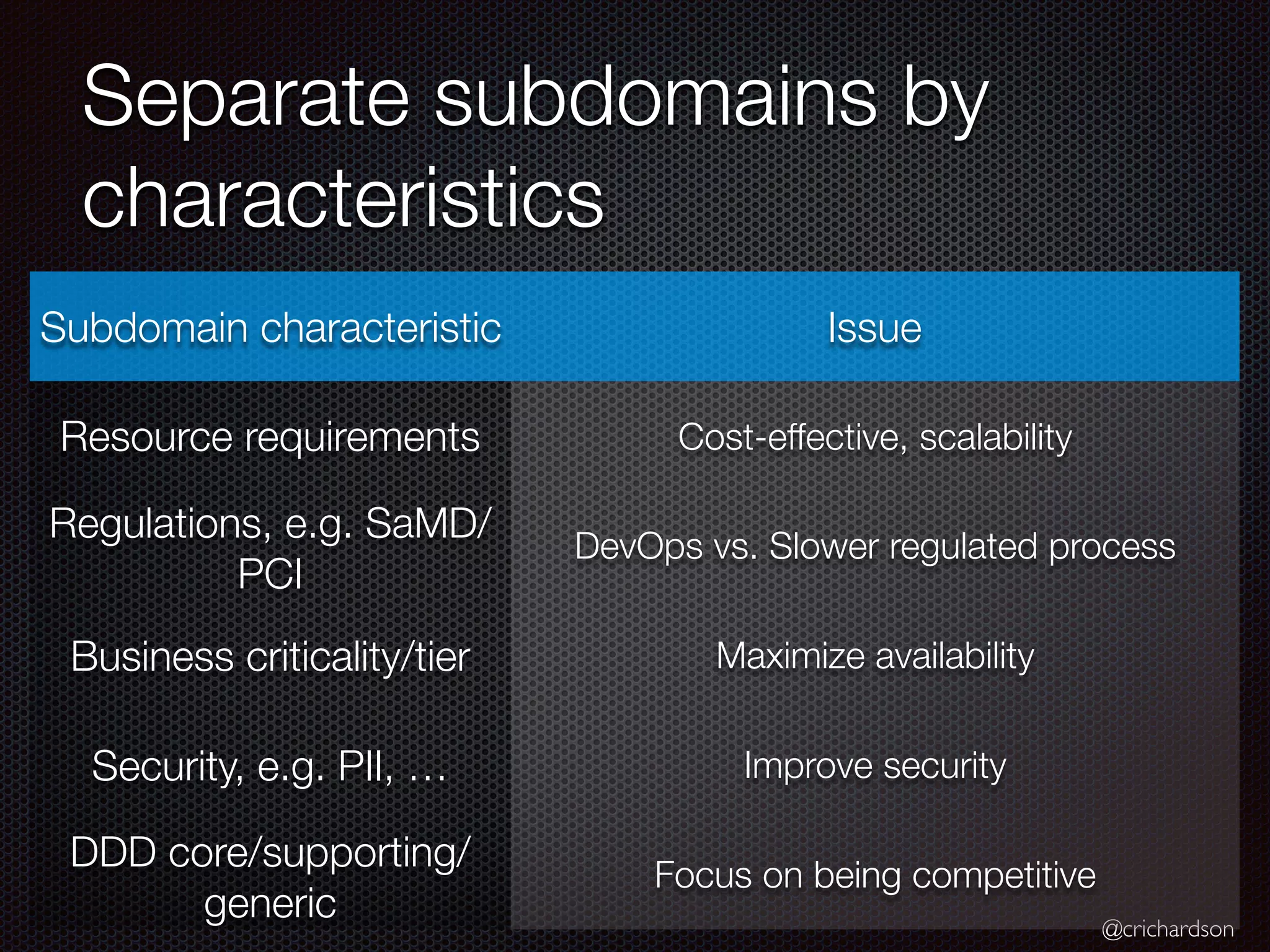
Separate subdomains by
characteristics
Subdomain characteristic Issue
Resource requirements Cost-effective, scalability
Regulations, e.g. SaMD/
PCI
DevOps vs. Slower regulated process
Business criticality/tier Maximize availability
Security, e.g. PII, … Improve security
DDD core/supporting/
generic
Focus on being competitive
@crichardson
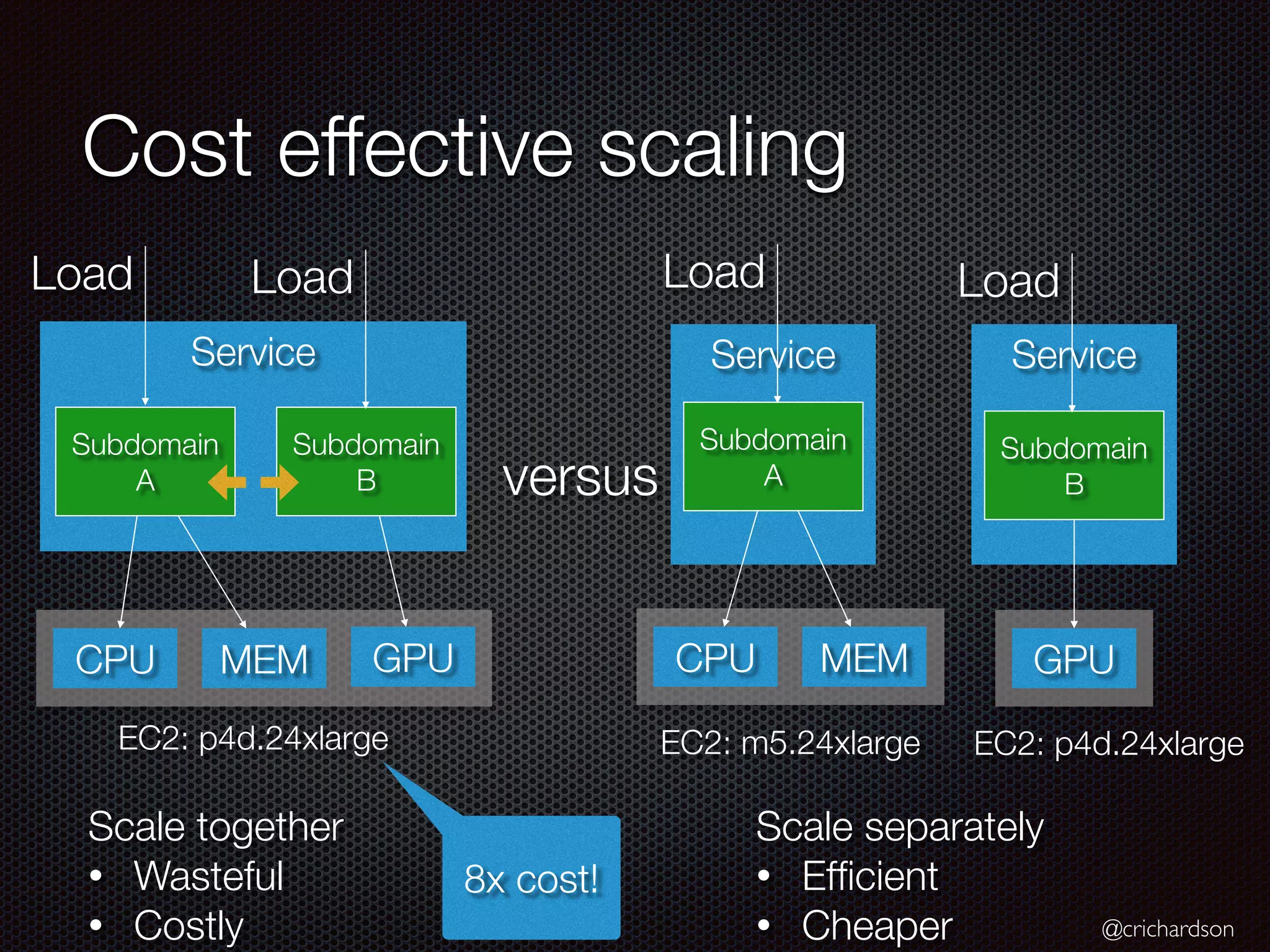
Cost effective scaling
Service
Service
Service
Subdomain
A
Subdomain
A
Subdomain
B
Subdomain
B
versus
CPU MEM GPU
Scale together
• Wasteful
• Costly
CPU MEM GPU
Scale separately
• Ef
fi
cient
• Cheaper
Load Load Load Load
EC2: p4d.24xlarge EC2: p4d.24xlarge
EC2: m5.24xlarge
8x cost!
@crichardson
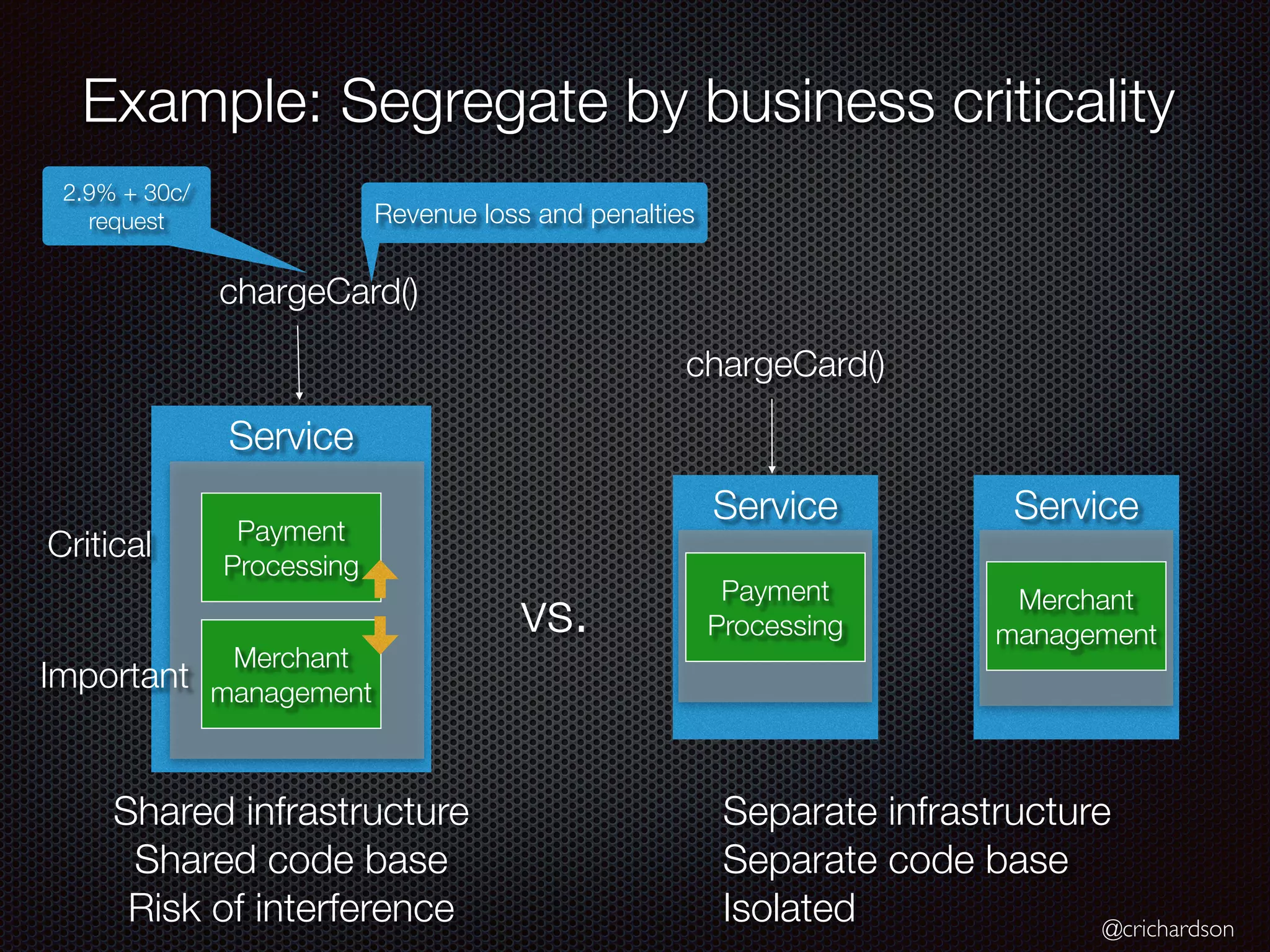
Example: Segregate by business criticality
Service
Service
Service
Payment
Processing
Payment
Processing
Merchant
management
Merchant
management
Shared infrastructure
Shared code base
Risk of interference
Separate infrastructure
Separate code base
Isolated
vs.
chargeCard()
2.9% + 30c/
request Revenue loss and penalties
chargeCard()
Critical
Important
@crichardson
Multiple “deployments” can address
some requirements
FTGO
Monolith
FTGO
Monolith
Router
chargeCard()
….()
SPRING_PROFILES_ACTIVE=….
Request
BUT not others:
• single code base
• ….
• Scalability
• Availability
• …
Module/New Feature → Service
=
Improves architecture via separation
@crichardson
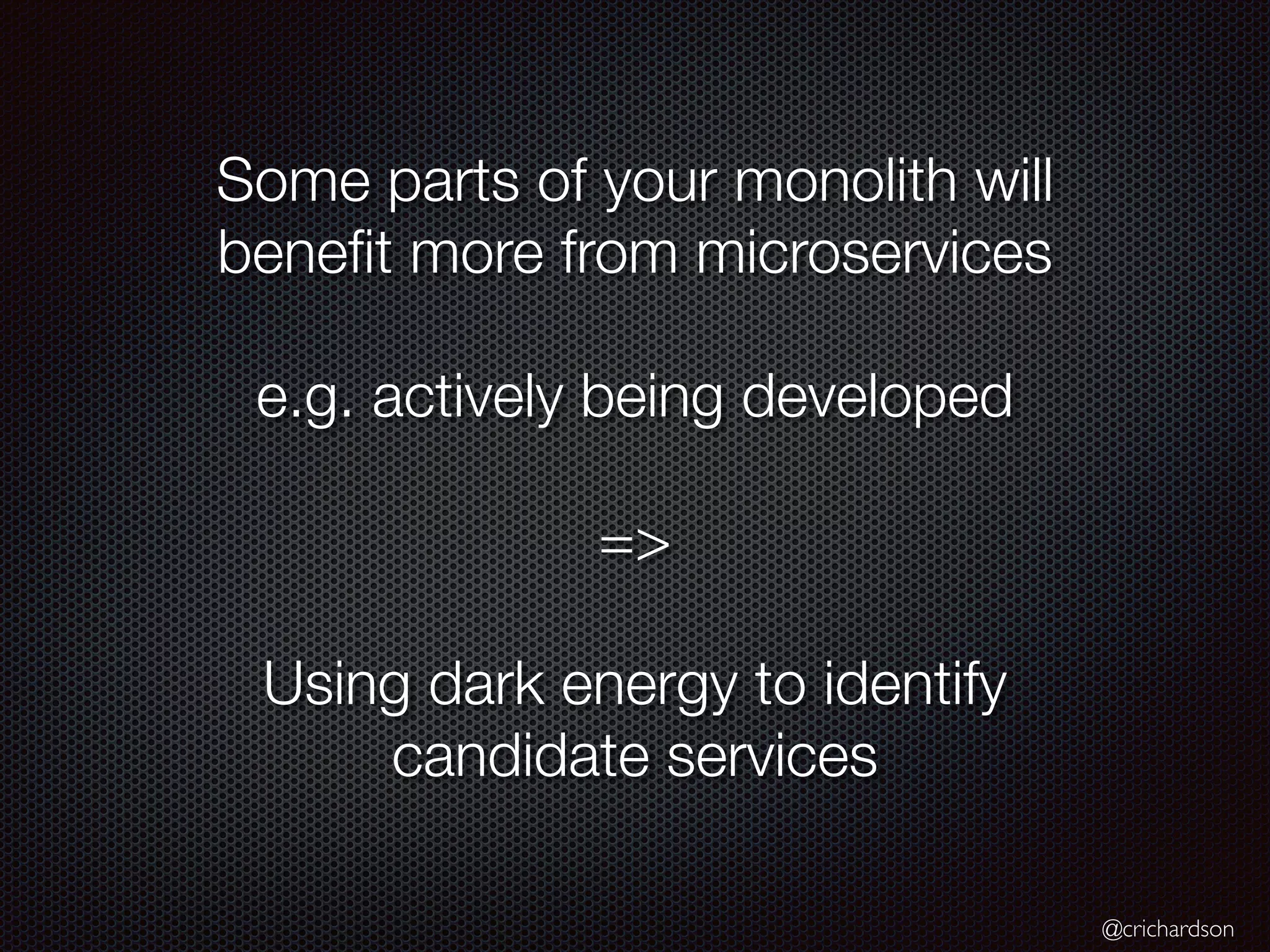
Some parts of your monolith will
bene
fi
t more from microservices
e.g. actively being developed
=>
Using dark energy to identify
candidate services
@crichardson
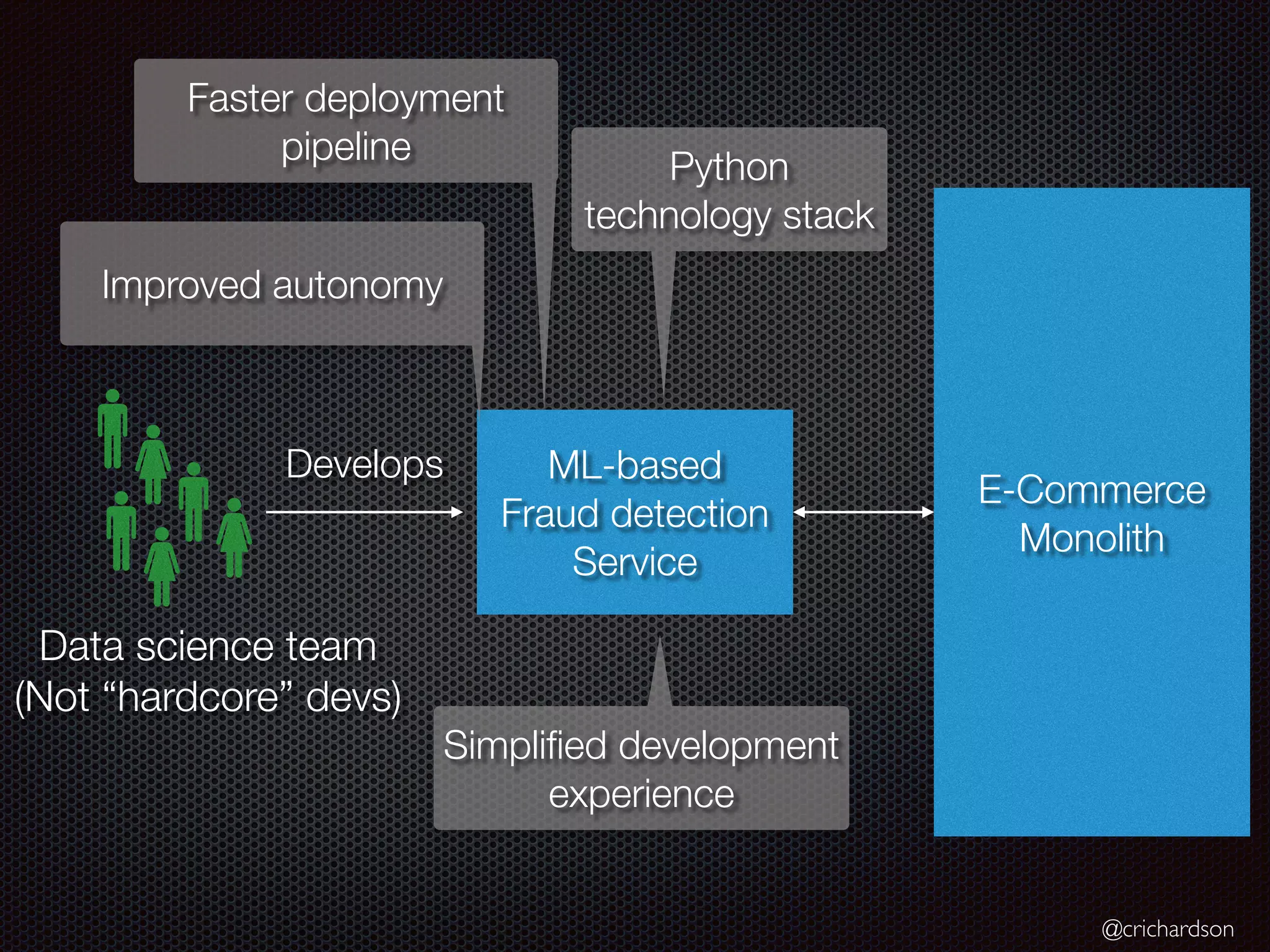
Data science team
(Not “hardcore” devs)
ML-based
Fraud detection
Service
E-Commerce
Monolith
Develops
Faster deployment
pipeline
Python
technology stack
Simpli
fi
ed development
experience
Improved autonomy
@crichardson
Agenda
Architecting for modern software delivery
Dark energy and dark matter: forces that drive the architecture
Dark energy: encouraging decomposition
Dark matter: resisting decomposition
@crichardson
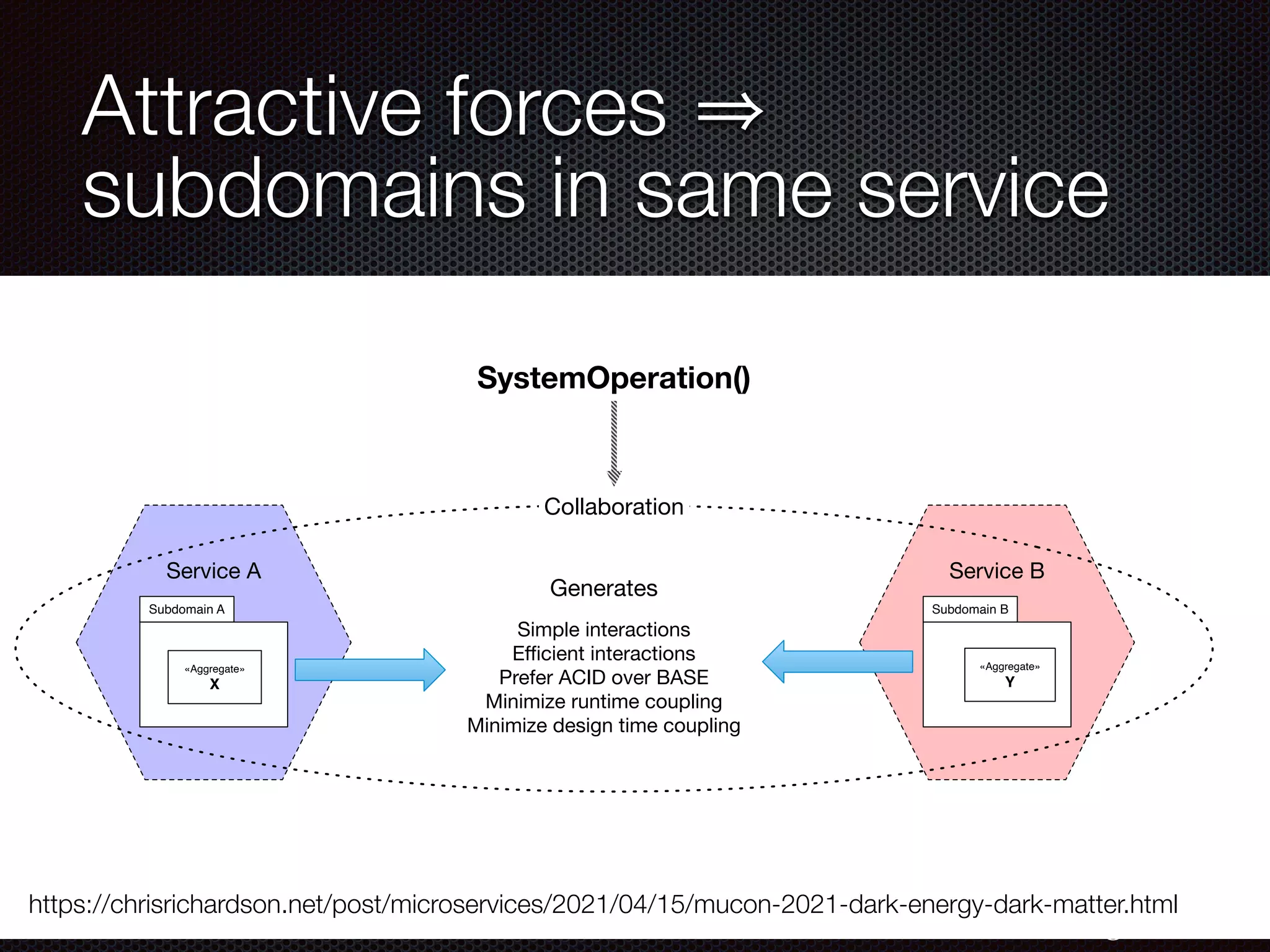
Attractive forces
subdomains in same service
https://chrisrichardson.net/post/microservices/2021/04/15/mucon-2021-dark-energy-dark-matter.html
Subdomain A
«Aggregate»
X
Subdomain B
«Aggregate»
Y
Service A Service B
Simple interactions
Efficient interactions
Prefer ACID over BASE
Minimize runtime coupling
Minimize design time coupling
Generates
SystemOperation()
Collaboration
@crichardson
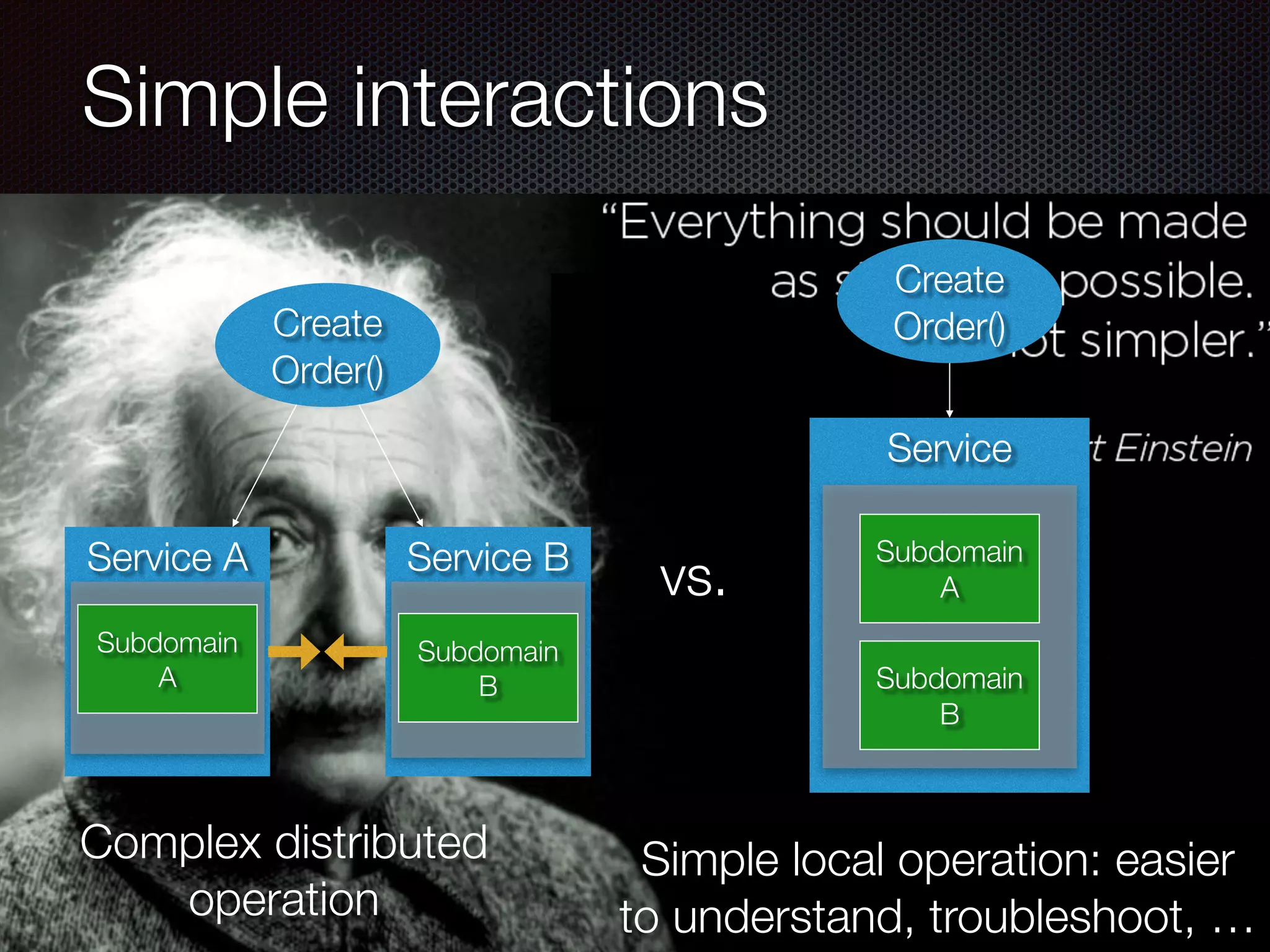
Simple interactions
Create
Order()
Service
Subdomain
A
Subdomain
B
Service B
Service A
Subdomain
A
Subdomain
B
Create
Order()
Complex distributed
operation
Simple local operation: easier
to understand, troubleshoot, …
vs.
@crichardson
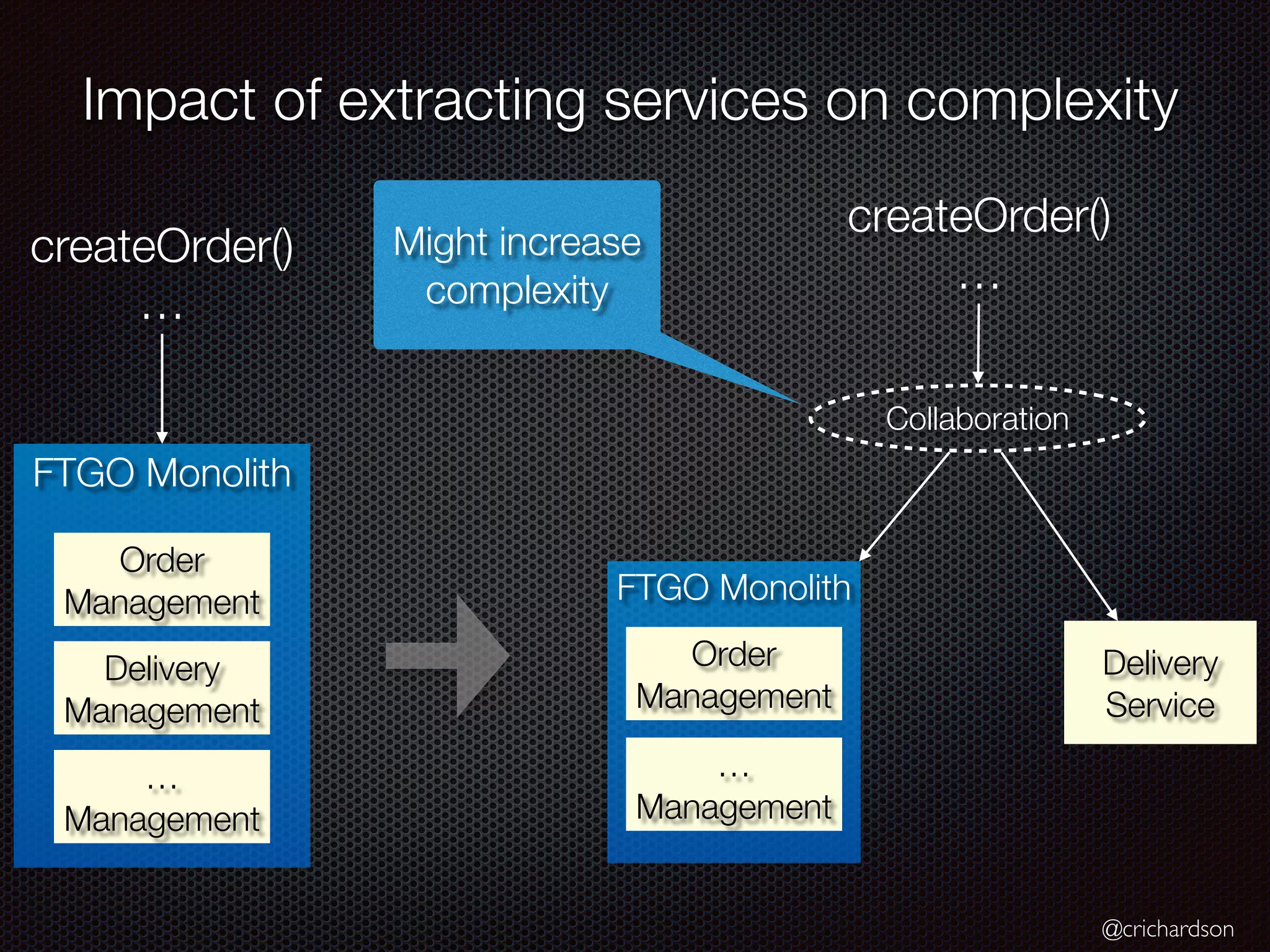
Impact of extracting services on complexity
FTGO Monolith
Delivery
Service
FTGO Monolith
Delivery
Management
createOrder()
…
createOrder()
…
Collaboration
Order
Management
…
Management
Order
Management
…
Management
Might increase
complexity
@crichardson
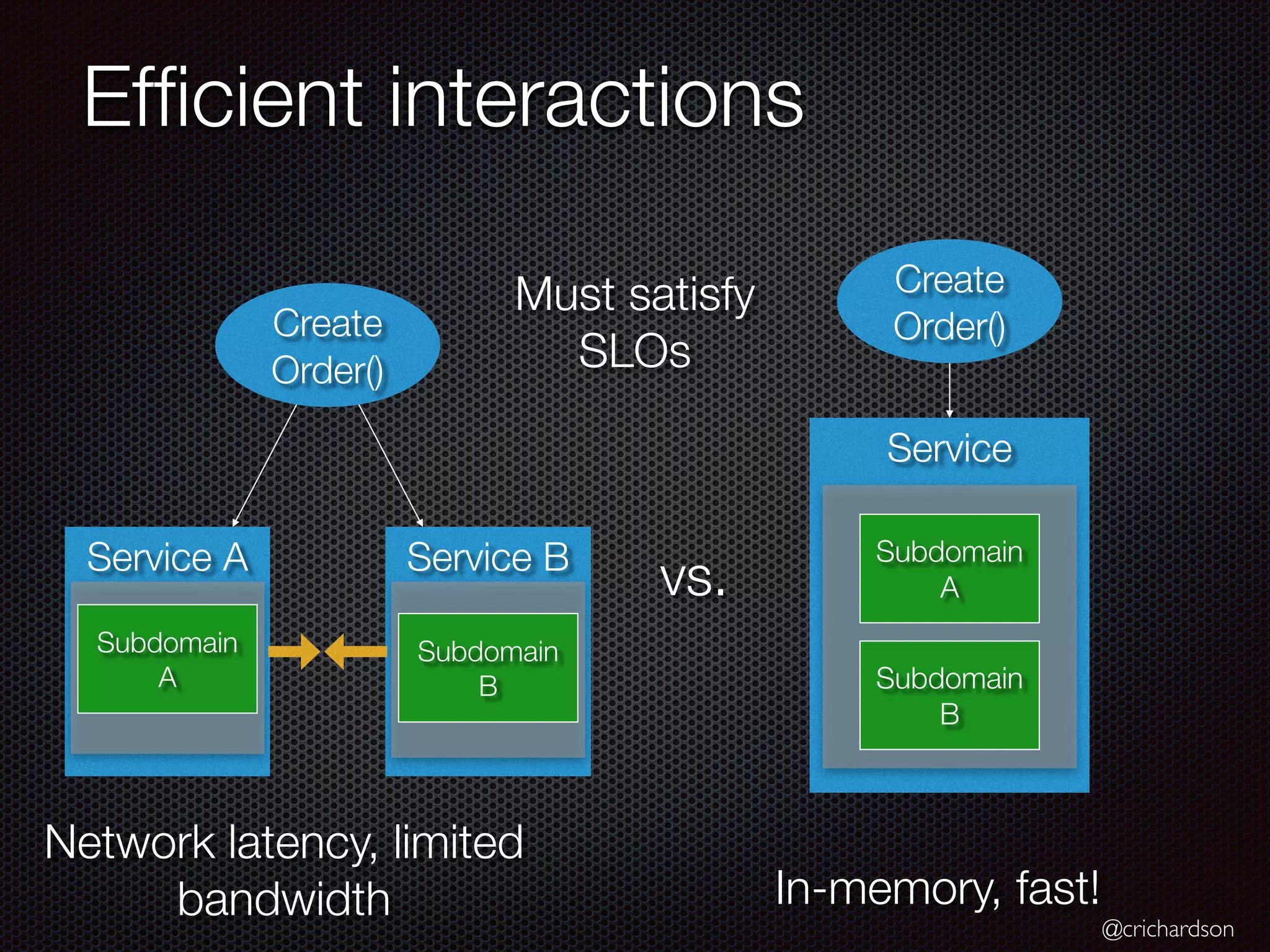
Ef
fi
cient interactions
Create
Order()
Service
Subdomain
A
Subdomain
B
Service B
Service A
Subdomain
A
Subdomain
B
Create
Order()
Network latency, limited
bandwidth In-memory, fast!
vs.
Must satisfy
SLOs
@crichardson
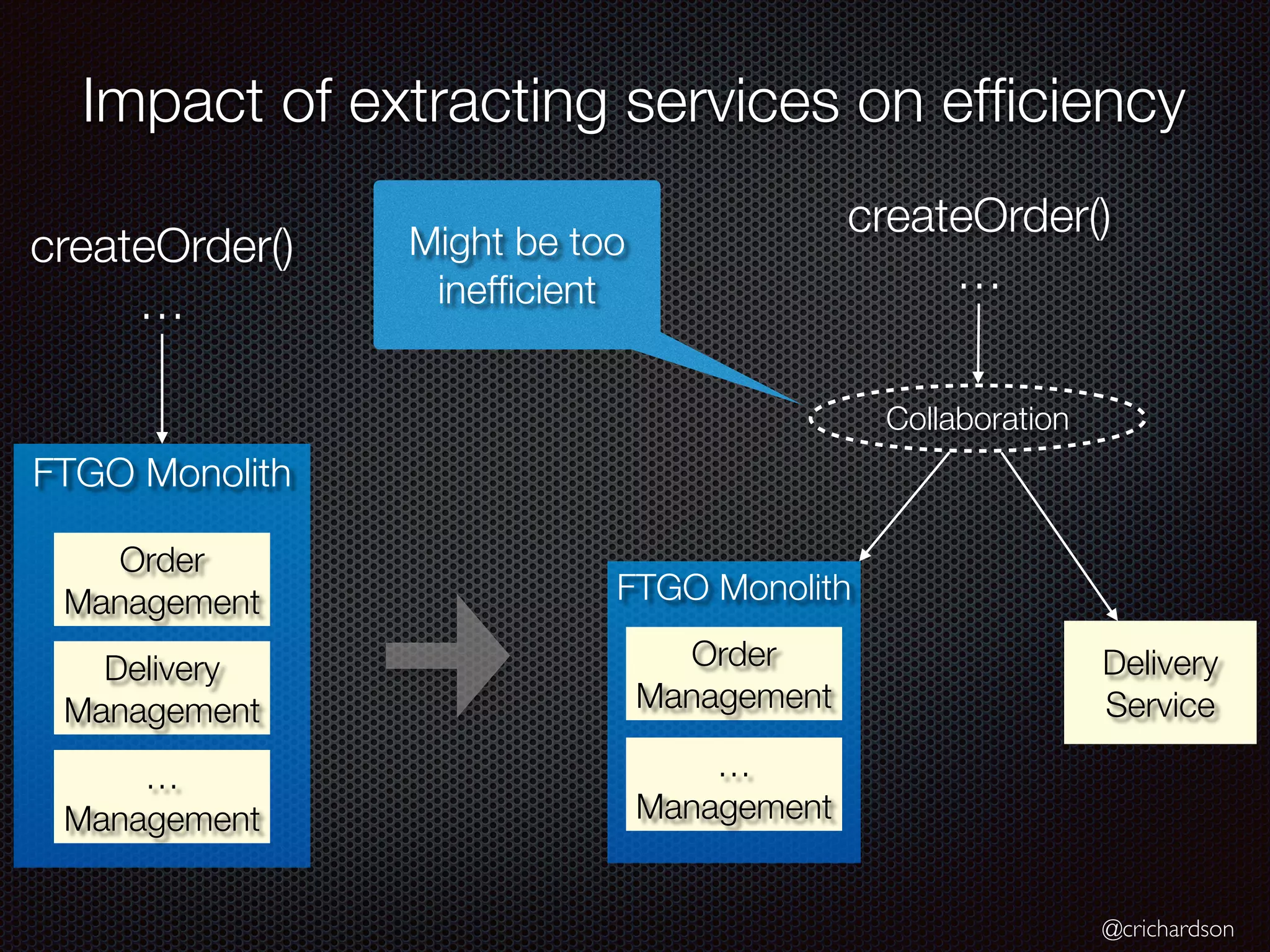
Impact of extracting services on ef
fi
ciency
FTGO Monolith
Delivery
Service
FTGO Monolith
Delivery
Management
createOrder()
…
createOrder()
…
Collaboration
Order
Management
…
Management
Order
Management
…
Management
Might be too
inef
fi
cient
@crichardson
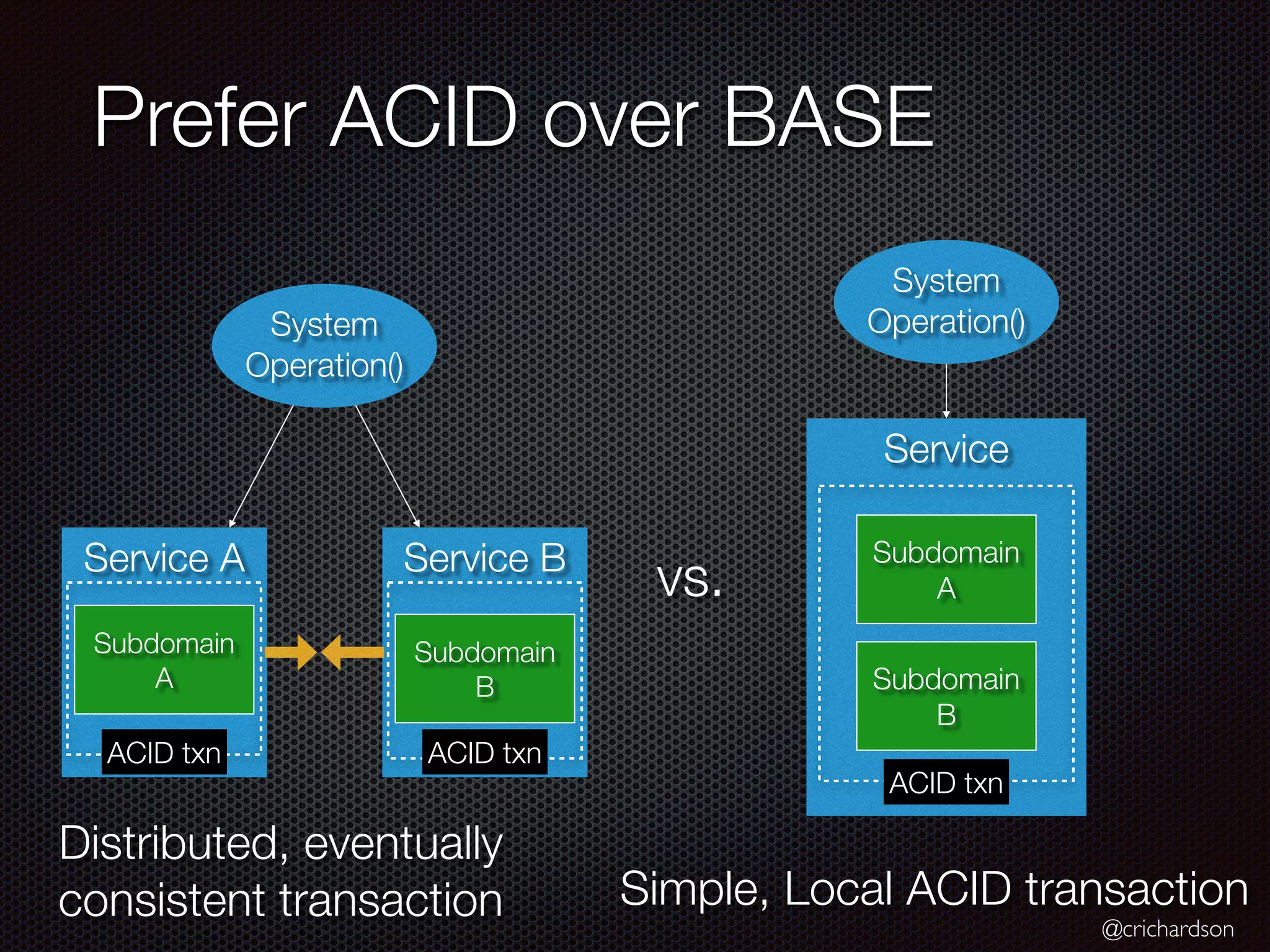
Prefer ACID over BASE
System
Operation()
Service
Subdomain
A
Subdomain
B
Service B
Service A
Subdomain
A
Subdomain
B
System
Operation()
Distributed, eventually
consistent transaction Simple, Local ACID transaction
vs.
ACID txn ACID txn
ACID txn
@crichardson
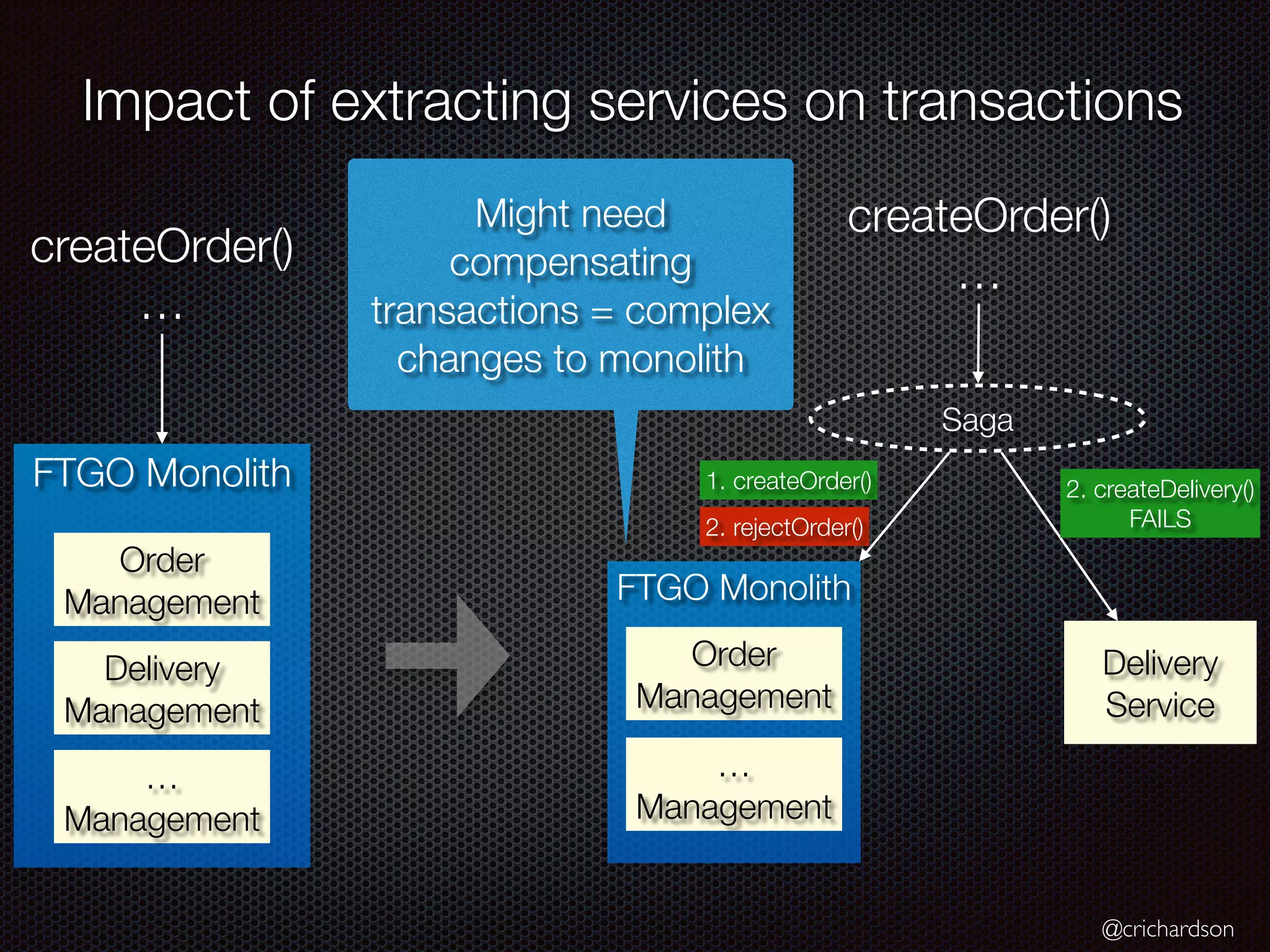
Impact of extracting services on transactions
FTGO Monolith
Delivery
Service
FTGO Monolith
Delivery
Management
createOrder()
…
createOrder()
…
Saga
Order
Management
…
Management
Order
Management
…
Management
Might need
compensating
transactions = complex
changes to monolith
1. createOrder() 2. createDelivery()
FAILS
2. rejectOrder()
@crichardson
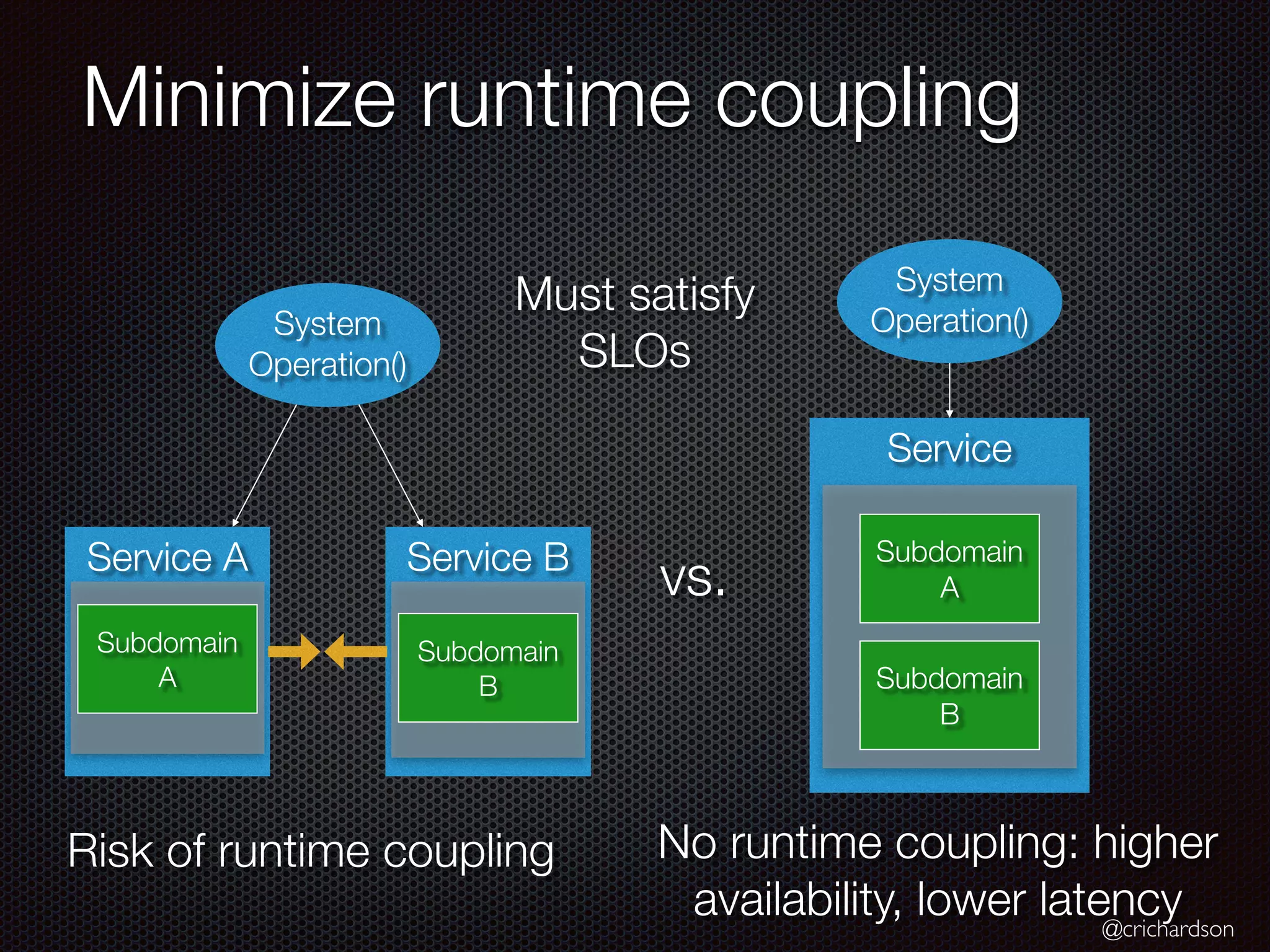
Minimize runtime coupling
System
Operation()
Service
Subdomain
A
Subdomain
B
Service B
Service A
Subdomain
A
Subdomain
B
System
Operation()
Risk of runtime coupling No runtime coupling: higher
availability, lower latency
vs.
Must satisfy
SLOs
@crichardson
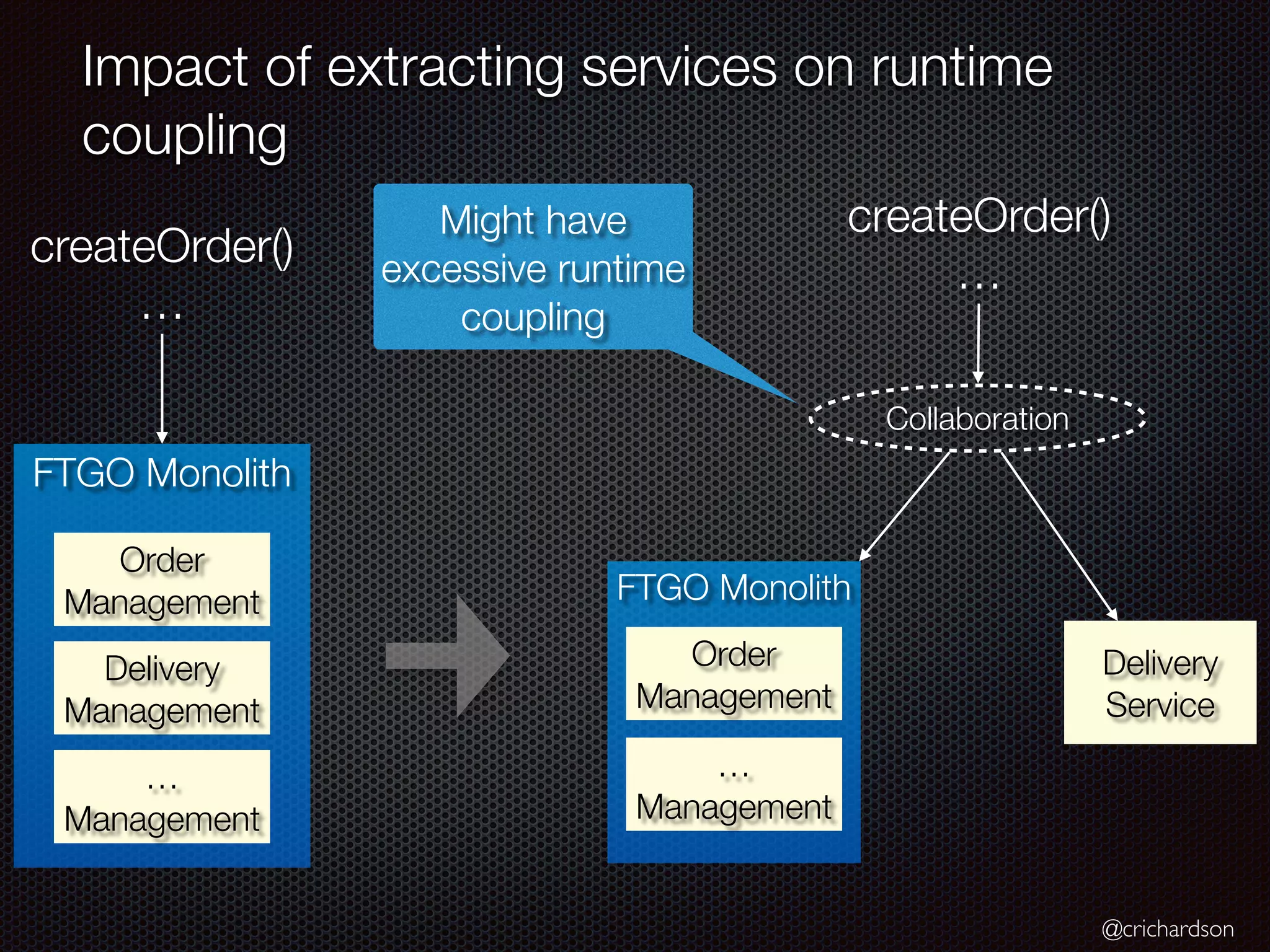
Impact of extracting services on runtime
coupling
FTGO Monolith
Delivery
Service
FTGO Monolith
Delivery
Management
createOrder()
…
createOrder()
…
Collaboration
Order
Management
…
Management
Order
Management
…
Management
Might have
excessive runtime
coupling
@crichardson
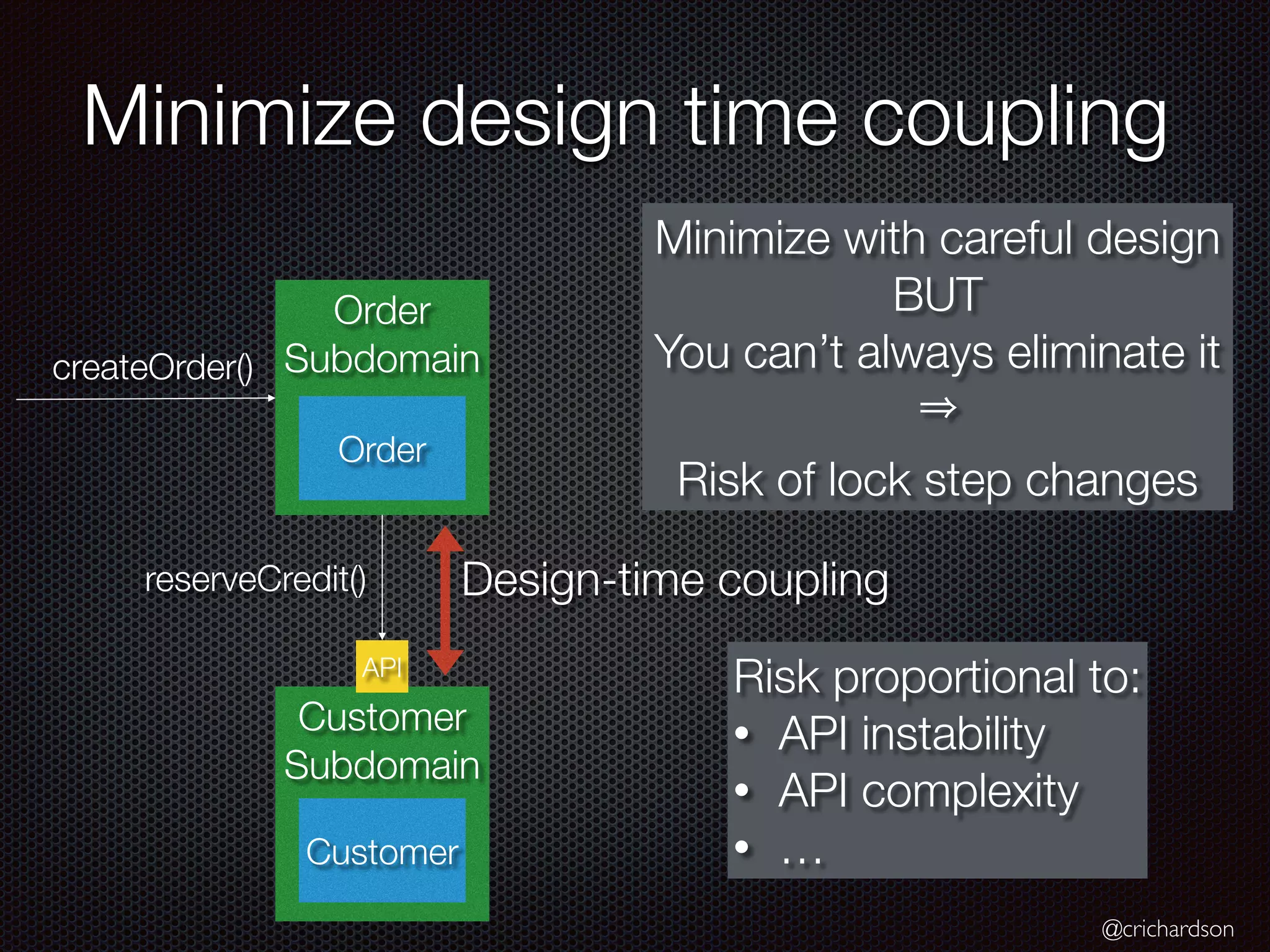
Minimize design time coupling
Order
Subdomain
Customer
Subdomain
reserveCredit()
createOrder()
Customer
Order
Design-time coupling
Minimize with careful design
BUT
You can’t always eliminate it
Risk of lock step changes
API
Risk proportional to:
• API instability
• API complexity
• …
@crichardson
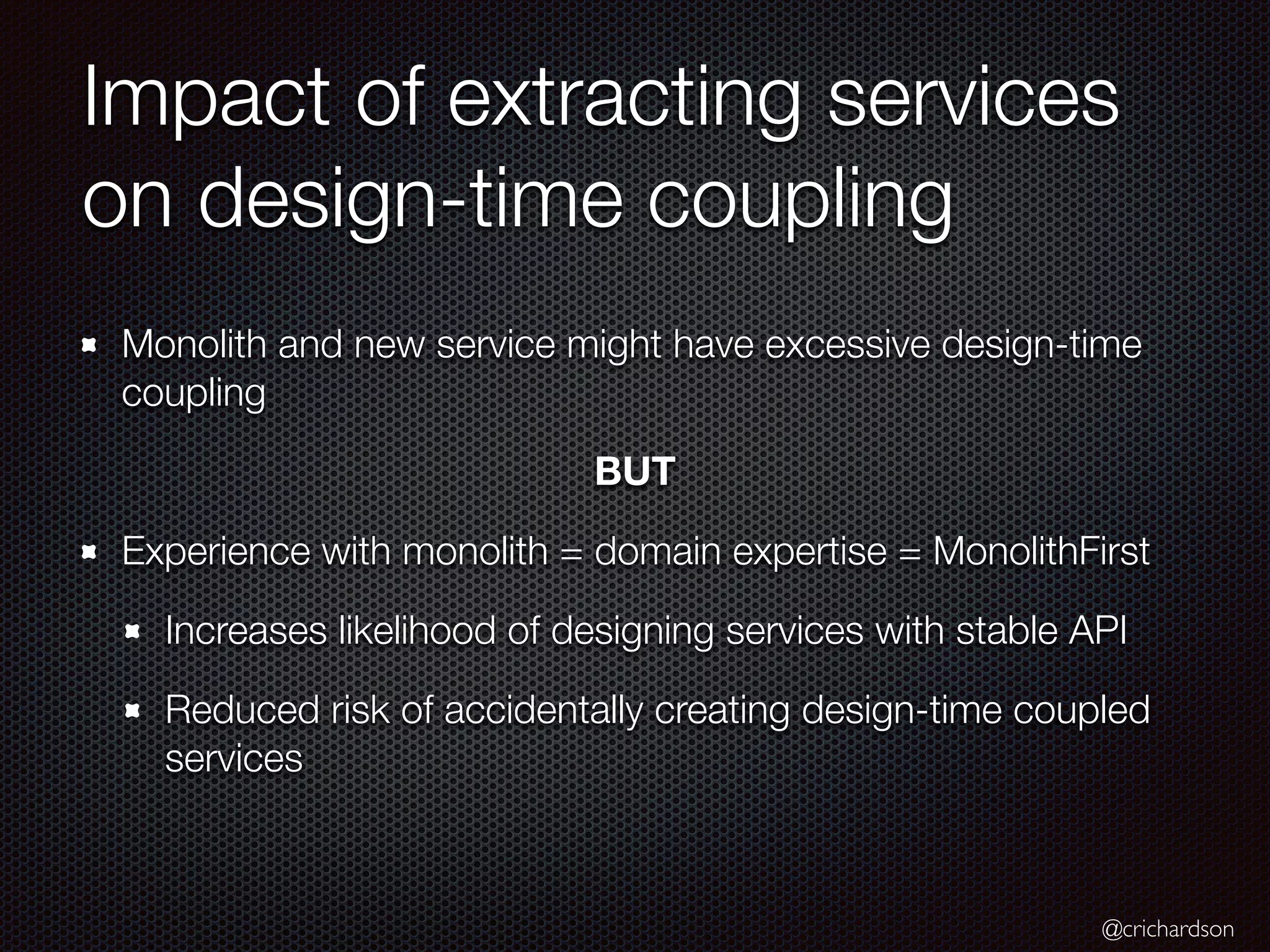
Impact of extracting services
on design-time coupling
Monolith and new service might have excessive design-time
coupling
BUT
Experience with monolith = domain expertise = MonolithFirst
Increases likelihood of designing services with stable API
Reduced risk of accidentally creating design-time coupled
services
@crichardson
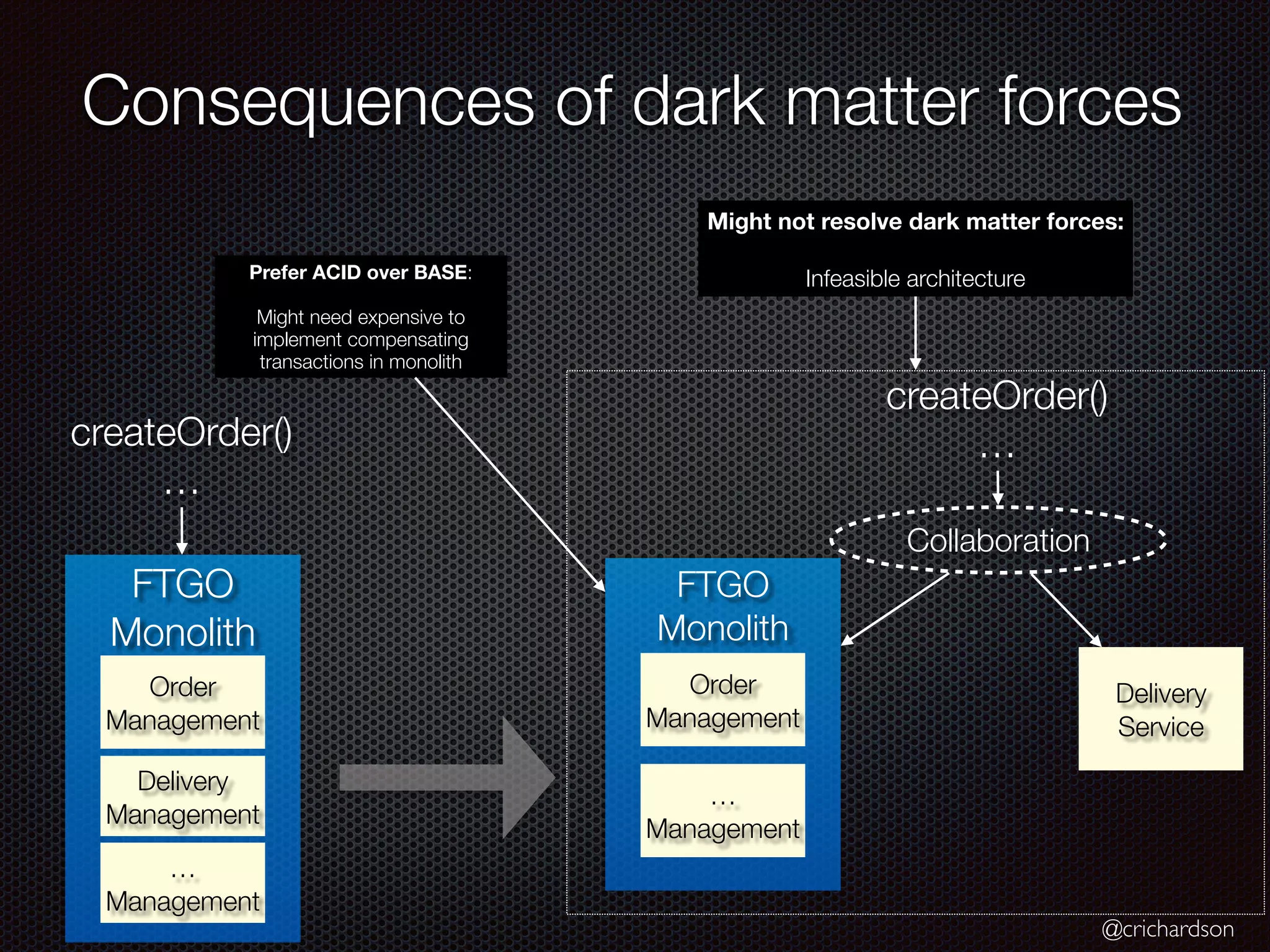
Consequences of dark matter forces
FTGO
Monolith
Delivery
Service
FTGO
Monolith
Delivery
Management
createOrder()
…
createOrder()
…
Collaboration
Order
Management
…
Management
Order
Management
…
Management
Might not resolve dark matter forces:
Infeasible architecture
Prefer ACID over BASE:
Might need expensive to
implement compensating
transactions in monolith
@crichardson
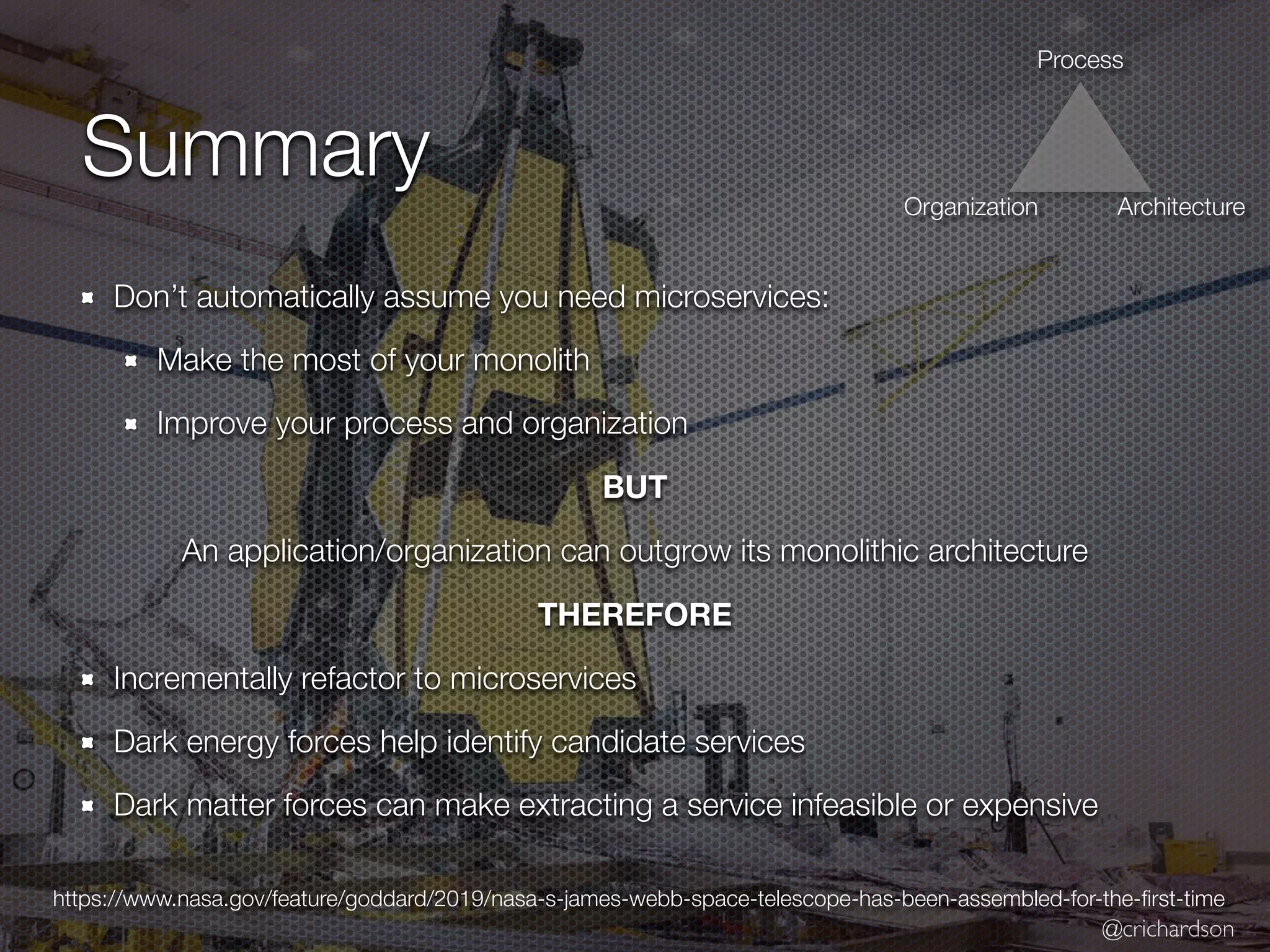
Summary
Don’t automatically assume you need microservices:
Make the most of your monolith
Improve your process and organization
BUT
An application/organization can outgrow its monolithic architecture
THEREFORE
Incrementally refactor to microservices
Dark energy forces help identify candidate services
Dark matter forces can make extracting a service infeasible or expensive
https://www.nasa.gov/feature/goddard/2019/nasa-s-james-webb-space-telescope-has-been-assembled-for-the-
fi
rst-time
Process
Organization Architecture
@crichardson
@crichardson chris@chrisrichardson.net
adopt.microservices.io
Questions?

YOW London - Considering Migrating a Monolith to Microservices? A Dark Energy, Dark Matter Perspective

  • 1.
    @crichardson Migrating a monolithto microservices? A dark energy, dark matter perspective Chris Richardson Founder of Eventuate.io Founder of the original CloudFoundry.com Author of POJOs in Action and Microservices Patterns @crichardson chris@chrisrichardson.net adopt.microservices.io Copyright © 2022. Chris Richardson Consulting, Inc. All rights reserved
  • 2.
  • 3.
    @crichardson Software is eatingthe world Business critical application You must deliver software rapidly, frequently, reliably and sustainably You Responsible for S/W VUCA
  • 4.
    @crichardson Goal Your reality Measuredby DORA metrics + your monolith’s technology stack is out of date
  • 5.
    @crichardson Adopting the microservice architecturewill make everything wonderful, right? Hint: it won’t
  • 6.
    @crichardson Presentation goal Using the darkenergy and dark matter forces to decide whether to refactor a monolith to microservices
  • 7.
  • 8.
    @crichardson Agenda Architecting for modernsoftware delivery Dark energy and dark matter: forces that drive the architecture Dark energy: encouraging decomposition Dark matter: resisting decomposition
  • 9.
    @crichardson O V I D - 1 9 https://www.ft.com/content/f9356bdc-3102-11ea-a329-0bcf87a328f2 https://www.ft.com/content/3f498e64-1aa6-11ea-97df-cc63de1d73f4 https://techcrunch.com/2019/06/18/the-rise-of-the-gig-economy-helps-london-based-insurtech-zego-to-raise-42m/ The success triangle Process:DevOps/Continuous Delivery & Deployment Organization: Network of small, loosely coupled, product teams IT must deliver software rapidly, frequently, reliably and sustainably. Measured by the DORA metrics Businesses must be nimble, agile and innovate faster S/W VUCA Architecture: ??? Supports Supports
  • 10.
    Required architectural quality attributes(.a.k.a. -ilities) DevOps Autonomous Teams Long-lived applications Testability Deployability Loose coupling Evolvability Enable incremental upgrades of technology stack
  • 11.
    @crichardson Make the mostof the monolith Process: adopt DevOps and automate Organization: Restructure and increase autonomy Monolithic architecture: Modularize and modernize Success triangle
  • 12.
    @crichardson If and onlyif that is insuf fi cient* then consider migrating to microservices *Large, complex applications developed by a (usually) large team that need to be delivered rapidly, frequently, and reliably
  • 13.
    @crichardson On the otherhand: Improving the monolith can take a while THEREFORE Implement urgent new features as services now
  • 14.
    @crichardson Strangler Fig Pattern:Incrementally refactoring a monolith to services Monolith Time Monolith Service Monolith Service Service Monolith Service Service Service Service …. Monolith Service Service Service Service Service Service Service Service Service Service Service Service Service Service Service Service …. Strangler application The strangler application grows larger over time The monolith shrinks over time Service Service Service Service Service Service Service Service New features Stop/resume at any point When should you migrate? And, which parts?
  • 15.
    @crichardson Agenda Architecting for modernsoftware delivery Dark energy and dark matter: forces that drive the architecture Dark energy: encouraging decomposition Dark matter: resisting decomposition
  • 16.
    @crichardson How to de fi nean Architecture… Application ≪subdomain≫ Customer management ≪aggregate≫ Customer ≪subdomain≫ Order management ≪aggregate≫ Order createCustomer() createOrder() fi ndOrder() fi ndOrderHistory() System operations Distill Requirements The “requests” that the application implements Have SLOs Customer Team Order Team About Subdomains • Business capability/function/etc • Logical view: packages and classes • Team-sized • Loosely coupled (Conways law) 1 2 Functional requirements As a consumer I want to place an Order So that I can …. As a Restaurant I want to accept an Order So that I can …. Event storming Wireframe/UI mockups Available Restaurants Restaurant Menu System quality attributes • SLA: Reliability/Latency • Scalability • …
  • 17.
    @crichardson Kitchen Service Delivery Service OrderService createOrder() … how to de fi ne an Architecture createOrder() <<subdomain>> Order Management Order System operations <<subdomain>> Order Management <<subdomain>> Kitchen Management <<subdomain>> Delivery Management <<subdomain>> Courier Management Group subdomains into services Application Collaboration Design collaborations for distributed operations createOrder() 3 Monolith or Microservices
  • 18.
    @crichardson Grouping subdomains into components:together or separate? ≪subdomain≫ Customer ≪aggregate≫ Customer ≪subdomain≫ Order ≪aggregate≫ Order Attraction Repulsion Simple components Team-sized services Fast deployment pipeline … Dark energy: an anti- gravity that’s accelerating the expansion of the universe Dark matter: an invisible matter that has a gravitational effect on stars and galaxies. https://www.nasa.gov/feature/goddard/2020/new-hubble-data-explains-missing-dark-matter Simple, ef fi cient interactions Prefer ACID over BASE Minimize runtime coupling … https://chrisrichardson.net/post/microservices/2021/04/15/mucon-2021-dark-energy-dark-matter.html Generate systemOperation()
  • 19.
    @crichardson Together or separate= Module vs. Service? FTGO Monolith Delivery Service FTGO Monolith Delivery Management createOrder() VS createOrder() Collaboration Order Management … Management Order Management … Management Dark Energy Dark Matter Bene fi ts Cost & Feasibility
  • 20.
    @crichardson Agenda Architecting for modernsoftware delivery Dark energy and dark matter: forces that drive the architecture Dark energy: encouraging decomposition Dark matter: resisting decomposition
  • 21.
    @crichardson Repulsive forces subdomains indifferent services https://chrisrichardson.net/post/microservices/2021/04/15/mucon-2021-dark-energy-dark-matter.html = reasons to migrate a module into a service Service Service «Subdomain» A «Aggregate» X «Subdomain» B «Aggregate» Y Simple components Team autonomy Fast deployment pipeline Support multiple technology stacks Segregate by characteristics Repulsive dark energy forces
  • 22.
  • 23.
    Simplifying a monolith Modularizingthe monolith helps reduce complexity Developer can focus on their module BUT Complexity ∝Size Github Repository «Gradle Project» FtgoApplication «Gradle Subproject» main main «Gradle Subproject» orders orders.web «Gradle Subproject» customerAPI orders. domain «Gradle Subproject» customers customers. persistence orders. persistence Customer team Order team customers. domain customers. web customers. api Module/New Feature → Service = simpler development IF • Module is actively being developed • Monolith is large
  • 24.
    @crichardson Team autonomy =service per team Service Service Service Subdomain A Subdomain A Subdomain B Subdomain B Coordination required Build, test and deploy independently vs. Team A Team B Team A Team B
  • 25.
    Monoliths and teamautonomy Modularization helps BUT Single code base Autonomy ∝ 1/ # developers Github Repository «Gradle Project» FtgoApplication «Gradle Subproject» main main «Gradle Subproject» orders orders.web «Gradle Subproject» customerAPI orders. domain «Gradle Subproject» customers customers. persistence orders. persistence Deployment pipeline Production FTGO Application Executable JAR customers. domain customers. web customers. api Module/New Feature → Service = increased autonomy IF • Module is actively being developed • Many teams
  • 26.
    @crichardson Fast deployment pipeline @mipsytipsy https://speakerdeck.com/charity/cd?slide=17 Service Subdomain Subdomain Service Subdomain Shorter leadtime Simpler build Longer lead time More complex build* * Parallelizing building/testing partially helps Service Subdomain vs.
  • 27.
    @crichardson Optimizing a monolith’sdeployment pipeline $ git pull $./gradlew test $ git push ! [rejected] …. Use merge queue Accelerate build/test: • Incremental testing through DIP and ISP • Parallelization/clustered builds • Selective test execution BUT if the application/team keeps growing Then eventually the deployment pipeline = bottleneck Module/New Feature → Service = faster deployment pipeline IF • Module is actively being developed • Monolith is large • Many teams
  • 28.
    @crichardson Support multiple technology stacks Service Python Service Java Service JVM Subdomain A Subdomain A Subdomain B Subdomain B Singletechnology stack Upgrade together Separate technology stacks Right tool for the job Upgrade independently Experiment easily versus
  • 29.
    @crichardson Monolith = singletechnology stack Single class path unless using exotic technology, eg. Layrry Single version of each dependency => big bang upgrades No opportunity to experiment No possibility of using non-JVM technologies, e.g. Python Module/New Feature → Service = multiple technology stacks
  • 30.
    @crichardson Separate subdomains by characteristics Subdomaincharacteristic Issue Resource requirements Cost-effective, scalability Regulations, e.g. SaMD/ PCI DevOps vs. Slower regulated process Business criticality/tier Maximize availability Security, e.g. PII, … Improve security DDD core/supporting/ generic Focus on being competitive
  • 31.
    @crichardson Cost effective scaling Service Service Service Subdomain A Subdomain A Subdomain B Subdomain B versus CPUMEM GPU Scale together • Wasteful • Costly CPU MEM GPU Scale separately • Ef fi cient • Cheaper Load Load Load Load EC2: p4d.24xlarge EC2: p4d.24xlarge EC2: m5.24xlarge 8x cost!
  • 32.
    @crichardson Example: Segregate bybusiness criticality Service Service Service Payment Processing Payment Processing Merchant management Merchant management Shared infrastructure Shared code base Risk of interference Separate infrastructure Separate code base Isolated vs. chargeCard() 2.9% + 30c/ request Revenue loss and penalties chargeCard() Critical Important
  • 33.
    @crichardson Multiple “deployments” canaddress some requirements FTGO Monolith FTGO Monolith Router chargeCard() ….() SPRING_PROFILES_ACTIVE=…. SPRING_PROFILES_ACTIVE=…. Request BUT not others: • single code base • …. • Scalability • Availability • … Module/New Feature → Service = Improves architecture via separation
  • 34.
    @crichardson Some parts ofyour monolith will bene fi t more from microservices e.g. actively being developed => Using dark energy to identify candidate services
  • 35.
    @crichardson Data science team (Not“hardcore” devs) ML-based Fraud detection Service E-Commerce Monolith Develops Faster deployment pipeline Python technology stack Simpli fi ed development experience Improved autonomy
  • 36.
    @crichardson Agenda Architecting for modernsoftware delivery Dark energy and dark matter: forces that drive the architecture Dark energy: encouraging decomposition Dark matter: resisting decomposition
  • 37.
    @crichardson Attractive forces subdomains insame service https://chrisrichardson.net/post/microservices/2021/04/15/mucon-2021-dark-energy-dark-matter.html Subdomain A «Aggregate» X Subdomain B «Aggregate» Y Service A Service B Simple interactions Efficient interactions Prefer ACID over BASE Minimize runtime coupling Minimize design time coupling Generates SystemOperation() Collaboration
  • 38.
    @crichardson Simple interactions Create Order() Service Subdomain A Subdomain B Service B ServiceA Subdomain A Subdomain B Create Order() Complex distributed operation Simple local operation: easier to understand, troubleshoot, … vs.
  • 39.
    @crichardson Impact of extractingservices on complexity FTGO Monolith Delivery Service FTGO Monolith Delivery Management createOrder() … createOrder() … Collaboration Order Management … Management Order Management … Management Might increase complexity
  • 40.
    @crichardson Ef fi cient interactions Create Order() Service Subdomain A Subdomain B Service B ServiceA Subdomain A Subdomain B Create Order() Network latency, limited bandwidth In-memory, fast! vs. Must satisfy SLOs
  • 41.
    @crichardson Impact of extractingservices on ef fi ciency FTGO Monolith Delivery Service FTGO Monolith Delivery Management createOrder() … createOrder() … Collaboration Order Management … Management Order Management … Management Might be too inef fi cient
  • 42.
    @crichardson Prefer ACID overBASE System Operation() Service Subdomain A Subdomain B Service B Service A Subdomain A Subdomain B System Operation() Distributed, eventually consistent transaction Simple, Local ACID transaction vs. ACID txn ACID txn ACID txn
  • 43.
    @crichardson Impact of extractingservices on transactions FTGO Monolith Delivery Service FTGO Monolith Delivery Management createOrder() … createOrder() … Saga Order Management … Management Order Management … Management Might need compensating transactions = complex changes to monolith 1. createOrder() 2. createDelivery() FAILS 2. rejectOrder()
  • 44.
    @crichardson Minimize runtime coupling System Operation() Service Subdomain A Subdomain B ServiceB Service A Subdomain A Subdomain B System Operation() Risk of runtime coupling No runtime coupling: higher availability, lower latency vs. Must satisfy SLOs
  • 45.
    @crichardson Impact of extractingservices on runtime coupling FTGO Monolith Delivery Service FTGO Monolith Delivery Management createOrder() … createOrder() … Collaboration Order Management … Management Order Management … Management Might have excessive runtime coupling
  • 46.
    @crichardson Minimize design timecoupling Order Subdomain Customer Subdomain reserveCredit() createOrder() Customer Order Design-time coupling Minimize with careful design BUT You can’t always eliminate it Risk of lock step changes API Risk proportional to: • API instability • API complexity • …
  • 47.
    @crichardson Impact of extractingservices on design-time coupling Monolith and new service might have excessive design-time coupling BUT Experience with monolith = domain expertise = MonolithFirst Increases likelihood of designing services with stable API Reduced risk of accidentally creating design-time coupled services
  • 48.
    @crichardson Consequences of darkmatter forces FTGO Monolith Delivery Service FTGO Monolith Delivery Management createOrder() … createOrder() … Collaboration Order Management … Management Order Management … Management Might not resolve dark matter forces: Infeasible architecture Prefer ACID over BASE: Might need expensive to implement compensating transactions in monolith
  • 49.
    @crichardson Summary Don’t automatically assumeyou need microservices: Make the most of your monolith Improve your process and organization BUT An application/organization can outgrow its monolithic architecture THEREFORE Incrementally refactor to microservices Dark energy forces help identify candidate services Dark matter forces can make extracting a service infeasible or expensive https://www.nasa.gov/feature/goddard/2019/nasa-s-james-webb-space-telescope-has-been-assembled-for-the- fi rst-time Process Organization Architecture
  • 50.