@crichardson
Decompose your monolith: Six
principles for refactoring a monolith
to microservices
Chris Richardson
Founder of Eventuate.io
Founder of the original CloudFoundry.com
Author of POJOs in Action and Microservices Patterns
@crichardson
chris@chrisrichardson.net
http://adopt.microservices.io
Copyright © 2020. Chris Richardson Consulting, Inc. All rights reserved
@crichardson
About Chris
http://adopt.microservices.io
@crichardson
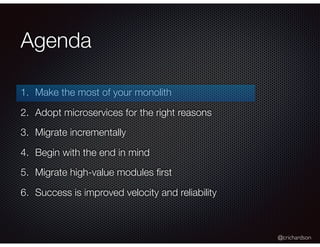
Agenda
1. Make the most of your monolith
2. Adopt microservices for the right reasons
3. Migrate incrementally
4. Begin with the end in mind
5. Migrate high-value modules first
6. Success is improved velocity and reliability
@crichardson
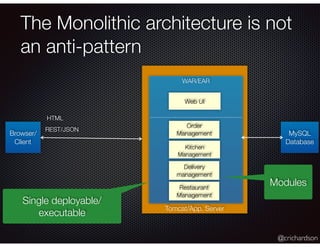
Tomcat/App. Server
The Monolithic architecture is not
an anti-pattern
Browser/
Client
WAR/EAR
MySQL
Database
Delivery
management
Order
Management
Kitchen
Management
Web UI
Restaurant
Management
HTML
REST/JSON
Single deployable/
executable
Modules
@crichardson
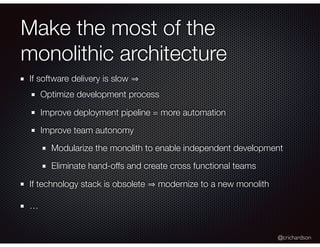
Make the most of the
monolithic architecture
If software delivery is slow
Optimize development process
Improve deployment pipeline = more automation
Improve team autonomy
Modularize the monolith to enable independent development
Eliminate hand-offs and create cross functional teams
If technology stack is obsolete modernize to a new monolith
…
@crichardson
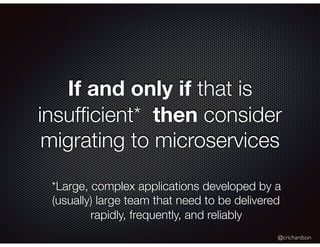
If and only if that is
insufficient* then consider
migrating to microservices
*Large, complex applications developed by a
(usually) large team that need to be delivered
rapidly, frequently, and reliably
@crichardson
Agenda
1. Make the most of your monolith
2. Adopt microservices for the right reasons
3. Migrate incrementally
4. Begin with the end in mind
5. Migrate high-value modules first
6. Success is improved velocity and reliability
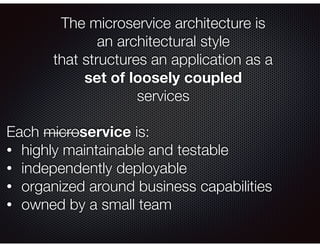
The microservice architecture is
an architectural style
that structures an application as a
set of loosely coupled
services
Each microservice is:
• highly maintainable and testable
• independently deployable
• organized around business capabilities
• owned by a small team
@crichardson
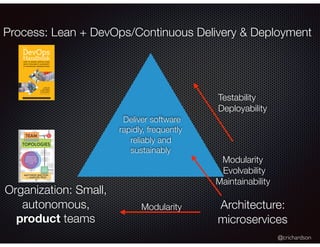
Process: Lean + DevOps/Continuous Delivery & Deployment
Organization: Small,
autonomous,
product teams
Architecture:
microservices
Testability
Deployability
Modularity
Modularity
Evolvability
Maintainability
Deliver software
rapidly, frequently
reliably and
sustainably
@crichardson
The microservice architecture
is NOT magic pixie dust
Adopting microservices won’t address:
Poor code quality
Lack of automated testing
Poor development process
….
And might make things worse!
https://chrisrichardson.net/post/antipatterns/2019/01/07/
microservices-are-a-magic-pixie-dust.html
@crichardson
Agenda
1. Make the most of your monolith
2. Adopt microservices for the right reasons
3. Migrate incrementally
4. Begin with the end in mind
5. Migrate high-value modules first
6. Success is improved velocity and reliability
@crichardson
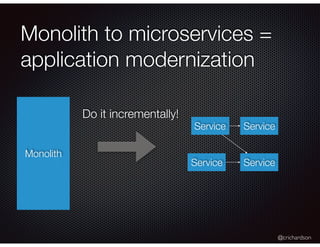
Monolith to microservices =
application modernization
Monolith
Service
Do it incrementally!
Service
Service
Service
@crichardson
Strangler
Application
http://www.martinfowler.com/bliki/StranglerApplication.html
Incrementally migrate
functionality
from
existing application
to
new (strangler)
application
@crichardson
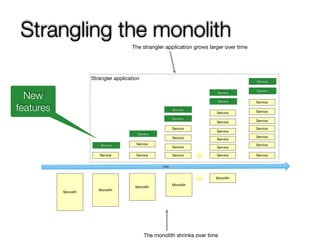
Strangling the monolith
Monolith
Time
Monolith
Service
Monolith
Service
Service
Monolith
Service
Service
Service
Service
…. Monolith
Service
Service
Service
Service
Service
Service
Service
Service
Service
Service
Service
Service
Service
Service
Service
Service
….
Strangler application
The strangler application grows larger over time
The monolith shrinks over time
Service
Service
Service
Service
Service
Service
Service
Service
New
features
@crichardsonDatabase
Module
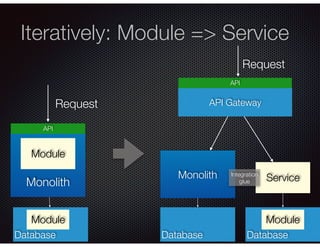
Iteratively: Module => Service
Monolith Service
API Gateway
Request
Module
Request
Monolith
Database
Module
Database
Module
Integration
glue
API
API
@crichardson
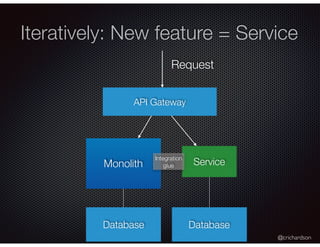
Iteratively: New feature = Service
Monolith Service
API Gateway
Request
DatabaseDatabase
Integration
glue
@crichardson
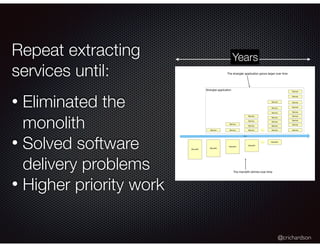
Repeat extracting
services until:
• Eliminated the
monolith
• Solved software
delivery problems
• Higher priority work
Monolith
Time
Monolith
Service
Monolith
Service
Service
Monolith
Service
Service
Service
Service
…. Monolith
Service
Service
Service
Service
Service
Service
Service
Service
Service
Service
Service
Service
Service
Service
Service
Service
….
Strangler application
The strangler application grows larger over time
The monolith shrinks over time
Years
@crichardson
Agenda
1. Make the most of your monolith
2. Adopt microservices for the right reasons
3. Migrate incrementally
4. Begin with the end in mind
5. Migrate high-value modules first
6. Success is improved velocity and reliability
@crichardson
Defining the correct service
boundaries is critical
(Using the latest, hot technology is not)
https://chrisrichardson.net/post/antipatterns/2019/04/30/
antipattern-focus-on-technology.html
@crichardson
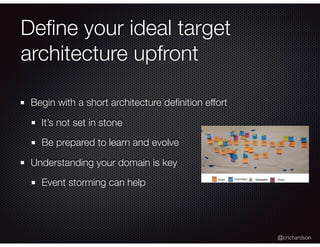
Define your ideal target
architecture upfront
Begin with a short architecture definition effort
It’s not set in stone
Be prepared to learn and evolve
Understanding your domain is key
Event storming can help
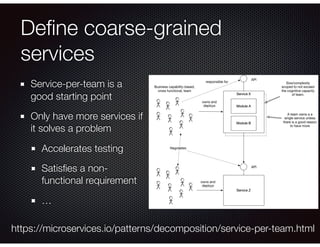
Define coarse-grained
services
Service-per-team is a
good starting point
Only have more services if
it solves a problem
Accelerates testing
Satisfies a non-
functional requirement
…
https://microservices.io/patterns/decomposition/service-per-team.html
@crichardson
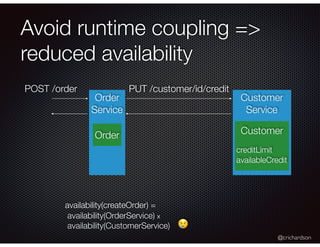
Avoid runtime coupling =>
reduced availability
Order
Service
Customer
Service
PUT /customer/id/credit
availability(createOrder) =
availability(OrderService) x
availability(CustomerService)
POST /order
😢
Order Customer
creditLimit
availableCredit
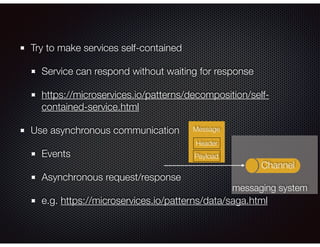
Try to make services self-contained
Service can respond without waiting for response
https://microservices.io/patterns/decomposition/self-
contained-service.html
Use asynchronous communication
Events
Asynchronous request/response
e.g. https://microservices.io/patterns/data/saga.html
messaging system
Message
Channel
Payload
Header
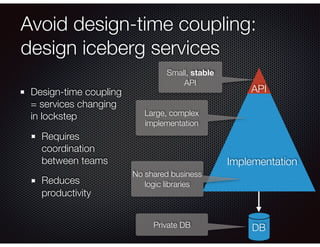
Avoid design-time coupling:
design iceberg services
Design-time coupling
= services changing
in lockstep
Requires
coordination
between teams
Reduces
productivity
Implementation
DB
API
Small, stable
API
Large, complex
implementation
Private DB
No shared business
logic libraries
@crichardson
Don’t be segment.com: shared
library, design-time coupling 😀
https://segment.com/blog/goodbye-microservices/
@crichardson
Agenda
1. Make the most of your monolith
2. Adopt microservices for the right reasons
3. Migrate incrementally
4. Begin with the end in mind
5. Migrate high-value modules first
6. Success is improved velocity and reliability
@crichardson
Start with the modules that
would give you the greatest
return on investment (ROI)
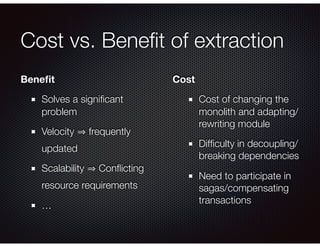
Cost vs. Benefit of extraction
Benefit
Solves a significant
problem
Velocity frequently
updated
Scalability Conflicting
resource requirements
…
Cost
Cost of changing the
monolith and adapting/
rewriting module
Difficulty in decoupling/
breaking dependencies
Need to participate in
sagas/compensating
transactions
@crichardson
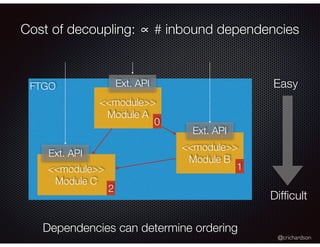
Cost of decoupling: ∝ # inbound dependencies
FTGO
<<module>>
Module A
<<module>>
Module B
<<module>>
Module C
Ext. API
Ext. API
Ext. API
Easy
Difficult
0
1
2
Dependencies can determine ordering
@crichardson
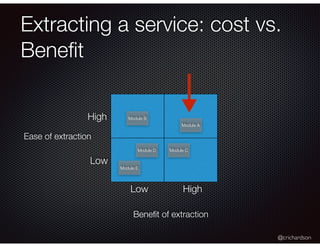
Extracting a service: cost vs.
Benefit
Benefit of extraction
Ease of extraction
High
HighLow
Low
Module B
Module A
Module CModule D
Module E
@crichardson
Agenda
1. Make the most of your monolith
2. Adopt microservices for the right reasons
3. Migrate incrementally
4. Begin with the end in mind
5. Migrate high-value modules first
6. Success is improved velocity and reliability
@crichardson
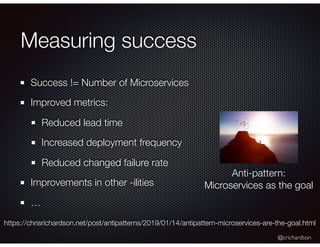
Measuring success
Success != Number of Microservices
Improved metrics:
Reduced lead time
Increased deployment frequency
Reduced changed failure rate
Improvements in other -ilities
…
Anti-pattern:
Microservices as the goal
https://chrisrichardson.net/post/antipatterns/2019/01/14/antipattern-microservices-are-the-goal.html
@crichardson
Summary: the six principles
1. Make the most of your monolith
2. Adopt microservices for the right reasons
3. Migrate incrementally
4. Begin with the end in mind
5. Migrate high-value modules first
6. Success is improved velocity and reliability
@crichardson
@crichardson chris@chrisrichardson.net
http://adopt.microservices.io
Questions?
35% discount with code 	
ctwcto20

Decompose your monolith: Six principles for refactoring a monolith to microservices

  • 1.
    @crichardson Decompose your monolith:Six principles for refactoring a monolith to microservices Chris Richardson Founder of Eventuate.io Founder of the original CloudFoundry.com Author of POJOs in Action and Microservices Patterns @crichardson chris@chrisrichardson.net http://adopt.microservices.io Copyright © 2020. Chris Richardson Consulting, Inc. All rights reserved
  • 2.
  • 3.
    @crichardson Agenda 1. Make themost of your monolith 2. Adopt microservices for the right reasons 3. Migrate incrementally 4. Begin with the end in mind 5. Migrate high-value modules first 6. Success is improved velocity and reliability
  • 4.
    @crichardson Tomcat/App. Server The Monolithicarchitecture is not an anti-pattern Browser/ Client WAR/EAR MySQL Database Delivery management Order Management Kitchen Management Web UI Restaurant Management HTML REST/JSON Single deployable/ executable Modules
  • 5.
    @crichardson Make the mostof the monolithic architecture If software delivery is slow Optimize development process Improve deployment pipeline = more automation Improve team autonomy Modularize the monolith to enable independent development Eliminate hand-offs and create cross functional teams If technology stack is obsolete modernize to a new monolith …
  • 6.
    @crichardson If and onlyif that is insufficient* then consider migrating to microservices *Large, complex applications developed by a (usually) large team that need to be delivered rapidly, frequently, and reliably
  • 7.
    @crichardson Agenda 1. Make themost of your monolith 2. Adopt microservices for the right reasons 3. Migrate incrementally 4. Begin with the end in mind 5. Migrate high-value modules first 6. Success is improved velocity and reliability
  • 8.
    The microservice architectureis an architectural style that structures an application as a set of loosely coupled services Each microservice is: • highly maintainable and testable • independently deployable • organized around business capabilities • owned by a small team
  • 9.
    @crichardson Process: Lean +DevOps/Continuous Delivery & Deployment Organization: Small, autonomous, product teams Architecture: microservices Testability Deployability Modularity Modularity Evolvability Maintainability Deliver software rapidly, frequently reliably and sustainably
  • 10.
    @crichardson The microservice architecture isNOT magic pixie dust Adopting microservices won’t address: Poor code quality Lack of automated testing Poor development process …. And might make things worse! https://chrisrichardson.net/post/antipatterns/2019/01/07/ microservices-are-a-magic-pixie-dust.html
  • 11.
    @crichardson Agenda 1. Make themost of your monolith 2. Adopt microservices for the right reasons 3. Migrate incrementally 4. Begin with the end in mind 5. Migrate high-value modules first 6. Success is improved velocity and reliability
  • 12.
    @crichardson Monolith to microservices= application modernization Monolith Service Do it incrementally! Service Service Service
  • 13.
  • 14.
    @crichardson Strangling the monolith Monolith Time Monolith Service Monolith Service Service Monolith Service Service Service Service ….Monolith Service Service Service Service Service Service Service Service Service Service Service Service Service Service Service Service …. Strangler application The strangler application grows larger over time The monolith shrinks over time Service Service Service Service Service Service Service Service New features
  • 15.
    @crichardsonDatabase Module Iteratively: Module =>Service Monolith Service API Gateway Request Module Request Monolith Database Module Database Module Integration glue API API
  • 16.
    @crichardson Iteratively: New feature= Service Monolith Service API Gateway Request DatabaseDatabase Integration glue
  • 17.
    @crichardson Repeat extracting services until: •Eliminated the monolith • Solved software delivery problems • Higher priority work Monolith Time Monolith Service Monolith Service Service Monolith Service Service Service Service …. Monolith Service Service Service Service Service Service Service Service Service Service Service Service Service Service Service Service …. Strangler application The strangler application grows larger over time The monolith shrinks over time Years
  • 18.
    @crichardson Agenda 1. Make themost of your monolith 2. Adopt microservices for the right reasons 3. Migrate incrementally 4. Begin with the end in mind 5. Migrate high-value modules first 6. Success is improved velocity and reliability
  • 19.
    @crichardson Defining the correctservice boundaries is critical (Using the latest, hot technology is not) https://chrisrichardson.net/post/antipatterns/2019/04/30/ antipattern-focus-on-technology.html
  • 20.
    @crichardson Define your idealtarget architecture upfront Begin with a short architecture definition effort It’s not set in stone Be prepared to learn and evolve Understanding your domain is key Event storming can help
  • 21.
    Define coarse-grained services Service-per-team isa good starting point Only have more services if it solves a problem Accelerates testing Satisfies a non- functional requirement … https://microservices.io/patterns/decomposition/service-per-team.html
  • 22.
    @crichardson Avoid runtime coupling=> reduced availability Order Service Customer Service PUT /customer/id/credit availability(createOrder) = availability(OrderService) x availability(CustomerService) POST /order 😢 Order Customer creditLimit availableCredit
  • 23.
    Try to makeservices self-contained Service can respond without waiting for response https://microservices.io/patterns/decomposition/self- contained-service.html Use asynchronous communication Events Asynchronous request/response e.g. https://microservices.io/patterns/data/saga.html messaging system Message Channel Payload Header
  • 24.
    Avoid design-time coupling: designiceberg services Design-time coupling = services changing in lockstep Requires coordination between teams Reduces productivity Implementation DB API Small, stable API Large, complex implementation Private DB No shared business logic libraries
  • 25.
    @crichardson Don’t be segment.com:shared library, design-time coupling 😀 https://segment.com/blog/goodbye-microservices/
  • 26.
    @crichardson Agenda 1. Make themost of your monolith 2. Adopt microservices for the right reasons 3. Migrate incrementally 4. Begin with the end in mind 5. Migrate high-value modules first 6. Success is improved velocity and reliability
  • 27.
    @crichardson Start with themodules that would give you the greatest return on investment (ROI)
  • 28.
    Cost vs. Benefitof extraction Benefit Solves a significant problem Velocity frequently updated Scalability Conflicting resource requirements … Cost Cost of changing the monolith and adapting/ rewriting module Difficulty in decoupling/ breaking dependencies Need to participate in sagas/compensating transactions
  • 29.
    @crichardson Cost of decoupling:∝ # inbound dependencies FTGO <<module>> Module A <<module>> Module B <<module>> Module C Ext. API Ext. API Ext. API Easy Difficult 0 1 2 Dependencies can determine ordering
  • 30.
    @crichardson Extracting a service:cost vs. Benefit Benefit of extraction Ease of extraction High HighLow Low Module B Module A Module CModule D Module E
  • 31.
    @crichardson Agenda 1. Make themost of your monolith 2. Adopt microservices for the right reasons 3. Migrate incrementally 4. Begin with the end in mind 5. Migrate high-value modules first 6. Success is improved velocity and reliability
  • 32.
    @crichardson Measuring success Success !=Number of Microservices Improved metrics: Reduced lead time Increased deployment frequency Reduced changed failure rate Improvements in other -ilities … Anti-pattern: Microservices as the goal https://chrisrichardson.net/post/antipatterns/2019/01/14/antipattern-microservices-are-the-goal.html
  • 33.
    @crichardson Summary: the sixprinciples 1. Make the most of your monolith 2. Adopt microservices for the right reasons 3. Migrate incrementally 4. Begin with the end in mind 5. Migrate high-value modules first 6. Success is improved velocity and reliability
  • 34.