@crichardson
Avoiding more the merrier:
a microservices anti-pattern
Chris Richardson
Microservice architecture consultant and trainer
Founder of the original CloudFoundry.com
Author of POJOs in Action and Microservices Patterns
Founder of Eventuate.io
@crichardson
chris@chrisrichardson.net
adopt.microservices.io
Copyright © 2023. Chris Richardson Consulting, Inc. All rights reserved
@crichardson
Presentation goal
How to rightsize your services
and
avoid creating an overly complex,
fi
ne-grained architecture
@crichardson
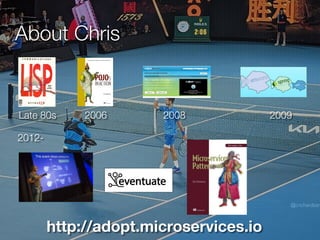
About Chris
http://adopt.microservices.io
Late 80s 2006 2008 2009
2012-
@crichardson
Agenda
How micro is a microservice?
Designing a microservice architecture
Dark matter forces: reasons to not use services
Dark energy forces: reasons to use services
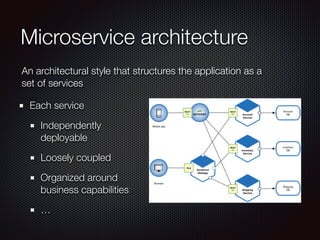
Microservice architecture
Each service
Independently
deployable
Loosely coupled
Organized around
business capabilities
…
An architectural style that structures the application as a
set of services
@crichardson
But how big is a service?
Microservice architecture
Must be small, right?!
A common conversation
Client: We are having problems testing our services. Can you
help us?
Me: Sure. How many services?
Client: 5
Me: Oh ok. BTW How many developers?
Client: 5
Me: Oh. How about merging into one service?
1 service/developer is remarkably common
@crichardson
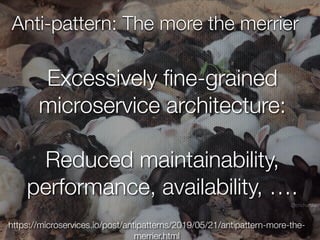
Anti-pattern: The more the merrier
Excessively
fi
ne-grained
microservice architecture:
Reduced maintainability,
performance, availability, ….
https://microservices.io/post/antipatterns/2019/05/21/antipattern-more-the-
merrier.html
@crichardson
Agenda
How micro is a microservice?
Designing a microservice architecture
Dark matter forces: reasons to not use services
Dark energy forces: reasons to use services
@crichardson
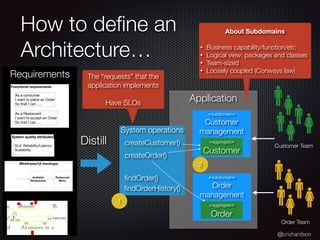
How to de
fi
ne an
Architecture…
Application
≪subdomain≫
Customer
management
≪aggregate≫
Customer
≪subdomain≫
Order
management
≪aggregate≫
Order
createCustomer()
createOrder()
fi
ndOrder()
fi
ndOrderHistory()
System operations
Distill
Requirements The “requests” that the
application implements
Have SLOs
Customer Team
Order Team
About Subdomains
• Business capability/function/etc
• Logical view: packages and classes
• Team-sized
• Loosely coupled (Conways law)
1
2
Functional requirements
As a consumer
I want to place an Order
So that I can ….
As a Restaurant
I want to accept an Order
So that I can ….
Event storming
Wireframe/UI mockups
Available
Restaurants
Restaurant
Menu
System quality attributes
• SLA: Reliability/Latency
• Scalability
• …
@crichardson
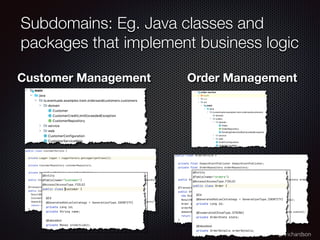
Subdomains: Eg. Java classes and
packages that implement business logic
Customer Management Order Management
@crichardson
Kitchen Service
Delivery Service
Order Service
createOrder()
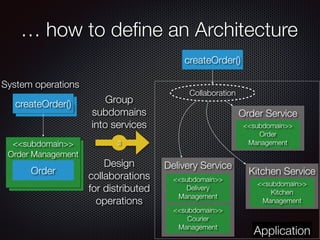
… how to de
fi
ne an Architecture
createOrder()
<<subdomain>>
Order Management
Order
System operations
<<subdomain>>
Order
Management
<<subdomain>>
Kitchen
Management
<<subdomain>>
Delivery
Management
<<subdomain>>
Courier
Management
Group
subdomains
into services
Application
Collaboration
Design
collaborations
for distributed
operations
createOrder()
3
@crichardson
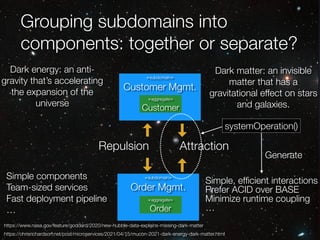
Grouping subdomains into
components: together or separate?
≪subdomain≫
Customer Mgmt.
≪aggregate≫
Customer
≪subdomain≫
Order Mgmt.
≪aggregate≫
Order
Attraction
Repulsion
Simple components
Team-sized services
Fast deployment pipeline
…
Dark energy: an anti-
gravity that’s accelerating
the expansion of the
universe
Dark matter: an invisible
matter that has a
gravitational effect on stars
and galaxies.
https://www.nasa.gov/feature/goddard/2020/new-hubble-data-explains-missing-dark-matter
Simple, ef
fi
cient interactions
Prefer ACID over BASE
Minimize runtime coupling
…
https://chrisrichardson.net/post/microservices/2021/04/15/mucon-2021-dark-energy-dark-matter.html
Generate
systemOperation()
@crichardson
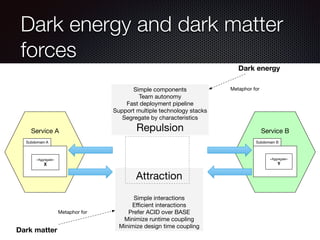
Dark energy and dark matter
forces
Subdomain A
«Aggregate»
X
Subdomain B
«Aggregate»
Y
Service A Service B
Attraction
Simple interactions
Efficient interactions
Prefer ACID over BASE
Minimize runtime coupling
Minimize design time coupling
Simple components
Team autonomy
Fast deployment pipeline
Support multiple technology stacks
Segregate by characteristics
Repulsion
Dark energy
Dark matter
Metaphor for
Metaphor for
@crichardson
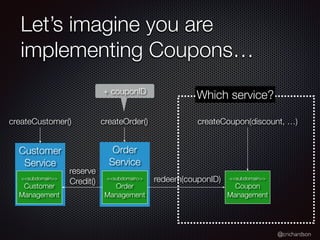
Let’s imagine you are
implementing Coupons…
Order
Service
<<subdomain>>
Order
Management
Customer
Service
<<subdomain>>
Customer
Management
createCustomer() createOrder()
<<subdomain>>
Coupon
Management
createCoupon(discount, …)
+ couponID
redeem(couponID)
Which service?
reserve
Credit()
@crichardson
Order
Service
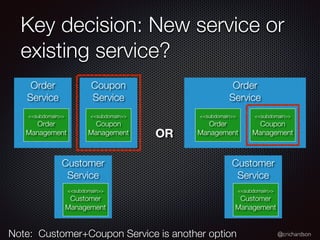
Key decision: New service or
existing service?
Coupon
Service
Order
Service
<<subdomain>>
Order
Management
<<subdomain>>
Coupon
Management
Customer
Service
<<subdomain>>
Customer
Management
<<subdomain>>
Order
Management
<<subdomain>>
Coupon
Management
Customer
Service
<<subdomain>>
Customer
Management
OR
Note: Customer+Coupon Service is another option
@crichardson
Agenda
How micro is a microservice?
Designing a microservice architecture
Dark matter forces: reasons to not use services
Dark energy forces: reasons to use services
@crichardson
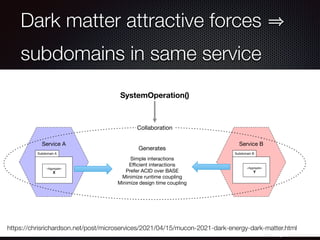
Dark matter attractive forces
subdomains in same service
https://chrisrichardson.net/post/microservices/2021/04/15/mucon-2021-dark-energy-dark-matter.html
Subdomain A
«Aggregate»
X
Subdomain B
«Aggregate»
Y
Service A Service B
Simple interactions
Efficient interactions
Prefer ACID over BASE
Minimize runtime coupling
Minimize design time coupling
Generates
SystemOperation()
Collaboration
@crichardson
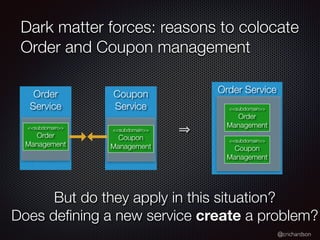
Dark matter forces: reasons to colocate
Order and Coupon management
Coupon
Service
Order
Service
Order Service
<<subdomain>>
Order
Management
<<subdomain>>
Order
Management
<<subdomain>>
Coupon
Management
<<subdomain>>
Coupon
Management
But do they apply in this situation?
Does de
fi
ning a new service create a problem?
@crichardson
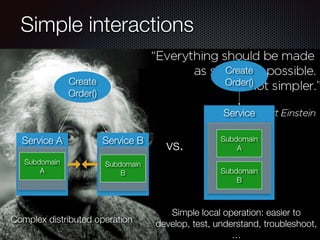
Simple interactions
Create
Order()
Service
Subdomain
A
Subdomain
B
Service B
Service A
Subdomain
A
Subdomain
B
Create
Order()
Complex distributed operation
Simple local operation: easier to
develop, test, understand, troubleshoot,
…
vs.
@crichardson
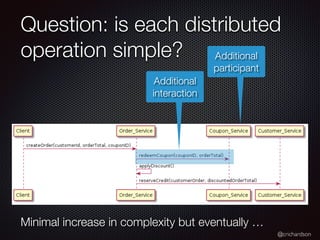
Question: is each distributed
operation simple?
Additional
interaction
Additional
participant
Minimal increase in complexity but eventually …
@crichardson
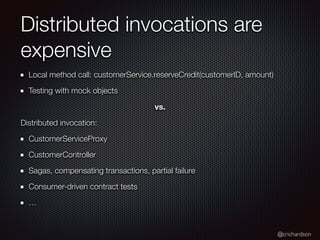
Distributed invocations are
expensive
Local method call: customerService.reserveCredit(customerID, amount)
Testing with mock objects
vs.
Distributed invocation:
CustomerServiceProxy
CustomerController
Sagas, compensating transactions, partial failure
Consumer-driven contract tests
…
@crichardson
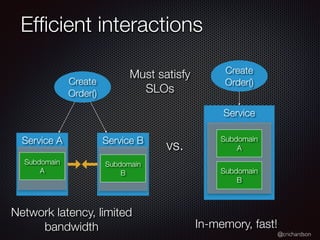
Ef
fi
cient interactions
Create
Order()
Service
Subdomain
A
Subdomain
B
Service B
Service A
Subdomain
A
Subdomain
B
Create
Order()
Network latency, limited
bandwidth In-memory, fast!
vs.
Must satisfy
SLOs
@crichardson
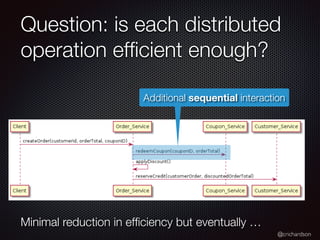
Question: is each distributed
operation ef
fi
cient enough?
Additional sequential interaction
Minimal reduction in ef
fi
ciency but eventually …
@crichardson
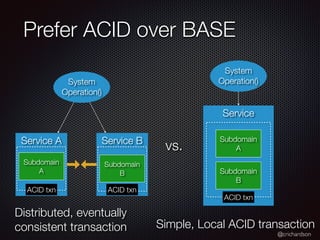
Prefer ACID over BASE
System
Operation()
Service
Subdomain
A
Subdomain
B
Service B
Service A
Subdomain
A
Subdomain
B
System
Operation()
Distributed, eventually
consistent transaction Simple, Local ACID transaction
vs.
ACID txn ACID txn
ACID txn
@crichardson
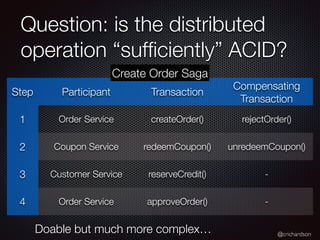
Question: is the distributed
operation “suf
fi
ciently” ACID?
Step Participant Transaction
Compensating
Transaction
1 Order Service createOrder() rejectOrder()
2 Coupon Service redeemCoupon() unredeemCoupon()
3 Customer Service reserveCredit() -
4 Order Service approveOrder() -
Create Order Saga
Doable but much more complex…
@crichardson
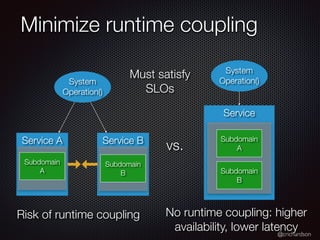
Minimize runtime coupling
System
Operation()
Service
Subdomain
A
Subdomain
B
Service B
Service A
Subdomain
A
Subdomain
B
System
Operation()
Risk of runtime coupling No runtime coupling: higher
availability, lower latency
vs.
Must satisfy
SLOs
@crichardson
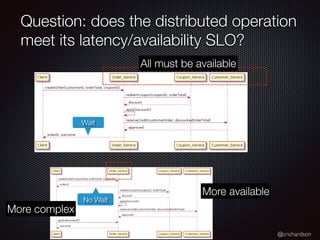
Question: does the distributed operation
meet its latency/availability SLO?
All must be available
More available
More complex
Wait
No Wait
@crichardson
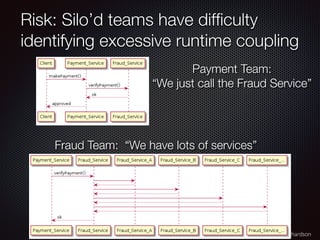
Risk: Silo’d teams have dif
fi
culty
identifying excessive runtime coupling
Payment Team:
“We just call the Fraud Service”
Fraud Team: “We have lots of services”
@crichardson
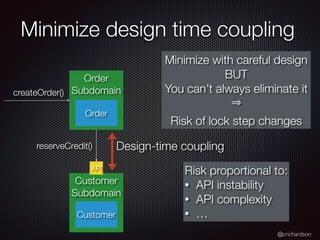
Minimize design time coupling
Order
Subdomain
Customer
Subdomain
reserveCredit()
createOrder()
Customer
Order
Design-time coupling
Minimize with careful design
BUT
You can’t always eliminate it
Risk of lock step changes
API
Risk proportional to:
• API instability
• API complexity
• …
@crichardson
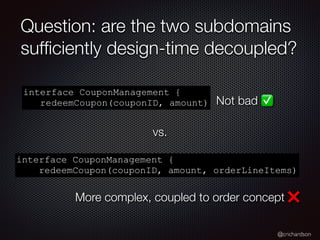
Question: are the two subdomains
suf
fi
ciently design-time decoupled?
interface CouponManagement {
redeemCoupon(couponID, amount)
interface CouponManagement {
redeemCoupon(couponID, amount, orderLineItems)
Not bad ✅
More complex, coupled to order concept ❌
vs.
@crichardson
Agenda
How micro is a microservice?
Designing a microservice architecture
Dark matter forces: reasons to not use services
Dark energy forces: reasons to use services
@crichardson
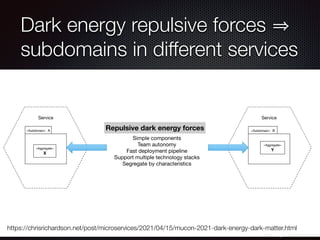
Dark energy repulsive forces
subdomains in different services
https://chrisrichardson.net/post/microservices/2021/04/15/mucon-2021-dark-energy-dark-matter.html
Service
Service
«Subdomain» A
«Aggregate»
X
«Subdomain» B
«Aggregate»
Y
Simple components
Team autonomy
Fast deployment pipeline
Support multiple technology stacks
Segregate by characteristics
Repulsive dark energy forces
@crichardson
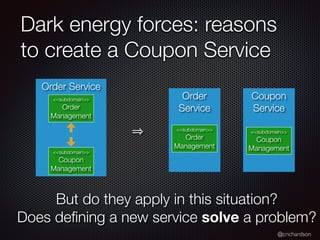
Dark energy forces: reasons
to create a Coupon Service
Coupon
Service
Order
Service
Order Service
<<subdomain>>
Order
Management
<<subdomain>>
Order
Management
<<subdomain>>
Coupon
Management
<<subdomain>>
Coupon
Management
But do they apply in this situation?
Does de
fi
ning a new service solve a problem?
@crichardson
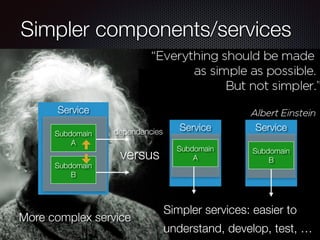
Simpler components/services
Service
Service
Service
Subdomain
A
Subdomain
A
Subdomain
B
Subdomain
B
More complex service
Simpler services: easier to
understand, develop, test, …
versus
dependencies
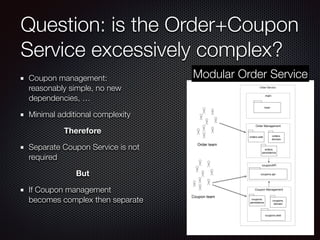
Question: is the Order+Coupon
Service excessively complex?
Coupon management:
reasonably simple, no new
dependencies, …
Minimal additional complexity
Therefore
Separate Coupon Service is not
required
But
If Coupon management
becomes complex then separate
Order Service
main
main
Order Management
orders.web
couponAPI
orders.
domain
Coupon Management
coupons.
persistence
orders.
persistence
Coupon team
Order team
coupons.
domain
coupons.web
coupons.api
Modular Order Service
@crichardson
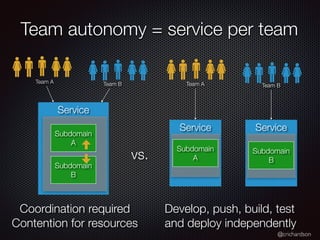
Team autonomy = service per team
Service
Service
Service
Subdomain
A
Subdomain
A
Subdomain
B
Subdomain
B
Coordination required
Contention for resources
Develop, push, build, test
and deploy independently
vs.
Team A Team B Team A Team B
@crichardson
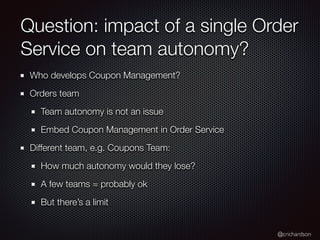
Question: impact of a single Order
Service on team autonomy?
Who develops Coupon Management?
Orders team
Team autonomy is not an issue
Embed Coupon Management in Order Service
Different team, e.g. Coupons Team:
How much autonomy would they lose?
A few teams = probably ok
But there’s a limit
@crichardson
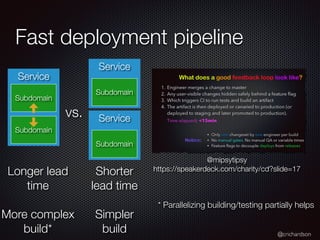
Fast deployment pipeline
@mipsytipsy
https://speakerdeck.com/charity/cd?slide=17
Service
Subdomain
Subdomain
Service
Subdomain
Shorter
lead time
Simpler
build
Longer lead
time
More complex
build*
* Parallelizing building/testing partially helps
Service
Subdomain
vs.
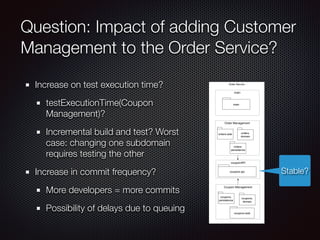
Question: Impact of adding Customer
Management to the Order Service?
Increase on test execution time?
testExecutionTime(Coupon
Management)?
Incremental build and test? Worst
case: changing one subdomain
requires testing the other
Increase in commit frequency?
More developers = more commits
Possibility of delays due to queuing
Order Service
main
main
Order Management
orders.web
couponAPI
orders.
domain
Coupon Management
coupons.
persistence
orders.
persistence
coupons.
domain
coupons.web
coupons.api Stable?
@crichardson
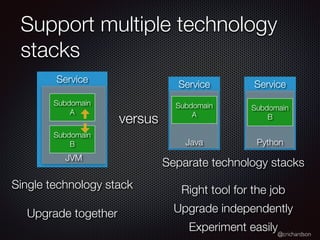
Support multiple technology
stacks
Service
Python
Service
Java
Service
JVM
Subdomain
A
Subdomain
A
Subdomain
B
Subdomain
B
Single technology stack
Upgrade together
Separate technology stacks
Right tool for the job
Upgrade independently
Experiment easily
versus
@crichardson
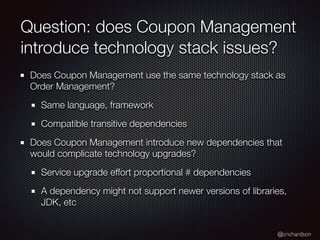
Question: does Coupon Management
introduce technology stack issues?
Does Coupon Management use the same technology stack as
Order Management?
Same language, framework
Compatible transitive dependencies
Does Coupon Management introduce new dependencies that
would complicate technology upgrades?
Service upgrade effort proportional # dependencies
A dependency might not support newer versions of libraries,
JDK, etc
@crichardson
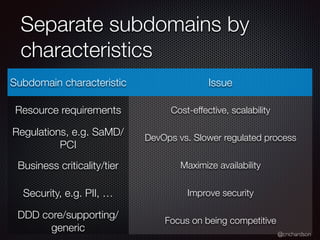
Separate subdomains by
characteristics
Subdomain characteristic Issue
Resource requirements Cost-effective, scalability
Regulations, e.g. SaMD/
PCI
DevOps vs. Slower regulated process
Business criticality/tier Maximize availability
Security, e.g. PII, … Improve security
DDD core/supporting/
generic
Focus on being competitive
@crichardson
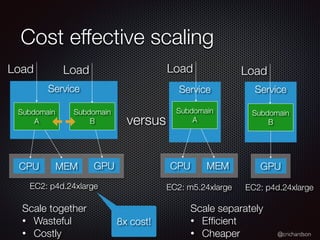
Cost effective scaling
Service
Service
Service
Subdomain
A
Subdomain
A
Subdomain
B
Subdomain
B
versus
CPU MEM GPU
Scale together
• Wasteful
• Costly
CPU MEM GPU
Scale separately
• Ef
fi
cient
• Cheaper
Load Load Load Load
EC2: p4d.24xlarge EC2: p4d.24xlarge
EC2: m5.24xlarge
8x cost!
@crichardson
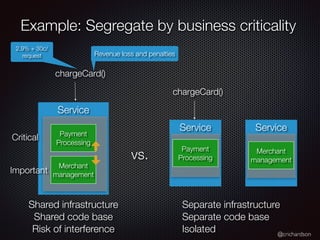
Example: Segregate by business criticality
Service
Service
Service
Payment
Processing
Payment
Processing
Merchant
management
Merchant
management
Shared infrastructure
Shared code base
Risk of interference
Separate infrastructure
Separate code base
Isolated
vs.
chargeCard()
2.9% + 30c/
request Revenue loss and penalties
chargeCard()
Critical
Important
@crichardson
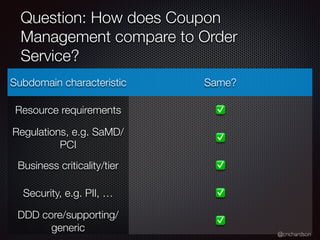
Question: How does Coupon
Management compare to Order
Service?
Subdomain characteristic Same?
Resource requirements ✅
Regulations, e.g. SaMD/
PCI
✅
Business criticality/tier ✅
Security, e.g. PII, … ✅
DDD core/supporting/
generic
✅
@crichardson
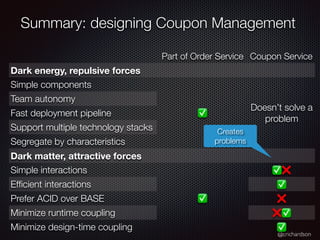
Summary: designing Coupon Management
Part of Order Service Coupon Service
Dark energy, repulsive forces
Simple components
✅
Doesn’t solve a
problem
Team autonomy
Fast deployment pipeline
Support multiple technology stacks
Segregate by characteristics
Dark matter, attractive forces
Simple interactions
✅
✅❌
Ef
fi
cient interactions ✅
Prefer ACID over BASE ❌
Minimize runtime coupling ❌✅
Minimize design-time coupling ✅
Creates
problems
@crichardson
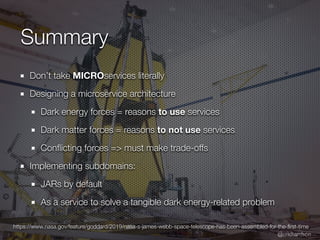
Summary
Don’t take MICROservices literally
Designing a microservice architecture
Dark energy forces = reasons to use services
Dark matter forces = reasons to not use services
Con
fl
icting forces => must make trade-offs
Implementing subdomains:
JARs by default
As a service to solve a tangible dark energy-related problem
https://www.nasa.gov/feature/goddard/2019/nasa-s-james-webb-space-telescope-has-been-assembled-for-the-
fi
rst-time
@crichardson
@crichardson chris@chrisrichardson.net
adopt.microservices.io
Questions?

More the merrier: a microservices anti-pattern

  • 1.
    @crichardson Avoiding more themerrier: a microservices anti-pattern Chris Richardson Microservice architecture consultant and trainer Founder of the original CloudFoundry.com Author of POJOs in Action and Microservices Patterns Founder of Eventuate.io @crichardson chris@chrisrichardson.net adopt.microservices.io Copyright © 2023. Chris Richardson Consulting, Inc. All rights reserved
  • 2.
    @crichardson Presentation goal How torightsize your services and avoid creating an overly complex, fi ne-grained architecture
  • 3.
  • 4.
    @crichardson Agenda How micro isa microservice? Designing a microservice architecture Dark matter forces: reasons to not use services Dark energy forces: reasons to use services
  • 5.
    Microservice architecture Each service Independently deployable Looselycoupled Organized around business capabilities … An architectural style that structures the application as a set of services
  • 6.
    @crichardson But how bigis a service? Microservice architecture Must be small, right?!
  • 7.
    A common conversation Client:We are having problems testing our services. Can you help us? Me: Sure. How many services? Client: 5 Me: Oh ok. BTW How many developers? Client: 5 Me: Oh. How about merging into one service? 1 service/developer is remarkably common
  • 8.
    @crichardson Anti-pattern: The morethe merrier Excessively fi ne-grained microservice architecture: Reduced maintainability, performance, availability, …. https://microservices.io/post/antipatterns/2019/05/21/antipattern-more-the- merrier.html
  • 9.
    @crichardson Agenda How micro isa microservice? Designing a microservice architecture Dark matter forces: reasons to not use services Dark energy forces: reasons to use services
  • 10.
    @crichardson How to de fi nean Architecture… Application ≪subdomain≫ Customer management ≪aggregate≫ Customer ≪subdomain≫ Order management ≪aggregate≫ Order createCustomer() createOrder() fi ndOrder() fi ndOrderHistory() System operations Distill Requirements The “requests” that the application implements Have SLOs Customer Team Order Team About Subdomains • Business capability/function/etc • Logical view: packages and classes • Team-sized • Loosely coupled (Conways law) 1 2 Functional requirements As a consumer I want to place an Order So that I can …. As a Restaurant I want to accept an Order So that I can …. Event storming Wireframe/UI mockups Available Restaurants Restaurant Menu System quality attributes • SLA: Reliability/Latency • Scalability • …
  • 11.
    @crichardson Subdomains: Eg. Javaclasses and packages that implement business logic Customer Management Order Management
  • 12.
    @crichardson Kitchen Service Delivery Service OrderService createOrder() … how to de fi ne an Architecture createOrder() <<subdomain>> Order Management Order System operations <<subdomain>> Order Management <<subdomain>> Kitchen Management <<subdomain>> Delivery Management <<subdomain>> Courier Management Group subdomains into services Application Collaboration Design collaborations for distributed operations createOrder() 3
  • 13.
    @crichardson Grouping subdomains into components:together or separate? ≪subdomain≫ Customer Mgmt. ≪aggregate≫ Customer ≪subdomain≫ Order Mgmt. ≪aggregate≫ Order Attraction Repulsion Simple components Team-sized services Fast deployment pipeline … Dark energy: an anti- gravity that’s accelerating the expansion of the universe Dark matter: an invisible matter that has a gravitational effect on stars and galaxies. https://www.nasa.gov/feature/goddard/2020/new-hubble-data-explains-missing-dark-matter Simple, ef fi cient interactions Prefer ACID over BASE Minimize runtime coupling … https://chrisrichardson.net/post/microservices/2021/04/15/mucon-2021-dark-energy-dark-matter.html Generate systemOperation()
  • 14.
    @crichardson Dark energy anddark matter forces Subdomain A «Aggregate» X Subdomain B «Aggregate» Y Service A Service B Attraction Simple interactions Efficient interactions Prefer ACID over BASE Minimize runtime coupling Minimize design time coupling Simple components Team autonomy Fast deployment pipeline Support multiple technology stacks Segregate by characteristics Repulsion Dark energy Dark matter Metaphor for Metaphor for
  • 15.
    @crichardson Let’s imagine youare implementing Coupons… Order Service <<subdomain>> Order Management Customer Service <<subdomain>> Customer Management createCustomer() createOrder() <<subdomain>> Coupon Management createCoupon(discount, …) + couponID redeem(couponID) Which service? reserve Credit()
  • 16.
    @crichardson Order Service Key decision: Newservice or existing service? Coupon Service Order Service <<subdomain>> Order Management <<subdomain>> Coupon Management Customer Service <<subdomain>> Customer Management <<subdomain>> Order Management <<subdomain>> Coupon Management Customer Service <<subdomain>> Customer Management OR Note: Customer+Coupon Service is another option
  • 17.
    @crichardson Agenda How micro isa microservice? Designing a microservice architecture Dark matter forces: reasons to not use services Dark energy forces: reasons to use services
  • 18.
    @crichardson Dark matter attractiveforces subdomains in same service https://chrisrichardson.net/post/microservices/2021/04/15/mucon-2021-dark-energy-dark-matter.html Subdomain A «Aggregate» X Subdomain B «Aggregate» Y Service A Service B Simple interactions Efficient interactions Prefer ACID over BASE Minimize runtime coupling Minimize design time coupling Generates SystemOperation() Collaboration
  • 19.
    @crichardson Dark matter forces:reasons to colocate Order and Coupon management Coupon Service Order Service Order Service <<subdomain>> Order Management <<subdomain>> Order Management <<subdomain>> Coupon Management <<subdomain>> Coupon Management But do they apply in this situation? Does de fi ning a new service create a problem?
  • 20.
    @crichardson Simple interactions Create Order() Service Subdomain A Subdomain B Service B ServiceA Subdomain A Subdomain B Create Order() Complex distributed operation Simple local operation: easier to develop, test, understand, troubleshoot, … vs.
  • 21.
    @crichardson Question: is eachdistributed operation simple? Additional interaction Additional participant Minimal increase in complexity but eventually …
  • 22.
    @crichardson Distributed invocations are expensive Localmethod call: customerService.reserveCredit(customerID, amount) Testing with mock objects vs. Distributed invocation: CustomerServiceProxy CustomerController Sagas, compensating transactions, partial failure Consumer-driven contract tests …
  • 23.
    @crichardson Ef fi cient interactions Create Order() Service Subdomain A Subdomain B Service B ServiceA Subdomain A Subdomain B Create Order() Network latency, limited bandwidth In-memory, fast! vs. Must satisfy SLOs
  • 24.
    @crichardson Question: is eachdistributed operation ef fi cient enough? Additional sequential interaction Minimal reduction in ef fi ciency but eventually …
  • 25.
    @crichardson Prefer ACID overBASE System Operation() Service Subdomain A Subdomain B Service B Service A Subdomain A Subdomain B System Operation() Distributed, eventually consistent transaction Simple, Local ACID transaction vs. ACID txn ACID txn ACID txn
  • 26.
    @crichardson Question: is thedistributed operation “suf fi ciently” ACID? Step Participant Transaction Compensating Transaction 1 Order Service createOrder() rejectOrder() 2 Coupon Service redeemCoupon() unredeemCoupon() 3 Customer Service reserveCredit() - 4 Order Service approveOrder() - Create Order Saga Doable but much more complex…
  • 27.
    @crichardson Minimize runtime coupling System Operation() Service Subdomain A Subdomain B ServiceB Service A Subdomain A Subdomain B System Operation() Risk of runtime coupling No runtime coupling: higher availability, lower latency vs. Must satisfy SLOs
  • 28.
    @crichardson Question: does thedistributed operation meet its latency/availability SLO? All must be available More available More complex Wait No Wait
  • 29.
    @crichardson Risk: Silo’d teamshave dif fi culty identifying excessive runtime coupling Payment Team: “We just call the Fraud Service” Fraud Team: “We have lots of services”
  • 30.
    @crichardson Minimize design timecoupling Order Subdomain Customer Subdomain reserveCredit() createOrder() Customer Order Design-time coupling Minimize with careful design BUT You can’t always eliminate it Risk of lock step changes API Risk proportional to: • API instability • API complexity • …
  • 31.
    @crichardson Question: are thetwo subdomains suf fi ciently design-time decoupled? interface CouponManagement { redeemCoupon(couponID, amount) interface CouponManagement { redeemCoupon(couponID, amount, orderLineItems) Not bad ✅ More complex, coupled to order concept ❌ vs.
  • 32.
    @crichardson Agenda How micro isa microservice? Designing a microservice architecture Dark matter forces: reasons to not use services Dark energy forces: reasons to use services
  • 33.
    @crichardson Dark energy repulsiveforces subdomains in different services https://chrisrichardson.net/post/microservices/2021/04/15/mucon-2021-dark-energy-dark-matter.html Service Service «Subdomain» A «Aggregate» X «Subdomain» B «Aggregate» Y Simple components Team autonomy Fast deployment pipeline Support multiple technology stacks Segregate by characteristics Repulsive dark energy forces
  • 34.
    @crichardson Dark energy forces:reasons to create a Coupon Service Coupon Service Order Service Order Service <<subdomain>> Order Management <<subdomain>> Order Management <<subdomain>> Coupon Management <<subdomain>> Coupon Management But do they apply in this situation? Does de fi ning a new service solve a problem?
  • 35.
    @crichardson Simpler components/services Service Service Service Subdomain A Subdomain A Subdomain B Subdomain B More complexservice Simpler services: easier to understand, develop, test, … versus dependencies
  • 36.
    Question: is theOrder+Coupon Service excessively complex? Coupon management: reasonably simple, no new dependencies, … Minimal additional complexity Therefore Separate Coupon Service is not required But If Coupon management becomes complex then separate Order Service main main Order Management orders.web couponAPI orders. domain Coupon Management coupons. persistence orders. persistence Coupon team Order team coupons. domain coupons.web coupons.api Modular Order Service
  • 37.
    @crichardson Team autonomy =service per team Service Service Service Subdomain A Subdomain A Subdomain B Subdomain B Coordination required Contention for resources Develop, push, build, test and deploy independently vs. Team A Team B Team A Team B
  • 38.
    @crichardson Question: impact ofa single Order Service on team autonomy? Who develops Coupon Management? Orders team Team autonomy is not an issue Embed Coupon Management in Order Service Different team, e.g. Coupons Team: How much autonomy would they lose? A few teams = probably ok But there’s a limit
  • 39.
    @crichardson Fast deployment pipeline @mipsytipsy https://speakerdeck.com/charity/cd?slide=17 Service Subdomain Subdomain Service Subdomain Shorter leadtime Simpler build Longer lead time More complex build* * Parallelizing building/testing partially helps Service Subdomain vs.
  • 40.
    Question: Impact ofadding Customer Management to the Order Service? Increase on test execution time? testExecutionTime(Coupon Management)? Incremental build and test? Worst case: changing one subdomain requires testing the other Increase in commit frequency? More developers = more commits Possibility of delays due to queuing Order Service main main Order Management orders.web couponAPI orders. domain Coupon Management coupons. persistence orders. persistence coupons. domain coupons.web coupons.api Stable?
  • 41.
    @crichardson Support multiple technology stacks Service Python Service Java Service JVM Subdomain A Subdomain A Subdomain B Subdomain B Singletechnology stack Upgrade together Separate technology stacks Right tool for the job Upgrade independently Experiment easily versus
  • 42.
    @crichardson Question: does CouponManagement introduce technology stack issues? Does Coupon Management use the same technology stack as Order Management? Same language, framework Compatible transitive dependencies Does Coupon Management introduce new dependencies that would complicate technology upgrades? Service upgrade effort proportional # dependencies A dependency might not support newer versions of libraries, JDK, etc
  • 43.
    @crichardson Separate subdomains by characteristics Subdomaincharacteristic Issue Resource requirements Cost-effective, scalability Regulations, e.g. SaMD/ PCI DevOps vs. Slower regulated process Business criticality/tier Maximize availability Security, e.g. PII, … Improve security DDD core/supporting/ generic Focus on being competitive
  • 44.
    @crichardson Cost effective scaling Service Service Service Subdomain A Subdomain A Subdomain B Subdomain B versus CPUMEM GPU Scale together • Wasteful • Costly CPU MEM GPU Scale separately • Ef fi cient • Cheaper Load Load Load Load EC2: p4d.24xlarge EC2: p4d.24xlarge EC2: m5.24xlarge 8x cost!
  • 45.
    @crichardson Example: Segregate bybusiness criticality Service Service Service Payment Processing Payment Processing Merchant management Merchant management Shared infrastructure Shared code base Risk of interference Separate infrastructure Separate code base Isolated vs. chargeCard() 2.9% + 30c/ request Revenue loss and penalties chargeCard() Critical Important
  • 46.
    @crichardson Question: How doesCoupon Management compare to Order Service? Subdomain characteristic Same? Resource requirements ✅ Regulations, e.g. SaMD/ PCI ✅ Business criticality/tier ✅ Security, e.g. PII, … ✅ DDD core/supporting/ generic ✅
  • 47.
    @crichardson Summary: designing CouponManagement Part of Order Service Coupon Service Dark energy, repulsive forces Simple components ✅ Doesn’t solve a problem Team autonomy Fast deployment pipeline Support multiple technology stacks Segregate by characteristics Dark matter, attractive forces Simple interactions ✅ ✅❌ Ef fi cient interactions ✅ Prefer ACID over BASE ❌ Minimize runtime coupling ❌✅ Minimize design-time coupling ✅ Creates problems
  • 48.
    @crichardson Summary Don’t take MICROservicesliterally Designing a microservice architecture Dark energy forces = reasons to use services Dark matter forces = reasons to not use services Con fl icting forces => must make trade-offs Implementing subdomains: JARs by default As a service to solve a tangible dark energy-related problem https://www.nasa.gov/feature/goddard/2019/nasa-s-james-webb-space-telescope-has-been-assembled-for-the- fi rst-time
  • 49.