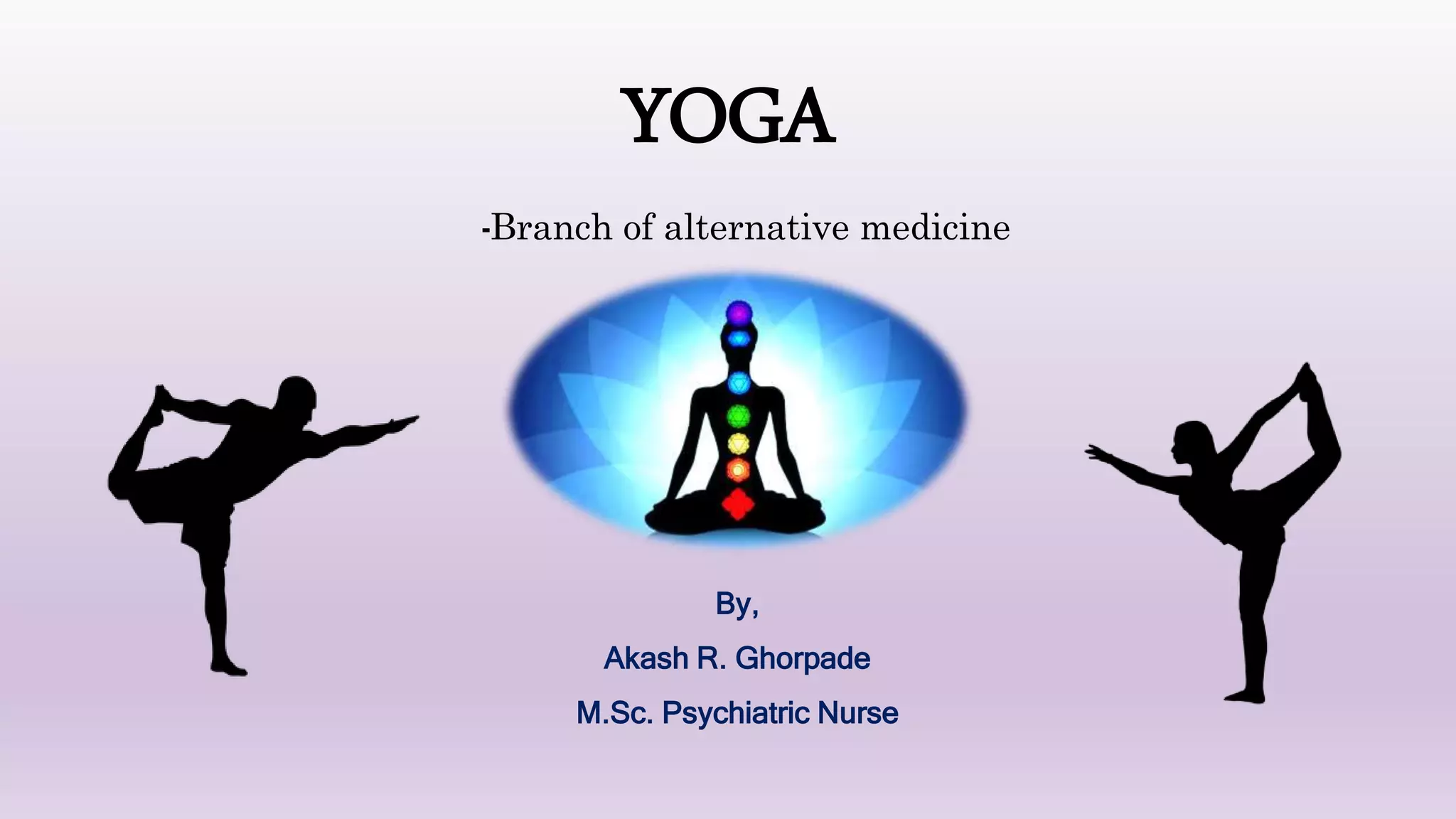
YOGA
-Branch of alternative medicine
By,
Akash R. Ghorpade
M.Sc. Psychiatric Nurse
 Yoga is a group of physical, mental, and spiritual practices or disciplines which originated in
ancient India.
 The term "Yoga" in the Western world often denotes a modern form of hatha yoga and yoga as
exercise, consisting largely of the postures called ‘asanas’.
 There is no consensus on its chronology or specific origin other than that yoga developed in
ancient India.
 Suggested origins are the Indus Valley Civilization (3300–1900 BCE) and pre-Vedic Eastern states
of India, the Vedic period (1500–500 BCE), and the Sramana movement.
INTRODUCTION
Meaning of Yoga
 The word Yoga has been derived from the Sanskrit word “Yug” which means to
joins or to unite.
 Yoga is the union of individual soul with divine soul.
 Yoga also means the unification of physical, mental, intellectual and spiritual
aspects of human being.
 Yoga is the science of development of a person’s consciousness.
DEFINITION
1. Yoga is physical, mental and spiritual practices which is originated from ancient
India, with a view to attain a state of permanent peace of mind in order to
experience one’s true self.
2. Yoga is a philosophy which first developed in India, in which physical exercises
and meditation are believed to help people to become calmer and united in spirit
with God.
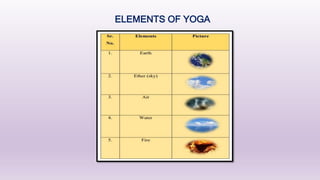
ELEMENTS OF YOGA
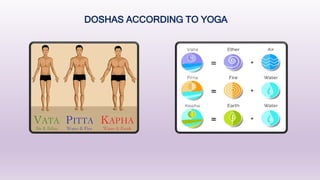
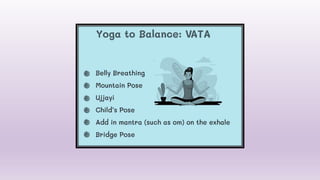
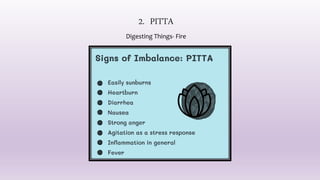
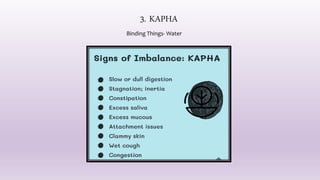
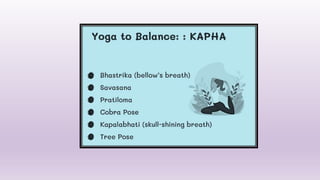
DOSHAS ACCORDING TO YOGA
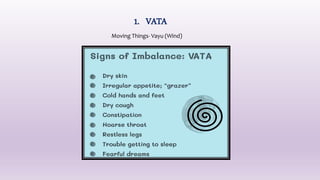
1. VATA
Moving Things- Vayu (Wind)
2. PITTA
Digesting Things- Fire
3. KAPHA
Binding Things- Water
BRANCHES OF YOGA
1. Yama (moral principles):
a. Ahimsa: Causing no harm to any living thing. Anxiety, hate, jealousy, anger are
violent behaviours.
b. Satya: Truthfulness, we must be truthful in our thoughts, speech and deeds.
c. Asteya: Not- stealing, the inclination to use others object, money and thoughts
for ones’ own benefit is stealing. Abstaining from it is Asteya
d. Brahamcharya: Conserving one’s energy. Using your energy for the benefit of
individual and society, not for pleasure.
e. Aparigraha: Non- possessiveness, nongrasping Keeping the desire and only for
what is necessary or
important according to context.
2. NIYAMA (OBSERVANCE):
1. Saucha: Cleanliness. Shatkarmas are to be performed which consists of 6 kriyas:
•Dhauti (cleansing of abdomen, teeth, tongue and ear)
•Basti (cleansing bowel)
•Neti (cleansing nasal canal)
•Nauli (abdomen massage)
•Trataka (gazing object without blinking. It provides excellent vision).
•Kapalbharti (purification of frontal lobes of head. It removes disorder of phlegm).
2. Santosha: Contentment.
3. Tapa: Austerity
4. Swadhyaya: Inner exploration.
5. Ishwara pranidhan: Surrender to god.
3.Asana (Body posture):
 Asana means the position or posture of body. These are slow stretching activities
performed to keep body flexible, agile and young.
4.Pranayama (Regulation of breath):
 It is te control of breathing process. It helps in regulating the metabolic activity and
enhances the function of heart and lungs and provides longevity to life.
5.Pratyahar (Abstraction of senses):
 Control over senses is called pratyahara. The senses no longer respond to external
objects that hinder mental concentration.
6.Dharana (Concentration):
 It is concentration of mind at one focal point. It is mental exercise which
enable yogi to go ahead towards Dhyana and Samadhi.
7.Dhyana (Meditation):
 Dhyana is complete constancy and concentration of mind.
7.Samadhi (Self realization):
 The union of one’s soul to the supreme soul is called Samadhi. During Dhyana
when disappearance of self-awareness takes place, yogi attains Samadhi.
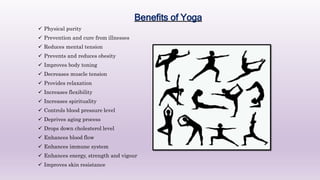
Benefits of Yoga
 Physical purity
 Prevention and cure from illnesses
 Reduces mental tension
 Prevents and reduces obesity
 Improves body toning
 Decreases muscle tension
 Provides relaxation
 Increases flexibility
 Increases spirituality
 Controls blood pressure level
 Deprives aging process
 Drops down cholesterol level
 Enhances blood flow
 Enhances immune system
 Enhances energy, strength and vigour
 Improves skin resistance
YOGA IN STRESS MANAGEMENT
Many of the popular techniques found to reduce stress derive from yoga:
• Controlled breathing
• Meditation
• Physical movement
• Mental imagery
• Stretching
Getting started:
• Although you can learn yoga from books and videos, beginners usually find it helpful to learn
with an instructor. Classes also offer camaraderie and friendship, which are also important
to overall well-being.
• When you find a class that sounds interesting, talk with the instructor so that you know what
to expect.
THANK YOU

YOGA- ALTERNATIVE MEDICINE.pptx

  • 1.
    YOGA -Branch of alternativemedicine By, Akash R. Ghorpade M.Sc. Psychiatric Nurse
  • 2.
     Yoga isa group of physical, mental, and spiritual practices or disciplines which originated in ancient India.  The term "Yoga" in the Western world often denotes a modern form of hatha yoga and yoga as exercise, consisting largely of the postures called ‘asanas’.  There is no consensus on its chronology or specific origin other than that yoga developed in ancient India.  Suggested origins are the Indus Valley Civilization (3300–1900 BCE) and pre-Vedic Eastern states of India, the Vedic period (1500–500 BCE), and the Sramana movement. INTRODUCTION
  • 3.
    Meaning of Yoga The word Yoga has been derived from the Sanskrit word “Yug” which means to joins or to unite.  Yoga is the union of individual soul with divine soul.  Yoga also means the unification of physical, mental, intellectual and spiritual aspects of human being.  Yoga is the science of development of a person’s consciousness.
  • 4.
    DEFINITION 1. Yoga isphysical, mental and spiritual practices which is originated from ancient India, with a view to attain a state of permanent peace of mind in order to experience one’s true self. 2. Yoga is a philosophy which first developed in India, in which physical exercises and meditation are believed to help people to become calmer and united in spirit with God.
  • 5.
  • 6.
  • 7.
  • 11.
  • 15.
  • 19.
    BRANCHES OF YOGA 1.Yama (moral principles): a. Ahimsa: Causing no harm to any living thing. Anxiety, hate, jealousy, anger are violent behaviours. b. Satya: Truthfulness, we must be truthful in our thoughts, speech and deeds. c. Asteya: Not- stealing, the inclination to use others object, money and thoughts for ones’ own benefit is stealing. Abstaining from it is Asteya d. Brahamcharya: Conserving one’s energy. Using your energy for the benefit of individual and society, not for pleasure. e. Aparigraha: Non- possessiveness, nongrasping Keeping the desire and only for what is necessary or important according to context.
  • 20.
    2. NIYAMA (OBSERVANCE): 1.Saucha: Cleanliness. Shatkarmas are to be performed which consists of 6 kriyas: •Dhauti (cleansing of abdomen, teeth, tongue and ear) •Basti (cleansing bowel) •Neti (cleansing nasal canal) •Nauli (abdomen massage) •Trataka (gazing object without blinking. It provides excellent vision). •Kapalbharti (purification of frontal lobes of head. It removes disorder of phlegm). 2. Santosha: Contentment. 3. Tapa: Austerity 4. Swadhyaya: Inner exploration. 5. Ishwara pranidhan: Surrender to god.
  • 21.
    3.Asana (Body posture): Asana means the position or posture of body. These are slow stretching activities performed to keep body flexible, agile and young. 4.Pranayama (Regulation of breath):  It is te control of breathing process. It helps in regulating the metabolic activity and enhances the function of heart and lungs and provides longevity to life. 5.Pratyahar (Abstraction of senses):  Control over senses is called pratyahara. The senses no longer respond to external objects that hinder mental concentration.
  • 22.
    6.Dharana (Concentration):  Itis concentration of mind at one focal point. It is mental exercise which enable yogi to go ahead towards Dhyana and Samadhi. 7.Dhyana (Meditation):  Dhyana is complete constancy and concentration of mind. 7.Samadhi (Self realization):  The union of one’s soul to the supreme soul is called Samadhi. During Dhyana when disappearance of self-awareness takes place, yogi attains Samadhi.
  • 23.
    Benefits of Yoga Physical purity  Prevention and cure from illnesses  Reduces mental tension  Prevents and reduces obesity  Improves body toning  Decreases muscle tension  Provides relaxation  Increases flexibility  Increases spirituality  Controls blood pressure level  Deprives aging process  Drops down cholesterol level  Enhances blood flow  Enhances immune system  Enhances energy, strength and vigour  Improves skin resistance
  • 24.
    YOGA IN STRESSMANAGEMENT Many of the popular techniques found to reduce stress derive from yoga: • Controlled breathing • Meditation • Physical movement • Mental imagery • Stretching Getting started: • Although you can learn yoga from books and videos, beginners usually find it helpful to learn with an instructor. Classes also offer camaraderie and friendship, which are also important to overall well-being. • When you find a class that sounds interesting, talk with the instructor so that you know what to expect.
  • 25.