NourishTo Flourish: Reducing Malnutrition
Road to a De-centralized National Mission
Team Members:
• Aakriti Mohal
• Anshul Meghani
• Ekta Rani
• Garvita Chokra
• Ishaan Bhatt
Every night in India, over 20 million
children sleep empty stomach
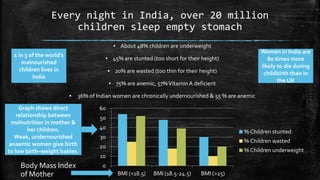
▪ About 48% children are underweight
▪ 45% are stunted (too short for their height)
▪ 20% are wasted (too thin for their height)
▪ 75% are anemic, 57%Vitamin A deficient
▪ 36% of Indian women are chronically undernourished & 55 % are anemic
1 in 3 of the world's
malnourished
children lives in
India
Women in India are
80 times more
likely to die during
childbirth than in
the UK
0
10
20
30
40
50
60
BMI (<18.5) BMI (18.5-24.5) BMI (>25)
% Children stunted
% Children wasted
% Children underweight
Body Mass Index
of Mother
Graph shows direct
relationship between
malnutrition in mother &
her children.
Weak, undernourished
anaemic women give birth
to low birth–weight babies.
A basic framework of Malnutrition
Malnutrition
and death
Inadequate
dietary intake
Disease
Inadequate education
Formal and
Non formal
institutions
Political and ideological superstructure
Economic structure
Potential
resources
Inadequate
access to food
Inadequate
care for mothers
and children
Insufficient
health services
and unhealthy
environment
Basic Causes. Natural resources of a country,
basic economy
Immediate Causes. Less efficient
infrastructure, low quality and lesser education
Effects and final result.
Many government policies like Mid Day Meal Scheme,
Integrated Child Development Services, National Food
Security Mission exist. Still…
Malnutrition
• Condition that results from eating a diet in which certain nutrients are lacking, in excess (too high an
intake), or in the wrong proportions
Affects
• Children : at risk even before birth, as their nutrition levels are directly tied to the that of their mothers
• Women : Because of pregnancies and breastfeeding, women have additional nutrient requirements.
Effects
• Impedes social, cognitive, motor and sensory development of child. Damages are irreversible.
• Increases the risk of infection and infectious disease.
• Affects productivity & earning potentials, hinders overall development of the country.
Factors
• Poverty, purchasing power, health care, ignorance on nutrition and health education, female illiteracy
and social convention.
Problem Lies
• Implementation of government policies, very high leakage in distribution system.
• Ensuring equitable distribution.
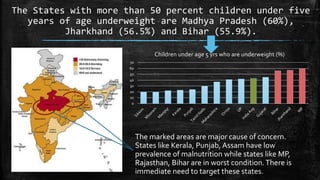
The States with more than 50 percent children under five
years of age underweight are Madhya Pradesh (60%),
Jharkhand (56.5%) and Bihar (55.9%).
0
10
20
30
40
50
60
70
Children under age 5 yrs who are underweight (%)
The marked areas are major cause of concern.
States like Kerala, Punjab, Assam have low
prevalence of malnutrition while states like MP,
Rajasthan, Bihar are in worst condition.There is
immediate need to target these states.
A targeted approach
• A centralized distribution system approach.
• Meal Production Unit (MPU) will be set in a town.
• MPU will be a centralized factory for cooking
meals, packaging the meals, and distributing
them in the schools of villages and near by areas
• Red Zones in the adjacent map will be targeted
areas.
• It includes districts (in MP) like Alirajpur, Datia,
Dindori ; (in Maharashtra) like Amravati, Nashik;
(in Bihar) like Saran, Buxar. In these areas
percentage of underweight, stunted and wasted
are above 60%
How it works?
Requirement Phase
*Gather statistics of the district
(including all towns and villages).
Also various other requirements
like number of schools,
population to be fed, location of
factory.
* Include manpower for full time
employment.Also various
volunteers for promotion work &
advertising, spreading awareness
among masses, educating,
helping in the work of factory,
and for encouraging donations.
Implementation Phase
*Set up factory in area with close
proximity to most of villages and
good base for other basic
requirements like electricity,
water etc.
*Set up channel for collection of
raw material. Use vehicles like
TataAce, which are capable of
storing good quantities and can
reach areas with narrow roads.
*Factory will be completely
automated. Machinery will be
Automatic Chapatti Making
Machine, Boilers & commercial
rice cookers. Also include
packaging of meals.
Distribution &
Operation Phase
*Use efficient distribution
network.Trucks or autos like
TataAce can be used.
*For distribution, school
staff, a worker of the MPU as
well as volunteer force can
be used.
Cost Chart and equipment requirements
Taking case of Barwani
district in MP. It is divided
into two sub district
Barwani and Sendhwa. It
has 646 villages &
population to be covered is
around is roughly around
40,000 ( mainly targeting
children 3-8 years)
Automatic Chapatti
Making Machine
(Makes 2500-3000
chapattis in 1 hr)
Approximately 5-8
Costs approx.
Rs.20,00,000/- per unit
Saves about Rs./kg 2500/-
Commercial Rice Cooker
(200 lts)
Approximately 20 units.
Costs approx. Rs. 10,000/-
per unit
3000 kgs dal & 4000 kgs
potatoes.
Other requirements are
salt, red pepper, clean
water every day.
Petrol for autos & trucks
around Rs. 60,000/- per
month
Net manpower requirement= 25 per factory Vehicles required = 6-8Tata Ace (or trucks accordingly) Net cost = Rs.500 per child per month
Other areas of work & Challenges
Awareness
regarding
breast
feeding
Educate
children
about
cleanliness
Volunteers will
promote
awareness
regarding basic
health care
Helping &
providing
reach of
doctors to
patients
Ensuring
good
governance
among MPU
networks
Promoting
other
campaigns
and setting
up yearly
visions.
Challenges
• Monitoring network of MPUs will
require internal control at various
levels will.
• Financial requirements & cost for
running MPUs
• Ensuring equitable distribution &
leakage control.
• Managing waste and promoting
inclusion of volunteers & donations
References
• Unicef.org
• Who.int
• Mospi.nic.in
• Angoc.org
Thank You
University Institute of Engineering andTechnology, Panjab University
Chandigarh

YNots

  • 1.
    NourishTo Flourish: ReducingMalnutrition Road to a De-centralized National Mission Team Members: • Aakriti Mohal • Anshul Meghani • Ekta Rani • Garvita Chokra • Ishaan Bhatt
  • 2.
    Every night inIndia, over 20 million children sleep empty stomach ▪ About 48% children are underweight ▪ 45% are stunted (too short for their height) ▪ 20% are wasted (too thin for their height) ▪ 75% are anemic, 57%Vitamin A deficient ▪ 36% of Indian women are chronically undernourished & 55 % are anemic 1 in 3 of the world's malnourished children lives in India Women in India are 80 times more likely to die during childbirth than in the UK 0 10 20 30 40 50 60 BMI (<18.5) BMI (18.5-24.5) BMI (>25) % Children stunted % Children wasted % Children underweight Body Mass Index of Mother Graph shows direct relationship between malnutrition in mother & her children. Weak, undernourished anaemic women give birth to low birth–weight babies.
  • 3.
    A basic frameworkof Malnutrition Malnutrition and death Inadequate dietary intake Disease Inadequate education Formal and Non formal institutions Political and ideological superstructure Economic structure Potential resources Inadequate access to food Inadequate care for mothers and children Insufficient health services and unhealthy environment Basic Causes. Natural resources of a country, basic economy Immediate Causes. Less efficient infrastructure, low quality and lesser education Effects and final result.
  • 4.
    Many government policieslike Mid Day Meal Scheme, Integrated Child Development Services, National Food Security Mission exist. Still… Malnutrition • Condition that results from eating a diet in which certain nutrients are lacking, in excess (too high an intake), or in the wrong proportions Affects • Children : at risk even before birth, as their nutrition levels are directly tied to the that of their mothers • Women : Because of pregnancies and breastfeeding, women have additional nutrient requirements. Effects • Impedes social, cognitive, motor and sensory development of child. Damages are irreversible. • Increases the risk of infection and infectious disease. • Affects productivity & earning potentials, hinders overall development of the country. Factors • Poverty, purchasing power, health care, ignorance on nutrition and health education, female illiteracy and social convention. Problem Lies • Implementation of government policies, very high leakage in distribution system. • Ensuring equitable distribution.
  • 5.
    The States withmore than 50 percent children under five years of age underweight are Madhya Pradesh (60%), Jharkhand (56.5%) and Bihar (55.9%). 0 10 20 30 40 50 60 70 Children under age 5 yrs who are underweight (%) The marked areas are major cause of concern. States like Kerala, Punjab, Assam have low prevalence of malnutrition while states like MP, Rajasthan, Bihar are in worst condition.There is immediate need to target these states.
  • 6.
    A targeted approach •A centralized distribution system approach. • Meal Production Unit (MPU) will be set in a town. • MPU will be a centralized factory for cooking meals, packaging the meals, and distributing them in the schools of villages and near by areas • Red Zones in the adjacent map will be targeted areas. • It includes districts (in MP) like Alirajpur, Datia, Dindori ; (in Maharashtra) like Amravati, Nashik; (in Bihar) like Saran, Buxar. In these areas percentage of underweight, stunted and wasted are above 60%
  • 7.
    How it works? RequirementPhase *Gather statistics of the district (including all towns and villages). Also various other requirements like number of schools, population to be fed, location of factory. * Include manpower for full time employment.Also various volunteers for promotion work & advertising, spreading awareness among masses, educating, helping in the work of factory, and for encouraging donations. Implementation Phase *Set up factory in area with close proximity to most of villages and good base for other basic requirements like electricity, water etc. *Set up channel for collection of raw material. Use vehicles like TataAce, which are capable of storing good quantities and can reach areas with narrow roads. *Factory will be completely automated. Machinery will be Automatic Chapatti Making Machine, Boilers & commercial rice cookers. Also include packaging of meals. Distribution & Operation Phase *Use efficient distribution network.Trucks or autos like TataAce can be used. *For distribution, school staff, a worker of the MPU as well as volunteer force can be used.
  • 8.
    Cost Chart andequipment requirements Taking case of Barwani district in MP. It is divided into two sub district Barwani and Sendhwa. It has 646 villages & population to be covered is around is roughly around 40,000 ( mainly targeting children 3-8 years) Automatic Chapatti Making Machine (Makes 2500-3000 chapattis in 1 hr) Approximately 5-8 Costs approx. Rs.20,00,000/- per unit Saves about Rs./kg 2500/- Commercial Rice Cooker (200 lts) Approximately 20 units. Costs approx. Rs. 10,000/- per unit 3000 kgs dal & 4000 kgs potatoes. Other requirements are salt, red pepper, clean water every day. Petrol for autos & trucks around Rs. 60,000/- per month Net manpower requirement= 25 per factory Vehicles required = 6-8Tata Ace (or trucks accordingly) Net cost = Rs.500 per child per month
  • 9.
    Other areas ofwork & Challenges Awareness regarding breast feeding Educate children about cleanliness Volunteers will promote awareness regarding basic health care Helping & providing reach of doctors to patients Ensuring good governance among MPU networks Promoting other campaigns and setting up yearly visions. Challenges • Monitoring network of MPUs will require internal control at various levels will. • Financial requirements & cost for running MPUs • Ensuring equitable distribution & leakage control. • Managing waste and promoting inclusion of volunteers & donations
  • 10.
  • 11.
    Thank You University Instituteof Engineering andTechnology, Panjab University Chandigarh