Created and compiled by Alyson Mitchell M.Ed.
Texas Tech University
You have learned that vocabulary instruction is part of the Big 5 of Reading. The
National Reading Panel (2000) stated its importance when they declared that
some vocabulary, particularly subject specific words, required direct instruction
versus incidental learning. You have learned in other classes that it is an integral
part of reading and therefore, demands teachers attention. Vocabulary
instruction is just as important when reading nonfiction texts as it is with the
reading of fiction.
Why? Content area topics often have technical terms that can affect the readers
understanding of the material.
Look at this sentence from pg 40 of Rainforest.
“Animals that wake up at night are called “nocturnal” and have special
features for survival in the dark.”
What knowledge does a reader need to have to fully comprehend this simple
sentence? Words like features, survival and the meaning of nocturnal need to be
understood by the child.
Let’s take a minute and activate our schema, what do you know about vocabulary
instruction? Take a piece of scratch paper and jot down what you think of when
you hear the term, “vocabulary”…
When thinking about what you know (what you
have learned in EDLL 3351/3352) in regards to
vocabulary you may have mentioned that:
• Vocabulary knowledge affects comprehension.
• New vocabulary instruction should connect to what children
know (schema).
• Vocabulary instruction should be balanced (in context with
real reading and writing experiences).
• Vocabulary instruction should be hands on versus traditional
“look up in dictionary, write definition and take quiz on Friday”
instruction.
• Teachers need to teach strategies to children versus teaching
words.
“Content are teachers have two responsibilities when it
comes to vocabulary instruction:
1. instruction in individual meanings
2. instruction in deriving meaning.
It is virtually impossible to teach every new word that
students need to learn for the entire school year.
Therefore, part of the time has to focus on teaching and
reinforcing students’ ability to handle unknown words
independently.”
(Pike and Mumper, pg 102)
I cannot teach children every word they will encounter in my classroom.
Rather, I need to introduce some important words to children and then
model and teach explicitly strategies of what to do when meeting an
unfamiliar word.
Teaching Vocabulary
Thinking back, I remember being taught vocabulary words in many classes (literature,
social studies, Spanish and science). My memory was that I was given words and
then required to look the words up and copy their definition. Sometimes I was
required to use the word in a sentence and I definitely remember the dreaded
quizzes on Friday.
Does this sound familiar to you?
If you ask me what words I learned, I would have no idea! Did I learn the words and
internalize their meanings or did I learn what I needed for the test? Probably
most of the time, it was getting through Friday! I now know there are better
ways to ensure that children understand what a word means and can use it
versus learning it for the test.
Alvermann, Swafford and Montero (2004) share four guidelines for vocabulary
instruction.
1. Students should be active in developing their understanding of
words.
2. Students should personalize word learning.
3. Students should be immersed in words.
4. Students should build on multiple sources of information to learn
words through repeated exposure.
Students should be active in developing their understanding of
words and ways to learn them
We know that we all learn more when we are active and involved versus listening.
Hands on is always better than lecture only teaching. We also know, “It is virtually
impossible to teach every new word that students need to learn for the entire school
year.” (Pike and Mumper, pg 102)
Therefore, we engage children in activities that show them how to group words, sort
words, illustrate words and how new words can be connected to words we know.
HOW DO WE DO THIS??
List-Group-Label-Write
Concept definition maps
Semantic maps
Semantic feature analysis
These are just a few of many activities that can be done with children to develop their
understanding of new words. Each of these activities will be illustrated or developed
further in the power point, try it section of the module, see it section or in the
readings for this module.
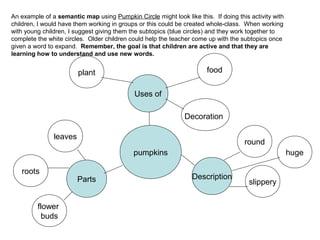
An example of a semantic map using Pumpkin Circle might look like this. If doing this activity with
children, I would have them working in groups or this could be created whole-class. When working
with young children, I suggest giving them the subtopics (blue circles) and they work together to
complete the white circles. Older children could help the teacher come up with the subtopics once
given a word to expand. Remember, the goal is that children are active and that they are
learning how to understand and use new words.
pumpkins
Uses of
DescriptionParts
foodplant
round
slippery
huge
leaves
roots
flower
buds
Decoration
Students should personalize word learning
Children can be encouraged to choose the words that they are studying. Many
benefits have been found especially with English Language Learners. “Vocabulary
self selection can provide especially useful information to teachers who are
uncertain as to which concepts and word labels these learners already know.”
(Alvermann, Swafford and Montero, 2004)
HOW DO WE DO THIS?
Vocabulary self awareness charts
Word expert cards
Contextual redefinition
Possible sentences
These are just a few of many activities that can be done with children to develop their
understanding of new words. Each of these activities will be illustrated or
developed further in the PowerPoint, Try It section of the module, See It section or
in the readings for this module.
Vocabulary Self Awareness Chart
Word + / - Example Definition
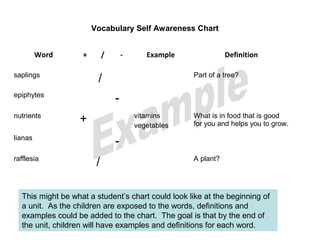
To use this with children, teachers can begin a unit of study by giving the children a list of words based
on a topic . These words would be listed under the word column. Next the children would independently
decide if they know the word, can give a definition and provide an example. If this is the case, they will
mark under the + and write in the appropriate column. If they have heard the word and know either an
example OR the definition, they would be asked to mark under the /. If they have never heard the word
then they would mark under the last column. As the children encounter the words in texts, children
should add to the chart so at the end of the unit all children are expected to have an example and
definition for each word.
This activity shows teachers what children already know. It helps children build and add to their schema
(what they know). This makes the learning more personal for the learner; thus, more meaningful.
Word + / - Example Definition
saplings
/ Part of a tree?
epiphytes
-
nutrients
+ vitamins
vegetables
What is in food that is good
for you and helps you to grow.
lianas
-
rafflesia
/ A plant?
Vocabulary Self Awareness Chart
This might be what a student’s chart could look like at the beginning of
a unit. As the children are exposed to the words, definitions and
examples could be added to the chart. The goal is that by the end of
the unit, children will have examples and definitions for each word.
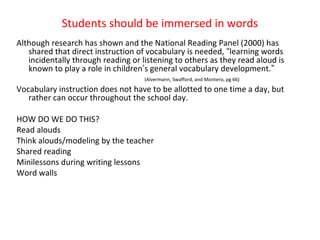
Students should be immersed in words
Although research has shown and the National Reading Panel (2000) has
shared that direct instruction of vocabulary is needed, “learning words
incidentally through reading or listening to others as they read aloud is
known to play a role in children’s general vocabulary development.”
(Alvermann, Swafford, and Montero, pg 66)
Vocabulary instruction does not have to be allotted to one time a day, but
rather can occur throughout the school day.
HOW DO WE DO THIS?
Read alouds
Think alouds/modeling by the teacher
Shared reading
Minilessons during writing lessons
Word walls
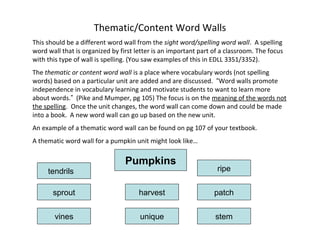
Thematic/Content Word Walls
This should be a different word wall from the sight word/spelling word wall. A spelling
word wall that is organized by first letter is an important part of a classroom. The focus
with this type of wall is spelling. (You saw examples of this in EDLL 3351/3352).
The thematic or content word wall is a place where vocabulary words (not spelling
words) based on a particular unit are added and are discussed. “Word walls promote
independence in vocabulary learning and motivate students to want to learn more
about words.” (Pike and Mumper, pg 105) The focus is on the meaning of the words not
the spelling. Once the unit changes, the word wall can come down and could be made
into a book. A new word wall can go up based on the new unit.
An example of a thematic word wall can be found on pg 107 of your textbook.
A thematic word wall for a pumpkin unit might look like…
Pumpkins
tendrils
sprout harvest
ripe
patch
uniquevines stem
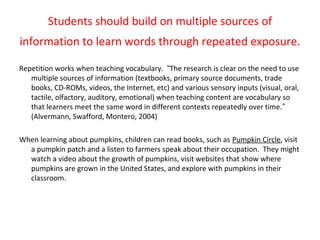
Students should build on multiple sources of
information to learn words through repeated exposure.
Repetition works when teaching vocabulary. “The research is clear on the need to use
multiple sources of information (textbooks, primary source documents, trade
books, CD-ROMs, videos, the Internet, etc) and various sensory inputs (visual, oral,
tactile, olfactory, auditory, emotional) when teaching content are vocabulary so
that learners meet the same word in different contexts repeatedly over time.”
(Alvermann, Swafford, Montero, 2004)
When learning about pumpkins, children can read books, such as Pumpkin Circle, visit
a pumpkin patch and a listen to farmers speak about their occupation. They might
watch a video about the growth of pumpkins, visit websites that show where
pumpkins are grown in the United States, and explore with pumpkins in their
classroom.
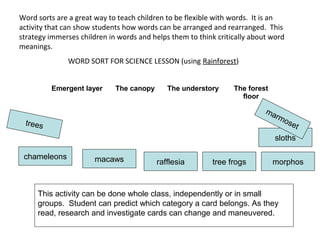
Word sorts are a great way to teach children to be flexible with words. It is an
activity that can show students how words can be arranged and rearranged. This
strategy immerses children in words and helps them to think critically about word
meanings.
WORD SORT FOR SCIENCE LESSON (using Rainforest)
Emergent layer The canopy The understory The forest
floor
macaws
sloths
rafflesia
chameleons
marmoset
tree frogs morphos
trees
This activity can be done whole class, independently or in small
groups. Student can predict which category a card belongs. As they
read, research and investigate cards can change and maneuvered.
What about dictionary instruction??
Remember the fourth guideline for vocabulary instruction told us that children need to
be able to use multiple sources of information so that they can encounter words in
different ways. One question is always how to use the dictionary in appropriate
ways.
When reading, having children stop to look up a definition should be a last resort.
Pausing in the middle of reading and looking up words can affect comprehension.
Ask children to use context clues as they come to unknown words. Show them
how to check their predictions using a glossary or dictionary. This needs to be
modeled by the teacher many times. An easy way to do this is during read alouds
of informational texts. As you read and come to a new word, stop and talk about
the word. Think aloud with children and show them how readers use the clues
around the new word to help with the meaning. Continue reading and check the
glossary if appropriate.
Gunning (2003) suggests when introducing a textbook (or tradebook) spend some time
talking about the glossary. Show the students how words that are found in the
glossary are often in bold print. Gunning (2003) continues by stating, “Dictionary
usage is critical for ELL students. As they encounter unknown words in their
reading, they have very little choice but to consult the dictionary (pg 96).”
Websites that can be used for
vocabulary instruction
• www.vocabulary.com
• www.gamequarium.com
• www.quia.com (I loved this one!)
“Words are typically learned gradually
and the more actively and deeply
students process words, the better they
learn them. Activities using words in
games, connecting words and
manipulating words creatively result in
excellent student learning. When
students are having fun, they are
motivated to learn.”
Richek, pg 414
References
Alvermann, Donna, Swafford, Jeanne, and Montero, M.Kristina (2004). Content Area Literacy
Instruction for the Elementary Grades. Boston, MA: Pearson.
Frey, Nancy and Fisher, Douglas (2007). Reading for Information in Elementary School: Content
Literacy Strategies to Build Comprehension. Columbus, OH: Pearson.
Gunning, Thomas (2003). Building Literacy into the Content Area. Boston, MA: Pearson.
Pike, Kathy and Mumper, Jean (2004). Making Nonfiction and Other Informational Texts Come
Alive. Boston, MA: Pearson.
Richek, Margaret Ann (2005). Words are Wonderful: Interactive, time-efficient strategies to
teach meaning vocabulary. The Reading Teacher, 58, 414-423.
Spencer, Brenda and Guillaume, Andrea (2009). 35 Strategies for Developing Content Area
Vocabulary. Boston, MA: Pearson.

Power point vocabulary

  • 1.
    Created and compiledby Alyson Mitchell M.Ed. Texas Tech University
  • 2.
    You have learnedthat vocabulary instruction is part of the Big 5 of Reading. The National Reading Panel (2000) stated its importance when they declared that some vocabulary, particularly subject specific words, required direct instruction versus incidental learning. You have learned in other classes that it is an integral part of reading and therefore, demands teachers attention. Vocabulary instruction is just as important when reading nonfiction texts as it is with the reading of fiction. Why? Content area topics often have technical terms that can affect the readers understanding of the material. Look at this sentence from pg 40 of Rainforest. “Animals that wake up at night are called “nocturnal” and have special features for survival in the dark.” What knowledge does a reader need to have to fully comprehend this simple sentence? Words like features, survival and the meaning of nocturnal need to be understood by the child. Let’s take a minute and activate our schema, what do you know about vocabulary instruction? Take a piece of scratch paper and jot down what you think of when you hear the term, “vocabulary”…
  • 3.
    When thinking aboutwhat you know (what you have learned in EDLL 3351/3352) in regards to vocabulary you may have mentioned that: • Vocabulary knowledge affects comprehension. • New vocabulary instruction should connect to what children know (schema). • Vocabulary instruction should be balanced (in context with real reading and writing experiences). • Vocabulary instruction should be hands on versus traditional “look up in dictionary, write definition and take quiz on Friday” instruction. • Teachers need to teach strategies to children versus teaching words.
  • 4.
    “Content are teachershave two responsibilities when it comes to vocabulary instruction: 1. instruction in individual meanings 2. instruction in deriving meaning. It is virtually impossible to teach every new word that students need to learn for the entire school year. Therefore, part of the time has to focus on teaching and reinforcing students’ ability to handle unknown words independently.” (Pike and Mumper, pg 102) I cannot teach children every word they will encounter in my classroom. Rather, I need to introduce some important words to children and then model and teach explicitly strategies of what to do when meeting an unfamiliar word.
  • 5.
    Teaching Vocabulary Thinking back,I remember being taught vocabulary words in many classes (literature, social studies, Spanish and science). My memory was that I was given words and then required to look the words up and copy their definition. Sometimes I was required to use the word in a sentence and I definitely remember the dreaded quizzes on Friday. Does this sound familiar to you? If you ask me what words I learned, I would have no idea! Did I learn the words and internalize their meanings or did I learn what I needed for the test? Probably most of the time, it was getting through Friday! I now know there are better ways to ensure that children understand what a word means and can use it versus learning it for the test. Alvermann, Swafford and Montero (2004) share four guidelines for vocabulary instruction. 1. Students should be active in developing their understanding of words. 2. Students should personalize word learning. 3. Students should be immersed in words. 4. Students should build on multiple sources of information to learn words through repeated exposure.
  • 6.
    Students should beactive in developing their understanding of words and ways to learn them We know that we all learn more when we are active and involved versus listening. Hands on is always better than lecture only teaching. We also know, “It is virtually impossible to teach every new word that students need to learn for the entire school year.” (Pike and Mumper, pg 102) Therefore, we engage children in activities that show them how to group words, sort words, illustrate words and how new words can be connected to words we know. HOW DO WE DO THIS?? List-Group-Label-Write Concept definition maps Semantic maps Semantic feature analysis These are just a few of many activities that can be done with children to develop their understanding of new words. Each of these activities will be illustrated or developed further in the power point, try it section of the module, see it section or in the readings for this module.
  • 7.
    An example ofa semantic map using Pumpkin Circle might look like this. If doing this activity with children, I would have them working in groups or this could be created whole-class. When working with young children, I suggest giving them the subtopics (blue circles) and they work together to complete the white circles. Older children could help the teacher come up with the subtopics once given a word to expand. Remember, the goal is that children are active and that they are learning how to understand and use new words. pumpkins Uses of DescriptionParts foodplant round slippery huge leaves roots flower buds Decoration
  • 8.
    Students should personalizeword learning Children can be encouraged to choose the words that they are studying. Many benefits have been found especially with English Language Learners. “Vocabulary self selection can provide especially useful information to teachers who are uncertain as to which concepts and word labels these learners already know.” (Alvermann, Swafford and Montero, 2004) HOW DO WE DO THIS? Vocabulary self awareness charts Word expert cards Contextual redefinition Possible sentences These are just a few of many activities that can be done with children to develop their understanding of new words. Each of these activities will be illustrated or developed further in the PowerPoint, Try It section of the module, See It section or in the readings for this module.
  • 9.
    Vocabulary Self AwarenessChart Word + / - Example Definition To use this with children, teachers can begin a unit of study by giving the children a list of words based on a topic . These words would be listed under the word column. Next the children would independently decide if they know the word, can give a definition and provide an example. If this is the case, they will mark under the + and write in the appropriate column. If they have heard the word and know either an example OR the definition, they would be asked to mark under the /. If they have never heard the word then they would mark under the last column. As the children encounter the words in texts, children should add to the chart so at the end of the unit all children are expected to have an example and definition for each word. This activity shows teachers what children already know. It helps children build and add to their schema (what they know). This makes the learning more personal for the learner; thus, more meaningful.
  • 10.
    Word + /- Example Definition saplings / Part of a tree? epiphytes - nutrients + vitamins vegetables What is in food that is good for you and helps you to grow. lianas - rafflesia / A plant? Vocabulary Self Awareness Chart This might be what a student’s chart could look like at the beginning of a unit. As the children are exposed to the words, definitions and examples could be added to the chart. The goal is that by the end of the unit, children will have examples and definitions for each word.
  • 11.
    Students should beimmersed in words Although research has shown and the National Reading Panel (2000) has shared that direct instruction of vocabulary is needed, “learning words incidentally through reading or listening to others as they read aloud is known to play a role in children’s general vocabulary development.” (Alvermann, Swafford, and Montero, pg 66) Vocabulary instruction does not have to be allotted to one time a day, but rather can occur throughout the school day. HOW DO WE DO THIS? Read alouds Think alouds/modeling by the teacher Shared reading Minilessons during writing lessons Word walls
  • 12.
    Thematic/Content Word Walls Thisshould be a different word wall from the sight word/spelling word wall. A spelling word wall that is organized by first letter is an important part of a classroom. The focus with this type of wall is spelling. (You saw examples of this in EDLL 3351/3352). The thematic or content word wall is a place where vocabulary words (not spelling words) based on a particular unit are added and are discussed. “Word walls promote independence in vocabulary learning and motivate students to want to learn more about words.” (Pike and Mumper, pg 105) The focus is on the meaning of the words not the spelling. Once the unit changes, the word wall can come down and could be made into a book. A new word wall can go up based on the new unit. An example of a thematic word wall can be found on pg 107 of your textbook. A thematic word wall for a pumpkin unit might look like… Pumpkins tendrils sprout harvest ripe patch uniquevines stem
  • 13.
    Students should buildon multiple sources of information to learn words through repeated exposure. Repetition works when teaching vocabulary. “The research is clear on the need to use multiple sources of information (textbooks, primary source documents, trade books, CD-ROMs, videos, the Internet, etc) and various sensory inputs (visual, oral, tactile, olfactory, auditory, emotional) when teaching content are vocabulary so that learners meet the same word in different contexts repeatedly over time.” (Alvermann, Swafford, Montero, 2004) When learning about pumpkins, children can read books, such as Pumpkin Circle, visit a pumpkin patch and a listen to farmers speak about their occupation. They might watch a video about the growth of pumpkins, visit websites that show where pumpkins are grown in the United States, and explore with pumpkins in their classroom.
  • 14.
    Word sorts area great way to teach children to be flexible with words. It is an activity that can show students how words can be arranged and rearranged. This strategy immerses children in words and helps them to think critically about word meanings. WORD SORT FOR SCIENCE LESSON (using Rainforest) Emergent layer The canopy The understory The forest floor macaws sloths rafflesia chameleons marmoset tree frogs morphos trees This activity can be done whole class, independently or in small groups. Student can predict which category a card belongs. As they read, research and investigate cards can change and maneuvered.
  • 15.
    What about dictionaryinstruction?? Remember the fourth guideline for vocabulary instruction told us that children need to be able to use multiple sources of information so that they can encounter words in different ways. One question is always how to use the dictionary in appropriate ways. When reading, having children stop to look up a definition should be a last resort. Pausing in the middle of reading and looking up words can affect comprehension. Ask children to use context clues as they come to unknown words. Show them how to check their predictions using a glossary or dictionary. This needs to be modeled by the teacher many times. An easy way to do this is during read alouds of informational texts. As you read and come to a new word, stop and talk about the word. Think aloud with children and show them how readers use the clues around the new word to help with the meaning. Continue reading and check the glossary if appropriate. Gunning (2003) suggests when introducing a textbook (or tradebook) spend some time talking about the glossary. Show the students how words that are found in the glossary are often in bold print. Gunning (2003) continues by stating, “Dictionary usage is critical for ELL students. As they encounter unknown words in their reading, they have very little choice but to consult the dictionary (pg 96).”
  • 16.
    Websites that canbe used for vocabulary instruction • www.vocabulary.com • www.gamequarium.com • www.quia.com (I loved this one!)
  • 17.
    “Words are typicallylearned gradually and the more actively and deeply students process words, the better they learn them. Activities using words in games, connecting words and manipulating words creatively result in excellent student learning. When students are having fun, they are motivated to learn.” Richek, pg 414
  • 18.
    References Alvermann, Donna, Swafford,Jeanne, and Montero, M.Kristina (2004). Content Area Literacy Instruction for the Elementary Grades. Boston, MA: Pearson. Frey, Nancy and Fisher, Douglas (2007). Reading for Information in Elementary School: Content Literacy Strategies to Build Comprehension. Columbus, OH: Pearson. Gunning, Thomas (2003). Building Literacy into the Content Area. Boston, MA: Pearson. Pike, Kathy and Mumper, Jean (2004). Making Nonfiction and Other Informational Texts Come Alive. Boston, MA: Pearson. Richek, Margaret Ann (2005). Words are Wonderful: Interactive, time-efficient strategies to teach meaning vocabulary. The Reading Teacher, 58, 414-423. Spencer, Brenda and Guillaume, Andrea (2009). 35 Strategies for Developing Content Area Vocabulary. Boston, MA: Pearson.