(Yet Another Hierarchical Officious Oracle)
The evolution of Strategy - Assignment
Sunday, May 10, 2015 1
Submitted to : Dr. K. Rangarajan
Subject: Strategic Management
Indian Institute of Foreign Trade
EPGDIB (VSAT) – 2014-2015
Trimester – II (July – October, 2014)
Submitted by: Group 1
Name Roll No
Sanjay Vaid 47
Puneet Diwan 39
Narendra Kumar 31
Komal Grovar 24
Anuj Abrol 10
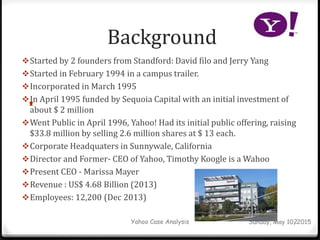
Background
Started by 2 founders from Standford: David filo and Jerry Yang
Started in February 1994 in a campus trailer.
Incorporated in March 1995
In April 1995 funded by Sequoia Capital with an initial investment of
about $ 2 million
Went Public in April 1996, Yahoo! Had its initial public offering, raising
$33.8 million by selling 2.6 million shares at $ 13 each.
Corporate Headquaters in Sunnywale, California
Director and Former- CEO of Yahoo, Timothy Koogle is a Wahoo
Present CEO - Marissa Mayer
Revenue : US$ 4.68 Billion (2013)
Employees: 12,200 (Dec 2013)
Sunday, May 10, 2015Yahoo Case Analysis 2
Segments
It operates the web portal which provides content
including the latest news, entertainment, sports and it
also gives users a quick access to other Yahoo! Services
Finance, Yahoo! Groups and the Yahoo! Messenger etc.
Services are available globally in more than 20
languages.
It also provides social Networking Services and user –
generated content such as Yahoo! Personals, Flick,
Yahoo! Buzz an
Content; Yahoo! Partners with hundred of leading
content provides on sports, finance music, movies,
news, answers and games to provide media content,
news and information.
Yahoo case analysis. 3
Abstract and Case Summary
4
Contd:
 Yahoo embarked on Strategy of opening up Yahoo
services around the world.
 In 2000, the company Generated revenue of over
900 million.
 First 9 months of 2001 sales slumped by 34
percent and the company registered loss of 84
million versus a profit of 169 million in the
previous year.
 The revenue and profit declined reflected
slumping advertising revenues, which accounted
for close to 80 percent of Yahoo’s revenue in 2000.
 The shrinking of advertising revenue was due to
slow down, cost cutting and Yahoo over reliance
on dot.com advertising customer which were
going bankrupt.
 In the wake of slumping revenues, CEO Koogle
resigned and was replaced by Terry Semel, a
former Warner Brothers executive.
 The Strategy which Semel embarked on in May
2001 was one of Diversification, Joint Ventures
and Restructuring.
Abstract: ‘The case analysis the Strategy of Yahoo Success between 1994 and 2011, and their decline in profit
between 2000 and 2011 subsequently leading to departure of their than CEO Mr. Timothy Koogle and Terry
Semel replacing him and introducing the next phase of strategies.
 1994 Jerry Yang and David Fil0 two students at
Standford University start a directory service Yahoo.
(http://www.yahoo.com) “Yet Another Hierarchical
Officious Oracle.”.
 1994 Yahoo draw 100,000 people per day and Yahoo
borrows server space from Netscape.
 Yang and Filo’s business model was to derive revenues
from renting advertising space on the pages of the fast-
growing directory.
 Their first Investment came from Sequoia Capital, a
Silicon Valley venture capital and as part for the
package Sequoia wanted Yahoo to hire an experience
CEO.
 In 1995 Mr. Andrew Koogle, joined the company as
CEO.
 By mid-1996 Koogle was heading a public listed
company with 200,000 websites under 20,000
different categories and used by 800,000 People daily.
 Koogle crafted a vision for Yahoo as a global media
company whose principle assets would be a major
internet gateway, or portal, that would enable any one
to connect with anything and anybody.
 In this vision Yahoo would continue to generate
revenue from sales of advertising space on its directory
pages, and revenue from small slice of each transaction
of e-commerce executed over its service.
Discussion Question
1. To what extent was the evolution of strategy at Yahoo
planned?
To what extent was it an emergent response to unforeseen
events?
2. Could Yahoo have done a better job of anticipating the
slowdown in advertising revenue that occurred in 2000 – 2001
and positioning itself for that slowdown? How? What might it
have done differently from a strategic planning perspective?
3. Does Yahoo have a source of potential long-term
competitive
advantage? Where does this come from?
4. What does Koogle’s resignation in May 2001 tell you about
the role of a CEO in a public company?
Yahoo case analysis.
5
Q1. . To what extent was the evolution of strategy at Yahoo planned?
To what extent was it an emergent response to unforeseen events?
Cont..
Yahoo case analysis 6
Koogle crafted a vision for Yahoo! – a global media company, whose principal asset
would be a major Internet gateway, or portal, that would enable anyone to connect
with anything or anybody
A good plan, but external factors were not accounted for , perhaps revenue model had to
considered along with customer vertical Segmentation for advertising revenue.
On April 5, 1995, Michael Moritz of Sequoia Capital provided Yahoo! with two
rounds of venture capital, raising approximately $3 million. But as part of the
investment package, Sequoia required Yahoo to hire an experienced CEO.
A wise strategy (planned) from Sequoia, to let engineers handle core functionality, and
let the running of a company in the hands of someone experienced
Jerry Yang and David Filo started Yahoo as Directory accidentally by 1994 yahoo was
drawing over 100,00 people per day
An emergent strategic experiment, whose success prompted Yahoo!’s incorporation
Q1. . To what extent was the evolution of strategy at Yahoo planned?
To what extent was it an emergent response to unforeseen events?
Cont.. 2
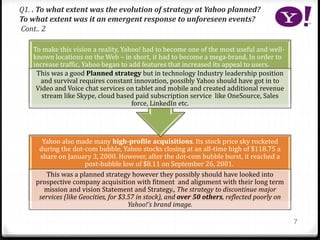
Yahoo also made many high-profile acquisitions. Its stock price sky rocketed
during the dot-com bubble, Yahoo stocks closing at an all-time high of $118.75 a
share on January 3, 2000. However, after the dot-com bubble burst, it reached a
post-bubble low of $8.11 on September 26, 2001.
This was a planned strategy however they possibly should have looked into
prospective company acquisition with fitment and alignment with their long term
mission and vision Statement and Strategy., The strategy to discontinue major
services (like Geocities, for $3.57 in stock), and over 50 others, reflected poorly on
Yahoo!’s brand image.
To make this vision a reality, Yahoo! had to become one of the most useful and well-
known locations on the Web – in short, it had to become a mega-brand, In order to
increase traffic, Yahoo began to add features that increased its appeal to users.
This was a good Planned strategy but in technology Industry leadership position
and survival requires constant innovation, possibly Yahoo should have got in to
Video and Voice chat services on tablet and mobile and created additional revenue
stream like Skype, cloud based paid subscription service like OneSource, Sales
force, LinkedIn etc.
7
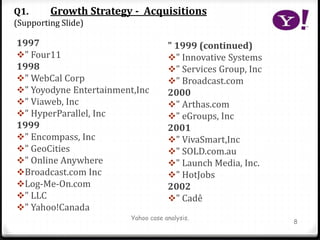
Q1. Growth Strategy - Acquisitions
(Supporting Slide)
1997
" Four11
1998
" WebCal Corp
" Yoyodyne Entertainment,Inc
" Viaweb, Inc
" HyperParallel, Inc
1999
" Encompass, Inc
" GeoCities
" Online Anywhere
Broadcast.com Inc
Log-Me-On.com
" LLC
" Yahoo!Canada
Yahoo case analysis.
8
" 1999 (continued)
" Innovative Systems
" Services Group, Inc
" Broadcast.com
2000
" Arthas.com
" eGroups, Inc
2001
" VivaSmart,Inc
" SOLD.com.au
" Launch Media, Inc.
" HotJobs
2002
" Cadê
Q1. To what extent was the evolution of strategy at Yahoo planned?
To what extent was it an emergent response to unforeseen events? Cont 3
 All in all, the strategy seemed both emergent and planned.
 More emergent at inception and later more planned, where one would question
the extent of the planning process.
 For example, there has been a deliberate and intense search over the course of
several years by Yahoo managers to find a way to increase revenues. This is a
difficult issue for Internet portals, which users believe should provide services
with little or no charge. Therefore, someone other than the user must pay for the
service. When one strategy for increasing revenues was successful, the firm
increased its efforts in that area. When the firm became over-reliant upon
revenues from one set of businesses, there was a deliberate search for alternate
customers.
 On the other hand, emergent strategies were also important. The founders did not
anticipate the explosive growth in the Internet, driven by the falling prices and
increased ease of use of personal computer hardware and software. The high-tech
slump and the failure of many Internet businesses were also unanticipated and
caused the firm to scramble for an adequate response.
 For instance, Yahoo! board should have addressed changes happening across
them both internal and external environment– they should have diversified in
new Segment and verticals for revenue and evolved new business models which
to some extended they tried, giving more emphasis on mobile, which should have
figured in their corporate dossier back in 2001.
9
Q2. Could Yahoo have done a better job of anticipating the slowdown in
advertising revenue that occurred in 2000 – 2001 and positioning itself for
that slowdown? How?
Although Yahoo was certainly not alone in being taken by surprise, it
could have done a better job of anticipating the high-tech slowdown.
Specifically, even in the absence of any evidence that pointed directly to
a slowdown, the firm should have looked carefully at its business model
for areas of vulnerability.
Early identification of potential weaknesses, threat and opportunity
would allow more time for planning and preparation of strategies to
offset those weaknesses and threat and successfully, timely mobilize
and align resources in direction of opportunities.
Yahoo’s model, charging advertisers in order to provide free services to
consumers, was very vulnerable to slowdown in advertising
expenditures.
Additionally, most of the firm’s advertisers were concentrated in the
high-tech industry, which increased Yahoo’s vulnerability.
Scenario planning is one tool the firm could have used to identify
vulnerabilities.
10
Q2. (Part 2) What might it have done differently from a
strategic planning perspective?
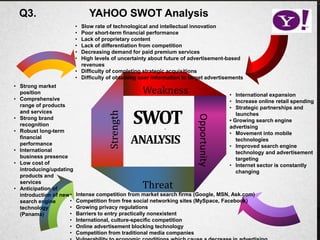
More diversification was required to reduce dependence on one
particular type of industry, e.g., dot com
Revenue streams needed to be broadened with the change in
economic environment
Sectors that are relatively less affected by economic slowdown could
be targeted, e.g., entertainment
Country specific services could be promoted
External: Diversify by broadening of the product line, spread Risk,
create Synergy and Joint Venture.
Building partnership and Joint Ventures.
Internal: Restructuring, cost reducing, concentrate on products &
division with high potential.
integrating they have 42 SBU reducing them, Liquidation and
Innovation.
Cost reduction and restructuring.
Focus should have shifted from market pull (dot.com frenzy) to
market push.
Intrinsic to this collection of strategies should be turning cost centers
into revenue centers.
11
Q3. Does Yahoo have a source of potential long-term competitive
advantage? Where does this come from?
Portfolio Analysis
2001
Secure Enterprise
Portals, Web-hosting
-Health Care,
program admin
- Retirement
programadmin
Broadcast svcs; Audio &
Video
1-to-1 Database
Marketing
Business E-
Mail
Consumer Transaction
Services -Shopping
Auctions, Finance, Travel.
Document DownloadsOn-line Market
Research
B2B Mobile
Services,
Pager, PDA’s,
Phone,
Trains, Taxis
Media Services,
News, Sports,
Games, music,
movies
Transaction &
Business
Services
Revenues25%
Advertising
Sponsorship
Key Word
Revenues
75%
1999
EVA created right side
table.
The Future since May
2001. Cost centres
changes to revenue
centres. MVA created
here.
Personal
Email -free
Advertising
Sponsorship
Key Words
Web Navigation
Guide – Free (search
engine)
1995
High
Flagship ‘www.yahoo.com’
pays for the Future
Relative Market ShareLow
IndustrialGrowthRate
High
Low
(CashUse)
(Cash Generated) 12
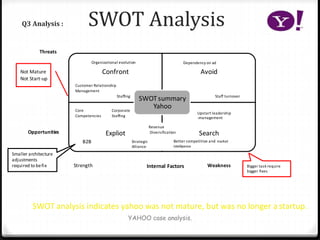
Weakness
Threat
Opportunity
Strength
SWOT
• Strong market
position
• Comprehensive
range of products
and services
• Strong brand
recognition
• Robust long-term
financial
performance
• International
business presence
• Low cost of
introducing/updating
products and
services
• Anticipation of
introduction of new
search engine
technology
(Panama)
• International expansion
• Increase online retail spending
• Strategic partnerships and
launches
• Growing search engine
advertising
• Movement into mobile
technologies
• Improved search engine
technology and advertisement
targeting
• Internet sector is constantly
changing
Q3. YAHOO SWOT Analysis
ANALYSIS
• Slow rate of technological and intellectual innovation
• Poor short-term financial performance
• Lack of proprietary content
• Lack of differentiation from competition
• Decreasing demand for paid premium services
• High levels of uncertainty about future of advertisement-based
revenues
• Difficulty of completing strategic acquisitions
• Difficulty of obtaining user information to target advertisements
• Intense competition from market search firms (Google, MSN, Ask.com)
• Competition from free social networking sites (MySpace, Facebook)
• Growing privacy regulations
• Barriers to entry practically nonexistent
• International, culture-specific competition
• Online advertisement blocking technology
• Competition from traditional media companies
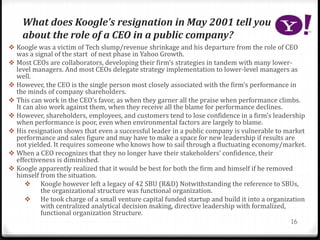
Confront Avoid
Expliot Search
SWOTsummary
Yahoo
Threats
External
Factors
Opportunities
Smaller architecture
adjustments
required to befix
Issues
Not Mature
Not Start-up
Organizational evolution
Customer Relationship
Management
Staffing
Core
Competencies
Corporate
Staffing
Revenue
Diversification
B2B Strategic
Alliance
Internal FactorsStrength Weakness
Upstart leadership
-management
Better competitive and market
intelligence
Dependency on ad
Staff turnover
Bigger task require
bigger fixes
Q3 Analysis : SWOT Analysis
YAHOO case analysis.
SWOT analysis indicates yahoo was not mature, but was no longer a startup.
Q3. Does Yahoo have a source of potential long-term
competitive advantage? Where does this come from?
Its flagship, www.Yahoo.com, is very much a “cow” and is
paying for the future by providing horizontal services of
email and community sites.
Still a high quality technology portal powerhouse, it should
now shifting to an emphasis on sales and marketing, with a
view to making money from its core competency and
managing its customer relationships.
Branding is a strong emphasis. It works in Low to High
quality product vector
 It is still a fast mover in responding to the market; early
cycle
 It’s now a cash rich company by strategically realigning it
self it has potential long term competitive advantage.
Yahoo case analysis.
15
What does Koogle’s resignation in May 2001 tell you
about the role of a CEO in a public company?
 Koogle was a victim of Tech slump/revenue shrinkage and his departure from the role of CEO
was a signal of the start of next phase in Yahoo Growth.
 Most CEOs are collaborators, developing their firm’s strategies in tandem with many lower-
level managers. And most CEOs delegate strategy implementation to lower-level managers as
well.
 However, the CEO is the single person most closely associated with the firm’s performance in
the minds of company shareholders.
 This can work in the CEO’s favor, as when they garner all the praise when performance climbs.
It can also work against them, when they receive all the blame for performance declines.
 However, shareholders, employees, and customers tend to lose confidence in a firm’s leadership
when performance is poor, even when environmental factors are largely to blame.
 His resignation shows that even a successful leader in a public company is vulnerable to market
performance and sales figure and may have to make a space for new leadership if results are
not yielded. It requires someone who knows how to sail through a fluctuating economy/market.
 When a CEO recognizes that they no longer have their stakeholders’ confidence, their
effectiveness is diminished.
 Koogle apparently realized that it would be best for both the firm and himself if he removed
himself from the situation.
 Koogle however left a legacy of 42 SBU (R&D) Notwithstanding the reference to SBUs,
the organizational structure was functional organization.
 He took charge of a small venture capital funded startup and build it into a organization
with centralized analytical decision making, directive leadership with formalized,
functional organization Structure.
16
Thank you
Source: Case study shared by IIFT - Strategy Management Dr. K. Ranagrajan and
research work over internet.

Yahoo case analysis

  • 1.
    (Yet Another HierarchicalOfficious Oracle) The evolution of Strategy - Assignment Sunday, May 10, 2015 1 Submitted to : Dr. K. Rangarajan Subject: Strategic Management Indian Institute of Foreign Trade EPGDIB (VSAT) – 2014-2015 Trimester – II (July – October, 2014) Submitted by: Group 1 Name Roll No Sanjay Vaid 47 Puneet Diwan 39 Narendra Kumar 31 Komal Grovar 24 Anuj Abrol 10
  • 2.
    Background Started by 2founders from Standford: David filo and Jerry Yang Started in February 1994 in a campus trailer. Incorporated in March 1995 In April 1995 funded by Sequoia Capital with an initial investment of about $ 2 million Went Public in April 1996, Yahoo! Had its initial public offering, raising $33.8 million by selling 2.6 million shares at $ 13 each. Corporate Headquaters in Sunnywale, California Director and Former- CEO of Yahoo, Timothy Koogle is a Wahoo Present CEO - Marissa Mayer Revenue : US$ 4.68 Billion (2013) Employees: 12,200 (Dec 2013) Sunday, May 10, 2015Yahoo Case Analysis 2
  • 3.
    Segments It operates theweb portal which provides content including the latest news, entertainment, sports and it also gives users a quick access to other Yahoo! Services Finance, Yahoo! Groups and the Yahoo! Messenger etc. Services are available globally in more than 20 languages. It also provides social Networking Services and user – generated content such as Yahoo! Personals, Flick, Yahoo! Buzz an Content; Yahoo! Partners with hundred of leading content provides on sports, finance music, movies, news, answers and games to provide media content, news and information. Yahoo case analysis. 3
  • 4.
    Abstract and CaseSummary 4 Contd:  Yahoo embarked on Strategy of opening up Yahoo services around the world.  In 2000, the company Generated revenue of over 900 million.  First 9 months of 2001 sales slumped by 34 percent and the company registered loss of 84 million versus a profit of 169 million in the previous year.  The revenue and profit declined reflected slumping advertising revenues, which accounted for close to 80 percent of Yahoo’s revenue in 2000.  The shrinking of advertising revenue was due to slow down, cost cutting and Yahoo over reliance on dot.com advertising customer which were going bankrupt.  In the wake of slumping revenues, CEO Koogle resigned and was replaced by Terry Semel, a former Warner Brothers executive.  The Strategy which Semel embarked on in May 2001 was one of Diversification, Joint Ventures and Restructuring. Abstract: ‘The case analysis the Strategy of Yahoo Success between 1994 and 2011, and their decline in profit between 2000 and 2011 subsequently leading to departure of their than CEO Mr. Timothy Koogle and Terry Semel replacing him and introducing the next phase of strategies.  1994 Jerry Yang and David Fil0 two students at Standford University start a directory service Yahoo. (http://www.yahoo.com) “Yet Another Hierarchical Officious Oracle.”.  1994 Yahoo draw 100,000 people per day and Yahoo borrows server space from Netscape.  Yang and Filo’s business model was to derive revenues from renting advertising space on the pages of the fast- growing directory.  Their first Investment came from Sequoia Capital, a Silicon Valley venture capital and as part for the package Sequoia wanted Yahoo to hire an experience CEO.  In 1995 Mr. Andrew Koogle, joined the company as CEO.  By mid-1996 Koogle was heading a public listed company with 200,000 websites under 20,000 different categories and used by 800,000 People daily.  Koogle crafted a vision for Yahoo as a global media company whose principle assets would be a major internet gateway, or portal, that would enable any one to connect with anything and anybody.  In this vision Yahoo would continue to generate revenue from sales of advertising space on its directory pages, and revenue from small slice of each transaction of e-commerce executed over its service.
  • 5.
    Discussion Question 1. Towhat extent was the evolution of strategy at Yahoo planned? To what extent was it an emergent response to unforeseen events? 2. Could Yahoo have done a better job of anticipating the slowdown in advertising revenue that occurred in 2000 – 2001 and positioning itself for that slowdown? How? What might it have done differently from a strategic planning perspective? 3. Does Yahoo have a source of potential long-term competitive advantage? Where does this come from? 4. What does Koogle’s resignation in May 2001 tell you about the role of a CEO in a public company? Yahoo case analysis. 5
  • 6.
    Q1. . Towhat extent was the evolution of strategy at Yahoo planned? To what extent was it an emergent response to unforeseen events? Cont.. Yahoo case analysis 6 Koogle crafted a vision for Yahoo! – a global media company, whose principal asset would be a major Internet gateway, or portal, that would enable anyone to connect with anything or anybody A good plan, but external factors were not accounted for , perhaps revenue model had to considered along with customer vertical Segmentation for advertising revenue. On April 5, 1995, Michael Moritz of Sequoia Capital provided Yahoo! with two rounds of venture capital, raising approximately $3 million. But as part of the investment package, Sequoia required Yahoo to hire an experienced CEO. A wise strategy (planned) from Sequoia, to let engineers handle core functionality, and let the running of a company in the hands of someone experienced Jerry Yang and David Filo started Yahoo as Directory accidentally by 1994 yahoo was drawing over 100,00 people per day An emergent strategic experiment, whose success prompted Yahoo!’s incorporation
  • 7.
    Q1. . Towhat extent was the evolution of strategy at Yahoo planned? To what extent was it an emergent response to unforeseen events? Cont.. 2 Yahoo also made many high-profile acquisitions. Its stock price sky rocketed during the dot-com bubble, Yahoo stocks closing at an all-time high of $118.75 a share on January 3, 2000. However, after the dot-com bubble burst, it reached a post-bubble low of $8.11 on September 26, 2001. This was a planned strategy however they possibly should have looked into prospective company acquisition with fitment and alignment with their long term mission and vision Statement and Strategy., The strategy to discontinue major services (like Geocities, for $3.57 in stock), and over 50 others, reflected poorly on Yahoo!’s brand image. To make this vision a reality, Yahoo! had to become one of the most useful and well- known locations on the Web – in short, it had to become a mega-brand, In order to increase traffic, Yahoo began to add features that increased its appeal to users. This was a good Planned strategy but in technology Industry leadership position and survival requires constant innovation, possibly Yahoo should have got in to Video and Voice chat services on tablet and mobile and created additional revenue stream like Skype, cloud based paid subscription service like OneSource, Sales force, LinkedIn etc. 7
  • 8.
    Q1. Growth Strategy- Acquisitions (Supporting Slide) 1997 " Four11 1998 " WebCal Corp " Yoyodyne Entertainment,Inc " Viaweb, Inc " HyperParallel, Inc 1999 " Encompass, Inc " GeoCities " Online Anywhere Broadcast.com Inc Log-Me-On.com " LLC " Yahoo!Canada Yahoo case analysis. 8 " 1999 (continued) " Innovative Systems " Services Group, Inc " Broadcast.com 2000 " Arthas.com " eGroups, Inc 2001 " VivaSmart,Inc " SOLD.com.au " Launch Media, Inc. " HotJobs 2002 " Cadê
  • 9.
    Q1. To whatextent was the evolution of strategy at Yahoo planned? To what extent was it an emergent response to unforeseen events? Cont 3  All in all, the strategy seemed both emergent and planned.  More emergent at inception and later more planned, where one would question the extent of the planning process.  For example, there has been a deliberate and intense search over the course of several years by Yahoo managers to find a way to increase revenues. This is a difficult issue for Internet portals, which users believe should provide services with little or no charge. Therefore, someone other than the user must pay for the service. When one strategy for increasing revenues was successful, the firm increased its efforts in that area. When the firm became over-reliant upon revenues from one set of businesses, there was a deliberate search for alternate customers.  On the other hand, emergent strategies were also important. The founders did not anticipate the explosive growth in the Internet, driven by the falling prices and increased ease of use of personal computer hardware and software. The high-tech slump and the failure of many Internet businesses were also unanticipated and caused the firm to scramble for an adequate response.  For instance, Yahoo! board should have addressed changes happening across them both internal and external environment– they should have diversified in new Segment and verticals for revenue and evolved new business models which to some extended they tried, giving more emphasis on mobile, which should have figured in their corporate dossier back in 2001. 9
  • 10.
    Q2. Could Yahoohave done a better job of anticipating the slowdown in advertising revenue that occurred in 2000 – 2001 and positioning itself for that slowdown? How? Although Yahoo was certainly not alone in being taken by surprise, it could have done a better job of anticipating the high-tech slowdown. Specifically, even in the absence of any evidence that pointed directly to a slowdown, the firm should have looked carefully at its business model for areas of vulnerability. Early identification of potential weaknesses, threat and opportunity would allow more time for planning and preparation of strategies to offset those weaknesses and threat and successfully, timely mobilize and align resources in direction of opportunities. Yahoo’s model, charging advertisers in order to provide free services to consumers, was very vulnerable to slowdown in advertising expenditures. Additionally, most of the firm’s advertisers were concentrated in the high-tech industry, which increased Yahoo’s vulnerability. Scenario planning is one tool the firm could have used to identify vulnerabilities. 10
  • 11.
    Q2. (Part 2)What might it have done differently from a strategic planning perspective? More diversification was required to reduce dependence on one particular type of industry, e.g., dot com Revenue streams needed to be broadened with the change in economic environment Sectors that are relatively less affected by economic slowdown could be targeted, e.g., entertainment Country specific services could be promoted External: Diversify by broadening of the product line, spread Risk, create Synergy and Joint Venture. Building partnership and Joint Ventures. Internal: Restructuring, cost reducing, concentrate on products & division with high potential. integrating they have 42 SBU reducing them, Liquidation and Innovation. Cost reduction and restructuring. Focus should have shifted from market pull (dot.com frenzy) to market push. Intrinsic to this collection of strategies should be turning cost centers into revenue centers. 11
  • 12.
    Q3. Does Yahoohave a source of potential long-term competitive advantage? Where does this come from? Portfolio Analysis 2001 Secure Enterprise Portals, Web-hosting -Health Care, program admin - Retirement programadmin Broadcast svcs; Audio & Video 1-to-1 Database Marketing Business E- Mail Consumer Transaction Services -Shopping Auctions, Finance, Travel. Document DownloadsOn-line Market Research B2B Mobile Services, Pager, PDA’s, Phone, Trains, Taxis Media Services, News, Sports, Games, music, movies Transaction & Business Services Revenues25% Advertising Sponsorship Key Word Revenues 75% 1999 EVA created right side table. The Future since May 2001. Cost centres changes to revenue centres. MVA created here. Personal Email -free Advertising Sponsorship Key Words Web Navigation Guide – Free (search engine) 1995 High Flagship ‘www.yahoo.com’ pays for the Future Relative Market ShareLow IndustrialGrowthRate High Low (CashUse) (Cash Generated) 12
  • 13.
    Weakness Threat Opportunity Strength SWOT • Strong market position •Comprehensive range of products and services • Strong brand recognition • Robust long-term financial performance • International business presence • Low cost of introducing/updating products and services • Anticipation of introduction of new search engine technology (Panama) • International expansion • Increase online retail spending • Strategic partnerships and launches • Growing search engine advertising • Movement into mobile technologies • Improved search engine technology and advertisement targeting • Internet sector is constantly changing Q3. YAHOO SWOT Analysis ANALYSIS • Slow rate of technological and intellectual innovation • Poor short-term financial performance • Lack of proprietary content • Lack of differentiation from competition • Decreasing demand for paid premium services • High levels of uncertainty about future of advertisement-based revenues • Difficulty of completing strategic acquisitions • Difficulty of obtaining user information to target advertisements • Intense competition from market search firms (Google, MSN, Ask.com) • Competition from free social networking sites (MySpace, Facebook) • Growing privacy regulations • Barriers to entry practically nonexistent • International, culture-specific competition • Online advertisement blocking technology • Competition from traditional media companies
  • 14.
    Confront Avoid Expliot Search SWOTsummary Yahoo Threats External Factors Opportunities Smallerarchitecture adjustments required to befix Issues Not Mature Not Start-up Organizational evolution Customer Relationship Management Staffing Core Competencies Corporate Staffing Revenue Diversification B2B Strategic Alliance Internal FactorsStrength Weakness Upstart leadership -management Better competitive and market intelligence Dependency on ad Staff turnover Bigger task require bigger fixes Q3 Analysis : SWOT Analysis YAHOO case analysis. SWOT analysis indicates yahoo was not mature, but was no longer a startup.
  • 15.
    Q3. Does Yahoohave a source of potential long-term competitive advantage? Where does this come from? Its flagship, www.Yahoo.com, is very much a “cow” and is paying for the future by providing horizontal services of email and community sites. Still a high quality technology portal powerhouse, it should now shifting to an emphasis on sales and marketing, with a view to making money from its core competency and managing its customer relationships. Branding is a strong emphasis. It works in Low to High quality product vector  It is still a fast mover in responding to the market; early cycle  It’s now a cash rich company by strategically realigning it self it has potential long term competitive advantage. Yahoo case analysis. 15
  • 16.
    What does Koogle’sresignation in May 2001 tell you about the role of a CEO in a public company?  Koogle was a victim of Tech slump/revenue shrinkage and his departure from the role of CEO was a signal of the start of next phase in Yahoo Growth.  Most CEOs are collaborators, developing their firm’s strategies in tandem with many lower- level managers. And most CEOs delegate strategy implementation to lower-level managers as well.  However, the CEO is the single person most closely associated with the firm’s performance in the minds of company shareholders.  This can work in the CEO’s favor, as when they garner all the praise when performance climbs. It can also work against them, when they receive all the blame for performance declines.  However, shareholders, employees, and customers tend to lose confidence in a firm’s leadership when performance is poor, even when environmental factors are largely to blame.  His resignation shows that even a successful leader in a public company is vulnerable to market performance and sales figure and may have to make a space for new leadership if results are not yielded. It requires someone who knows how to sail through a fluctuating economy/market.  When a CEO recognizes that they no longer have their stakeholders’ confidence, their effectiveness is diminished.  Koogle apparently realized that it would be best for both the firm and himself if he removed himself from the situation.  Koogle however left a legacy of 42 SBU (R&D) Notwithstanding the reference to SBUs, the organizational structure was functional organization.  He took charge of a small venture capital funded startup and build it into a organization with centralized analytical decision making, directive leadership with formalized, functional organization Structure. 16
  • 17.
    Thank you Source: Casestudy shared by IIFT - Strategy Management Dr. K. Ranagrajan and research work over internet.

Editor's Notes

  • #3 In March 1995, Filo and Yang incorporated the business and met with dozens of Silicon Valley venture capitalists. Sequoia Capital, whose successful investments included Apple Computer, Atari, Oracle and Cisco Systems, agreed to fund Yahoo! in April 1995 with an initial investment of almost $2 million. After this funding was secure, the two went to look for their management team. They hired Timothy Koogle, a Motorola employee and Stanford alumnus, as chief executive officer and Jeffrey Mallett, founder of Novell's WordPerfect consumer division, as chief operating officer. They secured even more funding in Fall 1995 from investors Reuters Ltd. and Softbank. Yahoo! launched its IPO in April 1996 with 49 employees. [7]