A Case Study of Yahoo
Microsoft offered to acquire Yahoo for $40.8 billion. Microsoft attempted
acquisition of Yahoo was through hostile takeover or through outright purchase (Asay
2008; Pimental, 2008). According to Pimental (2008), Microsoft has more money than
most countries; the company has an excessive cash of over $19 billion. Despite
Microsoft huge excessive liquidity, the company was unable to meet its immediate
short-term obligation of acquiring Yahoo. Explicitly show maybe, how desperate
Microsoft was in trying to acquire Yahoo; the company had sought to use debt to
finance this transaction. Microsoft intended to integrate Yahoo into its company’s core
philosophy and into its expanded business empire.
Without schism, this case study analysis will not be about Microsoft hodgepodge
of businesses but obviously, it is about Yahoo. Palpable kernel to this foreground
analysis is what propelled or prompted Microsoft attempted acquisition of Yahoo
through hostile takeover. What makes other technology companies envious of Yahoo
organizational culture; innovations and sustainable competitiveness through
Technological Situational Happenstances (TSHs); Strength, Weaknesses,
Opportunities, and Threats (SWOT); Political, Environmental, Social, Technological,
Economic, and Legal (PESTEL); are core to this analysis with some verisimilitude? For
instance, online advertisement expected to reach an epic proportion of over $80 $120
billion a year by 2010-2015 (Ackerson, 2010; Asay, 2008; Pimental. 2008). Facebook,
Google, Yahoo and Twitter, have now surpassed the predictable benchmark of $80
billion of online advertisement (Aluya, 2010). Yahoo innovative technology using TSHs,
SWOT, and PESTEL places the company at a sustainable competitive and comparable
advantage. Economically and strategically, Yahoo was positioned serendipitously to
maximizing profit through online advertisement. Not surprising therefore, that Microsoft
wanted to acquire Yahoo. This sanguine discussion starts with the background of
Yahoo and the analysis of the remarkable feat accomplished by the company will follow.
Background
In 1994, David Filo and Jerry Yang, doctoral students at Stanford University,
founded yahoo. Jerry and David started Yahoo as hobby while working on their doctoral
dissertation at Harvard Business School. Understanding the power of internet through
the use of TSH, the founders ascended to fragmenting informational materials into
categories. The reason why the founders decided to fragment or breakdown information
was due to the clustering, clogging and complexities and difficulties involved in finding
information within then popularized internet in the 1990s (Donegan, 2000). From initial
exotic to ubiquitous, the United States government in the early 1990s fully released the
internet for commercial use during this period. Finding information on the ever-
expanding World Wide Web was increasingly complex and difficult. Search processes
required tedious and time-consuming on the part of the end users. Exigencies of the
circumstances led Yahoo founders to categorize information into categories using
creative destruction, vis-à-vis disruptive situational technological happenstances. When
categories became too full, subcategories were developed, and more subcategories
followed. Aptly, the founder’s concept of creating more subcategories in the internet
cascaded into the conceptualized framework of what has become known as Yahoo.
Yahoo conceptualized from proposal to fruition using the creativity of this novel idea of
subcategories (Eisenhardt and Sull, 2001). Exquisitely using TSHs, SWOT, and
PESTEL, Yahoo became the First Prima Donna in this ideological eruption of
subcategories (Aluya and Garraway, 2014).
Yahoo is a major top internet portal (Donegan, 2000). Yahoo generates an
astounding numbers of subscribers on a daily basis with over 100 million visitors. Yahoo
systematically uses TSHs, SWOT and PESTEL to reposition the company strategically
into the followings (a) obtain exclusive content as a way of creating customer loyalty, (b)
establish product bundling packages similar to Microsoft Word, PowerPoint, EXCEL,
with e-mail accounts, instant messaging, calendaring, and hosting services, and (c)
create additional revenue streams. Yahoo was regarded as one of the major viable
competitor in the digital era. Currently, Yahoo burgeoning sales and growth has
exceeded 200% market capitalization. Comparably, Yahoo intangibles, intrinsic and
sales have exceeded the sales of Walt Disney Company (Eisenhardt and Sull, 2001).
Magnificently, Yahoo was a leading search engine site during the late 1990s. In
the late 1990s, according to Nielsen/Net Ratings, Yahoo trailed behind Google in the
United Kingdom, Australia, and Germany as the proverbial search engine of choice for
internet users. With TSH, subscribers and visitors now frequently use Yahoo search
engine due to innovations, inventions, and subcategories search methodologies. For
instance, rather than use complex software based algorithmic search solutions that
were initially used by competitor Excite, Yahoo uses human web-surfers to read, assess
and categorize website characteristics (Rindova and Kotha, 2001).
Rationally expected, the students-turned-entrepreneurs who invented Yahoo
attracted lore venture capitalists. With accessible venture capital funding, Filo and Yang
were former board of directors and the chief executive officers. The founders
understanding their handicap and inexperience in managing an organization hired
experts to managed Yahoo. Unlike Facebook initial public offering, Yahoo stock
skyrocketed to high price level from the opening price. Yahoo current CEO is Marissa
Mayer who took over the helms of affair from former CEO Scott Thomas and iCEO
Ross Levinsohn (Swisher, 2013).
Nusca (2010) purported that former CEO, Carol Bartz, stated,
“Yahoo is a great company that is very, very strong in content for its users,
uses amazing technology to serve up what increasingly we think is going
to be the web of one. People come to us to figure out what’s going on in
the world…it’s a place where you can just get it together” (Nusca, 2010,
p.1).
To be simplistic, leaders in Yahoo have transcended the company from a simple
business model through the use of TSH into a major internet portal.
Strauss, EL-Ansary and Frost (2003) defined a portal as a point of entry to the internet
that provides many services in addition to search capabilities. The internet business
portals were innovations that started from situational technological happenstances of
the internet. Portals were categorized as horizontal or vertical (Donegan, 2000).
Horizontal portals were referred as consumer portals, public portals or web portals that
were generic organizers for information. In contrast, vertical portals were referred as the
corporate portals, enterprise information portals or specialized portals that provide
information for groups or for particular organizational specific interests (Spitzer, 2000).
Innovative portal companies increased stickiness. Rosen (2002) purported that
stickiness is the capability of the internet portals to keep visitors at the site for as long as
possible and thus persuading them to return. Stickiness is also achievable through an
encouraging elixir of continuous innovative products and services through local,
national, international and global content changes. Stickiness includes using TSHs,
SWOT, and PESTEL to offer customized services to customers and increased
investment in branding.
With TSHs, SWOT, and PESTEL, Yahoo uses product bundling to maximize
profit (Shapiro and Varian, 1999). Yahoo basic informational materials were bundled
with services like homepage customization, e-mail accounts, calendaring, instant
messaging and hosting services. With TSHs, SWOT, and PESTEL Yahoo provides
other services free, although the services bundled up in comparable services (Cooper
and Schindler, 2003).
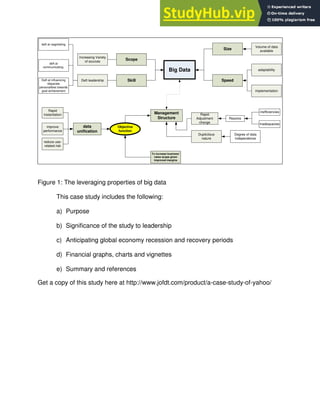
Yahoo’s strategic transition to portal technologies was due to situational
technological happenstances using real time data from large data sets (see the figure 1
below) in response to common competitive business pressures. These pressures
required constant product innovation, increased revenues through advertising and
premium content downloads. Yahoo accomplished this transition through a series of
strategic partnerships.
Big Data
Skill Speed
Scope
Size
Deft leadership
implementation
adaptability
Volume of data
available
Increasing Variety
of sources
Management
Structure
Objective
function
Duplicitous
nature
Rapid
Adjustment
change
Degree of data
independence
Resolve
inefficiencies
inadequacies
To increase business’
value scope given
improved margins
data
unification
Rapid
instantiation
improve
performance
reduce use-
related risk
deft at negotiating
deft at
communicating.
Deft at influencing
disparate
personalities towards
goal achievement
Figure 1: The leveraging properties of big data
This case study includes the following:
a) Purpose
b) Significance of the study to leadership
c) Anticipating global economy recession and recovery periods
d) Financial graphs, charts and vignettes
e) Summary and references
Get a copy of this study here at http://www.jofdt.com/product/a-case-study-of-yahoo/

A Case Study Of Yahoo

  • 1.
    A Case Studyof Yahoo Microsoft offered to acquire Yahoo for $40.8 billion. Microsoft attempted acquisition of Yahoo was through hostile takeover or through outright purchase (Asay 2008; Pimental, 2008). According to Pimental (2008), Microsoft has more money than most countries; the company has an excessive cash of over $19 billion. Despite Microsoft huge excessive liquidity, the company was unable to meet its immediate short-term obligation of acquiring Yahoo. Explicitly show maybe, how desperate Microsoft was in trying to acquire Yahoo; the company had sought to use debt to finance this transaction. Microsoft intended to integrate Yahoo into its company’s core philosophy and into its expanded business empire. Without schism, this case study analysis will not be about Microsoft hodgepodge of businesses but obviously, it is about Yahoo. Palpable kernel to this foreground analysis is what propelled or prompted Microsoft attempted acquisition of Yahoo through hostile takeover. What makes other technology companies envious of Yahoo organizational culture; innovations and sustainable competitiveness through Technological Situational Happenstances (TSHs); Strength, Weaknesses, Opportunities, and Threats (SWOT); Political, Environmental, Social, Technological, Economic, and Legal (PESTEL); are core to this analysis with some verisimilitude? For instance, online advertisement expected to reach an epic proportion of over $80 $120 billion a year by 2010-2015 (Ackerson, 2010; Asay, 2008; Pimental. 2008). Facebook, Google, Yahoo and Twitter, have now surpassed the predictable benchmark of $80 billion of online advertisement (Aluya, 2010). Yahoo innovative technology using TSHs, SWOT, and PESTEL places the company at a sustainable competitive and comparable
  • 2.
    advantage. Economically andstrategically, Yahoo was positioned serendipitously to maximizing profit through online advertisement. Not surprising therefore, that Microsoft wanted to acquire Yahoo. This sanguine discussion starts with the background of Yahoo and the analysis of the remarkable feat accomplished by the company will follow. Background In 1994, David Filo and Jerry Yang, doctoral students at Stanford University, founded yahoo. Jerry and David started Yahoo as hobby while working on their doctoral dissertation at Harvard Business School. Understanding the power of internet through the use of TSH, the founders ascended to fragmenting informational materials into categories. The reason why the founders decided to fragment or breakdown information was due to the clustering, clogging and complexities and difficulties involved in finding information within then popularized internet in the 1990s (Donegan, 2000). From initial exotic to ubiquitous, the United States government in the early 1990s fully released the internet for commercial use during this period. Finding information on the ever- expanding World Wide Web was increasingly complex and difficult. Search processes required tedious and time-consuming on the part of the end users. Exigencies of the circumstances led Yahoo founders to categorize information into categories using creative destruction, vis-à-vis disruptive situational technological happenstances. When categories became too full, subcategories were developed, and more subcategories followed. Aptly, the founder’s concept of creating more subcategories in the internet cascaded into the conceptualized framework of what has become known as Yahoo. Yahoo conceptualized from proposal to fruition using the creativity of this novel idea of subcategories (Eisenhardt and Sull, 2001). Exquisitely using TSHs, SWOT, and
  • 3.
    PESTEL, Yahoo becamethe First Prima Donna in this ideological eruption of subcategories (Aluya and Garraway, 2014). Yahoo is a major top internet portal (Donegan, 2000). Yahoo generates an astounding numbers of subscribers on a daily basis with over 100 million visitors. Yahoo systematically uses TSHs, SWOT and PESTEL to reposition the company strategically into the followings (a) obtain exclusive content as a way of creating customer loyalty, (b) establish product bundling packages similar to Microsoft Word, PowerPoint, EXCEL, with e-mail accounts, instant messaging, calendaring, and hosting services, and (c) create additional revenue streams. Yahoo was regarded as one of the major viable competitor in the digital era. Currently, Yahoo burgeoning sales and growth has exceeded 200% market capitalization. Comparably, Yahoo intangibles, intrinsic and sales have exceeded the sales of Walt Disney Company (Eisenhardt and Sull, 2001). Magnificently, Yahoo was a leading search engine site during the late 1990s. In the late 1990s, according to Nielsen/Net Ratings, Yahoo trailed behind Google in the United Kingdom, Australia, and Germany as the proverbial search engine of choice for internet users. With TSH, subscribers and visitors now frequently use Yahoo search engine due to innovations, inventions, and subcategories search methodologies. For instance, rather than use complex software based algorithmic search solutions that were initially used by competitor Excite, Yahoo uses human web-surfers to read, assess and categorize website characteristics (Rindova and Kotha, 2001). Rationally expected, the students-turned-entrepreneurs who invented Yahoo attracted lore venture capitalists. With accessible venture capital funding, Filo and Yang were former board of directors and the chief executive officers. The founders
  • 4.
    understanding their handicapand inexperience in managing an organization hired experts to managed Yahoo. Unlike Facebook initial public offering, Yahoo stock skyrocketed to high price level from the opening price. Yahoo current CEO is Marissa Mayer who took over the helms of affair from former CEO Scott Thomas and iCEO Ross Levinsohn (Swisher, 2013). Nusca (2010) purported that former CEO, Carol Bartz, stated, “Yahoo is a great company that is very, very strong in content for its users, uses amazing technology to serve up what increasingly we think is going to be the web of one. People come to us to figure out what’s going on in the world…it’s a place where you can just get it together” (Nusca, 2010, p.1). To be simplistic, leaders in Yahoo have transcended the company from a simple business model through the use of TSH into a major internet portal. Strauss, EL-Ansary and Frost (2003) defined a portal as a point of entry to the internet that provides many services in addition to search capabilities. The internet business portals were innovations that started from situational technological happenstances of the internet. Portals were categorized as horizontal or vertical (Donegan, 2000). Horizontal portals were referred as consumer portals, public portals or web portals that were generic organizers for information. In contrast, vertical portals were referred as the corporate portals, enterprise information portals or specialized portals that provide information for groups or for particular organizational specific interests (Spitzer, 2000). Innovative portal companies increased stickiness. Rosen (2002) purported that stickiness is the capability of the internet portals to keep visitors at the site for as long as possible and thus persuading them to return. Stickiness is also achievable through an encouraging elixir of continuous innovative products and services through local,
  • 5.
    national, international andglobal content changes. Stickiness includes using TSHs, SWOT, and PESTEL to offer customized services to customers and increased investment in branding. With TSHs, SWOT, and PESTEL, Yahoo uses product bundling to maximize profit (Shapiro and Varian, 1999). Yahoo basic informational materials were bundled with services like homepage customization, e-mail accounts, calendaring, instant messaging and hosting services. With TSHs, SWOT, and PESTEL Yahoo provides other services free, although the services bundled up in comparable services (Cooper and Schindler, 2003). Yahoo’s strategic transition to portal technologies was due to situational technological happenstances using real time data from large data sets (see the figure 1 below) in response to common competitive business pressures. These pressures required constant product innovation, increased revenues through advertising and premium content downloads. Yahoo accomplished this transition through a series of strategic partnerships.
  • 6.
    Big Data Skill Speed Scope Size Deftleadership implementation adaptability Volume of data available Increasing Variety of sources Management Structure Objective function Duplicitous nature Rapid Adjustment change Degree of data independence Resolve inefficiencies inadequacies To increase business’ value scope given improved margins data unification Rapid instantiation improve performance reduce use- related risk deft at negotiating deft at communicating. Deft at influencing disparate personalities towards goal achievement Figure 1: The leveraging properties of big data This case study includes the following: a) Purpose b) Significance of the study to leadership c) Anticipating global economy recession and recovery periods d) Financial graphs, charts and vignettes e) Summary and references Get a copy of this study here at http://www.jofdt.com/product/a-case-study-of-yahoo/