Prof. Dr. Mohamed Hegab
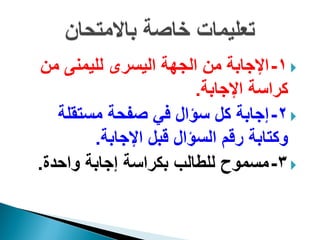
1-‫من‬ ‫لليمنى‬ ‫اليسرى‬ ‫الجهة‬ ‫من‬ ‫اإلجابة‬
‫اإلجابة‬ ‫كراسة‬.
2-‫مستقلة‬ ‫صفحة‬ ‫في‬ ‫سؤال‬ ‫كل‬ ‫إجابة‬
‫اإلجابة‬ ‫قبل‬ ‫السؤال‬ ‫رقم‬ ‫وكتابة‬.
3-‫واحدة‬ ‫إجابة‬ ‫بكراسة‬ ‫للطالب‬ ‫مسموح‬.
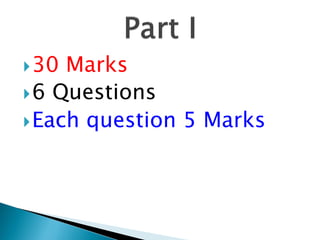
30 Marks
6 Questions
Each question 5 Marks
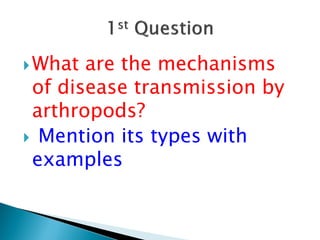
What are the mechanisms
of disease transmission by
arthropods?
 Mention its types with
examples
Mention five parasitic
diseases could be
trnsmitted by Musca
domestica.
Outline the control
measures for Musca.
Why Plasmodium
falciparum cause
malignant malaria?
Mention its
complications.
Classify clinical types of
cutaneous and
mucocutaneous
leishmaniasis
and name the causative
parasite.
Enumerate helminthes that
are transmitted by
autoinfection.
 Mention the infective stage,
the diagnostic stage, and the
definitive host for each of
them.
 What is the parasitic cause and mode
of human infection of the following :
 a. Primary amebic
meningeoencephalitis.
 b. Miners’ anaemia (Egyptian
chlorosis).
 c. Chagoma.
 d. Calabar swelling.
 e. Tropical pulmonary esinophilia.
 45 Marks
 A) Clinical Cases: 10 Marks
 B)Complete: 10 Marks
 C) Rewrite: 10 Marks
 D) MCQ –Single Answer: 5
Marks
 E) Matching: 10 Marks
10 Marks
2 cases
Each case 5 Marks
 A 70 years old diabetic female under
cytotoxic drugs treatment started to
complain of diarrhea with fuel smell.
She visited her doctor who ordered
stool analysis, it revealed the presence
of pear shaped flagellated trophozites
sized 15 x 8 µ. Also, there was an
increased fat content of the stool but
neither mucous nor blood was
existing.
 A) What is your provisional diagnosis
for that patient?
 B) What is the expected complication
that might occur for such patient?
 C) What is the drug of choice for
treating this patient?
 D) Mention other four opportunistic
parasites.
 A 43- years old farmer visited his physician
for routine physical examination. His
Physician noted an enlarged liver with a
palpable mass in the right hypochondrium.
He asked for stool examination and it was
negative for all parasites. His blood showed
slight eosinophilia. Abdominal sonography
revealed a cyst about 6 cm in diameter in
his right lobe of the liver. Aspiration of the
fluid of the cyst revealed some scolices.
 A) What is your provisional diagnosis?
 B) Mention the infective stage and
mode(s) of infection?
 C) Can this patient pass the disease to
other member of his family and why?
 D) What are the most important other
sites in the body that can be affected
by such a cyst?
10 Marks
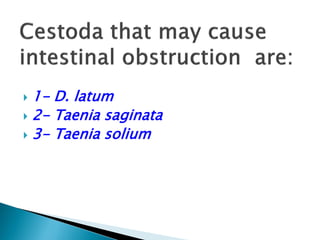
Fill in spaces
 1- ………………………….
 2- ………………………….
 3- ………………………….
 1- D. latum
 2- Taenia saginata
 3- Taenia solium
 1- ……………….
 2- ……………….
 3- ……………….
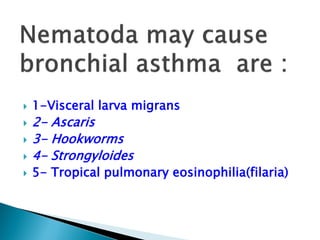
 1-Visceral larva migrans
 2- Ascaris
 3- Hookworms
 4- Strongyloides
 5- Tropical pulmonary eosinophilia(filaria)
10 Marks
 The underlined words in the
following sentences may be
True or False Rewrite each
statements with correction of
the false ones only without
correction of the true ones
Casoni test is used in
immunodiagnosis of
toxocariasis while
Bachman test is used for
immuno-diagnosis of
cysticercosis.
Casoni test is used in
immunodiagnosis of
toxocariasis while
Bachman test is used for
immuno-diagnosis of
cysticercosis.
Thiabendazole is the drug
of choice in treatment of
Trichuris and Ascaris while
albendazole is the drug of
choice in treatment of
Enterobius and hookworms.
Thiabendazole is the drug
of choice in treatment of
Strongyloides stercoralis
and Trichinella spiralis
while albendazole is the
drug of choice in treatment
of Enterobius and
hookworms.
 Answer in Answer Sheet (Red)
 Mark Circle Well.
 First of All: Write down your name,
number and form of exam (A,B,C,D or
E).
 Choose Best Single Answer for each of
the following questions
 5 Marks
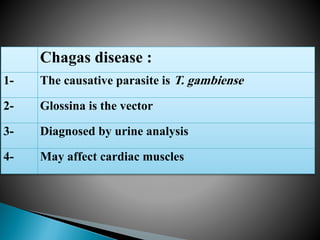
Chagas disease :
1- The causative parasite is T. gambiense
2- Glossina is the vector
3- Diagnosed by urine analysis
4- May affect cardiac muscles
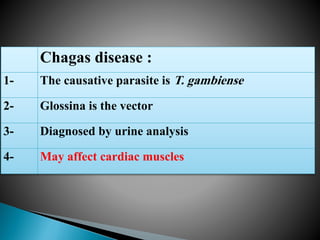
Chagas disease :
1- The causative parasite is T. gambiense
2- Glossina is the vector
3- Diagnosed by urine analysis
4- May affect cardiac muscles
 Matching has separate area in
the answer sheet (Lower part)
 Matching has separate
numbering in the answer sheet
 10 Marks
Match each disease
(syndrome) with its
causative parasite
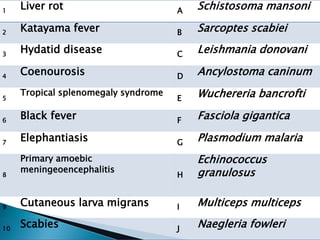
1
Liver rot A Schistosoma mansoni
2 Katayama fever B Sarcoptes scabiei
3
Hydatid disease C Leishmania donovani
4
Coenourosis D Ancylostoma caninum
5
Tropical splenomegaly syndrome
E Wuchereria bancrofti
6
Black fever F Fasciola gigantica
7
Elephantiasis G Plasmodium malaria
8
Primary amoebic
meningeoencephalitis
H
Echinococcus
granulosus
9 Cutaneous larva migrans I Multiceps multiceps
10
Scabies J Naegleria fowleri
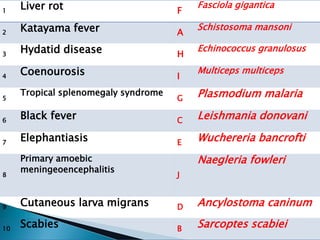
1
Liver rot F
Fasciola gigantica
2 Katayama fever A
Schistosoma mansoni
3
Hydatid disease H
Echinococcus granulosus
4
Coenourosis I
Multiceps multiceps
5
Tropical splenomegaly syndrome
G Plasmodium malaria
6
Black fever C Leishmania donovani
7
Elephantiasis E Wuchereria bancrofti
8
Primary amoebic
meningeoencephalitis
J
Naegleria fowleri
9 Cutaneous larva migrans D Ancylostoma caninum
10
Scabies B Sarcoptes scabiei
Parasitology revision 2016 mod ug

Parasitology revision 2016 mod ug

  • 1.
  • 2.
    1-‫من‬ ‫لليمنى‬ ‫اليسرى‬‫الجهة‬ ‫من‬ ‫اإلجابة‬ ‫اإلجابة‬ ‫كراسة‬. 2-‫مستقلة‬ ‫صفحة‬ ‫في‬ ‫سؤال‬ ‫كل‬ ‫إجابة‬ ‫اإلجابة‬ ‫قبل‬ ‫السؤال‬ ‫رقم‬ ‫وكتابة‬. 3-‫واحدة‬ ‫إجابة‬ ‫بكراسة‬ ‫للطالب‬ ‫مسموح‬.
  • 3.
  • 4.
    What are themechanisms of disease transmission by arthropods?  Mention its types with examples
  • 5.
    Mention five parasitic diseasescould be trnsmitted by Musca domestica. Outline the control measures for Musca.
  • 6.
    Why Plasmodium falciparum cause malignantmalaria? Mention its complications.
  • 7.
    Classify clinical typesof cutaneous and mucocutaneous leishmaniasis and name the causative parasite.
  • 8.
    Enumerate helminthes that aretransmitted by autoinfection.  Mention the infective stage, the diagnostic stage, and the definitive host for each of them.
  • 9.
     What isthe parasitic cause and mode of human infection of the following :  a. Primary amebic meningeoencephalitis.  b. Miners’ anaemia (Egyptian chlorosis).  c. Chagoma.  d. Calabar swelling.  e. Tropical pulmonary esinophilia.
  • 10.
     45 Marks A) Clinical Cases: 10 Marks  B)Complete: 10 Marks  C) Rewrite: 10 Marks  D) MCQ –Single Answer: 5 Marks  E) Matching: 10 Marks
  • 11.
  • 12.
     A 70years old diabetic female under cytotoxic drugs treatment started to complain of diarrhea with fuel smell. She visited her doctor who ordered stool analysis, it revealed the presence of pear shaped flagellated trophozites sized 15 x 8 µ. Also, there was an increased fat content of the stool but neither mucous nor blood was existing.
  • 13.
     A) Whatis your provisional diagnosis for that patient?  B) What is the expected complication that might occur for such patient?  C) What is the drug of choice for treating this patient?  D) Mention other four opportunistic parasites.
  • 14.
     A 43-years old farmer visited his physician for routine physical examination. His Physician noted an enlarged liver with a palpable mass in the right hypochondrium. He asked for stool examination and it was negative for all parasites. His blood showed slight eosinophilia. Abdominal sonography revealed a cyst about 6 cm in diameter in his right lobe of the liver. Aspiration of the fluid of the cyst revealed some scolices.
  • 15.
     A) Whatis your provisional diagnosis?  B) Mention the infective stage and mode(s) of infection?  C) Can this patient pass the disease to other member of his family and why?  D) What are the most important other sites in the body that can be affected by such a cyst?
  • 16.
  • 17.
     1- …………………………. 2- ………………………….  3- ………………………….
  • 18.
     1- D.latum  2- Taenia saginata  3- Taenia solium
  • 19.
     1- ………………. 2- ……………….  3- ……………….
  • 20.
     1-Visceral larvamigrans  2- Ascaris  3- Hookworms  4- Strongyloides  5- Tropical pulmonary eosinophilia(filaria)
  • 21.
    10 Marks  Theunderlined words in the following sentences may be True or False Rewrite each statements with correction of the false ones only without correction of the true ones
  • 22.
    Casoni test isused in immunodiagnosis of toxocariasis while Bachman test is used for immuno-diagnosis of cysticercosis.
  • 23.
    Casoni test isused in immunodiagnosis of toxocariasis while Bachman test is used for immuno-diagnosis of cysticercosis.
  • 24.
    Thiabendazole is thedrug of choice in treatment of Trichuris and Ascaris while albendazole is the drug of choice in treatment of Enterobius and hookworms.
  • 25.
    Thiabendazole is thedrug of choice in treatment of Strongyloides stercoralis and Trichinella spiralis while albendazole is the drug of choice in treatment of Enterobius and hookworms.
  • 26.
     Answer inAnswer Sheet (Red)  Mark Circle Well.  First of All: Write down your name, number and form of exam (A,B,C,D or E).  Choose Best Single Answer for each of the following questions  5 Marks
  • 27.
    Chagas disease : 1-The causative parasite is T. gambiense 2- Glossina is the vector 3- Diagnosed by urine analysis 4- May affect cardiac muscles
  • 28.
    Chagas disease : 1-The causative parasite is T. gambiense 2- Glossina is the vector 3- Diagnosed by urine analysis 4- May affect cardiac muscles
  • 29.
     Matching hasseparate area in the answer sheet (Lower part)  Matching has separate numbering in the answer sheet  10 Marks
  • 30.
    Match each disease (syndrome)with its causative parasite
  • 31.
    1 Liver rot ASchistosoma mansoni 2 Katayama fever B Sarcoptes scabiei 3 Hydatid disease C Leishmania donovani 4 Coenourosis D Ancylostoma caninum 5 Tropical splenomegaly syndrome E Wuchereria bancrofti 6 Black fever F Fasciola gigantica 7 Elephantiasis G Plasmodium malaria 8 Primary amoebic meningeoencephalitis H Echinococcus granulosus 9 Cutaneous larva migrans I Multiceps multiceps 10 Scabies J Naegleria fowleri
  • 32.
    1 Liver rot F Fasciolagigantica 2 Katayama fever A Schistosoma mansoni 3 Hydatid disease H Echinococcus granulosus 4 Coenourosis I Multiceps multiceps 5 Tropical splenomegaly syndrome G Plasmodium malaria 6 Black fever C Leishmania donovani 7 Elephantiasis E Wuchereria bancrofti 8 Primary amoebic meningeoencephalitis J Naegleria fowleri 9 Cutaneous larva migrans D Ancylostoma caninum 10 Scabies B Sarcoptes scabiei