



XLcloud – 3D Rendering in the Cloud 
Open Stack Summit, Paris, November, 2014 
Marius PREDA, TELECOM SudParis 
Philippe GRAVEZ, CEA
Summary 
Some words about the project 
Remote rendering principle and optimizations 
Remote Rendering middleware 
Demos
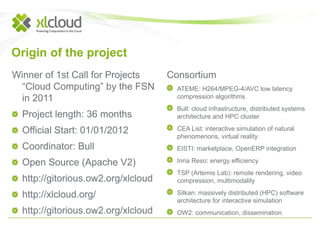
Consortium 
ATEME: H264/MPEG-4/AVC low latency 
compression algorithms 
Bull: cloud infrastructure, distributed systems 
architecture and HPC cluster 
CEA List: interactive simulation of natural 
phenomenons, virtual reality 
EISTI: marketplace, OpenERP integration 
Inria Reso: energy efficiency 
TSP (Artemis Lab): remote rendering, video 
compression, multimodality 
Silkan: massively distributed (HPC) software 
architecture for interactive simulation 
OW2: communication, dissemination 
Origin of the project 
Winner of 1st Call for Projects 
“Cloud Computing” by the FSN 
in 2011 
Project length: 36 months 
Official Start: 01/01/2012 
Coordinator: Bull 
Open Source (Apache V2) 
http://gitorious.ow2.org/xlcloud 
http://xlcloud.org/ 
http://gitorious.ow2.org/xlcloud
XLcloud objective 
Establish the demonstration of a High Performance Cloud 
Computing (HPCC) platform designed to run effectively a 
representative set of compute intensive workloads including 
interactive games and 3D graphics applications
Capabilities of the XLcloud platform 
The platform exposes an on-demand Platform-as-a-Service service 
endpoint (and GUI) which developers can use to manage software stacks 
of nearly any scale and complexity without sacrificing control 
The platform's main design paradigm is to make it easy to manage the 
complete application lifecycle, including resource provisioning, 
configuration management, application deployment, software updates, 
monitoring, and access control. 
The software stack artefacts produced by XLcloud are primarily targeted 
toward delivering two kinds of virtual clusters, but could easily be 
extended to produce other types of virtual platforms: 
● An HPC Virtual Cluster based on SLURM 
● A Remote Rendering Virtual Cluster based on Ogre3D Today’s topic
Remote Rendering
Scene 
analyzer 
Local Input 
Scene 
Data 
AI 
description 
Remote Input 
Network 
parameters 
User interaction 
Segmentation map 
Depth 
map 
Motion vectors 
Application 
Engine 
Scene Graph 
Rendering 
engine 
2D/3D graphics 
Video 
Encoder 
Graphics 
Encoder 
Server 
RTP/UDP 
Packetizer 
Network ready 
packets 
Streamer 
Compressed stream 
Player 
Terminal 
parameters 
Interactivity 
Network 
Client 
Network 
How remote rendering works?
Scene 
analyzer 
Local Input 
Scene 
Data 
AI 
description 
Remote Input 
Network 
parameters 
User interaction 
Segmentation map 
Depth 
map 
Motion vectors 
Application 
Engine 
Scene Graph 
Rendering 
engine 
2D/3D graphics 
Video 
Encoder 
Graphics 
Encoder 
Server 
RTP/UDP 
Packetizer 
Network ready 
packets 
Streamer 
Compressed stream 
Player 
Terminal 
parameters 
Interactivity 
Network 
Client 
Network 
How remote rendering works? 
xlcloud added value 
Transmoder 
Depth MAP 
Quality 
control 
Buffers 
extraction 
optimizations 
Pre- 
Processing
Scene 
analyzer 
Local Input 
Scene 
Data 
AI 
description 
Remote Input 
Network 
parameters 
User interaction 
Segmentation map 
Depth 
map 
Motion vectors 
Application 
Engine 
Scene Graph 
Rendering 
engine 
2D/3D graphics 
Video 
Encoder 
Graphics 
Encoder 
Server 
RTP/UDP 
Packetizer 
Network ready 
packets 
Streamer 
Compressed stream 
Player 
Terminal 
parameters 
Interactivity 
Network 
Client 
Network 
How remote rendering works? 
xlcloud added value 
Transmoder 
Depth MAP 
Quality 
control 
RoA 
Quality 
control 
Region Of 
Attention 
Map 
Buffers 
extraction 
optimizations 
Pre- 
Processing
Examples of applications in Remote Rendering
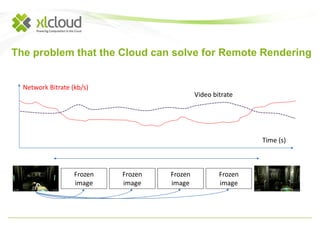
The problem that the Cloud can solve for Remote Rendering 
Video bitrate 
Network Bitrate (kb/s) 
Time (s) 
Frozen 
image 
Frozen 
image 
Frozen 
image 
Frozen 
image
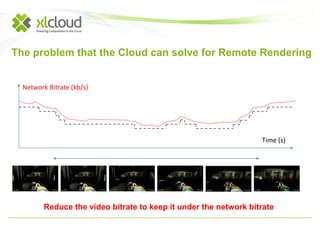
The problem that the Cloud can solve for Remote Rendering 
Network Bitrate (kb/s) 
Time (s) 
Reduce the video bitrate to keep it under the network bitrate
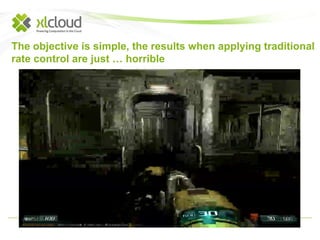
The objective is simple, the results when applying traditional 
rate control are just … horrible
Problem Statement 
Find new representation spaces of video sequences that allows to 
reduce the debit beyond the theoretical limit of the pixel space 
while preserving the user experience
Proposed Approach 
Statistically detect regions of interest (ROI) 
Create importance maps 
Concentrate the coding error in “less important” areas 
Correlate importance maps with the characteristics of the image, 
measured in real time 
Perform a segmentation of the image in relation to these 
characteristics 
Build a hybrid space 
Compress the hybrid space 
Transmit, decode and display the rendered hybrid space
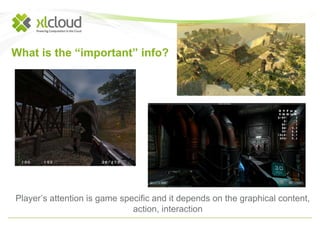
What is the “important” info? 
Player’s attention is game specific and it depends on the graphical content, 
action, interaction
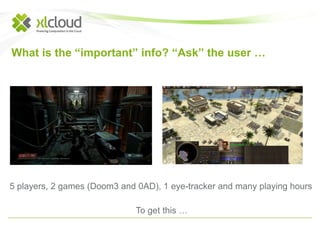
What is the “important” info? “Ask” the user … 
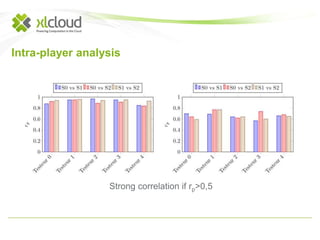
5 players, 2 games (Doom3 and 0AD), 1 eye-tracker and many playing hours 
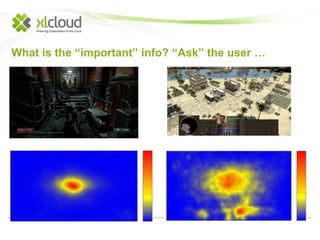
To get this …
What is the “important” info? “Ask” the user …
Intra-player analysis 
Strong correlation if rp>0,5
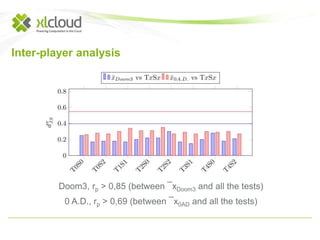
Inter-player analysis 
Doom3, rp > 0,85 (between ¯xDoom3 and all the tests) 
0 A.D., rp > 0,69 (between ¯x0AD and all the tests)
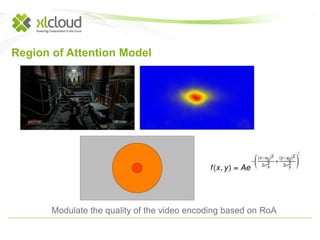
Region of Attention Model 
Modulate the quality of the video encoding based on RoA
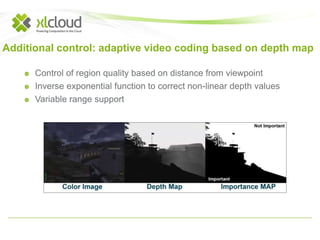
Additional control: adaptive video coding based on depth map 
Control of region quality based on distance from viewpoint 
Inverse exponential function to correct non-linear depth values 
Variable range support
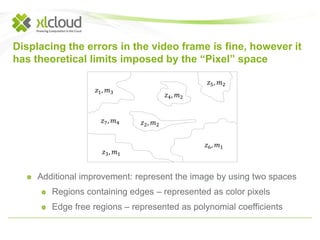
Displacing the errors in the video frame is fine, however it 
has theoretical limits imposed by the “Pixel” space 
푧5, 푚2 
푧6, 푚1 
푧1, 푚3 
푧3, 푚1 
푧2, 푚2 
푧4, 푚2 
푧7, 푚4 
Additional improvement: represent the image by using two spaces 
Regions containing edges – represented as color pixels 
Edge free regions – represented as polynomial coefficients
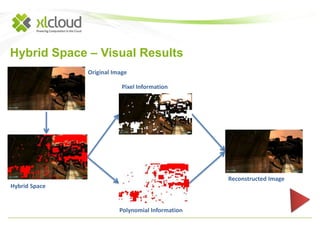
Hybrid Space – Visual Results 
Original Image 
Hybrid Space 
Pixel Information 
Polynomial Information 
Reconstructed Image
Remote Rendering Middleware
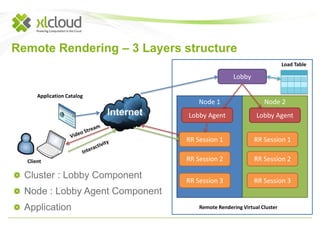
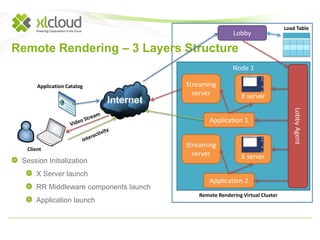
Remote Rendering – 3 Layers structure 
Lobby 
Node 1 Node 2 
Lobby Agent Lobby Agent 
RR Session 1 
RR Session 2 
RR Session 3 
RR Session 1 
RR Session 2 
RR Session 3 
Application Catalog 
Client 
Remote Rendering Virtual Cluster 
Cluster : Lobby Component 
Node : Lobby Agent Component 
Application 
Load Table
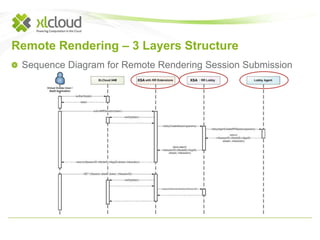
Remote Rendering – 3 Layers Structure 
Sequence Diagram for Remote Rendering Session Submission
Lobby 
Remote Rendering – 3 Layers Structure 
Node 1 
Lobby Agent 
X server 
Application 1 
Application Catalog 
Client 
Streaming 
server 
Remote Rendering Virtual Cluster 
Session Initialization 
X Server launch 
RR Middleware components launch 
Application launch 
Load Table 
Streaming 
server 
X server 
Application 2
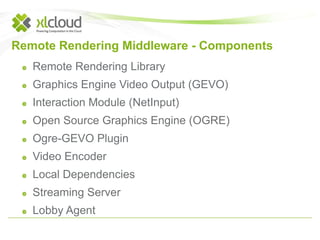
Remote Rendering Middleware - Components 
Remote Rendering Library 
Graphics Engine Video Output (GEVO) 
Interaction Module (NetInput) 
Open Source Graphics Engine (OGRE) 
Ogre-GEVO Plugin 
Video Encoder 
Local Dependencies 
Streaming Server 
Lobby Agent
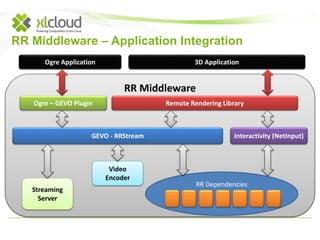
RR Middleware – Application Integration 
Ogre Application 3D Application 
RR Middleware 
Remote Rendering Library 
GEVO - RRStream Interactivity (NetInput) 
RR Dependencies 
Video 
Encoder 
Ogre – GEVO Plugin 
Streaming 
Server
Demo
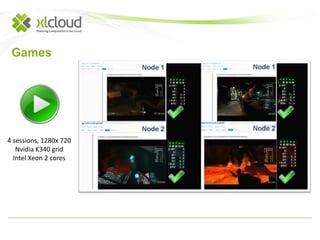
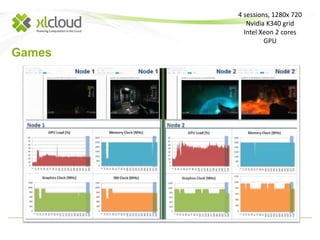
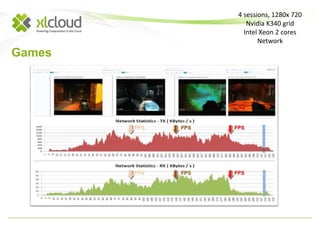
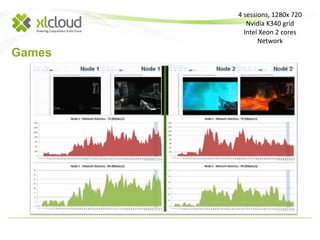
Games 
4 sessions, 1280x 720 
Nvidia K340 grid 
Intel Xeon 2 cores
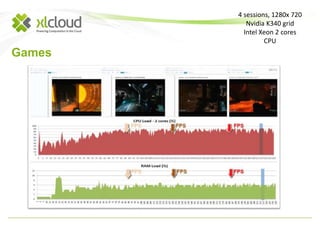
Games 
4 sessions, 1280x 720 
Nvidia K340 grid 
Intel Xeon 2 cores 
CPU
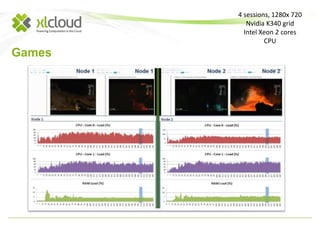
Games 
4 sessions, 1280x 720 
Nvidia K340 grid 
Intel Xeon 2 cores 
CPU
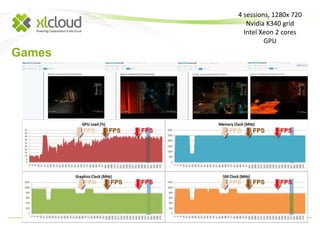
Games 
4 sessions, 1280x 720 
Nvidia K340 grid 
Intel Xeon 2 cores 
GPU
Games 
4 sessions, 1280x 720 
Nvidia K340 grid 
Intel Xeon 2 cores 
GPU
Games 
4 sessions, 1280x 720 
Nvidia K340 grid 
Intel Xeon 2 cores 
Network
Games 
4 sessions, 1280x 720 
Nvidia K340 grid 
Intel Xeon 2 cores 
Network
Concluding Remarks 
A demonstration of a High Performance Cloud Computing platform 
More computation is available, better compression is possible 
Modulate the compression quality with respect to user attention and 
application behavior 
Generate in real time complementary representation spaces for images

XLcloud 3-d remote rendering

  • 1.
    XLcloud – 3DRendering in the Cloud Open Stack Summit, Paris, November, 2014 Marius PREDA, TELECOM SudParis Philippe GRAVEZ, CEA
  • 2.
    Summary Some wordsabout the project Remote rendering principle and optimizations Remote Rendering middleware Demos
  • 3.
    Consortium ATEME: H264/MPEG-4/AVClow latency compression algorithms Bull: cloud infrastructure, distributed systems architecture and HPC cluster CEA List: interactive simulation of natural phenomenons, virtual reality EISTI: marketplace, OpenERP integration Inria Reso: energy efficiency TSP (Artemis Lab): remote rendering, video compression, multimodality Silkan: massively distributed (HPC) software architecture for interactive simulation OW2: communication, dissemination Origin of the project Winner of 1st Call for Projects “Cloud Computing” by the FSN in 2011 Project length: 36 months Official Start: 01/01/2012 Coordinator: Bull Open Source (Apache V2) http://gitorious.ow2.org/xlcloud http://xlcloud.org/ http://gitorious.ow2.org/xlcloud
  • 4.
    XLcloud objective Establishthe demonstration of a High Performance Cloud Computing (HPCC) platform designed to run effectively a representative set of compute intensive workloads including interactive games and 3D graphics applications
  • 5.
    Capabilities of theXLcloud platform The platform exposes an on-demand Platform-as-a-Service service endpoint (and GUI) which developers can use to manage software stacks of nearly any scale and complexity without sacrificing control The platform's main design paradigm is to make it easy to manage the complete application lifecycle, including resource provisioning, configuration management, application deployment, software updates, monitoring, and access control. The software stack artefacts produced by XLcloud are primarily targeted toward delivering two kinds of virtual clusters, but could easily be extended to produce other types of virtual platforms: ● An HPC Virtual Cluster based on SLURM ● A Remote Rendering Virtual Cluster based on Ogre3D Today’s topic
  • 6.
  • 7.
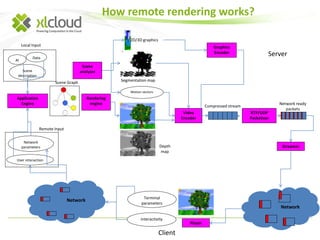
    Scene analyzer LocalInput Scene Data AI description Remote Input Network parameters User interaction Segmentation map Depth map Motion vectors Application Engine Scene Graph Rendering engine 2D/3D graphics Video Encoder Graphics Encoder Server RTP/UDP Packetizer Network ready packets Streamer Compressed stream Player Terminal parameters Interactivity Network Client Network How remote rendering works?
  • 8.
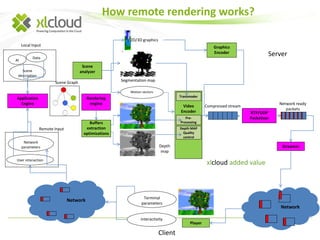
    Scene analyzer LocalInput Scene Data AI description Remote Input Network parameters User interaction Segmentation map Depth map Motion vectors Application Engine Scene Graph Rendering engine 2D/3D graphics Video Encoder Graphics Encoder Server RTP/UDP Packetizer Network ready packets Streamer Compressed stream Player Terminal parameters Interactivity Network Client Network How remote rendering works? xlcloud added value Transmoder Depth MAP Quality control Buffers extraction optimizations Pre- Processing
  • 9.
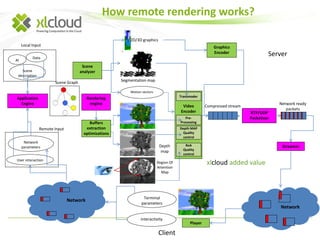
    Scene analyzer LocalInput Scene Data AI description Remote Input Network parameters User interaction Segmentation map Depth map Motion vectors Application Engine Scene Graph Rendering engine 2D/3D graphics Video Encoder Graphics Encoder Server RTP/UDP Packetizer Network ready packets Streamer Compressed stream Player Terminal parameters Interactivity Network Client Network How remote rendering works? xlcloud added value Transmoder Depth MAP Quality control RoA Quality control Region Of Attention Map Buffers extraction optimizations Pre- Processing
  • 10.
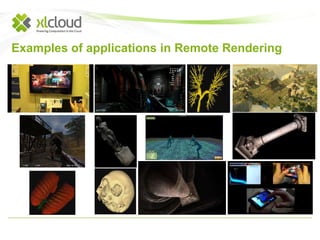
    Examples of applicationsin Remote Rendering
  • 11.
    The problem thatthe Cloud can solve for Remote Rendering Video bitrate Network Bitrate (kb/s) Time (s) Frozen image Frozen image Frozen image Frozen image
  • 12.
    The problem thatthe Cloud can solve for Remote Rendering Network Bitrate (kb/s) Time (s) Reduce the video bitrate to keep it under the network bitrate
  • 13.
    The objective issimple, the results when applying traditional rate control are just … horrible
  • 14.
    Problem Statement Findnew representation spaces of video sequences that allows to reduce the debit beyond the theoretical limit of the pixel space while preserving the user experience
  • 15.
    Proposed Approach Statisticallydetect regions of interest (ROI) Create importance maps Concentrate the coding error in “less important” areas Correlate importance maps with the characteristics of the image, measured in real time Perform a segmentation of the image in relation to these characteristics Build a hybrid space Compress the hybrid space Transmit, decode and display the rendered hybrid space
  • 16.
    What is the“important” info? Player’s attention is game specific and it depends on the graphical content, action, interaction
  • 17.
    What is the“important” info? “Ask” the user … 5 players, 2 games (Doom3 and 0AD), 1 eye-tracker and many playing hours To get this …
  • 18.
    What is the“important” info? “Ask” the user …
  • 19.
    Intra-player analysis Strongcorrelation if rp>0,5
  • 20.
    Inter-player analysis Doom3,rp > 0,85 (between ¯xDoom3 and all the tests) 0 A.D., rp > 0,69 (between ¯x0AD and all the tests)
  • 21.
    Region of AttentionModel Modulate the quality of the video encoding based on RoA
  • 22.
    Additional control: adaptivevideo coding based on depth map Control of region quality based on distance from viewpoint Inverse exponential function to correct non-linear depth values Variable range support
  • 23.
    Displacing the errorsin the video frame is fine, however it has theoretical limits imposed by the “Pixel” space 푧5, 푚2 푧6, 푚1 푧1, 푚3 푧3, 푚1 푧2, 푚2 푧4, 푚2 푧7, 푚4 Additional improvement: represent the image by using two spaces Regions containing edges – represented as color pixels Edge free regions – represented as polynomial coefficients
  • 24.
    Hybrid Space –Visual Results Original Image Hybrid Space Pixel Information Polynomial Information Reconstructed Image
  • 25.
  • 26.
    Remote Rendering –3 Layers structure Lobby Node 1 Node 2 Lobby Agent Lobby Agent RR Session 1 RR Session 2 RR Session 3 RR Session 1 RR Session 2 RR Session 3 Application Catalog Client Remote Rendering Virtual Cluster Cluster : Lobby Component Node : Lobby Agent Component Application Load Table
  • 27.
    Remote Rendering –3 Layers Structure Sequence Diagram for Remote Rendering Session Submission
  • 28.
    Lobby Remote Rendering– 3 Layers Structure Node 1 Lobby Agent X server Application 1 Application Catalog Client Streaming server Remote Rendering Virtual Cluster Session Initialization X Server launch RR Middleware components launch Application launch Load Table Streaming server X server Application 2
  • 29.
    Remote Rendering Middleware- Components Remote Rendering Library Graphics Engine Video Output (GEVO) Interaction Module (NetInput) Open Source Graphics Engine (OGRE) Ogre-GEVO Plugin Video Encoder Local Dependencies Streaming Server Lobby Agent
  • 30.
    RR Middleware –Application Integration Ogre Application 3D Application RR Middleware Remote Rendering Library GEVO - RRStream Interactivity (NetInput) RR Dependencies Video Encoder Ogre – GEVO Plugin Streaming Server
  • 31.
  • 32.
    Games 4 sessions,1280x 720 Nvidia K340 grid Intel Xeon 2 cores
  • 33.
    Games 4 sessions,1280x 720 Nvidia K340 grid Intel Xeon 2 cores CPU
  • 34.
    Games 4 sessions,1280x 720 Nvidia K340 grid Intel Xeon 2 cores CPU
  • 35.
    Games 4 sessions,1280x 720 Nvidia K340 grid Intel Xeon 2 cores GPU
  • 36.
    Games 4 sessions,1280x 720 Nvidia K340 grid Intel Xeon 2 cores GPU
  • 37.
    Games 4 sessions,1280x 720 Nvidia K340 grid Intel Xeon 2 cores Network
  • 38.
    Games 4 sessions,1280x 720 Nvidia K340 grid Intel Xeon 2 cores Network
  • 39.
    Concluding Remarks Ademonstration of a High Performance Cloud Computing platform More computation is available, better compression is possible Modulate the compression quality with respect to user attention and application behavior Generate in real time complementary representation spaces for images