Computer Graphics
The artand science of creating, manipulating, and displaying
visual content through computational methods -
transforming mathematical concepts into stunning digital
realities.
2.
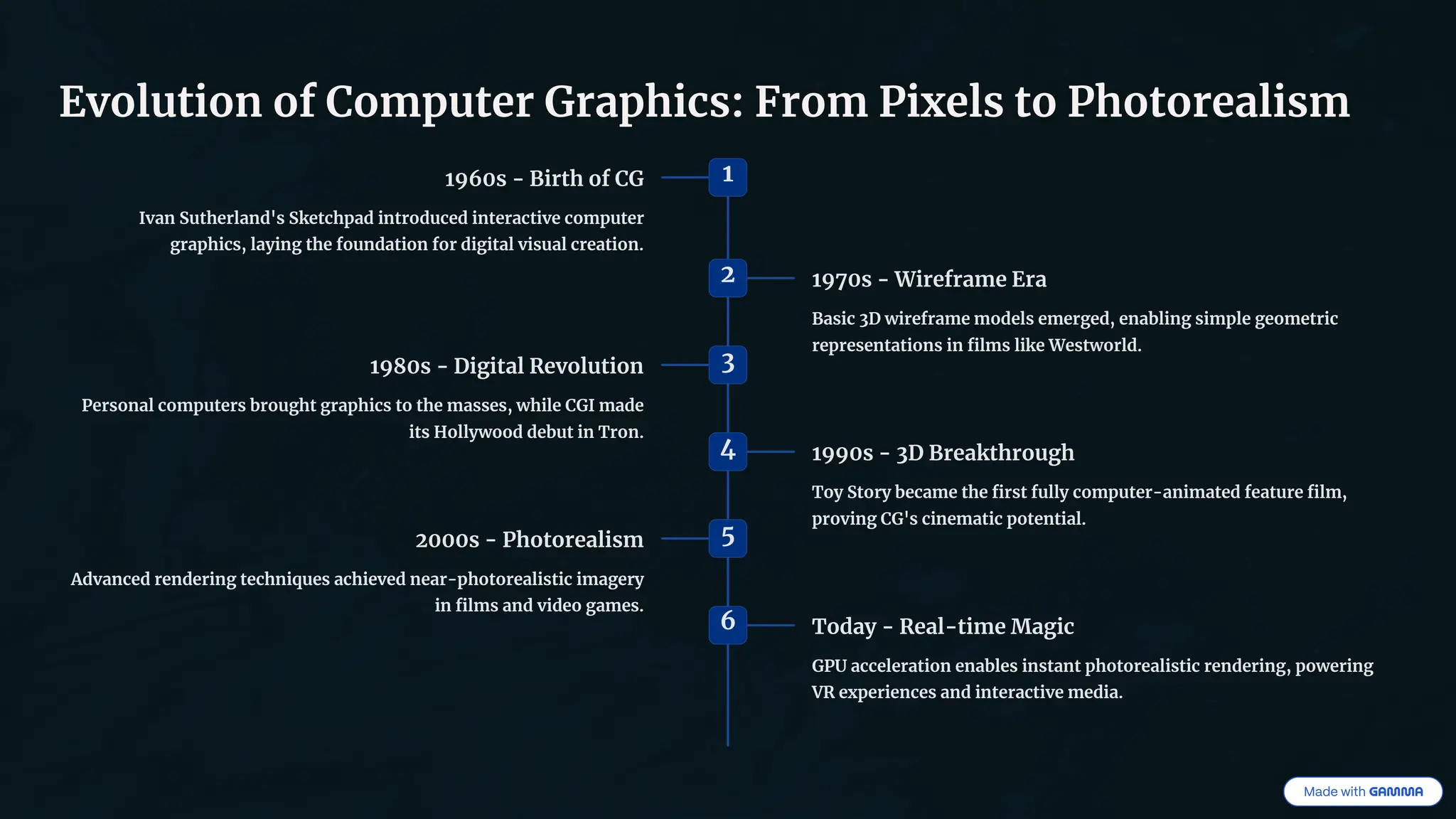
Evolution of ComputerGraphics: From Pixels to Photorealism
1
1960s - Birth of CG
Ivan Sutherland's Sketchpad introduced interactive computer
graphics, laying the foundation for digital visual creation.
2 1970s - Wireframe Era
Basic 3D wireframe models emerged, enabling simple geometric
representations in films like Westworld.
3
1980s - Digital Revolution
Personal computers brought graphics to the masses, while CGI made
its Hollywood debut in Tron.
4 1990s - 3D Breakthrough
Toy Story became the first fully computer-animated feature film,
proving CG's cinematic potential.
5
2000s - Photorealism
Advanced rendering techniques achieved near-photorealistic imagery
in films and video games.
6 Today - Real-time Magic
GPU acceleration enables instant photorealistic rendering, powering
VR experiences and interactive media.
3.
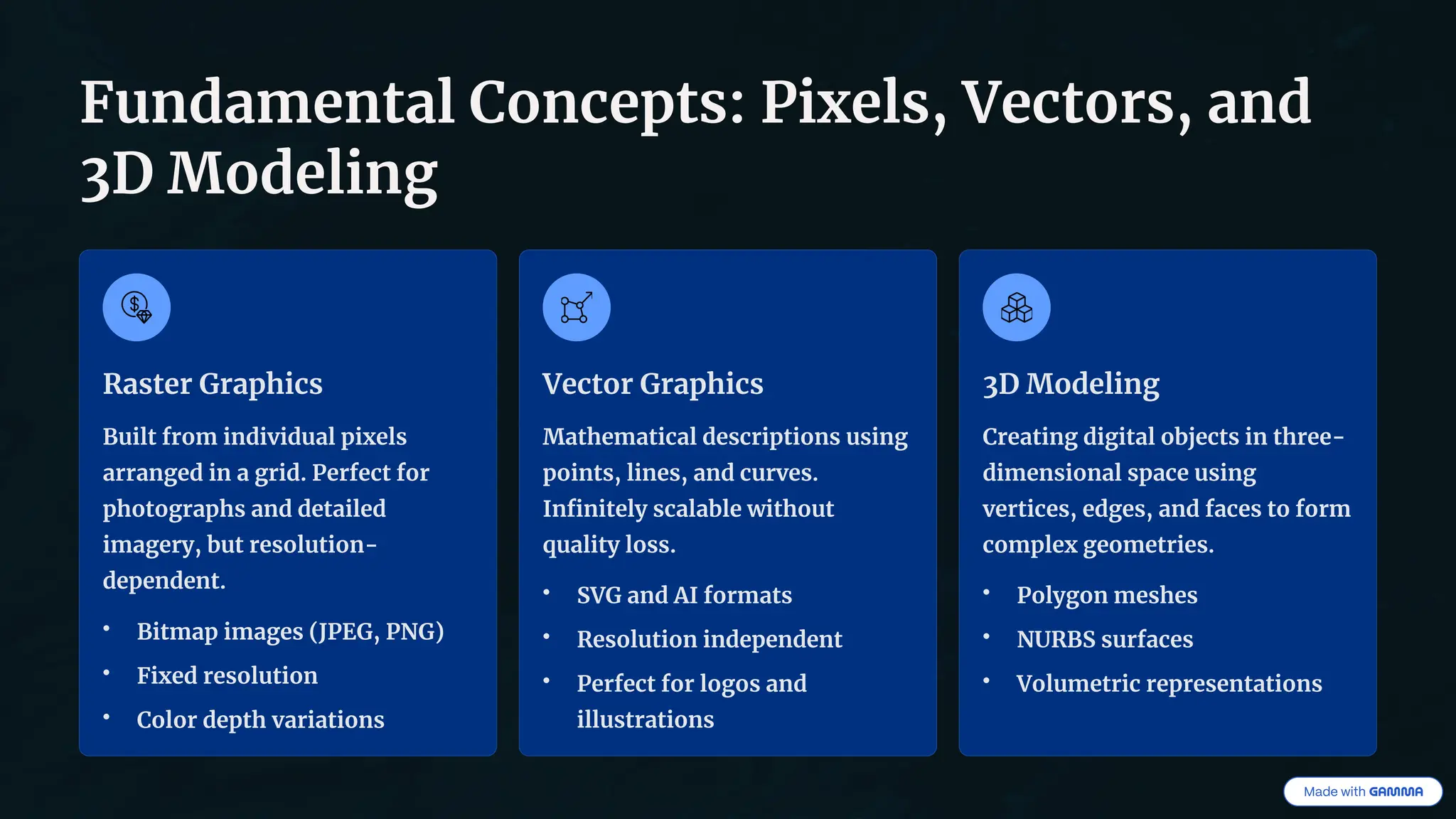
Fundamental Concepts: Pixels,Vectors, and
3D Modeling
Raster Graphics
Built from individual pixels
arranged in a grid. Perfect for
photographs and detailed
imagery, but resolution-
dependent.
• Bitmap images (JPEG, PNG)
• Fixed resolution
• Color depth variations
Vector Graphics
Mathematical descriptions using
points, lines, and curves.
Infinitely scalable without
quality loss.
• SVG and AI formats
• Resolution independent
• Perfect for logos and
illustrations
3D Modeling
Creating digital objects in three-
dimensional space using
vertices, edges, and faces to form
complex geometries.
• Polygon meshes
• NURBS surfaces
• Volumetric representations
4.
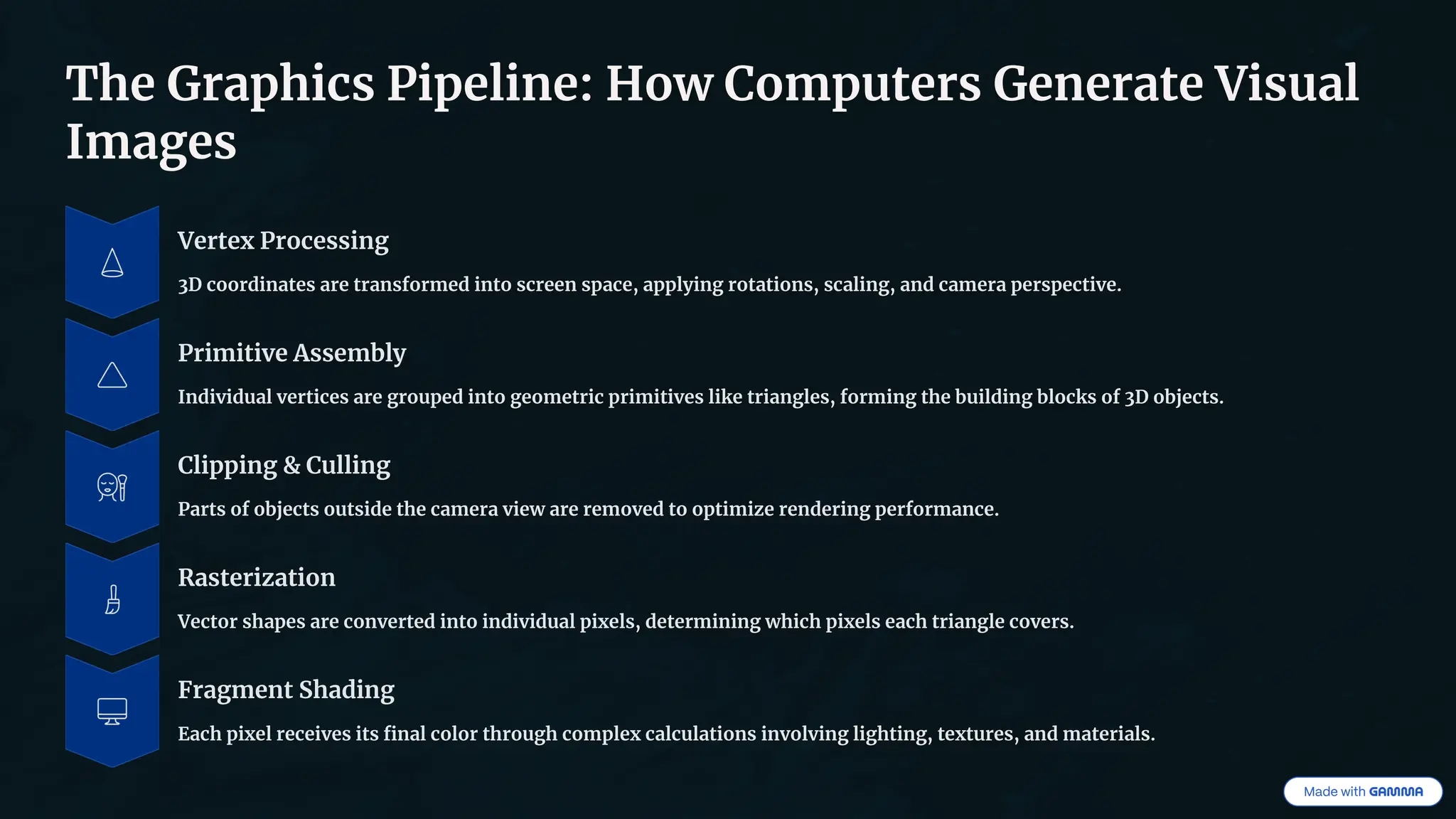
The Graphics Pipeline:How Computers Generate Visual
Images
Vertex Processing
3D coordinates are transformed into screen space, applying rotations, scaling, and camera perspective.
Primitive Assembly
Individual vertices are grouped into geometric primitives like triangles, forming the building blocks of 3D objects.
Clipping & Culling
Parts of objects outside the camera view are removed to optimize rendering performance.
Rasterization
Vector shapes are converted into individual pixels, determining which pixels each triangle covers.
Fragment Shading
Each pixel receives its final color through complex calculations involving lighting, textures, and materials.
5.
Rendering Techniques: CreatingRealistic Light and Shadows
1
Ray Tracing
Simulates the physical behavior of light by tracing rays from the camera through
each pixel, calculating reflections, refractions, and shadows with stunning accuracy.
2
Rasterization
Projects 3D objects onto a 2D screen using mathematical approximations. Faster
than ray tracing but less physically accurate.
3
Global Illumination
Calculates how light bounces between surfaces, creating realistic ambient lighting
and color bleeding effects throughout a scene.
4
Subsurface Scattering
Simulates light penetrating translucent materials like skin or wax, creating the soft,
realistic glow essential for lifelike characters.
Modern rendering combines multiple techniques to achieve
photorealism, balancing quality with computational
efficiency.
6.
Animation Principles: BringingDigital Objects to Life
Timing & Spacing
Controls the speed and rhythm of movement. Proper timing creates
believable physics, while spacing determines the smoothness of motion
between keyframes.
Squash & Stretch
Deforms objects to show impact and flexibility. A bouncing ball
compresses on impact and elongates during motion, adding life to rigid
geometry.
Rigging Systems
Digital skeletons control complex models. Bones, joints, and constraints
allow animators to pose characters naturally while maintaining realistic
deformation.
Keyframe Interpolation
Computer-generated in-between frames smooth the transition between
animator-defined poses, creating fluid motion from sparse control
points.
7.
Real-World Applications: Gaming,Film, and
Scientific Visualization
Video Game Industry
Real-time rendering
powers immersive gaming
experiences, from mobile
games to AAA console
titles. Advanced
techniques like temporal
upscaling and ray tracing
bring cinema-quality
visuals to interactive
entertainment.
Film & Entertainment
Hollywood relies on CG for
everything from subtle
digital makeup to entire
fantasy worlds. Motion
capture and AI-assisted
animation create
believable digital humans
and creatures.
Scientific Research
Researchers visualize
complex data through
interactive 3D models,
from molecular structures
to climate simulations.
Computer graphics makes
invisible phenomena
comprehensible and
shareable.
Architecture & Design
Architects and designers
create photorealistic
previews of unbuilt
structures, enabling
clients to experience
spaces before construction
begins and iterate on
designs efficiently.
8.
Emerging Technologies: VR,AR, and
Real-Time Graphics
Virtual Reality
Immersive 3D environments require ultra-
low latency rendering at 90+ FPS to
prevent motion sickness. Foveated
rendering optimizes performance by
reducing quality in peripheral vision.
• Stereoscopic rendering
• Head tracking integration
• Spatial audio synchronization
Augmented Reality
Overlays digital content onto the real
world using computer vision and sensor
fusion. SLAM (Simultaneous Localization
and Mapping) enables persistent virtual
objects in physical spaces.
• Real-time object tracking
• Occlusion handling
• Environmental lighting estimation
Real-Time Ray Tracing
Hardware acceleration makes cinema-quality lighting possible in interactive applications.
RTX and RDNA2 architectures dedicate silicon to ray-triangle intersection calculations.
• Hardware-accelerated BVH traversal
• Denoising algorithms
• Hybrid rendering pipelines
9.
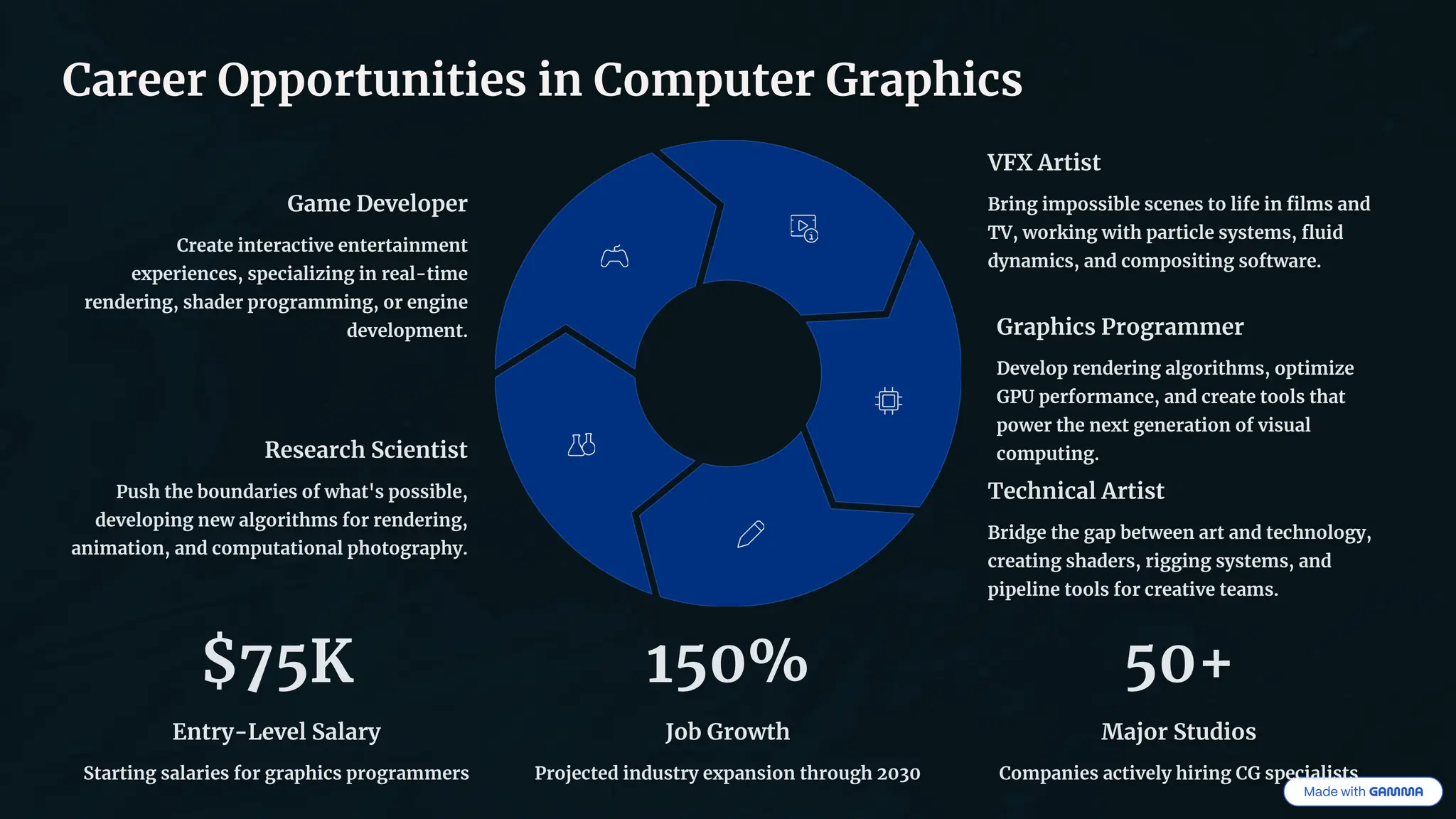
Career Opportunities inComputer Graphics
Game Developer
Create interactive entertainment
experiences, specializing in real-time
rendering, shader programming, or engine
development.
VFX Artist
Bring impossible scenes to life in films and
TV, working with particle systems, fluid
dynamics, and compositing software.
Graphics Programmer
Develop rendering algorithms, optimize
GPU performance, and create tools that
power the next generation of visual
computing.
Technical Artist
Bridge the gap between art and technology,
creating shaders, rigging systems, and
pipeline tools for creative teams.
Research Scientist
Push the boundaries of what's possible,
developing new algorithms for rendering,
animation, and computational photography.
$75K
Entry-Level Salary
Starting salaries for graphics programmers
150%
Job Growth
Projected industry expansion through 2030
50+
Major Studios
Companies actively hiring CG specialists
10.
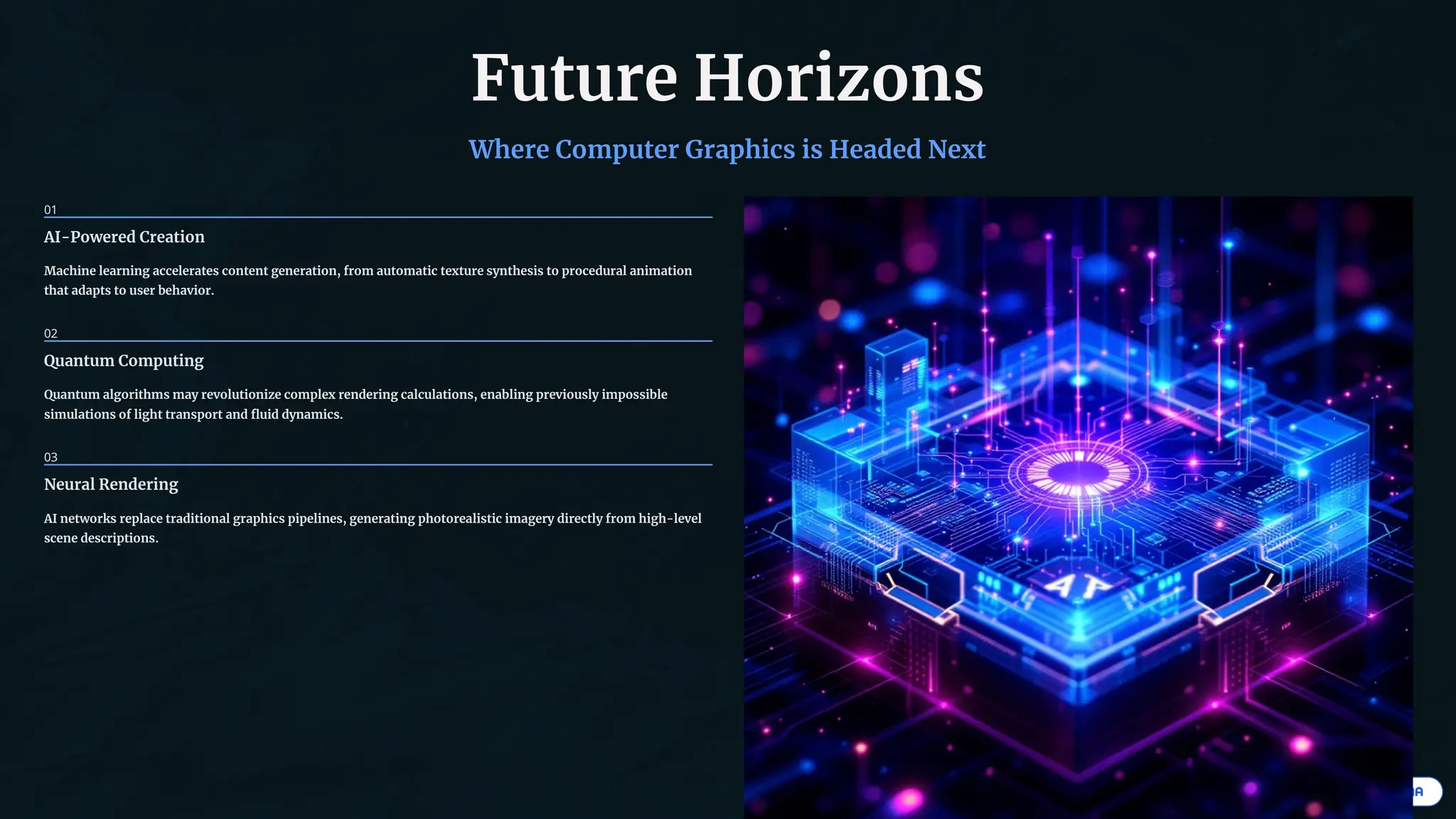
Future Horizons
Where ComputerGraphics is Headed Next
01
AI-Powered Creation
Machine learning accelerates content generation, from automatic texture synthesis to procedural animation
that adapts to user behavior.
02
Quantum Computing
Quantum algorithms may revolutionize complex rendering calculations, enabling previously impossible
simulations of light transport and fluid dynamics.
03
Neural Rendering
AI networks replace traditional graphics pipelines, generating photorealistic imagery directly from high-level
scene descriptions.