MPEG Immersive Media
Thomas Stockhammer (Qualcomm Incorporated)
On behalf of MPEG
MPEG
2
• Organized under ISO/IEC
• Some joint work with ITU-T, e.g.
HEVC
• Participants are accredited by their
national organization, i.e. country
• Development of specifications
follows a due process structure;
voting conducted by country
• Usually meets 3-4 times per year;
roughly 400 experts attend each
meeting
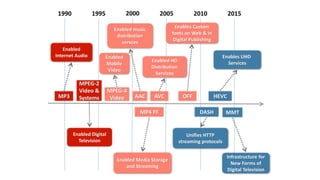
MP20 Standardisation Roadmap
1990 2000 20101995 2005 2015
MP3
MPEG-2
Video &
Systems AVC HEVC
MP4 FF MMTDASH
AAC
Enabled
Internet Audio
Enabled Digital
Television
Enabled music
distribution
servces
Enabled Media Storage
and Streaming
Enables UHD
Services
Infrastructure for
New Forms of
Digital Television
Unifies HTTP
streaming protocols
OFF
Enabled HD
Distribution
Services
Enabled
Mobile
Video
Enables Custom
fonts on Web & in
Digital Publishing
MPEG-4
Video
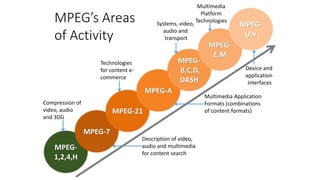
MPEG-
1,2,4,H
MPEG-7
MPEG-21
MPEG-A
MPEG-
B,C,D,
DASH
MPEG-
E,M
MPEG-
U,V
MPEG’s Areas
of Activity
Compression of
video, audio
and 3DG
Description of video,
audio and multimedia
for content search
Technologies
for content e-
commerce
Multimedia Application
Formats (combinations
of content formats)
Systems, video,
audio and
transport
Multimedia
Platform
Technologies
Device and
application
interfaces
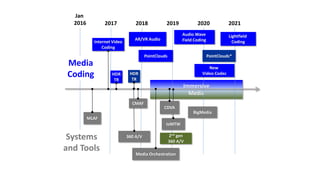
Immersive
Media
Media
Coding
Jan
2016 2018 20202017 2019 2021
Internet Video
Coding
360 A/V
BigMedia
IoMTW
Media Orchestration
HDR
TR
MLAF
Audio Wave
Field Coding
CMAF
Lightfield
Coding
PointClouds*
CDVA
New
Video Codec
AR/VR Audio
PointClouds
HDR
TR
Systems
and Tools
2nd gen
360 A/V
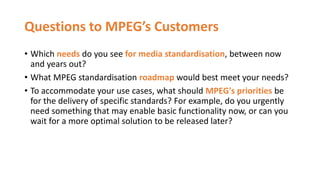
Questions to MPEG’s Customers
• Which needs do you see for media standardisation, between now
and years out?
• What MPEG standardisation roadmap would best meet your needs?
• To accommodate your use cases, what should MPEG's priorities be
for the delivery of specific standards? For example, do you urgently
need something that may enable basic functionality now, or can you
wait for a more optimal solution to be released later?
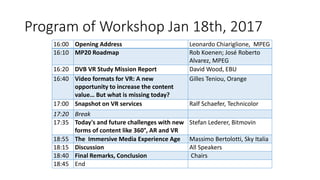
Program of Workshop Jan 18th, 2017
16:00 Opening Address Leonardo Chiariglione, MPEG
16:10 MP20 Roadmap Rob Koenen; José Roberto
Alvarez, MPEG
16:20 DVB VR Study Mission Report David Wood, EBU
16:40 Video formats for VR: A new
opportunity to increase the content
value… But what is missing today?
Gilles Teniou, Orange
17:00 Snapshot on VR services Ralf Schaefer, Technicolor
17:20 Break
17:35 Today's and future challenges with new
forms of content like 360°, AR and VR
Stefan Lederer, Bitmovin
18:55 The Immersive Media Experience Age Massimo Bertolotti, Sky Italia
18:15 Discussion All Speakers
18:40 Final Remarks, Conclusion Chairs
18:45 End
9© Cable Television Laboratories, Inc. 2016. All Rights Reserved.
Virtual Reality is a rendered
environment (visual and
acoustic, pre-dominantly
real-world) providing an
immersive experience to a
user who can interact with it
in a seemingly real or
physical way using special
electronic equipment (e.g.
display, audio rendering and
sensors/actuators)*
*MPEG’s definition).
9
What is virtual reality?
10© Cable Television Laboratories, Inc. 2016. All Rights Reserved.
Elements of VR from MPEG point of view
11© Cable Television Laboratories, Inc. 2016. All Rights Reserved.
• Single view
• Multiple view 3 DoF
• Multiple view with
continuous parallax +
6 DoF
11
360° degree video
12© Cable Television Laboratories, Inc. 2016. All Rights Reserved.
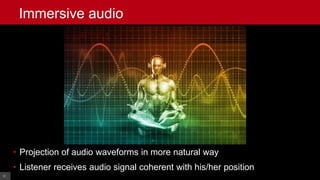
• Projection of audio waveforms in more natural way
• Listener receives audio signal coherent with his/her position
12
Immersive audio
13© Cable Television Laboratories, Inc. 2016. All Rights Reserved.13
Signaling and carriage of a/v media
Summary of MPEG VR
Questionnaire Results
Introduction
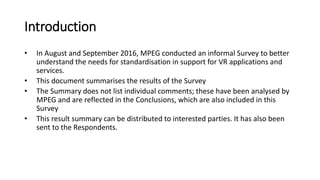
• In August and September 2016, MPEG conducted an informal Survey to better
understand the needs for standardisation in support for VR applications and
services.
• This document summarises the results of the Survey
• The Summary does not list individual comments; these have been analysed by
MPEG and are reflected in the Conclusions, which are also included in this
Survey
• This result summary can be distributed to interested parties. It has also been
sent to the Respondents.
Instructions given to respondents
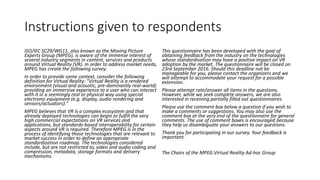
ISO/IEC SC29/WG11, also known as the Moving Picture
Experts Group (MPEG), is aware of the immense interest of
several industry segments in content, services and products
around Virtual Reality (VR). In order to address market needs,
MPEG has create the following survey.
In order to provide some context, consider the following
definition for Virtual Reality: "Virtual Reality is a rendered
environment (visual and acoustic, pre-dominantly real-world)
providing an immersive experience to a user who can interact
with it in a seemingly real or physical way using special
electronic equipment (e.g. display, audio rendering and
sensors/actuators)."
MPEG believes that VR is a complex ecosystem and that
already deployed technologies can begin to fulfill the very
high commercial expectations on VR services and
applications, but standards-based interoperability for certain
aspects around VR is required. Therefore MPEG is in the
process of identifying those technologies that are relevant to
market success in order to define an appropriate
standardization roadmap. The technologies considered
include, but are not restricted to, video and audio coding and
compression, metadata, storage formats and delivery
mechanisms.
This questionnaire has been developed with the goal of
obtaining feedback from the industry on the technologies
whose standardisation may have a positive impact on VR
adoption by the market. The questionnaire will be closed on
23rd September 2016. Should this deadline not be
manageable for you, please contact the organizers and we
will attempt to accommodate your request for a possible
extension.
Please attempt rate/answer all items in the questions.
However, while we seek complete answers, we are also
interested in receiving partially filled out questionnaires.
Please use the comment box below a question if you wish to
make a comments or suggestions. You may also use the
comment box at the very end of the questionnaire for general
comments. The use of comment boxes is encouraged because
they help us disambiguate your answers to our questions.
Thank you for participating in our survey. Your feedback is
important.
The Chairs of the MPEG Virtual Reality Ad-hoc Group
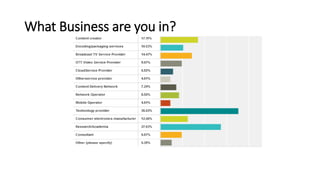
What Business are you in?
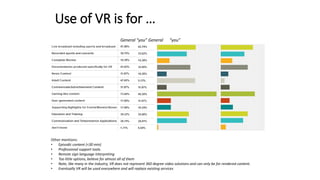
Use of VR is for …
Other mentions:
• Episodic content (<30 min)
• Professional support tools.
• Remote sign language interpreting
• Too little options, believe for almost all of them
• Note, like many in the industry, VR does not represent 360 degree video solutions and can only be for rendered content.
• Eventually VR will be used everywhere and will replace existing services
General “you” General “you”
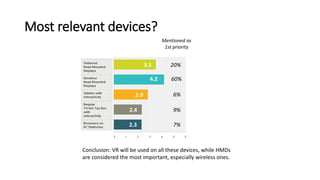
Most relevant devices?
3.5
4.2
2.9
2.4
2.3
Conclusion: VR will be used on all these devices, while HMDs
are considered the most important, especially wireless ones.
Mentioned as
1st priority
20%
60%
6%
9%
7%
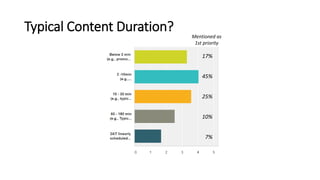
Typical Content Duration?
17%
45%
25%
10%
7%
Mentioned as
1st priority
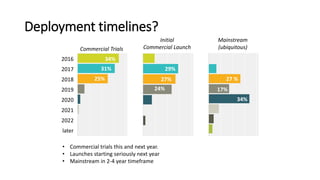
Deployment timelines?
Commercial Trials
Initial
Commercial Launch
Mainstream
(ubiquitous)
2016
2017
2018
2019
2020
2021
2022
later
• Commercial trials this and next year.
• Launches starting seriously next year
• Mainstream in 2-4 year timeframe
34%
31%
25%
29%
27%
24%
27 %
17%
34%
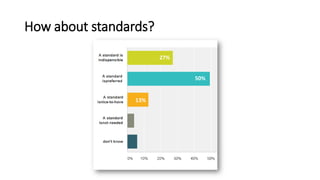
How about standards?
27%
50%
13%
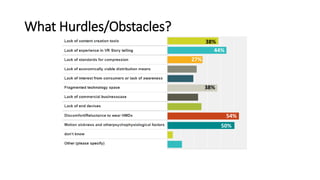
What Hurdles/Obstacles?
54%
50%
38%
44%
38%
27%
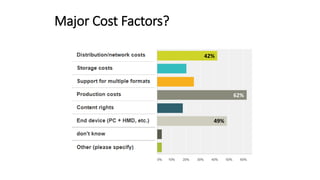
Major Cost Factors?
62%
42%
49%
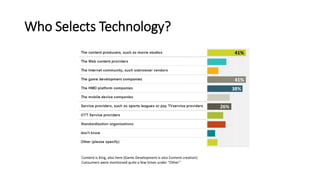
Who Selects Technology?
41%
41%
38%
26%
Content is King, also here (Game Development is also Content creation)
Consumers were mentioned quite a few times under “Other”
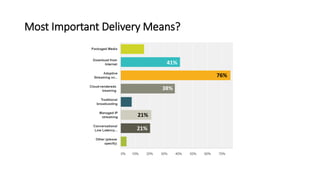
Most Important Delivery Means?
76%
41%
38%
21%
21%
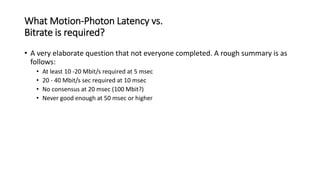
What Motion-Photon Latency vs.
Bitrate is required?
• A very elaborate question that not everyone completed. A rough summary is as
follows:
• At least 10 -20 Mbit/s required at 5 msec
• 20 - 40 Mbit/s sec required at 10 msec
• No consensus at 20 msec (100 Mbit?)
• Never good enough at 50 msec or higher
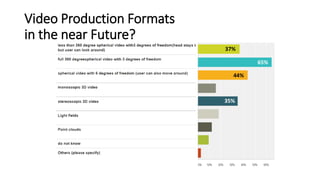
Video Production Formats
in the near Future?
65%
37%
44%
35%
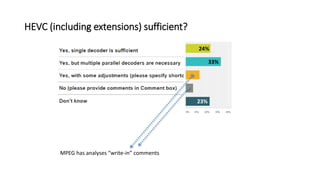
HEVC (including extensions) sufficient?
65%
23%
33%
24%
MPEG has analyses “write-in” comments
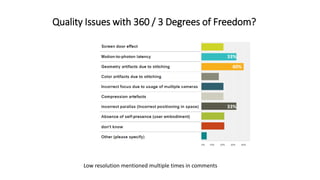
Quality Issues with 360 / 3 Degrees of Freedom?
33%
40%
33%
Low resolution mentioned multiple times in comments
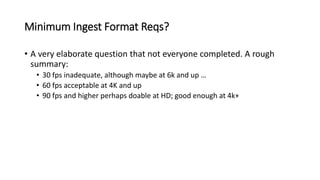
Minimum Ingest Format Reqs?
• A very elaborate question that not everyone completed. A rough
summary:
• 30 fps inadequate, although maybe at 6k and up …
• 60 fps acceptable at 4K and up
• 90 fps and higher perhaps doable at HD; good enough at 4k+
Minimum Reqs per Eye?
• A very elaborate question that not everyone completed. A rough
summary:
• 30 fps never good enough, well, maybe at 8k and up?
• 60 fps usable at 4k and up
• 90 fps and higher clearly usable at 4k and up, but not at HD
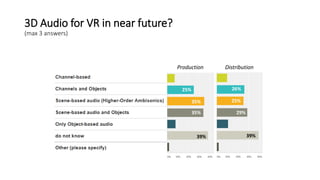
3D Audio for VR in near future?
(max 3 answers)
35%
39%
35%
25%
Production Distribution
29%
39%
25%
26%
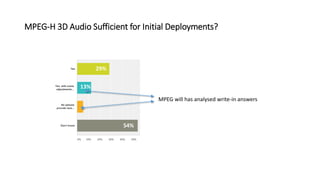
MPEG-H 3D Audio Sufficient for Initial Deployments?
29%
54%
13%
MPEG will has analysed write-in answers
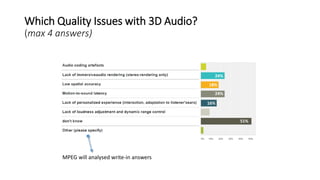
Which Quality Issues with 3D Audio?
(max 4 answers)
24%
24%
16%
18%
51%
MPEG will analysed write-in answers
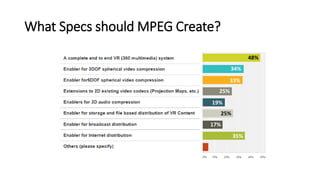
What Specs should MPEG Create?
48%
35%
34%
33%
25%
19%
25%
17%
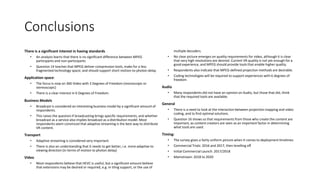
Conclusions
There is a significant interest in having standards
• An analysis learns that there is no significant difference between MPEG
participants and non-participants
• Question 14 teaches that MPEG deliver compression tools, make for a less
fragmented technology space; and should support short motion-to-photon delay
Application space:
• The focus is now on 360 Video with 3 Degrees of Freedom (monoscopic or
stereoscopic)
• There is a clear interest in 6 Degrees of Freedom.
Business Models
• Broadcast is considered an interesting business model by a significant amount of
respondents.
• This raises the question if broadcasting brings specific requirements, and whether
broadcast as a service also implies broadcast as a distribution model. Most
respondents seem convinced that adaptive streaming is the best way to distribute
VR content.
Transport
• Adaptive streaming is considered very important
• There is also an understanding that it needs to get better, i.e. more adaptive to
viewing direction (in terms of motion to photon delay)
Video
• Most respondents believe that HEVC is useful, but a significant amount believe
that extensions may be desired or required, e.g. in tiling support, or the use of
multiple decoders.
• No clear picture emerges on quality requirements for video, although it is clear
that very high resolutions are desired. Current VR quality is not yet enough for a
good experience, and MPEG should provide tools that enable higher quality.
• Respondents also indicate that MPEG-defined projection methods are desirable.
• Coding technologies will be required to support experiences with 6 degrees of
freedom
Audio
• Many respondents did not have an opinion on Audio, but those that did, think
that the required tools are available.
General
• There is a need to look at the interaction between projection mapping and video
coding, and to find optimal solutions.
• Question 16 shows us that requirements from those who create the content are
important, as content creators are seen as an important factor in determining
what tools are used.
Timing:
• The survey gives a fairly uniform picture when it comes to deployment timelines:
• Commercial Trials: 2016 and 2017, then levelling off
• Initial Commercial Launch: 2017/2018
• Mainstream: 2018 to 2020
MPEG-i Project
Immersive Media in MPEG
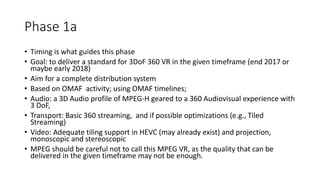
Phase 1a
• Timing is what guides this phase
• Goal: to deliver a standard for 3DoF 360 VR in the given timeframe (end 2017 or
maybe early 2018)
• Aim for a complete distribution system
• Based on OMAF activity; using OMAF timelines;
• Audio: a 3D Audio profile of MPEG-H geared to a 360 Audiovisual experience with
3 DoF,
• Transport: Basic 360 streaming, and if possible optimizations (e.g., Tiled
Streaming)
• Video: Adequate tiling support in HEVC (may already exist) and projection,
monoscopic and stereoscopic
• MPEG should be careful not to call this MPEG VR, as the quality that can be
delivered in the given timeframe may not be enough.
Phase 1b
• Mainly motivated by desire by a significant part of respondents to launch
commercial services in 2020
• deploy in 2020; spec ready in 2019, (which may match 5G deployments)
• Extension of 1a; focus very likely still on VR 360 with 3 DoF (again
monoscopic and stereoscopic)
• If there are elements that could not be included in phase 1a, improving
quality – it is not a foregone conclusion that there will be a phase 1b, and if
there is such a phase, it is to be further defined what this would comprise
• E.g., optimization in projection mapping
• E.g., further motion-to-photon delay reductions
• Optimizations for person-to-person communications
• Phase 1b should have some quality definition and verification
Phase 2
• A specification that is ready in 2021 or maybe 2022
• This would be a “native” VR spec (“MPEG VR”)
• Goal is support for 6 DoF
• Most important element probably new video codec with support for
6 DoF; to be decided by Video Group what tools are most suitable
• Audio support for 6 degrees of freedom
• Systems elements perhaps required too in support of 6 DoF, as well as
3D graphics.
Phase 1 Baseline Technology
Omni-directional Media Application Format and others
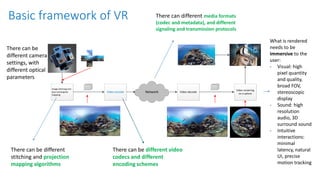
Image stitching and
equi-rectangular
mapping
Video encode Network Video decode
Video rendering
on a sphere
Basic framework of VR There can different media formats
(codec and metadata), and different
signaling and transmission protocols
There can be
different camera
settings, with
different optical
parameters
What is rendered
needs to be
immersive to the
user:
- Visual: high
pixel quantity
and quality,
broad FOV,
stereoscopic
display
- Sound: high
resolution
audio, 3D
surround sound
- Intuitive
interactions:
minimal
latency, natural
UI, precise
motion tracking
There can be different
stitching and projection
mapping algorithms
There can be different video
codecs and different
encoding schemes
Work already underway or completed
• Omni-directional Media Format
• DASH extensions for streaming VR and signaling ROI
• HEVC enhanced for flexible tiling
• Experiments for 360° stereo + 3 DoF video
• Audio completed for 3 DoF
• Experiments for many formats of projection mappings and
necessary signaling
44
• Will probably be the first industry standard on virtual reality (VR)
• MPEG started looking at VR and started the OMAF project in Oct. 2015
• Technical proposals started in Feb. 2016
• First working draft (WD) as an output of the Jun. 2016 MPEG meeting
• CD after Jan 2017 MPEG meeting, FDIS late 2017
OMAF – when
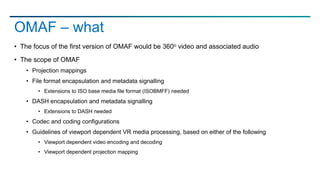
• The focus of the first version of OMAF would be 360o video and associated audio
• The scope of OMAF
• Projection mappings
• File format encapsulation and metadata signalling
• Extensions to ISO base media file format (ISOBMFF) needed
• DASH encapsulation and metadata signalling
• Extensions to DASH needed
• Codec and coding configurations
• Guidelines of viewport dependent VR media processing, based on either of the following
• Viewport dependent video encoding and decoding
• Viewport dependent projection mapping
OMAF – what
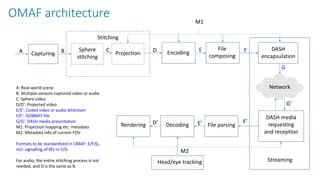
Capturing Encoding
DASH media
requesting
and reception
Network
Head/eye tracking
Sphere
stitching
Projection
File
composing
BA DC E DASH
encapsulation
F
File parsingDecoding E’ F’
Rendering D’
Stitching
M2
M1
G
G’
Streaming
A: Real-world scene
B: Multiple-sensors-captured video or audio
C: Sphere video
D/D’: Projected video
E/E’: Coded video or audio bitstream
F/F’: ISOBMFF file
G/G’: DASH media presentation
M1: Projection mapping etc. metadata
M2: Metadata info of current FOV
Formats to be standardized in OMAF: E/F/G,
incl. signalling of M1 in F/G.
For audio, the entire stitching process is not
needed, and D is the same as B.
OMAF architecture
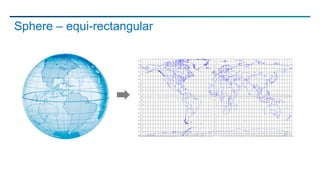
Sphere – equi-rectangular
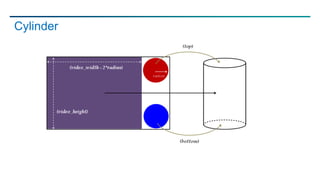
Cylinder
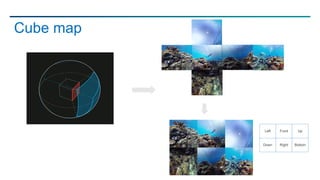
Cube map
Left Front Up
Down Right Bottom
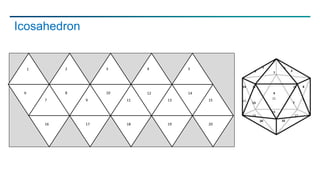
Icosahedron
1
⑤
2
8 12
11
16
14
13
6
7 9
10
3
15
17 18
1 2
34
5
6
7
8
9
10
11
12
13
14
15
16
17
18
19
20
⑤
4 5
19 20
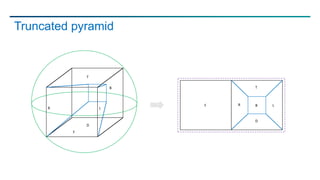
Truncated pyramid
F
R L
T
D
B
F B
D
R
T
L
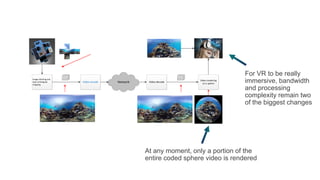
Image stitching and
equi-rectangular
mapping
Video encode Network Video decode
Video rendering
on a sphere
At any moment, only a portion of the
entire coded sphere video is rendered
For VR to be really
immersive, bandwidth
and processing
complexity remain two
of the biggest changes
Viewport dependent video processing
• To tackle the bandwidth and processing complexity challenges
• To utilize the fact that only a part of entire encoded sphere video is
rendered at any moment
• Two areas can be played with to reduce needed bandwidth and to
reduce video decoding complexity
• To play with (viewport dependent) video encoding, transmission, and
decoding
• To play with a viewport dependent projection mapping scheme
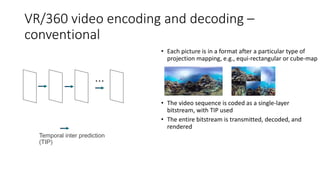
VR/360 video encoding and decoding –
conventional
• Each picture is in a format after a particular type of
projection mapping, e.g., equi-rectangular or cube-map
• The video sequence is coded as a single-layer
bitstream, with TIP used
• The entire bitstream is transmitted, decoded, and
rendered
…
Temporal inter prediction
(TIP)
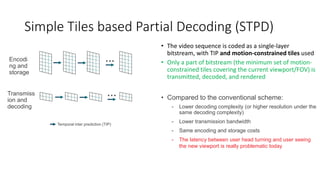
Simple Tiles based Partial Decoding (STPD)
• The video sequence is coded as a single-layer
bitstream, with TIP and motion-constrained tiles used
• Only a part of bitstream (the minimum set of motion-
constrained tiles covering the current viewport/FOV) is
transmitted, decoded, and rendered
• Compared to the conventional scheme:
- Lower decoding complexity (or higher resolution under the
same decoding complexity)
- Lower transmission bandwidth
- Same encoding and storage costs
- The latency between user head turning and user seeing
the new viewport is really problematic today
Transmiss
ion and
decoding
Temporal inter prediction (TIP)
…Encodi
ng and
storage
…
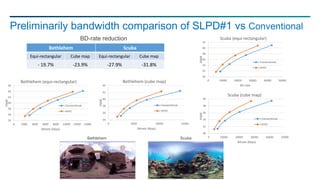
Preliminarily bandwidth comparison of SLPD#1 vs Conventional
Bethlehem Scuba
Equi-rectangular Cube map Equi-rectangular Cube map
- 19.7% -23.9% -27.9% -31.8%
BD-rate reduction
30
32
34
36
38
40
0 10000 20000 30000 40000 50000
PSNR
Bitrate (kbps)
Scuba (cube map)
Conventional
SHVC
30
32
34
36
38
40
42
0 10000 20000 30000 40000 50000
PSNR
Bit-rate
Scuba (equi-rectangular)
Conventional
SHVC
34
36
38
40
42
44
0 5000 10000 15000
PSNR
Bitrate (kbps)
Bethlehem (cube map)
Conventional
SHVC
34
36
38
40
42
44
46
0 2000 4000 6000 8000 10000 12000 14000
PSNR
Bitrate (kbps)
Bethlehem (equi-rectangular)
Conventional
SHVC
ScubaBethlehem
Elements of Phase 2
Studies, Exploration, etc.
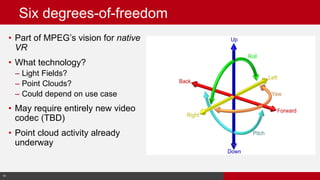
59© Cable Television Laboratories, Inc. 2016. All Rights Reserved.
• Part of MPEG’s vision for native
VR
• What technology?
– Light Fields?
– Point Clouds?
– Could depend on use case
• May require entirely new video
codec (TBD)
• Point cloud activity already
underway
59
Six degrees-of-freedom
60© Cable Television Laboratories, Inc. 2016. All Rights Reserved.
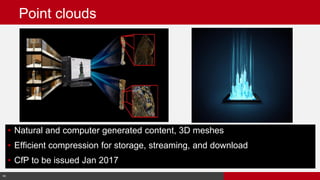
• Natural and computer generated content, 3D meshes
• Efficient compression for storage, streaming, and download
• CfP to be issued Jan 2017
60
Point clouds
61© Cable Television Laboratories, Inc. 2016. All Rights Reserved.
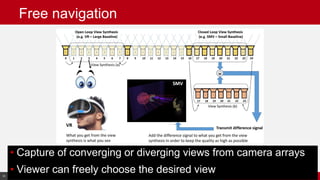
• Capture of converging or diverging views from camera arrays
• Viewer can freely choose the desired view61
Free navigation
62© Cable Television Laboratories, Inc. 2016. All Rights Reserved.
• Future light field head mounted
displays
• Free navigation, e.g. sporting
events
• Full coherent parallax
• Super multi-view display or
light field display
62
Goals and devices for light fields
63© Cable Television Laboratories, Inc. 2016. All Rights Reserved.
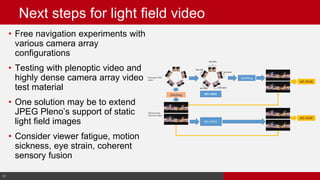
• Free navigation experiments with
various camera array
configurations
• Testing with plenoptic video and
highly dense camera array video
test material
• One solution may be to extend
JPEG Pleno’s support of static
light field images
• Consider viewer fatigue, motion
sickness, eye strain, coherent
sensory fusion
63
Next steps for light field video
Thank you

MPEG Immersive Media

  • 1.
    MPEG Immersive Media ThomasStockhammer (Qualcomm Incorporated) On behalf of MPEG
  • 2.
    MPEG 2 • Organized underISO/IEC • Some joint work with ITU-T, e.g. HEVC • Participants are accredited by their national organization, i.e. country • Development of specifications follows a due process structure; voting conducted by country • Usually meets 3-4 times per year; roughly 400 experts attend each meeting
  • 3.
  • 4.
    1990 2000 201019952005 2015 MP3 MPEG-2 Video & Systems AVC HEVC MP4 FF MMTDASH AAC Enabled Internet Audio Enabled Digital Television Enabled music distribution servces Enabled Media Storage and Streaming Enables UHD Services Infrastructure for New Forms of Digital Television Unifies HTTP streaming protocols OFF Enabled HD Distribution Services Enabled Mobile Video Enables Custom fonts on Web & in Digital Publishing MPEG-4 Video
  • 5.
    MPEG- 1,2,4,H MPEG-7 MPEG-21 MPEG-A MPEG- B,C,D, DASH MPEG- E,M MPEG- U,V MPEG’s Areas of Activity Compressionof video, audio and 3DG Description of video, audio and multimedia for content search Technologies for content e- commerce Multimedia Application Formats (combinations of content formats) Systems, video, audio and transport Multimedia Platform Technologies Device and application interfaces
  • 6.
    Immersive Media Media Coding Jan 2016 2018 202020172019 2021 Internet Video Coding 360 A/V BigMedia IoMTW Media Orchestration HDR TR MLAF Audio Wave Field Coding CMAF Lightfield Coding PointClouds* CDVA New Video Codec AR/VR Audio PointClouds HDR TR Systems and Tools 2nd gen 360 A/V
  • 7.
    Questions to MPEG’sCustomers • Which needs do you see for media standardisation, between now and years out? • What MPEG standardisation roadmap would best meet your needs? • To accommodate your use cases, what should MPEG's priorities be for the delivery of specific standards? For example, do you urgently need something that may enable basic functionality now, or can you wait for a more optimal solution to be released later?
  • 8.
    Program of WorkshopJan 18th, 2017 16:00 Opening Address Leonardo Chiariglione, MPEG 16:10 MP20 Roadmap Rob Koenen; José Roberto Alvarez, MPEG 16:20 DVB VR Study Mission Report David Wood, EBU 16:40 Video formats for VR: A new opportunity to increase the content value… But what is missing today? Gilles Teniou, Orange 17:00 Snapshot on VR services Ralf Schaefer, Technicolor 17:20 Break 17:35 Today's and future challenges with new forms of content like 360°, AR and VR Stefan Lederer, Bitmovin 18:55 The Immersive Media Experience Age Massimo Bertolotti, Sky Italia 18:15 Discussion All Speakers 18:40 Final Remarks, Conclusion Chairs 18:45 End
  • 9.
    9© Cable TelevisionLaboratories, Inc. 2016. All Rights Reserved. Virtual Reality is a rendered environment (visual and acoustic, pre-dominantly real-world) providing an immersive experience to a user who can interact with it in a seemingly real or physical way using special electronic equipment (e.g. display, audio rendering and sensors/actuators)* *MPEG’s definition). 9 What is virtual reality?
  • 10.
    10© Cable TelevisionLaboratories, Inc. 2016. All Rights Reserved. Elements of VR from MPEG point of view
  • 11.
    11© Cable TelevisionLaboratories, Inc. 2016. All Rights Reserved. • Single view • Multiple view 3 DoF • Multiple view with continuous parallax + 6 DoF 11 360° degree video
  • 12.
    12© Cable TelevisionLaboratories, Inc. 2016. All Rights Reserved. • Projection of audio waveforms in more natural way • Listener receives audio signal coherent with his/her position 12 Immersive audio
  • 13.
    13© Cable TelevisionLaboratories, Inc. 2016. All Rights Reserved.13 Signaling and carriage of a/v media
  • 14.
    Summary of MPEGVR Questionnaire Results
  • 15.
    Introduction • In Augustand September 2016, MPEG conducted an informal Survey to better understand the needs for standardisation in support for VR applications and services. • This document summarises the results of the Survey • The Summary does not list individual comments; these have been analysed by MPEG and are reflected in the Conclusions, which are also included in this Survey • This result summary can be distributed to interested parties. It has also been sent to the Respondents.
  • 16.
    Instructions given torespondents ISO/IEC SC29/WG11, also known as the Moving Picture Experts Group (MPEG), is aware of the immense interest of several industry segments in content, services and products around Virtual Reality (VR). In order to address market needs, MPEG has create the following survey. In order to provide some context, consider the following definition for Virtual Reality: "Virtual Reality is a rendered environment (visual and acoustic, pre-dominantly real-world) providing an immersive experience to a user who can interact with it in a seemingly real or physical way using special electronic equipment (e.g. display, audio rendering and sensors/actuators)." MPEG believes that VR is a complex ecosystem and that already deployed technologies can begin to fulfill the very high commercial expectations on VR services and applications, but standards-based interoperability for certain aspects around VR is required. Therefore MPEG is in the process of identifying those technologies that are relevant to market success in order to define an appropriate standardization roadmap. The technologies considered include, but are not restricted to, video and audio coding and compression, metadata, storage formats and delivery mechanisms. This questionnaire has been developed with the goal of obtaining feedback from the industry on the technologies whose standardisation may have a positive impact on VR adoption by the market. The questionnaire will be closed on 23rd September 2016. Should this deadline not be manageable for you, please contact the organizers and we will attempt to accommodate your request for a possible extension. Please attempt rate/answer all items in the questions. However, while we seek complete answers, we are also interested in receiving partially filled out questionnaires. Please use the comment box below a question if you wish to make a comments or suggestions. You may also use the comment box at the very end of the questionnaire for general comments. The use of comment boxes is encouraged because they help us disambiguate your answers to our questions. Thank you for participating in our survey. Your feedback is important. The Chairs of the MPEG Virtual Reality Ad-hoc Group
  • 17.
  • 18.
    Use of VRis for … Other mentions: • Episodic content (<30 min) • Professional support tools. • Remote sign language interpreting • Too little options, believe for almost all of them • Note, like many in the industry, VR does not represent 360 degree video solutions and can only be for rendered content. • Eventually VR will be used everywhere and will replace existing services General “you” General “you”
  • 19.
    Most relevant devices? 3.5 4.2 2.9 2.4 2.3 Conclusion:VR will be used on all these devices, while HMDs are considered the most important, especially wireless ones. Mentioned as 1st priority 20% 60% 6% 9% 7%
  • 20.
  • 21.
    Deployment timelines? Commercial Trials Initial CommercialLaunch Mainstream (ubiquitous) 2016 2017 2018 2019 2020 2021 2022 later • Commercial trials this and next year. • Launches starting seriously next year • Mainstream in 2-4 year timeframe 34% 31% 25% 29% 27% 24% 27 % 17% 34%
  • 22.
  • 23.
  • 24.
  • 25.
    Who Selects Technology? 41% 41% 38% 26% Contentis King, also here (Game Development is also Content creation) Consumers were mentioned quite a few times under “Other”
  • 26.
    Most Important DeliveryMeans? 76% 41% 38% 21% 21%
  • 27.
    What Motion-Photon Latencyvs. Bitrate is required? • A very elaborate question that not everyone completed. A rough summary is as follows: • At least 10 -20 Mbit/s required at 5 msec • 20 - 40 Mbit/s sec required at 10 msec • No consensus at 20 msec (100 Mbit?) • Never good enough at 50 msec or higher
  • 28.
    Video Production Formats inthe near Future? 65% 37% 44% 35%
  • 29.
    HEVC (including extensions)sufficient? 65% 23% 33% 24% MPEG has analyses “write-in” comments
  • 30.
    Quality Issues with360 / 3 Degrees of Freedom? 33% 40% 33% Low resolution mentioned multiple times in comments
  • 31.
    Minimum Ingest FormatReqs? • A very elaborate question that not everyone completed. A rough summary: • 30 fps inadequate, although maybe at 6k and up … • 60 fps acceptable at 4K and up • 90 fps and higher perhaps doable at HD; good enough at 4k+
  • 32.
    Minimum Reqs perEye? • A very elaborate question that not everyone completed. A rough summary: • 30 fps never good enough, well, maybe at 8k and up? • 60 fps usable at 4k and up • 90 fps and higher clearly usable at 4k and up, but not at HD
  • 33.
    3D Audio forVR in near future? (max 3 answers) 35% 39% 35% 25% Production Distribution 29% 39% 25% 26%
  • 34.
    MPEG-H 3D AudioSufficient for Initial Deployments? 29% 54% 13% MPEG will has analysed write-in answers
  • 35.
    Which Quality Issueswith 3D Audio? (max 4 answers) 24% 24% 16% 18% 51% MPEG will analysed write-in answers
  • 36.
    What Specs shouldMPEG Create? 48% 35% 34% 33% 25% 19% 25% 17%
  • 37.
    Conclusions There is asignificant interest in having standards • An analysis learns that there is no significant difference between MPEG participants and non-participants • Question 14 teaches that MPEG deliver compression tools, make for a less fragmented technology space; and should support short motion-to-photon delay Application space: • The focus is now on 360 Video with 3 Degrees of Freedom (monoscopic or stereoscopic) • There is a clear interest in 6 Degrees of Freedom. Business Models • Broadcast is considered an interesting business model by a significant amount of respondents. • This raises the question if broadcasting brings specific requirements, and whether broadcast as a service also implies broadcast as a distribution model. Most respondents seem convinced that adaptive streaming is the best way to distribute VR content. Transport • Adaptive streaming is considered very important • There is also an understanding that it needs to get better, i.e. more adaptive to viewing direction (in terms of motion to photon delay) Video • Most respondents believe that HEVC is useful, but a significant amount believe that extensions may be desired or required, e.g. in tiling support, or the use of multiple decoders. • No clear picture emerges on quality requirements for video, although it is clear that very high resolutions are desired. Current VR quality is not yet enough for a good experience, and MPEG should provide tools that enable higher quality. • Respondents also indicate that MPEG-defined projection methods are desirable. • Coding technologies will be required to support experiences with 6 degrees of freedom Audio • Many respondents did not have an opinion on Audio, but those that did, think that the required tools are available. General • There is a need to look at the interaction between projection mapping and video coding, and to find optimal solutions. • Question 16 shows us that requirements from those who create the content are important, as content creators are seen as an important factor in determining what tools are used. Timing: • The survey gives a fairly uniform picture when it comes to deployment timelines: • Commercial Trials: 2016 and 2017, then levelling off • Initial Commercial Launch: 2017/2018 • Mainstream: 2018 to 2020
  • 38.
  • 39.
    Phase 1a • Timingis what guides this phase • Goal: to deliver a standard for 3DoF 360 VR in the given timeframe (end 2017 or maybe early 2018) • Aim for a complete distribution system • Based on OMAF activity; using OMAF timelines; • Audio: a 3D Audio profile of MPEG-H geared to a 360 Audiovisual experience with 3 DoF, • Transport: Basic 360 streaming, and if possible optimizations (e.g., Tiled Streaming) • Video: Adequate tiling support in HEVC (may already exist) and projection, monoscopic and stereoscopic • MPEG should be careful not to call this MPEG VR, as the quality that can be delivered in the given timeframe may not be enough.
  • 40.
    Phase 1b • Mainlymotivated by desire by a significant part of respondents to launch commercial services in 2020 • deploy in 2020; spec ready in 2019, (which may match 5G deployments) • Extension of 1a; focus very likely still on VR 360 with 3 DoF (again monoscopic and stereoscopic) • If there are elements that could not be included in phase 1a, improving quality – it is not a foregone conclusion that there will be a phase 1b, and if there is such a phase, it is to be further defined what this would comprise • E.g., optimization in projection mapping • E.g., further motion-to-photon delay reductions • Optimizations for person-to-person communications • Phase 1b should have some quality definition and verification
  • 41.
    Phase 2 • Aspecification that is ready in 2021 or maybe 2022 • This would be a “native” VR spec (“MPEG VR”) • Goal is support for 6 DoF • Most important element probably new video codec with support for 6 DoF; to be decided by Video Group what tools are most suitable • Audio support for 6 degrees of freedom • Systems elements perhaps required too in support of 6 DoF, as well as 3D graphics.
  • 42.
    Phase 1 BaselineTechnology Omni-directional Media Application Format and others
  • 43.
    Image stitching and equi-rectangular mapping Videoencode Network Video decode Video rendering on a sphere Basic framework of VR There can different media formats (codec and metadata), and different signaling and transmission protocols There can be different camera settings, with different optical parameters What is rendered needs to be immersive to the user: - Visual: high pixel quantity and quality, broad FOV, stereoscopic display - Sound: high resolution audio, 3D surround sound - Intuitive interactions: minimal latency, natural UI, precise motion tracking There can be different stitching and projection mapping algorithms There can be different video codecs and different encoding schemes
  • 44.
    Work already underwayor completed • Omni-directional Media Format • DASH extensions for streaming VR and signaling ROI • HEVC enhanced for flexible tiling • Experiments for 360° stereo + 3 DoF video • Audio completed for 3 DoF • Experiments for many formats of projection mappings and necessary signaling 44
  • 45.
    • Will probablybe the first industry standard on virtual reality (VR) • MPEG started looking at VR and started the OMAF project in Oct. 2015 • Technical proposals started in Feb. 2016 • First working draft (WD) as an output of the Jun. 2016 MPEG meeting • CD after Jan 2017 MPEG meeting, FDIS late 2017 OMAF – when
  • 46.
    • The focusof the first version of OMAF would be 360o video and associated audio • The scope of OMAF • Projection mappings • File format encapsulation and metadata signalling • Extensions to ISO base media file format (ISOBMFF) needed • DASH encapsulation and metadata signalling • Extensions to DASH needed • Codec and coding configurations • Guidelines of viewport dependent VR media processing, based on either of the following • Viewport dependent video encoding and decoding • Viewport dependent projection mapping OMAF – what
  • 47.
    Capturing Encoding DASH media requesting andreception Network Head/eye tracking Sphere stitching Projection File composing BA DC E DASH encapsulation F File parsingDecoding E’ F’ Rendering D’ Stitching M2 M1 G G’ Streaming A: Real-world scene B: Multiple-sensors-captured video or audio C: Sphere video D/D’: Projected video E/E’: Coded video or audio bitstream F/F’: ISOBMFF file G/G’: DASH media presentation M1: Projection mapping etc. metadata M2: Metadata info of current FOV Formats to be standardized in OMAF: E/F/G, incl. signalling of M1 in F/G. For audio, the entire stitching process is not needed, and D is the same as B. OMAF architecture
  • 48.
  • 49.
  • 50.
    Cube map Left FrontUp Down Right Bottom
  • 51.
    Icosahedron 1 ⑤ 2 8 12 11 16 14 13 6 7 9 10 3 15 1718 1 2 34 5 6 7 8 9 10 11 12 13 14 15 16 17 18 19 20 ⑤ 4 5 19 20
  • 52.
  • 53.
    Image stitching and equi-rectangular mapping Videoencode Network Video decode Video rendering on a sphere At any moment, only a portion of the entire coded sphere video is rendered For VR to be really immersive, bandwidth and processing complexity remain two of the biggest changes
  • 54.
    Viewport dependent videoprocessing • To tackle the bandwidth and processing complexity challenges • To utilize the fact that only a part of entire encoded sphere video is rendered at any moment • Two areas can be played with to reduce needed bandwidth and to reduce video decoding complexity • To play with (viewport dependent) video encoding, transmission, and decoding • To play with a viewport dependent projection mapping scheme
  • 55.
    VR/360 video encodingand decoding – conventional • Each picture is in a format after a particular type of projection mapping, e.g., equi-rectangular or cube-map • The video sequence is coded as a single-layer bitstream, with TIP used • The entire bitstream is transmitted, decoded, and rendered … Temporal inter prediction (TIP)
  • 56.
    Simple Tiles basedPartial Decoding (STPD) • The video sequence is coded as a single-layer bitstream, with TIP and motion-constrained tiles used • Only a part of bitstream (the minimum set of motion- constrained tiles covering the current viewport/FOV) is transmitted, decoded, and rendered • Compared to the conventional scheme: - Lower decoding complexity (or higher resolution under the same decoding complexity) - Lower transmission bandwidth - Same encoding and storage costs - The latency between user head turning and user seeing the new viewport is really problematic today Transmiss ion and decoding Temporal inter prediction (TIP) …Encodi ng and storage …
  • 57.
    Preliminarily bandwidth comparisonof SLPD#1 vs Conventional Bethlehem Scuba Equi-rectangular Cube map Equi-rectangular Cube map - 19.7% -23.9% -27.9% -31.8% BD-rate reduction 30 32 34 36 38 40 0 10000 20000 30000 40000 50000 PSNR Bitrate (kbps) Scuba (cube map) Conventional SHVC 30 32 34 36 38 40 42 0 10000 20000 30000 40000 50000 PSNR Bit-rate Scuba (equi-rectangular) Conventional SHVC 34 36 38 40 42 44 0 5000 10000 15000 PSNR Bitrate (kbps) Bethlehem (cube map) Conventional SHVC 34 36 38 40 42 44 46 0 2000 4000 6000 8000 10000 12000 14000 PSNR Bitrate (kbps) Bethlehem (equi-rectangular) Conventional SHVC ScubaBethlehem
  • 58.
    Elements of Phase2 Studies, Exploration, etc.
  • 59.
    59© Cable TelevisionLaboratories, Inc. 2016. All Rights Reserved. • Part of MPEG’s vision for native VR • What technology? – Light Fields? – Point Clouds? – Could depend on use case • May require entirely new video codec (TBD) • Point cloud activity already underway 59 Six degrees-of-freedom
  • 60.
    60© Cable TelevisionLaboratories, Inc. 2016. All Rights Reserved. • Natural and computer generated content, 3D meshes • Efficient compression for storage, streaming, and download • CfP to be issued Jan 2017 60 Point clouds
  • 61.
    61© Cable TelevisionLaboratories, Inc. 2016. All Rights Reserved. • Capture of converging or diverging views from camera arrays • Viewer can freely choose the desired view61 Free navigation
  • 62.
    62© Cable TelevisionLaboratories, Inc. 2016. All Rights Reserved. • Future light field head mounted displays • Free navigation, e.g. sporting events • Full coherent parallax • Super multi-view display or light field display 62 Goals and devices for light fields
  • 63.
    63© Cable TelevisionLaboratories, Inc. 2016. All Rights Reserved. • Free navigation experiments with various camera array configurations • Testing with plenoptic video and highly dense camera array video test material • One solution may be to extend JPEG Pleno’s support of static light field images • Consider viewer fatigue, motion sickness, eye strain, coherent sensory fusion 63 Next steps for light field video
  • 64.