Reducing Emissions from Deforestation
 and Forest Degradation (REDD/ REDD+)-
                  Potential for Pakistan


                                                             Saadullah Ayaz
                                                   Climate Change Coordinator
                                                                 IUCN- Pakistan
                                                       Email: saad.ayaz@iucn.org

IUCN, INTERNATIONAL UNION FOR CONSERVATION OF NATURE
Forests and Climate Change


IUCN, INTERNATIONAL UNION FOR CONSERVATION OF NATURE
Forests and Climate Change

Forests represent the most significant terrestrial carbon stock
They contain:

– 77% of all carbon stored in vegetation
– 39% of all carbon stored in soils
(Eliasch Review )


Forests sequester and store more carbon (per hectare) than any
other type of land cover

Accounted for 17.4% of global GHG emission in 2004,
Equivalent to 49 GtCO2 eqv./ yr.
(IPCC- FAR, 2007)


    IUCN, INTERNATIONAL UNION FOR CONSERVATION OF NATURE
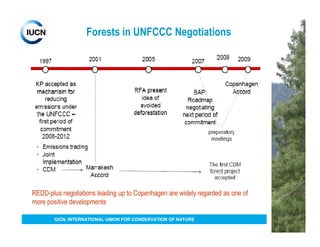
Forests in UNFCCC Negotiations


REDD-plus negotiations leading up to Copenhagen are widely regarded as one of
more positive developments

       IUCN, INTERNATIONAL UNION FOR CONSERVATION OF NATURE
Concept of REDD/ REDD+


IUCN, INTERNATIONAL UNION FOR CONSERVATION OF NATURE
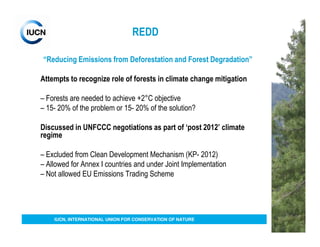
REDD

“Reducing Emissions from Deforestation and Forest Degradation”

Attempts to recognize role of forests in climate change mitigation

– Forests are needed to achieve +2°C objective
– 15- 20% of the problem or 15- 20% of the solution?

Discussed in UNFCCC negotiations as part of ‘post 2012’ climate
regime

– Excluded from Clean Development Mechanism (KP- 2012)
– Allowed for Annex I countries and under Joint Implementation
– Not allowed EU Emissions Trading Scheme


    IUCN, INTERNATIONAL UNION FOR CONSERVATION OF NATURE
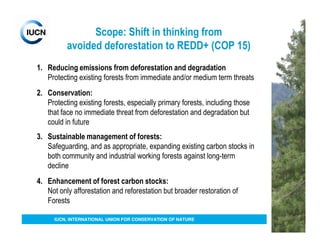
Scope: Shift in thinking from
          avoided deforestation to REDD+ (COP 15)
1. Reducing emissions from deforestation and degradation
   Protecting existing forests from immediate and/or medium term threats
2. Conservation:
   Protecting existing forests, especially primary forests, including those
   that face no immediate threat from deforestation and degradation but
   could in future
3. Sustainable management of forests:
   Safeguarding, and as appropriate, expanding existing carbon stocks in
   both community and industrial working forests against long-term
   decline
4. Enhancement of forest carbon stocks:
   Not only afforestation and reforestation but broader restoration of
   Forests

      IUCN, INTERNATIONAL UNION FOR CONSERVATION OF NATURE
REDD/ REDD+
              Readiness Initiatives
REDD+ readiness relates to the efforts a country is undertaking,
     with the support of multilateral or bilateral initiatives,
  to build its capacity to be ready for a REDD+ mechanism


IUCN, INTERNATIONAL UNION FOR CONSERVATION OF NATURE
UN-REDD Programme

Collaborative initiative (UN, FAO, UNDP) UNEP), launched in September
2008. Aims to assist developing countries prepare and implement national
REDD+ strategies

The Programme currently supports REDD+ readiness activities in nine pilot
countries (Bolivia, Democratic Republic of Congo (DRC), Indonesia, Panama,
Papua New Guinea, Paraguay, United Republic of Tanzania, Viet Nam and
Zambia)
13 others to be observers to its Policy Board, and has given them access to
many other benefits of the Programme (networking, participation in regional
workshops and knowledge sharing, facilitated by the Programme’s interactive
online workspace). They are; Argentina, Ecuador, Cambodia, Costa Rica,
Kenya, Mexico, Nepal, Nigeria, Philippines, Republic of Congo, Solomon
Islands, Sri Lanka, Sudan

UN-REDD Programme’s Policy Board has approved a total of US$42.6 million

       IUCN, INTERNATIONAL UNION FOR CONSERVATION OF NATURE
Activities under
            UN-REDD Programme

help develop analyses and guidelines on issues including; measurement,
reporting and verification (MRV) of carbon emissions and flows, ensuring
that forests continue to provide multiple benefits for livelihoods and the
environment, and supporting the engagement of Indigenous Peoples and
Civil Society at all stages of the design and implementation of REDD+
strategies

also seeks to build consensus and knowledge about REDD+, to ensure a
REDD+ mechanism is included in a post-2012 climate change agreement


   IUCN, INTERNATIONAL UNION FOR CONSERVATION OF NATURE
Forest Carbon Partnership Facility


Forest Carbon Partnership Facility (FCPF) (World Bank) assists developing
countries in their efforts to reduce emissions from deforestation and forest
degradation--called REDD+--by providing value to standing forests

builds the capacity of developing countries in tropical and subtropical regions
to reduce emissions from deforestation and forest degradation and to tap into
any future system of positive incentives for REDD+


      IUCN, INTERNATIONAL UNION FOR CONSERVATION OF NATURE
REDD/ REDD+ and Pakistan


IUCN, INTERNATIONAL UNION FOR CONSERVATION OF NATURE
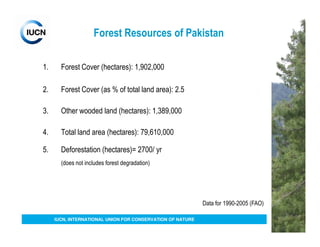
Forest Resources of Pakistan

1.     Forest Cover (hectares): 1,902,000

2.     Forest Cover (as % of total land area): 2.5

3.     Other wooded land (hectares): 1,389,000

4.     Total land area (hectares): 79,610,000

5.     Deforestation (hectares)= 2700/ yr
       (does not includes forest degradation)


                                                            Data for 1990-2005 (FAO)

     IUCN, INTERNATIONAL UNION FOR CONSERVATION OF NATURE
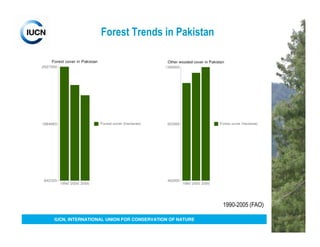
Forest Trends in Pakistan


                                                       1990-2005 (FAO)

IUCN, INTERNATIONAL UNION FOR CONSERVATION OF NATURE
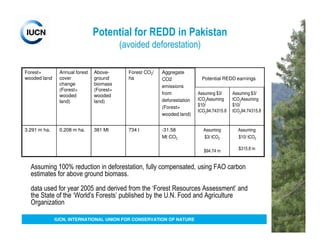
Potential for REDD in Pakistan
                                          (avoided deforestation)

Forest+        Annual forest   Above-       Forest CO2/   Aggregate
wooded land    cover           ground       ha            CO2              Potential REDD earnings
               change          biomass                    emissions
               (Forest+        (Forest+
               wooded          wooded                     from            Assuming $3/     Assuming $3/
               land)           land)                      deforestation   tCO2Assuming     tCO2Assuming
                                                          (Forest+        $10/             $10/
                                                                          tCO294.74315.8   tCO294.74315.8
                                                          wooded land)


3.291 m ha.    0.208 m ha.     381 Mt       734 t         -31.58            Assuming         Assuming
                                                          Mt CO2            $3/ tCO2         $10/ tCO2

                                                                            $94.74 m          $315.8 m


  Assuming 100% reduction in deforestation, fully compensated, using FAO carbon
  estimates for above ground biomass.

  data used for year 2005 and derived from the ‘Forest Resources Assessment’ and
  the State of the ‘World's Forests’ published by the U.N. Food and Agriculture
  Organization

              IUCN, INTERNATIONAL UNION FOR CONSERVATION OF NATURE
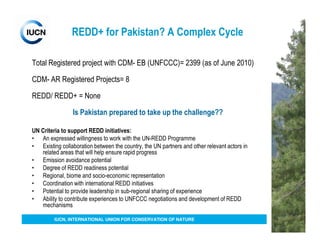
REDD+ for Pakistan? A Complex Cycle

Total Registered project with CDM- EB (UNFCCC)= 2399 (as of June 2010)

CDM- AR Registered Projects= 8

REDD/ REDD+ = None

                 Is Pakistan prepared to take up the challenge??

UN Criteria to support REDD initiatives:
• An expressed willingness to work with the UN-REDD Programme
• Existing collaboration between the country, the UN partners and other relevant actors in
   related areas that will help ensure rapid progress
• Emission avoidance potential
• Degree of REDD readiness potential
• Regional, biome and socio-economic representation
• Coordination with international REDD initiatives
• Potential to provide leadership in sub-regional sharing of experience
• Ability to contribute experiences to UNFCCC negotiations and development of REDD
   mechanisms

         IUCN, INTERNATIONAL UNION FOR CONSERVATION OF NATURE
Risks associated with Carbon business

1.   Natural/ climatic risks: (disease, growth lower than prediction drought,
     floods, damaging winds, land slides etc.)

2.   Anthropogenic factors: encroachment, poaching, fire

3.   Political risks: policy changes, unstable governments

4.   Economic risks: exchange rates, interest rates, lower than expected CER
     prices, changes in opportunity cost of land

5.   Risks associated with CER purchaser (willing to pay upfront?)

6.   Future of Kyoto??

7.   Crediting Period (5 years for forestry)

8.   Investment in forestry (is it viable business??)

      IUCN, INTERNATIONAL UNION FOR CONSERVATION OF NATURE
9.    Management/ ownership issues (influence of black market/
      feudalism)

10.   Baseline data/ methodology development/ monitoring (huge
      investments)- will it still be viable?

11.   Leakages in carbon budget (if not forests, where shall we cater for
      needs? Any alternates?)

12.   Long- term involvement of stakes~ easy at it sounds?


       IUCN, INTERNATIONAL UNION FOR CONSERVATION OF NATURE
Is it Practical for Pakistan?

Though the REDD policy has been finalized~ modalities and procedures yet
to be Clearfield

Not eligible for Kyoto first Commitment Period (2012)

REDD mechanism suitable for Pakistan….
          - high rate of deforestation- an opportunity!
            but can it be reduced…? If yes, how and how much??
          - How much time we nee to be prepared??
          - Is it cost effective??
          - Is it socio- politically applicable? If yes, how??
          - Administrative and technical capacities?

     IUCN, INTERNATIONAL UNION FOR CONSERVATION OF NATURE
REDD/ REDD+ and IUCN


IUCN, INTERNATIONAL UNION FOR CONSERVATION OF NATURE
REDD+ and IUCN

REDD+ is important for IUCN
   –     Our mission: To influence, encourage and assist societies
         throughout the world to conserve the integrity and diversity of nature
         and to ensure that any use of natural resources is equitable and
         ecologically sustainable
   –     Members’ decisions

IUCN’s work on REDD+
   –     Supporting the readiness phase – good forest governance
   –     Poverty – REDD+
   –     Forest Landscape Restoration – REDD+
   –     Advocacy and Technical Advice
   –     Ecosystem based Adaptation (EbA)

                                          (http://www.iucn.org/what/tpas/climate)
       IUCN, INTERNATIONAL UNION FOR CONSERVATION OF NATURE
IUCN for REDD+ (Post COP 15)
        IUCN’ Position Paper for 10th Session of AWG- LCA, May- June 2010, Bonn


IUCN urged Parties to reach an agreement on a REDD-plus mechanism
that recognizes that avoiding greenhouse gas emissions from
deforestation and forest degradation is a necessary component of
achieving deep cuts in all sources of anthropogenic emissions in order to
mitigate climate change

IUCN urged Parties to ensure that the full scope of REDD-plus is
respected and supported in the establishment of the mechanism, including
through the provision of financial resources and investment


   IUCN, INTERNATIONAL UNION FOR CONSERVATION OF NATURE
Concluding….
REDD/ REDD-plus will only achieve results if it is able to be
  adapted to the individual circumstances of countries

                                  AND

   if countries have the political will to adapt policies and
      methods to meet the needs of REDD/ REDD-plus
                       implementation


                                   The Forests Dialogue's initiative- IUCN CMS (2010)
   IUCN, INTERNATIONAL UNION FOR CONSERVATION OF NATURE
IUCN- TV VIDEO:
“Nature-our trusted ally in climate change fight”
                    Duration 5 (mins), 18 (Secs.)


            http://www.iucn.org/knowledge/multimedia/video/


  IUCN, INTERNATIONAL UNION FOR CONSERVATION OF NATURE
Thanks
                                                                                           :
                                                       For more information, please contact:

                                                                          Saadullah Ayaz
                                                               Climate Change Coordinator
                                                                           IUCN Pakistan

                                                                 Tel: +92 (51) 2271028- 30
IUCN, INTERNATIONAL UNION FOR CONSERVATION OF NATURE            Email: saad.ayaz@iucn.org

Presentation on REDD application for Pakistan Saadullah Ayaz

  • 1.
    Reducing Emissions fromDeforestation and Forest Degradation (REDD/ REDD+)- Potential for Pakistan Saadullah Ayaz Climate Change Coordinator IUCN- Pakistan Email: saad.ayaz@iucn.org IUCN, INTERNATIONAL UNION FOR CONSERVATION OF NATURE
  • 2.
    Forests and ClimateChange IUCN, INTERNATIONAL UNION FOR CONSERVATION OF NATURE
  • 3.
    Forests and ClimateChange Forests represent the most significant terrestrial carbon stock They contain: – 77% of all carbon stored in vegetation – 39% of all carbon stored in soils (Eliasch Review ) Forests sequester and store more carbon (per hectare) than any other type of land cover Accounted for 17.4% of global GHG emission in 2004, Equivalent to 49 GtCO2 eqv./ yr. (IPCC- FAR, 2007) IUCN, INTERNATIONAL UNION FOR CONSERVATION OF NATURE
  • 4.
    Forests in UNFCCCNegotiations REDD-plus negotiations leading up to Copenhagen are widely regarded as one of more positive developments IUCN, INTERNATIONAL UNION FOR CONSERVATION OF NATURE
  • 5.
    Concept of REDD/REDD+ IUCN, INTERNATIONAL UNION FOR CONSERVATION OF NATURE
  • 6.
    REDD “Reducing Emissions fromDeforestation and Forest Degradation” Attempts to recognize role of forests in climate change mitigation – Forests are needed to achieve +2°C objective – 15- 20% of the problem or 15- 20% of the solution? Discussed in UNFCCC negotiations as part of ‘post 2012’ climate regime – Excluded from Clean Development Mechanism (KP- 2012) – Allowed for Annex I countries and under Joint Implementation – Not allowed EU Emissions Trading Scheme IUCN, INTERNATIONAL UNION FOR CONSERVATION OF NATURE
  • 7.
    Scope: Shift inthinking from avoided deforestation to REDD+ (COP 15) 1. Reducing emissions from deforestation and degradation Protecting existing forests from immediate and/or medium term threats 2. Conservation: Protecting existing forests, especially primary forests, including those that face no immediate threat from deforestation and degradation but could in future 3. Sustainable management of forests: Safeguarding, and as appropriate, expanding existing carbon stocks in both community and industrial working forests against long-term decline 4. Enhancement of forest carbon stocks: Not only afforestation and reforestation but broader restoration of Forests IUCN, INTERNATIONAL UNION FOR CONSERVATION OF NATURE
  • 8.
    REDD/ REDD+ Readiness Initiatives REDD+ readiness relates to the efforts a country is undertaking, with the support of multilateral or bilateral initiatives, to build its capacity to be ready for a REDD+ mechanism IUCN, INTERNATIONAL UNION FOR CONSERVATION OF NATURE
  • 9.
    UN-REDD Programme Collaborative initiative(UN, FAO, UNDP) UNEP), launched in September 2008. Aims to assist developing countries prepare and implement national REDD+ strategies The Programme currently supports REDD+ readiness activities in nine pilot countries (Bolivia, Democratic Republic of Congo (DRC), Indonesia, Panama, Papua New Guinea, Paraguay, United Republic of Tanzania, Viet Nam and Zambia) 13 others to be observers to its Policy Board, and has given them access to many other benefits of the Programme (networking, participation in regional workshops and knowledge sharing, facilitated by the Programme’s interactive online workspace). They are; Argentina, Ecuador, Cambodia, Costa Rica, Kenya, Mexico, Nepal, Nigeria, Philippines, Republic of Congo, Solomon Islands, Sri Lanka, Sudan UN-REDD Programme’s Policy Board has approved a total of US$42.6 million IUCN, INTERNATIONAL UNION FOR CONSERVATION OF NATURE
  • 10.
    Activities under UN-REDD Programme help develop analyses and guidelines on issues including; measurement, reporting and verification (MRV) of carbon emissions and flows, ensuring that forests continue to provide multiple benefits for livelihoods and the environment, and supporting the engagement of Indigenous Peoples and Civil Society at all stages of the design and implementation of REDD+ strategies also seeks to build consensus and knowledge about REDD+, to ensure a REDD+ mechanism is included in a post-2012 climate change agreement IUCN, INTERNATIONAL UNION FOR CONSERVATION OF NATURE
  • 11.
    Forest Carbon PartnershipFacility Forest Carbon Partnership Facility (FCPF) (World Bank) assists developing countries in their efforts to reduce emissions from deforestation and forest degradation--called REDD+--by providing value to standing forests builds the capacity of developing countries in tropical and subtropical regions to reduce emissions from deforestation and forest degradation and to tap into any future system of positive incentives for REDD+ IUCN, INTERNATIONAL UNION FOR CONSERVATION OF NATURE
  • 12.
    REDD/ REDD+ andPakistan IUCN, INTERNATIONAL UNION FOR CONSERVATION OF NATURE
  • 13.
    Forest Resources ofPakistan 1. Forest Cover (hectares): 1,902,000 2. Forest Cover (as % of total land area): 2.5 3. Other wooded land (hectares): 1,389,000 4. Total land area (hectares): 79,610,000 5. Deforestation (hectares)= 2700/ yr (does not includes forest degradation) Data for 1990-2005 (FAO) IUCN, INTERNATIONAL UNION FOR CONSERVATION OF NATURE
  • 14.
    Forest Trends inPakistan 1990-2005 (FAO) IUCN, INTERNATIONAL UNION FOR CONSERVATION OF NATURE
  • 15.
    Potential for REDDin Pakistan (avoided deforestation) Forest+ Annual forest Above- Forest CO2/ Aggregate wooded land cover ground ha CO2 Potential REDD earnings change biomass emissions (Forest+ (Forest+ wooded wooded from Assuming $3/ Assuming $3/ land) land) deforestation tCO2Assuming tCO2Assuming (Forest+ $10/ $10/ tCO294.74315.8 tCO294.74315.8 wooded land) 3.291 m ha. 0.208 m ha. 381 Mt 734 t -31.58 Assuming Assuming Mt CO2 $3/ tCO2 $10/ tCO2 $94.74 m $315.8 m Assuming 100% reduction in deforestation, fully compensated, using FAO carbon estimates for above ground biomass. data used for year 2005 and derived from the ‘Forest Resources Assessment’ and the State of the ‘World's Forests’ published by the U.N. Food and Agriculture Organization IUCN, INTERNATIONAL UNION FOR CONSERVATION OF NATURE
  • 16.
    REDD+ for Pakistan?A Complex Cycle Total Registered project with CDM- EB (UNFCCC)= 2399 (as of June 2010) CDM- AR Registered Projects= 8 REDD/ REDD+ = None Is Pakistan prepared to take up the challenge?? UN Criteria to support REDD initiatives: • An expressed willingness to work with the UN-REDD Programme • Existing collaboration between the country, the UN partners and other relevant actors in related areas that will help ensure rapid progress • Emission avoidance potential • Degree of REDD readiness potential • Regional, biome and socio-economic representation • Coordination with international REDD initiatives • Potential to provide leadership in sub-regional sharing of experience • Ability to contribute experiences to UNFCCC negotiations and development of REDD mechanisms IUCN, INTERNATIONAL UNION FOR CONSERVATION OF NATURE
  • 17.
    Risks associated withCarbon business 1. Natural/ climatic risks: (disease, growth lower than prediction drought, floods, damaging winds, land slides etc.) 2. Anthropogenic factors: encroachment, poaching, fire 3. Political risks: policy changes, unstable governments 4. Economic risks: exchange rates, interest rates, lower than expected CER prices, changes in opportunity cost of land 5. Risks associated with CER purchaser (willing to pay upfront?) 6. Future of Kyoto?? 7. Crediting Period (5 years for forestry) 8. Investment in forestry (is it viable business??) IUCN, INTERNATIONAL UNION FOR CONSERVATION OF NATURE
  • 18.
    9. Management/ ownership issues (influence of black market/ feudalism) 10. Baseline data/ methodology development/ monitoring (huge investments)- will it still be viable? 11. Leakages in carbon budget (if not forests, where shall we cater for needs? Any alternates?) 12. Long- term involvement of stakes~ easy at it sounds? IUCN, INTERNATIONAL UNION FOR CONSERVATION OF NATURE
  • 19.
    Is it Practicalfor Pakistan? Though the REDD policy has been finalized~ modalities and procedures yet to be Clearfield Not eligible for Kyoto first Commitment Period (2012) REDD mechanism suitable for Pakistan…. - high rate of deforestation- an opportunity! but can it be reduced…? If yes, how and how much?? - How much time we nee to be prepared?? - Is it cost effective?? - Is it socio- politically applicable? If yes, how?? - Administrative and technical capacities? IUCN, INTERNATIONAL UNION FOR CONSERVATION OF NATURE
  • 20.
    REDD/ REDD+ andIUCN IUCN, INTERNATIONAL UNION FOR CONSERVATION OF NATURE
  • 21.
    REDD+ and IUCN REDD+is important for IUCN – Our mission: To influence, encourage and assist societies throughout the world to conserve the integrity and diversity of nature and to ensure that any use of natural resources is equitable and ecologically sustainable – Members’ decisions IUCN’s work on REDD+ – Supporting the readiness phase – good forest governance – Poverty – REDD+ – Forest Landscape Restoration – REDD+ – Advocacy and Technical Advice – Ecosystem based Adaptation (EbA) (http://www.iucn.org/what/tpas/climate) IUCN, INTERNATIONAL UNION FOR CONSERVATION OF NATURE
  • 22.
    IUCN for REDD+(Post COP 15) IUCN’ Position Paper for 10th Session of AWG- LCA, May- June 2010, Bonn IUCN urged Parties to reach an agreement on a REDD-plus mechanism that recognizes that avoiding greenhouse gas emissions from deforestation and forest degradation is a necessary component of achieving deep cuts in all sources of anthropogenic emissions in order to mitigate climate change IUCN urged Parties to ensure that the full scope of REDD-plus is respected and supported in the establishment of the mechanism, including through the provision of financial resources and investment IUCN, INTERNATIONAL UNION FOR CONSERVATION OF NATURE
  • 23.
    Concluding…. REDD/ REDD-plus willonly achieve results if it is able to be adapted to the individual circumstances of countries AND if countries have the political will to adapt policies and methods to meet the needs of REDD/ REDD-plus implementation The Forests Dialogue's initiative- IUCN CMS (2010) IUCN, INTERNATIONAL UNION FOR CONSERVATION OF NATURE
  • 24.
    IUCN- TV VIDEO: “Nature-ourtrusted ally in climate change fight” Duration 5 (mins), 18 (Secs.) http://www.iucn.org/knowledge/multimedia/video/ IUCN, INTERNATIONAL UNION FOR CONSERVATION OF NATURE
  • 25.
    Thanks : For more information, please contact: Saadullah Ayaz Climate Change Coordinator IUCN Pakistan Tel: +92 (51) 2271028- 30 IUCN, INTERNATIONAL UNION FOR CONSERVATION OF NATURE Email: saad.ayaz@iucn.org