REDD+
Reducing emissions from deforestation and forest
degradation in developing countries, and the role of
conservation, sustainable management of forests, and
enhancement of forest carbon stocks in developing
countries
• Reducing emissions from deforestation
• Reducing emissions from forest degradation
• Conservation of forest carbon stocks
• Sustainable management of forests
• Enhancement of forest carbon stocks
Part i: overview
MOVING FROM READINESS TO
PERFORMANCE-BASED PAYMENTS
LESSONS LEARNT FROM CIFOR’S GLOBAL
COMPARATIVE STUDY ON REDD+
CIFOR GCS-REDD+ Team
For ASIA PACIFIC RAINFOREST SUMMIT
REDD+
Reducing emissions from
deforestation and forest degradation
in developing countries, and the role
of conservation, sustainable
management of forests, and
enhancement of forest carbon stocks
in developing countries
• Reducing emissions from deforestation
• Reducing emissions from forest degradation
• Conservation of forest carbon stocks
• Sustainable management of forests
• Enhancement of forest carbon stocks
10 years of REDD+
• COP13 Bali (2007): Bali Action Plan – Parties commitment to include REDD
om a post-2012 climate agreement (Decision 2/CP.13).
• COP15 Copenhagen (2009): Copenhagen Accord and establishment of a
REDD+ mechanism, including the five activities and methodological guidance
for REDD+ (Decision 4/CP.15).
• COP16 Cancun (2010): Cancun Agreements and REDD+ "requirements":
national strategy/action plan, FREL/FRL, national forest monitoring systems
and safeguard information systems (SIS). Establishment of 7 safeguards and
the REDD+ phase approach.
• COP19 Warsaw (2013): Warsaw Framework for REDD+ and 7 decisions on
REDD+ (on finance and institutional agreement mechanisms).
• COP21 Paris (2015): REDD+ as part of Paris Agreement which came into force
on 4 November 2016
• COP 22 Marrakesh (2016): focus on finance, transparency and Nationally
Determined Contributions (NDCs)
• Green Climate Fund: 43 projects at 2.2 billion USD since late 2015. Results-
Based Payments Strategy finished in 2017. First call for projects.
• REDD+ in NDCs: 39 countries (27%) listed REDD+ in their INDCs representing
the bulk of global LULUCF emissions (UNFCCC Synthesis Report)
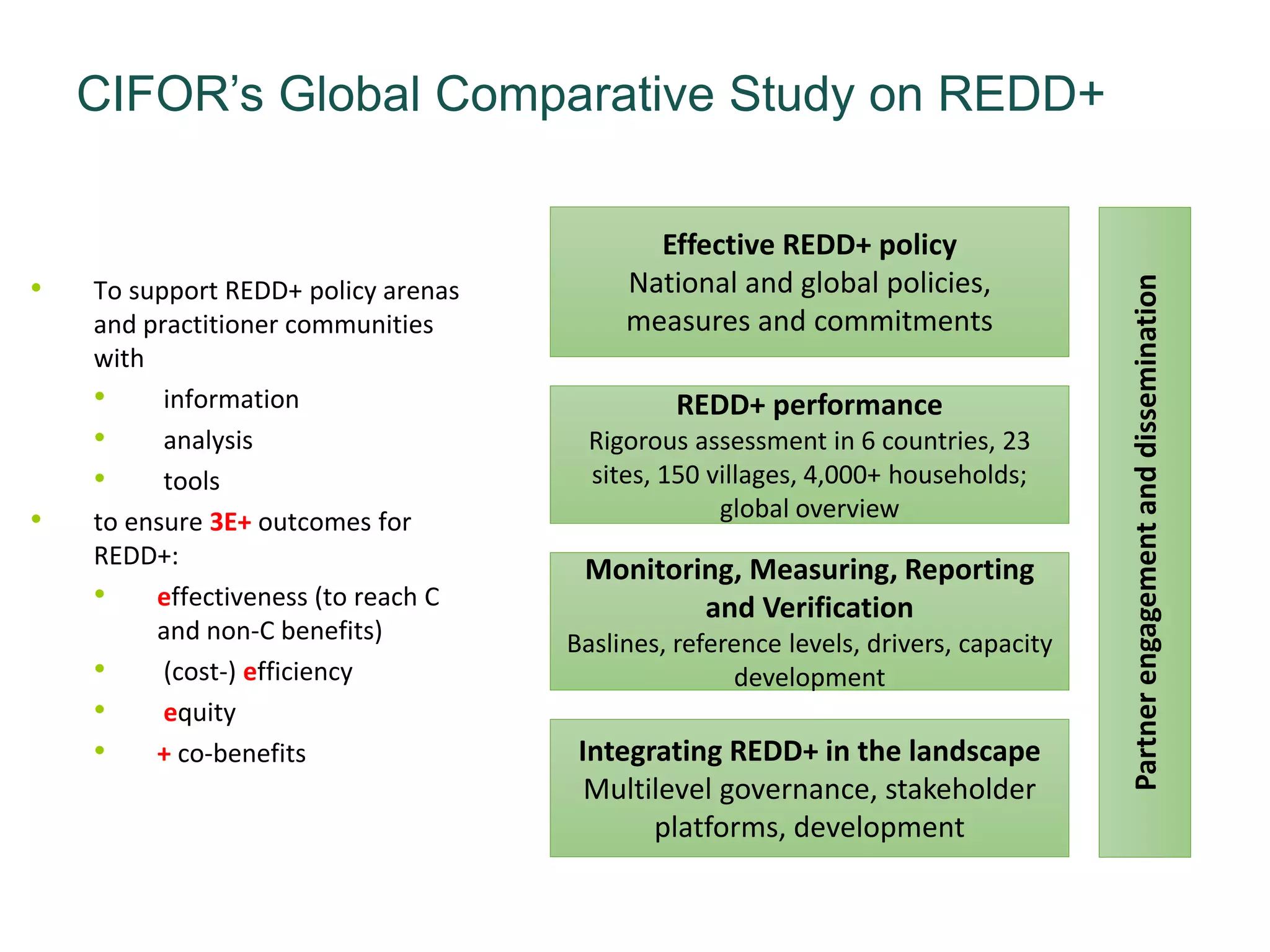
CIFOR’s Global Comparative Study on REDD+
• To support REDD+ policy arenas
and practitioner communities
with
• information
• analysis
• tools
• to ensure 3E+ outcomes for
REDD+:
• effectiveness (to reach C
and non-C benefits)
• (cost-) efficiency
• equity
• + co-benefits
Effective REDD+ policy
National and global policies,
measures and commitments
REDD+ performance
Rigorous assessment in 6 countries, 23
sites, 150 villages, 4,000+ households;
global overview
Integrating REDD+ in the landscape
Multilevel governance, stakeholder
platforms, development
Monitoring, Measuring, Reporting
and Verification
Baslines, reference levels, drivers, capacity
development
Partnerengagementanddissemination
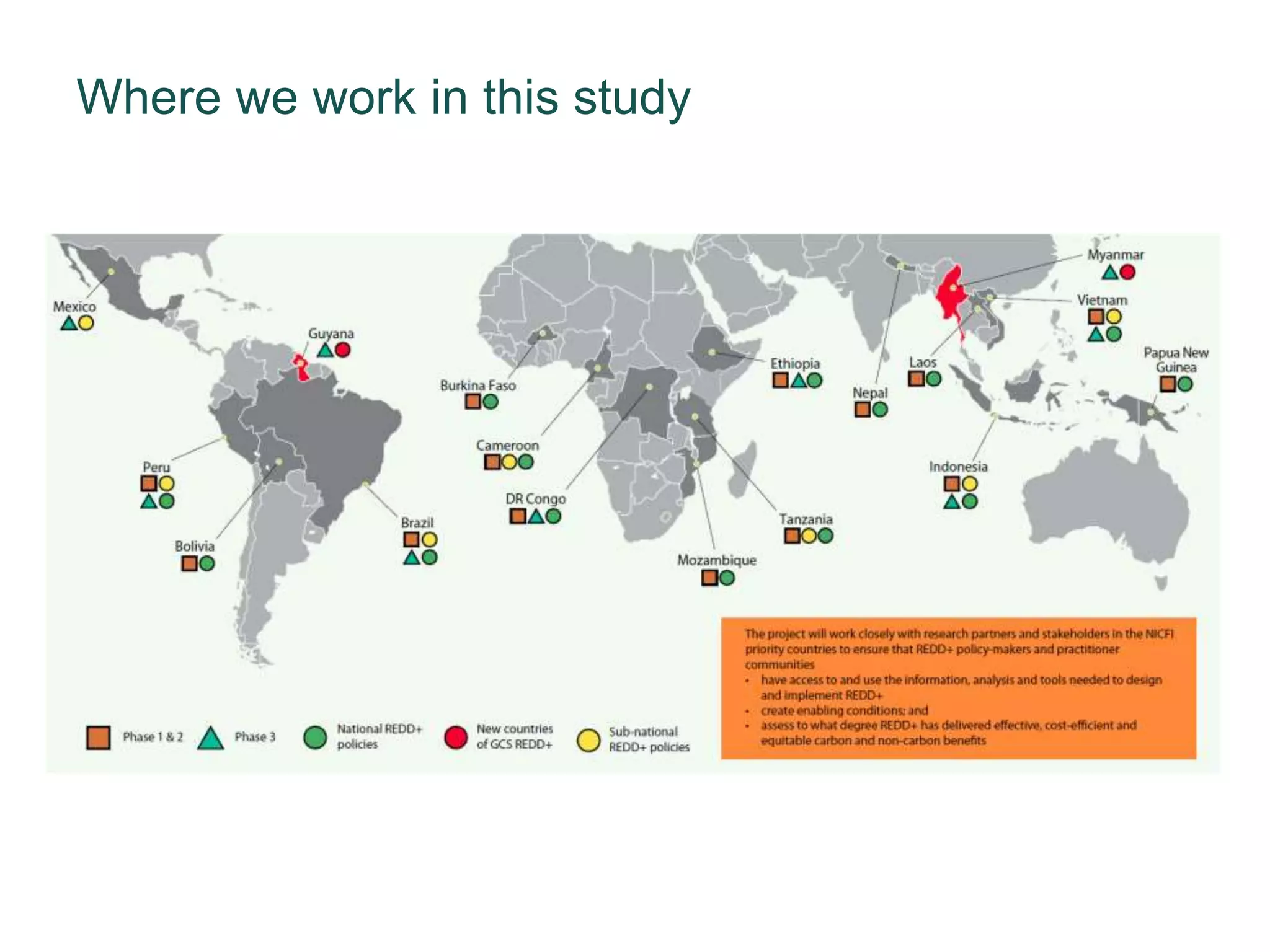
Where we work in this study
Carrots and sticks:
What REDD+ has aimed to do
• Be a pioneering approach to climate change mitigation
• Make forest protection more profitable than forest conversion by
paying the cost of foregone forest conversion
• Create a reward system for protecting/enhancing forests in
measurable way
• Mix of positive & negative incentives (as in ICDP)
• Policies and Measures (PAM) to support effort
Wikimedia Commons
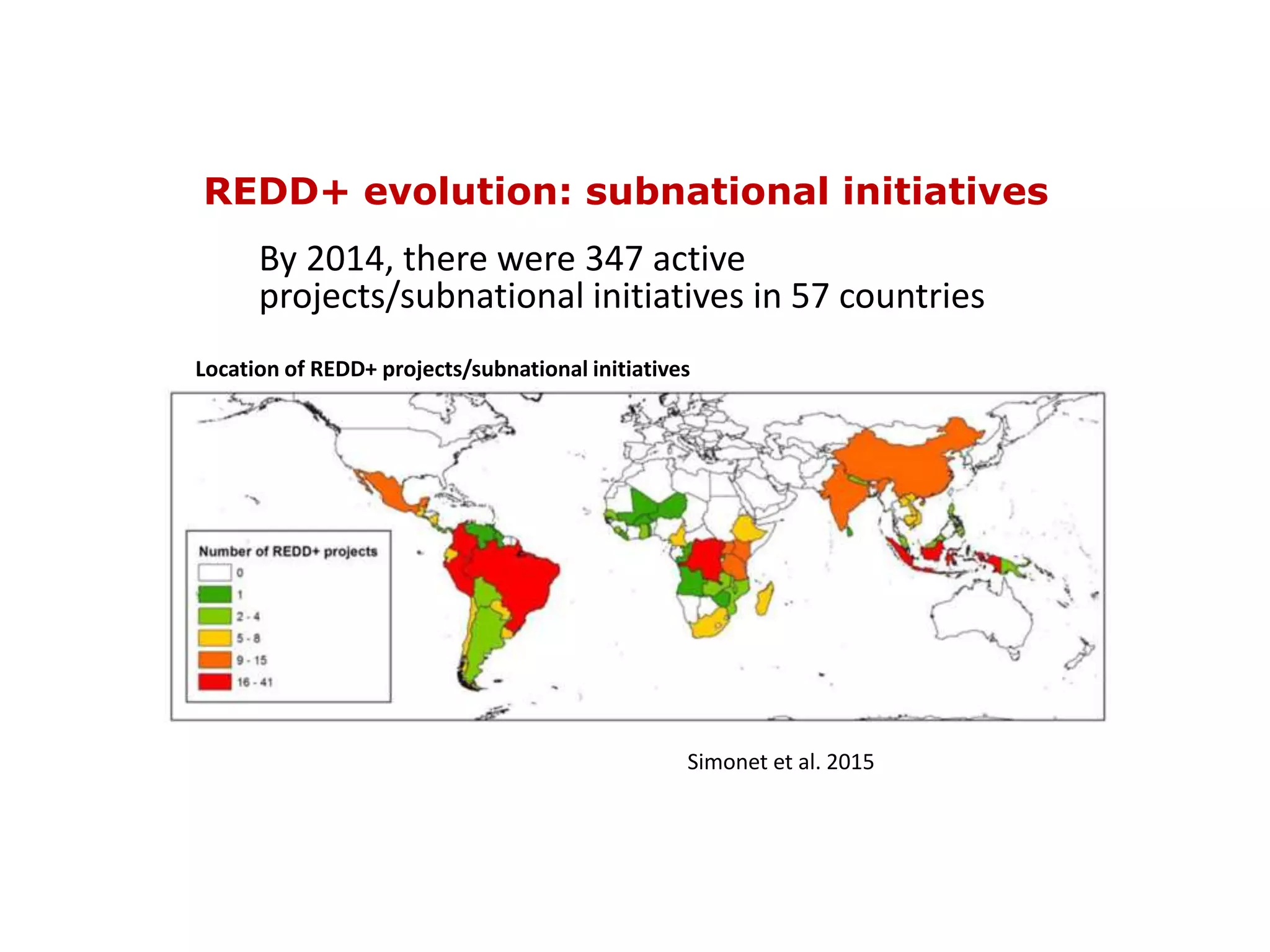
REDD+ evolution: subnational initiatives
By 2014, there were 347 active
projects/subnational initiatives in 57 countries
Location of REDD+ projects/subnational initiatives
Simonet et al. 2015
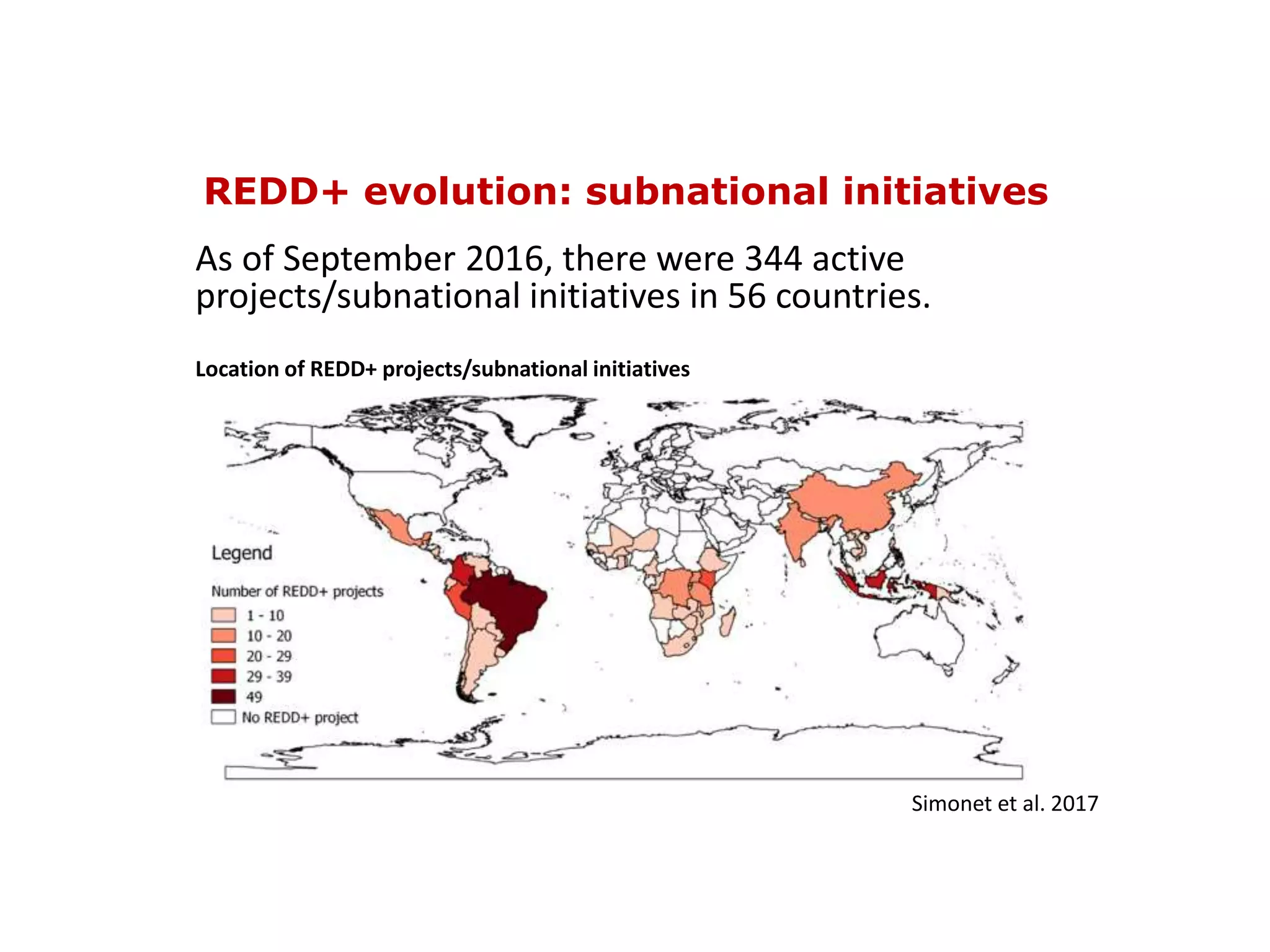
REDD+ evolution: subnational initiatives
As of September 2016, there were 344 active
projects/subnational initiatives in 56 countries.
Location of REDD+ projects/subnational initiatives
Simonet et al. 2017
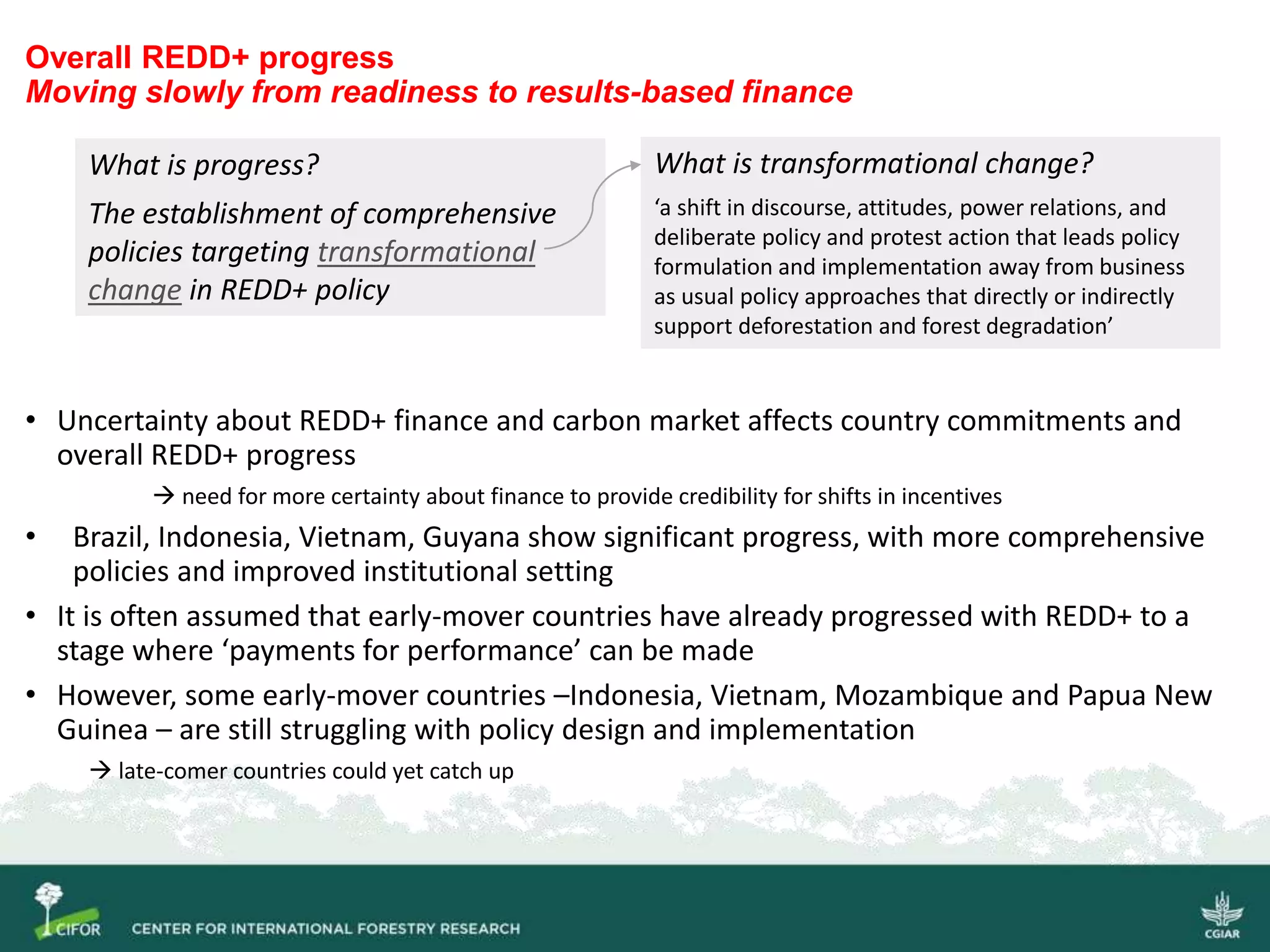
Overall REDD+ progress
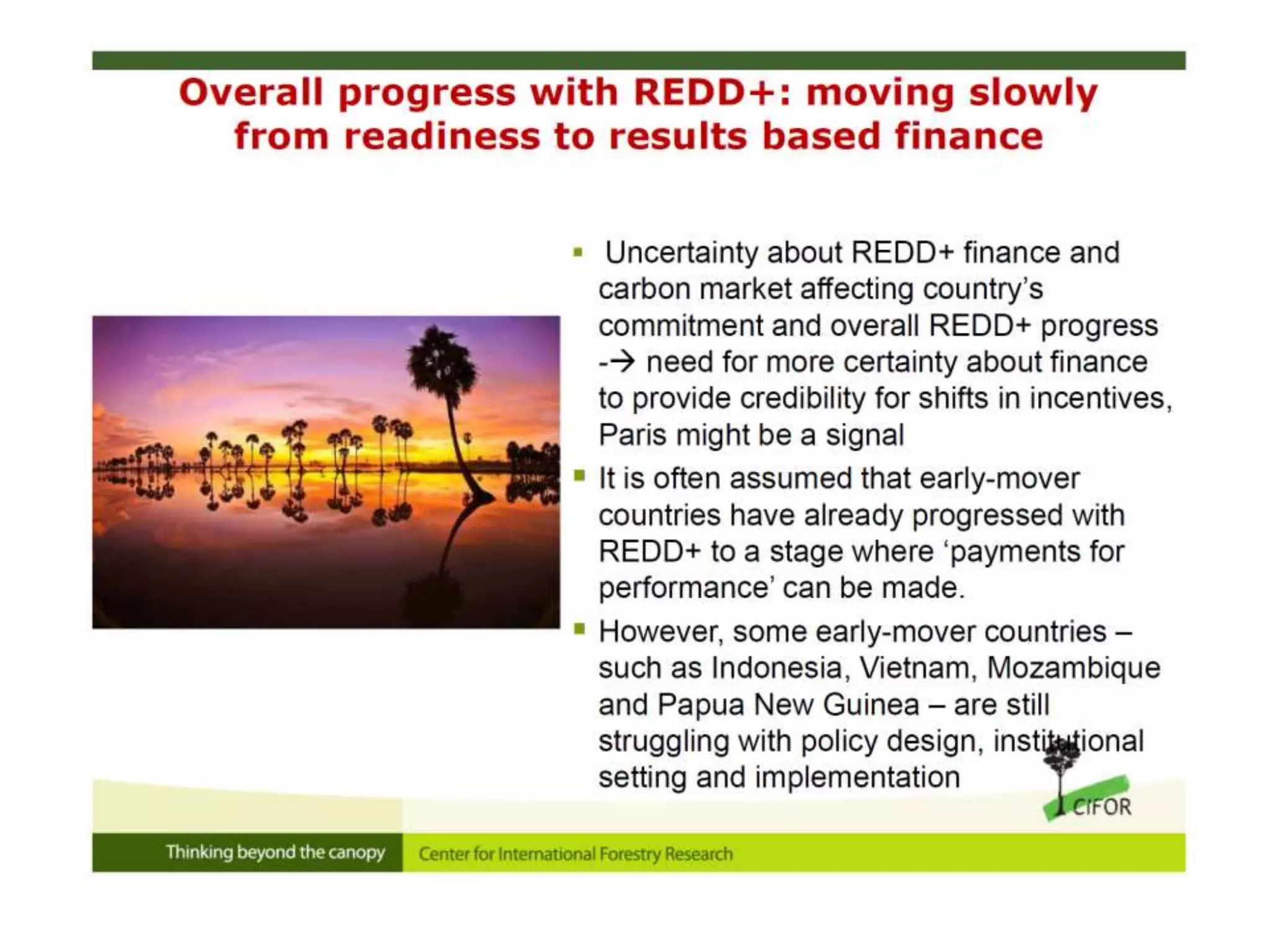
Moving slowly from readiness to results-based finance
• Uncertainty about REDD+ finance and carbon market affects country commitments and
overall REDD+ progress
 need for more certainty about finance to provide credibility for shifts in incentives
• Brazil, Indonesia, Vietnam, Guyana show significant progress, with more comprehensive
policies and improved institutional setting
• It is often assumed that early-mover countries have already progressed with REDD+ to a
stage where ‘payments for performance’ can be made
• However, some early-mover countries –Indonesia, Vietnam, Mozambique and Papua New
Guinea – are still struggling with policy design and implementation
 late-comer countries could yet catch up
What is progress?
The establishment of comprehensive
policies targeting transformational
change in REDD+ policy
What is transformational change?
‘a shift in discourse, attitudes, power relations, and
deliberate policy and protest action that leads policy
formulation and implementation away from business
as usual policy approaches that directly or indirectly
support deforestation and forest degradation’
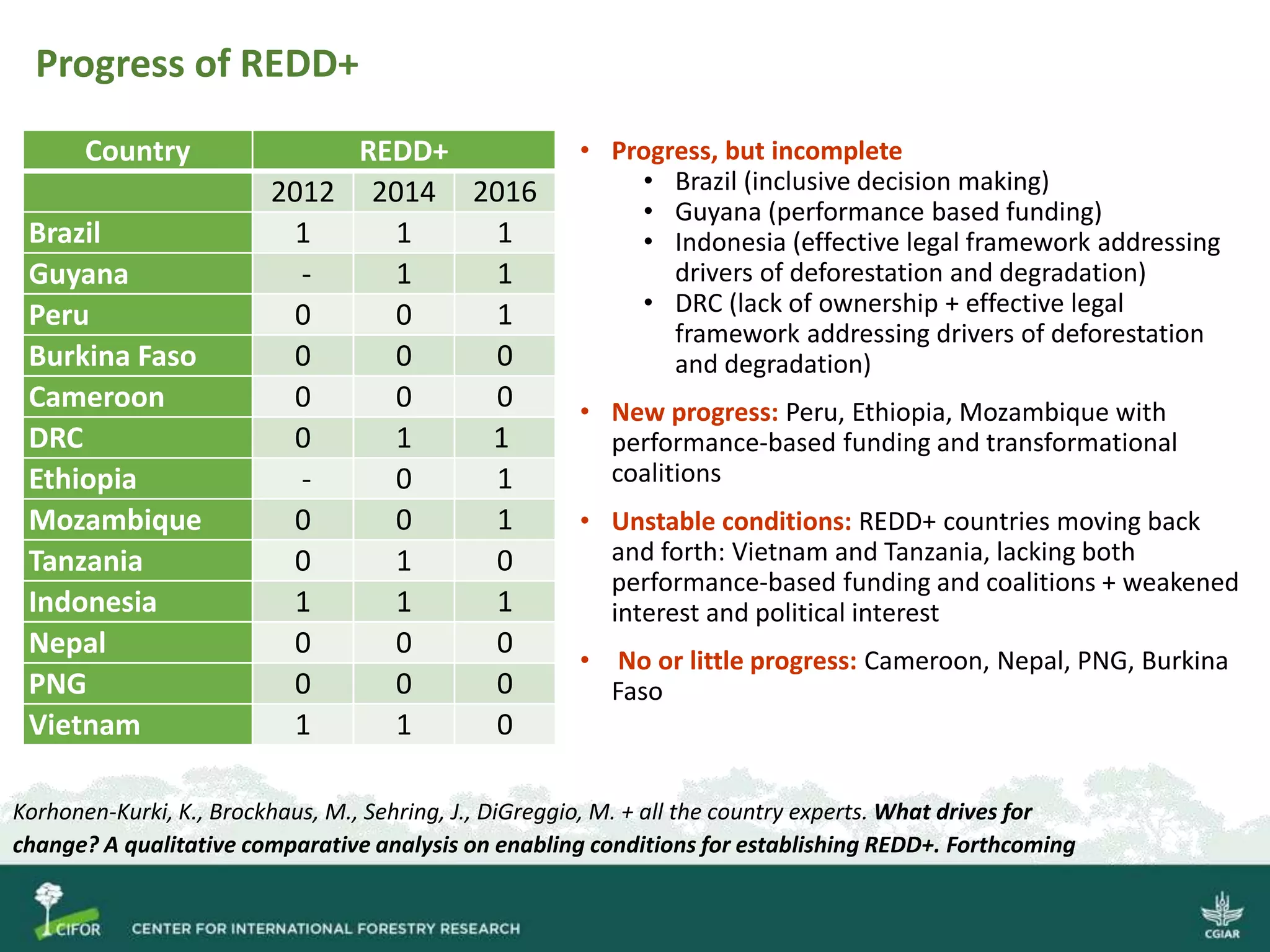
Progress of REDD+
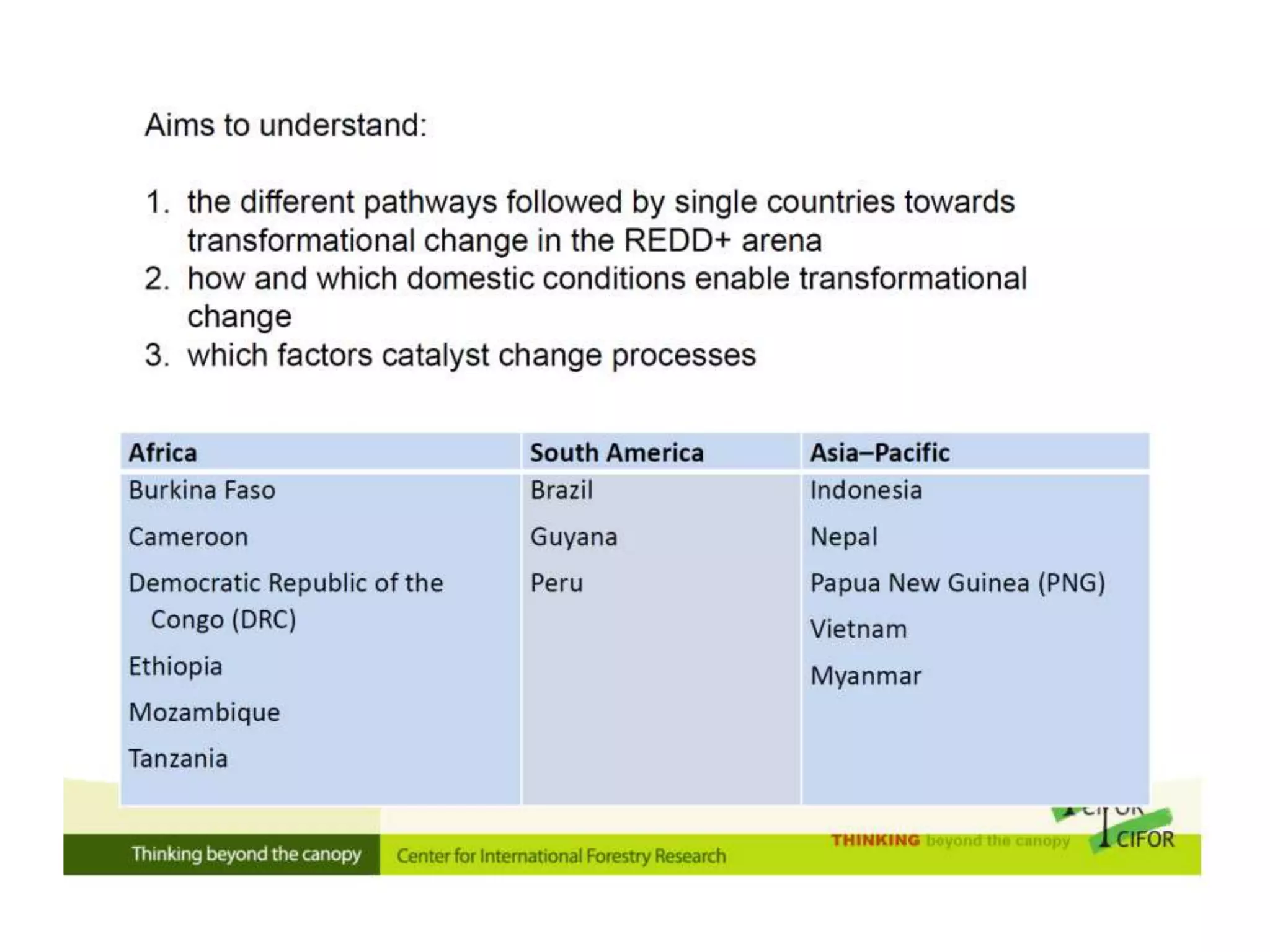
Country REDD+
2012 2014 2016
Brazil 1 1 1
Guyana - 1 1
Peru 0 0 1
Burkina Faso 0 0 0
Cameroon 0 0 0
DRC 0 1 1
Ethiopia - 0 1
Mozambique 0 0 1
Tanzania 0 1 0
Indonesia 1 1 1
Nepal 0 0 0
PNG 0 0 0
Vietnam 1 1 0
• Progress, but incomplete
• Brazil (inclusive decision making)
• Guyana (performance based funding)
• Indonesia (effective legal framework addressing
drivers of deforestation and degradation)
• DRC (lack of ownership + effective legal
framework addressing drivers of deforestation
and degradation)
• New progress: Peru, Ethiopia, Mozambique with
performance-based funding and transformational
coalitions
• Unstable conditions: REDD+ countries moving back
and forth: Vietnam and Tanzania, lacking both
performance-based funding and coalitions + weakened
interest and political interest
• No or little progress: Cameroon, Nepal, PNG, Burkina
Faso
Korhonen-Kurki, K., Brockhaus, M., Sehring, J., DiGreggio, M. + all the country experts. What drives for
change? A qualitative comparative analysis on enabling conditions for establishing REDD+. Forthcoming
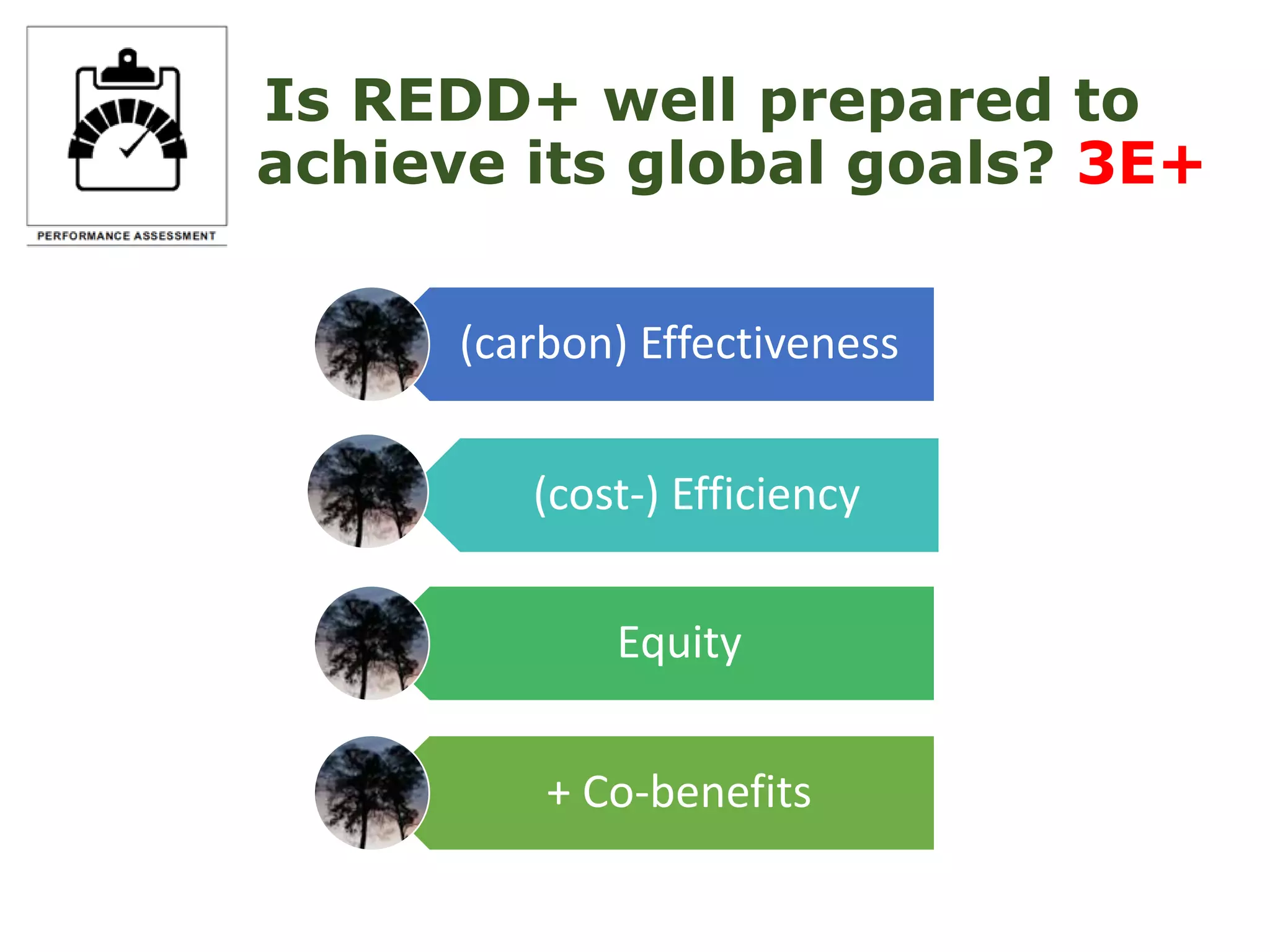
Is REDD+ well prepared to
achieve its global goals? 3E+
(carbon) Effectiveness
(cost-) Efficiency
Equity
+ Co-benefits
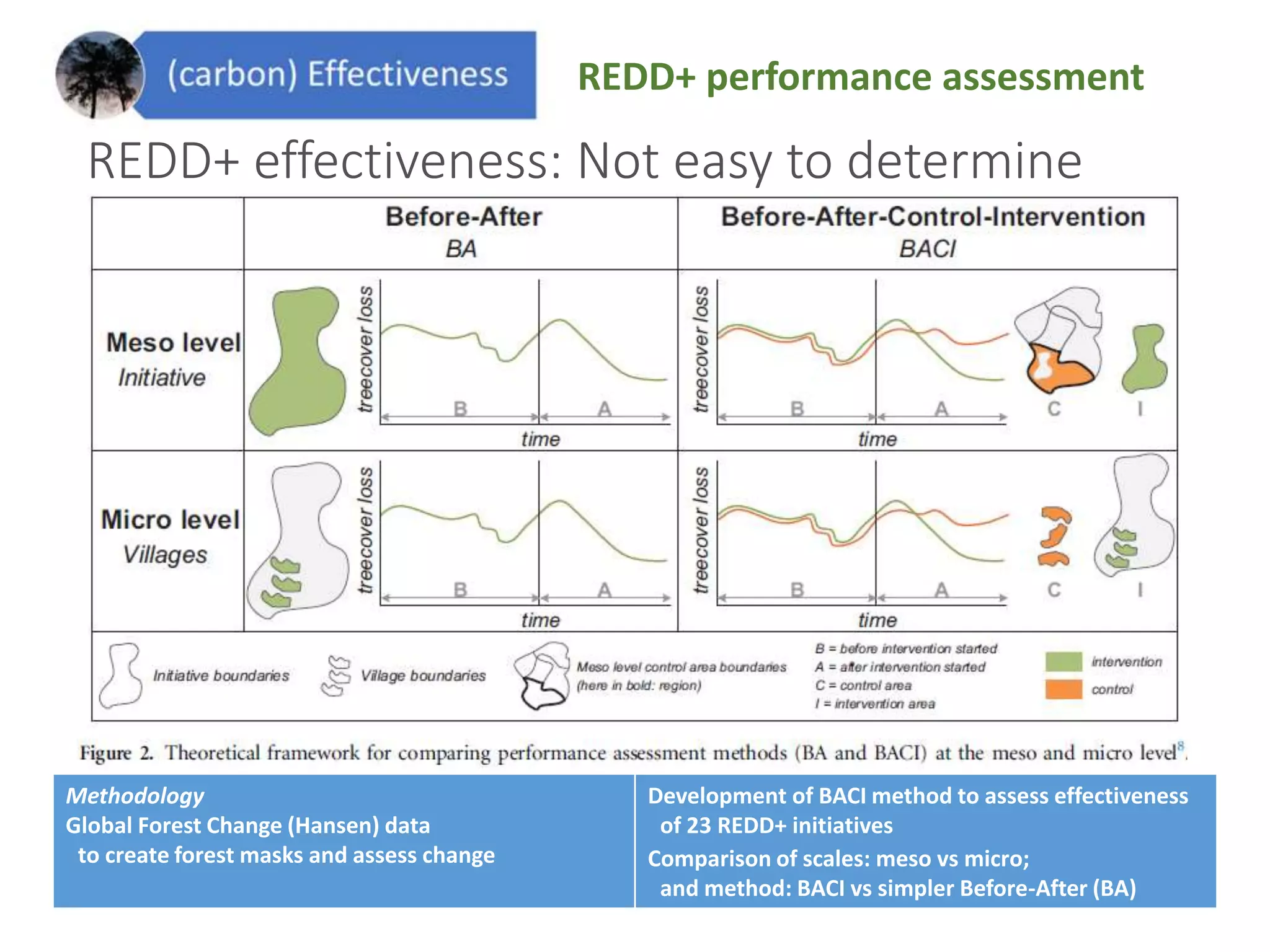
REDD+ effectiveness: Not easy to determine
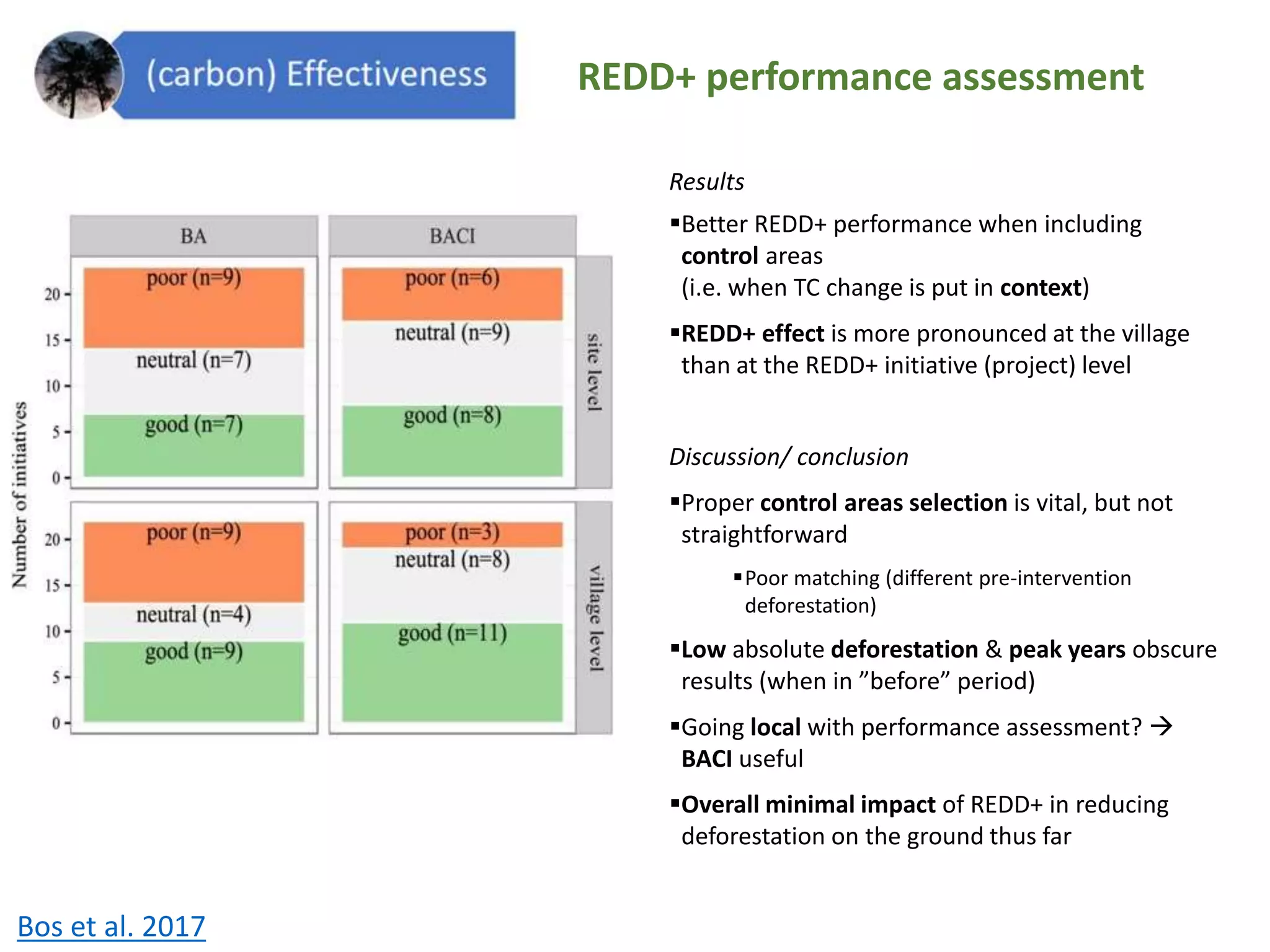
REDD+ performance assessment
Methodology
Global Forest Change (Hansen) data
to create forest masks and assess change
Development of BACI method to assess effectiveness
of 23 REDD+ initiatives
Comparison of scales: meso vs micro;
and method: BACI vs simpler Before-After (BA)
Results
Better REDD+ performance when including
control areas
(i.e. when TC change is put in context)
REDD+ effect is more pronounced at the village
than at the REDD+ initiative (project) level
Discussion/ conclusion
Proper control areas selection is vital, but not
straightforward
Poor matching (different pre-intervention
deforestation)
Low absolute deforestation & peak years obscure
results (when in ”before” period)
Going local with performance assessment? 
BACI useful
Overall minimal impact of REDD+ in reducing
deforestation on the ground thus far
Bos et al. 2017
REDD+ performance assessment
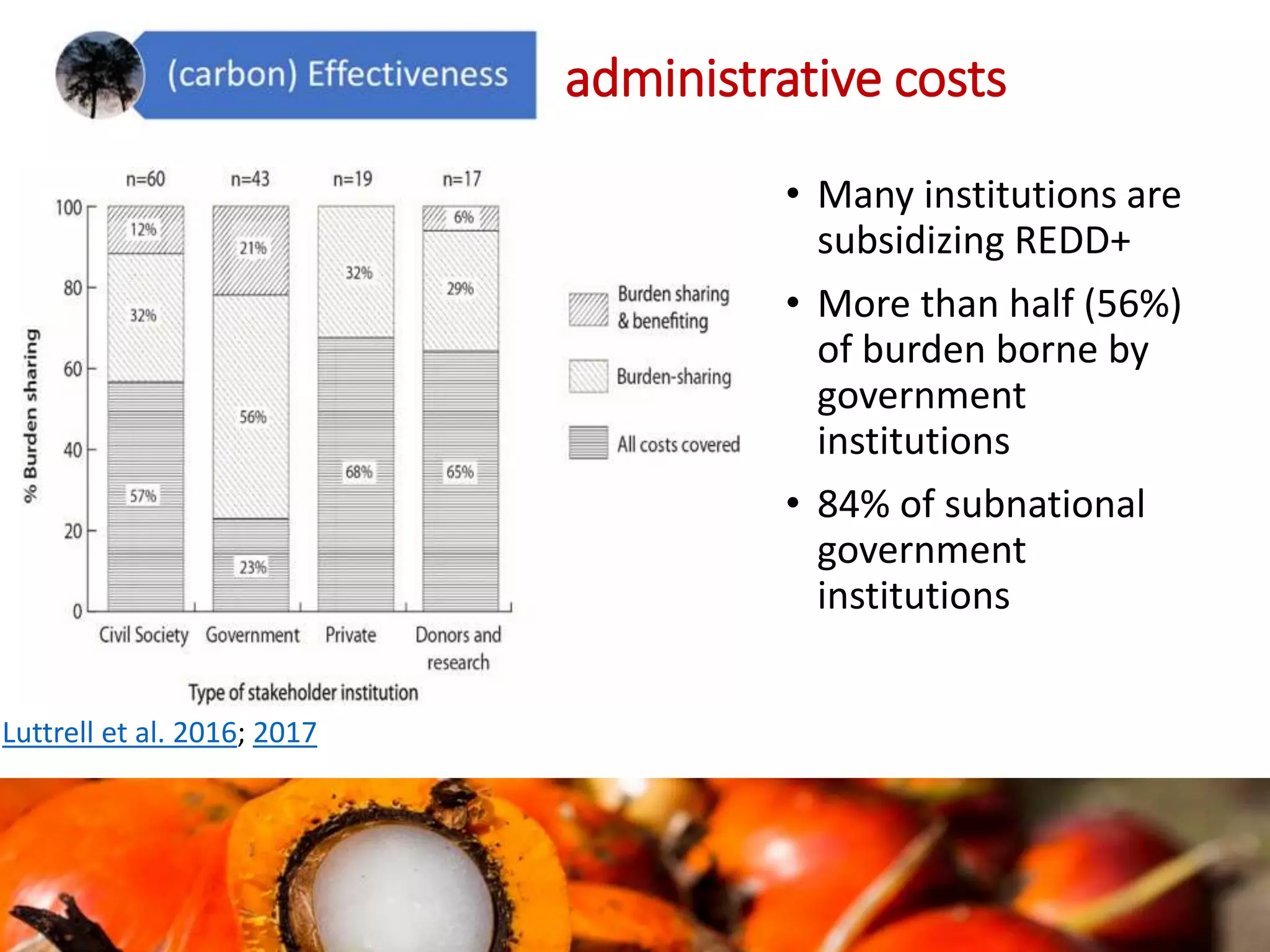
E2: Effectiveness administrative costs
• Many institutions are
subsidizing REDD+
• More than half (56%)
of burden borne by
government
institutions
• 84% of subnational
government
institutions
Luttrell et al. 2016; 2017
• Horizontal cross-sectoral challenges –
identified as one of the central
challenges to REDD+ at the national
level (Brockhaus et al. 2014) – persist at the
subnational level
• Coordination issues (horizontal and
vertical) related to scattered and non-
transparent data sharing are
complicated by divergent interests and
needs related to “technical issues”
(like MRV Kowler and Larson 2016)
• Issues like land tenure are often cast
in terms of project effectiveness at
higher levels, but are fundamentally
about equity and justice to people on
the ground (Larson et al. 2013, Myers and Muhajir, 2016)
Challenges of REDD+
implementation across levels
Challenges of REDD+
implementation across levels
• Communities living in forests are not necessarily
supportive of REDD+/ conservation initiatives due
to the fear of loss of control over forests and of
effects on livelihoods or rights
• Perceptions are shaped by past experiences
• Rights may be more important than ‘benefits’
• Processes for engaging with communities are
fundamental for winning support and legitimacy
• Legitimate processes are based on effective communication,
broad-based participation and effective representation, and a
clear definition of roles and expectations
• At all levels, from national to subnational and local,
‘ownership’ of initiatives for change is key to
legitimacy, and to finding embedded and
sustainable solutions
• Thought leaders matter…
• The same rules are applied in different/better ways because of
committed individuals
Ashwin Ravikumar, Annie Yang & Anne M Larson (unpubl.)
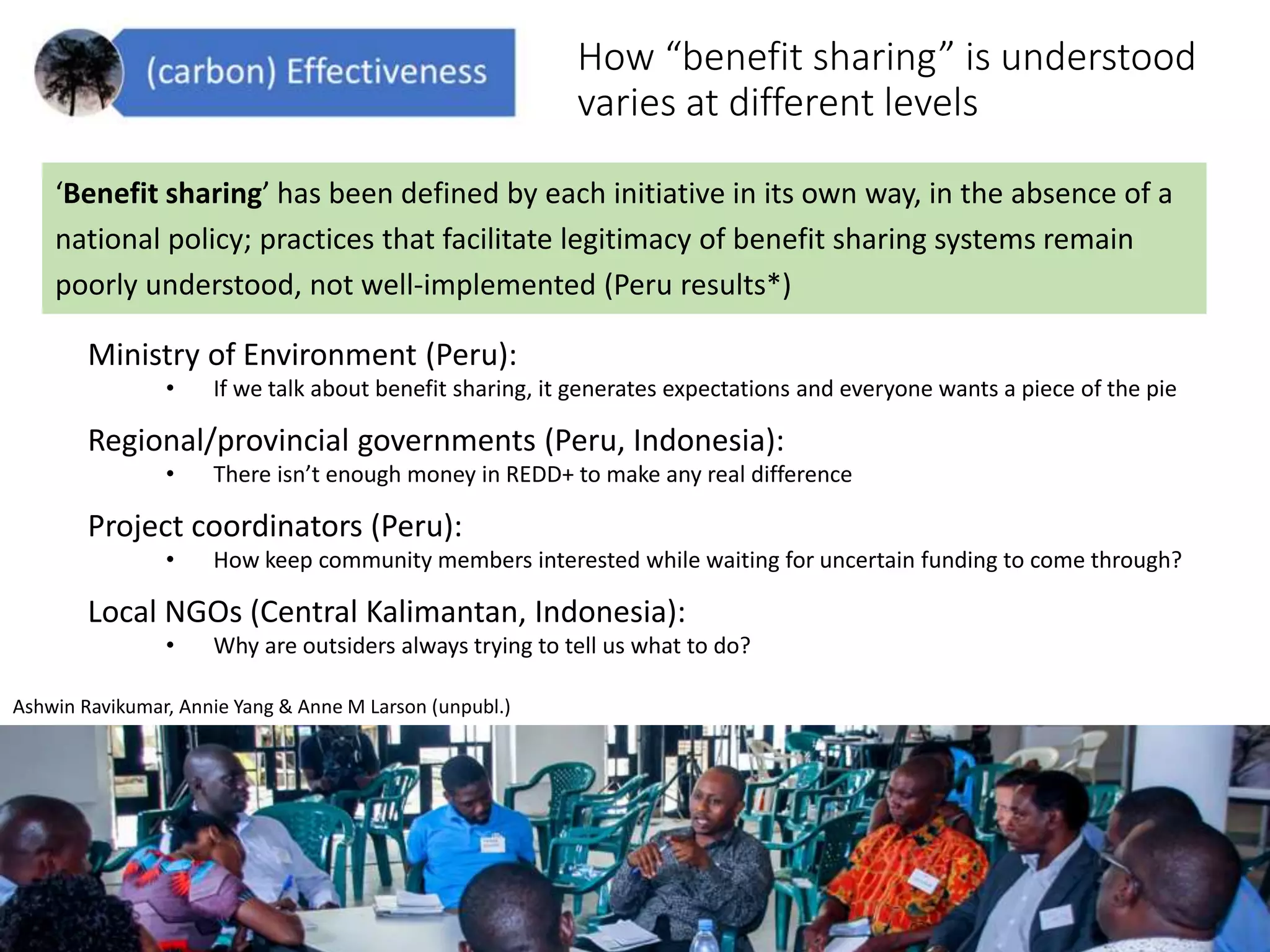
How “benefit sharing” is understood
varies at different levels
Ministry of Environment (Peru):
• If we talk about benefit sharing, it generates expectations and everyone wants a piece of the pie
Regional/provincial governments (Peru, Indonesia):
• There isn’t enough money in REDD+ to make any real difference
Project coordinators (Peru):
• How keep community members interested while waiting for uncertain funding to come through?
Local NGOs (Central Kalimantan, Indonesia):
• Why are outsiders always trying to tell us what to do?
Ashwin Ravikumar, Annie Yang & Anne M Larson (unpubl.)
‘Benefit sharing’ has been defined by each initiative in its own way, in the absence of a
national policy; practices that facilitate legitimacy of benefit sharing systems remain
poorly understood, not well-implemented (Peru results*)
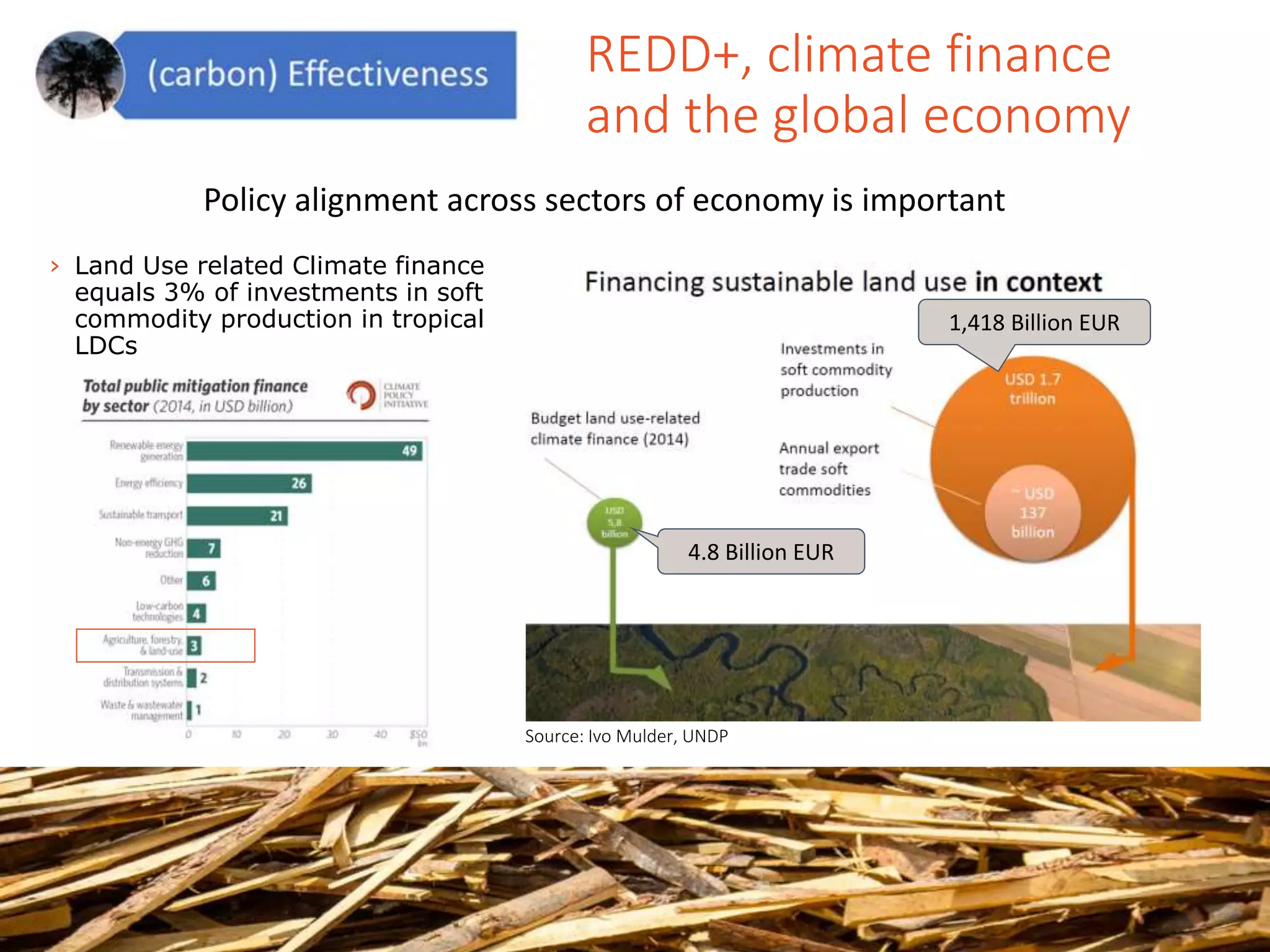
REDD+, climate finance
and the global economy
Source: Ivo Mulder, UNDP
› Land Use related Climate finance
equals 3% of investments in soft
commodity production in tropical
LDCs
4.8 Billion EUR
1,418 Billion EUR
Policy alignment across sectors of economy is important
Compensating forest users for the opportunity costs of foregoing deforestation
and degradation?
• Opportunity costs per t CO2 from deforestation
• were less than the social cost ($36) of carbon emissions in 16 of 17
sites
•  compensating households to reduce emissions makes economic
sense from a global perspective in all but one Tanzanian site
• were higher than the 2015 voluntary market carbon price in 11 of 17
sites ($3.30)
• Poorer households
• had lower opportunity costs from deforestation and degradation
• would benefit more than rich households from flat payments
Ickowitz et al. 2017
We estimated smallholder opportunity costs of REDD+ for 17 sites in 6 countries
Country (number of
initiatives)
Annual OC
[US$ per tonne C ]
Brazil (5) 0.95-6.89
Peru (2) 0.61-5.91
Cameroon (2) 1.72-6.44
Tanzania (2) [dry forests
– low C density]
9.59-84.29
Indonesia (5) 0.95-2.78
Vietnam (1) 1.94
opportunity costs
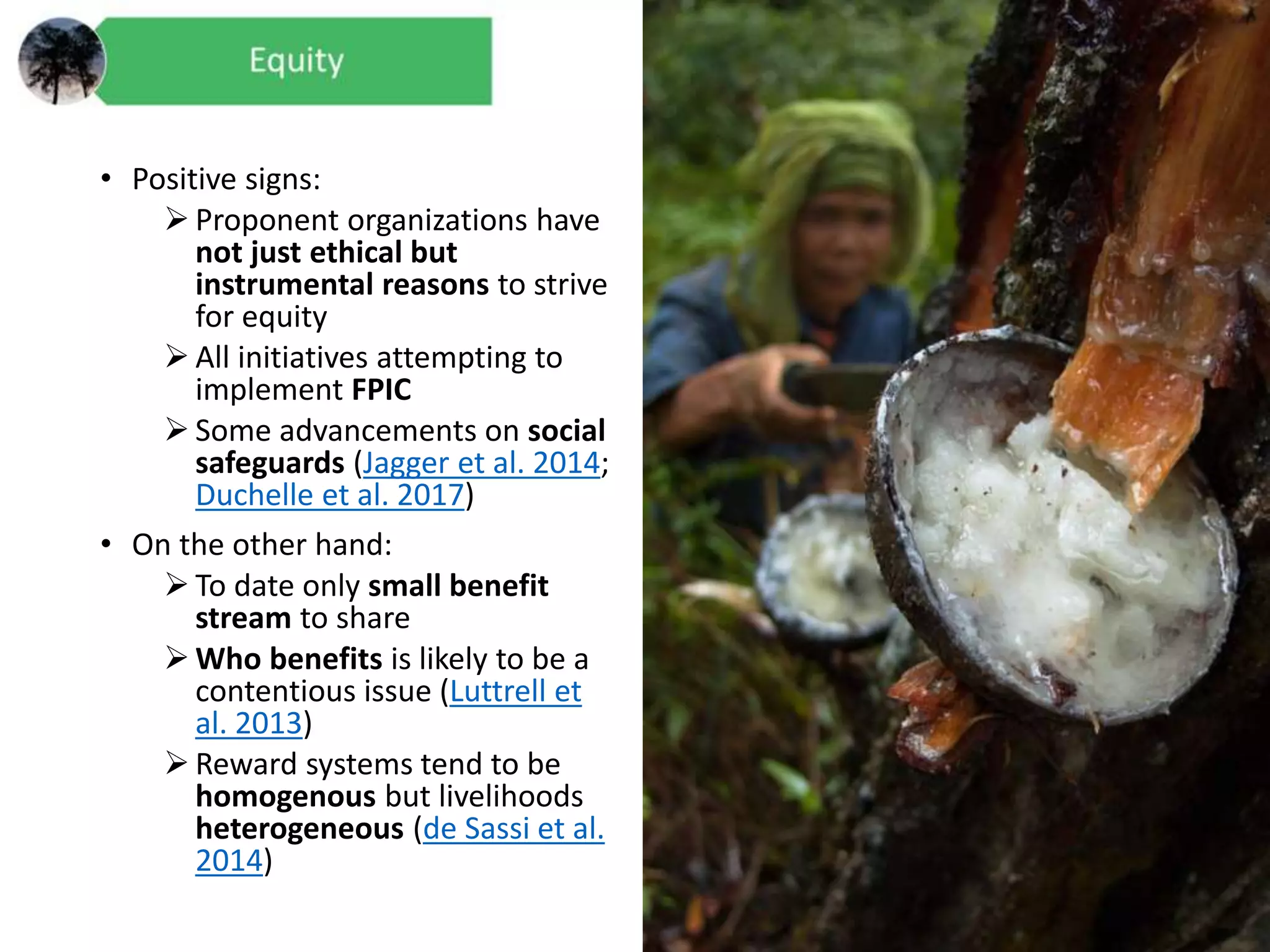
• Positive signs:
 Proponent organizations have
not just ethical but
instrumental reasons to strive
for equity
 All initiatives attempting to
implement FPIC
 Some advancements on social
safeguards (Jagger et al. 2014;
Duchelle et al. 2017)
• On the other hand:
 To date only small benefit
stream to share
 Who benefits is likely to be a
contentious issue (Luttrell et
al. 2013)
 Reward systems tend to be
homogenous but livelihoods
heterogeneous (de Sassi et al.
2014)
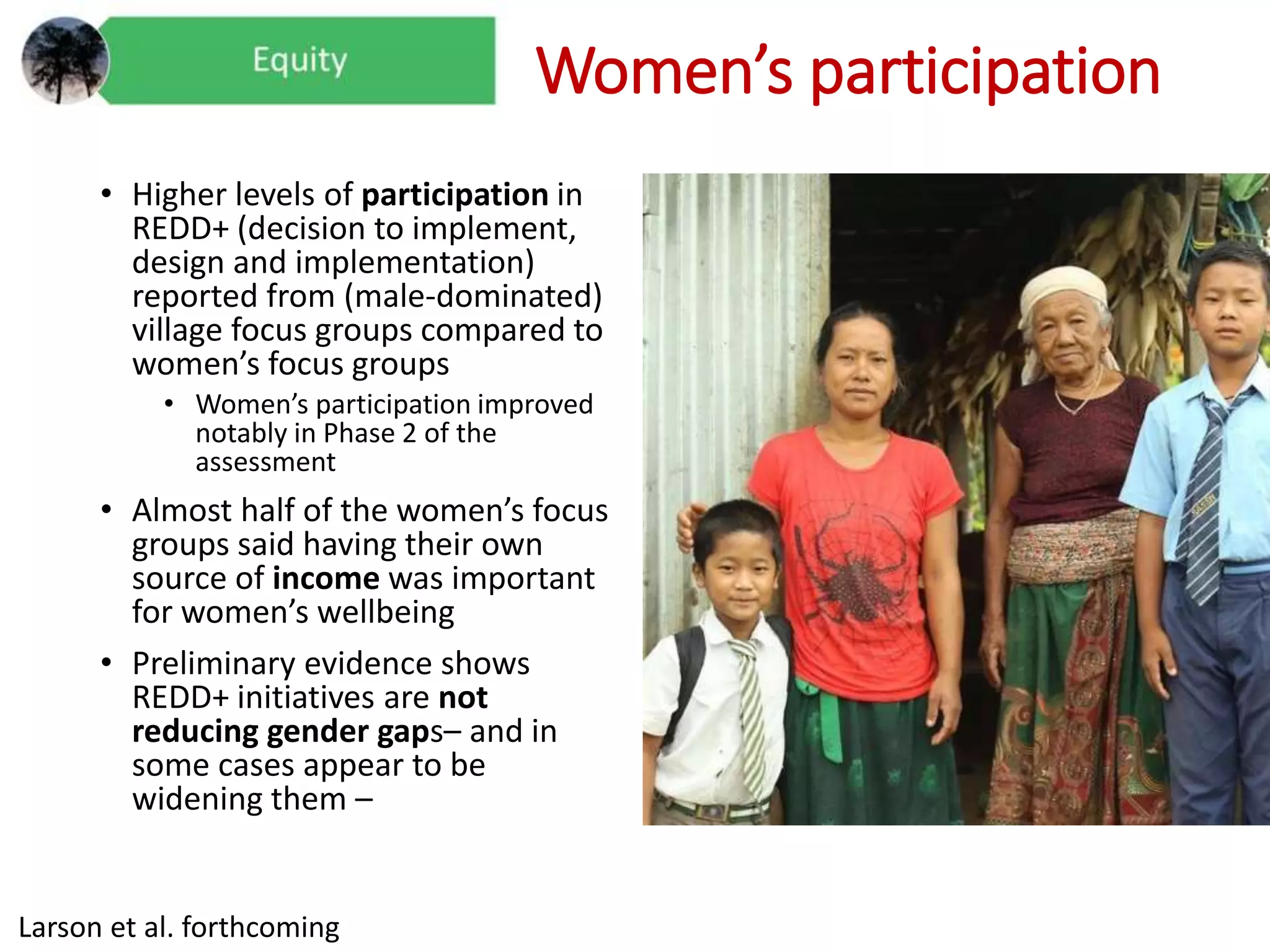
Women’s participation
• Higher levels of participation in
REDD+ (decision to implement,
design and implementation)
reported from (male-dominated)
village focus groups compared to
women’s focus groups
• Women’s participation improved
notably in Phase 2 of the
assessment
• Almost half of the women’s focus
groups said having their own
source of income was important
for women’s wellbeing
• Preliminary evidence shows
REDD+ initiatives are not
reducing gender gaps– and in
some cases appear to be
widening them –
Larson et al. forthcoming
Some thoughts for
equitable REDD+ design
• Distributional equity: Understanding the
types and variation in costs and who is
bearing different costs of REDD+ will be
critical in setting incentives for effective
and equitable outcomes
• Importance of non-cash benefits
• Procedural equity: Enabling broad
participation and transparent access to
REDD+ design process and data (including
review of performance) can support
legitimacy
• Contextual equity: Ensuring agreement
on what constitutes as performance,
outcomes and their indicators will be
critical to national/local ownership
• Safeguards: required for results-based
finance but risks being a simple checklist
in the absence of open review
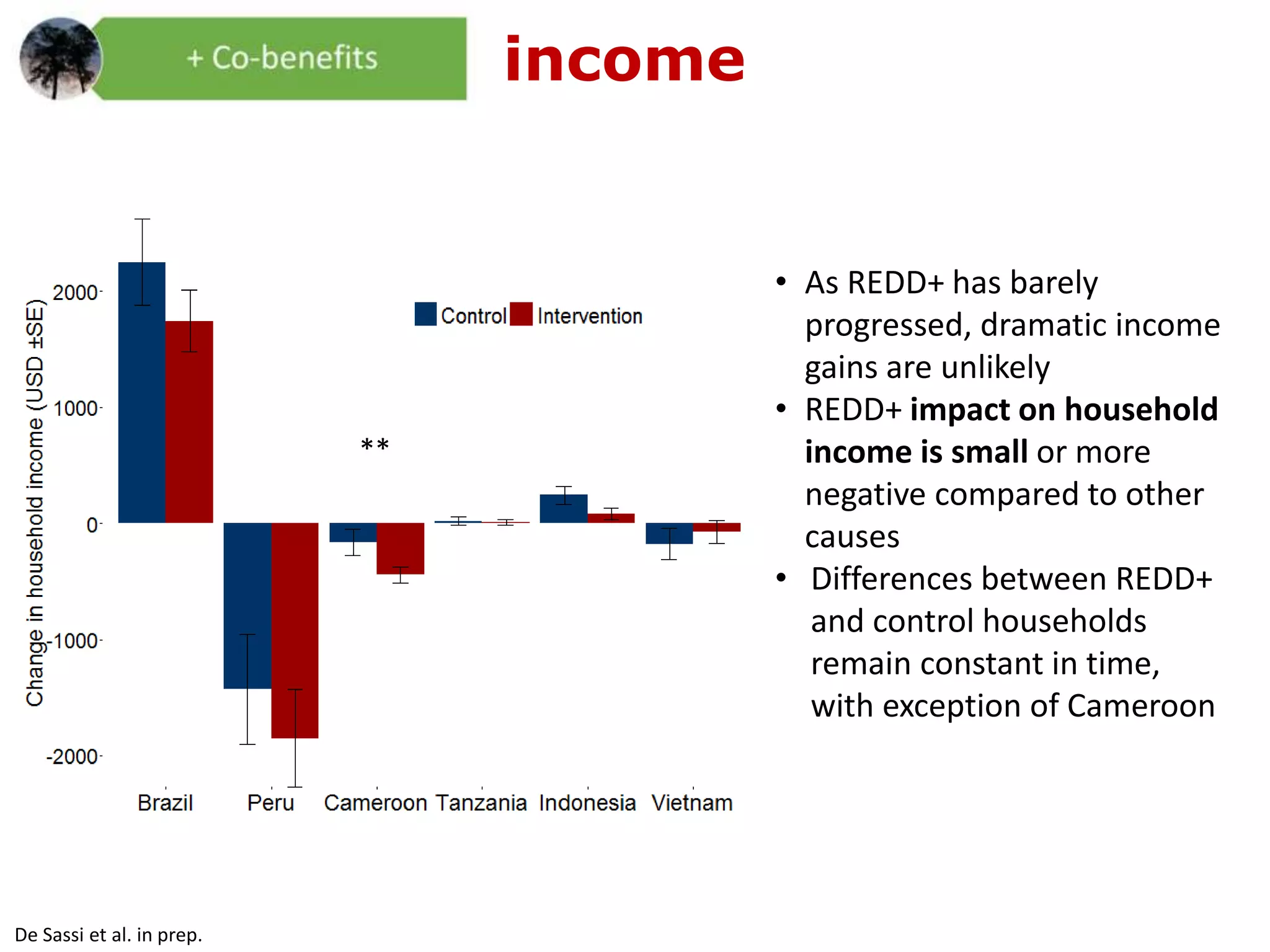
income
**
• As REDD+ has barely
progressed, dramatic income
gains are unlikely
• REDD+ impact on household
income is small or more
negative compared to other
causes
• Differences between REDD+
and control households
remain constant in time,
with exception of Cameroon
**
De Sassi et al. in prep.
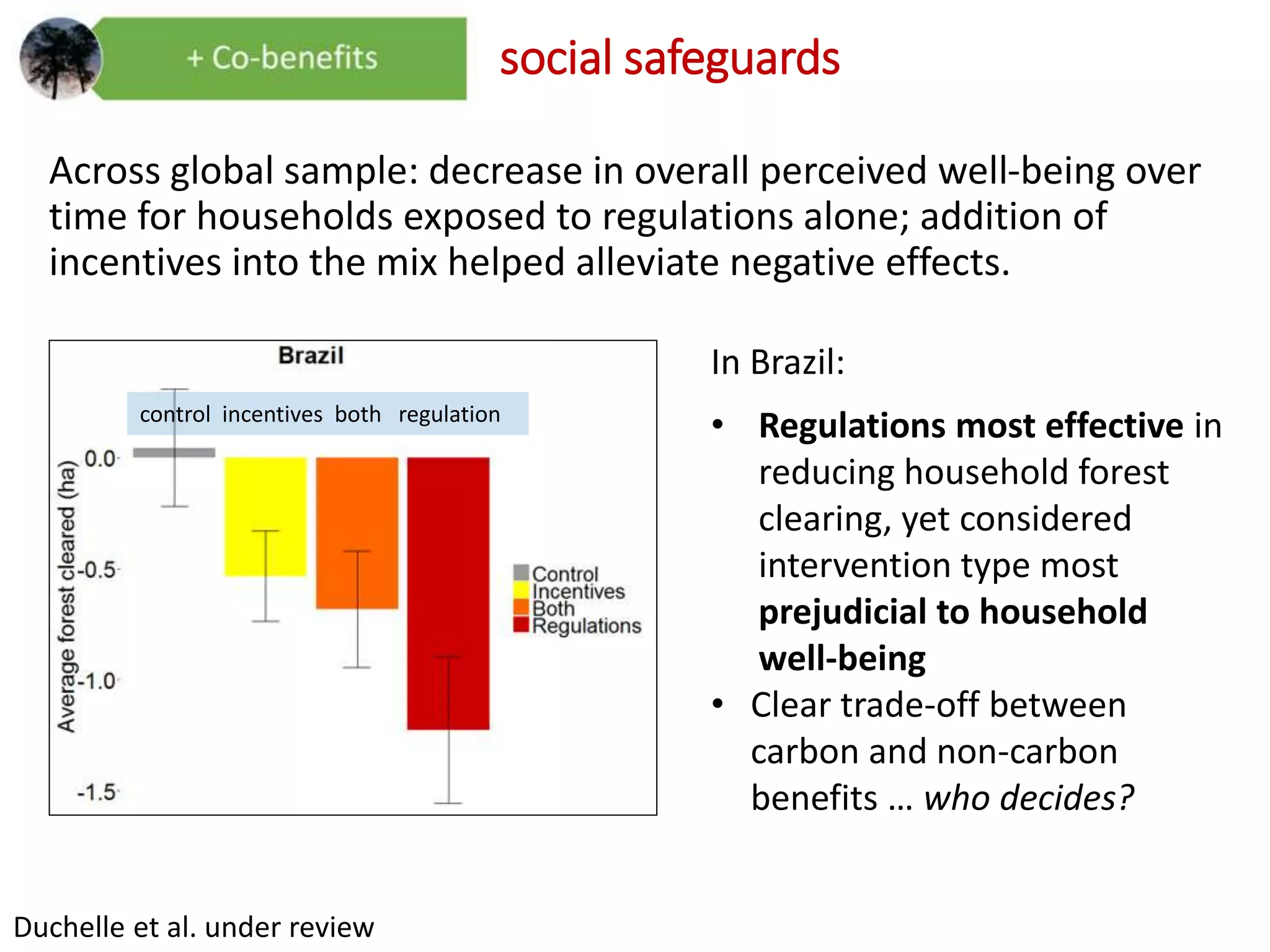
social safeguards
Across global sample: decrease in overall perceived well-being over
time for households exposed to regulations alone; addition of
incentives into the mix helped alleviate negative effects.
Duchelle et al. under review
In Brazil:
• Regulations most effective in
reducing household forest
clearing, yet considered
intervention type most
prejudicial to household
well-being
• Clear trade-off between
carbon and non-carbon
benefits … who decides?
control incentives both regulation
• Proponents have so far little to show for their efforts
• Tenure is typically solved at national level (not locally where proponents operate)
• Tenure insecurity decreased only slightly across sample
• Being in a REDD+ intervention area decreased smallholder tenure insecurity only in Cameroon,
and has increased insecurity of smallholder agricultural land tenure in Brazil
• main reasons reported for worsening tenure security: outside companies, lack of
title, and competition from neighboring villagers
• Slightly positive views of villagers on the effect of tenure interventions, including on
interventions that restrain access to forest
tenure
Sunderlin et al. under review
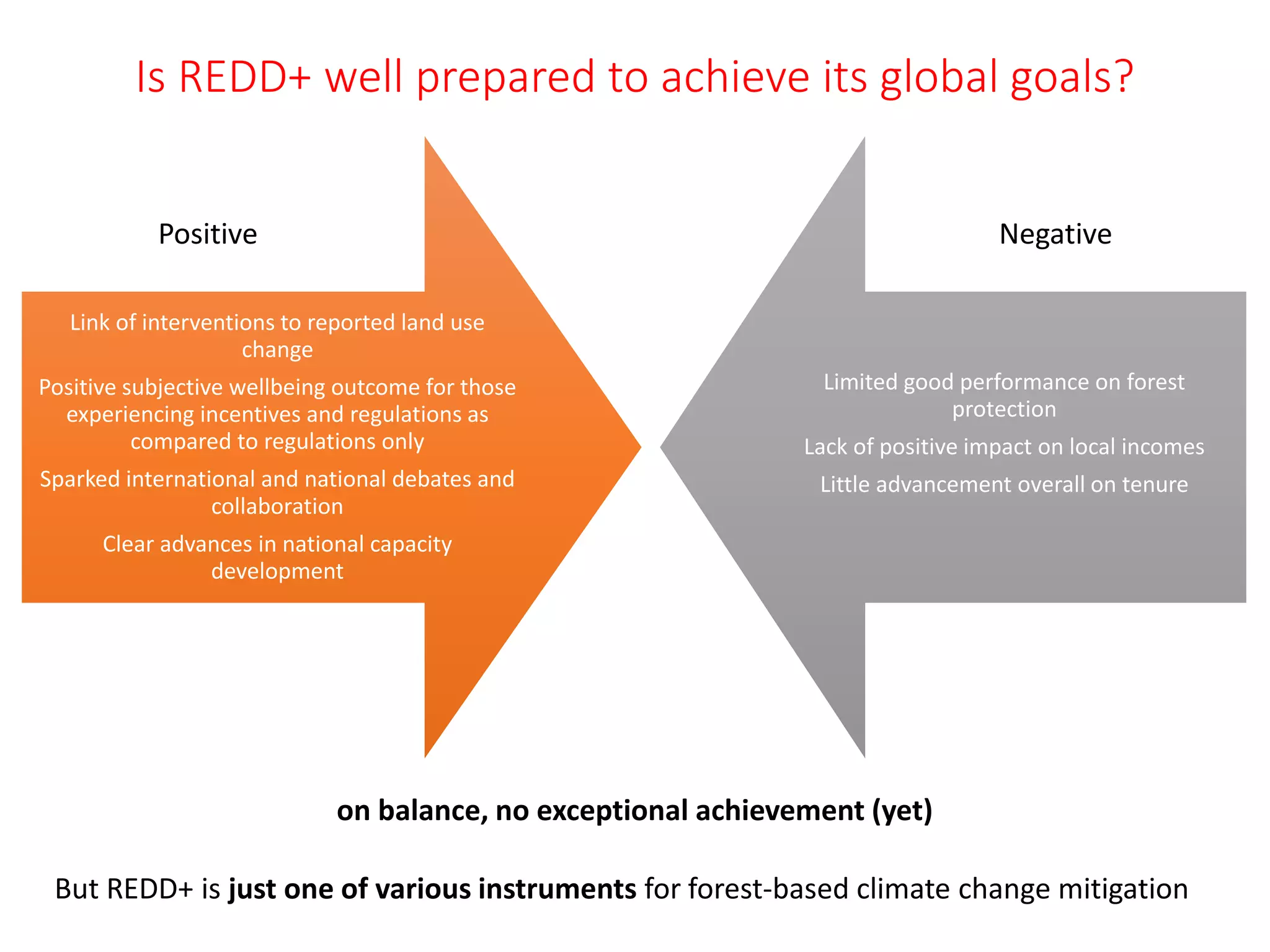
Is REDD+ well prepared to achieve its global goals?
on balance, no exceptional achievement (yet)
But REDD+ is just one of various instruments for forest-based climate change mitigation
Link of interventions to reported land use
change
Positive subjective wellbeing outcome for those
experiencing incentives and regulations as
compared to regulations only
Sparked international and national debates and
collaboration
Clear advances in national capacity
development
Limited good performance on forest
protection
Lack of positive impact on local incomes
Little advancement overall on tenure
Positive Negative
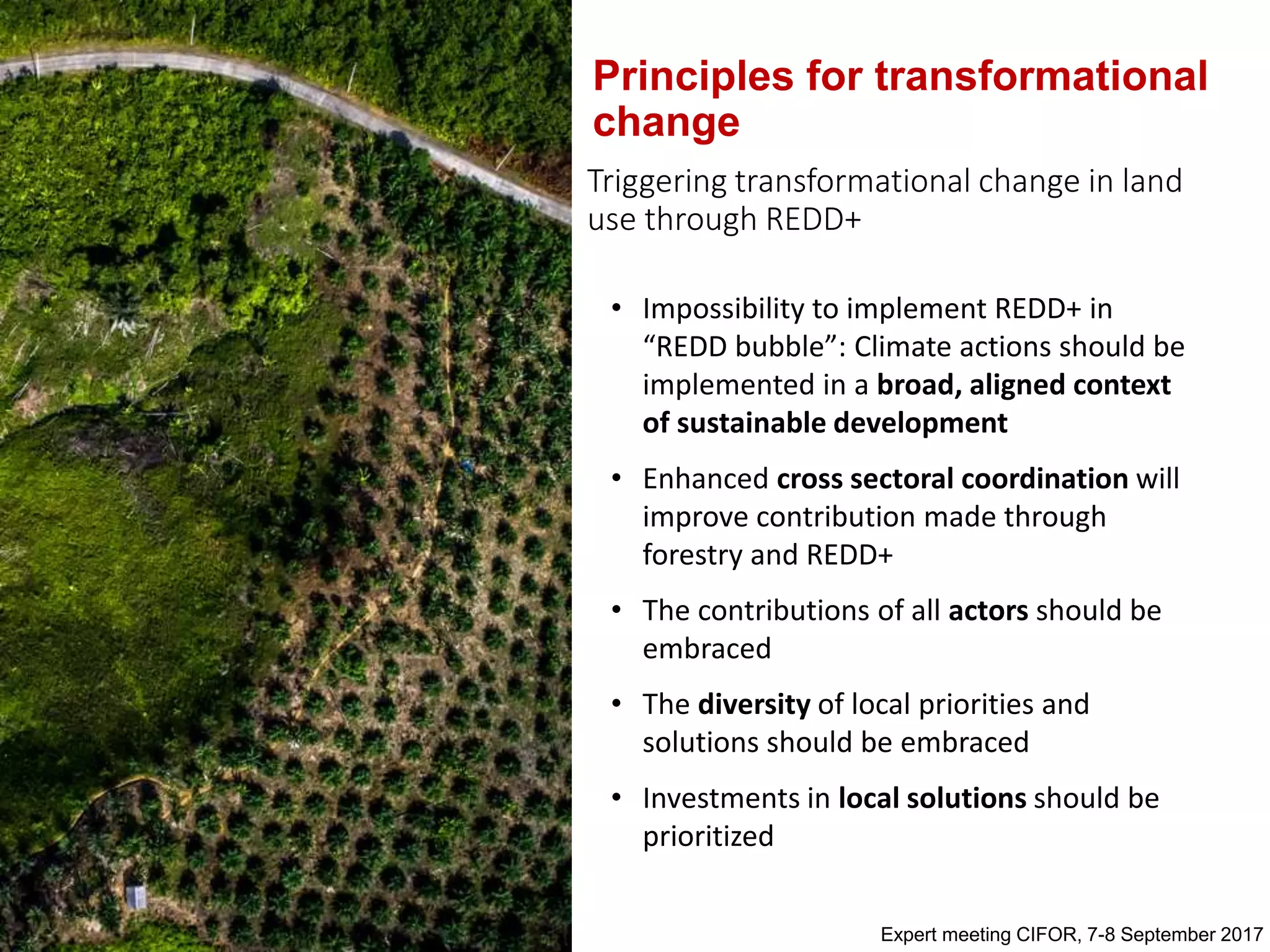
Triggering transformational change in land
use through REDD+
• Impossibility to implement REDD+ in
“REDD bubble”: Climate actions should be
implemented in a broad, aligned context
of sustainable development
• Enhanced cross sectoral coordination will
improve contribution made through
forestry and REDD+
• The contributions of all actors should be
embraced
• The diversity of local priorities and
solutions should be embraced
• Investments in local solutions should be
prioritized
Expert meeting CIFOR, 7-8 September 2017
Principles for transformational
change
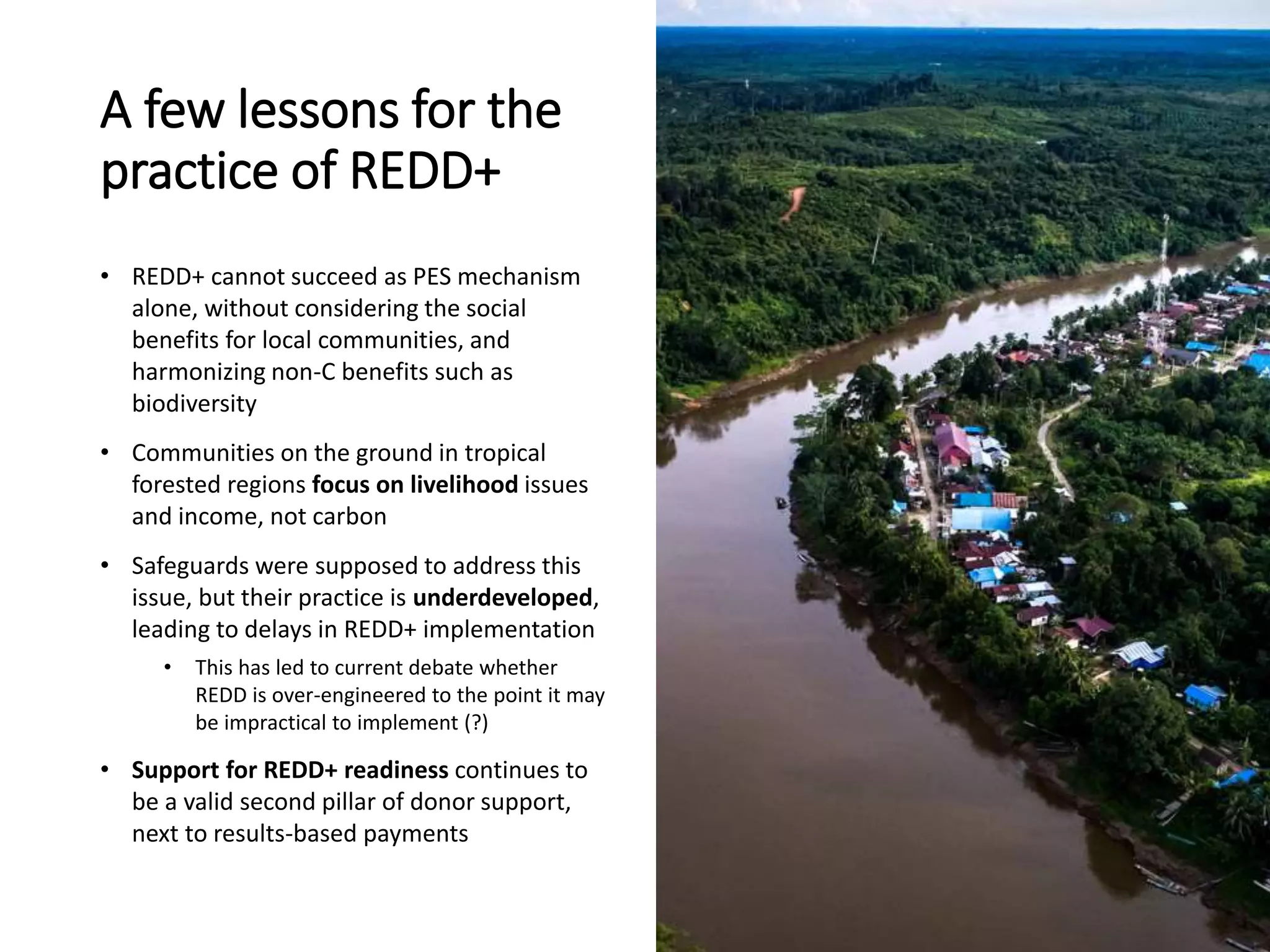
A few lessons for the
practice of REDD+
• REDD+ cannot succeed as PES mechanism
alone, without considering the social
benefits for local communities, and
harmonizing non-C benefits such as
biodiversity
• Communities on the ground in tropical
forested regions focus on livelihood issues
and income, not carbon
• Safeguards were supposed to address this
issue, but their practice is underdeveloped,
leading to delays in REDD+ implementation
• This has led to current debate whether
REDD is over-engineered to the point it may
be impractical to implement (?)
• Support for REDD+ readiness continues to
be a valid second pillar of donor support,
next to results-based payments
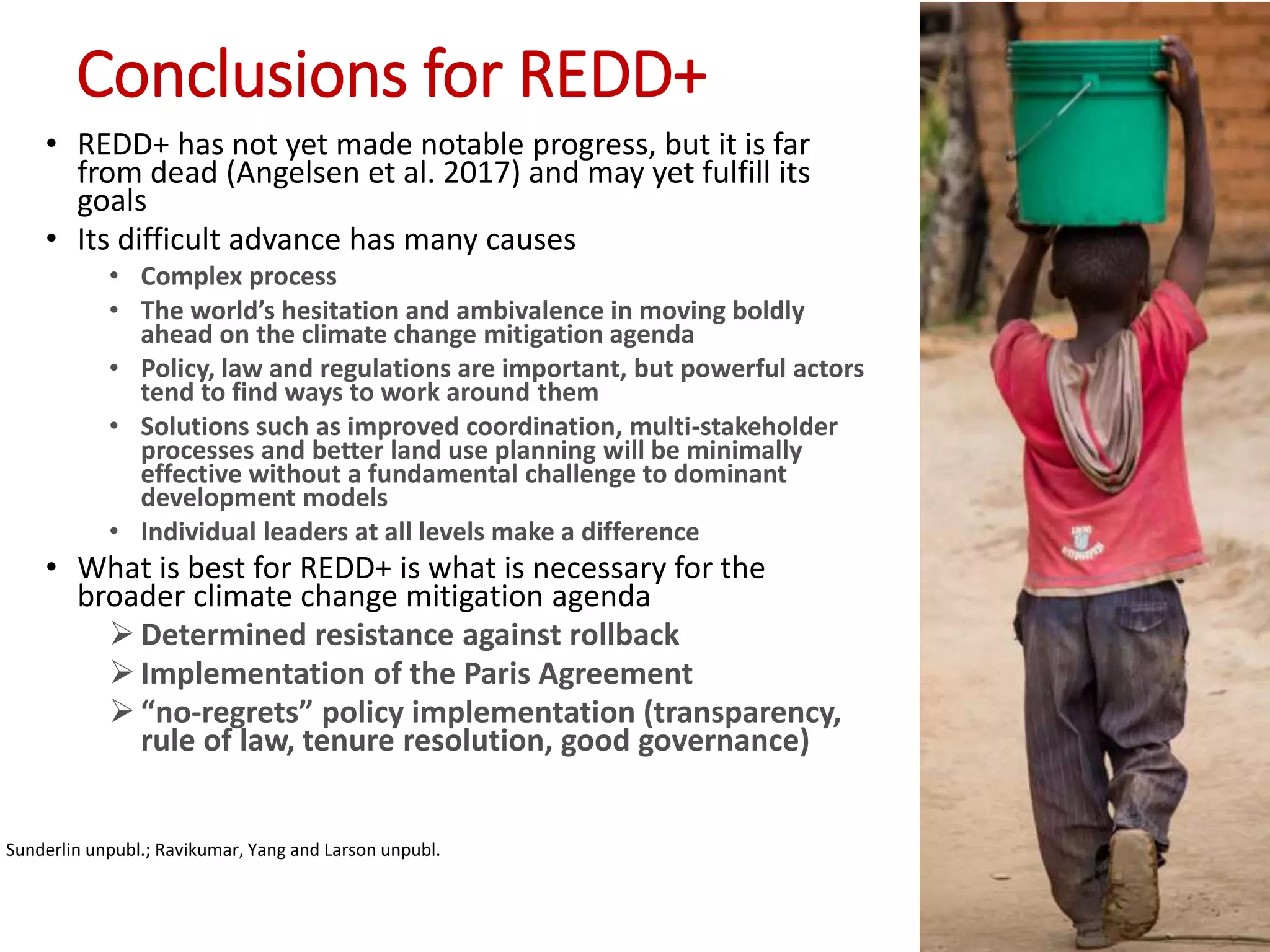
Conclusions for REDD+
• REDD+ has not yet made notable progress, but it is far
from dead (Angelsen et al. 2017) and may yet fulfill its
goals
• Its difficult advance has many causes
• Complex process
• The world’s hesitation and ambivalence in moving boldly
ahead on the climate change mitigation agenda
• Policy, law and regulations are important, but powerful actors
tend to find ways to work around them
• Solutions such as improved coordination, multi-stakeholder
processes and better land use planning will be minimally
effective without a fundamental challenge to dominant
development models
• Individual leaders at all levels make a difference
• What is best for REDD+ is what is necessary for the
broader climate change mitigation agenda
 Determined resistance against rollback
 Implementation of the Paris Agreement
 “no-regrets” policy implementation (transparency,
rule of law, tenure resolution, good governance)
Sunderlin unpubl.; Ravikumar, Yang and Larson unpubl.
REDD+ as a learning experience
• The question is not:
“should we continue
with REDD+ or not”?
• But rather:
“What have we learned
that can make our effort
to reduce forest
emissions more effective,
efficient and equitable?”
• Both, dismissing REDD+,
and telling unfounded
success stories,
prevent that learning
• The writing of lessons
learned has just begun
cifor.org
blog.cifor.org
ForestsTreesAgroforestry.org
THANK YOU!
www.cifor.org/gcs
Great thanks to

Moving from readiness to performance-based payments

  • 1.
    REDD+ Reducing emissions fromdeforestation and forest degradation in developing countries, and the role of conservation, sustainable management of forests, and enhancement of forest carbon stocks in developing countries • Reducing emissions from deforestation • Reducing emissions from forest degradation • Conservation of forest carbon stocks • Sustainable management of forests • Enhancement of forest carbon stocks Part i: overview MOVING FROM READINESS TO PERFORMANCE-BASED PAYMENTS LESSONS LEARNT FROM CIFOR’S GLOBAL COMPARATIVE STUDY ON REDD+ CIFOR GCS-REDD+ Team For ASIA PACIFIC RAINFOREST SUMMIT
  • 2.
    REDD+ Reducing emissions from deforestationand forest degradation in developing countries, and the role of conservation, sustainable management of forests, and enhancement of forest carbon stocks in developing countries • Reducing emissions from deforestation • Reducing emissions from forest degradation • Conservation of forest carbon stocks • Sustainable management of forests • Enhancement of forest carbon stocks
  • 3.
    10 years ofREDD+ • COP13 Bali (2007): Bali Action Plan – Parties commitment to include REDD om a post-2012 climate agreement (Decision 2/CP.13). • COP15 Copenhagen (2009): Copenhagen Accord and establishment of a REDD+ mechanism, including the five activities and methodological guidance for REDD+ (Decision 4/CP.15). • COP16 Cancun (2010): Cancun Agreements and REDD+ "requirements": national strategy/action plan, FREL/FRL, national forest monitoring systems and safeguard information systems (SIS). Establishment of 7 safeguards and the REDD+ phase approach. • COP19 Warsaw (2013): Warsaw Framework for REDD+ and 7 decisions on REDD+ (on finance and institutional agreement mechanisms). • COP21 Paris (2015): REDD+ as part of Paris Agreement which came into force on 4 November 2016 • COP 22 Marrakesh (2016): focus on finance, transparency and Nationally Determined Contributions (NDCs) • Green Climate Fund: 43 projects at 2.2 billion USD since late 2015. Results- Based Payments Strategy finished in 2017. First call for projects. • REDD+ in NDCs: 39 countries (27%) listed REDD+ in their INDCs representing the bulk of global LULUCF emissions (UNFCCC Synthesis Report)
  • 4.
    CIFOR’s Global ComparativeStudy on REDD+ • To support REDD+ policy arenas and practitioner communities with • information • analysis • tools • to ensure 3E+ outcomes for REDD+: • effectiveness (to reach C and non-C benefits) • (cost-) efficiency • equity • + co-benefits Effective REDD+ policy National and global policies, measures and commitments REDD+ performance Rigorous assessment in 6 countries, 23 sites, 150 villages, 4,000+ households; global overview Integrating REDD+ in the landscape Multilevel governance, stakeholder platforms, development Monitoring, Measuring, Reporting and Verification Baslines, reference levels, drivers, capacity development Partnerengagementanddissemination
  • 5.
    Where we workin this study
  • 6.
    Carrots and sticks: WhatREDD+ has aimed to do • Be a pioneering approach to climate change mitigation • Make forest protection more profitable than forest conversion by paying the cost of foregone forest conversion • Create a reward system for protecting/enhancing forests in measurable way • Mix of positive & negative incentives (as in ICDP) • Policies and Measures (PAM) to support effort Wikimedia Commons
  • 7.
    REDD+ evolution: subnationalinitiatives By 2014, there were 347 active projects/subnational initiatives in 57 countries Location of REDD+ projects/subnational initiatives Simonet et al. 2015
  • 8.
    REDD+ evolution: subnationalinitiatives As of September 2016, there were 344 active projects/subnational initiatives in 56 countries. Location of REDD+ projects/subnational initiatives Simonet et al. 2017
  • 13.
    Overall REDD+ progress Movingslowly from readiness to results-based finance • Uncertainty about REDD+ finance and carbon market affects country commitments and overall REDD+ progress  need for more certainty about finance to provide credibility for shifts in incentives • Brazil, Indonesia, Vietnam, Guyana show significant progress, with more comprehensive policies and improved institutional setting • It is often assumed that early-mover countries have already progressed with REDD+ to a stage where ‘payments for performance’ can be made • However, some early-mover countries –Indonesia, Vietnam, Mozambique and Papua New Guinea – are still struggling with policy design and implementation  late-comer countries could yet catch up What is progress? The establishment of comprehensive policies targeting transformational change in REDD+ policy What is transformational change? ‘a shift in discourse, attitudes, power relations, and deliberate policy and protest action that leads policy formulation and implementation away from business as usual policy approaches that directly or indirectly support deforestation and forest degradation’
  • 14.
    Progress of REDD+ CountryREDD+ 2012 2014 2016 Brazil 1 1 1 Guyana - 1 1 Peru 0 0 1 Burkina Faso 0 0 0 Cameroon 0 0 0 DRC 0 1 1 Ethiopia - 0 1 Mozambique 0 0 1 Tanzania 0 1 0 Indonesia 1 1 1 Nepal 0 0 0 PNG 0 0 0 Vietnam 1 1 0 • Progress, but incomplete • Brazil (inclusive decision making) • Guyana (performance based funding) • Indonesia (effective legal framework addressing drivers of deforestation and degradation) • DRC (lack of ownership + effective legal framework addressing drivers of deforestation and degradation) • New progress: Peru, Ethiopia, Mozambique with performance-based funding and transformational coalitions • Unstable conditions: REDD+ countries moving back and forth: Vietnam and Tanzania, lacking both performance-based funding and coalitions + weakened interest and political interest • No or little progress: Cameroon, Nepal, PNG, Burkina Faso Korhonen-Kurki, K., Brockhaus, M., Sehring, J., DiGreggio, M. + all the country experts. What drives for change? A qualitative comparative analysis on enabling conditions for establishing REDD+. Forthcoming
  • 15.
    Is REDD+ wellprepared to achieve its global goals? 3E+ (carbon) Effectiveness (cost-) Efficiency Equity + Co-benefits
  • 16.
    REDD+ effectiveness: Noteasy to determine REDD+ performance assessment Methodology Global Forest Change (Hansen) data to create forest masks and assess change Development of BACI method to assess effectiveness of 23 REDD+ initiatives Comparison of scales: meso vs micro; and method: BACI vs simpler Before-After (BA)
  • 17.
    Results Better REDD+ performancewhen including control areas (i.e. when TC change is put in context) REDD+ effect is more pronounced at the village than at the REDD+ initiative (project) level Discussion/ conclusion Proper control areas selection is vital, but not straightforward Poor matching (different pre-intervention deforestation) Low absolute deforestation & peak years obscure results (when in ”before” period) Going local with performance assessment?  BACI useful Overall minimal impact of REDD+ in reducing deforestation on the ground thus far Bos et al. 2017 REDD+ performance assessment
  • 18.
    E2: Effectiveness administrativecosts • Many institutions are subsidizing REDD+ • More than half (56%) of burden borne by government institutions • 84% of subnational government institutions Luttrell et al. 2016; 2017
  • 19.
    • Horizontal cross-sectoralchallenges – identified as one of the central challenges to REDD+ at the national level (Brockhaus et al. 2014) – persist at the subnational level • Coordination issues (horizontal and vertical) related to scattered and non- transparent data sharing are complicated by divergent interests and needs related to “technical issues” (like MRV Kowler and Larson 2016) • Issues like land tenure are often cast in terms of project effectiveness at higher levels, but are fundamentally about equity and justice to people on the ground (Larson et al. 2013, Myers and Muhajir, 2016) Challenges of REDD+ implementation across levels
  • 20.
    Challenges of REDD+ implementationacross levels • Communities living in forests are not necessarily supportive of REDD+/ conservation initiatives due to the fear of loss of control over forests and of effects on livelihoods or rights • Perceptions are shaped by past experiences • Rights may be more important than ‘benefits’ • Processes for engaging with communities are fundamental for winning support and legitimacy • Legitimate processes are based on effective communication, broad-based participation and effective representation, and a clear definition of roles and expectations • At all levels, from national to subnational and local, ‘ownership’ of initiatives for change is key to legitimacy, and to finding embedded and sustainable solutions • Thought leaders matter… • The same rules are applied in different/better ways because of committed individuals Ashwin Ravikumar, Annie Yang & Anne M Larson (unpubl.)
  • 21.
    How “benefit sharing”is understood varies at different levels Ministry of Environment (Peru): • If we talk about benefit sharing, it generates expectations and everyone wants a piece of the pie Regional/provincial governments (Peru, Indonesia): • There isn’t enough money in REDD+ to make any real difference Project coordinators (Peru): • How keep community members interested while waiting for uncertain funding to come through? Local NGOs (Central Kalimantan, Indonesia): • Why are outsiders always trying to tell us what to do? Ashwin Ravikumar, Annie Yang & Anne M Larson (unpubl.) ‘Benefit sharing’ has been defined by each initiative in its own way, in the absence of a national policy; practices that facilitate legitimacy of benefit sharing systems remain poorly understood, not well-implemented (Peru results*)
  • 22.
    REDD+, climate finance andthe global economy Source: Ivo Mulder, UNDP › Land Use related Climate finance equals 3% of investments in soft commodity production in tropical LDCs 4.8 Billion EUR 1,418 Billion EUR Policy alignment across sectors of economy is important
  • 23.
    Compensating forest usersfor the opportunity costs of foregoing deforestation and degradation? • Opportunity costs per t CO2 from deforestation • were less than the social cost ($36) of carbon emissions in 16 of 17 sites •  compensating households to reduce emissions makes economic sense from a global perspective in all but one Tanzanian site • were higher than the 2015 voluntary market carbon price in 11 of 17 sites ($3.30) • Poorer households • had lower opportunity costs from deforestation and degradation • would benefit more than rich households from flat payments Ickowitz et al. 2017 We estimated smallholder opportunity costs of REDD+ for 17 sites in 6 countries Country (number of initiatives) Annual OC [US$ per tonne C ] Brazil (5) 0.95-6.89 Peru (2) 0.61-5.91 Cameroon (2) 1.72-6.44 Tanzania (2) [dry forests – low C density] 9.59-84.29 Indonesia (5) 0.95-2.78 Vietnam (1) 1.94 opportunity costs
  • 24.
    • Positive signs: Proponent organizations have not just ethical but instrumental reasons to strive for equity  All initiatives attempting to implement FPIC  Some advancements on social safeguards (Jagger et al. 2014; Duchelle et al. 2017) • On the other hand:  To date only small benefit stream to share  Who benefits is likely to be a contentious issue (Luttrell et al. 2013)  Reward systems tend to be homogenous but livelihoods heterogeneous (de Sassi et al. 2014)
  • 25.
    Women’s participation • Higherlevels of participation in REDD+ (decision to implement, design and implementation) reported from (male-dominated) village focus groups compared to women’s focus groups • Women’s participation improved notably in Phase 2 of the assessment • Almost half of the women’s focus groups said having their own source of income was important for women’s wellbeing • Preliminary evidence shows REDD+ initiatives are not reducing gender gaps– and in some cases appear to be widening them – Larson et al. forthcoming
  • 26.
    Some thoughts for equitableREDD+ design • Distributional equity: Understanding the types and variation in costs and who is bearing different costs of REDD+ will be critical in setting incentives for effective and equitable outcomes • Importance of non-cash benefits • Procedural equity: Enabling broad participation and transparent access to REDD+ design process and data (including review of performance) can support legitimacy • Contextual equity: Ensuring agreement on what constitutes as performance, outcomes and their indicators will be critical to national/local ownership • Safeguards: required for results-based finance but risks being a simple checklist in the absence of open review
  • 27.
    income ** • As REDD+has barely progressed, dramatic income gains are unlikely • REDD+ impact on household income is small or more negative compared to other causes • Differences between REDD+ and control households remain constant in time, with exception of Cameroon ** De Sassi et al. in prep.
  • 28.
    social safeguards Across globalsample: decrease in overall perceived well-being over time for households exposed to regulations alone; addition of incentives into the mix helped alleviate negative effects. Duchelle et al. under review In Brazil: • Regulations most effective in reducing household forest clearing, yet considered intervention type most prejudicial to household well-being • Clear trade-off between carbon and non-carbon benefits … who decides? control incentives both regulation
  • 29.
    • Proponents haveso far little to show for their efforts • Tenure is typically solved at national level (not locally where proponents operate) • Tenure insecurity decreased only slightly across sample • Being in a REDD+ intervention area decreased smallholder tenure insecurity only in Cameroon, and has increased insecurity of smallholder agricultural land tenure in Brazil • main reasons reported for worsening tenure security: outside companies, lack of title, and competition from neighboring villagers • Slightly positive views of villagers on the effect of tenure interventions, including on interventions that restrain access to forest tenure Sunderlin et al. under review
  • 30.
    Is REDD+ wellprepared to achieve its global goals? on balance, no exceptional achievement (yet) But REDD+ is just one of various instruments for forest-based climate change mitigation Link of interventions to reported land use change Positive subjective wellbeing outcome for those experiencing incentives and regulations as compared to regulations only Sparked international and national debates and collaboration Clear advances in national capacity development Limited good performance on forest protection Lack of positive impact on local incomes Little advancement overall on tenure Positive Negative
  • 31.
    Triggering transformational changein land use through REDD+ • Impossibility to implement REDD+ in “REDD bubble”: Climate actions should be implemented in a broad, aligned context of sustainable development • Enhanced cross sectoral coordination will improve contribution made through forestry and REDD+ • The contributions of all actors should be embraced • The diversity of local priorities and solutions should be embraced • Investments in local solutions should be prioritized Expert meeting CIFOR, 7-8 September 2017 Principles for transformational change
  • 32.
    A few lessonsfor the practice of REDD+ • REDD+ cannot succeed as PES mechanism alone, without considering the social benefits for local communities, and harmonizing non-C benefits such as biodiversity • Communities on the ground in tropical forested regions focus on livelihood issues and income, not carbon • Safeguards were supposed to address this issue, but their practice is underdeveloped, leading to delays in REDD+ implementation • This has led to current debate whether REDD is over-engineered to the point it may be impractical to implement (?) • Support for REDD+ readiness continues to be a valid second pillar of donor support, next to results-based payments
  • 33.
    Conclusions for REDD+ •REDD+ has not yet made notable progress, but it is far from dead (Angelsen et al. 2017) and may yet fulfill its goals • Its difficult advance has many causes • Complex process • The world’s hesitation and ambivalence in moving boldly ahead on the climate change mitigation agenda • Policy, law and regulations are important, but powerful actors tend to find ways to work around them • Solutions such as improved coordination, multi-stakeholder processes and better land use planning will be minimally effective without a fundamental challenge to dominant development models • Individual leaders at all levels make a difference • What is best for REDD+ is what is necessary for the broader climate change mitigation agenda  Determined resistance against rollback  Implementation of the Paris Agreement  “no-regrets” policy implementation (transparency, rule of law, tenure resolution, good governance) Sunderlin unpubl.; Ravikumar, Yang and Larson unpubl.
  • 37.
    REDD+ as alearning experience • The question is not: “should we continue with REDD+ or not”? • But rather: “What have we learned that can make our effort to reduce forest emissions more effective, efficient and equitable?” • Both, dismissing REDD+, and telling unfounded success stories, prevent that learning • The writing of lessons learned has just begun
  • 38.
  • 39.

Editor's Notes

  • #17 The central role of forest in Paris Agreement makes it urgent to develop and test monitoring and evaluating of carbon effectiveness. Our study covers 23 subnational REDD initiatives in Brazil, Peru, Cameroon, Tanzania, Indonesia and Vietnam. As a proxy for deforestation, we use annual tree cover loss. We aggregate data into two periods (before and after the start of each initiative). Analysis using control areas (‘control-intervention’) suggests better REDD performance, although the effect is more pronounced at the micro than at the meso level. Yet, BACI requires more data than BA, and is subject to possible bias in the before period. Selection of proper control areas is vital, but at either scale is not straightforward. Low absolute deforestation numbers and peak years influence both our BA and BACI results. In principle, BACI is superior, with its potential to effectively control for confounding factors.
  • #18 ,
  • #20 Peru M2 results Phase 1 to phase 2: from 50% to 90% of HH aware of the project; From less than 20% to almost 60% participated in consent process; But almost none to only just over 20% provided inputs in design and implementation
  • #21 Processes are all the more important when they need to overcome past injustices
  • #28 Trying to make the last slide more readable, here I differenced out the change over time for C and I. what we notice is very different trajectories between countries but, more importantly, we see that REDD+ is having an effect in Cameroon only, whilst the other countries show some trends that were not statistically significant.
  • #29  Our global findings highlight a decrease in overall perceived well-being over time for households exposed to regulations alone, with the addition of incentives into the mix helping to alleviate these negative effects In Brazil, regulations were the only intervention effective in reducing forest clearing by smallholders, while considered the intervention that was most prejudicial to household well-being. This results highlights a clear trade-off between carbon and non-carbon benefits - . Who decides what level of trade-off is acceptable? Although social safeguards have the potential to empower local people in REDD+, the clear rules and guidance that are in place for MRV of carbon emissions do not exist for assessing the social performance of REDD+. Thus, REDD+ is still open to interpretation by different actors with different interests on acceptable level of trade-offs between carbon and non-carbon goals.