Learning to Teach: What Our Students
Taught Us About Teaching, Learning, and
Schools
• Brittany Rathway
– Developing Reading Ability Through Multiple
Reading Intervention Strategies

• Cierra Cupini
• Julia Chevlin
Developing Reading Ability Through Multiple Reading
Intervention Strategies

Brittany Rathway
West Virginia University
East Dale Elementary School
Purpose for my study
• Individual intervention
• Services being implemented were not beneficial
• Determined and motivated

• David’s constant struggle
• Influence of multiple intervention strategies
– How can implementing multiple reading intervention
strategies influence the reading ability of a third grade
student with a learning disability?
Context and Participant
• Fairmont, Marion County, West Virginia

• East Dale Elementary School
• Resource Room K-5

• Nine year old, Third grade male student
• Identified with a learning disability in reading,
ADHD, services for speech, memory issue
Methodology
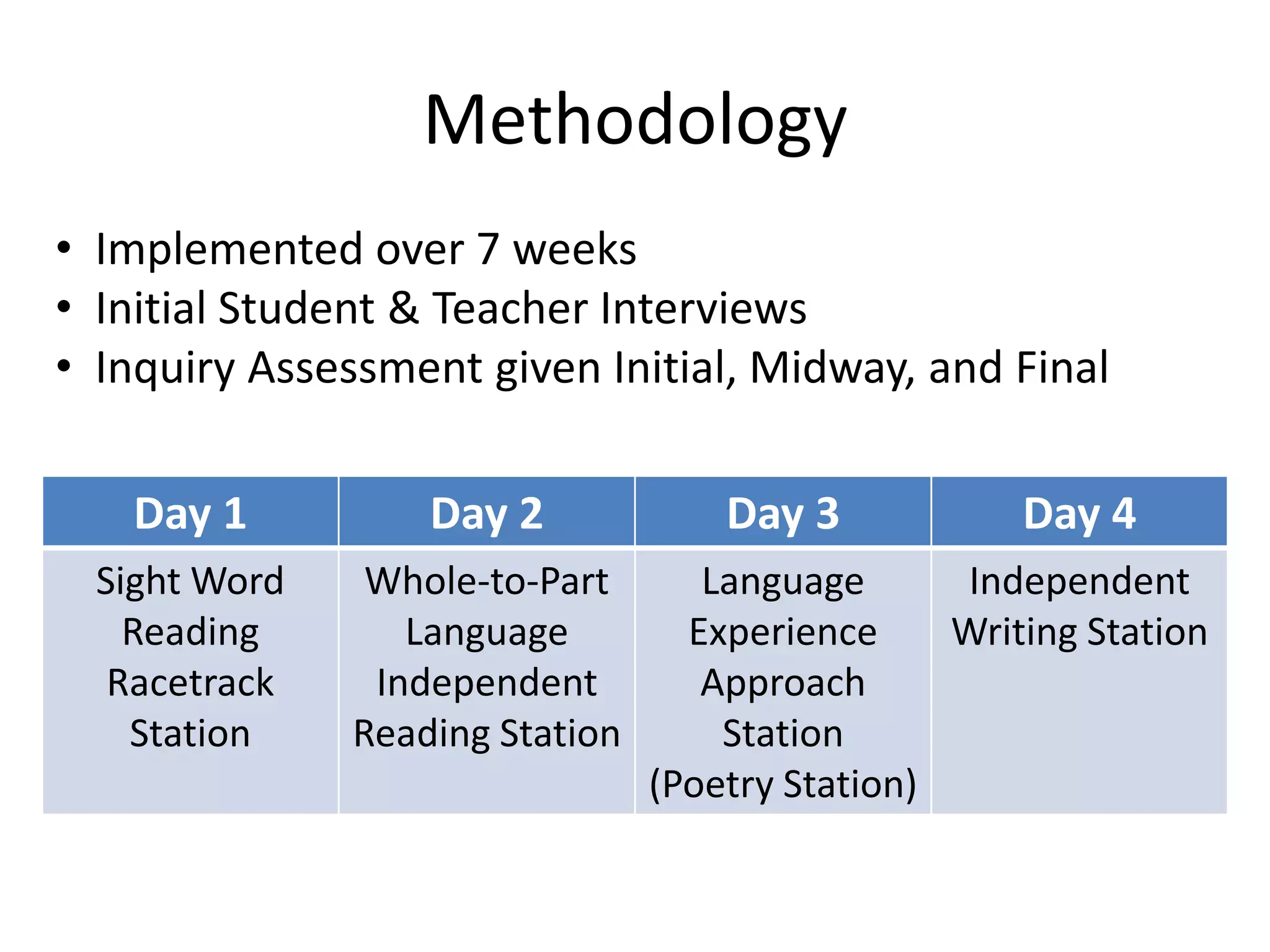
• Implemented over 7 weeks
• Initial Student & Teacher Interviews
• Inquiry Assessment given Initial, Midway, and Final
Day 1

Day 2

Sight Word
Reading
Racetrack
Station

Whole-to-Part
Language
Independent
Reading Station

Day 3

Day 4

Language
Independent
Experience
Writing Station
Approach
Station
(Poetry Station)
Data Sources and Analysis
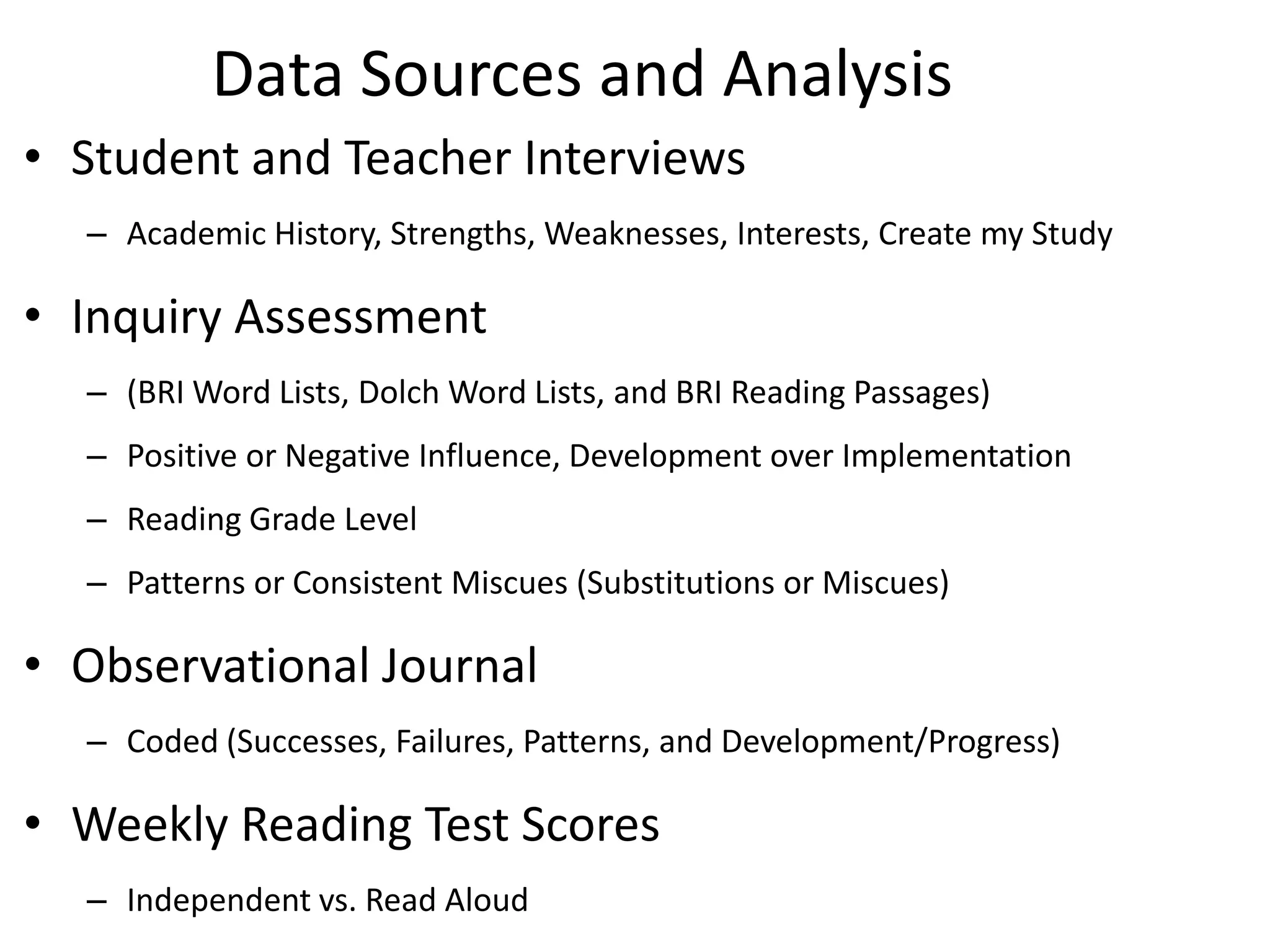
• Student and Teacher Interviews
– Academic History, Strengths, Weaknesses, Interests, Create my Study

• Inquiry Assessment
– (BRI Word Lists, Dolch Word Lists, and BRI Reading Passages)
– Positive or Negative Influence, Development over Implementation
– Reading Grade Level
– Patterns or Consistent Miscues (Substitutions or Miscues)

• Observational Journal
– Coded (Successes, Failures, Patterns, and Development/Progress)

• Weekly Reading Test Scores
– Independent vs. Read Aloud
Results: Student Interview
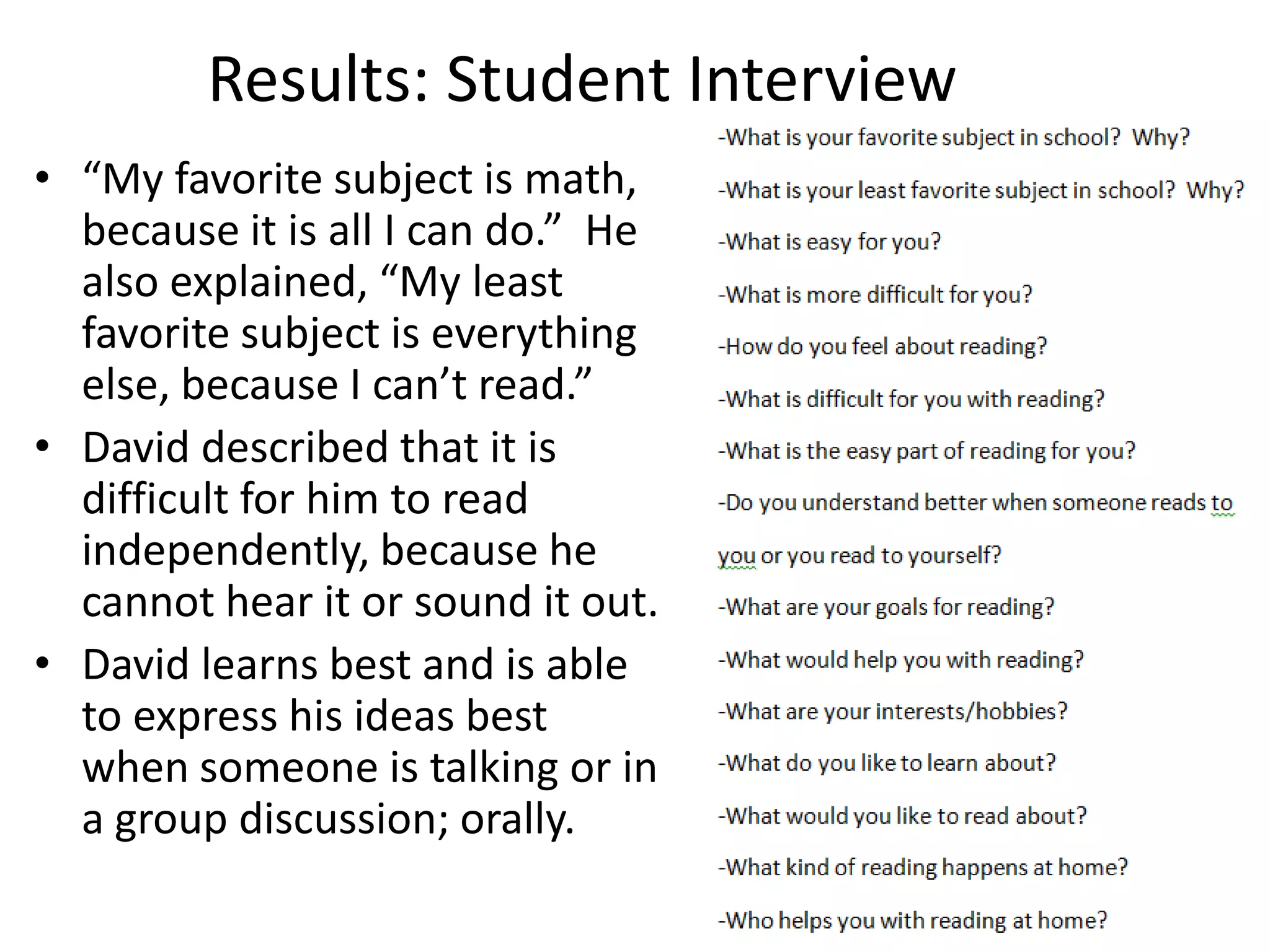
• “My favorite subject is math,
because it is all I can do.” He
also explained, “My least
favorite subject is everything
else, because I can’t read.”
• David described that it is
difficult for him to read
independently, because he
cannot hear it or sound it out.
• David learns best and is able
to express his ideas best
when someone is talking or in
a group discussion; orally.
Results: Teacher Interviews
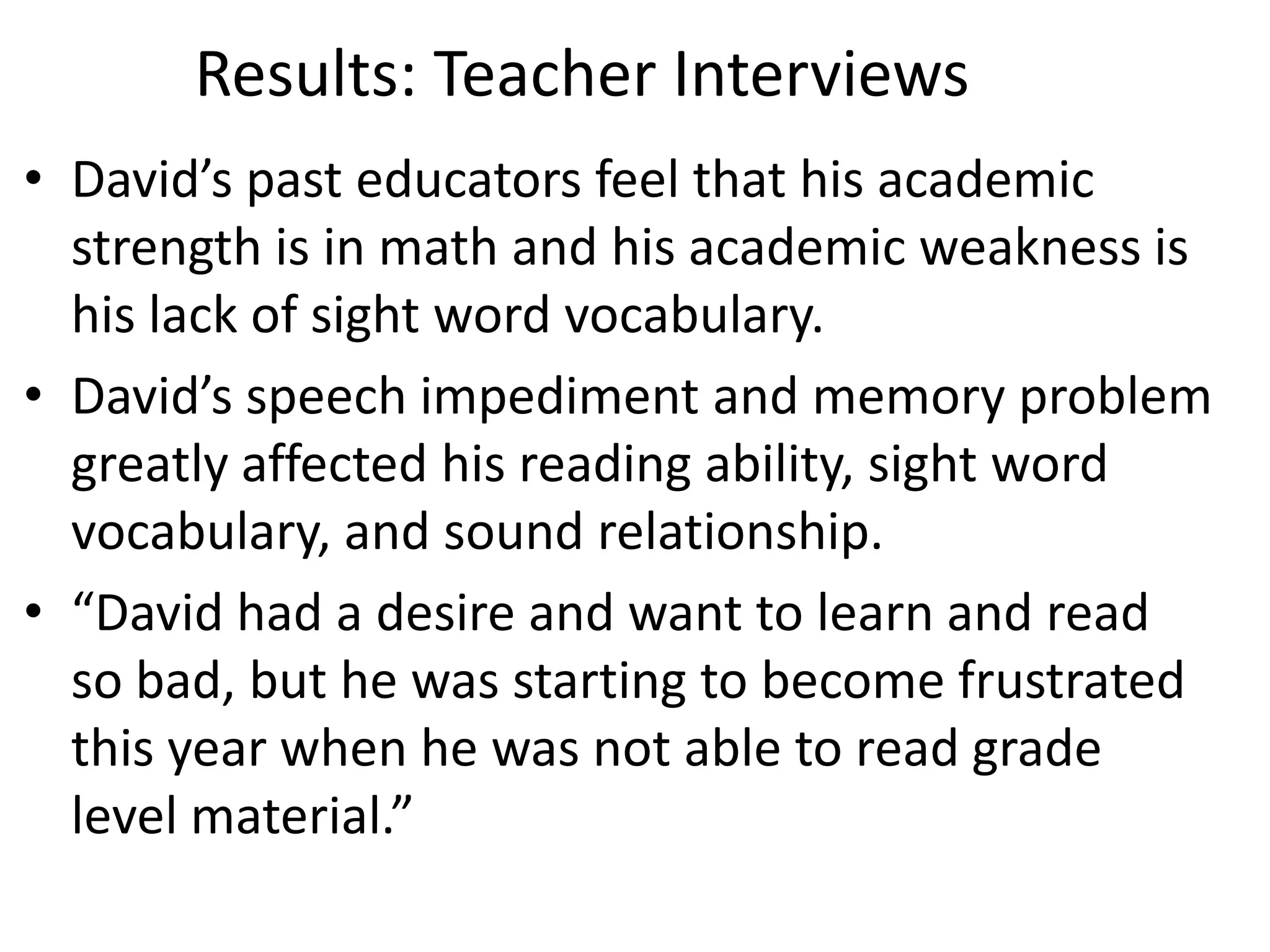
• David’s past educators feel that his academic
strength is in math and his academic weakness is
his lack of sight word vocabulary.
• David’s speech impediment and memory problem
greatly affected his reading ability, sight word
vocabulary, and sound relationship.
• “David had a desire and want to learn and read
so bad, but he was starting to become frustrated
this year when he was not able to read grade
level material.”
Results: Reading Racetrack
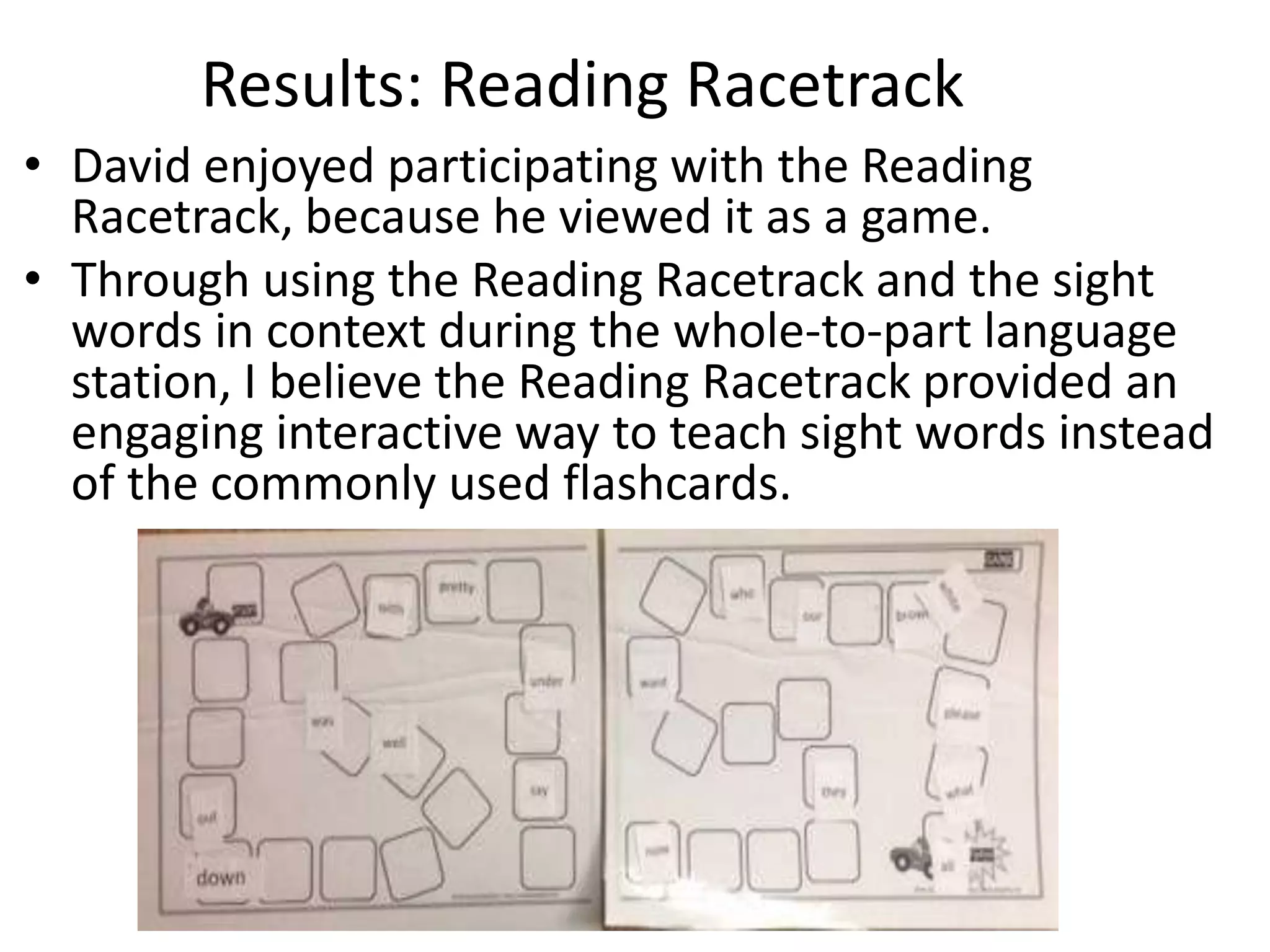
• David enjoyed participating with the Reading
Racetrack, because he viewed it as a game.
• Through using the Reading Racetrack and the sight
words in context during the whole-to-part language
station, I believe the Reading Racetrack provided an
engaging interactive way to teach sight words instead
of the commonly used flashcards.
Results: Sight Word Vocabulary
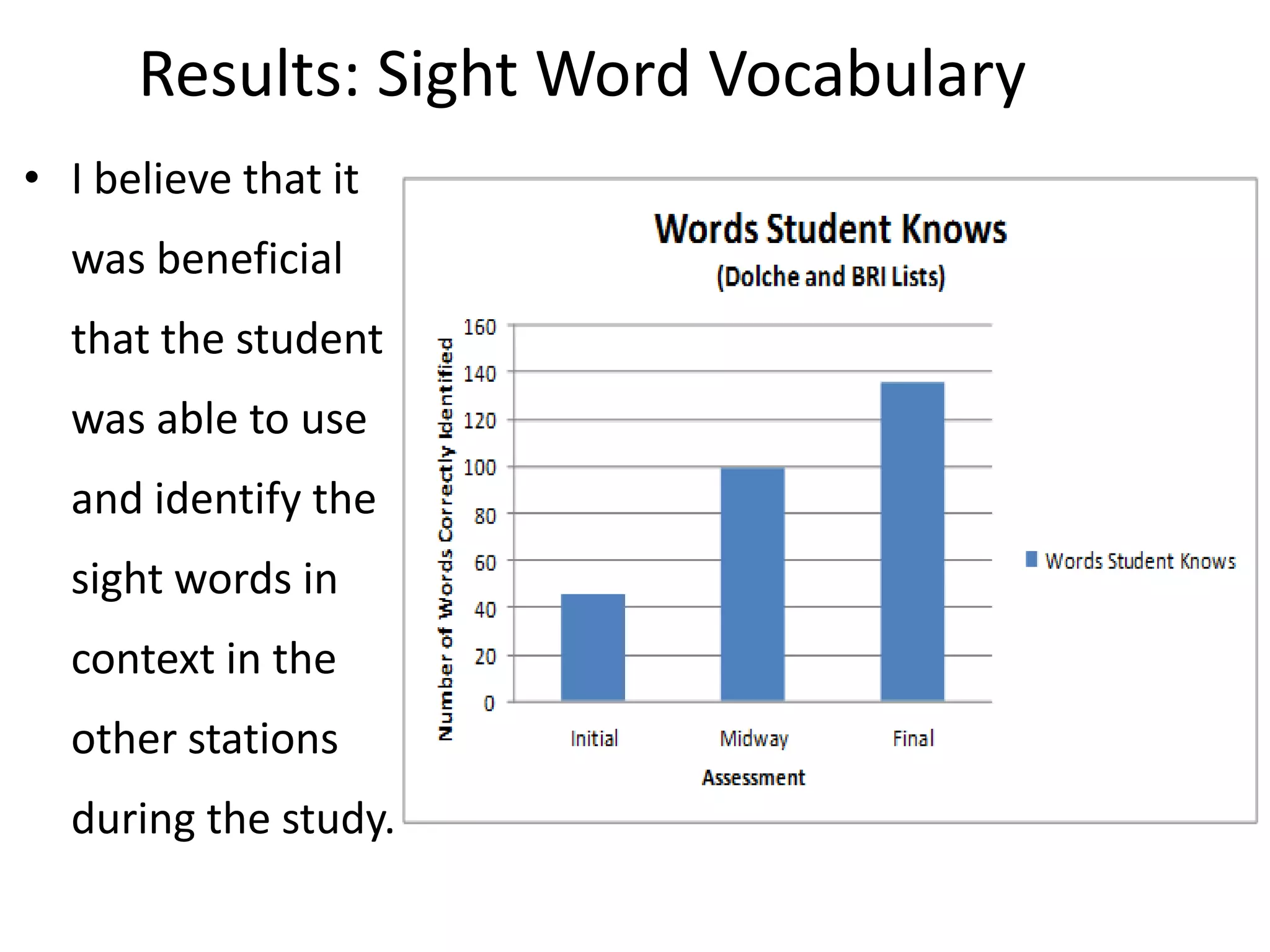
• I believe that it
was beneficial

that the student
was able to use
and identify the
sight words in
context in the
other stations
during the study.
Results: Inquiry Assessment
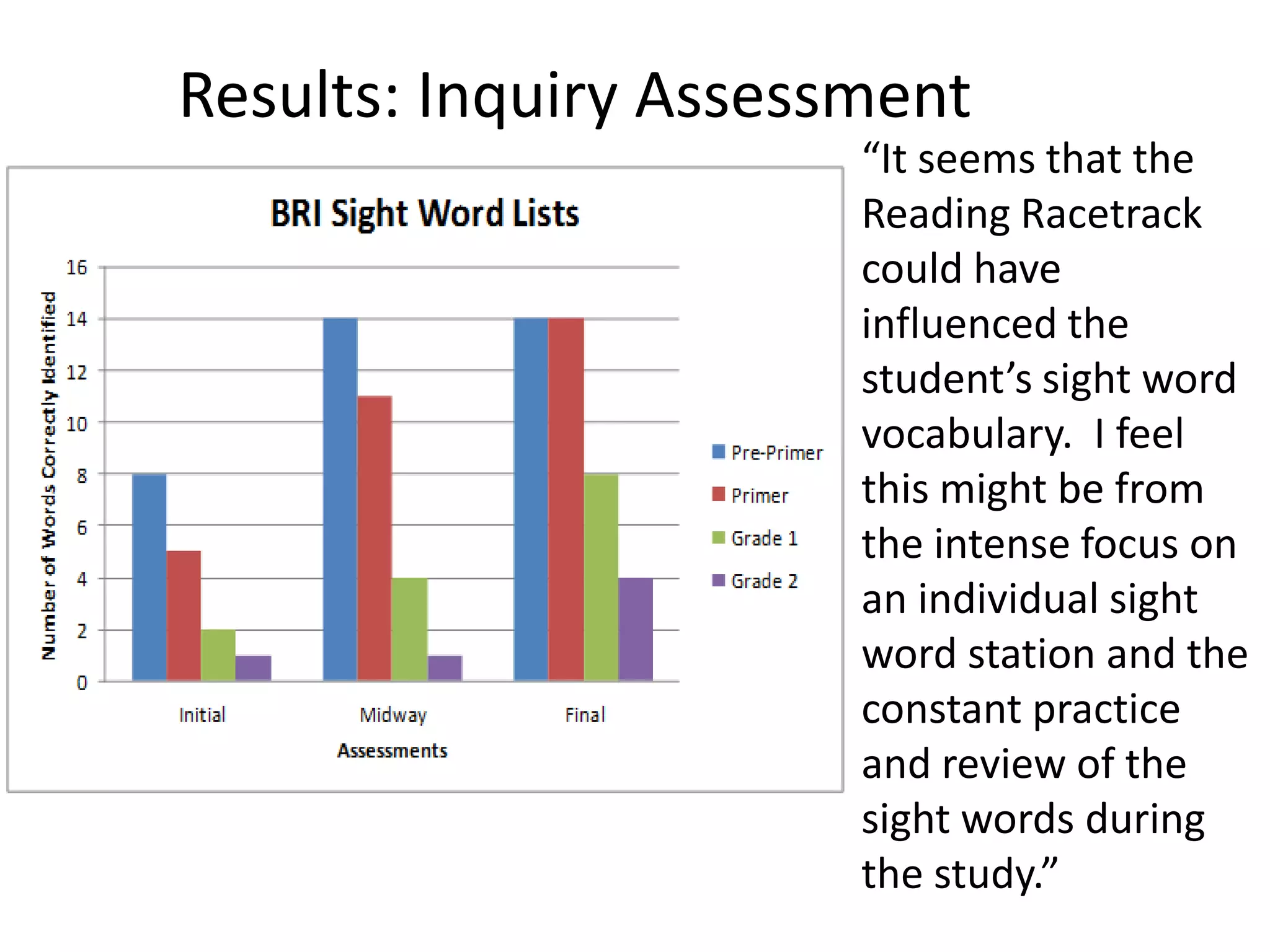
“It seems that the
Reading Racetrack
could have
influenced the
student’s sight word
vocabulary. I feel
this might be from
the intense focus on
an individual sight
word station and the
constant practice
and review of the
sight words during
the study.”
Results: Inquiry Assessment
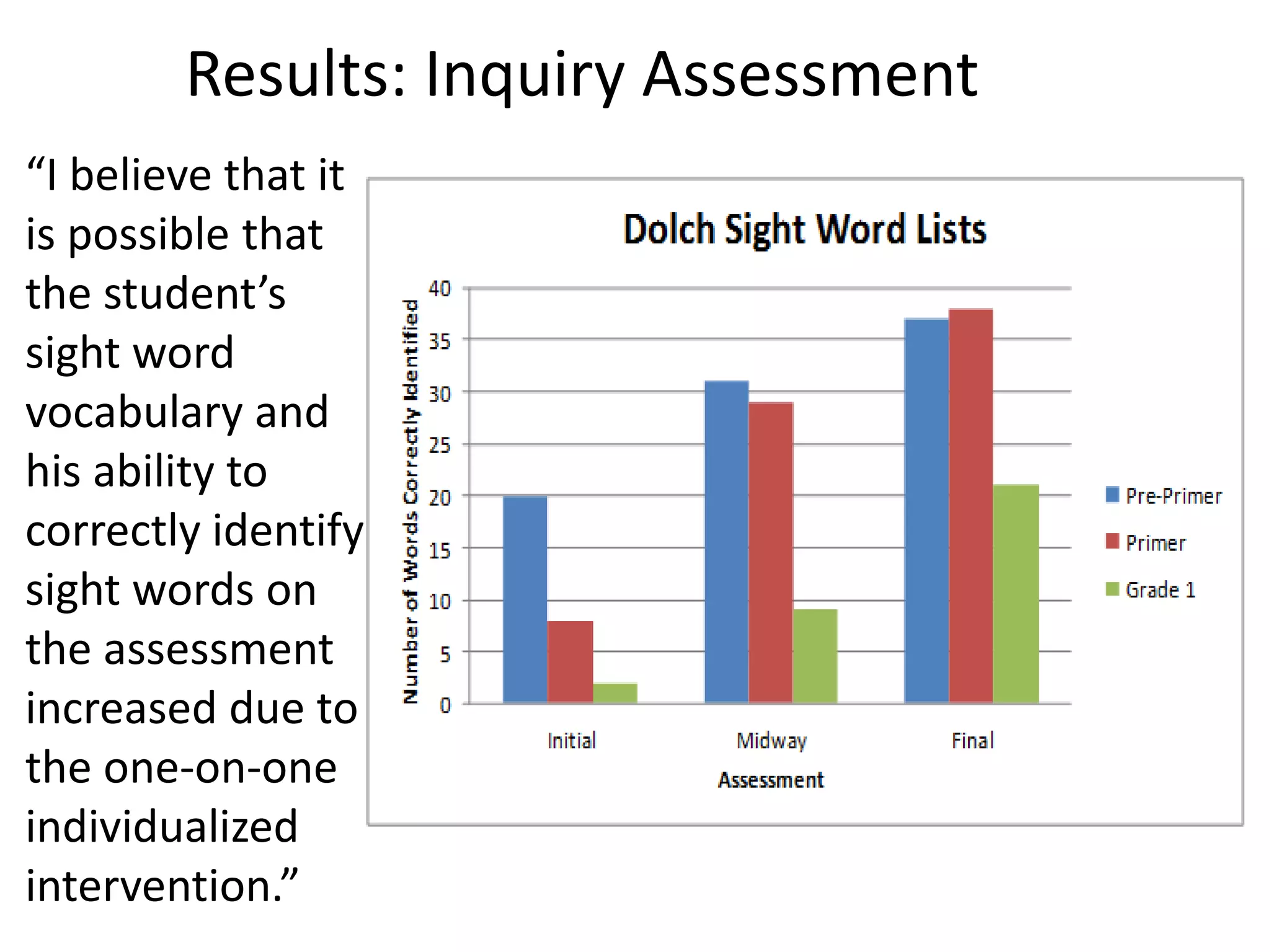
“I believe that it
is possible that
the student’s
sight word
vocabulary and
his ability to
correctly identify
sight words on
the assessment
increased due to
the one-on-one
individualized
intervention.”
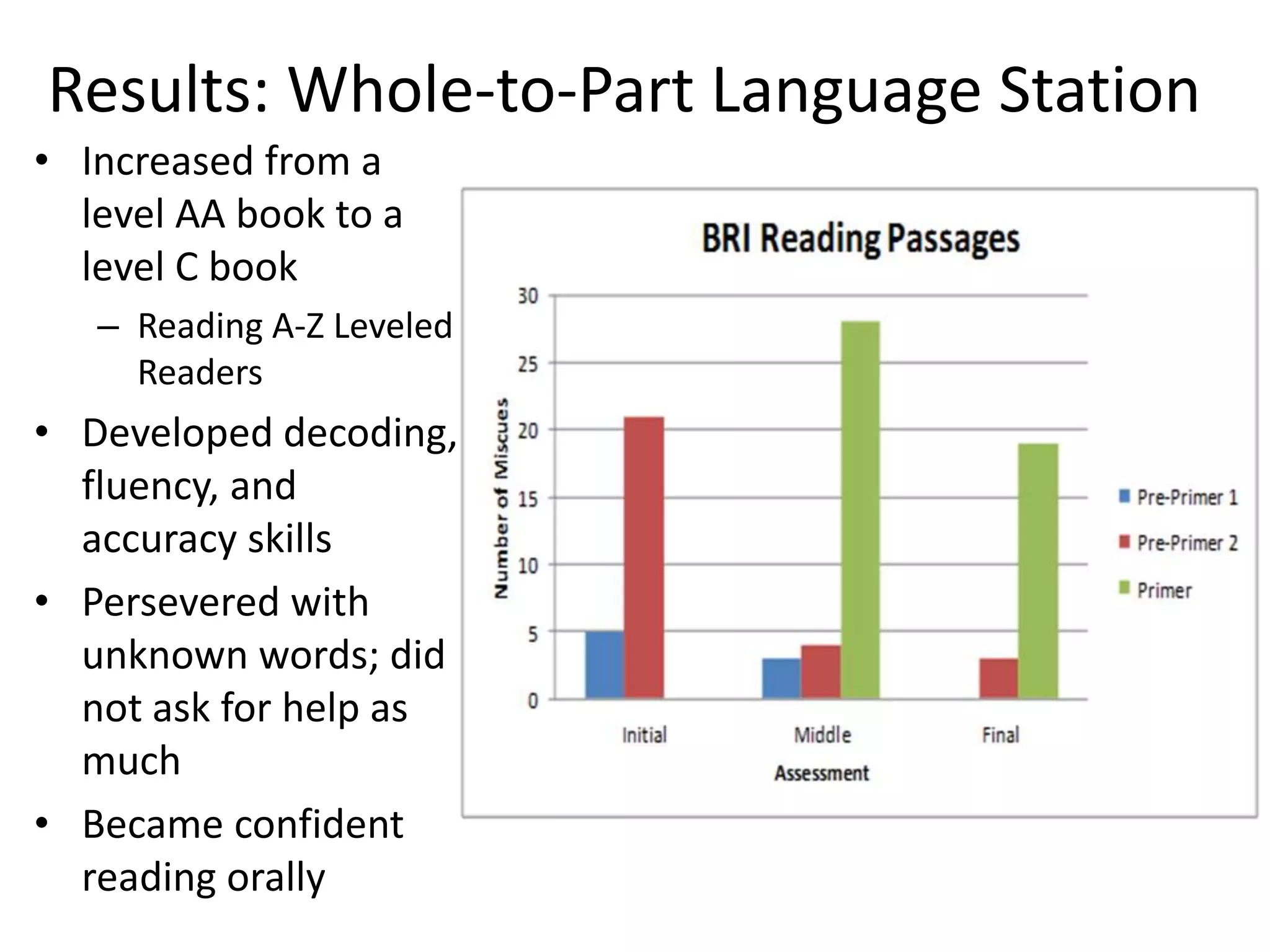
Results: Whole-to-Part Language Station
• Increased from a
level AA book to a
level C book
– Reading A-Z Leveled
Readers

• Developed decoding,
fluency, and
accuracy skills
• Persevered with
unknown words; did
not ask for help as
much
• Became confident
reading orally
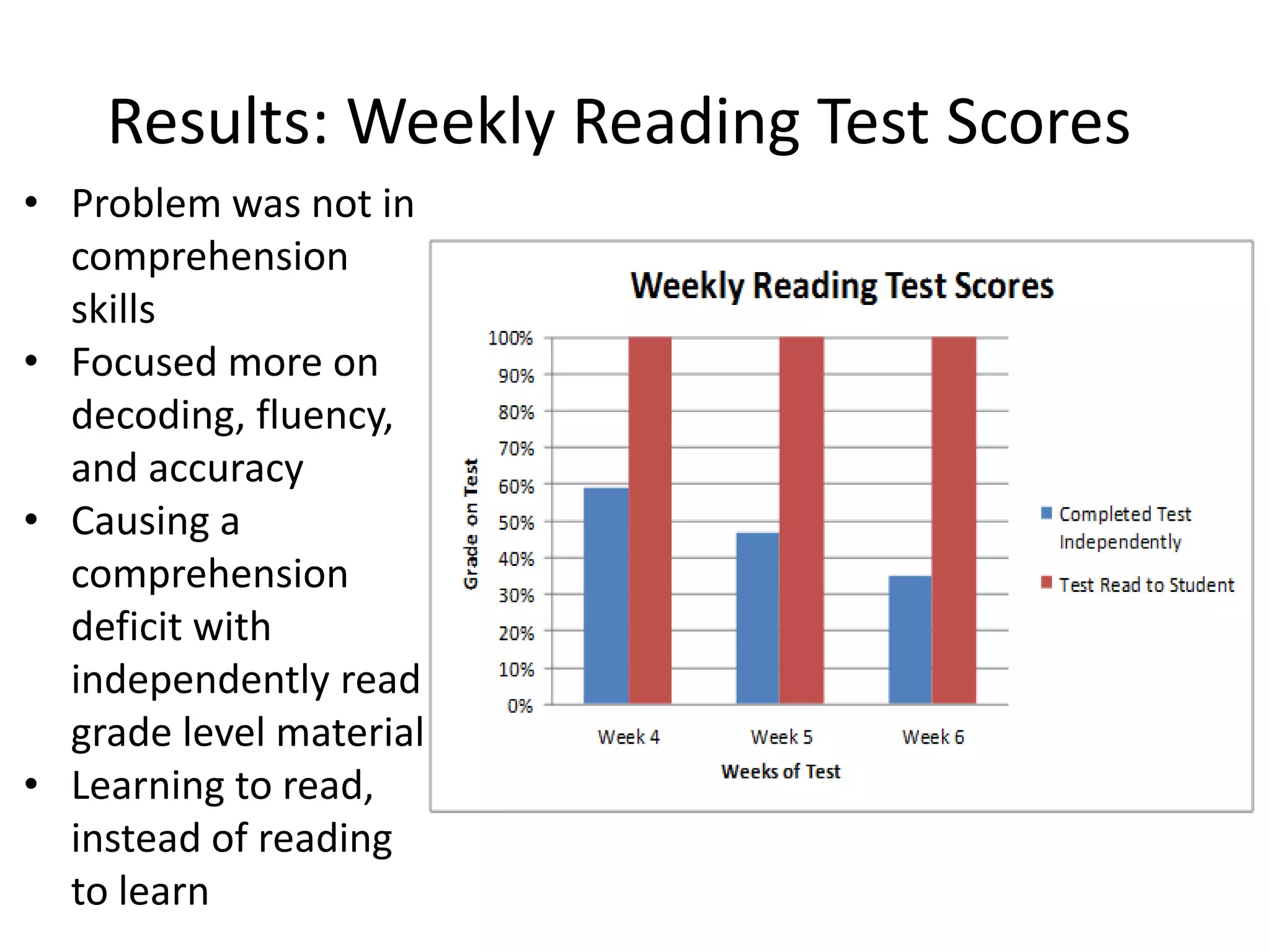
Results: Weekly Reading Test Scores
• Problem was not in
comprehension
skills
• Focused more on
decoding, fluency,
and accuracy
• Causing a
comprehension
deficit with
independently read
grade level material
• Learning to read,
instead of reading
to learn
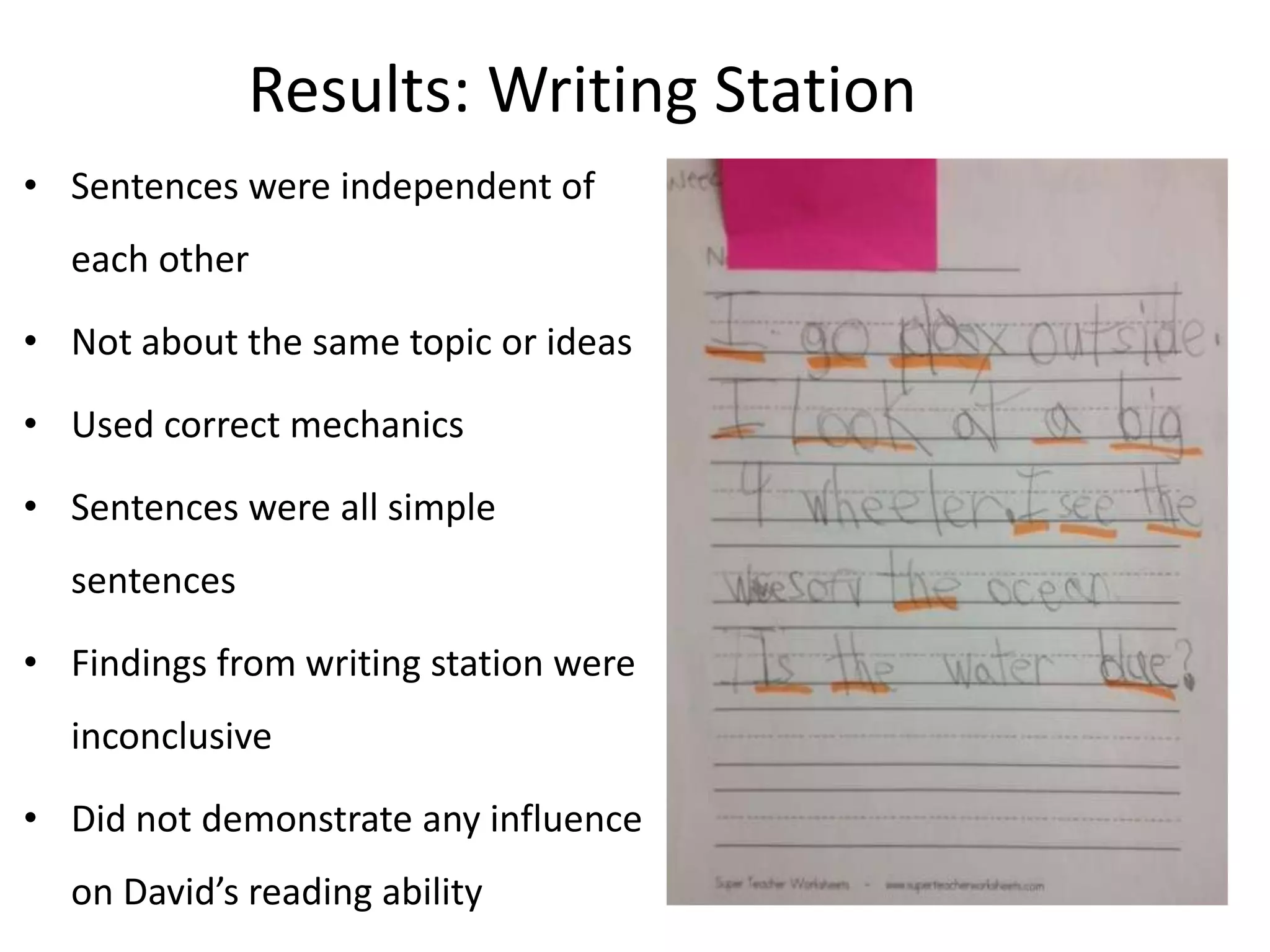
Results: Writing Station
• Sentences were independent of
each other

• Not about the same topic or ideas
• Used correct mechanics
• Sentences were all simple
sentences
• Findings from writing station were
inconclusive
• Did not demonstrate any influence
on David’s reading ability
Implications For My Study
• Beneficial to individualize the reading intervention
strategies based on the student, his ability, and
needs to increase the positive influence.
• Using multiple intervention strategies was beneficial.
• From findings, David’s reading ability developed and
the reading intervention strategies positively

influenced his reading ability in regards to sight
word vocabulary, fluency, accuracy, and confidence.
Implications For My Teaching
• Continue to base my studies on the students and their
individual needs.

• Be aware and conscious of what is beneficial and what is not
• Make changes to create a successful study and to benefit my
students.

• Important to know your students both academically and
personally.
• Importance of using multiple teaching strategies

• Important to support my students through their successes and
their struggles
Implications for Educators
• Take my study and make it your own based on
your own individual students’ and their needs.
• I encourage you to create intervention strategies
and stations that will meet your students’ needs.
• I feel that this study would be most beneficial for
a student or small group of students who are
below grade level by two or more grade levels.
References
Cummings, K., Dewey, E., Latimer, R., & Good, R. (2011). Pathways to word reading and
decoding: The roles of automaticity and accuracy. School Psychology Review, 40(2), 284295.
Dilorenzo, K., Carlotta, R., Bucholz, J., & Brady, M. (2011). Teach letter-sound connections
with picture mnemonics: Itch'ys alphabet and early decoding.Preventing School
Failure, 55(1), 28-34.
Hudson, C., Isakson, C., Richman, T., Lane, H., & Arriaza-Allen, S. (2011). An examination of a
small-group decoding intervention for struggling readers: Comparing accuracy and
automaticity criteria. Learning Disabilities Research & Practice, 26(1), 15-27.
Kaufman, L., McLaughlin, T., Derby, K., & Waco, T. (2011). Employing reading racetracks and
di flashcards with and without cover, copy, and compare and rewards to teach of sight
words to three students with learning disabilities in reading.Educational Research
Quarterly, 34(4), 24-42.
Moustafa, M., & Maldonado-Colon, E. (1999). Whole-to-part phonics instruction: Building on
what children know tohelp them know more. Reading Teacher, 52(5), 448-460.
Contact Information
• Brittany Rathway
–brathway@mix.wvu.edu
Connecting Our Inquiries
• In our studies, we explored how to develop the
verbal and mathematical literacies of students
with special needs.
• We discovered how to design instruction that
would meet the diverse needs of our learners.
• Being situated in a professional development
school provided a space not only for our learning,
but also the learning of our mentor teachers, and
more importantly the learning of our students.
Discussion Questions
• How were we able to integrate professional
and student learning through inquiry?
• How might we change the structures of
schools in order to ensure they are more
inclusive and meet the needs of all students?

Wvpds slideshow fina

  • 1.
    Learning to Teach:What Our Students Taught Us About Teaching, Learning, and Schools • Brittany Rathway – Developing Reading Ability Through Multiple Reading Intervention Strategies • Cierra Cupini • Julia Chevlin
  • 2.
    Developing Reading AbilityThrough Multiple Reading Intervention Strategies Brittany Rathway West Virginia University East Dale Elementary School
  • 3.
    Purpose for mystudy • Individual intervention • Services being implemented were not beneficial • Determined and motivated • David’s constant struggle • Influence of multiple intervention strategies – How can implementing multiple reading intervention strategies influence the reading ability of a third grade student with a learning disability?
  • 4.
    Context and Participant •Fairmont, Marion County, West Virginia • East Dale Elementary School • Resource Room K-5 • Nine year old, Third grade male student • Identified with a learning disability in reading, ADHD, services for speech, memory issue
  • 5.
    Methodology • Implemented over7 weeks • Initial Student & Teacher Interviews • Inquiry Assessment given Initial, Midway, and Final Day 1 Day 2 Sight Word Reading Racetrack Station Whole-to-Part Language Independent Reading Station Day 3 Day 4 Language Independent Experience Writing Station Approach Station (Poetry Station)
  • 6.
    Data Sources andAnalysis • Student and Teacher Interviews – Academic History, Strengths, Weaknesses, Interests, Create my Study • Inquiry Assessment – (BRI Word Lists, Dolch Word Lists, and BRI Reading Passages) – Positive or Negative Influence, Development over Implementation – Reading Grade Level – Patterns or Consistent Miscues (Substitutions or Miscues) • Observational Journal – Coded (Successes, Failures, Patterns, and Development/Progress) • Weekly Reading Test Scores – Independent vs. Read Aloud
  • 7.
    Results: Student Interview •“My favorite subject is math, because it is all I can do.” He also explained, “My least favorite subject is everything else, because I can’t read.” • David described that it is difficult for him to read independently, because he cannot hear it or sound it out. • David learns best and is able to express his ideas best when someone is talking or in a group discussion; orally.
  • 8.
    Results: Teacher Interviews •David’s past educators feel that his academic strength is in math and his academic weakness is his lack of sight word vocabulary. • David’s speech impediment and memory problem greatly affected his reading ability, sight word vocabulary, and sound relationship. • “David had a desire and want to learn and read so bad, but he was starting to become frustrated this year when he was not able to read grade level material.”
  • 9.
    Results: Reading Racetrack •David enjoyed participating with the Reading Racetrack, because he viewed it as a game. • Through using the Reading Racetrack and the sight words in context during the whole-to-part language station, I believe the Reading Racetrack provided an engaging interactive way to teach sight words instead of the commonly used flashcards.
  • 10.
    Results: Sight WordVocabulary • I believe that it was beneficial that the student was able to use and identify the sight words in context in the other stations during the study.
  • 11.
    Results: Inquiry Assessment “Itseems that the Reading Racetrack could have influenced the student’s sight word vocabulary. I feel this might be from the intense focus on an individual sight word station and the constant practice and review of the sight words during the study.”
  • 12.
    Results: Inquiry Assessment “Ibelieve that it is possible that the student’s sight word vocabulary and his ability to correctly identify sight words on the assessment increased due to the one-on-one individualized intervention.”
  • 13.
    Results: Whole-to-Part LanguageStation • Increased from a level AA book to a level C book – Reading A-Z Leveled Readers • Developed decoding, fluency, and accuracy skills • Persevered with unknown words; did not ask for help as much • Became confident reading orally
  • 14.
    Results: Weekly ReadingTest Scores • Problem was not in comprehension skills • Focused more on decoding, fluency, and accuracy • Causing a comprehension deficit with independently read grade level material • Learning to read, instead of reading to learn
  • 15.
    Results: Writing Station •Sentences were independent of each other • Not about the same topic or ideas • Used correct mechanics • Sentences were all simple sentences • Findings from writing station were inconclusive • Did not demonstrate any influence on David’s reading ability
  • 16.
    Implications For MyStudy • Beneficial to individualize the reading intervention strategies based on the student, his ability, and needs to increase the positive influence. • Using multiple intervention strategies was beneficial. • From findings, David’s reading ability developed and the reading intervention strategies positively influenced his reading ability in regards to sight word vocabulary, fluency, accuracy, and confidence.
  • 17.
    Implications For MyTeaching • Continue to base my studies on the students and their individual needs. • Be aware and conscious of what is beneficial and what is not • Make changes to create a successful study and to benefit my students. • Important to know your students both academically and personally. • Importance of using multiple teaching strategies • Important to support my students through their successes and their struggles
  • 18.
    Implications for Educators •Take my study and make it your own based on your own individual students’ and their needs. • I encourage you to create intervention strategies and stations that will meet your students’ needs. • I feel that this study would be most beneficial for a student or small group of students who are below grade level by two or more grade levels.
  • 19.
    References Cummings, K., Dewey,E., Latimer, R., & Good, R. (2011). Pathways to word reading and decoding: The roles of automaticity and accuracy. School Psychology Review, 40(2), 284295. Dilorenzo, K., Carlotta, R., Bucholz, J., & Brady, M. (2011). Teach letter-sound connections with picture mnemonics: Itch'ys alphabet and early decoding.Preventing School Failure, 55(1), 28-34. Hudson, C., Isakson, C., Richman, T., Lane, H., & Arriaza-Allen, S. (2011). An examination of a small-group decoding intervention for struggling readers: Comparing accuracy and automaticity criteria. Learning Disabilities Research & Practice, 26(1), 15-27. Kaufman, L., McLaughlin, T., Derby, K., & Waco, T. (2011). Employing reading racetracks and di flashcards with and without cover, copy, and compare and rewards to teach of sight words to three students with learning disabilities in reading.Educational Research Quarterly, 34(4), 24-42. Moustafa, M., & Maldonado-Colon, E. (1999). Whole-to-part phonics instruction: Building on what children know tohelp them know more. Reading Teacher, 52(5), 448-460.
  • 20.
    Contact Information • BrittanyRathway –brathway@mix.wvu.edu
  • 21.
    Connecting Our Inquiries •In our studies, we explored how to develop the verbal and mathematical literacies of students with special needs. • We discovered how to design instruction that would meet the diverse needs of our learners. • Being situated in a professional development school provided a space not only for our learning, but also the learning of our mentor teachers, and more importantly the learning of our students.
  • 22.
    Discussion Questions • Howwere we able to integrate professional and student learning through inquiry? • How might we change the structures of schools in order to ensure they are more inclusive and meet the needs of all students?