ANNOTATED BIBLIOGRAPHY RESEARCH
STRATEGIES
WRITING SEMINAR
Kelly Kobiela, Systems Librarian
Heterick Memorial Library
WELCOME TO THE LIBRARY
 Kelly Kobiela, k-kobiela@onu.edu
 Jenny Donley, j-donley.1@onu.edu
 Kathleen Baril, k-baril@onu.edu
 Reference Email, reference@onu.edu
 Librarians on duty:
 Monday – Wednesday
 8:00 AM – 4:30 PM
 6:00 PM – 9:00 PM
 Thursday – Friday
 8:00 AM – 4:30 PM
WHAT THE LIBRARY OFFERS:
 ~400,000 items in POLAR, the ONU library catalog
 ~20,000,000 items in OhioLink
 260 Databases
 400+ print periodicals
 Tens of thousands of electronic journal titles
 Juvenile, Young Adult, and Graphic Novel
collections
 DVDs, CDs, streaming audiovisuals, and streaming
music
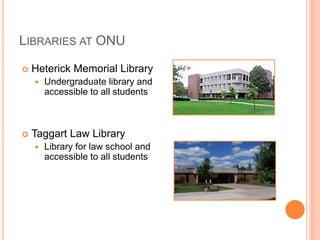
LIBRARIES AT ONU
 Heterick Memorial Library
 Undergraduate library and
accessible to all students
 Taggart Law Library
 Library for law school and
accessible to all students
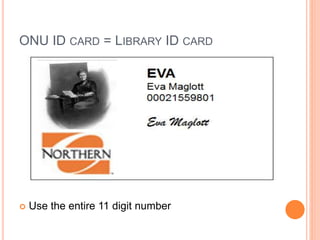
ONU ID CARD = LIBRARY ID CARD
 Use the entire 11 digit number
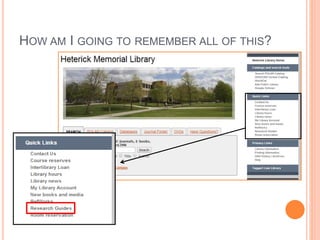
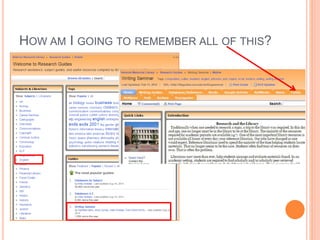
HOW AM I GOING TO REMEMBER ALL OF THIS?
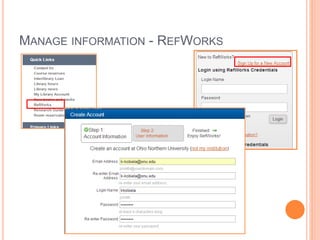
MANAGE INFORMATION - REFWORKS
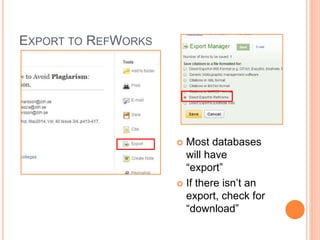
EXPORT TO REFWORKS
 Most databases
will have
“export”
 If there isn’t an
export, check for
“download”
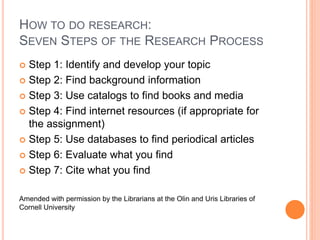
HOW TO DO RESEARCH:
SEVEN STEPS OF THE RESEARCH PROCESS
 Step 1: Identify and develop your topic
 Step 2: Find background information
 Step 3: Use catalogs to find books and media
 Step 4: Find internet resources (if appropriate for
the assignment)
 Step 5: Use databases to find periodical articles
 Step 6: Evaluate what you find
 Step 7: Cite what you find
Amended with permission by the Librarians at the Olin and Uris Libraries of
Cornell University
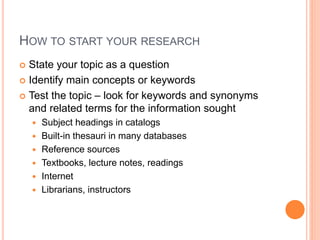
HOW TO START YOUR RESEARCH
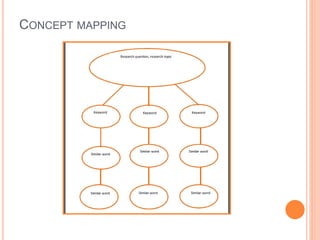
 State your topic as a question
 Identify main concepts or keywords
 Test the topic – look for keywords and synonyms
and related terms for the information sought
 Subject headings in catalogs
 Built-in thesauri in many databases
 Reference sources
 Textbooks, lecture notes, readings
 Internet
 Librarians, instructors
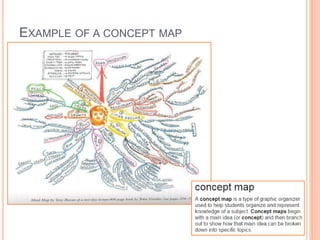
EXAMPLE OF A CONCEPT MAP
CONCEPT MAPPING
BACKGROUND RESEARCH
 Internet Resources
 Background research = Reference and
Encyclopedias
 Library catalog
 Look at Databases/Reference tab in the Writing
Seminar research guide for a link to the library’s
databases as well as links to electronic
encyclopedias and reference materials
INTERNET RESOURCES
 Google
 Google Scholar
 Wikipedia
 Helpful for identifying additional keywords and
subjects for your concept map
 Does the information located satisfy the research
need?
 Is the information factual and unbiased?
 Refer to Critically Analyzing Web Sources
BUT I FOUND THIS GREAT WEBSITE…
Critically analyzing web sources
 What? is the page/site about
 Who? created and maintains this site
 Where? is the information coming from
 Why? is the information presented on the web
 When? was the page created or last updated
 How? accurate or credible is the page
From the University of Wisconsin Library, worksheet for evaluating web
sites
CATALOGS – BOOKS AND MEDIA
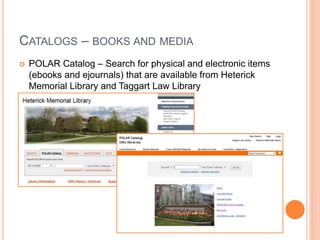
 POLAR Catalog – Search for physical and electronic items
(ebooks and ejournals) that are available from Heterick
Memorial Library and Taggart Law Library
FIND A BOOK – POLAR: KEYWORD SEARCH
 Looks in several locations
 Subject
 Article title
 Abstracts
 Table of contents
 Does not require an exact match
 Generates comparatively large number of hits
 Good if you are not familiar with terminology
 Good for a beginning search
FIND A BOOK – POLAR: SUBJECT SEARCH
 Looks at the subject headings in the records
 Requires an exact match
 Provides a results list with related headings to use
for broader and narrower searches
 Generates comparatively smaller number of hits
 Good if you are familiar with terminology
 Good for a next step after a keyword search
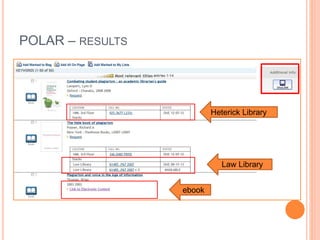
POLAR – RESULTS
ebook
Law Library
Heterick Library
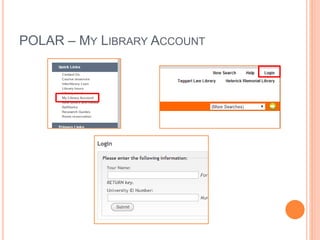
POLAR – MY LIBRARY ACCOUNT
FIND A BOOK – OHIOLINK
 Materials owned by 92 other libraries in Ohio:
colleges, universities, public libraries
 Can submit request for an item to be delivered to
Heterick Memorial Library
 Most requests arrive in 2-3 working days
 No charge to request items (unless they become
overdue)
 Maximum of 25 requests at a time
 Items can usually be renewed
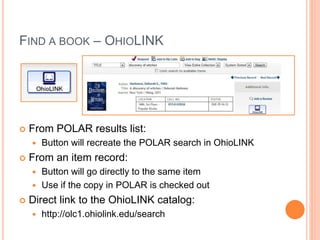
FIND A BOOK – OHIOLINK
 From POLAR results list:
 Button will recreate the POLAR search in OhioLINK
 From an item record:
 Button will go directly to the same item
 Use if the copy in POLAR is checked out
 Direct link to the OhioLINK catalog:
 http://olc1.ohiolink.edu/search
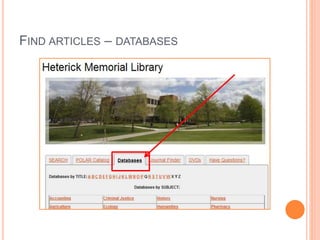
FIND ARTICLES – DATABASES
 What is the basic definition of a library database?
 A library database is an electronic (online) catalog or index
 Library databases contain information about published items
 Library databases are searchable
 The library subscribes to many databases so the ONU community has
access to these resources. When you’re searching a database, you
are not searching “the web.”
 What types of items are indexed by library databases?
 Articles in Journals/Magazines/Newspapers
 Reference Information (i.e. entries from Encyclopedias, Dictionaries,
etc.)
 Books & other documents
Source: http://web.calstatela.edu/library/whatisadatabase.htm
WEB RESEARCH VS. LIBRARY DATABASES
Internet
 Material from numerous
sources, individuals,
government, etc.
 Search engines must work
with material prepared
without regard for specific
software
 Quality of material varies
 Generally do not access for-
profit information
 Content often anonymous
and undated
Databases
 Usually created by a single
publisher
 Content pre-arranged for
easy searching
 Quality-controlled by editorial
staff
 Most are available only to
subscribers
 Sources are usually identified
and dated
 Databases often focus on a
specific subject or discipline,
but some cover several areas
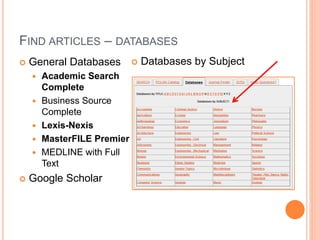
FIND ARTICLES – DATABASES
 General Databases
 Academic Search
Complete
 Business Source
Complete
 Lexis-Nexis
 MasterFILE Premier
 MEDLINE with Full
Text
 Google Scholar
 Databases by Subject
ARTICLES – POPULAR VS. SCHOLARLY
 Popular = Magazine
 Scholarly = Journal
 Magazines tend to have glossy pages, lots of
pictures, and can be read and understood by the
general public
 Scholarly journals are usually peer-reviewed and
tend to be aimed at professionals in the field
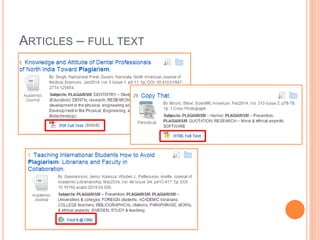
ARTICLES – FULL TEXT
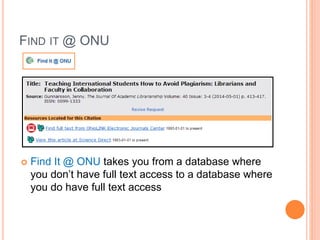
FIND IT @ ONU
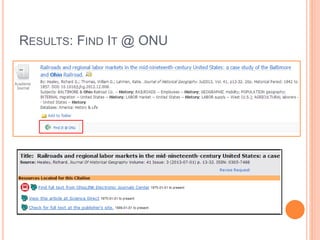
 Find It @ ONU takes you from a database where
you don’t have full text access to a database where
you do have full text access
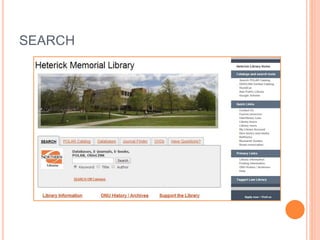
SEARCH
WHAT IS INCLUDED?
 POLAR
 Article-level searching for all EBSCO databases
 Article-level searching for a variety of other
databases: JSTOR, Hoover’s, AccessPharmacy,
etc.
 Title-level searching for most other databases:
IEEE, CIAO, Proquest Nursing & Allied Health
 OhioLINK Central Catalog
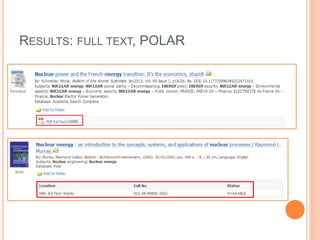
RESULTS: FULL TEXT, POLAR
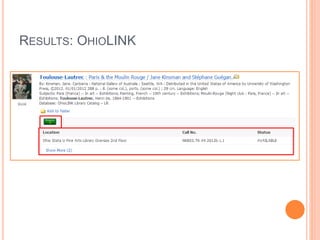
RESULTS: OHIOLINK
RESULTS: FIND IT @ ONU
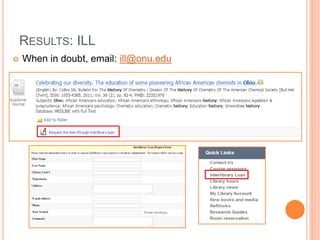
RESULTS: ILL
 When in doubt, email: ill@onu.edu
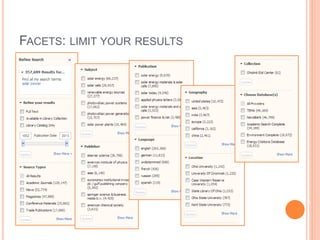
FACETS: LIMIT YOUR RESULTS
REMINDER!
 Kelly Kobiela, k-kobiela@onu.edu
 Jenny Donley, j-donley.1@onu.edu
 Kathleen Baril, k-baril@onu.edu
 Reference Email, reference@onu.edu
 Librarians on duty:
 Monday – Wednesday
 8:00 AM – 4:30 PM
 6:00 PM – 9:00 PM
 Thursday – Friday
 8:00 AM – 4:30 PM

WSCullen

  • 1.
    ANNOTATED BIBLIOGRAPHY RESEARCH STRATEGIES WRITINGSEMINAR Kelly Kobiela, Systems Librarian Heterick Memorial Library
  • 2.
    WELCOME TO THELIBRARY  Kelly Kobiela, k-kobiela@onu.edu  Jenny Donley, j-donley.1@onu.edu  Kathleen Baril, k-baril@onu.edu  Reference Email, reference@onu.edu  Librarians on duty:  Monday – Wednesday  8:00 AM – 4:30 PM  6:00 PM – 9:00 PM  Thursday – Friday  8:00 AM – 4:30 PM
  • 3.
    WHAT THE LIBRARYOFFERS:  ~400,000 items in POLAR, the ONU library catalog  ~20,000,000 items in OhioLink  260 Databases  400+ print periodicals  Tens of thousands of electronic journal titles  Juvenile, Young Adult, and Graphic Novel collections  DVDs, CDs, streaming audiovisuals, and streaming music
  • 4.
    LIBRARIES AT ONU Heterick Memorial Library  Undergraduate library and accessible to all students  Taggart Law Library  Library for law school and accessible to all students
  • 5.
    ONU ID CARD= LIBRARY ID CARD  Use the entire 11 digit number
  • 6.
    HOW AM IGOING TO REMEMBER ALL OF THIS?
  • 7.
    HOW AM IGOING TO REMEMBER ALL OF THIS?
  • 8.
  • 9.
    EXPORT TO REFWORKS Most databases will have “export”  If there isn’t an export, check for “download”
  • 10.
    HOW TO DORESEARCH: SEVEN STEPS OF THE RESEARCH PROCESS  Step 1: Identify and develop your topic  Step 2: Find background information  Step 3: Use catalogs to find books and media  Step 4: Find internet resources (if appropriate for the assignment)  Step 5: Use databases to find periodical articles  Step 6: Evaluate what you find  Step 7: Cite what you find Amended with permission by the Librarians at the Olin and Uris Libraries of Cornell University
  • 11.
    HOW TO STARTYOUR RESEARCH  State your topic as a question  Identify main concepts or keywords  Test the topic – look for keywords and synonyms and related terms for the information sought  Subject headings in catalogs  Built-in thesauri in many databases  Reference sources  Textbooks, lecture notes, readings  Internet  Librarians, instructors
  • 12.
    EXAMPLE OF ACONCEPT MAP
  • 13.
  • 14.
    BACKGROUND RESEARCH  InternetResources  Background research = Reference and Encyclopedias  Library catalog  Look at Databases/Reference tab in the Writing Seminar research guide for a link to the library’s databases as well as links to electronic encyclopedias and reference materials
  • 15.
    INTERNET RESOURCES  Google Google Scholar  Wikipedia  Helpful for identifying additional keywords and subjects for your concept map  Does the information located satisfy the research need?  Is the information factual and unbiased?  Refer to Critically Analyzing Web Sources
  • 16.
    BUT I FOUNDTHIS GREAT WEBSITE… Critically analyzing web sources  What? is the page/site about  Who? created and maintains this site  Where? is the information coming from  Why? is the information presented on the web  When? was the page created or last updated  How? accurate or credible is the page From the University of Wisconsin Library, worksheet for evaluating web sites
  • 17.
    CATALOGS – BOOKSAND MEDIA  POLAR Catalog – Search for physical and electronic items (ebooks and ejournals) that are available from Heterick Memorial Library and Taggart Law Library
  • 18.
    FIND A BOOK– POLAR: KEYWORD SEARCH  Looks in several locations  Subject  Article title  Abstracts  Table of contents  Does not require an exact match  Generates comparatively large number of hits  Good if you are not familiar with terminology  Good for a beginning search
  • 19.
    FIND A BOOK– POLAR: SUBJECT SEARCH  Looks at the subject headings in the records  Requires an exact match  Provides a results list with related headings to use for broader and narrower searches  Generates comparatively smaller number of hits  Good if you are familiar with terminology  Good for a next step after a keyword search
  • 20.
    POLAR – RESULTS ebook LawLibrary Heterick Library
  • 21.
    POLAR – MYLIBRARY ACCOUNT
  • 22.
    FIND A BOOK– OHIOLINK  Materials owned by 92 other libraries in Ohio: colleges, universities, public libraries  Can submit request for an item to be delivered to Heterick Memorial Library  Most requests arrive in 2-3 working days  No charge to request items (unless they become overdue)  Maximum of 25 requests at a time  Items can usually be renewed
  • 23.
    FIND A BOOK– OHIOLINK  From POLAR results list:  Button will recreate the POLAR search in OhioLINK  From an item record:  Button will go directly to the same item  Use if the copy in POLAR is checked out  Direct link to the OhioLINK catalog:  http://olc1.ohiolink.edu/search
  • 24.
    FIND ARTICLES –DATABASES  What is the basic definition of a library database?  A library database is an electronic (online) catalog or index  Library databases contain information about published items  Library databases are searchable  The library subscribes to many databases so the ONU community has access to these resources. When you’re searching a database, you are not searching “the web.”  What types of items are indexed by library databases?  Articles in Journals/Magazines/Newspapers  Reference Information (i.e. entries from Encyclopedias, Dictionaries, etc.)  Books & other documents Source: http://web.calstatela.edu/library/whatisadatabase.htm
  • 25.
    WEB RESEARCH VS.LIBRARY DATABASES Internet  Material from numerous sources, individuals, government, etc.  Search engines must work with material prepared without regard for specific software  Quality of material varies  Generally do not access for- profit information  Content often anonymous and undated Databases  Usually created by a single publisher  Content pre-arranged for easy searching  Quality-controlled by editorial staff  Most are available only to subscribers  Sources are usually identified and dated  Databases often focus on a specific subject or discipline, but some cover several areas
  • 26.
  • 27.
    FIND ARTICLES –DATABASES  General Databases  Academic Search Complete  Business Source Complete  Lexis-Nexis  MasterFILE Premier  MEDLINE with Full Text  Google Scholar  Databases by Subject
  • 28.
    ARTICLES – POPULARVS. SCHOLARLY  Popular = Magazine  Scholarly = Journal  Magazines tend to have glossy pages, lots of pictures, and can be read and understood by the general public  Scholarly journals are usually peer-reviewed and tend to be aimed at professionals in the field
  • 29.
  • 30.
    FIND IT @ONU  Find It @ ONU takes you from a database where you don’t have full text access to a database where you do have full text access
  • 31.
  • 32.
    WHAT IS INCLUDED? POLAR  Article-level searching for all EBSCO databases  Article-level searching for a variety of other databases: JSTOR, Hoover’s, AccessPharmacy, etc.  Title-level searching for most other databases: IEEE, CIAO, Proquest Nursing & Allied Health  OhioLINK Central Catalog
  • 33.
  • 34.
  • 35.
  • 36.
    RESULTS: ILL  Whenin doubt, email: ill@onu.edu
  • 37.
  • 38.
    REMINDER!  Kelly Kobiela,k-kobiela@onu.edu  Jenny Donley, j-donley.1@onu.edu  Kathleen Baril, k-baril@onu.edu  Reference Email, reference@onu.edu  Librarians on duty:  Monday – Wednesday  8:00 AM – 4:30 PM  6:00 PM – 9:00 PM  Thursday – Friday  8:00 AM – 4:30 PM