Writing & Academic
Writing
A summary
Design: Step by step
Pre-writing
- Build sub-skills ([focusing on] topic, vocabulary [not in
isolation, but in function to the topic], grammar, etc)
Through
. Associograms / Brainstorming
. Prompt (images, music, realia)
. Interviews
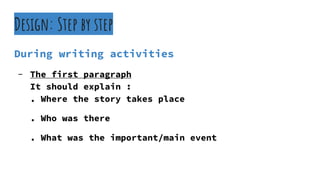
Design: Step by step
During writing activities
- The first paragraph
It should explain :
. Where the story takes place
. Who was there
. What was the important/main event
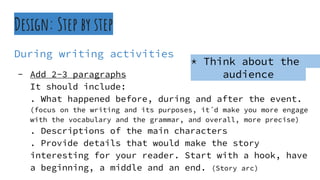
Design: Step by step
During writing activities
- Add 2-3 paragraphs
It should include:
. What happened before, during and after the event.
(focus on the writing and its purposes, it´d make you more engage
with the vocabulary and the grammar, and overall, more precise)
. Descriptions of the main characters
. Provide details that would make the story
interesting for your reader. Start with a hook, have
a beginning, a middle and an end. (Story arc)
* Think about the
. audience .
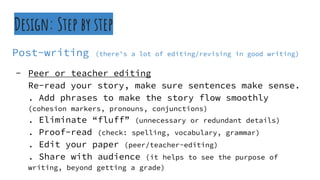
Design: Step by step
Post-writing (there’s a lot of editing/revising in good writing)
- Peer or teacher editing
Re-read your story, make sure sentences make sense.
. Add phrases to make the story flow smoothly
(cohesion markers, pronouns, conjunctions)
. Eliminate “fluff” (unnecessary or redundant details)
. Proof-read (check: spelling, vocabulary, grammar)
. Edit your paper (peer/teacher-editing)
. Share with audience (it helps to see the purpose of
writing, beyond getting a grade)
Define your purpose and reader (academic writing)
. Most formal academic writing at university is set
by, and written for, an academic tutor or assessor,
and there should be clear criteria against which they
will mark your work.
. You will need to spend some time interpreting your
question and deciding how to tackle your assignment
. When writing on your own you can set your own
criteria such as clarity, brevity and relevance.
Use clear and concise language (academic writing)
. Be concise:
Only use one main idea per sentence. Keep your sentences .
to reasonable length. Avoid repetition.
. Use formal language:
Avoid using colloquialisms or slangs. Write word out in .
full. Avoid using cliché phrases.
. Use a blend of active and passive voice:
Passive voice is more formal. However, is not always easy
. to read and it may add unnecessary words.
How to incorporate evidence (academic writing)
Academic writing must be supported by evidence such as
data, facts, quotations, arguments, statistics,
research, and theories. How to incorporate other’s
words:
. Paraphrasing
. Summarising
. Synthesising
. Quoting
Build your argument (academic writing)
. Make an argument:
It is how you show your viewpoint and answer the
. questions you have been set. Make sure it runs
. throughout your writing and everything you include
. is relevant to it.
. Structure your argument:
Guide your reader through your argument in a .
. logical way. Present both sides of the debate.
. Develop your argument:
Take in consideration your evidence and your conclusion.

Entry #7

  • 1.
  • 2.
    Design: Step bystep Pre-writing - Build sub-skills ([focusing on] topic, vocabulary [not in isolation, but in function to the topic], grammar, etc) Through . Associograms / Brainstorming . Prompt (images, music, realia) . Interviews
  • 3.
    Design: Step bystep During writing activities - The first paragraph It should explain : . Where the story takes place . Who was there . What was the important/main event
  • 4.
    Design: Step bystep During writing activities - Add 2-3 paragraphs It should include: . What happened before, during and after the event. (focus on the writing and its purposes, it´d make you more engage with the vocabulary and the grammar, and overall, more precise) . Descriptions of the main characters . Provide details that would make the story interesting for your reader. Start with a hook, have a beginning, a middle and an end. (Story arc) * Think about the . audience .
  • 5.
    Design: Step bystep Post-writing (there’s a lot of editing/revising in good writing) - Peer or teacher editing Re-read your story, make sure sentences make sense. . Add phrases to make the story flow smoothly (cohesion markers, pronouns, conjunctions) . Eliminate “fluff” (unnecessary or redundant details) . Proof-read (check: spelling, vocabulary, grammar) . Edit your paper (peer/teacher-editing) . Share with audience (it helps to see the purpose of writing, beyond getting a grade)
  • 6.
    Define your purposeand reader (academic writing) . Most formal academic writing at university is set by, and written for, an academic tutor or assessor, and there should be clear criteria against which they will mark your work. . You will need to spend some time interpreting your question and deciding how to tackle your assignment . When writing on your own you can set your own criteria such as clarity, brevity and relevance.
  • 7.
    Use clear andconcise language (academic writing) . Be concise: Only use one main idea per sentence. Keep your sentences . to reasonable length. Avoid repetition. . Use formal language: Avoid using colloquialisms or slangs. Write word out in . full. Avoid using cliché phrases. . Use a blend of active and passive voice: Passive voice is more formal. However, is not always easy . to read and it may add unnecessary words.
  • 8.
    How to incorporateevidence (academic writing) Academic writing must be supported by evidence such as data, facts, quotations, arguments, statistics, research, and theories. How to incorporate other’s words: . Paraphrasing . Summarising . Synthesising . Quoting
  • 9.
    Build your argument(academic writing) . Make an argument: It is how you show your viewpoint and answer the . questions you have been set. Make sure it runs . throughout your writing and everything you include . is relevant to it. . Structure your argument: Guide your reader through your argument in a . . logical way. Present both sides of the debate. . Develop your argument: Take in consideration your evidence and your conclusion.