Step 1: PRE-WRITING
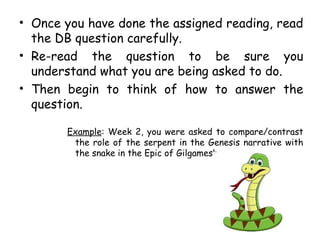
• Once you have done the assigned reading, read
the DB question carefully.
• Re-read the question to be sure you
understand what you are being asked to do.
• Then begin to think of how to answer the
question.
Example: Week 2, you were asked to compare/contrast
the role of the serpent in the Genesis narrative with
the snake in the Epic of Gilgamesh.
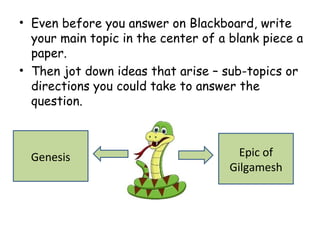
• Even before you answer on Blackboard, write
your main topic in the center of a blank piece a
paper.
• Then jot down ideas that arise – sub-topics or
directions you could take to answer the
question.
Genesis Epic of
Gilgamesh
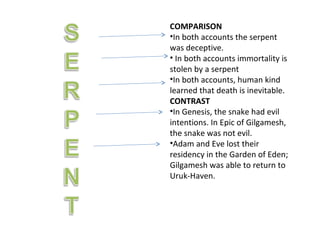
COMPARISON
•In both accounts the serpent
was deceptive.
• In both accounts immortality is
stolen by a serpent
•In both accounts, human kind
learned that death is inevitable.
CONTRAST
•In Genesis, the snake had evil
intentions. In Epic of Gilgamesh,
the snake was not evil.
•Adam and Eve lost their
residency in the Garden of Eden;
Gilgamesh was able to return to
Uruk-Haven.
• Research is also an important part
of your writing.
• Do your research diligently.
• Be sure to carefully document all
information that you take from other
sources, even from your own
textbook.
STEP 2: DRAFTING
• Sit down with your pre-writing plan beside
you, and start writing your first draft (also
known as the rough draft or rough copy).
• Be selective.  You don't have to include
everything that was in your prewriting! Pick
your best ideas..
• At this stage, don’t worry too much about
grammar, punctuation or spelling. You will
make revisions later on in the process.
Just keep writing!
• When working on your first draft try to:
– Set aside at least thirty minutes to
concentrate.
– Go somewhere without interruptions.
– Switch off distracting programs
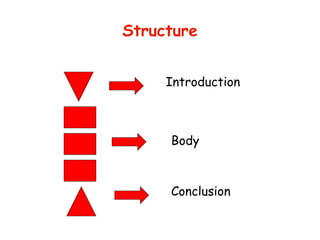
Structure
Introduction
Body
Conclusion
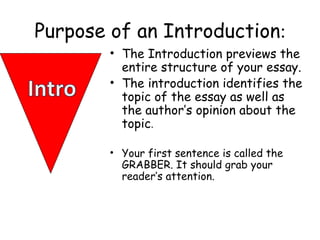
Purpose of an Introduction:
• The Introduction previews the
entire structure of your essay.
• The introduction identifies the
topic of the essay as well as
the author’s opinion about the
topic.
• Your first sentence is called the
GRABBER. It should grab your
reader’s attention.
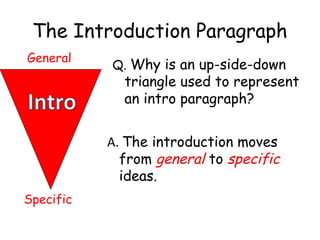
The Introduction Paragraph
Q. Why is an up-side-down
triangle used to represent
an intro paragraph?
A. The introduction moves
from general to specific
ideas.
General
Specific
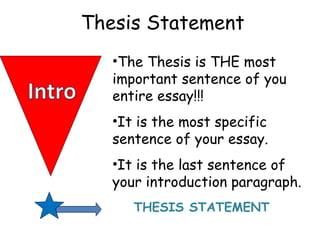
•The Thesis is THE most
important sentence of you
entire essay!!!
•It is the most specific
sentence of your essay.
•It is the last sentence of
your introduction paragraph.
THESIS STATEMENT
Thesis Statement
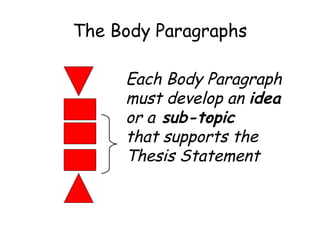
The Body Paragraphs
.
Each Body Paragraph
must develop an idea
or a sub-topic
that supports the
Thesis Statement
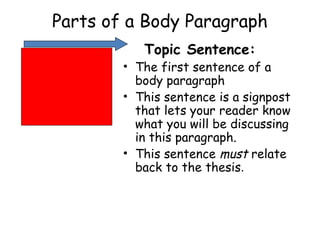
Parts of a Body Paragraph
• The first sentence of a
body paragraph
• This sentence is a signpost
that lets your reader know
what you will be discussing
in this paragraph.
• This sentence must relate
back to the thesis.
Topic Sentence:
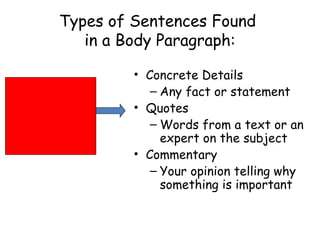
Types of Sentences Found
in a Body Paragraph:
• Concrete Details
– Any fact or statement
• Quotes
– Words from a text or an
expert on the subject
• Commentary
– Your opinion telling why
something is important
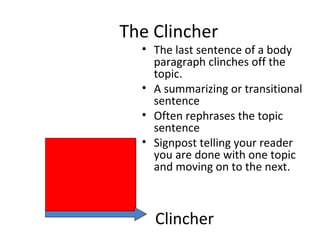
The Clincher
• The last sentence of a body
paragraph clinches off the
topic.
• A summarizing or transitional
sentence
• Often rephrases the topic
sentence
• Signpost telling your reader
you are done with one topic
and moving on to the next.
Clincher
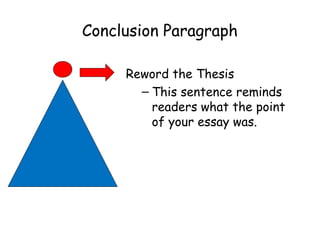
Conclusion Paragraph
Reword the Thesis
– This sentence reminds
readers what the point
of your essay was.
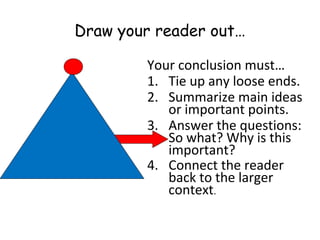
Draw your reader out…
Your conclusion must…
1. Tie up any loose ends.
2. Summarize main ideas
or important points.
3. Answer the questions:
So what? Why is this
important?
4. Connect the reader
back to the larger
context.
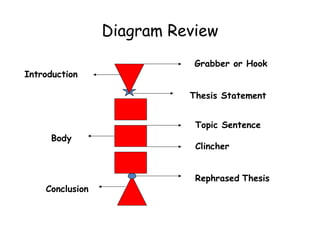
Diagram Review
Introduction
Grabber or Hook
Thesis Statement
Body
Topic Sentence
Clincher
Conclusion
Rephrased Thesis
STEP 3: REVISING
MAKE IT BETTER
.
Revision is an important part
of the writing process and
should be given as much time
and care as prewriting and
drafting.
Everyone needs to revise.
Even experienced writers do
many revisions.
REVISING TIPS - Ask yourself these questions . . .
• Can you read your essay out loud without
stumbling?
• Is your train of thought clear? Are there any
tangents?
• Is there a catchy introduction? Is a vivid
mental picture created in the reader's mind?
• Is there a strong hook, thesis and lead-in?
• Does the conclusion leave the reader
thinking?
• Are all sentences complete or are there
sentence fragments?
• Do supporting details support only the topic
sentence of that paragraph?
• Is your writing wordy and redundant? Are you
using the same words and phrases
over and over again?
• Did you use a thesaurus?
During the revision stage, it can be
helpful to use the A.R.R.R. approach:
• Adding
• Rearranging
• Removing
• Replacing
Adding
• What else does the reader need to
know?
• What areas could you expand on?.
Rearranging
• Would the argument flow better if you
reordered your paragraphs?
Removing
• Have you gone off-point in some
sections of your essay?
Replacing
• Would more vivid details help bring
your piece to life?
• Do you need to look for stronger
examples and quotations to support
your argument?
• Read what you have written and judge
if it says what you mean.
If any particular part of your essay
isn’t working, REVISE!
STEP 4: EDITING
• The editing stage is distinct from
revision and needs to be done after
revising.
• Print out your work and edit on paper.
Many writers find it easier to spot
mistakes this way.
MAKE IT CORRECT
• spelling
• capitalization
• punctuation
• grammar
• sentence structure
• subject/verb agreement
• consistent verb tense
• word usage
EDITING IS……
• When editing, go through your piece line
by line.
• Read it aloud.
• Read your work backwards. Read the
last sentence, then the second
last sentence, etc.
• Check that each sentence makes sense
when you read it on its own.
.
MAKE IT CORRECT
• Be sure that every sentence has two parts:
subject (who or what) predicate (what's
happening)
• Use sentence combining words: and, but, or,
yet, because, although, when, if, where etc.
• Use periods and commas where necessary but
do not overuse.
• Do not overuse the exclamation mark!
• Use a spell-checker, but be careful with
words that sound alike, but are spelled
differently such as then/than, its/it’s,
there/their etc.
• .A useful checklist for writers to use for
a peer and self edit is available at
http://206.218.128.2/laintech/peer.htm
• Now key your answer onto Blackboard
and remember to save a copy in your own
file in case of computer problems when
sending.

Writing a short essay (1)

  • 1.
  • 2.
    • Once youhave done the assigned reading, read the DB question carefully. • Re-read the question to be sure you understand what you are being asked to do. • Then begin to think of how to answer the question. Example: Week 2, you were asked to compare/contrast the role of the serpent in the Genesis narrative with the snake in the Epic of Gilgamesh.
  • 3.
    • Even beforeyou answer on Blackboard, write your main topic in the center of a blank piece a paper. • Then jot down ideas that arise – sub-topics or directions you could take to answer the question. Genesis Epic of Gilgamesh
  • 4.
    COMPARISON •In both accountsthe serpent was deceptive. • In both accounts immortality is stolen by a serpent •In both accounts, human kind learned that death is inevitable. CONTRAST •In Genesis, the snake had evil intentions. In Epic of Gilgamesh, the snake was not evil. •Adam and Eve lost their residency in the Garden of Eden; Gilgamesh was able to return to Uruk-Haven.
  • 5.
    • Research isalso an important part of your writing. • Do your research diligently. • Be sure to carefully document all information that you take from other sources, even from your own textbook.
  • 6.
  • 7.
    • Sit downwith your pre-writing plan beside you, and start writing your first draft (also known as the rough draft or rough copy). • Be selective.  You don't have to include everything that was in your prewriting! Pick your best ideas.. • At this stage, don’t worry too much about grammar, punctuation or spelling. You will make revisions later on in the process. Just keep writing!
  • 8.
    • When workingon your first draft try to: – Set aside at least thirty minutes to concentrate. – Go somewhere without interruptions. – Switch off distracting programs
  • 9.
  • 10.
    Purpose of anIntroduction: • The Introduction previews the entire structure of your essay. • The introduction identifies the topic of the essay as well as the author’s opinion about the topic. • Your first sentence is called the GRABBER. It should grab your reader’s attention.
  • 11.
    The Introduction Paragraph Q.Why is an up-side-down triangle used to represent an intro paragraph? A. The introduction moves from general to specific ideas. General Specific
  • 12.
    •The Thesis isTHE most important sentence of you entire essay!!! •It is the most specific sentence of your essay. •It is the last sentence of your introduction paragraph. THESIS STATEMENT Thesis Statement
  • 13.
    The Body Paragraphs . EachBody Paragraph must develop an idea or a sub-topic that supports the Thesis Statement
  • 14.
    Parts of aBody Paragraph • The first sentence of a body paragraph • This sentence is a signpost that lets your reader know what you will be discussing in this paragraph. • This sentence must relate back to the thesis. Topic Sentence:
  • 15.
    Types of SentencesFound in a Body Paragraph: • Concrete Details – Any fact or statement • Quotes – Words from a text or an expert on the subject • Commentary – Your opinion telling why something is important
  • 16.
    The Clincher • Thelast sentence of a body paragraph clinches off the topic. • A summarizing or transitional sentence • Often rephrases the topic sentence • Signpost telling your reader you are done with one topic and moving on to the next. Clincher
  • 17.
    Conclusion Paragraph Reword theThesis – This sentence reminds readers what the point of your essay was.
  • 18.
    Draw your readerout… Your conclusion must… 1. Tie up any loose ends. 2. Summarize main ideas or important points. 3. Answer the questions: So what? Why is this important? 4. Connect the reader back to the larger context.
  • 19.
    Diagram Review Introduction Grabber orHook Thesis Statement Body Topic Sentence Clincher Conclusion Rephrased Thesis
  • 20.
  • 21.
    MAKE IT BETTER . Revisionis an important part of the writing process and should be given as much time and care as prewriting and drafting. Everyone needs to revise. Even experienced writers do many revisions.
  • 22.
    REVISING TIPS -Ask yourself these questions . . . • Can you read your essay out loud without stumbling? • Is your train of thought clear? Are there any tangents? • Is there a catchy introduction? Is a vivid mental picture created in the reader's mind? • Is there a strong hook, thesis and lead-in? • Does the conclusion leave the reader thinking?
  • 23.
    • Are allsentences complete or are there sentence fragments? • Do supporting details support only the topic sentence of that paragraph? • Is your writing wordy and redundant? Are you using the same words and phrases over and over again? • Did you use a thesaurus?
  • 24.
    During the revisionstage, it can be helpful to use the A.R.R.R. approach: • Adding • Rearranging • Removing • Replacing
  • 25.
    Adding • What elsedoes the reader need to know? • What areas could you expand on?. Rearranging • Would the argument flow better if you reordered your paragraphs? Removing • Have you gone off-point in some sections of your essay?
  • 26.
    Replacing • Would morevivid details help bring your piece to life? • Do you need to look for stronger examples and quotations to support your argument? • Read what you have written and judge if it says what you mean. If any particular part of your essay isn’t working, REVISE!
  • 27.
  • 28.
    • The editingstage is distinct from revision and needs to be done after revising. • Print out your work and edit on paper. Many writers find it easier to spot mistakes this way. MAKE IT CORRECT
  • 29.
    • spelling • capitalization •punctuation • grammar • sentence structure • subject/verb agreement • consistent verb tense • word usage EDITING IS……
  • 30.
    • When editing,go through your piece line by line. • Read it aloud. • Read your work backwards. Read the last sentence, then the second last sentence, etc. • Check that each sentence makes sense when you read it on its own. . MAKE IT CORRECT
  • 31.
    • Be surethat every sentence has two parts: subject (who or what) predicate (what's happening) • Use sentence combining words: and, but, or, yet, because, although, when, if, where etc. • Use periods and commas where necessary but do not overuse. • Do not overuse the exclamation mark! • Use a spell-checker, but be careful with words that sound alike, but are spelled differently such as then/than, its/it’s, there/their etc.
  • 32.
    • .A usefulchecklist for writers to use for a peer and self edit is available at http://206.218.128.2/laintech/peer.htm • Now key your answer onto Blackboard and remember to save a copy in your own file in case of computer problems when sending.