PSYC 3401
Experimental
Psychology

Prof Traci Welch Moritz
Public Services Librarian
Assistant Professor
Heterick Memorial Library
Goals for today
Devise

a research strategy
Begin background research
Select and access resources
Critically evaluating resources
Saving resources found using
Bibliographic Citation Software
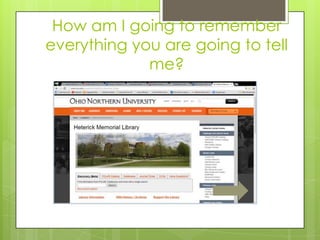
How am I going to remember
everything you are going to tell
me?
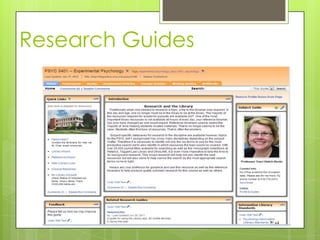
Research Guides
What do I do first?
Take a look at your topic and identify
key search terms, Ask a question.
 Most databases now use an implied
Boolean logic search scheme so a
keyword search will get you started.
 Boolean logic is the use of AND, NOT,
OR to narrow or expand your search
 See Research Guide for PSYC 3401

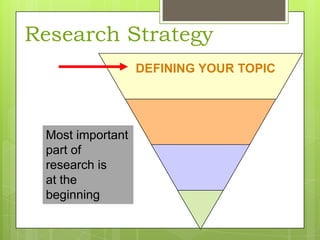
Research Strategy
DEFINING YOUR TOPIC

Most important
part of
research is
at the
beginning
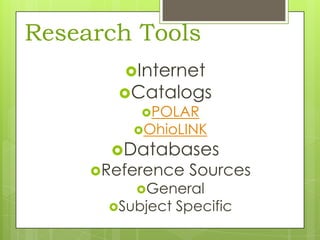
Research Tools
Internet

Catalogs
POLAR

OhioLINK

Databases

Reference

Sources

General

Subject

Specific
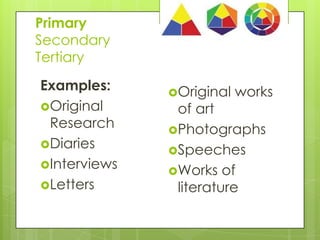
Primary
Secondary
Tertiary
 In

the humanities and social sciences, primary
sources are the direct evidence or first-hand
accounts of events without secondary analysis
or interpretation. A primary source is a work
that was created or written contemporary with
the period or subject being studied.



A primary source is an original document containing
firsthand information about a topic. Different fields of
study may use different types of primary sources.

http://www.lib.vt.edu/help/research/primary-secondary-tertiary.html
Virginia Tech University Libraries
Accessed 08/23/2013
Primary
Secondary
Tertiary
Examples:
Original
Research
Diaries
Interviews
Letters

9

Original

works

of art
Photographs
Speeches
Works of
literature
Primary
Secondary
Tertiary
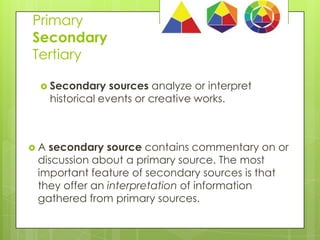
 Secondary

sources analyze or interpret
historical events or creative works.

A

secondary source contains commentary on or
discussion about a primary source. The most
important feature of secondary sources is that
they offer an interpretation of information
gathered from primary sources.
Primary
Secondary
Tertiary
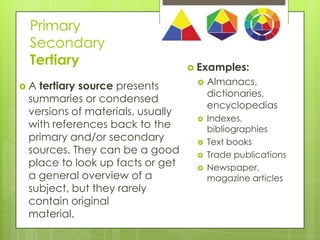
A

11

tertiary source presents
summaries or condensed
versions of materials, usually
with references back to the
primary and/or secondary
sources. They can be a good
place to look up facts or get
a general overview of a
subject, but they rarely
contain original
material.

 Examples:








Almanacs,
dictionaries,
encyclopedias
Indexes,
bibliographies
Text books
Trade publications
Newspaper,
magazine articles
Reference Resources
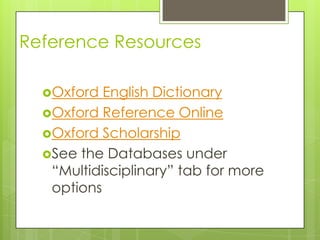
Oxford

English Dictionary
Oxford Reference Online
Oxford Scholarship
See the Databases under
“Multidisciplinary” tab for more
options
So what next?
•
•
•

•
•

•

Start big doing background reading
Look for patterns
Look at reference sources, LC subject
heading list, subject headings in
research tools
Ask a librarian 
Look at thesaurus in the research tools
Narrow your topic for a more focused
product
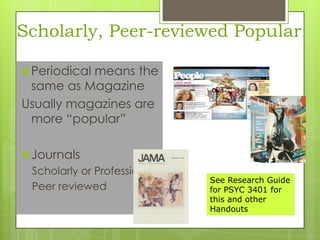
Scholarly, Peer-reviewed Popular
 Periodical

means the
same as Magazine
Usually magazines are
more “popular”
 Journals

Scholarly or Professional
Peer reviewed

See Research Guide
for PSYC 3401 for
this and other
Handouts
Empirical Article -summarizing original research

Components of…
 Abstract – A report of an empirical study includes an abstract that
provides a very brief summary of the research.
 Introduction – The introduction sets the research in a context, which
provides a review of related research and develops the hypotheses
for the research.
 Method – The method section is a description of how the research
was conducted, including who the participants were, the design of
the study, what the participants did, and what measures were used.
 Results – The results section describes the outcomes of the measures
of the study.
 Discussion – The discussion section contains the interpretations and
implications of the study.
 General Discussion – There may be more than one study in the
report; in this case, there are usually separate Method and Results
sections for each study followed by a general discussion that ties all
the research together.
 References – A references section contains information about the
articles and books cited in the report.
 Language

Recognizing Empirical
Research

 measurement

 psychological

aspects

 reports
 research

statistics

 usage
 Length

of Article
 Empirical research articles are usually substantial
(more than 1 or 2 pages) and include a
bibliography or cited references section (usually at
the end of the article).
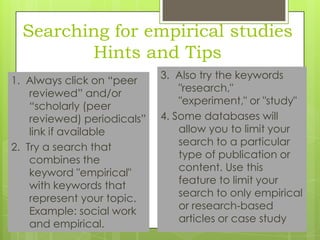
Searching for empirical studies
Hints and Tips
1. Always click on “peer
reviewed” and/or
“scholarly (peer
reviewed) periodicals”
link if available
2. Try a search that
combines the
keyword "empirical"
with keywords that
represent your topic.
Example: social work
and empirical.

3. Also try the keywords
"research,"
"experiment," or "study"
4. Some databases will
allow you to limit your
search to a particular
type of publication or
content. Use this
feature to limit your
search to only empirical
or research-based
articles or case study
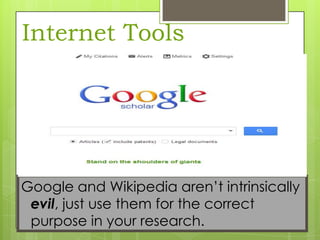
Internet Tools

Google and Wikipedia aren’t intrinsically
evil, just use them for the correct
purpose in your research.
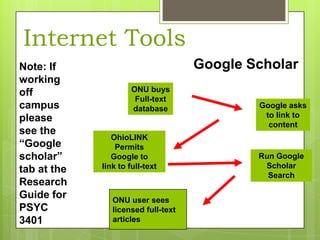
Internet Tools
Note: If
working
off
campus
please
see the
“Google
scholar”
tab at the
Research
Guide for
PSYC
3401

Google Scholar
ONU buys
Full-text
database

OhioLINK
Permits
Google to
link to full-text

ONU user sees
licensed full-text
articles

Google asks
to link to
content

Run Google
Scholar
Search
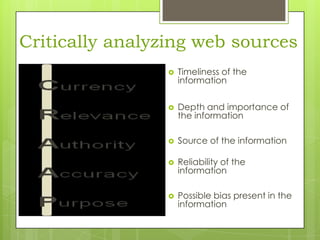
Critically analyzing web sources


Timeliness of the
information



Depth and importance of
the information



Source of the information



Reliability of the
information



Possible bias present in the
information
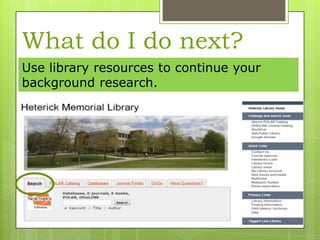
What do I do next?
Use library resources to continue your
background research.
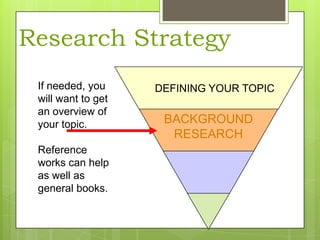
Research Strategy
If needed, you
will want to get
an overview of
your topic.
Reference
works can help
as well as
general books.

DEFINING YOUR TOPIC

BACKGROUND
RESEARCH
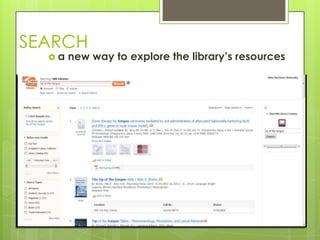
SEARCH
a

new way to explore the library’s resources
What is included?
 POLAR

 Article-level

searching for all EBSCO

databases
 Article-level searching for a variety
of other databases: JSTOR,
Hoover’s, AccessPharmacy, etc.
 Title-level searching for most other
databases: IEEE, CIAO, Proquest
Nursing & Allied Health
 OhioLink central catalog
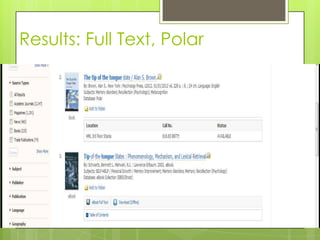
Results: Full Text, Polar
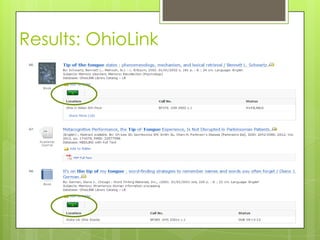
Results: OhioLink
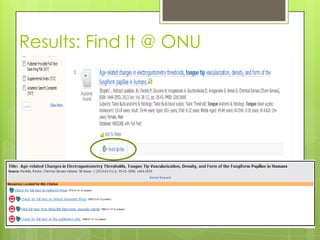
Results: Find It @ ONU
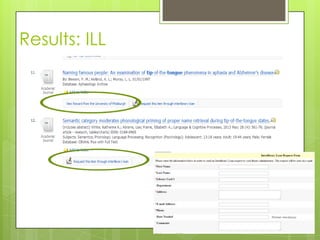
Results: ILL
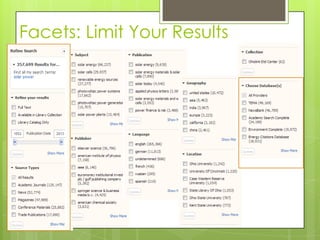
Facets: Limit Your Results
Things to Remember
 Facets

are your Friend: After you
search, limit your results to what you
really want
 A tool not a solution: This is not the
solution to everything
 Ask the librarians for help: We would be
glad to help you or your students with
best practices
 There will still be some small changes
coming
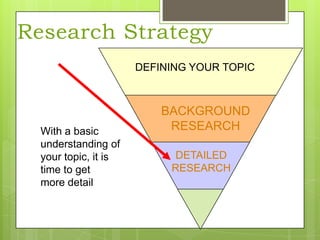
Research Strategy
DEFINING YOUR TOPIC

With a basic
understanding of
your topic, it is
time to get
more detail

BACKGROUND
RESEARCH
DETAILED
RESEARCH
Research Tools∞Databases
Often

tools for locating journal
and newspaper articles
Most are subject-specific –
some multi-disciplinary
Many give access to full text of
articles
Heterick has over 250
Databases -- Subject Specific






MEDLINE with Full Text
PsycINFO 1967 – present
Psychology and Behavioral
Science Collection
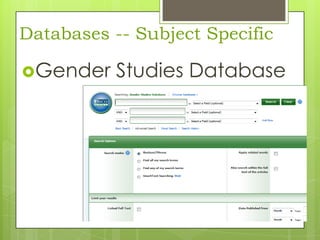
Gender Studies Database
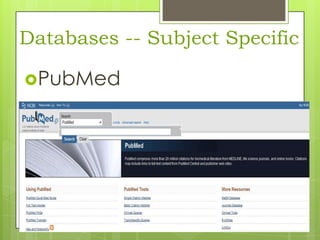
PubMed

(for off campus access, click on the “off-campus access” flag and log
in using first and last name and all 11 digits ONU ID )
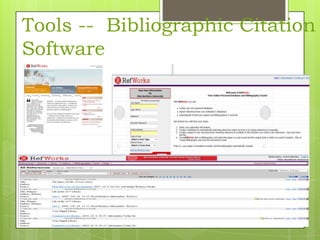
Tools -- Bibliographic Citation
Software
Databases -- Subject Specific
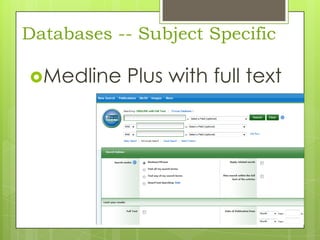
Medline

Plus with full text
Databases -- Subject Specific
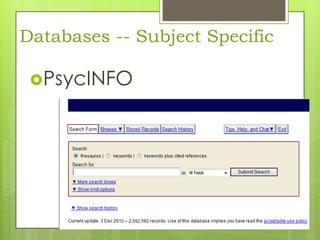
PsycINFO
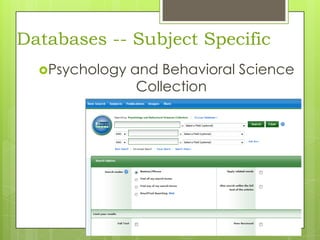
Databases -- Subject Specific
Psychology

and Behavioral Science
Collection
Databases -- Subject Specific
Gender

Studies Database
Databases -- Subject Specific
PubMed
Databases -- Subject Specific
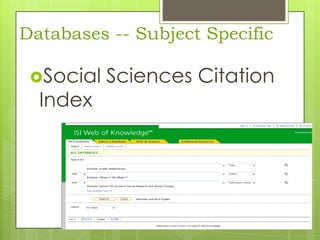
Social

Index

Sciences Citation
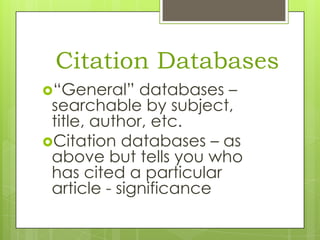
Citation Databases
“General”

databases –
searchable by subject,
title, author, etc.
Citation databases – as
above but tells you who
has cited a particular
article - significance
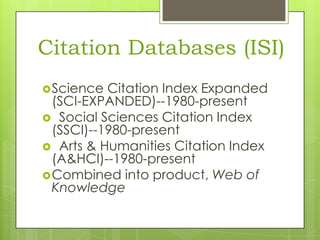
Citation Databases (ISI)
 Science

Citation Index Expanded
(SCI-EXPANDED)--1980-present
 Social Sciences Citation Index
(SSCI)--1980-present
 Arts & Humanities Citation Index
(A&HCI)--1980-present
 Combined into product, Web of
Knowledge
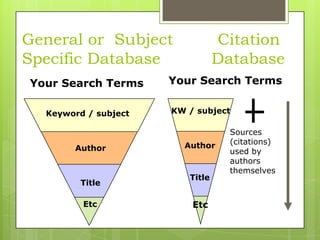
General or Subject
Specific Database
Your Search Terms
Keyword / subject

Author

Title
Etc

Citation
Database

Your Search Terms
KW / subject

Author

Title

Etc.

Sources
(citations)
used by
authors
themselves
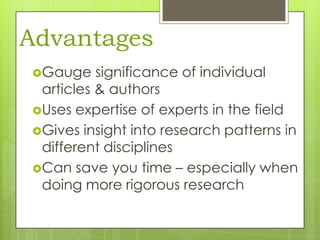
Advantages
Gauge

significance of individual
articles & authors
Uses expertise of experts in the field
Gives insight into research patterns in
different disciplines
Can save you time – especially when
doing more rigorous research
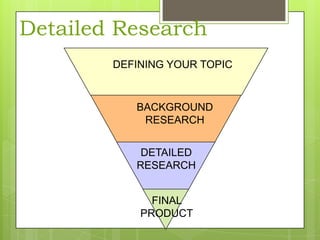
Detailed Research
DEFINING YOUR TOPIC

BACKGROUND
RESEARCH
DETAILED
RESEARCH
FINAL
PRODUCT
QUESTIONS?
Ask

at the Reference Desk
Phone the Reference Desk – 2185
Contact us by E-mail
reference@onu.edu
PSYC 3401

PSYC 3401

  • 1.
    PSYC 3401 Experimental Psychology Prof TraciWelch Moritz Public Services Librarian Assistant Professor Heterick Memorial Library
  • 2.
    Goals for today Devise aresearch strategy Begin background research Select and access resources Critically evaluating resources Saving resources found using Bibliographic Citation Software
  • 3.
    How am Igoing to remember everything you are going to tell me?
  • 4.
  • 5.
    What do Ido first? Take a look at your topic and identify key search terms, Ask a question.  Most databases now use an implied Boolean logic search scheme so a keyword search will get you started.  Boolean logic is the use of AND, NOT, OR to narrow or expand your search  See Research Guide for PSYC 3401 
  • 6.
    Research Strategy DEFINING YOURTOPIC Most important part of research is at the beginning
  • 7.
  • 8.
    Primary Secondary Tertiary  In the humanitiesand social sciences, primary sources are the direct evidence or first-hand accounts of events without secondary analysis or interpretation. A primary source is a work that was created or written contemporary with the period or subject being studied.  A primary source is an original document containing firsthand information about a topic. Different fields of study may use different types of primary sources. http://www.lib.vt.edu/help/research/primary-secondary-tertiary.html Virginia Tech University Libraries Accessed 08/23/2013
  • 9.
  • 10.
    Primary Secondary Tertiary  Secondary sources analyzeor interpret historical events or creative works. A secondary source contains commentary on or discussion about a primary source. The most important feature of secondary sources is that they offer an interpretation of information gathered from primary sources.
  • 11.
    Primary Secondary Tertiary A 11 tertiary source presents summariesor condensed versions of materials, usually with references back to the primary and/or secondary sources. They can be a good place to look up facts or get a general overview of a subject, but they rarely contain original material.  Examples:      Almanacs, dictionaries, encyclopedias Indexes, bibliographies Text books Trade publications Newspaper, magazine articles
  • 12.
    Reference Resources Oxford English Dictionary OxfordReference Online Oxford Scholarship See the Databases under “Multidisciplinary” tab for more options
  • 13.
    So what next? • • • • • • Startbig doing background reading Look for patterns Look at reference sources, LC subject heading list, subject headings in research tools Ask a librarian  Look at thesaurus in the research tools Narrow your topic for a more focused product
  • 14.
    Scholarly, Peer-reviewed Popular Periodical means the same as Magazine Usually magazines are more “popular”  Journals Scholarly or Professional Peer reviewed See Research Guide for PSYC 3401 for this and other Handouts
  • 15.
    Empirical Article -summarizingoriginal research Components of…  Abstract – A report of an empirical study includes an abstract that provides a very brief summary of the research.  Introduction – The introduction sets the research in a context, which provides a review of related research and develops the hypotheses for the research.  Method – The method section is a description of how the research was conducted, including who the participants were, the design of the study, what the participants did, and what measures were used.  Results – The results section describes the outcomes of the measures of the study.  Discussion – The discussion section contains the interpretations and implications of the study.  General Discussion – There may be more than one study in the report; in this case, there are usually separate Method and Results sections for each study followed by a general discussion that ties all the research together.  References – A references section contains information about the articles and books cited in the report.
  • 16.
     Language Recognizing Empirical Research measurement  psychological aspects  reports  research statistics  usage  Length of Article  Empirical research articles are usually substantial (more than 1 or 2 pages) and include a bibliography or cited references section (usually at the end of the article).
  • 17.
    Searching for empiricalstudies Hints and Tips 1. Always click on “peer reviewed” and/or “scholarly (peer reviewed) periodicals” link if available 2. Try a search that combines the keyword "empirical" with keywords that represent your topic. Example: social work and empirical. 3. Also try the keywords "research," "experiment," or "study" 4. Some databases will allow you to limit your search to a particular type of publication or content. Use this feature to limit your search to only empirical or research-based articles or case study
  • 18.
    Internet Tools Google andWikipedia aren’t intrinsically evil, just use them for the correct purpose in your research.
  • 19.
    Internet Tools Note: If working off campus please seethe “Google scholar” tab at the Research Guide for PSYC 3401 Google Scholar ONU buys Full-text database OhioLINK Permits Google to link to full-text ONU user sees licensed full-text articles Google asks to link to content Run Google Scholar Search
  • 20.
    Critically analyzing websources  Timeliness of the information  Depth and importance of the information  Source of the information  Reliability of the information  Possible bias present in the information
  • 21.
    What do Ido next? Use library resources to continue your background research.
  • 22.
    Research Strategy If needed,you will want to get an overview of your topic. Reference works can help as well as general books. DEFINING YOUR TOPIC BACKGROUND RESEARCH
  • 23.
    SEARCH a new way toexplore the library’s resources
  • 24.
    What is included? POLAR  Article-level searching for all EBSCO databases  Article-level searching for a variety of other databases: JSTOR, Hoover’s, AccessPharmacy, etc.  Title-level searching for most other databases: IEEE, CIAO, Proquest Nursing & Allied Health  OhioLink central catalog
  • 25.
  • 26.
  • 27.
  • 28.
  • 29.
  • 30.
    Things to Remember Facets are your Friend: After you search, limit your results to what you really want  A tool not a solution: This is not the solution to everything  Ask the librarians for help: We would be glad to help you or your students with best practices  There will still be some small changes coming
  • 31.
    Research Strategy DEFINING YOURTOPIC With a basic understanding of your topic, it is time to get more detail BACKGROUND RESEARCH DETAILED RESEARCH
  • 32.
    Research Tools∞Databases Often tools forlocating journal and newspaper articles Most are subject-specific – some multi-disciplinary Many give access to full text of articles Heterick has over 250
  • 33.
    Databases -- SubjectSpecific      MEDLINE with Full Text PsycINFO 1967 – present Psychology and Behavioral Science Collection Gender Studies Database PubMed (for off campus access, click on the “off-campus access” flag and log in using first and last name and all 11 digits ONU ID )
  • 34.
    Tools -- BibliographicCitation Software
  • 35.
    Databases -- SubjectSpecific Medline Plus with full text
  • 36.
    Databases -- SubjectSpecific PsycINFO
  • 37.
    Databases -- SubjectSpecific Psychology and Behavioral Science Collection
  • 38.
    Databases -- SubjectSpecific Gender Studies Database
  • 39.
    Databases -- SubjectSpecific PubMed
  • 40.
    Databases -- SubjectSpecific Social Index Sciences Citation
  • 41.
    Citation Databases “General” databases – searchableby subject, title, author, etc. Citation databases – as above but tells you who has cited a particular article - significance
  • 42.
    Citation Databases (ISI) Science Citation Index Expanded (SCI-EXPANDED)--1980-present  Social Sciences Citation Index (SSCI)--1980-present  Arts & Humanities Citation Index (A&HCI)--1980-present  Combined into product, Web of Knowledge
  • 43.
    General or Subject SpecificDatabase Your Search Terms Keyword / subject Author Title Etc Citation Database Your Search Terms KW / subject Author Title Etc. Sources (citations) used by authors themselves
  • 44.
    Advantages Gauge significance of individual articles& authors Uses expertise of experts in the field Gives insight into research patterns in different disciplines Can save you time – especially when doing more rigorous research
  • 45.
    Detailed Research DEFINING YOURTOPIC BACKGROUND RESEARCH DETAILED RESEARCH FINAL PRODUCT
  • 46.
    QUESTIONS? Ask at the ReferenceDesk Phone the Reference Desk – 2185 Contact us by E-mail reference@onu.edu