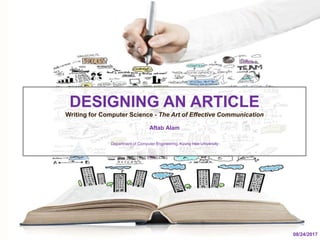

DESIGNING AN ARTICLE
Writing for Computer Science - The Art of Effective Communication
Aftab Alam
Department of Computer Engineering, Kyung Hee University
08/24/2017
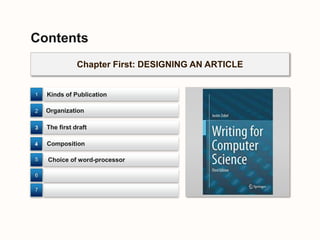
Chapter First: DESIGNING AN ARTICLE
Contents
Kinds of Publication
Organization
Choice of word-processor
7
6
5
2
1
4
3 The first draft
Composition
Data & Knowledge Engineering Laboratory
Department of Computer Engineering, Kyung Hee
Designing n Article
Motivation
• A scientific article
– a description of new ideas and a demonstration of their correctness.
– Remarkable for long time, and
– if published in a major journal/conf.,
o may be read by thousands of other scientists.
– a report will not convince anybody/useless
o if it is difficult to understudy.
– Important
o Better: results, supporting arguments & presentation .
Data & Knowledge Engineering Laboratory
Department of Computer Engineering, Kyung Hee
Designing n Article
Motivation
• Publication not only makes knowledge available,
– it establishes the authors as the creators of that knowledge
• Rewards for author
– position, promotion, H-index, Nobel prizes, etc.
• Public mistakes not only make a scientist look foolish,
– they can hurt a career
– Article
o styling,
o polishing process,
o clarity, and
o simplicity
Data & Knowledge Engineering Laboratory
Department of Computer Engineering, Kyung Hee
Designing n Article
Scientific Research
• Designing an Article
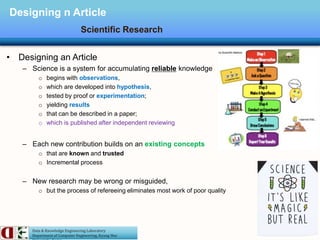
– Science is a system for accumulating reliable knowledge
o begins with observations,
o which are developed into hypothesis,
o tested by proof or experimentation;
o yielding results
o that can be described in a paper;
o which is published after independent reviewing
– Each new contribution builds on an existing concepts
o that are known and trusted
o Incremental process
– New research may be wrong or misguided,
o but the process of refereeing eliminates most work of poor quality
Data & Knowledge Engineering Laboratory
Department of Computer Engineering, Kyung Hee
Designing n Article
Authors needs to:
• Describe
– the position of the new idea in the body of scientific knowledge
• Formally state the idea,
– often as a theory or hypothesis
• Explain
– what is new about the idea/contribution the paper is making
• Justify the theory,
– by methods such as proof or experiment
Data & Knowledge Engineering Laboratory
Department of Computer Engineering, Kyung Hee
Designing n Article
Kinds of Publications
1. Books
2. Theses & Dissertations
3. Research Articles
– Journal Papers,
– Conference Proceedings
4. Review Article
– Survey Paper
5. Case Study
6. Meta Analysis
7. Technical Report
8. White Paper
9. Concept Paper
10. Position Paper
11. Working Paper
Data & Knowledge Engineering Laboratory
Department of Computer Engineering, Kyung Hee
Designing n Article
Kinds of Publications
1. Books
2. Theses & Dissertations
3. Research Articles
– Journal Papers,
– Conference Proceedings
4. Review Article
– Survey Paper
5. Case Study
6. Meta Analysis
7. Technical Report
8. White Paper
9. Concept Paper
10. Position Paper
11. Working Paper
• Books
– Contains texts & information
– no new results or idea
• Purpose
– to collect information and present
o an accessible &
o readable form
– Texts are generally better written than are
papers
Data & Knowledge Engineering Laboratory
Department of Computer Engineering, Kyung Hee
Designing n Article
Kinds of Publications
1. Books
2. Theses & Dissertations
3. Research Articles
– Journal Papers,
– Conference Proceedings
4. Review Article
– Survey Paper
5. Case Study
6. Meta Analysis
7. Technical Report
8. White Paper
9. Concept Paper
10. Position Paper
11. Working Paper
• Theses & Dissertations
– usually a deep exploration of a single problem.
– A long essay on a particular subject
o one has done original research,
o for a diploma or degree
– A document submitted
o academic degree or professional qualification
o presenting the author's research and findings
– Dissertation: Doctorate,
– Thesis: Master's degree requirement
Data & Knowledge Engineering Laboratory
Department of Computer Engineering, Kyung Hee
Designing n Article
Kinds of Publications
1. Books
2. Theses & Dissertations
3. Research Articles
– Journal Papers,
– Conference Proceedings
4. Review Article
– Survey Paper
5. Case Study
6. Meta Analysis
7. Technical Report
8. White Paper
9. Concept Paper
10. Position Paper
11. Working Paper
• Research Articles
– Purpose: To present original/new findings
– Common elements:
o an introduction
o description of the research design,
o discussion of the data and methods,
o bibliography.
– Also sometimes referred to as
o “empirical studies,” and they will usually
make up the majority of the content in a
journal.
Data & Knowledge Engineering Laboratory
Department of Computer Engineering, Kyung Hee
Designing n Article
Kinds of Publications
1. Books
2. Theses & Dissertations
3. Research Articles
– Journal Papers,
– Conference Proceedings
4. Review Article
– Survey Paper
5. Case Study
6. Meta Analysis
7. Technical Report
8. White Paper
9. Concept Paper
10. Position Paper
11. Working Paper
• A journal article
– is usually the end product of the research
process,
– a careful presentation of new ideas that has
been revised,
– sometimes over several iterations, according to
referees’ suggestions and criticisms.
– Volume, Issue?
Data & Knowledge Engineering Laboratory
Department of Computer Engineering, Kyung Hee
Designing n Article
Kinds of Publications
1. Books
2. Theses & Dissertations
3. Research Articles
– Journal Papers,
– Conference Proceedings
4. Review Article
– Survey Paper
5. Case Study
6. Meta Analysis
7. Technical Report
8. White Paper
9. Concept Paper
10. Position Paper
11. Working Paper
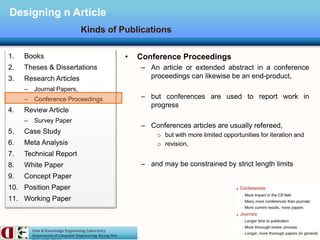
• Conference Proceedings
– An article or extended abstract in a conference
proceedings can likewise be an end-product,
– but conferences are used to report work in
progress
– Conferences articles are usually refereed,
o but with more limited opportunities for iteration and
o revision,
– and may be constrained by strict length limits
Data & Knowledge Engineering Laboratory
Department of Computer Engineering, Kyung Hee
Designing n Article
Kinds of Publications
1. Books
2. Theses & Dissertations
3. Research Articles
– Journal Papers,
– Conference Proceedings
4. Review Article
– Survey Paper
5. Case Study
6. Meta Analysis
7. Technical Report
8. White Paper
9. Concept Paper
10. Position Paper
11. Working Paper
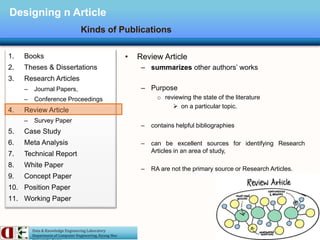
• Review Article
– summarizes other authors’ works
– Purpose
o reviewing the state of the literature
 on a particular topic.
– contains helpful bibliographies
– can be excellent sources for identifying Research
Articles in an area of study,
– RA are not the primary source or Research Articles.
Data & Knowledge Engineering Laboratory
Department of Computer Engineering, Kyung Hee
Designing n Article
Kinds of Publications
1. Books
2. Theses & Dissertations
3. Research Articles
– Journal Papers,
– Conference Proceedings
4. Review Article
– Survey Paper
5. Case Study
6. Meta Analysis
7. Technical Report
8. White Paper
9. Concept Paper
10. Position Paper
11. Working Paper
• Case Study
– A detailed report of clinically important cases
o of common and rare conditions.
– In the social sciences and life sciences,
o a case study (or case report) is a descriptive,
explanatory analysis of a person, group or event.
– An explanatory case study is used to explore
causation in order to find underlying principles.
– Example:
o The Use of Social Networking Sites in Education:
A Case Study of Facebook
Data & Knowledge Engineering Laboratory
Department of Computer Engineering, Kyung Hee
Designing n Article
Kinds of Publications
1. Books
2. Theses & Dissertations
3. Research Articles
– Journal Papers,
– Conference Proceedings
4. Review Article
– Survey Paper
5. Case Study
6. Meta Analysis
7. Technical Report
8. White Paper
9. Concept Paper
10. Position Paper
11. Working Paper
• Meta-analysis
– is a mathematical synthesis of the results of two
or more primary studies
o that addressed the same hypothesis in the same
way.
– Meta-analysis refers to the analysis of analyses
o the statistical analysis of a large collection of
analysis resulted from individual studies for the
purpose of integrating the findings.
– Example.
o The Effectiveness of Computer Applications
A Meta-Analysis
Data & Knowledge Engineering Laboratory
Department of Computer Engineering, Kyung Hee
Designing n Article
Kinds of Publications
1. Books
2. Theses & Dissertations
3. Research Articles
– Journal Papers,
– Conference Proceedings
4. Review Article
– Survey Paper
5. Case Study
6. Meta Analysis
7. Technical Report
8. White Paper
9. Concept Paper
10. Position Paper
11. Working Paper
• Technical Report
– Researchers may also publish work in early form
as a technical report to establish novelty,
o without having to wait for the often long production
schedules of academic journals.
– Advantage: available quickly
o but, because of lack of refereeing,
 readers have less confidence in the work’s
validity.
– There is no formal publishing procedures for
such reports, except where established locally.
– considered as "non-archival" publications,
– considered as grey literature.
Data & Knowledge Engineering Laboratory
Department of Computer Engineering, Kyung Hee
Designing n Article
Kinds of Publications
1. Books
2. Theses & Dissertations
3. Research Articles
– Journal Papers,
– Conference Proceedings
4. Review Article
– Survey Paper
5. Case Study
6. Meta Analysis
7. Technical Report
8. White Paper
9. Concept Paper
10. Position Paper
11. Working Paper
• White Paper
– is an authoritative report or
– guide helping readers to understand an issue,
– solve a problem, or
– make a decision.
– used in two main spheres:
o government and
o business-to-business marketing
– used as a means of
o presenting government policy preferences prior to the
introduction of legislation; as such, the publication of a
White Paper serves to test the climate of public opinion
regarding a controversial policy issue
o and enables the government to gauge its probable impact.
Data & Knowledge Engineering Laboratory
Department of Computer Engineering, Kyung Hee
Designing n Article
Kinds of Publications
1. Books
2. Theses & Dissertations
3. Research Articles
– Journal Papers,
– Conference Proceedings
4. Review Article
– Survey Paper
5. Case Study
6. Meta Analysis
7. Technical Report
8. White Paper
9. Concept Paper
10. Position Paper
11. Working Paper
• Concept Paper
– Lays the foundation for the applied dissertation process,
– providing an introductory form of communication
o between the doctoral student and
o the doctoral committee.
– it allows the doctoral student the opportunity to define a
research focus and
– obtain early feedback on the research idea
• Title Page
• Problem Statement
• Literature Review
• Goal Statement
• Research Questions
• Methodology
• Timeline
• References
Data & Knowledge Engineering Laboratory
Department of Computer Engineering, Kyung Hee
Designing n Article
Kinds of Publications
1. Books
2. Theses & Dissertations
3. Research Articles
– Journal Papers,
– Conference Proceedings
4. Review Article
– Survey Paper
5. Case Study
6. Meta Analysis
7. Technical Report
8. White Paper
9. Concept Paper
10. Position Paper
11. Working Paper
• Position Paper
– Position papers in academia enable discussion on
emerging topics
– without the experimentation and
– original research normally present in an academic
paper.
Data & Knowledge Engineering Laboratory
Department of Computer Engineering, Kyung Hee
Designing n Article
Kinds of Publications
1. Books
2. Theses & Dissertations
3. Research Articles
– Journal Papers,
– Conference Proceedings
4. Review Article
– Survey Paper
5. Case Study
6. Meta Analysis
7. Technical Report
8. White Paper
9. Concept Paper
10. Position Paper
11. Working Paper
• Working Paper
– A preliminary scientific or technical paper
– Preliminary materials, idea
o circulated to stimulate discussion and
o critical comment
o to share ideas about a topic or
o to elicit feedback
 before submitting to a peer reviewed
conference or academic journal
– They may be considered as grey literature
Data & Knowledge Engineering Laboratory
Department of Computer Engineering, Kyung Hee
Sections of Technical Paper
Organization
• Scientific Articles
– Follow standard structure
– Allow readers quickly discover the main idea
o Interested or
o Not interested.
– Quick Scan
Data & Knowledge Engineering Laboratory
Department of Computer Engineering, Kyung Hee
Sections of Technical Paper
Organization
• A typical article has most of the following components
1. Title & Authors
2. Abstract
3. Introduction
4. Survey
5. Results
6. Summary
7. Bibliography
8. Appendices
Data & Knowledge Engineering Laboratory
Department of Computer Engineering, Kyung Hee
Sections of Technical Paper
Organization
1. Title & Authors
2. Abstract
3. Introduction
4. Survey
5. Results
6. Summary
7. Bibliography
8. Appendices
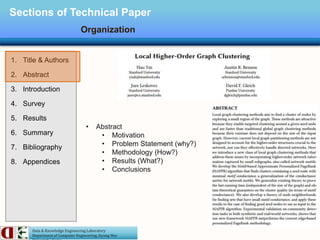
• Abstract
• Motivation
• Problem Statement (why?)
• Methodology (How?)
• Results (What?)
• Conclusions
Data & Knowledge Engineering Laboratory
Department of Computer Engineering, Kyung Hee
Sections of Technical Paper
Organization
1. Title & Authors
2. Abstract
3. Introduction
4. Survey
5. Results
6. Summary
7. Bibliography
8. Appendices
• Introduction
• Motivation
• Problem Statement (why?)
• Methodology (How?)
• Results (What?)
• Conclusions
• Expended version of the abstract
Data & Knowledge Engineering Laboratory
Department of Computer Engineering, Kyung Hee
Sections of Technical Paper
Organization
1. Title & Authors
2. Abstract
3. Introduction
4. Survey
5. Results
6. Summary
7. Bibliography
8. Appendices
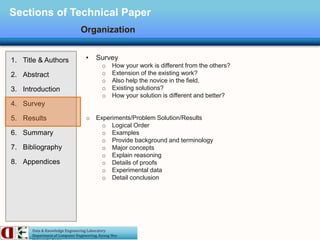
• Survey
o How your work is different from the others?
o Extension of the existing work?
o Also help the novice in the field.
o Existing solutions?
o How your solution is different and better?
o Experiments/Problem Solution/Results
o Logical Order
o Examples
o Provide background and terminology
o Major concepts
o Explain reasoning
o Details of proofs
o Experimental data
o Detail conclusion
Data & Knowledge Engineering Laboratory
Department of Computer Engineering, Kyung Hee
Sections of Technical Paper
Organization
1. Title & Authors
2. Abstract
3. Introduction
4. Survey
5. Results
6. Summary
7. Bibliography
8. Appendices
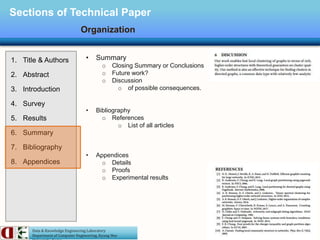
• Summary
o Closing Summary or Conclusions
o Future work?
o Discussion
o of possible consequences.
• Bibliography
o References
o List of all articles
• Appendices
o Details
o Proofs
o Experimental results
Data & Knowledge Engineering Laboratory
Department of Computer Engineering, Kyung Hee
Sections of Technical Paper
The first draft and Composition
• Write Freely Without
– Style, Layout, or punctuation
• Concentrate
– smooth flow of idea
– Logical structure
• If stuck
– Write anything and refine later
• Write and research
– don’t wait to finish the research first
• Brainstorm
– Writing in points
• Edit and revise
Data & Knowledge Engineering Laboratory
Department of Computer Engineering, Kyung Hee
Sections of Technical Paper
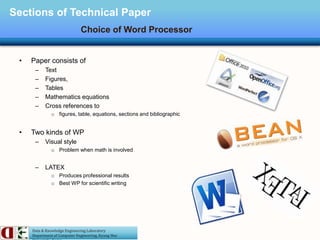
Choice of Word Processor
• Paper consists of
– Text
– Figures,
– Tables
– Mathematics equations
– Cross references to
o figures, table, equations, sections and bibliographic
• Two kinds of WP
– Visual style
o Problem when math is involved
– LATEX
o Produces professional results
o Best WP for scientific writing
Your Logo
THANK YOU
?

Writing for Computer Science: Design an article

  • 1.
    DESIGNING AN ARTICLE Writingfor Computer Science - The Art of Effective Communication Aftab Alam Department of Computer Engineering, Kyung Hee University 08/24/2017
  • 2.
    Chapter First: DESIGNINGAN ARTICLE Contents Kinds of Publication Organization Choice of word-processor 7 6 5 2 1 4 3 The first draft Composition
  • 3.
    Data & KnowledgeEngineering Laboratory Department of Computer Engineering, Kyung Hee Designing n Article Motivation • A scientific article – a description of new ideas and a demonstration of their correctness. – Remarkable for long time, and – if published in a major journal/conf., o may be read by thousands of other scientists. – a report will not convince anybody/useless o if it is difficult to understudy. – Important o Better: results, supporting arguments & presentation .
  • 4.
    Data & KnowledgeEngineering Laboratory Department of Computer Engineering, Kyung Hee Designing n Article Motivation • Publication not only makes knowledge available, – it establishes the authors as the creators of that knowledge • Rewards for author – position, promotion, H-index, Nobel prizes, etc. • Public mistakes not only make a scientist look foolish, – they can hurt a career – Article o styling, o polishing process, o clarity, and o simplicity
  • 5.
    Data & KnowledgeEngineering Laboratory Department of Computer Engineering, Kyung Hee Designing n Article Scientific Research • Designing an Article – Science is a system for accumulating reliable knowledge o begins with observations, o which are developed into hypothesis, o tested by proof or experimentation; o yielding results o that can be described in a paper; o which is published after independent reviewing – Each new contribution builds on an existing concepts o that are known and trusted o Incremental process – New research may be wrong or misguided, o but the process of refereeing eliminates most work of poor quality
  • 6.
    Data & KnowledgeEngineering Laboratory Department of Computer Engineering, Kyung Hee Designing n Article Authors needs to: • Describe – the position of the new idea in the body of scientific knowledge • Formally state the idea, – often as a theory or hypothesis • Explain – what is new about the idea/contribution the paper is making • Justify the theory, – by methods such as proof or experiment
  • 7.
    Data & KnowledgeEngineering Laboratory Department of Computer Engineering, Kyung Hee Designing n Article Kinds of Publications 1. Books 2. Theses & Dissertations 3. Research Articles – Journal Papers, – Conference Proceedings 4. Review Article – Survey Paper 5. Case Study 6. Meta Analysis 7. Technical Report 8. White Paper 9. Concept Paper 10. Position Paper 11. Working Paper
  • 8.
    Data & KnowledgeEngineering Laboratory Department of Computer Engineering, Kyung Hee Designing n Article Kinds of Publications 1. Books 2. Theses & Dissertations 3. Research Articles – Journal Papers, – Conference Proceedings 4. Review Article – Survey Paper 5. Case Study 6. Meta Analysis 7. Technical Report 8. White Paper 9. Concept Paper 10. Position Paper 11. Working Paper • Books – Contains texts & information – no new results or idea • Purpose – to collect information and present o an accessible & o readable form – Texts are generally better written than are papers
  • 9.
    Data & KnowledgeEngineering Laboratory Department of Computer Engineering, Kyung Hee Designing n Article Kinds of Publications 1. Books 2. Theses & Dissertations 3. Research Articles – Journal Papers, – Conference Proceedings 4. Review Article – Survey Paper 5. Case Study 6. Meta Analysis 7. Technical Report 8. White Paper 9. Concept Paper 10. Position Paper 11. Working Paper • Theses & Dissertations – usually a deep exploration of a single problem. – A long essay on a particular subject o one has done original research, o for a diploma or degree – A document submitted o academic degree or professional qualification o presenting the author's research and findings – Dissertation: Doctorate, – Thesis: Master's degree requirement
  • 10.
    Data & KnowledgeEngineering Laboratory Department of Computer Engineering, Kyung Hee Designing n Article Kinds of Publications 1. Books 2. Theses & Dissertations 3. Research Articles – Journal Papers, – Conference Proceedings 4. Review Article – Survey Paper 5. Case Study 6. Meta Analysis 7. Technical Report 8. White Paper 9. Concept Paper 10. Position Paper 11. Working Paper • Research Articles – Purpose: To present original/new findings – Common elements: o an introduction o description of the research design, o discussion of the data and methods, o bibliography. – Also sometimes referred to as o “empirical studies,” and they will usually make up the majority of the content in a journal.
  • 11.
    Data & KnowledgeEngineering Laboratory Department of Computer Engineering, Kyung Hee Designing n Article Kinds of Publications 1. Books 2. Theses & Dissertations 3. Research Articles – Journal Papers, – Conference Proceedings 4. Review Article – Survey Paper 5. Case Study 6. Meta Analysis 7. Technical Report 8. White Paper 9. Concept Paper 10. Position Paper 11. Working Paper • A journal article – is usually the end product of the research process, – a careful presentation of new ideas that has been revised, – sometimes over several iterations, according to referees’ suggestions and criticisms. – Volume, Issue?
  • 12.
    Data & KnowledgeEngineering Laboratory Department of Computer Engineering, Kyung Hee Designing n Article Kinds of Publications 1. Books 2. Theses & Dissertations 3. Research Articles – Journal Papers, – Conference Proceedings 4. Review Article – Survey Paper 5. Case Study 6. Meta Analysis 7. Technical Report 8. White Paper 9. Concept Paper 10. Position Paper 11. Working Paper • Conference Proceedings – An article or extended abstract in a conference proceedings can likewise be an end-product, – but conferences are used to report work in progress – Conferences articles are usually refereed, o but with more limited opportunities for iteration and o revision, – and may be constrained by strict length limits
  • 13.
    Data & KnowledgeEngineering Laboratory Department of Computer Engineering, Kyung Hee Designing n Article Kinds of Publications 1. Books 2. Theses & Dissertations 3. Research Articles – Journal Papers, – Conference Proceedings 4. Review Article – Survey Paper 5. Case Study 6. Meta Analysis 7. Technical Report 8. White Paper 9. Concept Paper 10. Position Paper 11. Working Paper • Review Article – summarizes other authors’ works – Purpose o reviewing the state of the literature  on a particular topic. – contains helpful bibliographies – can be excellent sources for identifying Research Articles in an area of study, – RA are not the primary source or Research Articles.
  • 14.
    Data & KnowledgeEngineering Laboratory Department of Computer Engineering, Kyung Hee Designing n Article Kinds of Publications 1. Books 2. Theses & Dissertations 3. Research Articles – Journal Papers, – Conference Proceedings 4. Review Article – Survey Paper 5. Case Study 6. Meta Analysis 7. Technical Report 8. White Paper 9. Concept Paper 10. Position Paper 11. Working Paper • Case Study – A detailed report of clinically important cases o of common and rare conditions. – In the social sciences and life sciences, o a case study (or case report) is a descriptive, explanatory analysis of a person, group or event. – An explanatory case study is used to explore causation in order to find underlying principles. – Example: o The Use of Social Networking Sites in Education: A Case Study of Facebook
  • 15.
    Data & KnowledgeEngineering Laboratory Department of Computer Engineering, Kyung Hee Designing n Article Kinds of Publications 1. Books 2. Theses & Dissertations 3. Research Articles – Journal Papers, – Conference Proceedings 4. Review Article – Survey Paper 5. Case Study 6. Meta Analysis 7. Technical Report 8. White Paper 9. Concept Paper 10. Position Paper 11. Working Paper • Meta-analysis – is a mathematical synthesis of the results of two or more primary studies o that addressed the same hypothesis in the same way. – Meta-analysis refers to the analysis of analyses o the statistical analysis of a large collection of analysis resulted from individual studies for the purpose of integrating the findings. – Example. o The Effectiveness of Computer Applications A Meta-Analysis
  • 16.
    Data & KnowledgeEngineering Laboratory Department of Computer Engineering, Kyung Hee Designing n Article Kinds of Publications 1. Books 2. Theses & Dissertations 3. Research Articles – Journal Papers, – Conference Proceedings 4. Review Article – Survey Paper 5. Case Study 6. Meta Analysis 7. Technical Report 8. White Paper 9. Concept Paper 10. Position Paper 11. Working Paper • Technical Report – Researchers may also publish work in early form as a technical report to establish novelty, o without having to wait for the often long production schedules of academic journals. – Advantage: available quickly o but, because of lack of refereeing,  readers have less confidence in the work’s validity. – There is no formal publishing procedures for such reports, except where established locally. – considered as "non-archival" publications, – considered as grey literature.
  • 17.
    Data & KnowledgeEngineering Laboratory Department of Computer Engineering, Kyung Hee Designing n Article Kinds of Publications 1. Books 2. Theses & Dissertations 3. Research Articles – Journal Papers, – Conference Proceedings 4. Review Article – Survey Paper 5. Case Study 6. Meta Analysis 7. Technical Report 8. White Paper 9. Concept Paper 10. Position Paper 11. Working Paper • White Paper – is an authoritative report or – guide helping readers to understand an issue, – solve a problem, or – make a decision. – used in two main spheres: o government and o business-to-business marketing – used as a means of o presenting government policy preferences prior to the introduction of legislation; as such, the publication of a White Paper serves to test the climate of public opinion regarding a controversial policy issue o and enables the government to gauge its probable impact.
  • 18.
    Data & KnowledgeEngineering Laboratory Department of Computer Engineering, Kyung Hee Designing n Article Kinds of Publications 1. Books 2. Theses & Dissertations 3. Research Articles – Journal Papers, – Conference Proceedings 4. Review Article – Survey Paper 5. Case Study 6. Meta Analysis 7. Technical Report 8. White Paper 9. Concept Paper 10. Position Paper 11. Working Paper • Concept Paper – Lays the foundation for the applied dissertation process, – providing an introductory form of communication o between the doctoral student and o the doctoral committee. – it allows the doctoral student the opportunity to define a research focus and – obtain early feedback on the research idea • Title Page • Problem Statement • Literature Review • Goal Statement • Research Questions • Methodology • Timeline • References
  • 19.
    Data & KnowledgeEngineering Laboratory Department of Computer Engineering, Kyung Hee Designing n Article Kinds of Publications 1. Books 2. Theses & Dissertations 3. Research Articles – Journal Papers, – Conference Proceedings 4. Review Article – Survey Paper 5. Case Study 6. Meta Analysis 7. Technical Report 8. White Paper 9. Concept Paper 10. Position Paper 11. Working Paper • Position Paper – Position papers in academia enable discussion on emerging topics – without the experimentation and – original research normally present in an academic paper.
  • 20.
    Data & KnowledgeEngineering Laboratory Department of Computer Engineering, Kyung Hee Designing n Article Kinds of Publications 1. Books 2. Theses & Dissertations 3. Research Articles – Journal Papers, – Conference Proceedings 4. Review Article – Survey Paper 5. Case Study 6. Meta Analysis 7. Technical Report 8. White Paper 9. Concept Paper 10. Position Paper 11. Working Paper • Working Paper – A preliminary scientific or technical paper – Preliminary materials, idea o circulated to stimulate discussion and o critical comment o to share ideas about a topic or o to elicit feedback  before submitting to a peer reviewed conference or academic journal – They may be considered as grey literature
  • 21.
    Data & KnowledgeEngineering Laboratory Department of Computer Engineering, Kyung Hee Sections of Technical Paper Organization • Scientific Articles – Follow standard structure – Allow readers quickly discover the main idea o Interested or o Not interested. – Quick Scan
  • 22.
    Data & KnowledgeEngineering Laboratory Department of Computer Engineering, Kyung Hee Sections of Technical Paper Organization • A typical article has most of the following components 1. Title & Authors 2. Abstract 3. Introduction 4. Survey 5. Results 6. Summary 7. Bibliography 8. Appendices
  • 23.
    Data & KnowledgeEngineering Laboratory Department of Computer Engineering, Kyung Hee Sections of Technical Paper Organization 1. Title & Authors 2. Abstract 3. Introduction 4. Survey 5. Results 6. Summary 7. Bibliography 8. Appendices • Abstract • Motivation • Problem Statement (why?) • Methodology (How?) • Results (What?) • Conclusions
  • 24.
    Data & KnowledgeEngineering Laboratory Department of Computer Engineering, Kyung Hee Sections of Technical Paper Organization 1. Title & Authors 2. Abstract 3. Introduction 4. Survey 5. Results 6. Summary 7. Bibliography 8. Appendices • Introduction • Motivation • Problem Statement (why?) • Methodology (How?) • Results (What?) • Conclusions • Expended version of the abstract
  • 25.
    Data & KnowledgeEngineering Laboratory Department of Computer Engineering, Kyung Hee Sections of Technical Paper Organization 1. Title & Authors 2. Abstract 3. Introduction 4. Survey 5. Results 6. Summary 7. Bibliography 8. Appendices • Survey o How your work is different from the others? o Extension of the existing work? o Also help the novice in the field. o Existing solutions? o How your solution is different and better? o Experiments/Problem Solution/Results o Logical Order o Examples o Provide background and terminology o Major concepts o Explain reasoning o Details of proofs o Experimental data o Detail conclusion
  • 26.
    Data & KnowledgeEngineering Laboratory Department of Computer Engineering, Kyung Hee Sections of Technical Paper Organization 1. Title & Authors 2. Abstract 3. Introduction 4. Survey 5. Results 6. Summary 7. Bibliography 8. Appendices • Summary o Closing Summary or Conclusions o Future work? o Discussion o of possible consequences. • Bibliography o References o List of all articles • Appendices o Details o Proofs o Experimental results
  • 27.
    Data & KnowledgeEngineering Laboratory Department of Computer Engineering, Kyung Hee Sections of Technical Paper The first draft and Composition • Write Freely Without – Style, Layout, or punctuation • Concentrate – smooth flow of idea – Logical structure • If stuck – Write anything and refine later • Write and research – don’t wait to finish the research first • Brainstorm – Writing in points • Edit and revise
  • 28.
    Data & KnowledgeEngineering Laboratory Department of Computer Engineering, Kyung Hee Sections of Technical Paper Choice of Word Processor • Paper consists of – Text – Figures, – Tables – Mathematics equations – Cross references to o figures, table, equations, sections and bibliographic • Two kinds of WP – Visual style o Problem when math is involved – LATEX o Produces professional results o Best WP for scientific writing
  • 29.