Technical Writing for
Scientific Journalism
and Lay Science
Colleen M. Farrelly
Meet Your Instructor
• Data scientist who writes technical and lay articles in machine learning
and mathematics
– Several articles in lay science digests/journals
– Lay audience book contract
– Internet writing on technical topics
• Course geared towards
– Journalisms hoping to venture into scientific journalism
– Researchers hoping to venture into journalism related to their fields
Course Overview
• Types of science journalism
• How to write a technical article
• How to write a lay audience article
• Adding visuals/analogies to convey meaning
Types of Science Journalism
• Technical
– For audiences who have a background in the general topic but not the specific
subject matter
– KDnuggets
– Academic publishers
– Generally involves in-depth treatment of subject matter
– Assumption that biologists know some genetics but may not know the latest analysis
being applied to genomics data
– Assumption that a general physics audience will know about black holes or quarks but
perhaps not the latest paper on the topic
Types of Science Journalism
• Lay audience
– College-educated audiences in other fields
– Forbes
– Local newspapers
– Popular science publishers
– Generally aimed at providing a high-level overview of a topic without using
specialist jargon
– High school teacher curious about current gravity research for use in his/her
classroom
– Sociologist curious about recent gene sequencing technologies that might help on
his/her next grant
Technical Articles: Part I
• Scope
– Field overview (ex. machine learning for executives)
– Major breakthrough on a problem (new cancer treatment, for instance)
– New research (perhaps a series of string theory papers)
• Goals
– Teach the audience
– Highlight someone’s research
– Share your own research to those outside your field
Technical Articles: Part II
• Audience assumptions
– Topic: a new GWAS study with clustered selection in predictive models
– In your topic’s research area (quantitative geneticists)
– In your topic’s field (biologists)
– In another field related to your topic’s field (clinical researchers)
• Importance of fresh topics
– Something new (not the 100th article on the topic)
– Something impactful for the audience type
Technical Articles: Part III
• Leveraging your expertise
– Landing a book deal/article solicitation
– Acceptance of your open submission article
– Starting a blog that receives many views
• Example
– My expertise in topological data analysis
– Scarcity of researchers
– Solicited to write an initial article for a social media website
Lay Audience Article: Part I
• Scope
– Field overview (ex. machine learning for executives)
– Major breakthrough on a problem (new cancer treatment, for instance)
– New research (perhaps a series of string theory papers)
• Goals
– Teach the audience
– Highlight someone else’s research
– Share your own research
Lay Audience Articles: Part II
• Audience assumptions
– Topic: a new GWAS study with clustered selection in predictive models
– College-educated audience (assume some biology knowledge)
– High school audience (assume a little less biology knowledge)
– General public (start with the basics)
• Importance of fresh topics
– Something new (not the 100th article on the topic)
– Something of importance to the audience
– Explanation of technical articles
Technical Articles: Part III
• Leveraging your expertise
– Best-positioned to explain the subject in a non-technical manner
– Credentials typically needed for a lay audience book or writing position
• Blogging
– Can be a good way to establish credibility in the field
– Creates an audience (important for book contracts)
• Importance of visuals/analogies in communication
– Picture is worth a thousand words…
– Gives concrete form to abstract or complicated material
Visuals/Analogies: Case I
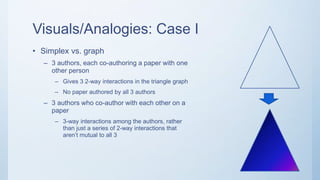
• Simplex vs. graph
– 3 authors, each co-authoring a paper with one
other person
– Gives 3 2-way interactions in the triangle graph
– No paper authored by all 3 authors
– 3 authors who co-author with each other on a
paper
– 3-way interactions among the authors, rather
than just a series of 2-way interactions that
aren’t mutual to all 3
Visuals/Analogies: Case II
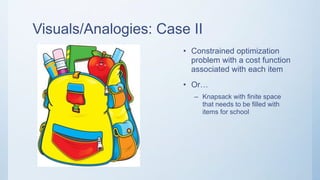
• Constrained optimization
problem with a cost function
associated with each item
• Or…
– Knapsack with finite space
that needs to be filled with
items for school
Visuals/Analogies: Case III
• Bridging constructs in psychology, where survey items are loosely
connected but not in a hierarchical fashion
– Difficult to convey the idea to statisticians
– Difficult to explain the methods used to psychologists
– Resolution in the paper
– Symphony with different movements involving different instruments during different
movements
Closing Thoughts
• Context matters.
• A picture can be worth a thousand words.
• Resources:
– https://www.americanscientist.org/blog/from-the-staff/12-tips-for-scientists-writing-
for-the-general-public
– https://journal.emwa.org/writing-for-lay-audiences/writing-for-lay-audiences-a-
challenge-for-scientists/
– https://web.mit.edu/course/21/21.guide/laypers.htm

Technical writing for scientific journalism and lay science

  • 1.
    Technical Writing for ScientificJournalism and Lay Science Colleen M. Farrelly
  • 2.
    Meet Your Instructor •Data scientist who writes technical and lay articles in machine learning and mathematics – Several articles in lay science digests/journals – Lay audience book contract – Internet writing on technical topics • Course geared towards – Journalisms hoping to venture into scientific journalism – Researchers hoping to venture into journalism related to their fields
  • 3.
    Course Overview • Typesof science journalism • How to write a technical article • How to write a lay audience article • Adding visuals/analogies to convey meaning
  • 4.
    Types of ScienceJournalism • Technical – For audiences who have a background in the general topic but not the specific subject matter – KDnuggets – Academic publishers – Generally involves in-depth treatment of subject matter – Assumption that biologists know some genetics but may not know the latest analysis being applied to genomics data – Assumption that a general physics audience will know about black holes or quarks but perhaps not the latest paper on the topic
  • 5.
    Types of ScienceJournalism • Lay audience – College-educated audiences in other fields – Forbes – Local newspapers – Popular science publishers – Generally aimed at providing a high-level overview of a topic without using specialist jargon – High school teacher curious about current gravity research for use in his/her classroom – Sociologist curious about recent gene sequencing technologies that might help on his/her next grant
  • 6.
    Technical Articles: PartI • Scope – Field overview (ex. machine learning for executives) – Major breakthrough on a problem (new cancer treatment, for instance) – New research (perhaps a series of string theory papers) • Goals – Teach the audience – Highlight someone’s research – Share your own research to those outside your field
  • 7.
    Technical Articles: PartII • Audience assumptions – Topic: a new GWAS study with clustered selection in predictive models – In your topic’s research area (quantitative geneticists) – In your topic’s field (biologists) – In another field related to your topic’s field (clinical researchers) • Importance of fresh topics – Something new (not the 100th article on the topic) – Something impactful for the audience type
  • 8.
    Technical Articles: PartIII • Leveraging your expertise – Landing a book deal/article solicitation – Acceptance of your open submission article – Starting a blog that receives many views • Example – My expertise in topological data analysis – Scarcity of researchers – Solicited to write an initial article for a social media website
  • 9.
    Lay Audience Article:Part I • Scope – Field overview (ex. machine learning for executives) – Major breakthrough on a problem (new cancer treatment, for instance) – New research (perhaps a series of string theory papers) • Goals – Teach the audience – Highlight someone else’s research – Share your own research
  • 10.
    Lay Audience Articles:Part II • Audience assumptions – Topic: a new GWAS study with clustered selection in predictive models – College-educated audience (assume some biology knowledge) – High school audience (assume a little less biology knowledge) – General public (start with the basics) • Importance of fresh topics – Something new (not the 100th article on the topic) – Something of importance to the audience – Explanation of technical articles
  • 11.
    Technical Articles: PartIII • Leveraging your expertise – Best-positioned to explain the subject in a non-technical manner – Credentials typically needed for a lay audience book or writing position • Blogging – Can be a good way to establish credibility in the field – Creates an audience (important for book contracts) • Importance of visuals/analogies in communication – Picture is worth a thousand words… – Gives concrete form to abstract or complicated material
  • 12.
    Visuals/Analogies: Case I •Simplex vs. graph – 3 authors, each co-authoring a paper with one other person – Gives 3 2-way interactions in the triangle graph – No paper authored by all 3 authors – 3 authors who co-author with each other on a paper – 3-way interactions among the authors, rather than just a series of 2-way interactions that aren’t mutual to all 3
  • 13.
    Visuals/Analogies: Case II •Constrained optimization problem with a cost function associated with each item • Or… – Knapsack with finite space that needs to be filled with items for school
  • 14.
    Visuals/Analogies: Case III •Bridging constructs in psychology, where survey items are loosely connected but not in a hierarchical fashion – Difficult to convey the idea to statisticians – Difficult to explain the methods used to psychologists – Resolution in the paper – Symphony with different movements involving different instruments during different movements
  • 15.
    Closing Thoughts • Contextmatters. • A picture can be worth a thousand words. • Resources: – https://www.americanscientist.org/blog/from-the-staff/12-tips-for-scientists-writing- for-the-general-public – https://journal.emwa.org/writing-for-lay-audiences/writing-for-lay-audiences-a- challenge-for-scientists/ – https://web.mit.edu/course/21/21.guide/laypers.htm