FOURTEEN STEPS TO A CLEARLY WRITTEN TECHNICAL PAPER
Aftab Alam
Department of Computer Engineering, Kyung Hee University
Fourteen steps to a clearly written technical paper
Contents
Sections of Technical Paper
-- Conclusion & Introduction
-- Abstract Words, Polishing
Fourteen Steps for Clarity
-- Avoid Passive Verbs, Verb Nouns
7
6
5
2
1
4
3 -- Complete First Draft, Order, Transitions
-- Paragraph, Simple Sentences
Data & Knowledge Engineering Laboratory
Department of Computer Engineering, Kyung Hee
Sections of Technical Paper
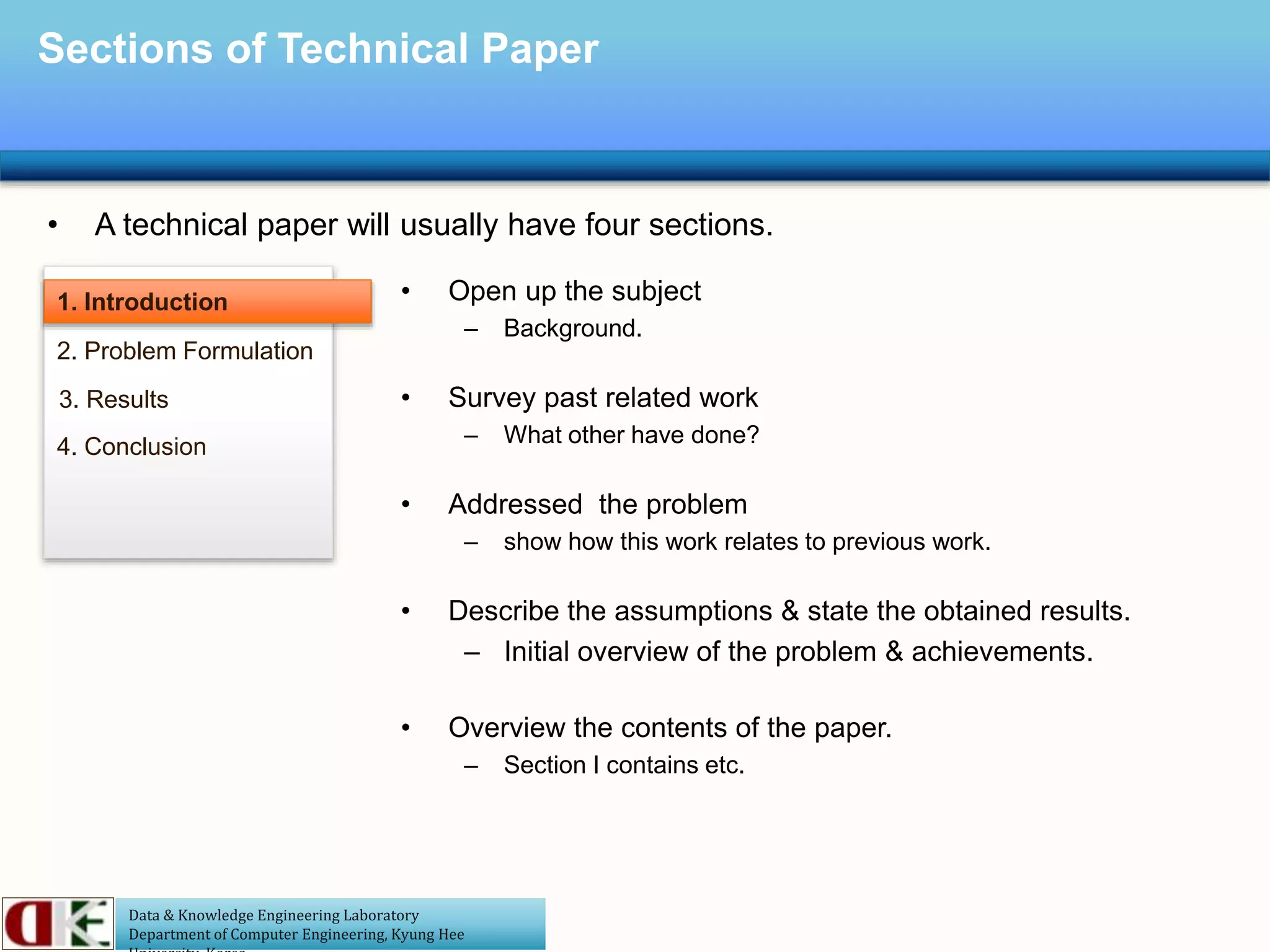
• A technical paper will usually have four sections.
1. Introduction
2. Problem Formulation
3. Results
4. Conclusion
• This is the common format for an engineering paper.
• The names of the sections can be different.
Data & Knowledge Engineering Laboratory
Department of Computer Engineering, Kyung Hee
Sections of Technical Paper
• A technical paper will usually have four sections.
1. Introduction
2. Problem Formulation
3. Results
4. Conclusion
• Open up the subject
– Background.
• Survey past related work
– What other have done?
• Addressed the problem
– show how this work relates to previous work.
• Describe the assumptions & state the obtained results.
– Initial overview of the problem & achievements.
• Overview the contents of the paper.
– Section I contains etc.
Data & Knowledge Engineering Laboratory
Department of Computer Engineering, Kyung Hee
Sections of Technical Paper
• A technical paper will usually have four sections.
1. Introduction
2. Problem Formulation
3. Results
4. Conclusion
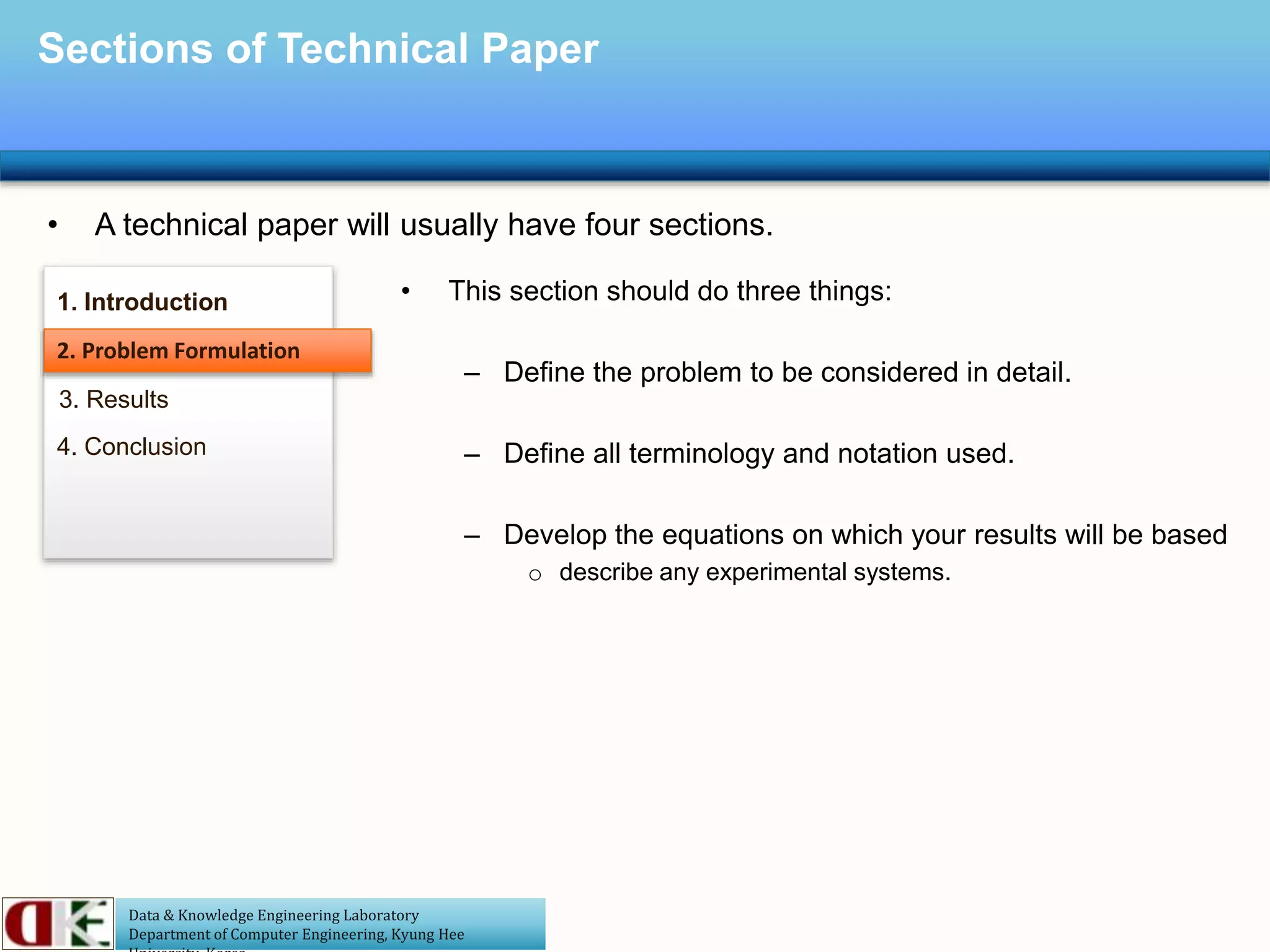
• This section should do three things:
– Define the problem to be considered in detail.
– Define all terminology and notation used.
– Develop the equations on which your results will be based
o describe any experimental systems.
Data & Knowledge Engineering Laboratory
Department of Computer Engineering, Kyung Hee
Sections of Technical Paper
• A technical paper will usually have four sections.
1. Introduction
2. Problem Formulation
3. Results
4. Conclusion
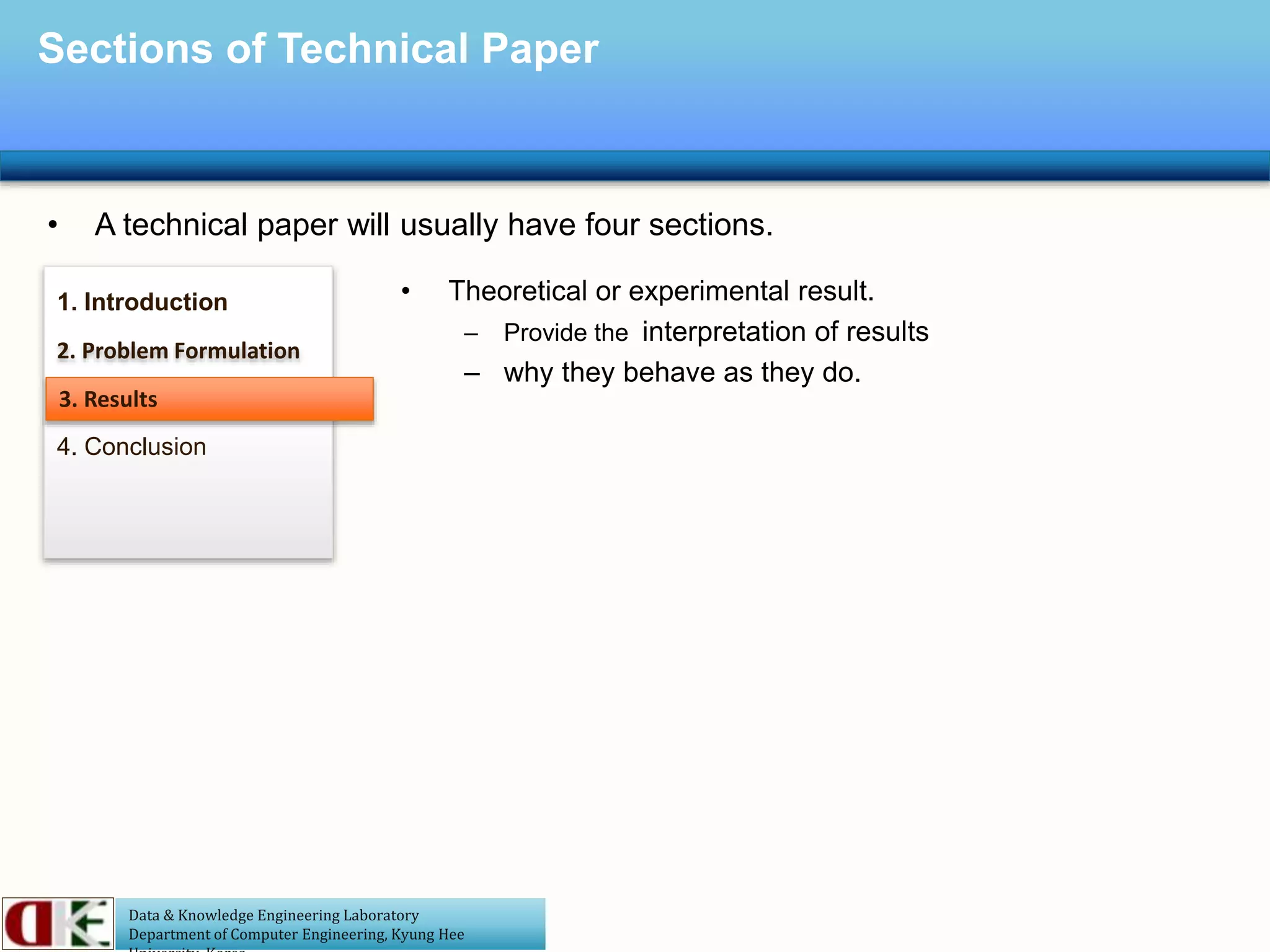
• Theoretical or experimental result.
– Provide the interpretation of results
– why they behave as they do.
Data & Knowledge Engineering Laboratory
Department of Computer Engineering, Kyung Hee
Sections of Technical Paper
• A technical paper will usually have four sections.
1. Introduction
2. Problem Formulation
3. Results
4. Conclusion
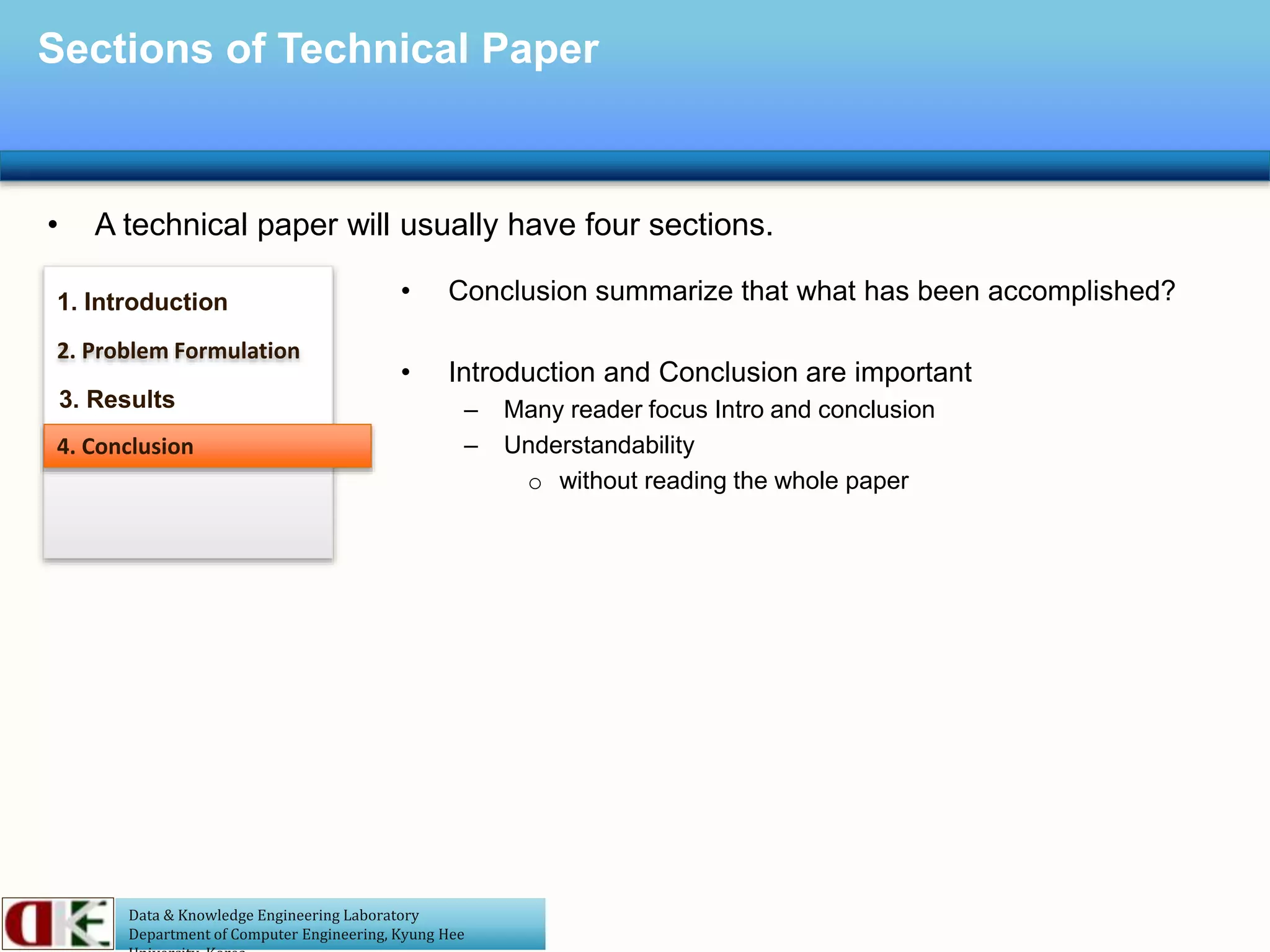
• Conclusion summarize that what has been accomplished?
• Introduction and Conclusion are important
– Many reader focus Intro and conclusion
– Understandability
o without reading the whole paper
Data & Knowledge Engineering Laboratory
Department of Computer Engineering, Kyung Hee
14 Steps to a Clearly Written Technical Paper
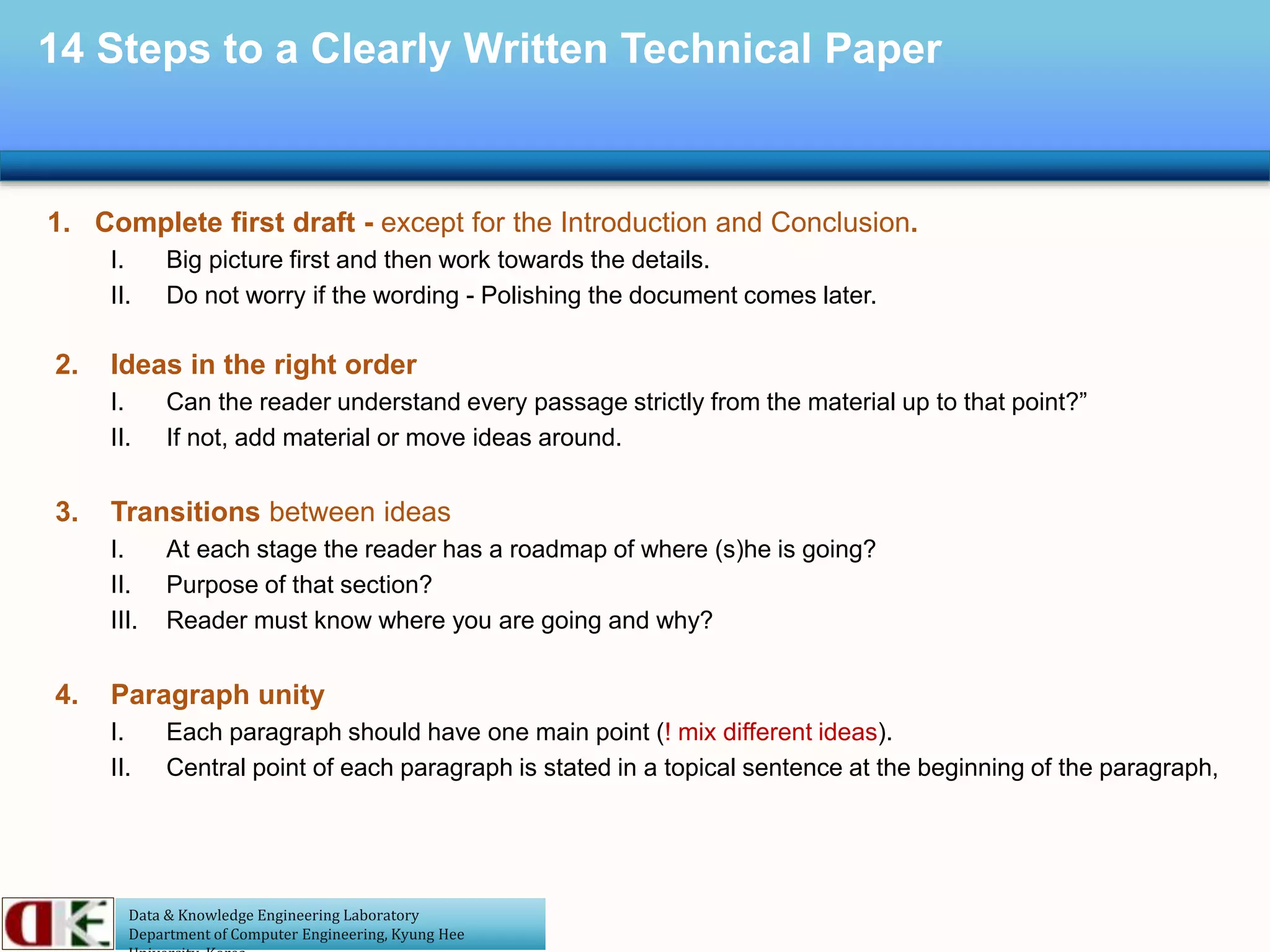
1. Complete first draft - except for the Introduction and Conclusion.
I. Big picture first and then work towards the details.
II. Do not worry if the wording - Polishing the document comes later.
2. Ideas in the right order
I. Can the reader understand every passage strictly from the material up to that point?”
II. If not, add material or move ideas around.
3. Transitions between ideas
I. At each stage the reader has a roadmap of where (s)he is going?
II. Purpose of that section?
III. Reader must know where you are going and why?
4. Paragraph unity
I. Each paragraph should have one main point (! mix different ideas).
II. Central point of each paragraph is stated in a topical sentence at the beginning of the paragraph,
Data & Knowledge Engineering Laboratory
Department of Computer Engineering, Kyung Hee
14 Steps to a Clearly Written Technical Paper (Cont’d)
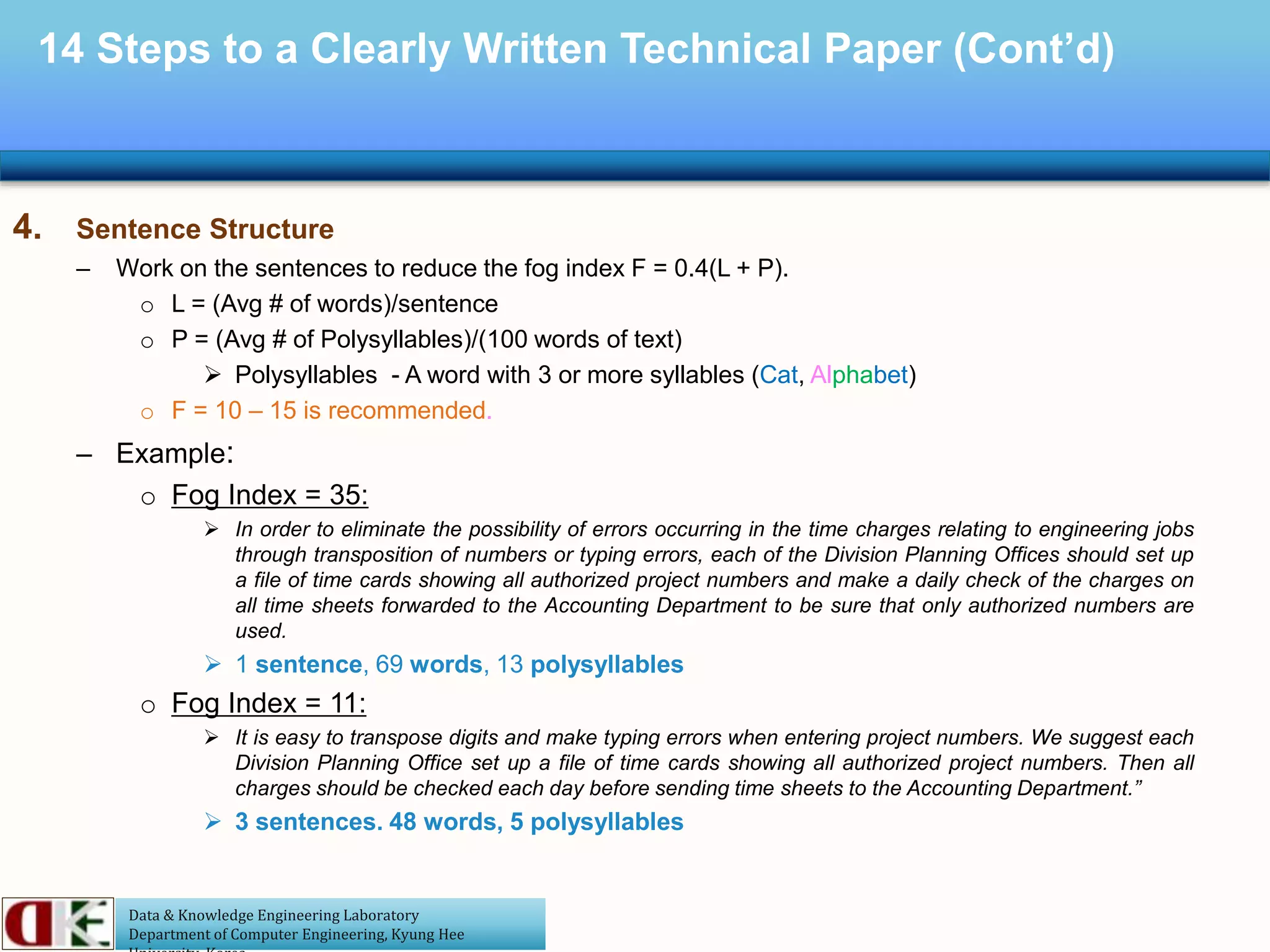
4. Sentence Structure
– Work on the sentences to reduce the fog index F = 0.4(L + P).
o L = (Avg # of words)/sentence
o P = (Avg # of Polysyllables)/(100 words of text)
 Polysyllables - A word with 3 or more syllables (Cat, Alphabet)
o F = 10 – 15 is recommended.
– Example:
o Fog Index = 35:
 In order to eliminate the possibility of errors occurring in the time charges relating to engineering jobs
through transposition of numbers or typing errors, each of the Division Planning Offices should set up
a file of time cards showing all authorized project numbers and make a daily check of the charges on
all time sheets forwarded to the Accounting Department to be sure that only authorized numbers are
used.
 1 sentence, 69 words, 13 polysyllables
o Fog Index = 11:
 It is easy to transpose digits and make typing errors when entering project numbers. We suggest each
Division Planning Office set up a file of time cards showing all authorized project numbers. Then all
charges should be checked each day before sending time sheets to the Accounting Department.”
 3 sentences. 48 words, 5 polysyllables
Data & Knowledge Engineering Laboratory
Department of Computer Engineering, Kyung Hee
14 Steps to a Clearly Written Technical Paper (Cont’d)
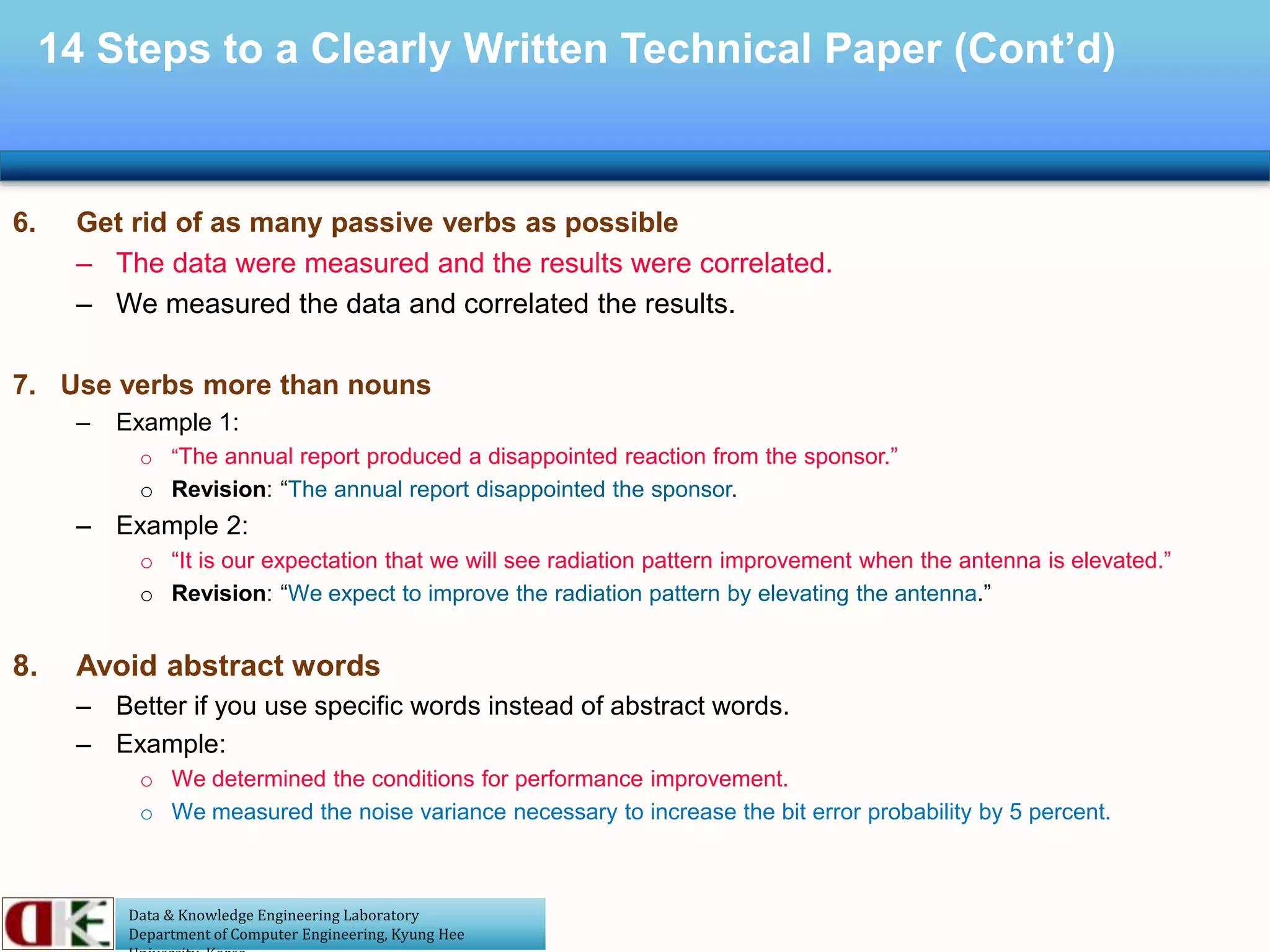
6. Get rid of as many passive verbs as possible
– The data were measured and the results were correlated.
– We measured the data and correlated the results.
7. Use verbs more than nouns
– Example 1:
o “The annual report produced a disappointed reaction from the sponsor.”
o Revision: “The annual report disappointed the sponsor.
– Example 2:
o “It is our expectation that we will see radiation pattern improvement when the antenna is elevated.”
o Revision: “We expect to improve the radiation pattern by elevating the antenna.”
8. Avoid abstract words
– Better if you use specific words instead of abstract words.
– Example:
o We determined the conditions for performance improvement.
o We measured the noise variance necessary to increase the bit error probability by 5 percent.
Data & Knowledge Engineering Laboratory
Department of Computer Engineering, Kyung Hee
14 Steps to a Clearly Written Technical Paper (Cont’d)
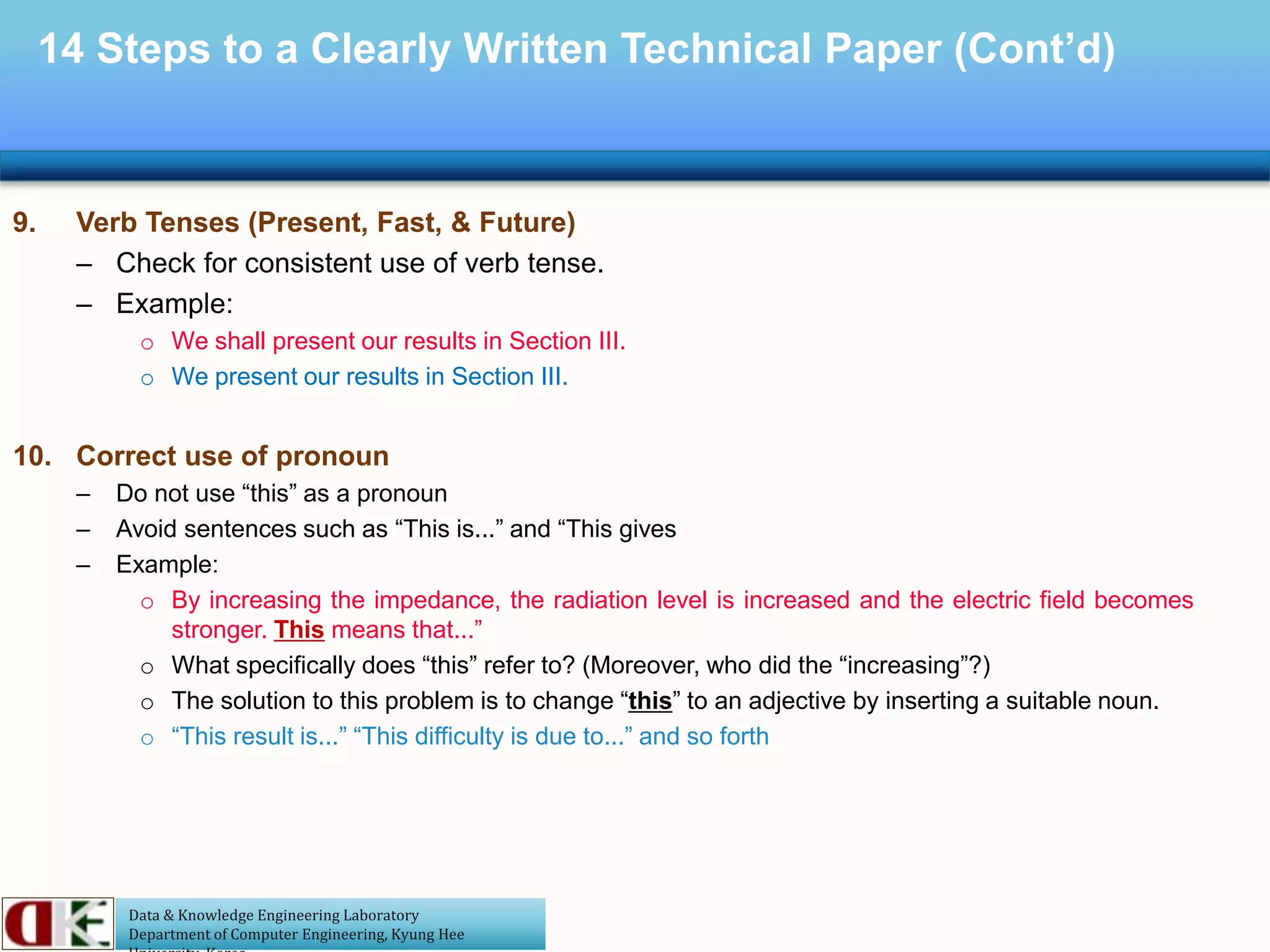
9. Verb Tenses (Present, Fast, & Future)
– Check for consistent use of verb tense.
– Example:
o We shall present our results in Section III.
o We present our results in Section III.
10. Correct use of pronoun
– Do not use “this” as a pronoun
– Avoid sentences such as “This is...” and “This gives
– Example:
o By increasing the impedance, the radiation level is increased and the electric field becomes
stronger. This means that...”
o What specifically does “this” refer to? (Moreover, who did the “increasing”?)
o The solution to this problem is to change “this” to an adjective by inserting a suitable noun.
o “This result is...” “This difficulty is due to...” and so forth
Data & Knowledge Engineering Laboratory
Department of Computer Engineering, Kyung Hee
14 Steps to a Clearly Written Technical Paper (Cont’d)
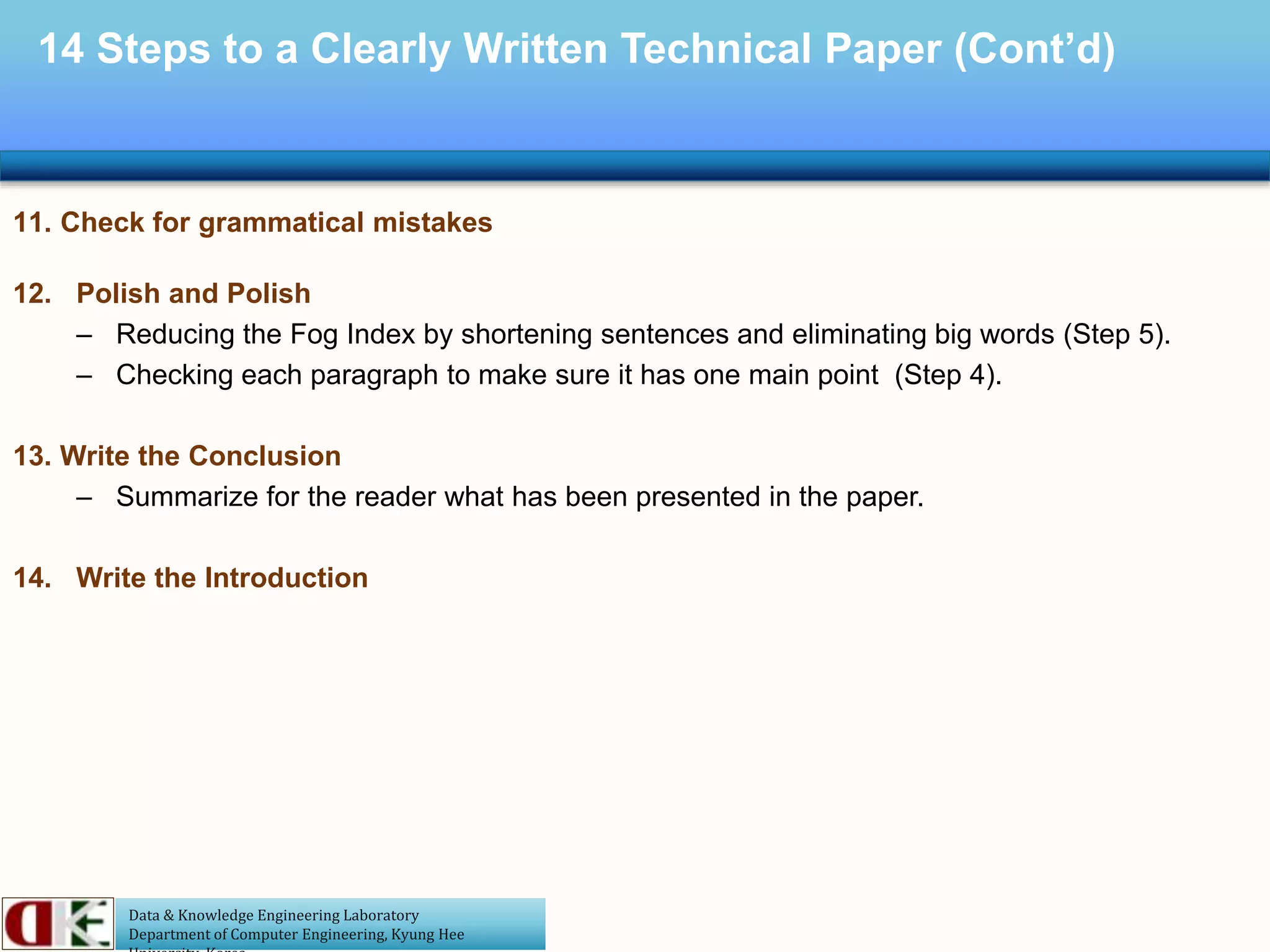
11. Check for grammatical mistakes
12. Polish and Polish
– Reducing the Fog Index by shortening sentences and eliminating big words (Step 5).
– Checking each paragraph to make sure it has one main point (Step 4).
13. Write the Conclusion
– Summarize for the reader what has been presented in the paper.
14. Write the Introduction
Your Logo
THANK YOU
?

Writing for computer science: Fourteen steps to a clearly written technical paper

  • 1.
    FOURTEEN STEPS TOA CLEARLY WRITTEN TECHNICAL PAPER Aftab Alam Department of Computer Engineering, Kyung Hee University
  • 2.
    Fourteen steps toa clearly written technical paper Contents Sections of Technical Paper -- Conclusion & Introduction -- Abstract Words, Polishing Fourteen Steps for Clarity -- Avoid Passive Verbs, Verb Nouns 7 6 5 2 1 4 3 -- Complete First Draft, Order, Transitions -- Paragraph, Simple Sentences
  • 3.
    Data & KnowledgeEngineering Laboratory Department of Computer Engineering, Kyung Hee Sections of Technical Paper • A technical paper will usually have four sections. 1. Introduction 2. Problem Formulation 3. Results 4. Conclusion • This is the common format for an engineering paper. • The names of the sections can be different.
  • 4.
    Data & KnowledgeEngineering Laboratory Department of Computer Engineering, Kyung Hee Sections of Technical Paper • A technical paper will usually have four sections. 1. Introduction 2. Problem Formulation 3. Results 4. Conclusion • Open up the subject – Background. • Survey past related work – What other have done? • Addressed the problem – show how this work relates to previous work. • Describe the assumptions & state the obtained results. – Initial overview of the problem & achievements. • Overview the contents of the paper. – Section I contains etc.
  • 5.
    Data & KnowledgeEngineering Laboratory Department of Computer Engineering, Kyung Hee Sections of Technical Paper • A technical paper will usually have four sections. 1. Introduction 2. Problem Formulation 3. Results 4. Conclusion • This section should do three things: – Define the problem to be considered in detail. – Define all terminology and notation used. – Develop the equations on which your results will be based o describe any experimental systems.
  • 6.
    Data & KnowledgeEngineering Laboratory Department of Computer Engineering, Kyung Hee Sections of Technical Paper • A technical paper will usually have four sections. 1. Introduction 2. Problem Formulation 3. Results 4. Conclusion • Theoretical or experimental result. – Provide the interpretation of results – why they behave as they do.
  • 7.
    Data & KnowledgeEngineering Laboratory Department of Computer Engineering, Kyung Hee Sections of Technical Paper • A technical paper will usually have four sections. 1. Introduction 2. Problem Formulation 3. Results 4. Conclusion • Conclusion summarize that what has been accomplished? • Introduction and Conclusion are important – Many reader focus Intro and conclusion – Understandability o without reading the whole paper
  • 8.
    Data & KnowledgeEngineering Laboratory Department of Computer Engineering, Kyung Hee 14 Steps to a Clearly Written Technical Paper 1. Complete first draft - except for the Introduction and Conclusion. I. Big picture first and then work towards the details. II. Do not worry if the wording - Polishing the document comes later. 2. Ideas in the right order I. Can the reader understand every passage strictly from the material up to that point?” II. If not, add material or move ideas around. 3. Transitions between ideas I. At each stage the reader has a roadmap of where (s)he is going? II. Purpose of that section? III. Reader must know where you are going and why? 4. Paragraph unity I. Each paragraph should have one main point (! mix different ideas). II. Central point of each paragraph is stated in a topical sentence at the beginning of the paragraph,
  • 9.
    Data & KnowledgeEngineering Laboratory Department of Computer Engineering, Kyung Hee 14 Steps to a Clearly Written Technical Paper (Cont’d) 4. Sentence Structure – Work on the sentences to reduce the fog index F = 0.4(L + P). o L = (Avg # of words)/sentence o P = (Avg # of Polysyllables)/(100 words of text)  Polysyllables - A word with 3 or more syllables (Cat, Alphabet) o F = 10 – 15 is recommended. – Example: o Fog Index = 35:  In order to eliminate the possibility of errors occurring in the time charges relating to engineering jobs through transposition of numbers or typing errors, each of the Division Planning Offices should set up a file of time cards showing all authorized project numbers and make a daily check of the charges on all time sheets forwarded to the Accounting Department to be sure that only authorized numbers are used.  1 sentence, 69 words, 13 polysyllables o Fog Index = 11:  It is easy to transpose digits and make typing errors when entering project numbers. We suggest each Division Planning Office set up a file of time cards showing all authorized project numbers. Then all charges should be checked each day before sending time sheets to the Accounting Department.”  3 sentences. 48 words, 5 polysyllables
  • 10.
    Data & KnowledgeEngineering Laboratory Department of Computer Engineering, Kyung Hee 14 Steps to a Clearly Written Technical Paper (Cont’d) 6. Get rid of as many passive verbs as possible – The data were measured and the results were correlated. – We measured the data and correlated the results. 7. Use verbs more than nouns – Example 1: o “The annual report produced a disappointed reaction from the sponsor.” o Revision: “The annual report disappointed the sponsor. – Example 2: o “It is our expectation that we will see radiation pattern improvement when the antenna is elevated.” o Revision: “We expect to improve the radiation pattern by elevating the antenna.” 8. Avoid abstract words – Better if you use specific words instead of abstract words. – Example: o We determined the conditions for performance improvement. o We measured the noise variance necessary to increase the bit error probability by 5 percent.
  • 11.
    Data & KnowledgeEngineering Laboratory Department of Computer Engineering, Kyung Hee 14 Steps to a Clearly Written Technical Paper (Cont’d) 9. Verb Tenses (Present, Fast, & Future) – Check for consistent use of verb tense. – Example: o We shall present our results in Section III. o We present our results in Section III. 10. Correct use of pronoun – Do not use “this” as a pronoun – Avoid sentences such as “This is...” and “This gives – Example: o By increasing the impedance, the radiation level is increased and the electric field becomes stronger. This means that...” o What specifically does “this” refer to? (Moreover, who did the “increasing”?) o The solution to this problem is to change “this” to an adjective by inserting a suitable noun. o “This result is...” “This difficulty is due to...” and so forth
  • 12.
    Data & KnowledgeEngineering Laboratory Department of Computer Engineering, Kyung Hee 14 Steps to a Clearly Written Technical Paper (Cont’d) 11. Check for grammatical mistakes 12. Polish and Polish – Reducing the Fog Index by shortening sentences and eliminating big words (Step 5). – Checking each paragraph to make sure it has one main point (Step 4). 13. Write the Conclusion – Summarize for the reader what has been presented in the paper. 14. Write the Introduction
  • 13.