GLOBAL
WARMIN
G
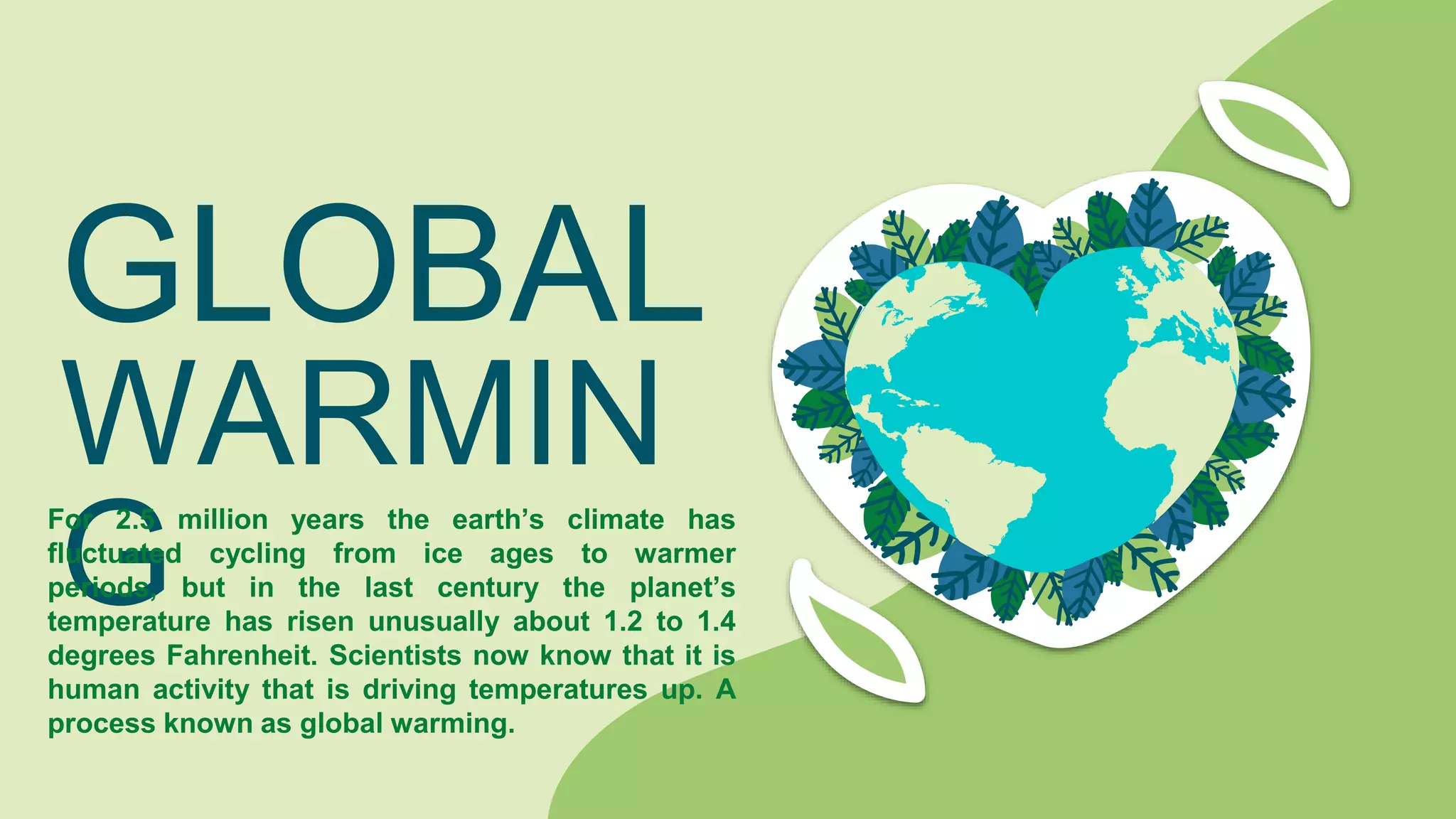
For 2.5 million years the earth’s climate has
fluctuated cycling from ice ages to warmer
periods, but in the last century the planet’s
temperature has risen unusually about 1.2 to 1.4
degrees Fahrenheit. Scientists now know that it is
human activity that is driving temperatures up. A
process known as global warming.
What is the
Global
Warming?
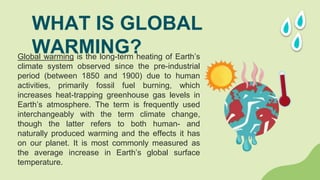
Global warming is the long-term heating of Earth’s
climate system observed since the pre-industrial
period (between 1850 and 1900) due to human
activities, primarily fossil fuel burning, which
increases heat-trapping greenhouse gas levels in
Earth’s atmosphere. The term is frequently used
interchangeably with the term climate change,
though the latter refers to both human- and
naturally produced warming and the effects it has
on our planet. It is most commonly measured as
the average increase in Earth’s global surface
temperature.
WHAT IS GLOBAL
WARMING?
• Ever since the industrial revolution began, factories, power plants and eventually
cars, are burning fossil fuels such as oil and releasing huge amounts of carbon
dioxide and other gases into the atmosphere these greenhouse gases trap heat
near the earth through a naturally occurring process called the greenhouse effect.
• The greenhouse effect begins with the sun and the energy radiates to the earth. The
earth and the atmosphere absorb some of this energy, while the rest is radiated
back to space. Naturally occurring gases in the atmosphere trap some of this energy
and reflected back, warming the earth. Scientists now believe that the greenhouse
effect is being intensified by the excess greenhouse gases that humans have
released.
EVIDENCE OF GLOBAL
WARMING
• Evidence for global warming includes a recent string of very warm years. Scientists
report that 1998 was the warmest year in measured history with 2005 coming in
second. Meanwhile, readings taken from ice cores show that the greenhouse gases,
carbon dioxide and methane, have hit their highest levels in the past 420,000 years.
• Arctic sea ice is also shrinking. According to NASA studies, the extent of Arctic sea
ice has declined about 10% in the last 30 years. As long as industrial nations
consume energy and developing countries increase their fossil fuel consumption,
the concentration of greenhouse gases in the atmosphere will continue to rise.
EVIDENCE OF GLOBAL
WARMING
• Researchers predict that temperatures will increase about 2 to 10 degrees
Fahrenheit by the end of the century. What is less certain is what rising
temperatures mean for the planet. Some climate models predict subtle
changes. Others forecast rising sea levels, which could flood coastal areas
around the world. Global weather patterns could change including stronger
hurricanes and severe drought could become more common in warm
climates. Species unable to adapt to the changing conditions could face
extinction.
EVIDENCE OF GLOBAL
WARMING
WHAT
CAN
WE DO?
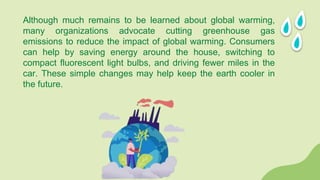
Although much remains to be learned about global warming,
many organizations advocate cutting greenhouse gas
emissions to reduce the impact of global warming. Consumers
can help by saving energy around the house, switching to
compact fluorescent light bulbs, and driving fewer miles in the
car. These simple changes may help keep the earth cooler in
the future.
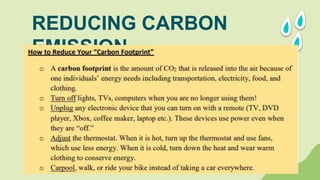
REDUCING CARBON
EMISSION
CREDITS: This presentation template was
created by Slidesgo, including icons by Flaticon,
infographics & images by Freepik
“Preservation of our
environment is not a
liberal or conservative
challenge, it's common
sense.”
- Ronald Reagan
Please keep this slide for attribution
Thank
You!

GLOBAL WARMING.pptx

  • 1.
    GLOBAL WARMIN G For 2.5 millionyears the earth’s climate has fluctuated cycling from ice ages to warmer periods, but in the last century the planet’s temperature has risen unusually about 1.2 to 1.4 degrees Fahrenheit. Scientists now know that it is human activity that is driving temperatures up. A process known as global warming.
  • 2.
  • 3.
    Global warming isthe long-term heating of Earth’s climate system observed since the pre-industrial period (between 1850 and 1900) due to human activities, primarily fossil fuel burning, which increases heat-trapping greenhouse gas levels in Earth’s atmosphere. The term is frequently used interchangeably with the term climate change, though the latter refers to both human- and naturally produced warming and the effects it has on our planet. It is most commonly measured as the average increase in Earth’s global surface temperature. WHAT IS GLOBAL WARMING?
  • 4.
    • Ever sincethe industrial revolution began, factories, power plants and eventually cars, are burning fossil fuels such as oil and releasing huge amounts of carbon dioxide and other gases into the atmosphere these greenhouse gases trap heat near the earth through a naturally occurring process called the greenhouse effect. • The greenhouse effect begins with the sun and the energy radiates to the earth. The earth and the atmosphere absorb some of this energy, while the rest is radiated back to space. Naturally occurring gases in the atmosphere trap some of this energy and reflected back, warming the earth. Scientists now believe that the greenhouse effect is being intensified by the excess greenhouse gases that humans have released. EVIDENCE OF GLOBAL WARMING
  • 5.
    • Evidence forglobal warming includes a recent string of very warm years. Scientists report that 1998 was the warmest year in measured history with 2005 coming in second. Meanwhile, readings taken from ice cores show that the greenhouse gases, carbon dioxide and methane, have hit their highest levels in the past 420,000 years. • Arctic sea ice is also shrinking. According to NASA studies, the extent of Arctic sea ice has declined about 10% in the last 30 years. As long as industrial nations consume energy and developing countries increase their fossil fuel consumption, the concentration of greenhouse gases in the atmosphere will continue to rise. EVIDENCE OF GLOBAL WARMING
  • 6.
    • Researchers predictthat temperatures will increase about 2 to 10 degrees Fahrenheit by the end of the century. What is less certain is what rising temperatures mean for the planet. Some climate models predict subtle changes. Others forecast rising sea levels, which could flood coastal areas around the world. Global weather patterns could change including stronger hurricanes and severe drought could become more common in warm climates. Species unable to adapt to the changing conditions could face extinction. EVIDENCE OF GLOBAL WARMING
  • 7.
  • 8.
    Although much remainsto be learned about global warming, many organizations advocate cutting greenhouse gas emissions to reduce the impact of global warming. Consumers can help by saving energy around the house, switching to compact fluorescent light bulbs, and driving fewer miles in the car. These simple changes may help keep the earth cooler in the future.
  • 9.
  • 10.
    CREDITS: This presentationtemplate was created by Slidesgo, including icons by Flaticon, infographics & images by Freepik “Preservation of our environment is not a liberal or conservative challenge, it's common sense.” - Ronald Reagan Please keep this slide for attribution Thank You!