THESIS
R E A D T H R O U G H S O M E O F T H E T H E S I S S U B M I T T E D
& M Y C O M M E N T S
The storm is a significant part of both
the plot and the story.
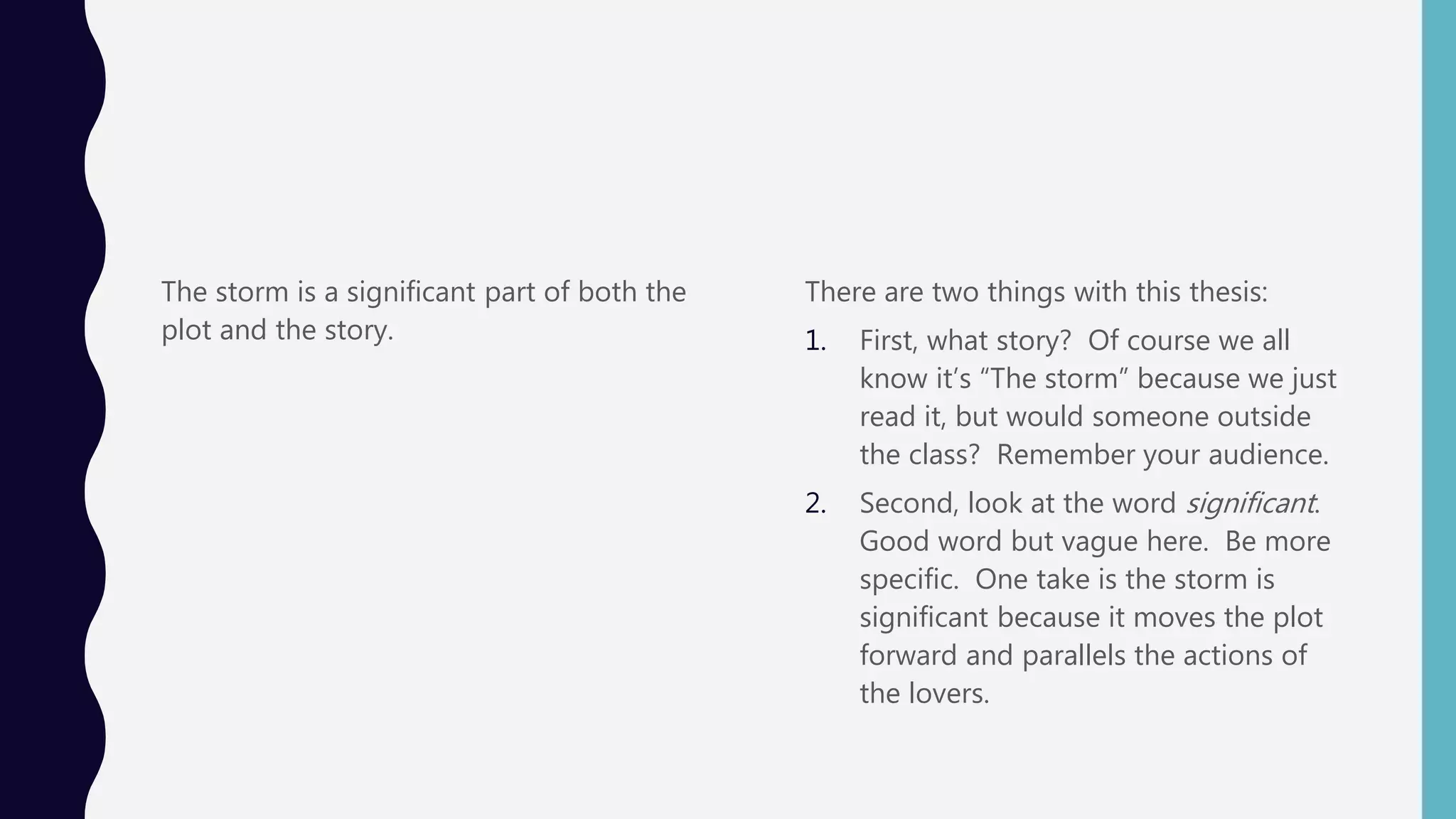
The storm is a significant part of both the
plot and the story.
There are two things with this thesis:
1. First, what story? Of course we all
know it’s “The storm” because we just
read it, but would someone outside
the class? Remember your audience.
2. Second, look at the word significant.
Good word but vague here. Be more
specific. One take is the storm is
significant because it moves the plot
forward and parallels the actions of
the lovers.
The storm approaching in “The Storm”
symbolizes trouble and secret chaos that
is going to occur.
The storm approaching in “The Storm”
symbolizes trouble and secret chaos that
is going to occur.
This one is pretty good as long as the
writer knows what he/she is going to
cover in terms of trouble and chaos. It
means the title of the work and specific
details – trouble is a bit vague, but secret
chaos is perfect.
In “The Storm” by Kate Chopin, the
storm symbolizes the chaos within the
house, and it follows the plot.
In “The Storm” by Kate Chopin, the
storm symbolizes the chaos within the
house, and it follows the plot.
This one is fine as written. It mentions
the story, and it refers to chaos within
the house and how the storm also
follows the plot. Now, you could take
out “and it follows the plot” because it is
obvious and you would cover that with
symbolizing chaos and describing the
lovers’ actions along with the storm’s.
In “The Storm,” the author uses
symbolism to compare the stormy
weather to a secret relationship between
a married woman and a former lover.
In “The Storm,” the author uses
symbolism to compare the stormy
weather to a secret relationship between
a married woman and a former lover.
This one is fine as written. It mentions
the story and very specifically mentions
that the essay will be a comparison of
the storm to the relationship of the two
lovers.
In Edgar Allan Poe’s “The Tell-Tale
Heart,” the old man’s one pale eye
symbolizes the narrator’s other
personality that causes him to go crazy.
In Edgar Allan Poe’s “The Tell-Tale
Heart,” the old man’s one pale eye
symbolizes the narrator’s other
personality that causes him to go crazy.
This one names the story and then says
that the pale eye symbolizes the
narrator’s other personality.
Now the part that may need work is
whether the writer will be able to show
that the narrator has more than one
personality – and that one of those
personalities causes him to go mad. If
the writer feels confident with that path,
then it’s good to go.
The obstacles that have been taken on his
journey severe; Anyone can last in the
cold; it’s about how long you do that
counts.
This one is harder to comment on. It has
some really good elements, but I would
have to talk to the writer about what
direction he/she wants to take. How would
you relate the “how long” to the story?
Does the writer want to concentrate on the
setting and how the main character
interacts with it? Or does the writer want
to concentrate on the man’s lack
experience and that’s why he did not last.
Also, for academic papers, no contractions.
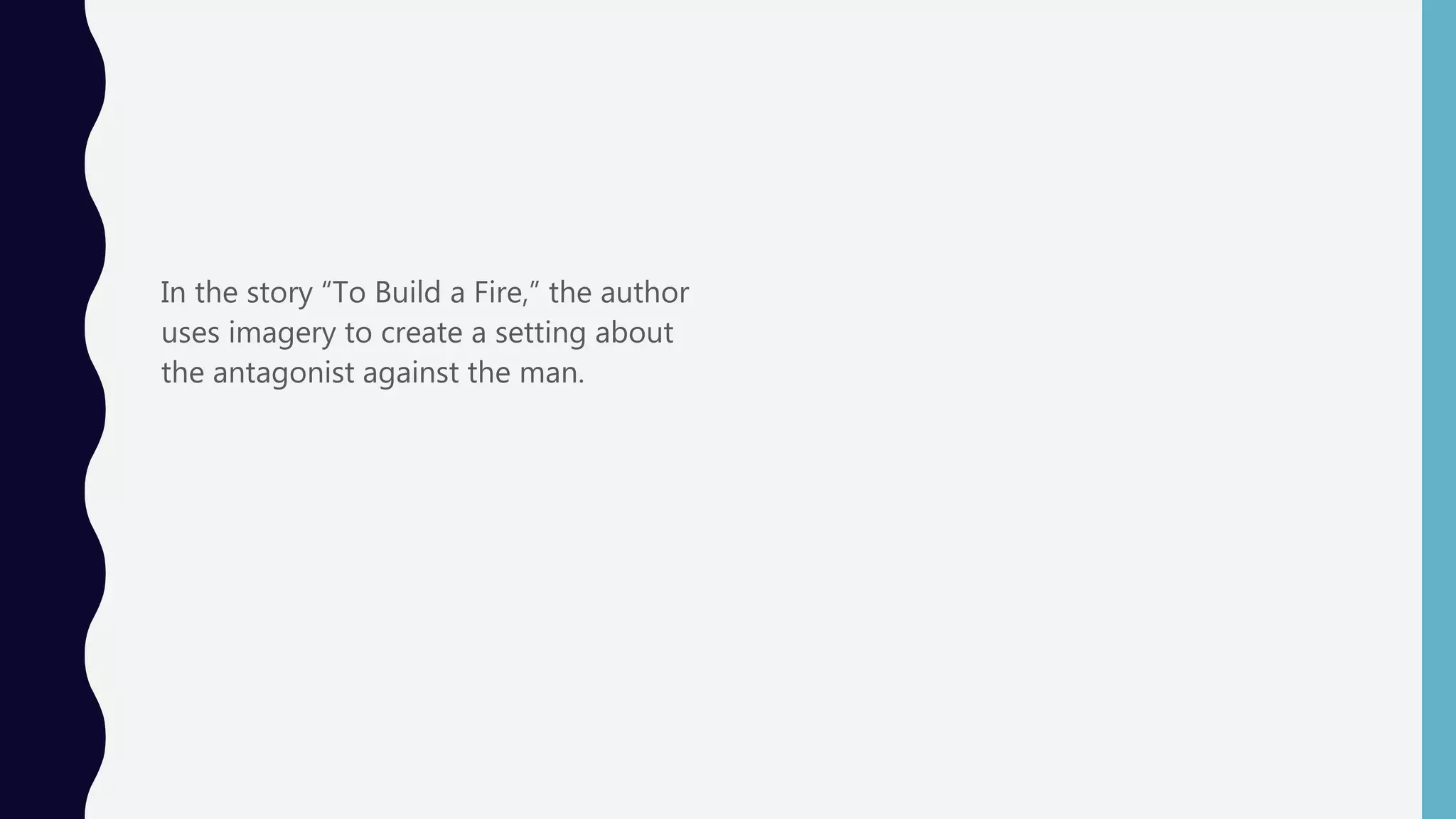
In the story “To Build a Fire,” the author
uses imagery to create a setting about
the antagonist against the man.
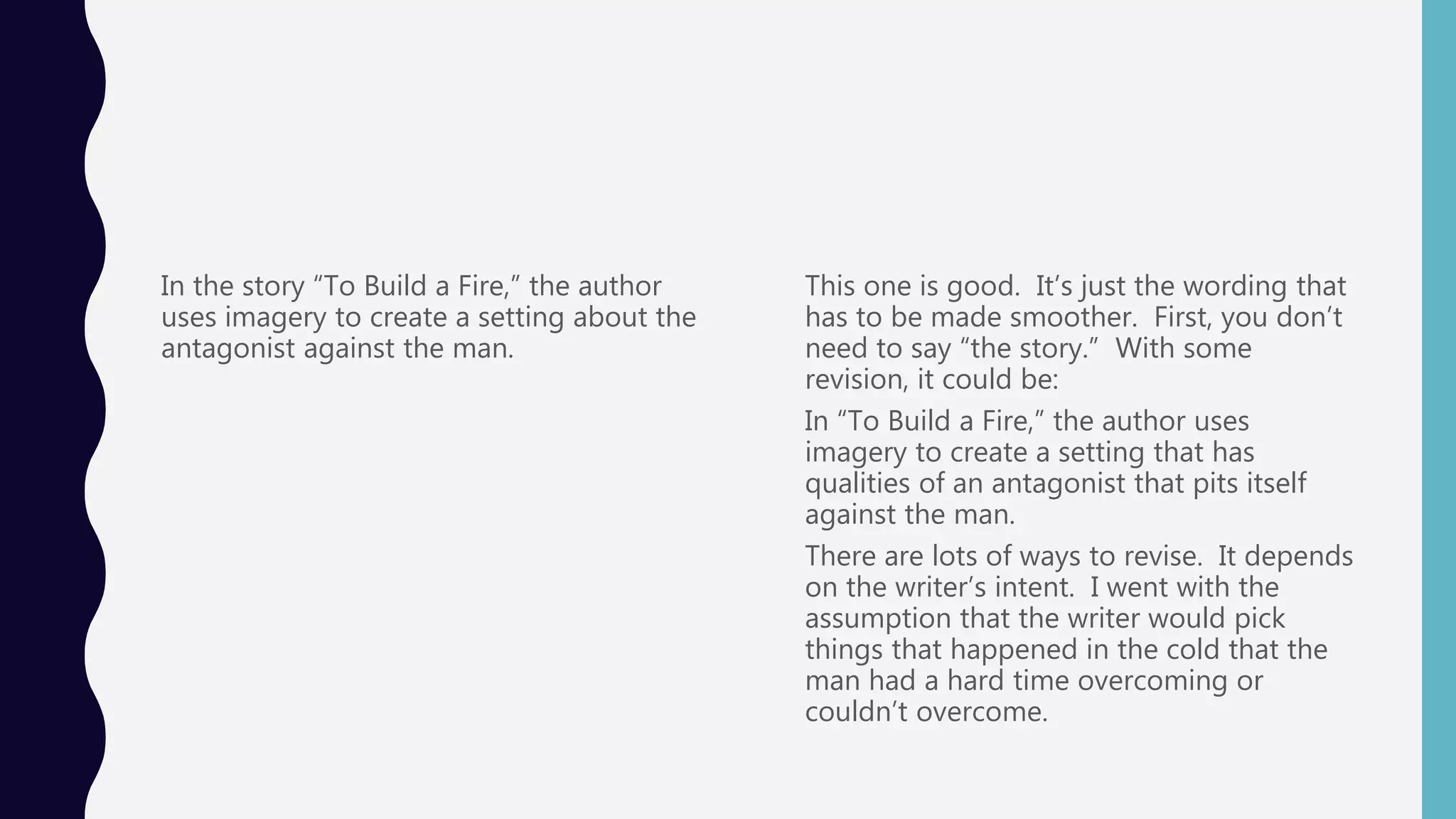
In the story “To Build a Fire,” the author
uses imagery to create a setting about the
antagonist against the man.
This one is good. It’s just the wording that
has to be made smoother. First, you don’t
need to say “the story.” With some
revision, it could be:
In “To Build a Fire,” the author uses
imagery to create a setting that has
qualities of an antagonist that pits itself
against the man.
There are lots of ways to revise. It depends
on the writer’s intent. I went with the
assumption that the writer would pick
things that happened in the cold that the
man had a hard time overcoming or
couldn’t overcome.
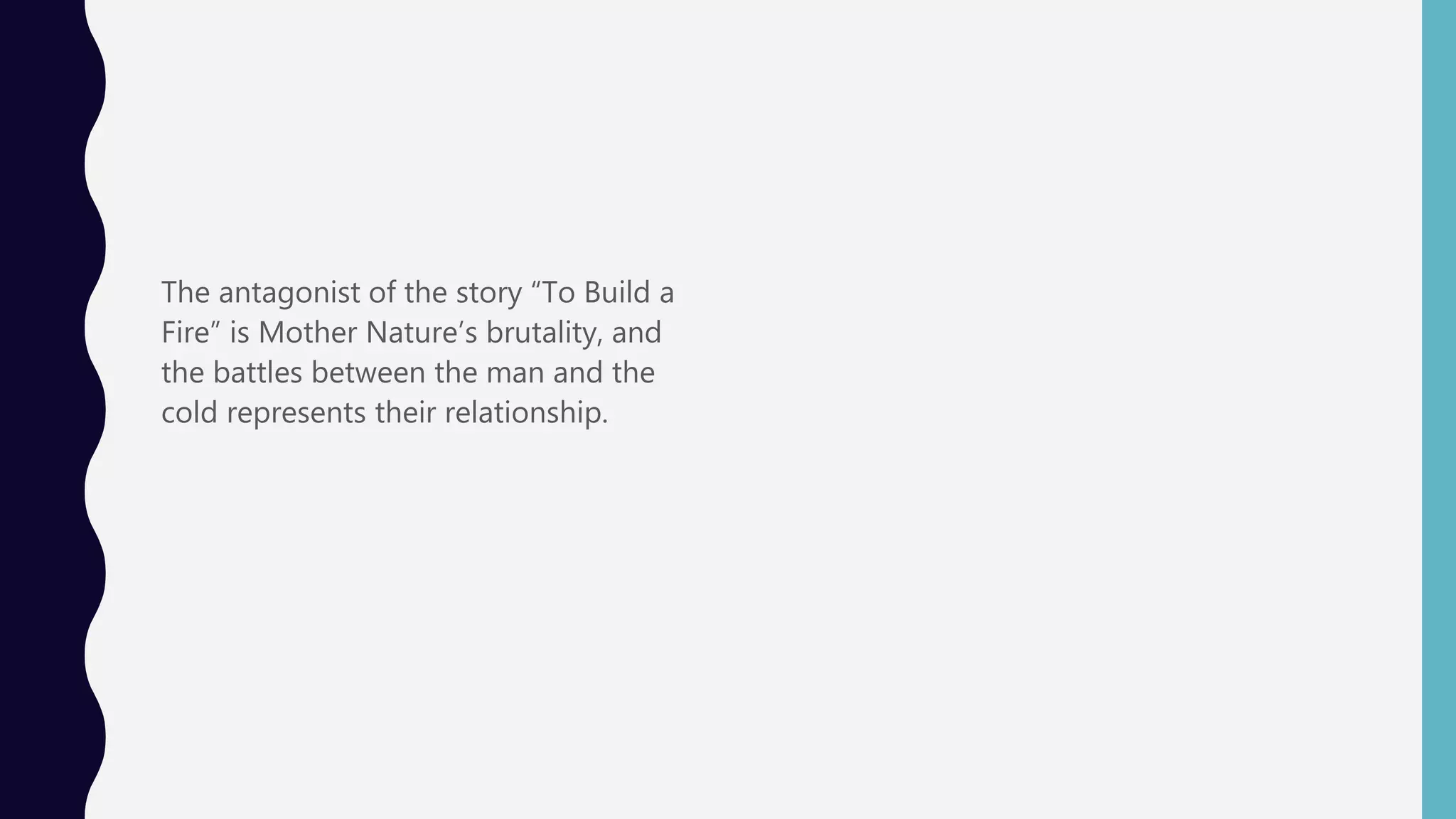
The antagonist of the story “To Build a
Fire” is Mother Nature’s brutality, and
the battles between the man and the
cold represents their relationship.
The antagonist of the story “To Build a
Fire” is Mother Nature’s brutality, and
the battles between the man and the
cold represents their relationship.
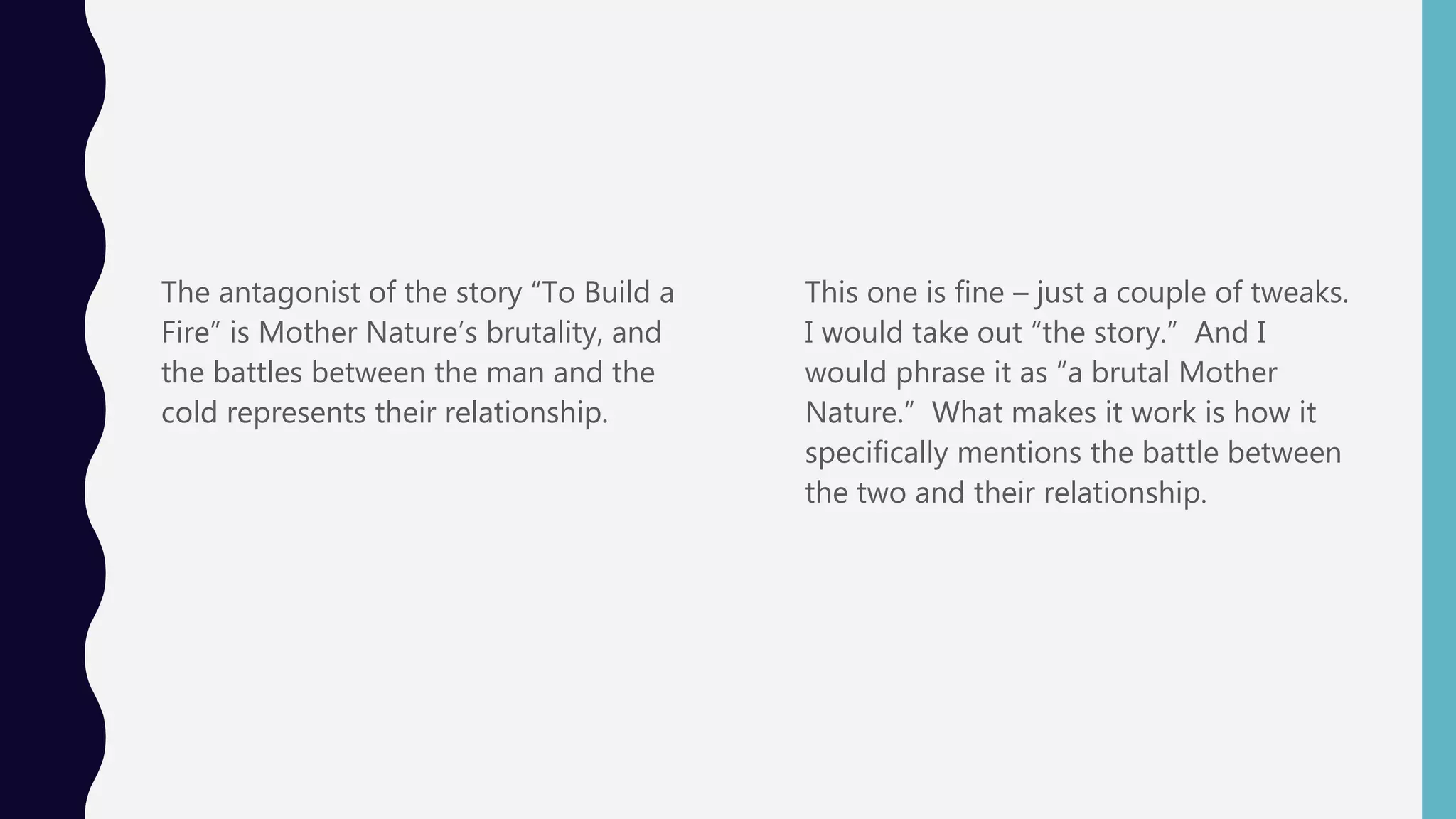
This one is fine – just a couple of tweaks.
I would take out “the story.” And I
would phrase it as “a brutal Mother
Nature.” What makes it work is how it
specifically mentions the battle between
the two and their relationship.
In the Tell Tale Heart the narrator’s
motives are self driven thoughts and
illness drive him into his madness.
In the Tell Tale Heart the narrator’s
motives are self driven thoughts and
illness drive him into his madness.
Remember good writing conventions
when you write and how you should
write titles: “The Tell-Tale Heart.” Be
sure to write it as the author does and to
use quotations for short story titles. Oh
it’s self-driven.
The part I would focus on is the word
illness. Does the writer mean a physical
illness or mental illness? Does the writer
mean the illness of the old man or the
narrator? Makes that area more specific
and the thesis works.
The speaker is completely unreliable and
he never loved the old man and he
murdered him for his possessions.
The speaker is completely unreliable and
he never loved the old man and he
murdered him for his possessions.
While there are some good things in this
thesis, it does need revision. First, don’t
forget to mention the story – a reader
outside this class wouldn’t know. We all
know the speaker is unreliable so make it a
a description. The two parts that are
debatable is that the narrator never loved
him and wanted his possessions. As long
as the writer can show how he came to
that thought, the thesis would work. A
revision could look like this:
The unreliable narrator in “The Tell-Tale
Heart” never loved the old man and
murdered him for his possessions.
In Jack London’s “To Build a Fire,”
London uses the setting to establish a
man versus nature conflict, giving the
Yukon a vibrant personality that the man
within the story lacks.
In Jack London’s “To Build a Fire,”
London uses the setting to establish a
man versus nature conflict, giving the
Yukon a vibrant personality that the man
within the story lacks.
This one works. It has all the elements
necessary as long as the writer focuses
on the two’s personalities – he/she has
to show the Yukon as vibrant and the
man as plain or boring through the
details London uses.
By shifting the point-of-view throughout
the story, Jack London highlights and
contrasts pride found in the man and the
instinct in animals and how these traits
lead to fatal circumstances.
By shifting the point-of-view throughout
the story, Jack London highlights and
contrasts pride found in the man and the
instinct in animals and how these traits
lead to fatal circumstances.
This one is good in terms of the topic
and how specific it is. What needs to be
worked on is wording. Oh and naming
the story. One revision could be:
By shifting the point-of-view throughout
“To Build a Fire,” Jack London highlights
and contrasts the man’s pride with the
dog’s instinct [the writer used animals,
but the dog is who we get to know] and
how these traits lead to the man’s fatal
circumstances.
In “The Tell-Tale Heart,” Poe writes as a
murderer whose exaggerations, intensity,
and insanity grow as his denial of each
increases.
In “The Tell-Tale Heart,” Poe writes as a
murderer whose exaggerations, intensity,
and insanity grow as his denial of each
increases.
This is well-written, but it’s borderline in
terms of the statement being debatable.
We are probably all in agreement that he
exaggerates more and more as the story
goes along and his insanity grows. What
I would recommend is coming up for a
reason he gets crazier as the story goes
on. What is the writer’s theory about
why or how?

Your Thesis and My Comments

  • 1.
    THESIS R E AD T H R O U G H S O M E O F T H E T H E S I S S U B M I T T E D & M Y C O M M E N T S
  • 2.
    The storm isa significant part of both the plot and the story.
  • 3.
    The storm isa significant part of both the plot and the story. There are two things with this thesis: 1. First, what story? Of course we all know it’s “The storm” because we just read it, but would someone outside the class? Remember your audience. 2. Second, look at the word significant. Good word but vague here. Be more specific. One take is the storm is significant because it moves the plot forward and parallels the actions of the lovers.
  • 4.
    The storm approachingin “The Storm” symbolizes trouble and secret chaos that is going to occur.
  • 5.
    The storm approachingin “The Storm” symbolizes trouble and secret chaos that is going to occur. This one is pretty good as long as the writer knows what he/she is going to cover in terms of trouble and chaos. It means the title of the work and specific details – trouble is a bit vague, but secret chaos is perfect.
  • 6.
    In “The Storm”by Kate Chopin, the storm symbolizes the chaos within the house, and it follows the plot.
  • 7.
    In “The Storm”by Kate Chopin, the storm symbolizes the chaos within the house, and it follows the plot. This one is fine as written. It mentions the story, and it refers to chaos within the house and how the storm also follows the plot. Now, you could take out “and it follows the plot” because it is obvious and you would cover that with symbolizing chaos and describing the lovers’ actions along with the storm’s.
  • 8.
    In “The Storm,”the author uses symbolism to compare the stormy weather to a secret relationship between a married woman and a former lover.
  • 9.
    In “The Storm,”the author uses symbolism to compare the stormy weather to a secret relationship between a married woman and a former lover. This one is fine as written. It mentions the story and very specifically mentions that the essay will be a comparison of the storm to the relationship of the two lovers.
  • 10.
    In Edgar AllanPoe’s “The Tell-Tale Heart,” the old man’s one pale eye symbolizes the narrator’s other personality that causes him to go crazy.
  • 11.
    In Edgar AllanPoe’s “The Tell-Tale Heart,” the old man’s one pale eye symbolizes the narrator’s other personality that causes him to go crazy. This one names the story and then says that the pale eye symbolizes the narrator’s other personality. Now the part that may need work is whether the writer will be able to show that the narrator has more than one personality – and that one of those personalities causes him to go mad. If the writer feels confident with that path, then it’s good to go.
  • 12.
    The obstacles thathave been taken on his journey severe; Anyone can last in the cold; it’s about how long you do that counts. This one is harder to comment on. It has some really good elements, but I would have to talk to the writer about what direction he/she wants to take. How would you relate the “how long” to the story? Does the writer want to concentrate on the setting and how the main character interacts with it? Or does the writer want to concentrate on the man’s lack experience and that’s why he did not last. Also, for academic papers, no contractions.
  • 13.
    In the story“To Build a Fire,” the author uses imagery to create a setting about the antagonist against the man.
  • 14.
    In the story“To Build a Fire,” the author uses imagery to create a setting about the antagonist against the man. This one is good. It’s just the wording that has to be made smoother. First, you don’t need to say “the story.” With some revision, it could be: In “To Build a Fire,” the author uses imagery to create a setting that has qualities of an antagonist that pits itself against the man. There are lots of ways to revise. It depends on the writer’s intent. I went with the assumption that the writer would pick things that happened in the cold that the man had a hard time overcoming or couldn’t overcome.
  • 15.
    The antagonist ofthe story “To Build a Fire” is Mother Nature’s brutality, and the battles between the man and the cold represents their relationship.
  • 16.
    The antagonist ofthe story “To Build a Fire” is Mother Nature’s brutality, and the battles between the man and the cold represents their relationship. This one is fine – just a couple of tweaks. I would take out “the story.” And I would phrase it as “a brutal Mother Nature.” What makes it work is how it specifically mentions the battle between the two and their relationship.
  • 17.
    In the TellTale Heart the narrator’s motives are self driven thoughts and illness drive him into his madness.
  • 18.
    In the TellTale Heart the narrator’s motives are self driven thoughts and illness drive him into his madness. Remember good writing conventions when you write and how you should write titles: “The Tell-Tale Heart.” Be sure to write it as the author does and to use quotations for short story titles. Oh it’s self-driven. The part I would focus on is the word illness. Does the writer mean a physical illness or mental illness? Does the writer mean the illness of the old man or the narrator? Makes that area more specific and the thesis works.
  • 19.
    The speaker iscompletely unreliable and he never loved the old man and he murdered him for his possessions.
  • 20.
    The speaker iscompletely unreliable and he never loved the old man and he murdered him for his possessions. While there are some good things in this thesis, it does need revision. First, don’t forget to mention the story – a reader outside this class wouldn’t know. We all know the speaker is unreliable so make it a a description. The two parts that are debatable is that the narrator never loved him and wanted his possessions. As long as the writer can show how he came to that thought, the thesis would work. A revision could look like this: The unreliable narrator in “The Tell-Tale Heart” never loved the old man and murdered him for his possessions.
  • 21.
    In Jack London’s“To Build a Fire,” London uses the setting to establish a man versus nature conflict, giving the Yukon a vibrant personality that the man within the story lacks.
  • 22.
    In Jack London’s“To Build a Fire,” London uses the setting to establish a man versus nature conflict, giving the Yukon a vibrant personality that the man within the story lacks. This one works. It has all the elements necessary as long as the writer focuses on the two’s personalities – he/she has to show the Yukon as vibrant and the man as plain or boring through the details London uses.
  • 23.
    By shifting thepoint-of-view throughout the story, Jack London highlights and contrasts pride found in the man and the instinct in animals and how these traits lead to fatal circumstances.
  • 24.
    By shifting thepoint-of-view throughout the story, Jack London highlights and contrasts pride found in the man and the instinct in animals and how these traits lead to fatal circumstances. This one is good in terms of the topic and how specific it is. What needs to be worked on is wording. Oh and naming the story. One revision could be: By shifting the point-of-view throughout “To Build a Fire,” Jack London highlights and contrasts the man’s pride with the dog’s instinct [the writer used animals, but the dog is who we get to know] and how these traits lead to the man’s fatal circumstances.
  • 25.
    In “The Tell-TaleHeart,” Poe writes as a murderer whose exaggerations, intensity, and insanity grow as his denial of each increases.
  • 26.
    In “The Tell-TaleHeart,” Poe writes as a murderer whose exaggerations, intensity, and insanity grow as his denial of each increases. This is well-written, but it’s borderline in terms of the statement being debatable. We are probably all in agreement that he exaggerates more and more as the story goes along and his insanity grows. What I would recommend is coming up for a reason he gets crazier as the story goes on. What is the writer’s theory about why or how?