Clear Writing:
language and grammar
by Dr Jennifer Minter
How to avoid common errors
and
How to write better sentences
Jim says:
“I am often marked down in
English because my
teacher says that my
expression is unclear or
clumsy. I thought ideas
were the thing that
mattered.”
Better Essays and Persuasive Techniques: pp. 97-111.
Dear Jim
• “This is a very common problem and you
are by no means alone. Your teacher is
drawing your attention to the fact that
there is a link between good expression
and good ideas/clear thought processes.
• If you are consistently losing marks in
English, it is often because you have
awkward phrases/expression. If the
entire essay consists of clumsy, clunky
grammar, it is hard to achieve an A.”
Better Essays and Persuasive Techniques: pp. 97-111.
Clear Writing: language and grammar, pp 5-34; 46-60.
Writing Better Sentences
• Sentences are the building
blocks of each of your
paragraphs.
• If words and phrases are put
together in a muddled way, the
sentence, and hence your
message, will be unclear.
Better Essays and Persuasive Techniques: pp. 97-111.
Clear Writing: language and grammar, pp 5-34; 46-60.
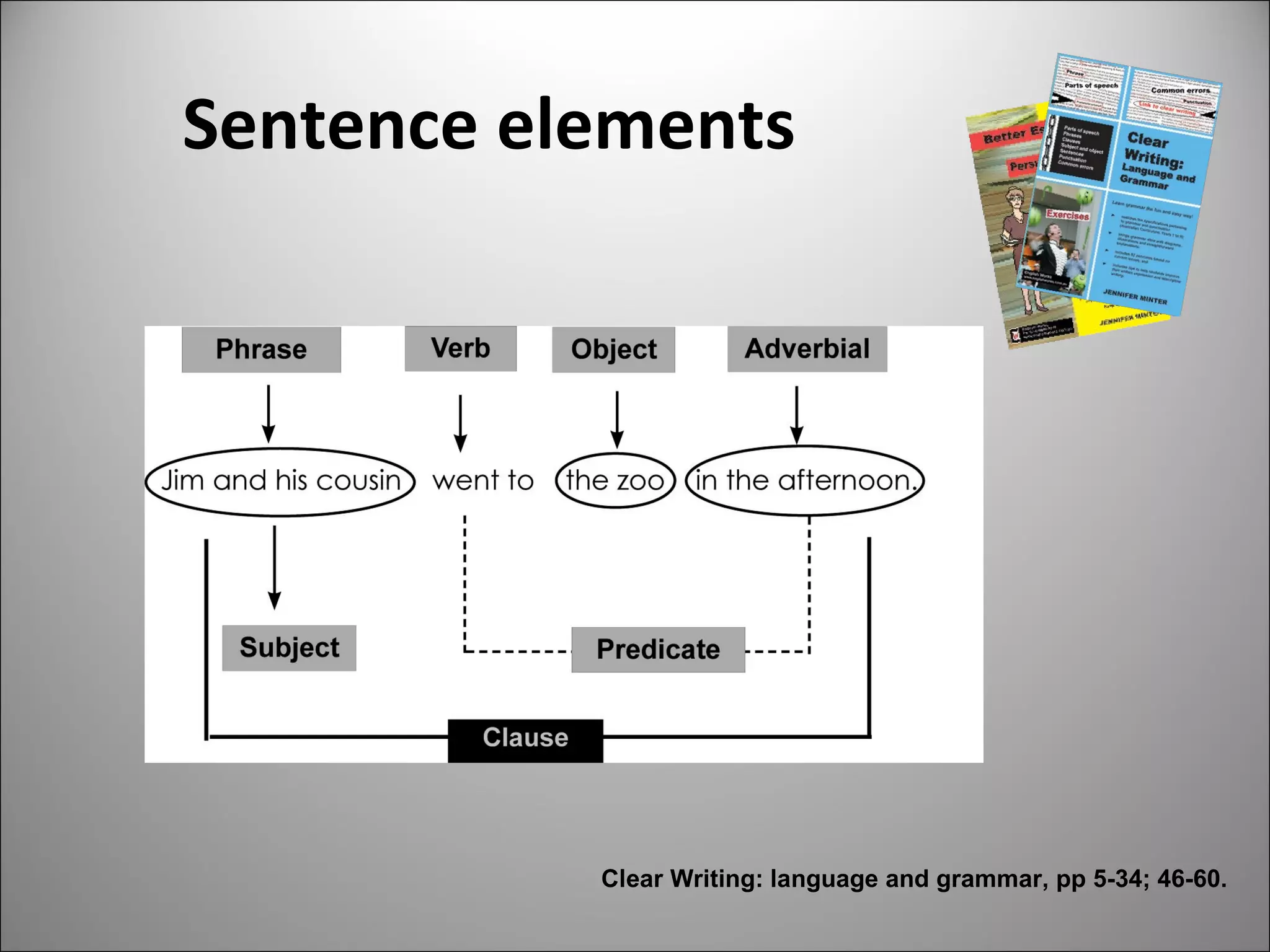
Sentence elements
Clear Writing: language and grammar, pp 5-34; 46-60.
Common errors
• Follow the grammar tips
relating to common grammatical
errors such as:
• The clause lacks a subject.
• The (transitive) verb lacks an object.
• The tenses are incorrect.
• The subject-verb agreements are incorrect.
Better Essays and Persuasive Techniques: pp. 97-111.
Spot the error
• Jack writes:
“He believes that war have many
negatives, something which the rest of the
town don’t believe.”
Clear Writing: language and grammar, pp 41-46.
A clause must have a subject
• Sally writes: “Hence, showing
the reader that the senator does not
take her profession seriously.”
• This sentence does not have a grammatical
subject.
• Correction: “Hence, the author shows the
reader that the senator does not take her
profession seriously.”
Clear Writing: language and grammar, pp 41-46.
The present participle : “.. ing”
form of the verb
• Present participles, “going”, “having”
“showing” do not have a direct subject.
• Sally writes: “Owing to his bad temper, … “
• Sally’s next clause must include a
grammatical subject.
• “… Sam did not want to join in.”
Clear Writing: language and grammar, pp. 15-20.
A transitive verb
must have an object
• Sally writes: “Ms Duff condemns
that there are parents who do not
vaccinate their children.
• The verb “condemns” must take a
grammatical object.
• Correction: “Ms Duff condemns the fact that
many parents do not vaccinate their children.
Clear Writing: language and grammar, pp 43-44.
Other grammar tips:
use of pronouns
• The pronoun must clearly relate
to a previous noun or pronoun.
It must agree in number and gender.
• The relative pronoun is incorrect.
• Do not use “that” to refer to a person.
Clear Writing: language and grammar, pp 10-13.
Stand alone clauses
• An independent clause can
“stand alone”.
• A dependent clause cannot
“stand alone”.
• Jim writes: “Because he was denied access to the
station.” (Because = subordinating conjunction and
the clause cannot stand alone.)
Clear Writing: language and grammar, pp 52-56.
Longer (and
sophisticated) sentences
• When writing long sentences, watch out
for listing devices or multiple predicates.
• If sharing a grammatical subject, we
cannot join two different parts of speech
with “and”.
Clear Writing: language and grammar, pp 66-67.
Be careful with listing devices
• Kate writes: “In Macbeth, we see Macbeth’s
struggle for power and upholding this power.”
• Kate uses a listing device: in this case two phrases
are joined by “and”. The “struggle for power” is a
noun phrase and “upholding this power” is a verb
phrase.
• If sharing a grammatical subject, we cannot join
two different parts of speech with “and”.
Better Essays and Persuasive Techniques: pp. 97-111.
A long sentence
• Jack writes:
“Scott feels guilty about leaving his family and the
townspeople scorn him because of his cowardice.
As a result, Scott is torn between staying with
Elroy, fleeing to Canada or returning home and
going to war.”
• (Notice the effective list based on the “….ing” verb
(present participle).
Better Essays and Persuasive Techniques: pp. 97-111.
Spot the error
• The author juxtaposes how dangerous the fireworks can be by
giving examples of Carlos’s death.
• This implies that illegal fireworks should be monitored and
encourages the use of fireworks in celebratory events.
• Evidence such as the reference from the past about a stolen child
and if she had this product we would have found her.
• The author also uses emotive connotations such as “anxiously
searching”.
• Alliteration such as “care and concern”, this focuses on the
attitude of the parents.
• With the comparison of a well known pet, it demonstrates the
unnecessary actions.
See Writing Better Sentences: E-book 5 (plus responses)
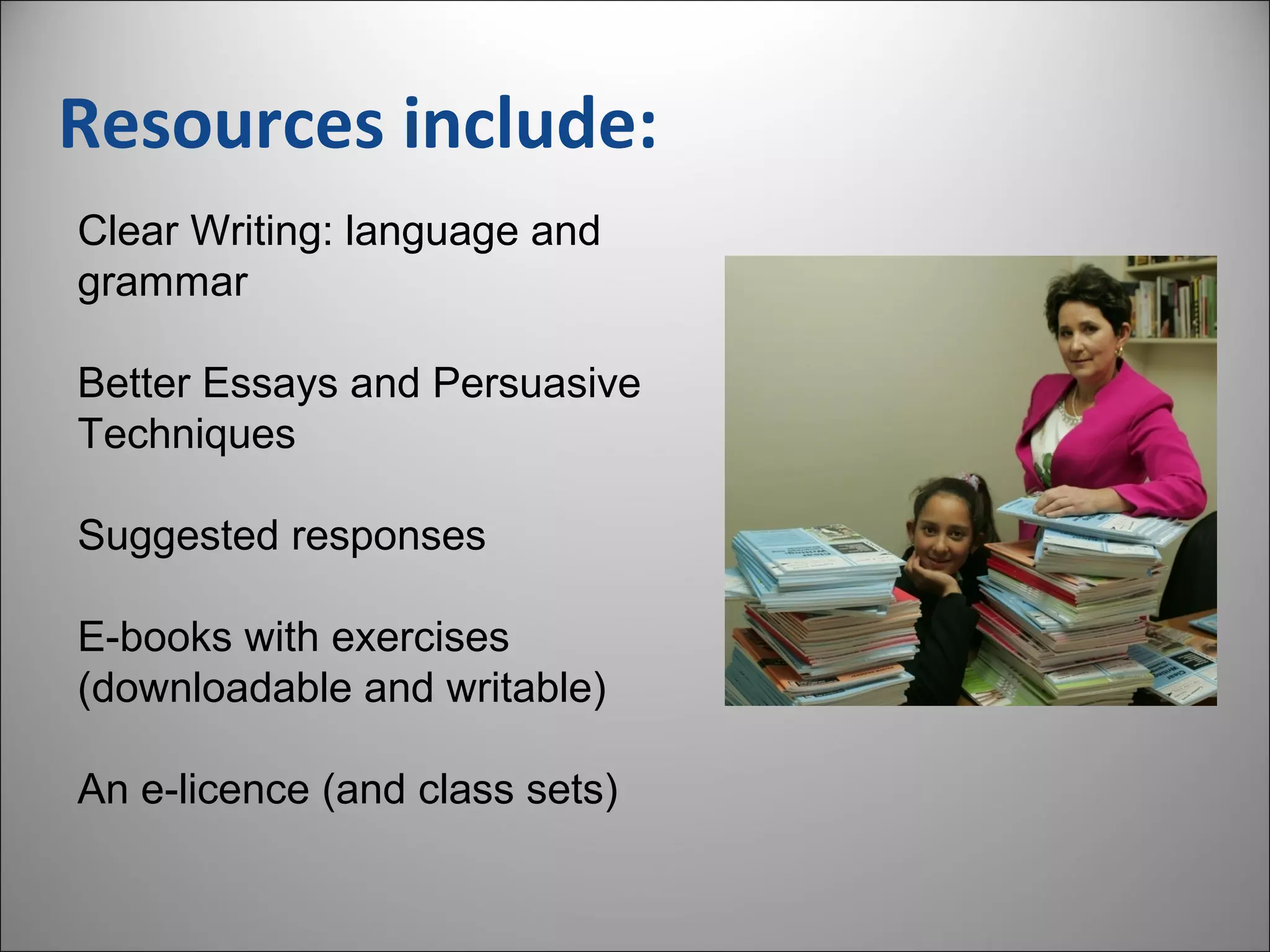
Resources include:
Clear Writing: language and
grammar
Better Essays and Persuasive
Techniques
Suggested responses
E-books with exercises
(downloadable and writable)
An e-licence (and class sets)

Writing better sentences

  • 1.
    Clear Writing: language andgrammar by Dr Jennifer Minter How to avoid common errors and How to write better sentences
  • 2.
    Jim says: “I amoften marked down in English because my teacher says that my expression is unclear or clumsy. I thought ideas were the thing that mattered.” Better Essays and Persuasive Techniques: pp. 97-111.
  • 3.
    Dear Jim • “Thisis a very common problem and you are by no means alone. Your teacher is drawing your attention to the fact that there is a link between good expression and good ideas/clear thought processes. • If you are consistently losing marks in English, it is often because you have awkward phrases/expression. If the entire essay consists of clumsy, clunky grammar, it is hard to achieve an A.” Better Essays and Persuasive Techniques: pp. 97-111. Clear Writing: language and grammar, pp 5-34; 46-60.
  • 4.
    Writing Better Sentences •Sentences are the building blocks of each of your paragraphs. • If words and phrases are put together in a muddled way, the sentence, and hence your message, will be unclear. Better Essays and Persuasive Techniques: pp. 97-111. Clear Writing: language and grammar, pp 5-34; 46-60.
  • 5.
    Sentence elements Clear Writing:language and grammar, pp 5-34; 46-60.
  • 6.
    Common errors • Followthe grammar tips relating to common grammatical errors such as: • The clause lacks a subject. • The (transitive) verb lacks an object. • The tenses are incorrect. • The subject-verb agreements are incorrect. Better Essays and Persuasive Techniques: pp. 97-111.
  • 7.
    Spot the error •Jack writes: “He believes that war have many negatives, something which the rest of the town don’t believe.” Clear Writing: language and grammar, pp 41-46.
  • 8.
    A clause musthave a subject • Sally writes: “Hence, showing the reader that the senator does not take her profession seriously.” • This sentence does not have a grammatical subject. • Correction: “Hence, the author shows the reader that the senator does not take her profession seriously.” Clear Writing: language and grammar, pp 41-46.
  • 9.
    The present participle: “.. ing” form of the verb • Present participles, “going”, “having” “showing” do not have a direct subject. • Sally writes: “Owing to his bad temper, … “ • Sally’s next clause must include a grammatical subject. • “… Sam did not want to join in.” Clear Writing: language and grammar, pp. 15-20.
  • 10.
    A transitive verb musthave an object • Sally writes: “Ms Duff condemns that there are parents who do not vaccinate their children. • The verb “condemns” must take a grammatical object. • Correction: “Ms Duff condemns the fact that many parents do not vaccinate their children. Clear Writing: language and grammar, pp 43-44.
  • 11.
    Other grammar tips: useof pronouns • The pronoun must clearly relate to a previous noun or pronoun. It must agree in number and gender. • The relative pronoun is incorrect. • Do not use “that” to refer to a person. Clear Writing: language and grammar, pp 10-13.
  • 12.
    Stand alone clauses •An independent clause can “stand alone”. • A dependent clause cannot “stand alone”. • Jim writes: “Because he was denied access to the station.” (Because = subordinating conjunction and the clause cannot stand alone.) Clear Writing: language and grammar, pp 52-56.
  • 13.
    Longer (and sophisticated) sentences •When writing long sentences, watch out for listing devices or multiple predicates. • If sharing a grammatical subject, we cannot join two different parts of speech with “and”. Clear Writing: language and grammar, pp 66-67.
  • 14.
    Be careful withlisting devices • Kate writes: “In Macbeth, we see Macbeth’s struggle for power and upholding this power.” • Kate uses a listing device: in this case two phrases are joined by “and”. The “struggle for power” is a noun phrase and “upholding this power” is a verb phrase. • If sharing a grammatical subject, we cannot join two different parts of speech with “and”. Better Essays and Persuasive Techniques: pp. 97-111.
  • 15.
    A long sentence •Jack writes: “Scott feels guilty about leaving his family and the townspeople scorn him because of his cowardice. As a result, Scott is torn between staying with Elroy, fleeing to Canada or returning home and going to war.” • (Notice the effective list based on the “….ing” verb (present participle). Better Essays and Persuasive Techniques: pp. 97-111.
  • 16.
    Spot the error •The author juxtaposes how dangerous the fireworks can be by giving examples of Carlos’s death. • This implies that illegal fireworks should be monitored and encourages the use of fireworks in celebratory events. • Evidence such as the reference from the past about a stolen child and if she had this product we would have found her. • The author also uses emotive connotations such as “anxiously searching”. • Alliteration such as “care and concern”, this focuses on the attitude of the parents. • With the comparison of a well known pet, it demonstrates the unnecessary actions. See Writing Better Sentences: E-book 5 (plus responses)
  • 17.
    Resources include: Clear Writing:language and grammar Better Essays and Persuasive Techniques Suggested responses E-books with exercises (downloadable and writable) An e-licence (and class sets)