Language Analysis
pathway program by
Dr Jennifer Minter
(Yr 7-12)
Series 1. Techniques of
Persuasion/Better
Essays
Series 2. Language analysis:
become an expert
Series 3. Language analysis:
an essay-writing guide
www.englishworks.com.a
u
Stage 1: Years 7-8
Outcomes
Students will:
 learn to accurately identify the author’s views:
 Ms Johnson criticises the installation of CCTV cameras
because they invade people’s privacy
 identify a range of persuasive and reasoning techniques
 write sentences relating to the author’s tone and techniques:
 Adopting an authoritative tone, Mr Jon comments that “its use is shaming their religion
and is of no benefit to anyone.”
Build an analytical vocabulary: In order to accurately identify the author’s attitude and
values, you will need an extensive vocabulary relating to tone.
 Tone descriptors: The workbooks encourage you to become familiar with an extensive list
of tone words. Tone words are modelled in the responses. There are also tone tests and
match-up exercises to constantly test and reinforce the tone words.
The Techniques of Persuasion: pp. 54-55, Ex.34
Outcomes:
analytical precision
• Students will recognise the difference between
generic and analytically-precise sentences.
• Generic sentences:
– The speech is in a forthright tone, getting straight to the point to
show you how serious he is.
– He uses his first-hand experience to build credibility and to show an
unbiased and reasonable perspective.
– He uses an expert who can be trusted because he has experience in
the field.
Outcomes: aim for
analytical precision
• Students will rewrite their sentences:
• “Sharing the fat load”
Evidence/technique; The expert, Mr Webber who is a
trusted economist with experience in the airline industry,
states that obese jetsetters must contribute fairly to the
cost of airline travel. He adopts a logical tone to suggest
that the heavier a person is, the heavier the aircraft and
therefore the cost of fuel increases.
Part 2: Year 9-10 goals
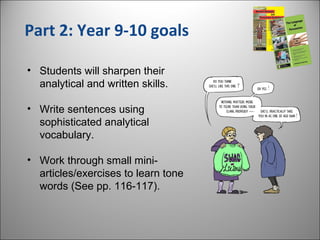
• Students will sharpen their
analytical and written skills.
• Write sentences using
sophisticated analytical
vocabulary.
• Work through small mini-
articles/exercises to learn tone
words (See pp. 116-117).
Part 2: Student’s typical
response (Year 8-9), p. 13
Better Essays and Persuasive Techniques: pp. 43-70.
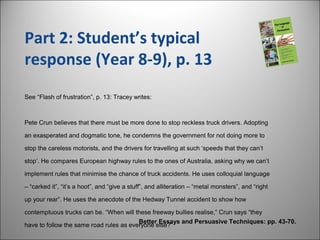
See “Flash of frustration”, p. 13: Tracey writes:
Pete Crun believes that there must be more done to stop reckless truck drivers. Adopting
an exasperated and dogmatic tone, he condemns the government for not doing more to
stop the careless motorists, and the drivers for travelling at such ‘speeds that they can’t
stop’. He compares European highway rules to the ones of Australia, asking why we can’t
implement rules that minimise the chance of truck accidents. He uses colloquial language
– “carked it”, “it’s a hoot”, and “give a stuff”, and alliteration – “metal monsters”, and “right
up your rear”. He uses the anecdote of the Hedway Tunnel accident to show how
contemptuous trucks can be. “When will these freeway bullies realise,” Crun says “they
have to follow the same road rules as everyone else?”
Improvements:
“Flash of frustration”, p. 13
• Tracey uses a series of sentence models and
metalanguage to improve analytical accuracy.
• For example:
– (Tone)Dogmatically,MrCruncondemnstherecklessdrivinghabitsoftruckdriversthatcausechaosanddeathonourroads.
– (Bigpicture)ThecomparisonbetweentheEuropeanandtheAustralianroadruleshighlightstheneedforapreferablesolutiononour
freeways.
Year 9: outcomes, p. 13.
• TheauthorjuxtaposesthecourteousdrivinghabitsofEuropeantruckdriverswiththeinconsideratehabitsofAustraliantruckdrivers
tohighlighttheneedforgreaterrespect.
• (wordchoice/attack)Thecolloquialreferencetothefactthatdrivers“don’tgiveastuff”drawsattentiontotheirirresponsible
attitude. Accordingly,MrCrunexpectsallconcernedmotoriststofeelindignantatthemannerinwhichthetruckdriversundermine
roadsafety.
• (wordchoice/attack)Thealliterativereferencetothe“metalmonsters”highlightsthethreateningbehaviour ofthetruckdrivers. Its
usereflectsMrCrun’sattempttoshameorisolatetruckdriversandencouragemoreconsiderateattitudes.
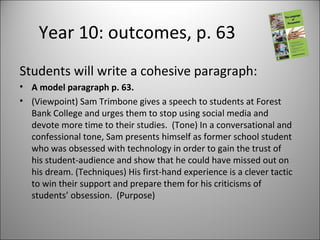
Year 10: outcomes, p. 63
Students will write a cohesive paragraph:
• A model paragraph p. 63.
• (Viewpoint) Sam Trimbone gives a speech to students at Forest
Bank College and urges them to stop using social media and
devote more time to their studies. (Tone) In a conversational and
confessional tone, Sam presents himself as former school student
who was obsessed with technology in order to gain the trust of
his student-audience and show that he could have missed out on
his dream. (Techniques) His first-hand experience is a clever tactic
to win their support and prepare them for his criticisms of
students’ obsession. (Purpose)
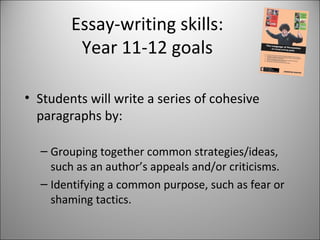
Essay-writing skills:
Year 11-12 goals
• Students will write a series of cohesive
paragraphs by:
– Grouping together common strategies/ideas,
such as an author’s appeals and/or criticisms.
– Identifying a common purpose, such as fear or
shaming tactics.
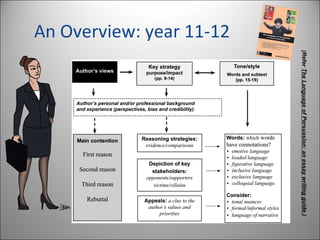
An Overview: year 11-12
(ReferTheLanguageofPersuasion:anessaywritingguide.)
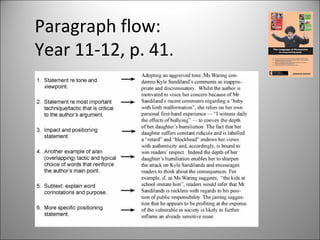
Paragraph flow:
Year 11-12, p. 41.
Essay-writing skills:
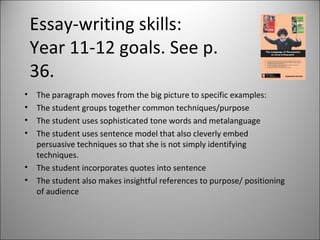
Year 11-12 goals. See p.
36.
• The paragraph moves from the big picture to specific examples:
• The student groups together common techniques/purpose
• The student uses sophisticated tone words and metalanguage
• The student uses sentence model that also cleverly embed
persuasive techniques so that she is not simply identifying
techniques.
• The student incorporates quotes into sentence
• The student also makes insightful references to purpose/ positioning
of audience
Essay-writing skills:
Year 12 goals, p. 36
• Reproachfully,(Censoriously)DrKrisanskidrawsuponhisprofessionalbackgroundasapsychologistandnumerousconsultationstosupporthisviewthatthedemise
of“oldfashioned”parentingstyleisharmingchildren’ssocialdevelopment.DrKrisanskidecriesthemodern-styleofparenting,thathebelieves,isleadingtoalackof
interpersonalskillsinchildrenandbreedingself-indulgentchildren.Certainly,parentswouldbeashamedatthealliterativereferencestotheir“flipflopping”andtheir
tameeffortsto“squashthesquabbles”whichimplythattheyareirresponsibleandcareless.Theywouldalsobealarmedatthefactthatsuchineffectualleadershipis
alsolikelytodisadvantagetheirteenagechildren.Thereferencetochildrenas“narcissistic”whoare“usedtogettingtheirownwaywitheverything”andwholack
importantlifeskillssuggeststhattheyarepoorlyequippedtocopewiththeworkplaceandarelikelytobeemotionallydisadvantaged.Thecomparisonsbetweenthe
presentandpastparentingstylesremindsthoseparents,tologically,foregroundwhatthepsychologistidentifiesas,old-fashionedco-operativeinterpersonalskills
thatarelikelytobetterprepareteenagersforfutureroles.
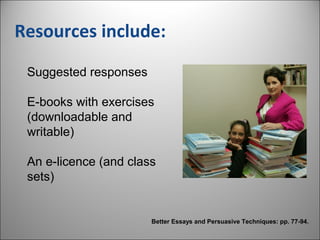
Resources include:
Suggested responses
E-books with exercises
(downloadable and
writable)
An e-licence (and class
sets)
Better Essays and Persuasive Techniques: pp. 77-94.

Language analysis scoping overview

  • 1.
    Language Analysis pathway programby Dr Jennifer Minter (Yr 7-12) Series 1. Techniques of Persuasion/Better Essays Series 2. Language analysis: become an expert Series 3. Language analysis: an essay-writing guide www.englishworks.com.a u
  • 2.
    Stage 1: Years7-8 Outcomes Students will:  learn to accurately identify the author’s views:  Ms Johnson criticises the installation of CCTV cameras because they invade people’s privacy  identify a range of persuasive and reasoning techniques  write sentences relating to the author’s tone and techniques:  Adopting an authoritative tone, Mr Jon comments that “its use is shaming their religion and is of no benefit to anyone.” Build an analytical vocabulary: In order to accurately identify the author’s attitude and values, you will need an extensive vocabulary relating to tone.  Tone descriptors: The workbooks encourage you to become familiar with an extensive list of tone words. Tone words are modelled in the responses. There are also tone tests and match-up exercises to constantly test and reinforce the tone words. The Techniques of Persuasion: pp. 54-55, Ex.34
  • 3.
    Outcomes: analytical precision • Studentswill recognise the difference between generic and analytically-precise sentences. • Generic sentences: – The speech is in a forthright tone, getting straight to the point to show you how serious he is. – He uses his first-hand experience to build credibility and to show an unbiased and reasonable perspective. – He uses an expert who can be trusted because he has experience in the field.
  • 4.
    Outcomes: aim for analyticalprecision • Students will rewrite their sentences: • “Sharing the fat load” Evidence/technique; The expert, Mr Webber who is a trusted economist with experience in the airline industry, states that obese jetsetters must contribute fairly to the cost of airline travel. He adopts a logical tone to suggest that the heavier a person is, the heavier the aircraft and therefore the cost of fuel increases.
  • 5.
    Part 2: Year9-10 goals • Students will sharpen their analytical and written skills. • Write sentences using sophisticated analytical vocabulary. • Work through small mini- articles/exercises to learn tone words (See pp. 116-117).
  • 6.
    Part 2: Student’stypical response (Year 8-9), p. 13 Better Essays and Persuasive Techniques: pp. 43-70. See “Flash of frustration”, p. 13: Tracey writes: Pete Crun believes that there must be more done to stop reckless truck drivers. Adopting an exasperated and dogmatic tone, he condemns the government for not doing more to stop the careless motorists, and the drivers for travelling at such ‘speeds that they can’t stop’. He compares European highway rules to the ones of Australia, asking why we can’t implement rules that minimise the chance of truck accidents. He uses colloquial language – “carked it”, “it’s a hoot”, and “give a stuff”, and alliteration – “metal monsters”, and “right up your rear”. He uses the anecdote of the Hedway Tunnel accident to show how contemptuous trucks can be. “When will these freeway bullies realise,” Crun says “they have to follow the same road rules as everyone else?”
  • 7.
    Improvements: “Flash of frustration”,p. 13 • Tracey uses a series of sentence models and metalanguage to improve analytical accuracy. • For example: – (Tone)Dogmatically,MrCruncondemnstherecklessdrivinghabitsoftruckdriversthatcausechaosanddeathonourroads. – (Bigpicture)ThecomparisonbetweentheEuropeanandtheAustralianroadruleshighlightstheneedforapreferablesolutiononour freeways.
  • 8.
    Year 9: outcomes,p. 13. • TheauthorjuxtaposesthecourteousdrivinghabitsofEuropeantruckdriverswiththeinconsideratehabitsofAustraliantruckdrivers tohighlighttheneedforgreaterrespect. • (wordchoice/attack)Thecolloquialreferencetothefactthatdrivers“don’tgiveastuff”drawsattentiontotheirirresponsible attitude. Accordingly,MrCrunexpectsallconcernedmotoriststofeelindignantatthemannerinwhichthetruckdriversundermine roadsafety. • (wordchoice/attack)Thealliterativereferencetothe“metalmonsters”highlightsthethreateningbehaviour ofthetruckdrivers. Its usereflectsMrCrun’sattempttoshameorisolatetruckdriversandencouragemoreconsiderateattitudes.
  • 9.
    Year 10: outcomes,p. 63 Students will write a cohesive paragraph: • A model paragraph p. 63. • (Viewpoint) Sam Trimbone gives a speech to students at Forest Bank College and urges them to stop using social media and devote more time to their studies. (Tone) In a conversational and confessional tone, Sam presents himself as former school student who was obsessed with technology in order to gain the trust of his student-audience and show that he could have missed out on his dream. (Techniques) His first-hand experience is a clever tactic to win their support and prepare them for his criticisms of students’ obsession. (Purpose)
  • 10.
    Essay-writing skills: Year 11-12goals • Students will write a series of cohesive paragraphs by: – Grouping together common strategies/ideas, such as an author’s appeals and/or criticisms. – Identifying a common purpose, such as fear or shaming tactics.
  • 11.
    An Overview: year11-12 (ReferTheLanguageofPersuasion:anessaywritingguide.)
  • 12.
  • 13.
    Essay-writing skills: Year 11-12goals. See p. 36. • The paragraph moves from the big picture to specific examples: • The student groups together common techniques/purpose • The student uses sophisticated tone words and metalanguage • The student uses sentence model that also cleverly embed persuasive techniques so that she is not simply identifying techniques. • The student incorporates quotes into sentence • The student also makes insightful references to purpose/ positioning of audience
  • 14.
    Essay-writing skills: Year 12goals, p. 36 • Reproachfully,(Censoriously)DrKrisanskidrawsuponhisprofessionalbackgroundasapsychologistandnumerousconsultationstosupporthisviewthatthedemise of“oldfashioned”parentingstyleisharmingchildren’ssocialdevelopment.DrKrisanskidecriesthemodern-styleofparenting,thathebelieves,isleadingtoalackof interpersonalskillsinchildrenandbreedingself-indulgentchildren.Certainly,parentswouldbeashamedatthealliterativereferencestotheir“flipflopping”andtheir tameeffortsto“squashthesquabbles”whichimplythattheyareirresponsibleandcareless.Theywouldalsobealarmedatthefactthatsuchineffectualleadershipis alsolikelytodisadvantagetheirteenagechildren.Thereferencetochildrenas“narcissistic”whoare“usedtogettingtheirownwaywitheverything”andwholack importantlifeskillssuggeststhattheyarepoorlyequippedtocopewiththeworkplaceandarelikelytobeemotionallydisadvantaged.Thecomparisonsbetweenthe presentandpastparentingstylesremindsthoseparents,tologically,foregroundwhatthepsychologistidentifiesas,old-fashionedco-operativeinterpersonalskills thatarelikelytobetterprepareteenagersforfutureroles.
  • 15.
    Resources include: Suggested responses E-bookswith exercises (downloadable and writable) An e-licence (and class sets) Better Essays and Persuasive Techniques: pp. 77-94.

Editor's Notes

  • #9 4. Typical example of words/depiction/tactics that reinforce main point: emotive words / phrases / labels such as .................... capture the extent of his pain and encourage readers to ............................ 5. (Depiction)/ By presenting himself as someone who ........... he shows that he deserves the reader’s sympathy .. He provocatively asks “what of all the other ....” / he .......................... insinuates
  • #10 4. Typical example of words/depiction/tactics that reinforce main point: emotive words / phrases / labels such as .................... capture the extent of his pain and encourage readers to ............................ 5. (Depiction)/ By presenting himself as someone who ........... he shows that he deserves the reader’s sympathy .. He provocatively asks “what of all the other ....” / he .......................... insinuates
  • #11 4. Typical example of words/depiction/tactics that reinforce main point: emotive words / phrases / labels such as .................... capture the extent of his pain and encourage readers to ............................ 5. (Depiction)/ By presenting himself as someone who ........... he shows that he deserves the reader’s sympathy .. He provocatively asks “what of all the other ....” / he .......................... insinuates
  • #13 4. Typical example of words/depiction/tactics that reinforce main point: emotive words / phrases / labels such as .................... capture the extent of his pain and encourage readers to ............................ 5. (Depiction)/ By presenting himself as someone who ........... he shows that he deserves the reader’s sympathy .. He provocatively asks “what of all the other ....” / he .......................... insinuates
  • #14 4. Typical example of words/depiction/tactics that reinforce main point: emotive words / phrases / labels such as .................... capture the extent of his pain and encourage readers to ............................ 5. (Depiction)/ By presenting himself as someone who ........... he shows that he deserves the reader’s sympathy .. He provocatively asks “what of all the other ....” / he .......................... insinuates
  • #15 4. Typical example of words/depiction/tactics that reinforce main point: emotive words / phrases / labels such as .................... capture the extent of his pain and encourage readers to ............................ 5. (Depiction)/ By presenting himself as someone who ........... he shows that he deserves the reader’s sympathy .. He provocatively asks “what of all the other ....” / he .......................... insinuates