Writing AC TIVITY


  Nowhere in the university system is the
  debate about the ‘crisis’ in education and
  the ‘lowering of standards’ more intense
  than in the arena of student writing.
 (Lillis 2001)
Typically Students:
       Working 20 or more hours per week
       Supporting or raising families
       Engaging in modules rather than courses…
       Have little time:
       to tackle new material
       to practice their thinking/writing
   to familiarise themselves with a bewildering
    array of assessment engines
Imagine tackling
   Presentations &
    seminars                     Seen & unseen exams
   Essays, reports,
                                 Open or closed book
                                  exams
    papers, dissertations &      Exams with differing time
    projects                      limits
   Case studies & child         Exams with differing word
    studies                       limits
   Annotated
    bibliographies            AND that perennial favourite
                               Group work – with group
   Reading Records             mark awarded
   Learning Logs              Group work – with
   Abstracts &                 individual mark awarded
                               Group work - with self-
    Summaries                   and/or peer evaluation
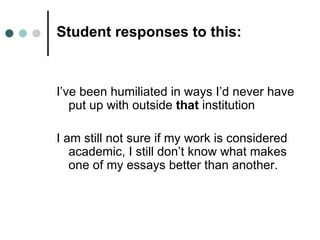
Student responses to this:


I’ve been humiliated in ways I’d never have
   put up with outside that institution

I am still not sure if my work is considered
   academic, I still don’t know what makes
   one of my essays better than another.
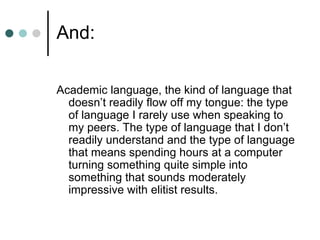
And:

Academic language, the kind of language that
  doesn’t readily flow off my tongue: the type
  of language I rarely use when speaking to
  my peers. The type of language that I don’t
  readily understand and the type of language
  that means spending hours at a computer
  turning something quite simple into
  something that sounds moderately
  impressive with elitist results.
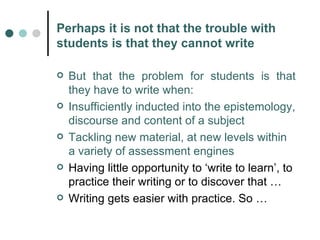
Perhaps it is not that the trouble with
students is that they cannot write

   But that the problem for students is that
    they have to write when:
   Insufficiently inducted into the epistemology,
    discourse and content of a subject
   Tackling new material, at new levels within
    a variety of assessment engines
   Having little opportunity to ‘write to learn’, to
    practice their writing or to discover that …
   Writing gets easier with practice. So …
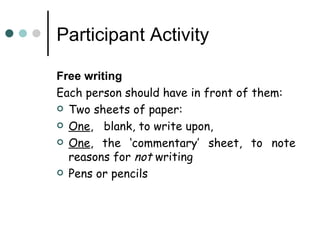
Participant Activity

Free writing
Each person should have in front of them:
 Two sheets of paper:

 One, blank, to write upon,

 One, the ‘commentary’ sheet, to note
  reasons for not writing
 Pens or pencils
Participant Activity
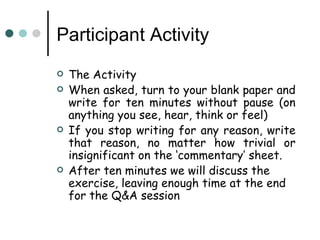
   The Activity
   When asked, turn to your blank paper and
    write for ten minutes without pause (on
    anything you see, hear, think or feel)
   If you stop writing for any reason, write
    that reason, no matter how trivial or
    insignificant on the ‘commentary’ sheet.
   After ten minutes we will discuss the
    exercise, leaving enough time at the end
    for the Q&A session
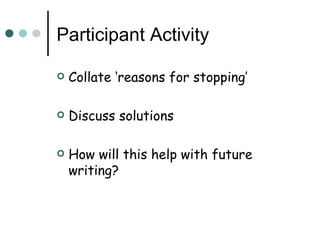
Participant Activity

   Collate ‘reasons for stopping’

   Discuss solutions

   How will this help with future
    writing?
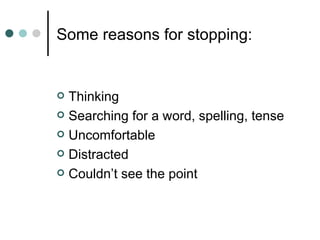
Some reasons for stopping:


 Thinking
 Searching for a word, spelling, tense

 Uncomfortable

 Distracted

 Couldn’t see the point
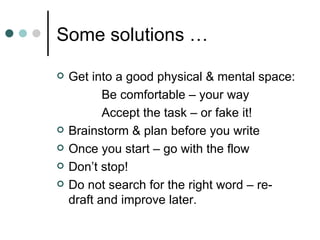
Some solutions …

   Get into a good physical & mental space:
           Be comfortable – your way
           Accept the task – or fake it!
   Brainstorm & plan before you write
   Once you start – go with the flow
   Don’t stop!
   Do not search for the right word – re-
    draft and improve later.
Writing …
   How will this help with your writing?

   Collect responses…

Writing activity

  • 1.
    Writing AC TIVITY Nowhere in the university system is the debate about the ‘crisis’ in education and the ‘lowering of standards’ more intense than in the arena of student writing. (Lillis 2001)
  • 2.
    Typically Students:  Working 20 or more hours per week  Supporting or raising families  Engaging in modules rather than courses…  Have little time:  to tackle new material  to practice their thinking/writing  to familiarise themselves with a bewildering array of assessment engines
  • 3.
    Imagine tackling  Presentations & seminars  Seen & unseen exams  Essays, reports,  Open or closed book exams papers, dissertations &  Exams with differing time projects limits  Case studies & child  Exams with differing word studies limits  Annotated bibliographies AND that perennial favourite  Group work – with group  Reading Records mark awarded  Learning Logs  Group work – with  Abstracts & individual mark awarded  Group work - with self- Summaries and/or peer evaluation
  • 4.
    Student responses tothis: I’ve been humiliated in ways I’d never have put up with outside that institution I am still not sure if my work is considered academic, I still don’t know what makes one of my essays better than another.
  • 5.
    And: Academic language, thekind of language that doesn’t readily flow off my tongue: the type of language I rarely use when speaking to my peers. The type of language that I don’t readily understand and the type of language that means spending hours at a computer turning something quite simple into something that sounds moderately impressive with elitist results.
  • 6.
    Perhaps it isnot that the trouble with students is that they cannot write  But that the problem for students is that they have to write when:  Insufficiently inducted into the epistemology, discourse and content of a subject  Tackling new material, at new levels within a variety of assessment engines  Having little opportunity to ‘write to learn’, to practice their writing or to discover that …  Writing gets easier with practice. So …
  • 7.
    Participant Activity Free writing Eachperson should have in front of them:  Two sheets of paper:  One, blank, to write upon,  One, the ‘commentary’ sheet, to note reasons for not writing  Pens or pencils
  • 8.
    Participant Activity  The Activity  When asked, turn to your blank paper and write for ten minutes without pause (on anything you see, hear, think or feel)  If you stop writing for any reason, write that reason, no matter how trivial or insignificant on the ‘commentary’ sheet.  After ten minutes we will discuss the exercise, leaving enough time at the end for the Q&A session
  • 9.
    Participant Activity  Collate ‘reasons for stopping’  Discuss solutions  How will this help with future writing?
  • 10.
    Some reasons forstopping:  Thinking  Searching for a word, spelling, tense  Uncomfortable  Distracted  Couldn’t see the point
  • 11.
    Some solutions …  Get into a good physical & mental space: Be comfortable – your way Accept the task – or fake it!  Brainstorm & plan before you write  Once you start – go with the flow  Don’t stop!  Do not search for the right word – re- draft and improve later.
  • 12.
    Writing …  How will this help with your writing?  Collect responses…