Workshop week 13: Adapting
materials
• Bring lesson aim
• Bring materials (activities from textbooks
internet, texts, pictures, things you’ve
developed yourself etc.)
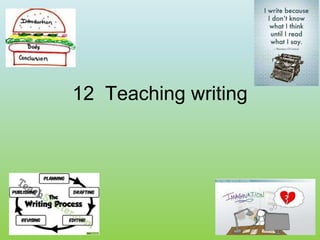
12 Teaching writing
Issues around teaching writing
• Unclear what learners’ needs are
• Teachers/learners do not enjoy
teaching/learning writing
• Writing is also used to practice grammar,
BUT this is NOT the same as teaching
writing
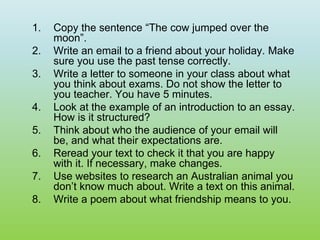
Look at the instructions for activities.
Which aspects of writing do these activities
develop?
1. Copy the sentence “The cow jumped over the
moon”.
2. Write an email to a friend about your holiday. Make
sure you use the past tense correctly.
3. Write a letter to someone in your class about what
you think about exams. Do not show the letter to
you teacher. You have 5 minutes.
4. Look at the example of an introduction to an essay.
How is it structured?
5. Think about who the audience of your email will
be, and what their expectations are.
6. Reread your text to check it that you are happy
with it. If necessary, make changes.
7. Use websites to research an Australian animal you
don’t know much about. Write a text on this animal.
8. Write a poem about what friendship means to you.
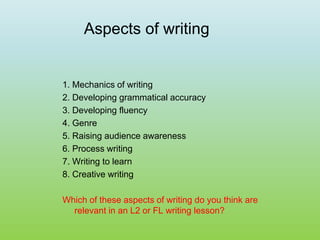
Aspects of writing
1. Mechanics of writing
2. Developing grammatical accuracy
3. Developing fluency
4. Genre
5. Raising audience awareness
6. Process writing
7. Writing to learn
8. Creative writing
Which of these aspects of writing do you think are
relevant in an L2 or FL writing lesson?
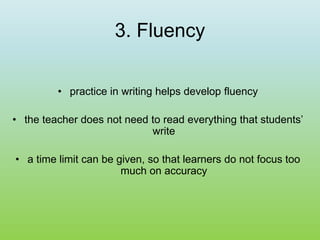
3. Fluency
• practice in writing helps develop fluency
• the teacher does not need to read everything that students’
write
• a time limit can be given, so that learners do not focus too
much on accuracy
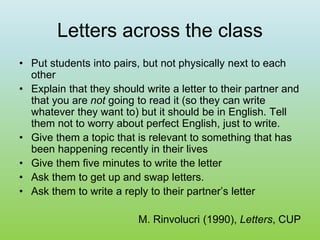
Letters across the class
• Put students into pairs, but not physically next to each
other
• Explain that they should write a letter to their partner and
that you are not going to read it (so they can write
whatever they want to) but it should be in English. Tell
them not to worry about perfect English, just to write.
• Give them a topic that is relevant to something that has
been happening recently in their lives
• Give them five minutes to write the letter
• Ask them to get up and swap letters.
• Ask them to write a reply to their partner’s letter
M. Rinvolucri (1990), Letters, CUP
What approach to writing is
this?
• Learners are given two emails to a company about an
advertisement – one complaining and one praising
• Features of the emails are pointed out e.g. genre,
structure, style, vocabulary
• Learners do practice exercises on more than one of
these features
• Learners are shown WWF ad and asked opinions
• Learners write a email to WWF expressing an opinion
about this ad
4. Genre-based approach
• Emphasizes texts
• Genre of a text influences its structure and
features
• Begin by analysing model text of a specific
genre
• Learners practice features relevant to the
model text
• Learners then produce their own text of the
SAME genre
NB. At lower levels, this could mean students copy some of the original
text and add only some elements of their own
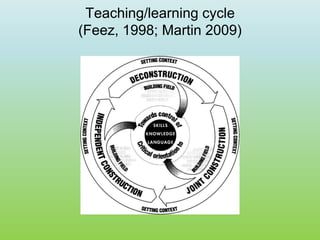
Teaching/learning cycle
(Feez, 1998; Martin 2009)
Genres
• Personal writing
e.g. diaries, shopping lists
• Public writing
e.g. form filling, letters of enquiry/complaint, opinion letters
• Social writing
e.g. e-mails, text messages, birthday cards
• Study writing
e.g. lecture notes, reading notes, essays
• Institutional writing
e.g. minutes of meetings, CVs, business e-mails
• Creative writing
e.g. stories, poems
Raising awareness of
features of writing
- text structure e.g. paragraphing, order of information
- cohesion e.g. linking words, referencing
- style e.g. formal/informal
- vocabulary
- grammar
Also providing exercises that allow students to
practice these!!!!
New media and writing
Writing has changed greatly!
– E-mails
– Text messages (SMS)
– You-tubes
– Power point
– Chat rooms
– Home-pages
– Social networking sites (e.g. Face-book, Twitter)
– Blogs
– Virtual worlds (e.g. Second Life)
We need to think of ways of incorporating new media
into writing instruction
A variation on the genre-
based approach
Design an advertisement for a product or
for something you believe in.
Think carefully about who your audience
are, what their values are, and how you
can appeal to these values in your
advertisment. Also, think carefully about
how you will combine images and text in
your advertisement.
What approach to writing
is this?
• learners gives opinions about WWF ad
• T explains that learners are going to write an email
to WWF either praising or criticizing the ad
• class brainstorms more ‘for’ & ‘against’ arguments
for the ad
• learners (with similar opinions?) work in pairs to
decide:
– Which position they will take
– Which for and/or against arguments they will use
• learners plan their letter together,
noting any useful phrases and planning
how to organise the text
• teacher monitors and helps
• learners work in pairs to write a first
draft of their letter
• training in revising skills
• pairs revise their own letters
• learners work in fours to give peer
feedback
• learners revise letter again
6. Process approach
• In this approach, writing processes and strategies
are identified and focussed on
• Writing processes include:
» Generating ideas: (e.g. Brainstorming)
» Planning: text content, organisation and layout
» Formulating: sentences
» Reading: own text, task instructions, other sources
» Revising: making changes to text (own and peer
writing)
(Silva, 1990; Hedge, 2005)
Encouraging students to revise
• Teachers tend to ONLY give feedback on language errors (this is
also what learners expect)
However, learners can also benefit from feedback on content
• FL teachers tend to correct all errors themselves
However, learners can benefit from less direct forms of teacher
feedback (e.g. message comments, error-correction symbols)
Developing noticing skills
- Develop ability to notice problems
Those who notice the most, learn the most
(Schmidt, 1990)
- Draw attention to particular (kinds of)
problems in own (or others’) texts
- Use of correction symbols to aid noticing
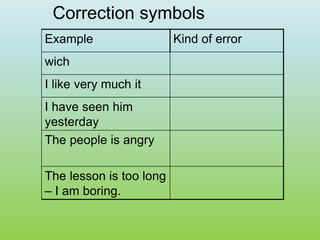
Correction symbols
Example Kind of error
wich
I like very much it
I have seen him
yesterday
The people is angry
The lesson is too long
– I am boring.
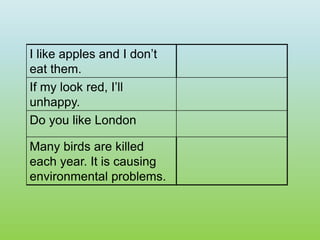
I like apples and I don’t
eat them.
If my look red, I’ll
unhappy.
Do you like London
Many birds are killed
each year. It is causing
environmental problems.
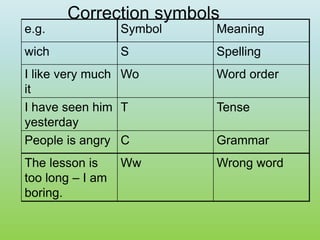
Correction symbols
e.g. Symbol Meaning
wich S Spelling
I like very much
it
Wo Word order
I have seen him
yesterday
T Tense
People is angry C Grammar
The lesson is
too long – I am
boring.
Ww Wrong word
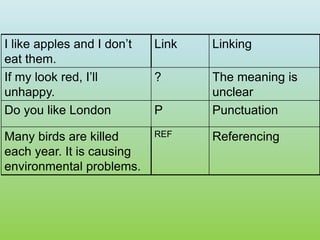
I like apples and I don’t
eat them.
Link Linking
If my look red, I’ll
unhappy.
? The meaning is
unclear
Do you like London P Punctuation
Many birds are killed
each year. It is causing
environmental problems.
REF Referencing
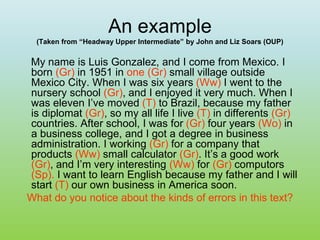
An example
(Taken from “Headway Upper Intermediate” by John and Liz Soars (OUP)
My name is Luis Gonzalez, and I come from Mexico. I
born (Gr) in 1951 in one (Gr) small village outside
Mexico City. When I was six years (Ww) I went to the
nursery school (Gr), and I enjoyed it very much. When I
was eleven I’ve moved (T) to Brazil, because my father
is diplomat (Gr), so my all life I live (T) in differents (Gr)
countries. After school, I was for (Gr) four years (Wo) in
a business college, and I got a degree in business
administration. I working (Gr) for a company that
products (Ww) small calculator (Gr). It’s a good work
(Gr), and I’m very interesting (Ww) for (Gr) computors
(Sp). I want to learn English because my father and I will
start (T) our own business in America soon.
What do you notice about the kinds of errors in this text?
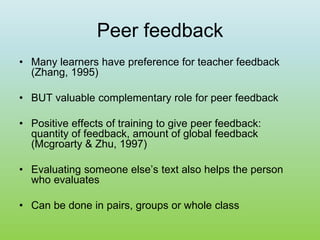
Peer feedback
• Many learners have preference for teacher feedback
(Zhang, 1995)
• BUT valuable complementary role for peer feedback
• Positive effects of training to give peer feedback:
quantity of feedback, amount of global feedback
(Mcgroarty & Zhu, 1997)
• Evaluating someone else’s text also helps the person
who evaluates
• Can be done in pairs, groups or whole class
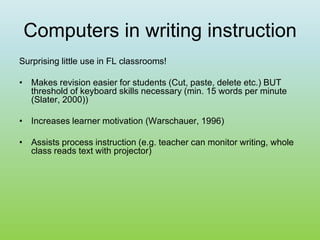
Computers in writing instruction
Surprising little use in FL classrooms!
• Makes revision easier for students (Cut, paste, delete etc.) BUT
threshold of keyboard skills necessary (min. 15 words per minute
(Slater, 2000))
• Increases learner motivation (Warschauer, 1996)
• Assists process instruction (e.g. teacher can monitor writing, whole
class reads text with projector)
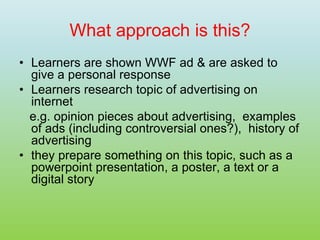
What approach is this?
• Learners are shown WWF ad & are asked to
give a personal response
• Learners research topic of advertising on
internet
e.g. opinion pieces about advertising, examples
of ads (including controversial ones?), history of
advertising
• they prepare something on this topic, such as a
powerpoint presentation, a poster, a text or a
digital story
7. Writing to learn
• writing tasks that focus on learning about
a particular topic
• writing to learn traditionally used in school
content subjects e.g. science, history
• BUT also possible in language classroom
e.g. research projects, surveys etc.
Learning-to-write vs. writing-to-
learn
Learning-to-write
Teaching students how to write
Writing-to-learn
Teaching students how to use writing to learn content
• Writing to think, discover (intellectual engagement is goal; errors a
natural part of learning)
• Allows students to voice and explore questions
• Students see writing as a tool, a way to help them think about new
material
Although the goals for each are different, instruction for both can happen
simultaneously
What approach is this?
Write a Japanese Haiku about wild animals
8. Creative writing
• focus on feelings, physical sensations,
intuition and musicality
• risk is encouraged
• playing with language
• but sometimes within the ‘rules’ of the
genre e.g. haiku
Haiku
old pond
. . . a frog leaps in
water's sound
Summer here again.
Music plays sweetly, drifting
And life is renewed
Formative assessment
Writing major form of assessment on many
courses
Formative portfolio assessment is an
alternative to traditional essays/tests
Portfolios
• Collection of student work
– Can include teacher work/feedback
• Student has ownership
• Some element of choice
– Showcase
– Demonstrating process of writing - drafts

How to teach writing for EFL learners

  • 1.
    Workshop week 13:Adapting materials • Bring lesson aim • Bring materials (activities from textbooks internet, texts, pictures, things you’ve developed yourself etc.)
  • 2.
  • 3.
    Issues around teachingwriting • Unclear what learners’ needs are • Teachers/learners do not enjoy teaching/learning writing • Writing is also used to practice grammar, BUT this is NOT the same as teaching writing
  • 4.
    Look at theinstructions for activities. Which aspects of writing do these activities develop?
  • 5.
    1. Copy thesentence “The cow jumped over the moon”. 2. Write an email to a friend about your holiday. Make sure you use the past tense correctly. 3. Write a letter to someone in your class about what you think about exams. Do not show the letter to you teacher. You have 5 minutes. 4. Look at the example of an introduction to an essay. How is it structured? 5. Think about who the audience of your email will be, and what their expectations are. 6. Reread your text to check it that you are happy with it. If necessary, make changes. 7. Use websites to research an Australian animal you don’t know much about. Write a text on this animal. 8. Write a poem about what friendship means to you.
  • 6.
    Aspects of writing 1.Mechanics of writing 2. Developing grammatical accuracy 3. Developing fluency 4. Genre 5. Raising audience awareness 6. Process writing 7. Writing to learn 8. Creative writing Which of these aspects of writing do you think are relevant in an L2 or FL writing lesson?
  • 7.
    3. Fluency • practicein writing helps develop fluency • the teacher does not need to read everything that students’ write • a time limit can be given, so that learners do not focus too much on accuracy
  • 8.
    Letters across theclass • Put students into pairs, but not physically next to each other • Explain that they should write a letter to their partner and that you are not going to read it (so they can write whatever they want to) but it should be in English. Tell them not to worry about perfect English, just to write. • Give them a topic that is relevant to something that has been happening recently in their lives • Give them five minutes to write the letter • Ask them to get up and swap letters. • Ask them to write a reply to their partner’s letter M. Rinvolucri (1990), Letters, CUP
  • 11.
    What approach towriting is this? • Learners are given two emails to a company about an advertisement – one complaining and one praising • Features of the emails are pointed out e.g. genre, structure, style, vocabulary • Learners do practice exercises on more than one of these features • Learners are shown WWF ad and asked opinions • Learners write a email to WWF expressing an opinion about this ad
  • 12.
    4. Genre-based approach •Emphasizes texts • Genre of a text influences its structure and features • Begin by analysing model text of a specific genre • Learners practice features relevant to the model text • Learners then produce their own text of the SAME genre NB. At lower levels, this could mean students copy some of the original text and add only some elements of their own
  • 13.
  • 14.
    Genres • Personal writing e.g.diaries, shopping lists • Public writing e.g. form filling, letters of enquiry/complaint, opinion letters • Social writing e.g. e-mails, text messages, birthday cards • Study writing e.g. lecture notes, reading notes, essays • Institutional writing e.g. minutes of meetings, CVs, business e-mails • Creative writing e.g. stories, poems
  • 15.
    Raising awareness of featuresof writing - text structure e.g. paragraphing, order of information - cohesion e.g. linking words, referencing - style e.g. formal/informal - vocabulary - grammar Also providing exercises that allow students to practice these!!!!
  • 16.
    New media andwriting Writing has changed greatly! – E-mails – Text messages (SMS) – You-tubes – Power point – Chat rooms – Home-pages – Social networking sites (e.g. Face-book, Twitter) – Blogs – Virtual worlds (e.g. Second Life) We need to think of ways of incorporating new media into writing instruction
  • 17.
    A variation onthe genre- based approach Design an advertisement for a product or for something you believe in. Think carefully about who your audience are, what their values are, and how you can appeal to these values in your advertisment. Also, think carefully about how you will combine images and text in your advertisement.
  • 18.
    What approach towriting is this? • learners gives opinions about WWF ad • T explains that learners are going to write an email to WWF either praising or criticizing the ad • class brainstorms more ‘for’ & ‘against’ arguments for the ad • learners (with similar opinions?) work in pairs to decide: – Which position they will take – Which for and/or against arguments they will use
  • 19.
    • learners plantheir letter together, noting any useful phrases and planning how to organise the text • teacher monitors and helps • learners work in pairs to write a first draft of their letter • training in revising skills • pairs revise their own letters • learners work in fours to give peer feedback • learners revise letter again
  • 20.
    6. Process approach •In this approach, writing processes and strategies are identified and focussed on • Writing processes include: » Generating ideas: (e.g. Brainstorming) » Planning: text content, organisation and layout » Formulating: sentences » Reading: own text, task instructions, other sources » Revising: making changes to text (own and peer writing) (Silva, 1990; Hedge, 2005)
  • 21.
    Encouraging students torevise • Teachers tend to ONLY give feedback on language errors (this is also what learners expect) However, learners can also benefit from feedback on content • FL teachers tend to correct all errors themselves However, learners can benefit from less direct forms of teacher feedback (e.g. message comments, error-correction symbols)
  • 22.
    Developing noticing skills -Develop ability to notice problems Those who notice the most, learn the most (Schmidt, 1990) - Draw attention to particular (kinds of) problems in own (or others’) texts - Use of correction symbols to aid noticing
  • 23.
    Correction symbols Example Kindof error wich I like very much it I have seen him yesterday The people is angry The lesson is too long – I am boring.
  • 24.
    I like applesand I don’t eat them. If my look red, I’ll unhappy. Do you like London Many birds are killed each year. It is causing environmental problems.
  • 25.
    Correction symbols e.g. SymbolMeaning wich S Spelling I like very much it Wo Word order I have seen him yesterday T Tense People is angry C Grammar The lesson is too long – I am boring. Ww Wrong word
  • 26.
    I like applesand I don’t eat them. Link Linking If my look red, I’ll unhappy. ? The meaning is unclear Do you like London P Punctuation Many birds are killed each year. It is causing environmental problems. REF Referencing
  • 27.
    An example (Taken from“Headway Upper Intermediate” by John and Liz Soars (OUP) My name is Luis Gonzalez, and I come from Mexico. I born (Gr) in 1951 in one (Gr) small village outside Mexico City. When I was six years (Ww) I went to the nursery school (Gr), and I enjoyed it very much. When I was eleven I’ve moved (T) to Brazil, because my father is diplomat (Gr), so my all life I live (T) in differents (Gr) countries. After school, I was for (Gr) four years (Wo) in a business college, and I got a degree in business administration. I working (Gr) for a company that products (Ww) small calculator (Gr). It’s a good work (Gr), and I’m very interesting (Ww) for (Gr) computors (Sp). I want to learn English because my father and I will start (T) our own business in America soon. What do you notice about the kinds of errors in this text?
  • 28.
    Peer feedback • Manylearners have preference for teacher feedback (Zhang, 1995) • BUT valuable complementary role for peer feedback • Positive effects of training to give peer feedback: quantity of feedback, amount of global feedback (Mcgroarty & Zhu, 1997) • Evaluating someone else’s text also helps the person who evaluates • Can be done in pairs, groups or whole class
  • 29.
    Computers in writinginstruction Surprising little use in FL classrooms! • Makes revision easier for students (Cut, paste, delete etc.) BUT threshold of keyboard skills necessary (min. 15 words per minute (Slater, 2000)) • Increases learner motivation (Warschauer, 1996) • Assists process instruction (e.g. teacher can monitor writing, whole class reads text with projector)
  • 30.
    What approach isthis? • Learners are shown WWF ad & are asked to give a personal response • Learners research topic of advertising on internet e.g. opinion pieces about advertising, examples of ads (including controversial ones?), history of advertising • they prepare something on this topic, such as a powerpoint presentation, a poster, a text or a digital story
  • 31.
    7. Writing tolearn • writing tasks that focus on learning about a particular topic • writing to learn traditionally used in school content subjects e.g. science, history • BUT also possible in language classroom e.g. research projects, surveys etc.
  • 32.
    Learning-to-write vs. writing-to- learn Learning-to-write Teachingstudents how to write Writing-to-learn Teaching students how to use writing to learn content • Writing to think, discover (intellectual engagement is goal; errors a natural part of learning) • Allows students to voice and explore questions • Students see writing as a tool, a way to help them think about new material Although the goals for each are different, instruction for both can happen simultaneously
  • 33.
    What approach isthis? Write a Japanese Haiku about wild animals
  • 34.
    8. Creative writing •focus on feelings, physical sensations, intuition and musicality • risk is encouraged • playing with language • but sometimes within the ‘rules’ of the genre e.g. haiku
  • 35.
    Haiku old pond . .. a frog leaps in water's sound Summer here again. Music plays sweetly, drifting And life is renewed
  • 36.
    Formative assessment Writing majorform of assessment on many courses Formative portfolio assessment is an alternative to traditional essays/tests
  • 37.
    Portfolios • Collection ofstudent work – Can include teacher work/feedback • Student has ownership • Some element of choice – Showcase – Demonstrating process of writing - drafts