Writing WORKSHOP

Writing is easy – you just stare at a blank piece of paper till
your eyeballs bleed!
Brainstorm
• What are your hopes and fears about
University level writing?
Writing WORKSHOP
•
•
•
•
•

Writing activity
Reflecting on the activity
What we can do ...
Next steps
Useful resources
Writing Activity
Free writing
Each person should have in front of them:
• Two sheets of paper:
• One, ‘Writing’ - blank, to write upon,
• Two, ‘Commentary’ - to note reasons for not
writing
• Pens or pencils
The Activity
• When asked, turn to your ‘Writing’ page
and write for ten minutes without pause
on the question on the next slide.
• If you stop writing for any reason, write
that reason, no matter how trivial or
insignificant on the ‘Commentary’ sheet.
Now for ten minutes write on:
Winnicott (1971) argued that play is
necessary to counteract the implicit
threat that occurs when we are in
transitional spaces – between worlds,
between classes, in alien educational
settings. Discuss in relation either to
becoming a successful student or
becoming a successful teacher.
Reflection (1) What was your reaction to that writing?
Reflection (2) Why did you STOP writing?
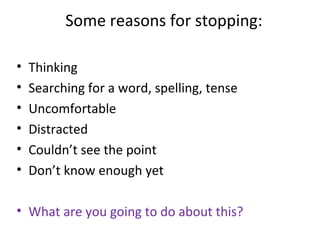
Some reasons for stopping:
•
•
•
•
•
•

Thinking
Searching for a word, spelling, tense
Uncomfortable
Distracted
Couldn’t see the point
Don’t know enough yet

• What are you going to do about this?
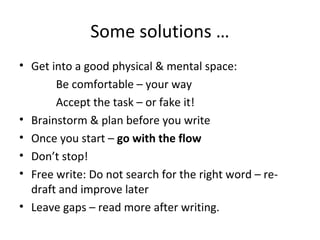
Some solutions …
• Get into a good physical & mental space:
Be comfortable – your way
Accept the task – or fake it!
• Brainstorm & plan before you write
• Once you start – go with the flow
• Don’t stop!
• Free write: Do not search for the right word – redraft and improve later
• Leave gaps – read more after writing.
Reflection (3)
• What do you like about your own academic
writing practices?
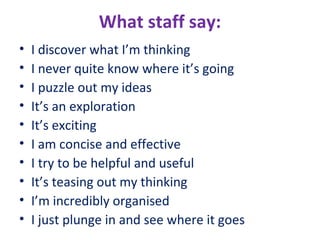
What staff say:
•
•
•
•
•
•
•
•
•
•

I discover what I’m thinking
I never quite know where it’s going
I puzzle out my ideas
It’s an exploration
It’s exciting
I am concise and effective
I try to be helpful and useful
It’s teasing out my thinking
I’m incredibly organised
I just plunge in and see where it goes
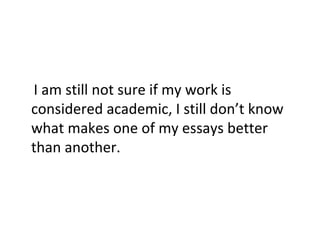
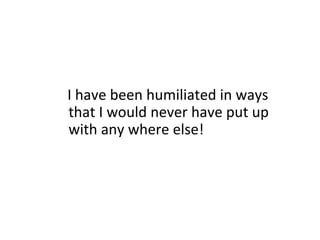
What UG students say:
I am still not sure if my work is
considered academic, I still don’t know
what makes one of my essays better
than another.
I have been humiliated in ways
that I would never have put up
with any where else!
Academic language, the kind of language that
doesn’t readily flow off my tongue: the type of
language I rarely use when speaking to my
peers. The type of language that I don’t
readily understand and the type of language
that means spending hours at a computer
turning something quite simple into
something that sounds moderately impressive
with elitist results.
Can we get you to feel more
positive?
Safe spaces to write
Things to think about:
• We treat writing differently… If it were sport
or driving or cooking...
• Process not product
• Craft not perfect
• Practise, practise, practise…
Free Writing
• Peter Elbow (1998) argues that free-writing
encourages us to write at length without fear
of censorship ...
• Frees us to explore a topic
• Encourages understanding
• Focusses on having something to say - with
• Spelling & grammar (3 min) ... The least
important part
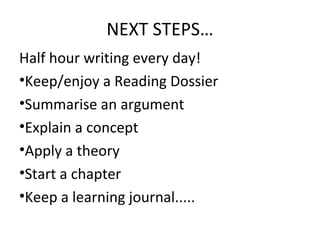
NEXT STEPS…
Half hour writing every day!
•Keep/enjoy a Reading Dossier
•Summarise an argument
•Explain a concept
•Apply a theory
•Start a chapter
•Keep a learning journal.....
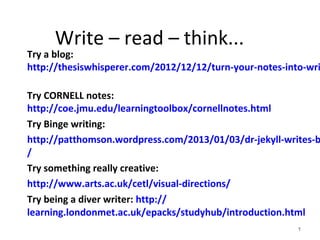
Write – read – think...

Try a blog:
http://thesiswhisperer.com/2012/12/12/turn-your-notes-into-wri

Try CORNELL notes:
http://coe.jmu.edu/learningtoolbox/cornellnotes.html
Try Binge writing:
http://patthomson.wordpress.com/2013/01/03/dr-jekyll-writes-b
/
Try something really creative:
http://www.arts.ac.uk/cetl/visual-directions/
Try being a diver writer: http://
learning.londonmet.ac.uk/epacks/studyhub/introduction.html
1
•
•
•
•
•
•
•
•
•
•
•
•
•

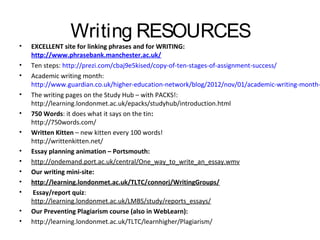
Writing RESOURCES

EXCELLENT site for linking phrases and for WRITING:
http://www.phrasebank.manchester.ac.uk/
Ten steps: http://prezi.com/cbaj9e5kised/copy-of-ten-stages-of-assignment-success/
Academic writing month:
http://www.guardian.co.uk/higher-education-network/blog/2012/nov/01/academic-writing-monthThe writing pages on the Study Hub – with PACKS!:
http://learning.londonmet.ac.uk/epacks/studyhub/introduction.html
750 Words: it does what it says on the tin:
http://750words.com/
Written Kitten – new kitten every 100 words!
http://writtenkitten.net/
Essay planning animation – Portsmouth:
http://ondemand.port.ac.uk/central/One_way_to_write_an_essay.wmv
Our writing mini-site:
http://learning.londonmet.ac.uk/TLTC/connorj/WritingGroups/
Essay/report quiz:
http://learning.londonmet.ac.uk/LMBS/study/reports_essays/
Our Preventing Plagiarism course (also in WebLearn):
http://learning.londonmet.ac.uk/TLTC/learnhigher/Plagiarism/

Becoming w6 academic_writing#1 Starts with Academic Writing workshop

  • 1.
    Writing WORKSHOP Writing iseasy – you just stare at a blank piece of paper till your eyeballs bleed!
  • 2.
    Brainstorm • What areyour hopes and fears about University level writing?
  • 3.
    Writing WORKSHOP • • • • • Writing activity Reflectingon the activity What we can do ... Next steps Useful resources
  • 4.
    Writing Activity Free writing Eachperson should have in front of them: • Two sheets of paper: • One, ‘Writing’ - blank, to write upon, • Two, ‘Commentary’ - to note reasons for not writing • Pens or pencils
  • 5.
    The Activity • Whenasked, turn to your ‘Writing’ page and write for ten minutes without pause on the question on the next slide. • If you stop writing for any reason, write that reason, no matter how trivial or insignificant on the ‘Commentary’ sheet.
  • 6.
    Now for tenminutes write on: Winnicott (1971) argued that play is necessary to counteract the implicit threat that occurs when we are in transitional spaces – between worlds, between classes, in alien educational settings. Discuss in relation either to becoming a successful student or becoming a successful teacher.
  • 7.
    Reflection (1) Whatwas your reaction to that writing?
  • 8.
    Reflection (2) Whydid you STOP writing?
  • 9.
    Some reasons forstopping: • • • • • • Thinking Searching for a word, spelling, tense Uncomfortable Distracted Couldn’t see the point Don’t know enough yet • What are you going to do about this?
  • 10.
    Some solutions … •Get into a good physical & mental space: Be comfortable – your way Accept the task – or fake it! • Brainstorm & plan before you write • Once you start – go with the flow • Don’t stop! • Free write: Do not search for the right word – redraft and improve later • Leave gaps – read more after writing.
  • 11.
    Reflection (3) • Whatdo you like about your own academic writing practices?
  • 12.
    What staff say: • • • • • • • • • • Idiscover what I’m thinking I never quite know where it’s going I puzzle out my ideas It’s an exploration It’s exciting I am concise and effective I try to be helpful and useful It’s teasing out my thinking I’m incredibly organised I just plunge in and see where it goes
  • 13.
  • 14.
    I am stillnot sure if my work is considered academic, I still don’t know what makes one of my essays better than another.
  • 15.
    I have beenhumiliated in ways that I would never have put up with any where else!
  • 16.
    Academic language, thekind of language that doesn’t readily flow off my tongue: the type of language I rarely use when speaking to my peers. The type of language that I don’t readily understand and the type of language that means spending hours at a computer turning something quite simple into something that sounds moderately impressive with elitist results.
  • 17.
    Can we getyou to feel more positive?
  • 18.
    Safe spaces towrite Things to think about: • We treat writing differently… If it were sport or driving or cooking... • Process not product • Craft not perfect • Practise, practise, practise…
  • 19.
    Free Writing • PeterElbow (1998) argues that free-writing encourages us to write at length without fear of censorship ... • Frees us to explore a topic • Encourages understanding • Focusses on having something to say - with • Spelling & grammar (3 min) ... The least important part
  • 20.
    NEXT STEPS… Half hourwriting every day! •Keep/enjoy a Reading Dossier •Summarise an argument •Explain a concept •Apply a theory •Start a chapter •Keep a learning journal.....
  • 21.
    Write – read– think... Try a blog: http://thesiswhisperer.com/2012/12/12/turn-your-notes-into-wri Try CORNELL notes: http://coe.jmu.edu/learningtoolbox/cornellnotes.html Try Binge writing: http://patthomson.wordpress.com/2013/01/03/dr-jekyll-writes-b / Try something really creative: http://www.arts.ac.uk/cetl/visual-directions/ Try being a diver writer: http:// learning.londonmet.ac.uk/epacks/studyhub/introduction.html 1
  • 22.
    • • • • • • • • • • • • • Writing RESOURCES EXCELLENT sitefor linking phrases and for WRITING: http://www.phrasebank.manchester.ac.uk/ Ten steps: http://prezi.com/cbaj9e5kised/copy-of-ten-stages-of-assignment-success/ Academic writing month: http://www.guardian.co.uk/higher-education-network/blog/2012/nov/01/academic-writing-monthThe writing pages on the Study Hub – with PACKS!: http://learning.londonmet.ac.uk/epacks/studyhub/introduction.html 750 Words: it does what it says on the tin: http://750words.com/ Written Kitten – new kitten every 100 words! http://writtenkitten.net/ Essay planning animation – Portsmouth: http://ondemand.port.ac.uk/central/One_way_to_write_an_essay.wmv Our writing mini-site: http://learning.londonmet.ac.uk/TLTC/connorj/WritingGroups/ Essay/report quiz: http://learning.londonmet.ac.uk/LMBS/study/reports_essays/ Our Preventing Plagiarism course (also in WebLearn): http://learning.londonmet.ac.uk/TLTC/learnhigher/Plagiarism/