Process Writing
for Composition Success


       by Susan Joyce Du Bosque &
           Gabriela Gaione Catepón
About us and the topic we
      chose:
 Susan Joyce, American, published author-book
  writer, publisher for

  “ Information
+ Imagination
_______________________
GREAT CREATION”

 Gabriela Gaione, Uruguayan, EFL teacher, amateur
  writer

 “Writing comes from the soul”
Why improve writing in EFL?


 Evidence indicates that Ss are not getting good results
  in the writing skill- hence INSPECCIÓN de INGLÉS
  suggested this topic was critical this year

 It is a requirement in all EFL syllabi

 It is an academic and social need

 It is a market labor need

 It is an integral part of a whole education
A bit of history: The Rise of Literacy-

 Domination of history over myth
 The distinction between the natural and the supernatural
 Ability to store and access greater amounts of knowledge
 The creation of abstract logical deduction
 The ability to analyze language itself as an object
 The awareness of the individual as distinct from the group and
  consequently the need for private introspection
 The rise of critical skepticism towards previously reified
  knowledge and beliefs.
           The rise of democratic institutions- Greek city states

Adapted from Goody and Watt (in Grabe and Kaplan 1996 )
Writing
 Identifies
Writing
 identifies,
 communicates
 and
 reminds


            http://www.flickr.com/photos/henrybloomfield/5695330591/sizes/o/in/photostream/
Writing
 Communicates and reminds
Writing
 Satisfies a requirement
Writing
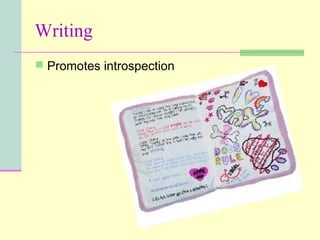
 Promotes introspection
Writing
 Communicates, recombines and allows
 introspection
Writing
 May exemplify what is known as aesthetic
  creativity
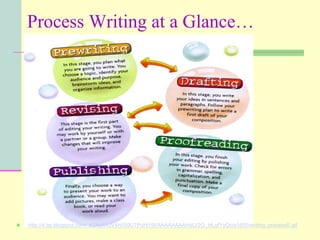
Process Writing at a Glance…


   http://4.bp.blogspot.com/_kZAaX4JV4nI/S9U7PqHi19I/AAAAAAAAHdU/2G_HLgfYyQc/s1600/writing_processS.gif
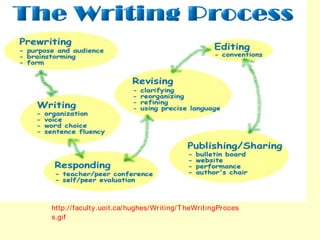
 http://faculty.uoit.ca/hughes/Writing/TheWriting
  Process.gif


     http:// faculty .uoit.ca/ hughes/ Wr iting/T heWritingProces
     s.gif
 Source: http://www.monash.edu.au/lls/llonline/assets/images/writing/art-
   design/writing-skills.jpg
Grabe and Kaplan –(page 3)
Audience      Writing         Writing with composing
              without
              composing
                              For              For
                              knowledge        knowledge
                              telling          transforming
self          Shopping list   Personal diary   Journal entry
One known     Note to
other         milkman
One unknown                   Business
other                         letter
Small group                   Lesson plan
unknown                       sermon
Small group   questionnaire   Newsletter       proposal
unknown                       item
Large group   Tax form
              Driving
              licence
              Application                      Poem drama
              form                             novel short
                                               story
P 38 Grabe and Kaplan
Some questions to reflect upon:
 What is a text?
 How may texts be examined as product?
 How may texts be analyzed as process?
 How may product and process be viewed as
  reflecting an Interactive model?
 How do process and product issues embed
  themselves within a coherent interpretation of wider
  social contexts for writing?
 What types of texts do we want learners to produce?
 What do these issues suggest for writing instruction
  in the classroom?
Ethnographic Research on elementary
school writing
by Calkins, Graves and others
   writing should be seen as a process of discovery---- problem solving
   drawing and talking are means for pre-writing a rehearsal
   internalize their conversations to the point where they do not simply write down
    what they say
   move from writing for themselves to writing for others
   learn to spend time planning pre-writing and rehearsing activities
   serious revision about themselves by conferencing with teachers about their
    writing
   students learn that they need to have control over their writing
   since schools do not create student motivation and involvement teachers need
    to generate a commitment to writing – involved and motivated to write and
    teachers need to practice writing in class and to share their writing with children-
   teachers need to have control over their classrooms and become active teacher/
    researchers with respect to their own practice.
   Sentence combining does lead to writing improvement to some extent ---
    Beaugrande 1984 Hillocks 1986
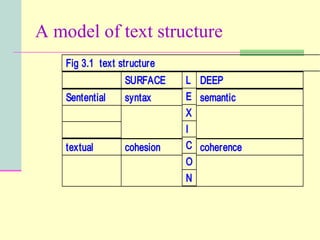
A model of text structure
    Fig 3.1 text structure
                  SURFACE    L DEEP
    Sentential    syntax     E semantic
                             X
                             I
    textual       cohesion   C coherence
                             O
                             N
P79 Non linguistic knowledge
 reference
 world background knowledge
 memory
 emotion
 perception
 intention
 logical arrangement
 situation
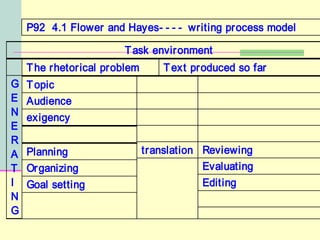
P92 4.1 Flower and Hayes- - - - writing process model

                        T ask envir onment
    T he rhetor ical problem       T ext pr oduced so far
G   T opic
E   Audience
N
    exigency
E
R
A   Planning                   translation Reviewing
T   Or ganizing                            Evaluating
I   Goal setting                           Editing
N
G
ABC brainstorm- link – list -combine
Order, edit and proof-read
Bibliography & LINKS
 Grabe, W. & Kaplan, R.B. Theory and Practice of Writing- An Applied
  Linguistics Perspective -1996 -Longman
 Scarpa, S. Cursos de Sensibilización para Docentes del Plan 1996
  Febrero Marzo 2001- Cuadernos de la ANEP
 Tribble, C. Writing 1996 Oxford University Press -

 Ur, P.A Course in Language Teaching 1999 Cambridge University
  Press


http://www.flickr.com/
http://faculty.uoit.ca/hughes/Writing/TheWritingProcess.g

http://www.flickr.com/photos/henrybloomfield/5695330591/sizes/o/in/photostrea

Process Writing for Composition Success in EFL

  • 1.
    Process Writing for CompositionSuccess by Susan Joyce Du Bosque & Gabriela Gaione Catepón
  • 2.
    About us andthe topic we chose:  Susan Joyce, American, published author-book writer, publisher for “ Information + Imagination _______________________ GREAT CREATION”  Gabriela Gaione, Uruguayan, EFL teacher, amateur writer  “Writing comes from the soul”
  • 4.
    Why improve writingin EFL?  Evidence indicates that Ss are not getting good results in the writing skill- hence INSPECCIÓN de INGLÉS suggested this topic was critical this year  It is a requirement in all EFL syllabi  It is an academic and social need  It is a market labor need  It is an integral part of a whole education
  • 5.
    A bit ofhistory: The Rise of Literacy-  Domination of history over myth  The distinction between the natural and the supernatural  Ability to store and access greater amounts of knowledge  The creation of abstract logical deduction  The ability to analyze language itself as an object  The awareness of the individual as distinct from the group and consequently the need for private introspection  The rise of critical skepticism towards previously reified knowledge and beliefs.  The rise of democratic institutions- Greek city states Adapted from Goody and Watt (in Grabe and Kaplan 1996 )
  • 6.
  • 7.
    Writing  identifies,  communicates and  reminds http://www.flickr.com/photos/henrybloomfield/5695330591/sizes/o/in/photostream/
  • 8.
  • 9.
  • 10.
  • 11.
    Writing  Communicates, recombinesand allows introspection
  • 12.
    Writing  May exemplifywhat is known as aesthetic creativity
  • 13.
    Process Writing ata Glance…  http://4.bp.blogspot.com/_kZAaX4JV4nI/S9U7PqHi19I/AAAAAAAAHdU/2G_HLgfYyQc/s1600/writing_processS.gif
  • 14.
     http://faculty.uoit.ca/hughes/Writing/TheWriting Process.gif http:// faculty .uoit.ca/ hughes/ Wr iting/T heWritingProces s.gif
  • 15.
  • 16.
    Grabe and Kaplan–(page 3) Audience Writing Writing with composing without composing For For knowledge knowledge telling transforming self Shopping list Personal diary Journal entry One known Note to other milkman One unknown Business other letter Small group Lesson plan unknown sermon Small group questionnaire Newsletter proposal unknown item Large group Tax form Driving licence Application Poem drama form novel short story
  • 17.
    P 38 Grabeand Kaplan Some questions to reflect upon:  What is a text?  How may texts be examined as product?  How may texts be analyzed as process?  How may product and process be viewed as reflecting an Interactive model?  How do process and product issues embed themselves within a coherent interpretation of wider social contexts for writing?  What types of texts do we want learners to produce?  What do these issues suggest for writing instruction in the classroom?
  • 18.
    Ethnographic Research onelementary school writing by Calkins, Graves and others  writing should be seen as a process of discovery---- problem solving  drawing and talking are means for pre-writing a rehearsal  internalize their conversations to the point where they do not simply write down what they say  move from writing for themselves to writing for others  learn to spend time planning pre-writing and rehearsing activities  serious revision about themselves by conferencing with teachers about their writing  students learn that they need to have control over their writing  since schools do not create student motivation and involvement teachers need to generate a commitment to writing – involved and motivated to write and teachers need to practice writing in class and to share their writing with children-  teachers need to have control over their classrooms and become active teacher/ researchers with respect to their own practice.  Sentence combining does lead to writing improvement to some extent --- Beaugrande 1984 Hillocks 1986
  • 19.
    A model oftext structure Fig 3.1 text structure SURFACE L DEEP Sentential syntax E semantic X I textual cohesion C coherence O N
  • 20.
    P79 Non linguisticknowledge  reference  world background knowledge  memory  emotion  perception  intention  logical arrangement  situation
  • 21.
    P92 4.1 Flowerand Hayes- - - - writing process model T ask envir onment T he rhetor ical problem T ext pr oduced so far G T opic E Audience N exigency E R A Planning translation Reviewing T Or ganizing Evaluating I Goal setting Editing N G
  • 22.
    ABC brainstorm- link– list -combine
  • 23.
    Order, edit andproof-read
  • 26.
    Bibliography & LINKS Grabe, W. & Kaplan, R.B. Theory and Practice of Writing- An Applied Linguistics Perspective -1996 -Longman  Scarpa, S. Cursos de Sensibilización para Docentes del Plan 1996 Febrero Marzo 2001- Cuadernos de la ANEP  Tribble, C. Writing 1996 Oxford University Press -  Ur, P.A Course in Language Teaching 1999 Cambridge University Press http://www.flickr.com/ http://faculty.uoit.ca/hughes/Writing/TheWritingProcess.g http://www.flickr.com/photos/henrybloomfield/5695330591/sizes/o/in/photostrea