What have we learned about faults from
three decades of Tectonic InSAR?
Tim J Wright
COMET, University of Leeds, European Union
@NERC_COMET
@timwright_leeds
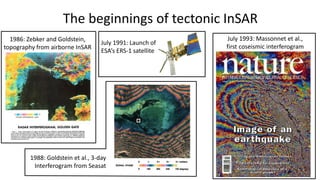
The beginnings of tectonic InSAR
July 1993: Massonnet et al.,
first coseismic interferogram
July 1991: Launch of
ESA’s ERS-1 satellite
1988: Goldstein et al., 3-day
Interferogram from Seasat
1986: Zebker and Goldstein,
topography from airborne InSAR
The beginnings of tectonic InSAR
July 1993: Massonnet et al.,
first coseismic interferogram
July 1991: Launch of
ESA’s ERS-1 satellite
1988: Goldstein et al., 3-day
Interferogram from Seasat
1986: Zebker and Goldstein,
topography from airborne InSAR
Athens, September 1997What has Tectonic InSAR done for us?
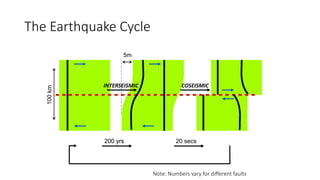
The Earthquake Cycle
200 yrs 20 secs
100km
200 yrs
5m
Note: Numbers vary for different faults
COSEISMICINTERSEISMIC
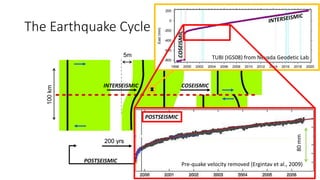
The Earthquake Cycle
200 yrs 20 secs
100km
200 yrs
5m
Note: Numbers vary for different faults
COSEISMIC
TUBI (IGS08) from Nevada Geodetic Lab
80mm
Pre-quake velocity removed (Ergintav et al., 2009)
POSTSEISMIC
COSEISMICINTERSEISMIC
POSTSEISMIC
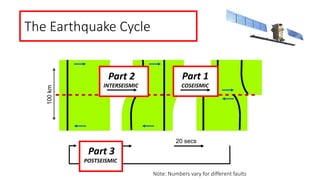
The Earthquake Cycle
20 secs
100km
Note: Numbers vary for different faults
COSEISMICINTERSEISMIC
POSTSEISMIC
Part 1
Part 3
Part 2
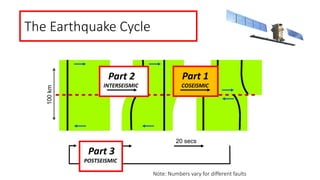
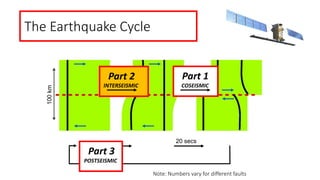
The Earthquake Cycle
20 secs
100km
Note: Numbers vary for different faults
COSEISMICINTERSEISMIC
POSTSEISMIC
Part 1
Part 3
Part 2
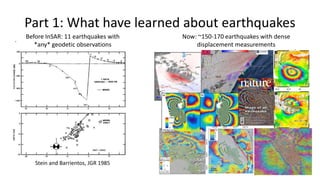
Part 1: What have learned about earthquakes
.
Before InSAR: 11 earthquakes with
*any* geodetic observations
Now: ~150-170 earthquakes with dense
displacement measurements
Stein and Barrientos, JGR 1985
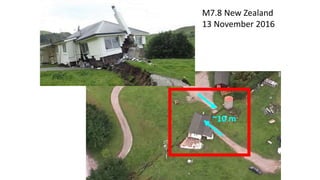
~10 m
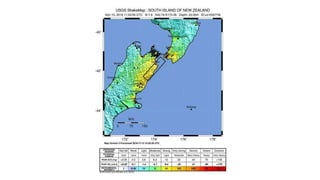
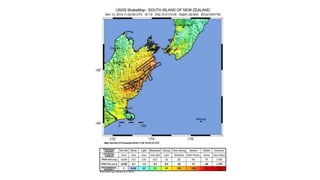
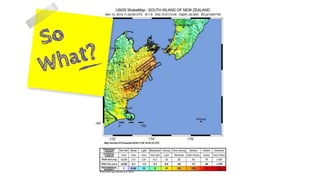
M7.8 New Zealand
13 November 2016
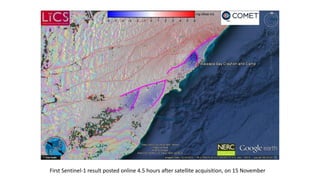
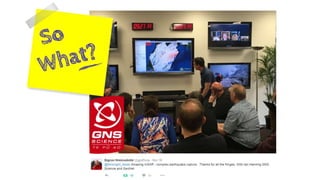
First Sentinel-1 result posted online 4.5 hours after satellite acquisition, on 15 November
100 km
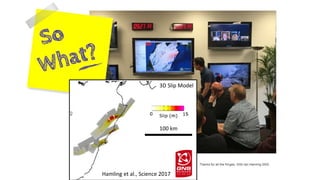
3D Slip Model
Hamling et al., Science 2017
100 km
3D Slip Model
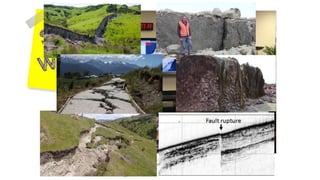
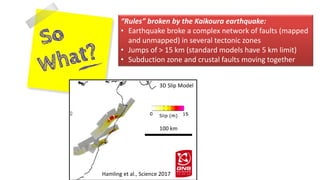
“Rules” broken by the Kaikoura earthquake:
• Earthquake broke a complex network of faults (mapped
and unmapped) in several tectonic zones
• Jumps of > 15 km (standard models have 5 km limit)
• Subduction zone and crustal faults moving together
Hamling et al., Science 2017
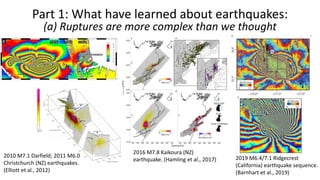
Part 1: What have learned about earthquakes:
(a) Ruptures are more complex than we thought
2016 M7.8 Kaikoura (NZ)
earthquake. (Hamling et al., 2017) 2019 M6.4/7.1 Ridgecrest
(California) earthquake sequence.
(Barnhart et al., 2019)
2010 M7.1 Darfield; 2011 M6.0
Christchurch (NZ) earthquakes.
(Elliott et al., 2012)
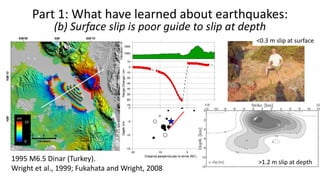
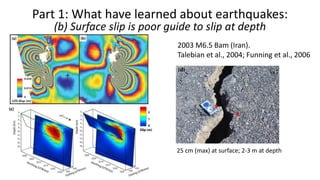
Part 1: What have learned about earthquakes:
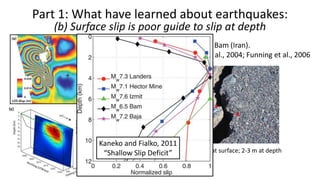
(b) Surface slip is poor guide to slip at depth
10
0
cm
1995 M6.5 Dinar (Turkey).
Wright et al., 1999; Fukahata and Wright, 2008
>1.2 m slip at depth
<0.3 m slip at surface
2003 M6.5 Bam (Iran).
Talebian et al., 2004; Funning et al., 2006
25 cm (max) at surface; 2-3 m at depth
Part 1: What have learned about earthquakes:
(b) Surface slip is poor guide to slip at depth
2003 M6.5 Bam (Iran).
Talebian et al., 2004; Funning et al., 2006
25 cm (max) at surface; 2-3 m at depth
Kaneko and Fialko, 2011
“Shallow Slip Deficit”
Part 1: What have learned about earthquakes:
(b) Surface slip is poor guide to slip at depth
Part 1: What have learned about earthquakes:
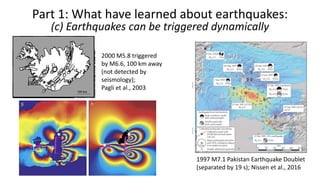
(c) Earthquakes can be triggered dynamically
1997 M7.1 Pakistan Earthquake Doublet
(separated by 19 s); Nissen et al., 2016
2000 M5.8 triggered
by M6.6, 100 km away
(not detected by
seismology);
Pagli et al., 2003
Part 1: What have learned about earthquakes:
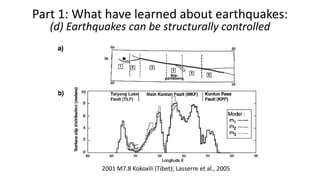
(d) Earthquakes can be structurally controlled
2001 M7.8 Kokoxili (Tibet); Lasserre et al., 2005
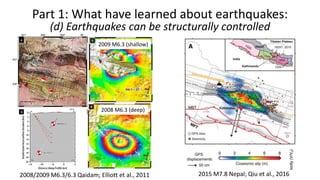
2015 M7.8 Nepal; Qiu et al., 20162008/2009 M6.3/6.3 Qaidam; Elliott et al., 2011
2009 M6.3 (shallow)
2008 M6.3 (deep)
Part 1: What have learned about earthquakes:
(d) Earthquakes can be structurally controlled
The Earthquake Cycle
20 secs
100km
Note: Numbers vary for different faults
COSEISMICINTERSEISMIC
POSTSEISMIC
Part 1
Part 3
Part 2
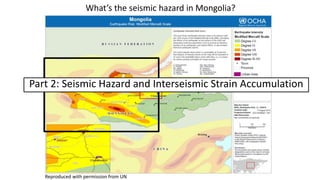
Reproduced with permission from UN
Part 2: Seismic Hazard and Interseismic Strain Accumulation
What’s the seismic hazard in Mongolia?
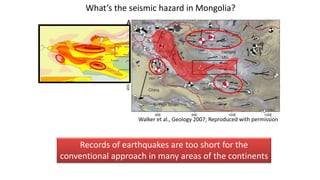
Walker et al., Geology 2007; Reproduced with permission
What’s the seismic hazard in Mongolia?
Records of earthquakes are too short for the
conventional approach in many areas of the continents
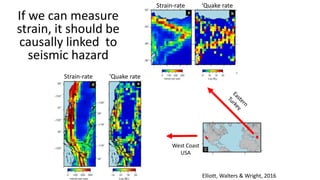
If we can measure
strain, it should be
causally linked to
seismic hazard
West Coast
USA
Strain-rate ‘Quake rate
Elliott, Walters & Wright, 2016
Strain-rate ‘Quake rate
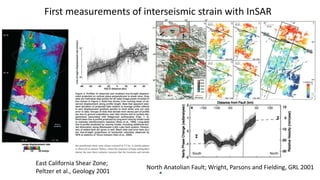
First measurements of interseismic strain with InSAR
North Anatolian Fault; Wright, Parsons and Fielding, GRL 2001
East California Shear Zone;
Peltzer et al., Geology 2001
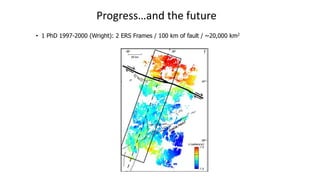
• 1 PhD 1997-2000 (Wright): 2 ERS Frames / 100 km of fault / ~20,000 km2
Progress…and the future
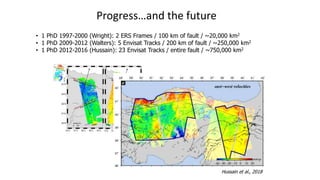
• 1 PhD 1997-2000 (Wright): 2 ERS Frames / 100 km of fault / ~20,000 km2
• 1 PhD 2009-2012 (Walters): 5 Envisat Tracks / 200 km of fault / ~250,000 km2
• 1 PhD 2012-2016 (Hussain): 23 Envisat Tracks / entire fault / ~750,000 km2
Hussain et al., 2018
Progress…and the future
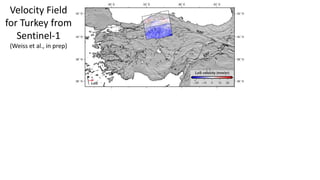
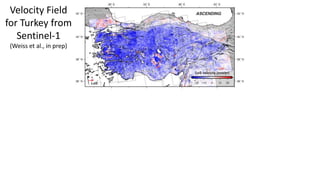
Velocity Field
for Turkey from
Sentinel-1
(Weiss et al., in prep)
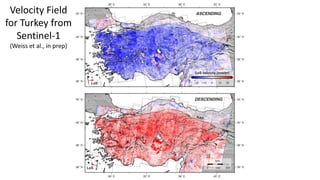
Velocity Field
for Turkey from
Sentinel-1
(Weiss et al., in prep)
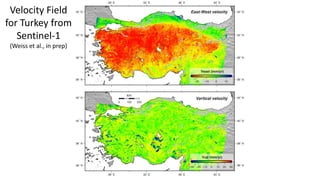
Velocity Field
for Turkey from
Sentinel-1
(Weiss et al., in prep)
Velocity Field
for Turkey from
Sentinel-1
(Weiss et al., in prep)
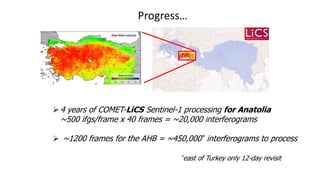
4 years of COMET-LiCS Sentinel-1 processing for Anatolia
~500 ifgs/frame x 40 frames = ~20,000 interferograms
 ~1200 frames for the AHB = ~450,000* interferograms to process
*east of Turkey only 12-day revisit
Progress…
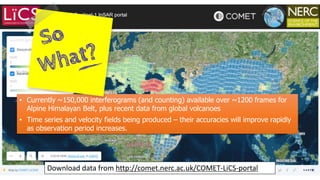
Download data from http://comet.nerc.ac.uk/COMET-LiCS-portal
• Currently ~150,000 interferograms (and counting) available over ~1200 frames for
Alpine Himalayan Belt, plus recent data from global volcanoes
• Time series and velocity fields being produced – their accuracies will improve rapidly
as observation period increases.
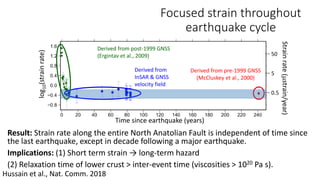
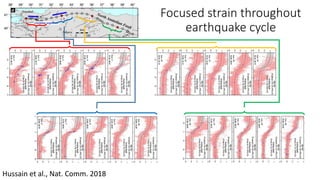
Focused strain throughout
earthquake cycle
Hussain et al., Nat. Comm. 2018
Focused strain throughout
earthquake cycle
Hussain et al., Nat. Comm. 2018
Time since earthquake (years)
log10(strainrate)
Derived from
InSAR & GNSS
velocity field
Derived from pre-1999 GNSS
(McCluskey et al., 2000)
Derived from post-1999 GNSS
(Ergintav et al., 2009)
0.5
Strainrate(mstrain/year)
5
50
Result: Strain rate along the entire North Anatolian Fault is independent of time since
the last earthquake, except in decade following a major earthquake.
Implications: (1) Short term strain → long-term hazard
(2) Relaxation time of lower crust > inter-event time (viscosities > 1020 Pa s).
Xianshuihe
Karakoram
ATF
Hunter
Mountain
Haiyuan
Zagros–Makran
Khazar
NAF
DSF
Alps
Alpine
SISZ
Fairweather & Denali
SAF
Imperial
Saging
Sumatra
Tierra del Fuego
Husavik Flatey
EVZ
Yammouneh
Carmel
PMF
Riganpei Co
Manyi
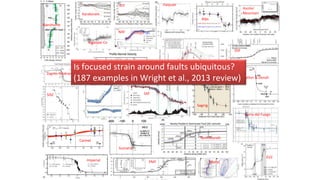
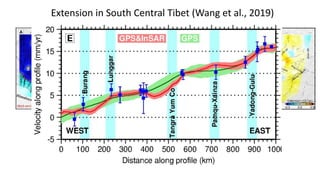
Is focused strain around faults ubiquitous?
(187 examples in Wright et al., 2013 review)
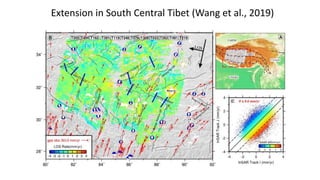
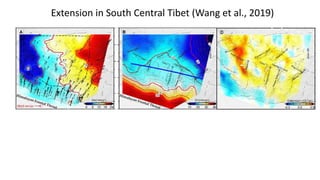
Extension in South Central Tibet (Wang et al., 2019)
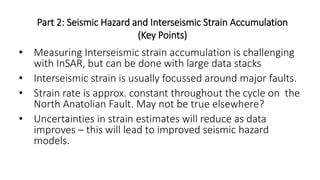
Part 2: Seismic Hazard and Interseismic Strain Accumulation
(Key Points)
• Measuring Interseismic strain accumulation is challenging
with InSAR, but can be done with large data stacks
• Interseismic strain is usually focussed around major faults.
• Strain rate is approx. constant throughout the cycle on the
North Anatolian Fault. May not be true elsewhere?
• Uncertainties in strain estimates will reduce as data
improves – this will lead to improved seismic hazard
models.
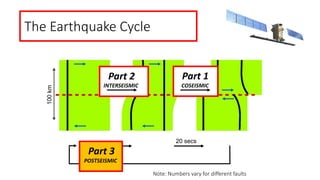
The Earthquake Cycle
20 secs
100km
Note: Numbers vary for different faults
COSEISMICINTERSEISMIC
POSTSEISMIC
Part 1
Part 3
Part 2
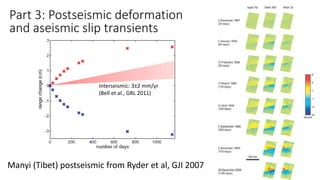
Part 3: Postseismic deformation
and aseismic slip transients
Manyi (Tibet) postseismic from Ryder et al, GJI 2007
Interseismic: 3±2 mm/yr
(Bell et al., GRL 2011)
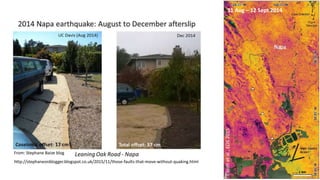
From: Stephane Baize blog
Elliottetal.,EOS2015
31 Aug – 12 Sept 2014
http://stephaneonblogger.blogspot.co.uk/2015/11/those-faults-that-move-without-quaking.html
Elliottetal.,EOS2015
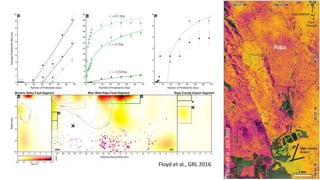
Floyd et al., GRL 2016
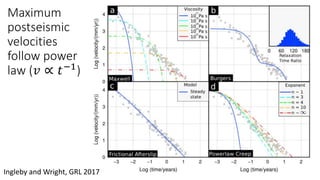
Maximum
postseismic
velocities
follow power
law (𝑣 ∝ 𝑡−1
)
Ingleby and Wright, GRL 2017
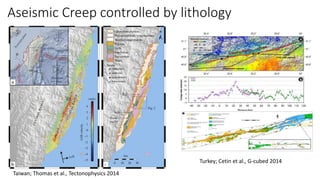
Aseismic Creep controlled by lithology
Taiwan; Thomas et al., Tectonophysics 2014
Turkey; Cetin et al., G-cubed 2014
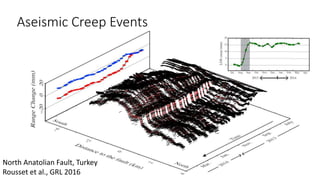
Aseismic Creep Events
North Anatolian Fault, Turkey
Rousset et al., GRL 2016
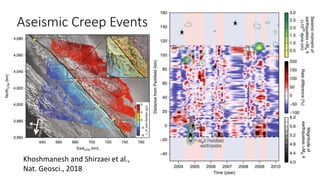
Aseismic Creep Events
Khoshmanesh and Shirzaei et al.,
Nat. Geosci., 2018
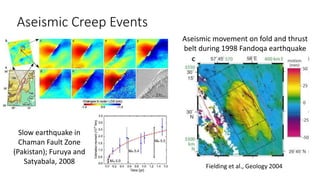
Aseismic Creep Events
Slow earthquake in
Chaman Fault Zone
(Pakistan); Furuya and
Satyabala, 2008
Aseismic movement on fold and thrust
belt during 1998 Fandoqa earthquake
Fielding et al., Geology 2004
Part 3: Postseismic deformation and aseismic slip transients
(key points)
• Details of postseismic transient behaviour can be
spatially complex
• But overall, postseismic deformation may be
remarkably simple: 𝑣 ∝ 𝑡−1
• InSAR has helped identify a range of aseismic
creep behaviour including time-varying shallow
creep, slow earthquakes and triggered slip.
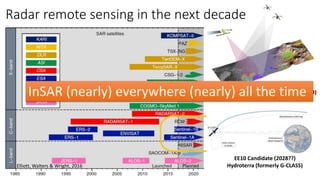
EE10 Candidate (2028??)
Harmony (formerly STEREOID)
Radar remote sensing in the next decade
Freeand
OpenData!
EE10 Candidate (2028??)
Hydroterra (formerly G-CLASS)
InSAR (nearly) everywhere (nearly) all the time
Elliott, Walters & Wright, 2016
Big Unsolved Questions in (Continental) Tectonics
How can we link short-term earthquake-cycle deformation with long-term tectonics?
How can we incorporate strain estimates in seismic hazard models?
What causes time-varying deformation?
What are the dynamics of continental tectonics?
How does fault friction vary in space and time, and how is it controlled by geology?
What is the role of fluids in fault zones?
What do the deep roots of faults look like and do they control what we see at the surface?
How does magmatism influence tectonics?
…?
Take Home Messages
Tectonic InSAR is living up to the potential identified by early pioneers.
Earthquakes continue to surprise us and we continue to learn from them
Measuring slow, long-wavelength deformation is more challenging but data
from long-duration missions like Sentinel-1 will lead to exciting new discoveries
Trans-national partnerships, collaborations, discussions essential for success
@NERC_COMET
@timwright_leeds
With thanks to colleagues in NERC COMET

Wright mdis2019 shared

  • 1.
    What have welearned about faults from three decades of Tectonic InSAR? Tim J Wright COMET, University of Leeds, European Union @NERC_COMET @timwright_leeds
  • 2.
    The beginnings oftectonic InSAR July 1993: Massonnet et al., first coseismic interferogram July 1991: Launch of ESA’s ERS-1 satellite 1988: Goldstein et al., 3-day Interferogram from Seasat 1986: Zebker and Goldstein, topography from airborne InSAR
  • 3.
    The beginnings oftectonic InSAR July 1993: Massonnet et al., first coseismic interferogram July 1991: Launch of ESA’s ERS-1 satellite 1988: Goldstein et al., 3-day Interferogram from Seasat 1986: Zebker and Goldstein, topography from airborne InSAR Athens, September 1997What has Tectonic InSAR done for us?
  • 4.
    The Earthquake Cycle 200yrs 20 secs 100km 200 yrs 5m Note: Numbers vary for different faults COSEISMICINTERSEISMIC
  • 5.
    The Earthquake Cycle 200yrs 20 secs 100km 200 yrs 5m Note: Numbers vary for different faults COSEISMIC TUBI (IGS08) from Nevada Geodetic Lab 80mm Pre-quake velocity removed (Ergintav et al., 2009) POSTSEISMIC COSEISMICINTERSEISMIC POSTSEISMIC
  • 6.
    The Earthquake Cycle 20secs 100km Note: Numbers vary for different faults COSEISMICINTERSEISMIC POSTSEISMIC Part 1 Part 3 Part 2
  • 7.
    The Earthquake Cycle 20secs 100km Note: Numbers vary for different faults COSEISMICINTERSEISMIC POSTSEISMIC Part 1 Part 3 Part 2
  • 8.
    Part 1: Whathave learned about earthquakes . Before InSAR: 11 earthquakes with *any* geodetic observations Now: ~150-170 earthquakes with dense displacement measurements Stein and Barrientos, JGR 1985
  • 9.
    ~10 m M7.8 NewZealand 13 November 2016
  • 11.
    First Sentinel-1 resultposted online 4.5 hours after satellite acquisition, on 15 November
  • 16.
    100 km 3D SlipModel Hamling et al., Science 2017
  • 17.
    100 km 3D SlipModel “Rules” broken by the Kaikoura earthquake: • Earthquake broke a complex network of faults (mapped and unmapped) in several tectonic zones • Jumps of > 15 km (standard models have 5 km limit) • Subduction zone and crustal faults moving together Hamling et al., Science 2017
  • 18.
    Part 1: Whathave learned about earthquakes: (a) Ruptures are more complex than we thought 2016 M7.8 Kaikoura (NZ) earthquake. (Hamling et al., 2017) 2019 M6.4/7.1 Ridgecrest (California) earthquake sequence. (Barnhart et al., 2019) 2010 M7.1 Darfield; 2011 M6.0 Christchurch (NZ) earthquakes. (Elliott et al., 2012)
  • 19.
    Part 1: Whathave learned about earthquakes: (b) Surface slip is poor guide to slip at depth 10 0 cm 1995 M6.5 Dinar (Turkey). Wright et al., 1999; Fukahata and Wright, 2008 >1.2 m slip at depth <0.3 m slip at surface
  • 20.
    2003 M6.5 Bam(Iran). Talebian et al., 2004; Funning et al., 2006 25 cm (max) at surface; 2-3 m at depth Part 1: What have learned about earthquakes: (b) Surface slip is poor guide to slip at depth
  • 21.
    2003 M6.5 Bam(Iran). Talebian et al., 2004; Funning et al., 2006 25 cm (max) at surface; 2-3 m at depth Kaneko and Fialko, 2011 “Shallow Slip Deficit” Part 1: What have learned about earthquakes: (b) Surface slip is poor guide to slip at depth
  • 22.
    Part 1: Whathave learned about earthquakes: (c) Earthquakes can be triggered dynamically 1997 M7.1 Pakistan Earthquake Doublet (separated by 19 s); Nissen et al., 2016 2000 M5.8 triggered by M6.6, 100 km away (not detected by seismology); Pagli et al., 2003
  • 23.
    Part 1: Whathave learned about earthquakes: (d) Earthquakes can be structurally controlled 2001 M7.8 Kokoxili (Tibet); Lasserre et al., 2005
  • 24.
    2015 M7.8 Nepal;Qiu et al., 20162008/2009 M6.3/6.3 Qaidam; Elliott et al., 2011 2009 M6.3 (shallow) 2008 M6.3 (deep) Part 1: What have learned about earthquakes: (d) Earthquakes can be structurally controlled
  • 25.
    The Earthquake Cycle 20secs 100km Note: Numbers vary for different faults COSEISMICINTERSEISMIC POSTSEISMIC Part 1 Part 3 Part 2
  • 26.
    Reproduced with permissionfrom UN Part 2: Seismic Hazard and Interseismic Strain Accumulation What’s the seismic hazard in Mongolia?
  • 27.
    Walker et al.,Geology 2007; Reproduced with permission What’s the seismic hazard in Mongolia? Records of earthquakes are too short for the conventional approach in many areas of the continents
  • 28.
    If we canmeasure strain, it should be causally linked to seismic hazard West Coast USA Strain-rate ‘Quake rate Elliott, Walters & Wright, 2016 Strain-rate ‘Quake rate
  • 29.
    First measurements ofinterseismic strain with InSAR North Anatolian Fault; Wright, Parsons and Fielding, GRL 2001 East California Shear Zone; Peltzer et al., Geology 2001
  • 30.
    • 1 PhD1997-2000 (Wright): 2 ERS Frames / 100 km of fault / ~20,000 km2 Progress…and the future
  • 31.
    • 1 PhD1997-2000 (Wright): 2 ERS Frames / 100 km of fault / ~20,000 km2 • 1 PhD 2009-2012 (Walters): 5 Envisat Tracks / 200 km of fault / ~250,000 km2 • 1 PhD 2012-2016 (Hussain): 23 Envisat Tracks / entire fault / ~750,000 km2 Hussain et al., 2018 Progress…and the future
  • 32.
    Velocity Field for Turkeyfrom Sentinel-1 (Weiss et al., in prep)
  • 33.
    Velocity Field for Turkeyfrom Sentinel-1 (Weiss et al., in prep)
  • 34.
    Velocity Field for Turkeyfrom Sentinel-1 (Weiss et al., in prep)
  • 35.
    Velocity Field for Turkeyfrom Sentinel-1 (Weiss et al., in prep)
  • 36.
    4 years ofCOMET-LiCS Sentinel-1 processing for Anatolia ~500 ifgs/frame x 40 frames = ~20,000 interferograms  ~1200 frames for the AHB = ~450,000* interferograms to process *east of Turkey only 12-day revisit Progress…
  • 37.
    Download data fromhttp://comet.nerc.ac.uk/COMET-LiCS-portal • Currently ~150,000 interferograms (and counting) available over ~1200 frames for Alpine Himalayan Belt, plus recent data from global volcanoes • Time series and velocity fields being produced – their accuracies will improve rapidly as observation period increases.
  • 38.
    Focused strain throughout earthquakecycle Hussain et al., Nat. Comm. 2018
  • 39.
    Focused strain throughout earthquakecycle Hussain et al., Nat. Comm. 2018 Time since earthquake (years) log10(strainrate) Derived from InSAR & GNSS velocity field Derived from pre-1999 GNSS (McCluskey et al., 2000) Derived from post-1999 GNSS (Ergintav et al., 2009) 0.5 Strainrate(mstrain/year) 5 50 Result: Strain rate along the entire North Anatolian Fault is independent of time since the last earthquake, except in decade following a major earthquake. Implications: (1) Short term strain → long-term hazard (2) Relaxation time of lower crust > inter-event time (viscosities > 1020 Pa s).
  • 40.
    Xianshuihe Karakoram ATF Hunter Mountain Haiyuan Zagros–Makran Khazar NAF DSF Alps Alpine SISZ Fairweather & Denali SAF Imperial Saging Sumatra Tierradel Fuego Husavik Flatey EVZ Yammouneh Carmel PMF Riganpei Co Manyi Is focused strain around faults ubiquitous? (187 examples in Wright et al., 2013 review)
  • 41.
    Extension in SouthCentral Tibet (Wang et al., 2019)
  • 42.
    Extension in SouthCentral Tibet (Wang et al., 2019)
  • 43.
    Extension in SouthCentral Tibet (Wang et al., 2019)
  • 44.
    Part 2: SeismicHazard and Interseismic Strain Accumulation (Key Points) • Measuring Interseismic strain accumulation is challenging with InSAR, but can be done with large data stacks • Interseismic strain is usually focussed around major faults. • Strain rate is approx. constant throughout the cycle on the North Anatolian Fault. May not be true elsewhere? • Uncertainties in strain estimates will reduce as data improves – this will lead to improved seismic hazard models.
  • 45.
    The Earthquake Cycle 20secs 100km Note: Numbers vary for different faults COSEISMICINTERSEISMIC POSTSEISMIC Part 1 Part 3 Part 2
  • 46.
    Part 3: Postseismicdeformation and aseismic slip transients Manyi (Tibet) postseismic from Ryder et al, GJI 2007 Interseismic: 3±2 mm/yr (Bell et al., GRL 2011)
  • 47.
    From: Stephane Baizeblog Elliottetal.,EOS2015 31 Aug – 12 Sept 2014 http://stephaneonblogger.blogspot.co.uk/2015/11/those-faults-that-move-without-quaking.html
  • 48.
  • 49.
    Maximum postseismic velocities follow power law (𝑣∝ 𝑡−1 ) Ingleby and Wright, GRL 2017
  • 50.
    Aseismic Creep controlledby lithology Taiwan; Thomas et al., Tectonophysics 2014 Turkey; Cetin et al., G-cubed 2014
  • 51.
    Aseismic Creep Events NorthAnatolian Fault, Turkey Rousset et al., GRL 2016
  • 52.
    Aseismic Creep Events Khoshmaneshand Shirzaei et al., Nat. Geosci., 2018
  • 53.
    Aseismic Creep Events Slowearthquake in Chaman Fault Zone (Pakistan); Furuya and Satyabala, 2008 Aseismic movement on fold and thrust belt during 1998 Fandoqa earthquake Fielding et al., Geology 2004
  • 54.
    Part 3: Postseismicdeformation and aseismic slip transients (key points) • Details of postseismic transient behaviour can be spatially complex • But overall, postseismic deformation may be remarkably simple: 𝑣 ∝ 𝑡−1 • InSAR has helped identify a range of aseismic creep behaviour including time-varying shallow creep, slow earthquakes and triggered slip.
  • 55.
    EE10 Candidate (2028??) Harmony(formerly STEREOID) Radar remote sensing in the next decade Freeand OpenData! EE10 Candidate (2028??) Hydroterra (formerly G-CLASS) InSAR (nearly) everywhere (nearly) all the time Elliott, Walters & Wright, 2016
  • 56.
    Big Unsolved Questionsin (Continental) Tectonics How can we link short-term earthquake-cycle deformation with long-term tectonics? How can we incorporate strain estimates in seismic hazard models? What causes time-varying deformation? What are the dynamics of continental tectonics? How does fault friction vary in space and time, and how is it controlled by geology? What is the role of fluids in fault zones? What do the deep roots of faults look like and do they control what we see at the surface? How does magmatism influence tectonics? …?
  • 57.
    Take Home Messages TectonicInSAR is living up to the potential identified by early pioneers. Earthquakes continue to surprise us and we continue to learn from them Measuring slow, long-wavelength deformation is more challenging but data from long-duration missions like Sentinel-1 will lead to exciting new discoveries Trans-national partnerships, collaborations, discussions essential for success @NERC_COMET @timwright_leeds
  • 58.
    With thanks tocolleagues in NERC COMET