Institute  for  Microbiology, Medical Faculty of Masaryk University  and St. Anna Faculty Hospital  in Brno Agents of wound infections
Types of wound Common  superficial  injuries Severe  contused  wounds Wounds sustained  in water Injuries sustained in the  tropics Surgical  wounds Burns Bites  inflicted by  man Animal  bites  and other injuries
Common superficial injuries Staphylococcus   aureus Streptococcus   pyogenes beta-hemolytic streptococci of other groups (above all G, F, C) ! Attention in case of the foreign body in the wound (splinter, thorn) and in case of deeper stab wounds (fork soiled by horse manure):  Clostridium   tetani
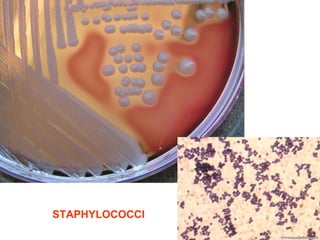
STAPHYLOCOCCI
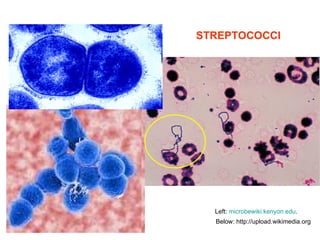
Below: http://upload.wikimedia.org Left:  microbewiki . kenyon . edu .   STREPTOCOCCI
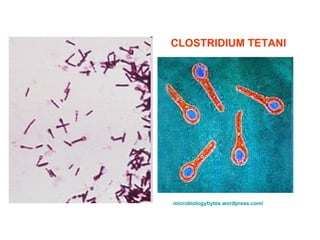
microbiologybytes . wordpress . com /   CLOSTRIDIUM TETANI
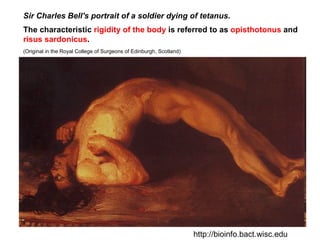
Sir Charles Bell's portrait of a soldier dying of tetanus.  The characteristic  rigidity of the body  is referred to as  opisthotonus  and  risus sardonicus .  (Original in the Royal College of Surgeons of Edinburgh, Scotland)  http://bioinfo.bact.wisc.edu
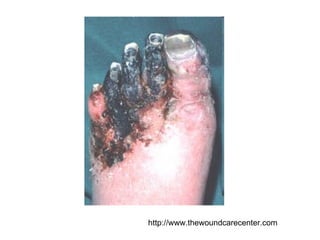
Severe  contused wounds Agents of clostridial myonecrosis  ( Clostridium perfringens, C. septicum,  C. novyi, C. histolyticum)   clostridial myonecrosis = anaerobic traumatosis =  gas gangrene   ~   malignant edema Clostridium   tetani
http://www.thewoundcarecenter.com
Wounds sustained in water In fresh water: Pseudomonas aeruginosa Aeromonas hydrophila other   pseudomonads and aeromonads In salt water: Vibrio parahaemolyticus, V. vulnificus Mycobacterium marinum  (also in fresh-water swimming pools, tanks and aquaria)
Injuries sustained in the tropics  Mainly on feet soil nocardiae  ( Dermatophilus congolensis, Rhodococcus equi ) atypical mycobacteria  ( Mycobacterium ulcerans, Mycobacterium haemophilum ) micromycetes  ( Sporothrix schenckii, Paracoccidioides brasiliensis )
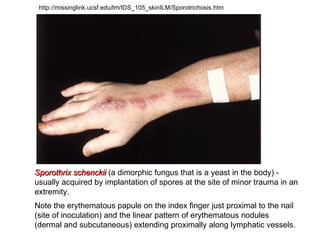
Sporothrix schenckii  (a dimorphic fungus that is a yeast in the body) - usually acquired by implantation of spores at the site of minor trauma in an extremity. Note the erythematous papule on the index finger just proximal to the nail (site of inoculation) and the linear pattern of erythematous nodules (dermal and subcutaneous) extending proximally along lymphatic vessels. http://missinglink.ucsf.edu/lm/IDS_105_skinILM/Sporotrichosis.htm
Surgical wounds Staphylococcus aureus coagulase-negative staphylococci  (mainly  Staph .  epidermidis ) Enterobacteriaceae  ( Esch .  coli ,  Pr .  mirabilis ) Streptococcus pyogenes anaerobes  (Peptostreptococcus micros, Peptostreptococcus anaerobius,  Bacteroides fragilis)
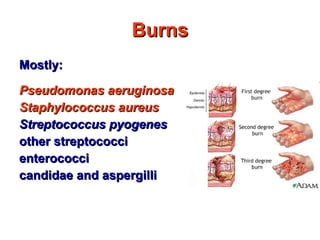
Burns M ostly: Pseudomonas aeruginosa Staphylococcus aureus Streptococcus pyogenes other streptococci enterococci candidae and aspergilli
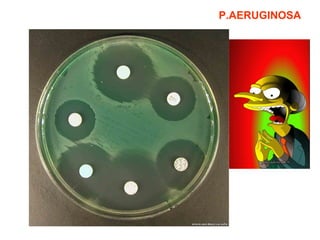
P.AERUGINOSA
Bites inflicted by man members of oral microflora : - „oral streptococci“ ( Streptococcus  sanguinis, S. oralis, S. anginosus )  - anaerobes ( Fusobacterium nucleatum  ssp.  nucleatum, Porphyromonas gingivalis ) Staphylococcus aureus
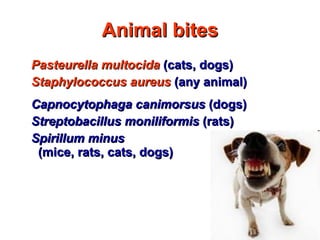
Animal bites Pasteurella multocida  (cats, dogs) Staphylococcus aureus   (any animal) Capnocytophaga canimorsus  (dogs) Streptobacillus moniliformis  (rats) Spirillum minus  (mice, rats, cats, dogs)
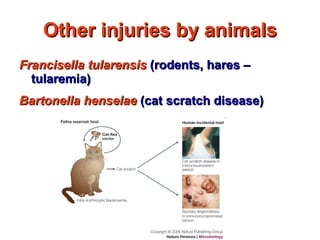
Other injuries by animals Francisella tularensis  (rodents, hares – tularemia) Bartonella henselae  (cat scratch disease)
FRANCISELLA TULARENSIS
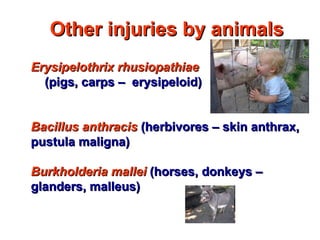
Other injuries by animals Erysipelothrix rhusiopathiae  (pigs, carps –  erysipeloid) Bacillus anthracis  (herbivores – skin anthrax, pustula maligna) Burkholderia mallei  (horses, donkeys –  glanders, malleus)
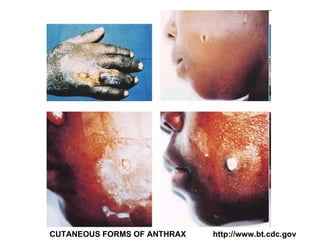
CUTANEOUS FORMS OF ANTHRAX  http://www.bt.cdc.gov
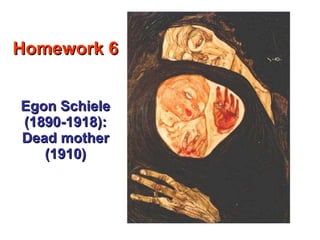
Homework  6 Egon Schiele (1890-1918): Dead mother (1910)
Homework  7 Who is the author of this painting and what is its name?

Wounds

  • 1.
    Institute for Microbiology, Medical Faculty of Masaryk University and St. Anna Faculty Hospital in Brno Agents of wound infections
  • 2.
    Types of woundCommon superficial injuries Severe contused wounds Wounds sustained in water Injuries sustained in the tropics Surgical wounds Burns Bites inflicted by man Animal bites and other injuries
  • 3.
    Common superficial injuriesStaphylococcus aureus Streptococcus pyogenes beta-hemolytic streptococci of other groups (above all G, F, C) ! Attention in case of the foreign body in the wound (splinter, thorn) and in case of deeper stab wounds (fork soiled by horse manure): Clostridium tetani
  • 4.
  • 5.
    Below: http://upload.wikimedia.org Left: microbewiki . kenyon . edu . STREPTOCOCCI
  • 6.
    microbiologybytes . wordpress. com / CLOSTRIDIUM TETANI
  • 7.
    Sir Charles Bell'sportrait of a soldier dying of tetanus. The characteristic rigidity of the body is referred to as opisthotonus and risus sardonicus . (Original in the Royal College of Surgeons of Edinburgh, Scotland) http://bioinfo.bact.wisc.edu
  • 8.
    Severe contusedwounds Agents of clostridial myonecrosis ( Clostridium perfringens, C. septicum, C. novyi, C. histolyticum) clostridial myonecrosis = anaerobic traumatosis = gas gangrene ~ malignant edema Clostridium tetani
  • 9.
  • 10.
    Wounds sustained inwater In fresh water: Pseudomonas aeruginosa Aeromonas hydrophila other pseudomonads and aeromonads In salt water: Vibrio parahaemolyticus, V. vulnificus Mycobacterium marinum (also in fresh-water swimming pools, tanks and aquaria)
  • 11.
    Injuries sustained inthe tropics Mainly on feet soil nocardiae ( Dermatophilus congolensis, Rhodococcus equi ) atypical mycobacteria ( Mycobacterium ulcerans, Mycobacterium haemophilum ) micromycetes ( Sporothrix schenckii, Paracoccidioides brasiliensis )
  • 12.
    Sporothrix schenckii (a dimorphic fungus that is a yeast in the body) - usually acquired by implantation of spores at the site of minor trauma in an extremity. Note the erythematous papule on the index finger just proximal to the nail (site of inoculation) and the linear pattern of erythematous nodules (dermal and subcutaneous) extending proximally along lymphatic vessels. http://missinglink.ucsf.edu/lm/IDS_105_skinILM/Sporotrichosis.htm
  • 13.
    Surgical wounds Staphylococcusaureus coagulase-negative staphylococci (mainly Staph . epidermidis ) Enterobacteriaceae ( Esch . coli , Pr . mirabilis ) Streptococcus pyogenes anaerobes (Peptostreptococcus micros, Peptostreptococcus anaerobius, Bacteroides fragilis)
  • 14.
    Burns M ostly:Pseudomonas aeruginosa Staphylococcus aureus Streptococcus pyogenes other streptococci enterococci candidae and aspergilli
  • 15.
  • 16.
    Bites inflicted byman members of oral microflora : - „oral streptococci“ ( Streptococcus sanguinis, S. oralis, S. anginosus ) - anaerobes ( Fusobacterium nucleatum ssp. nucleatum, Porphyromonas gingivalis ) Staphylococcus aureus
  • 17.
    Animal bites Pasteurellamultocida (cats, dogs) Staphylococcus aureus (any animal) Capnocytophaga canimorsus (dogs) Streptobacillus moniliformis (rats) Spirillum minus (mice, rats, cats, dogs)
  • 18.
    Other injuries byanimals Francisella tularensis (rodents, hares – tularemia) Bartonella henselae (cat scratch disease)
  • 19.
  • 20.
    Other injuries byanimals Erysipelothrix rhusiopathiae (pigs, carps – erysipeloid) Bacillus anthracis (herbivores – skin anthrax, pustula maligna) Burkholderia mallei (horses, donkeys – glanders, malleus)
  • 21.
    CUTANEOUS FORMS OFANTHRAX http://www.bt.cdc.gov
  • 22.
    Homework 6Egon Schiele (1890-1918): Dead mother (1910)
  • 23.
    Homework 7Who is the author of this painting and what is its name?