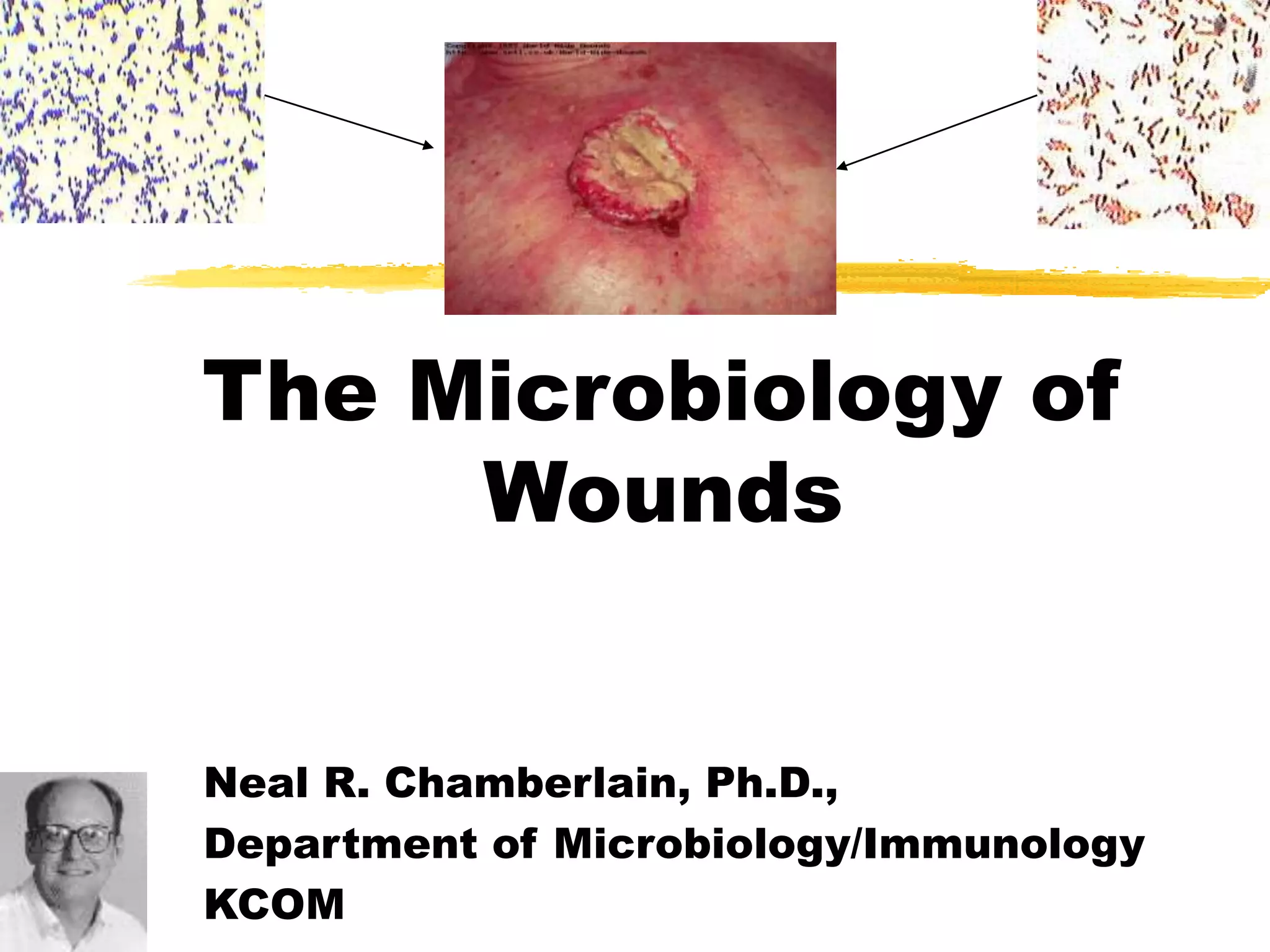
The Microbiology of
Wounds
Neal R. Chamberlain, Ph.D.,
Department of Microbiology/Immunology
KCOM
Microbes and Chronic
Wounds
All chronic wounds are contaminated by
bacteria.
Wound healing occurs in the presence of
bacteria.
Certain bacteria appear to aid wound healing.
It is not the presence of organisms but their
interaction with the patient that determines
their influence on wound healing.
Definitions
Wound contamination: the presence
of non-replicating organisms in the
wound.
All chronic wounds are contaminated.
These contaminants come from the
indigenous microflora and/or the
environment.
Most contaminating organisms are not able to
multiply in a wound. (Ex. Most organisms in
the soil won’t grow in a wound).
Definitions
Wound colonization: the presence of
replicating microorganisms adherent to
the wound in the absence of injury to the
host.
This is also very common.
Most of these organisms are normal skin flora.
Staphylococcus epidermidis, other coagulase
negative Staph., Corynebacterium sp.,
Brevibacterium sp., Proprionibacterium acnes,
Pityrosporum sp..
Definitions
Wound Infection: the presence of
replicating microorganisms within a
wound that cause host injury.
Primarily pathogens are of concern here.
Examples include; Staphylococcus aureus, Beta-
hemolytic Streptococcus (S. pyogenes, S.
agalactiae), E. coli, Proteus, Klebsiella,
anaerobes, Pseudomonas, Acinetobacter,
Stenotrophomonas (Xanthomonas).
Microbiology of Wounds
The microbial flora in wounds appear to
change over time.
Early acute wound; Normal skin flora
predominate.
S. aureus, and Beta-hemolytic Streptococcus
soon follow. (Group B Streptococcus and S.
aureus are common organisms found in diabetic
foot ulcers)
Microbiology of Wounds
After about 4 weeks
Facultative anaerobic gram negative rods will
colonize the wound.
Most common ones= Proteus, E. coli, and
Klebsiella.
As the wound deteriorates deeper
structures are affected. Anaerobes
become more common. Oftentimes
infections are polymicrobial (4-5).
Microbiology of Wounds
Long-term chronic wounds oftentimes
contain more anaerobes than aerobes.
Aerobic gram-negative rods also infect wounds
late in the course of chronic wound
degeneration. Usually acquired from exogenous
sources; bath and foot water
Ex. Pseudomonas, Acinetobacter,
Stenotrophomonas (Xanthomonas).
Microbiology of Wounds
Organisms like Pseudomonas are not very
invasive unless the patient is highly
compromised (ex. Ecthyma gangrenosum
in neutropenic patients).
These organisms are associated with
marked wound deterioration due to
endotoxin, enzymes, and exotoxins.
Microbiology of Wounds
As the wounds go deeper and become
more complex they can infect the
underlying muscles and bone causing
osteomyelitis.
Coliforms and anaerobes are associated
with osteomyelitis in these patients. You
also see Staphylococcus aureus.
Microbiology of Wounds
Enterococcus and Candida are often
isolated from wounds.
Treating a patient for these organisms is
only indicated if there are no other
pathogens present and the organisms are
present in high concentrations (106 CFU’s
per gram of tissue)
Microbiology of Wounds
In summary: early chronic wounds
contain mostly gram-positive
organisms.
Wounds of several months duration with
deep structure involvement will have on
average 4-5 microbial pathogens,
including anaerobes (see more gram-
negative organisms).
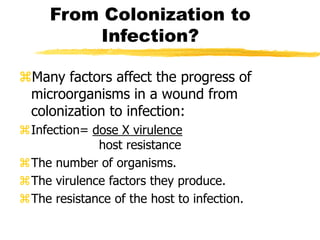
From Colonization to
Infection?
Many factors affect the progress of
microorganisms in a wound from
colonization to infection:
Infection= dose X virulence
__________host resistance
The number of organisms.
The virulence factors they produce.
The resistance of the host to infection.
Dose of Bacteria
Differs depending on the organism
involved.
Some organisms would need to be in high
concentrations. (ex. Candida,
Enterococcus)
Various combinations of bacterial species
result in more host damage (synergy)
Example; Group B Streptococcus (S.
agalatiae) and Staphylococcus aureus.
Dose of Bacteria
Organisms that should be treated
regardless of the numbers present.
Beta-hemolytic streptococci, Mycobacteria
sp., Bacillus anthracis, Yersinia pestis,
Corynebacterium diphtheriae,
Erysipelothrix rhusiopathiae, Leptospira
sp., Treponema sp., Brucella sp.,
Clostridium sp., VZV, HSV, dimorphic fungi,
Leishmaniasis.
Bacterial Problems to
Consider
Streptococcus pyogenes
Can result in necrotizing fasciitis or
streptococcal toxic shock syndrome. Not
very common. Only about 520 cases per
year of each condition.
More common to see cellulitis and
erysipelas after infection of a chronic
wound.
Bacterial Problems to
Consider
Clostridium tetani
Contamination of chronic wounds by
exogenous sources is common.
Of the 41 cases of tetanus that occurred
in 1998, a total of 16 (39%) were among
persons aged greater than or equal to 60
years.
Make sure your patients have gotten their
tetanus vaccination.
Bacterial Problems to
Consider
Erysipelothrix rhusiopathiae can infect
chronic wounds. Associated with hog
farmers and people who fish.
Mycobacteria marinum and M. ulcerans
can infect chronic wounds. Think of
people who have aquariums, pools, go
fishing, etc..
Virulence
Factors an organism produces can result
in host damage.
Ex. Hyaluronidase (Streptococcus
pyogenes), proteases (Staphylococcus
aureus, Pseudomonas aeruginosa), toxins
(Streptococcus pyogenes, Staphylococcus
aureus), endotoxin (gram negative
organisms).
Virulence
Some organisms produce few virulence
factors.
However, synergy between different
bacterial factors can cause host damage.
Group B Streptococcus and
Staphylococcus aureus: Synergy between
two toxins results in hemolysis.
Host Resistance
Host resistance is the single most
important determinant in wound
infection.
Local and Systemic factors both play a
role in increasing the chances a wound
will become infected.
Host Resistance
Local factors that increase chances of
wound infection:
Large wound area
Increased wound depth
Degree of chronicity
Anatomic location (distal extremity, perineal)
Foreign body
Necrotic tissue
Mechanism of injury (bites, perforated
viscus)
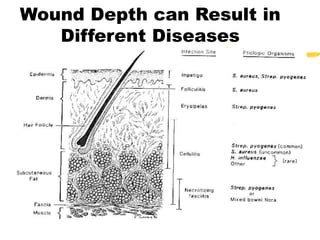
Wound Depth can Result in
Different Diseases
Host Resistance
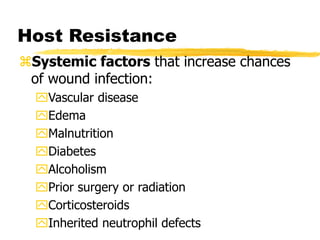
Systemic factors that increase chances
of wound infection:
Vascular disease
Edema
Malnutrition
Diabetes
Alcoholism
Prior surgery or radiation
Corticosteroids
Inherited neutrophil defects
How do you know when a
wound is infected?
This can be very difficult.
A continuum exists between when
pathogens colonize the wound and then
start to cause damage.
There is no absolutely foolproof laboratory
test that will aid in this diagnosis.
How do you know when a
wound is infected?
One feature is common to all infected
chronic wounds;
The failure of the wound to heal and
progressive deterioration of the
wound.
Unfortunately, wound infections are not
the only reasons for poor wound healing.
How do you know when a
wound is infected?
The typical features of wound infections:
increased exudate
increased swelling
increased erythema
increased pain
increased local temperature
Periwound cellulitis, ascending infection, change
in appearance of granulation tissue
(discoloration, prone to bleed, highly friable).
Specimen Collection and
Culture Techniques.
There is a good deal of controversy
concerning specimen collection.
The gold standard collection method is to
do a tissue biopsy or needle aspirate of
the leading edge of the wound after
debridement.
>105 CFU/gm of tissue= greater likelihood
of sepsis developing.
Specimen Collection and
Culture Techniques.
Indicate the specific anatomic site the
biopsy is collected from.
Indicate whether this is a surface or deep
wound. Ask for a smear and gram stain of
the tissue.
Surface wounds are NOT cultured for
anaerobes.
Deep wounds are cultured for anaerobes.
Specimen Collection and
Culture Techniques.
If a tissue biopsy is not possible;
cleanse the wound with sterile saline
vigorously swab the base of the lesion
Surface wounds place the swab in a
sterile container for transport.
Deep wounds place the swab in a sterile
anaerobic container for transport.
Thank You
I would like to thank
KCOM
Department of Continuing Medical Education
The following article is a helpful review of
this topic: Dow, G., Browne, A., and
Sibbald, R.G. Infection in Chronic
Wounds: Controversies in Diagnosis and
Treatment. Ostomy/Wound Management.
1999;45(8):23-40.

wound infection microbiology.PPT

  • 1.
    The Microbiology of Wounds NealR. Chamberlain, Ph.D., Department of Microbiology/Immunology KCOM
  • 2.
    Microbes and Chronic Wounds Allchronic wounds are contaminated by bacteria. Wound healing occurs in the presence of bacteria. Certain bacteria appear to aid wound healing. It is not the presence of organisms but their interaction with the patient that determines their influence on wound healing.
  • 3.
    Definitions Wound contamination: thepresence of non-replicating organisms in the wound. All chronic wounds are contaminated. These contaminants come from the indigenous microflora and/or the environment. Most contaminating organisms are not able to multiply in a wound. (Ex. Most organisms in the soil won’t grow in a wound).
  • 4.
    Definitions Wound colonization: thepresence of replicating microorganisms adherent to the wound in the absence of injury to the host. This is also very common. Most of these organisms are normal skin flora. Staphylococcus epidermidis, other coagulase negative Staph., Corynebacterium sp., Brevibacterium sp., Proprionibacterium acnes, Pityrosporum sp..
  • 5.
    Definitions Wound Infection: thepresence of replicating microorganisms within a wound that cause host injury. Primarily pathogens are of concern here. Examples include; Staphylococcus aureus, Beta- hemolytic Streptococcus (S. pyogenes, S. agalactiae), E. coli, Proteus, Klebsiella, anaerobes, Pseudomonas, Acinetobacter, Stenotrophomonas (Xanthomonas).
  • 6.
    Microbiology of Wounds Themicrobial flora in wounds appear to change over time. Early acute wound; Normal skin flora predominate. S. aureus, and Beta-hemolytic Streptococcus soon follow. (Group B Streptococcus and S. aureus are common organisms found in diabetic foot ulcers)
  • 7.
    Microbiology of Wounds Afterabout 4 weeks Facultative anaerobic gram negative rods will colonize the wound. Most common ones= Proteus, E. coli, and Klebsiella. As the wound deteriorates deeper structures are affected. Anaerobes become more common. Oftentimes infections are polymicrobial (4-5).
  • 8.
    Microbiology of Wounds Long-termchronic wounds oftentimes contain more anaerobes than aerobes. Aerobic gram-negative rods also infect wounds late in the course of chronic wound degeneration. Usually acquired from exogenous sources; bath and foot water Ex. Pseudomonas, Acinetobacter, Stenotrophomonas (Xanthomonas).
  • 9.
    Microbiology of Wounds Organismslike Pseudomonas are not very invasive unless the patient is highly compromised (ex. Ecthyma gangrenosum in neutropenic patients). These organisms are associated with marked wound deterioration due to endotoxin, enzymes, and exotoxins.
  • 10.
    Microbiology of Wounds Asthe wounds go deeper and become more complex they can infect the underlying muscles and bone causing osteomyelitis. Coliforms and anaerobes are associated with osteomyelitis in these patients. You also see Staphylococcus aureus.
  • 11.
    Microbiology of Wounds Enterococcusand Candida are often isolated from wounds. Treating a patient for these organisms is only indicated if there are no other pathogens present and the organisms are present in high concentrations (106 CFU’s per gram of tissue)
  • 12.
    Microbiology of Wounds Insummary: early chronic wounds contain mostly gram-positive organisms. Wounds of several months duration with deep structure involvement will have on average 4-5 microbial pathogens, including anaerobes (see more gram- negative organisms).
  • 13.
    From Colonization to Infection? Manyfactors affect the progress of microorganisms in a wound from colonization to infection: Infection= dose X virulence __________host resistance The number of organisms. The virulence factors they produce. The resistance of the host to infection.
  • 14.
    Dose of Bacteria Differsdepending on the organism involved. Some organisms would need to be in high concentrations. (ex. Candida, Enterococcus) Various combinations of bacterial species result in more host damage (synergy) Example; Group B Streptococcus (S. agalatiae) and Staphylococcus aureus.
  • 15.
    Dose of Bacteria Organismsthat should be treated regardless of the numbers present. Beta-hemolytic streptococci, Mycobacteria sp., Bacillus anthracis, Yersinia pestis, Corynebacterium diphtheriae, Erysipelothrix rhusiopathiae, Leptospira sp., Treponema sp., Brucella sp., Clostridium sp., VZV, HSV, dimorphic fungi, Leishmaniasis.
  • 16.
    Bacterial Problems to Consider Streptococcuspyogenes Can result in necrotizing fasciitis or streptococcal toxic shock syndrome. Not very common. Only about 520 cases per year of each condition. More common to see cellulitis and erysipelas after infection of a chronic wound.
  • 17.
    Bacterial Problems to Consider Clostridiumtetani Contamination of chronic wounds by exogenous sources is common. Of the 41 cases of tetanus that occurred in 1998, a total of 16 (39%) were among persons aged greater than or equal to 60 years. Make sure your patients have gotten their tetanus vaccination.
  • 18.
    Bacterial Problems to Consider Erysipelothrixrhusiopathiae can infect chronic wounds. Associated with hog farmers and people who fish. Mycobacteria marinum and M. ulcerans can infect chronic wounds. Think of people who have aquariums, pools, go fishing, etc..
  • 19.
    Virulence Factors an organismproduces can result in host damage. Ex. Hyaluronidase (Streptococcus pyogenes), proteases (Staphylococcus aureus, Pseudomonas aeruginosa), toxins (Streptococcus pyogenes, Staphylococcus aureus), endotoxin (gram negative organisms).
  • 20.
    Virulence Some organisms producefew virulence factors. However, synergy between different bacterial factors can cause host damage. Group B Streptococcus and Staphylococcus aureus: Synergy between two toxins results in hemolysis.
  • 21.
    Host Resistance Host resistanceis the single most important determinant in wound infection. Local and Systemic factors both play a role in increasing the chances a wound will become infected.
  • 22.
    Host Resistance Local factorsthat increase chances of wound infection: Large wound area Increased wound depth Degree of chronicity Anatomic location (distal extremity, perineal) Foreign body Necrotic tissue Mechanism of injury (bites, perforated viscus)
  • 23.
    Wound Depth canResult in Different Diseases
  • 24.
    Host Resistance Systemic factorsthat increase chances of wound infection: Vascular disease Edema Malnutrition Diabetes Alcoholism Prior surgery or radiation Corticosteroids Inherited neutrophil defects
  • 25.
    How do youknow when a wound is infected? This can be very difficult. A continuum exists between when pathogens colonize the wound and then start to cause damage. There is no absolutely foolproof laboratory test that will aid in this diagnosis.
  • 26.
    How do youknow when a wound is infected? One feature is common to all infected chronic wounds; The failure of the wound to heal and progressive deterioration of the wound. Unfortunately, wound infections are not the only reasons for poor wound healing.
  • 27.
    How do youknow when a wound is infected? The typical features of wound infections: increased exudate increased swelling increased erythema increased pain increased local temperature Periwound cellulitis, ascending infection, change in appearance of granulation tissue (discoloration, prone to bleed, highly friable).
  • 28.
    Specimen Collection and CultureTechniques. There is a good deal of controversy concerning specimen collection. The gold standard collection method is to do a tissue biopsy or needle aspirate of the leading edge of the wound after debridement. >105 CFU/gm of tissue= greater likelihood of sepsis developing.
  • 29.
    Specimen Collection and CultureTechniques. Indicate the specific anatomic site the biopsy is collected from. Indicate whether this is a surface or deep wound. Ask for a smear and gram stain of the tissue. Surface wounds are NOT cultured for anaerobes. Deep wounds are cultured for anaerobes.
  • 30.
    Specimen Collection and CultureTechniques. If a tissue biopsy is not possible; cleanse the wound with sterile saline vigorously swab the base of the lesion Surface wounds place the swab in a sterile container for transport. Deep wounds place the swab in a sterile anaerobic container for transport.
  • 31.
    Thank You I wouldlike to thank KCOM Department of Continuing Medical Education The following article is a helpful review of this topic: Dow, G., Browne, A., and Sibbald, R.G. Infection in Chronic Wounds: Controversies in Diagnosis and Treatment. Ostomy/Wound Management. 1999;45(8):23-40.