WOUND DRESSING
Prof. (Dr.) Virendra Singh
DEFINITION:-
 Wound, any break in the external or internal surfaces
of the body involving a separation of tissue, and
caused by external injury or force.
 A wound is a break or cut in the continuity of any
body structure, external or internal caused by
external injury or force.
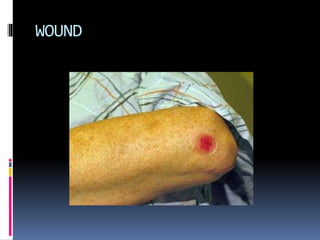
WOUND
CLASSIFICATION OF WOUNDS
1.Mechanism of injury
Incision- open wound:- Means wound involving break in
skin or mucus membrane. Eg. Surgical incision, gunshot
wound.
Contusion- closed wound:- Means wound involving no
break in skin integrity caused by blow by blunt object. Eg.
bleeding in underlying tissues, bone fracture or tear of
visceral organs.
Abrasion- Superficial wound involving scrapping or
rubbing of skins surface by friction. Eg. Fall skinned knee
or elbow.
 Intentional wound:- Wound resulting from
therapy. Eg. Surgical incision, introduction of
needle in the body parts.
 Unintentional wound:- wound occurring
unexpectedly. Eg. Knife wound, burn and
pressure ulcer.
 Superficial wound:- wound involving only
epidermal layers of skin. Eg. Abrasion, first
degree burn.
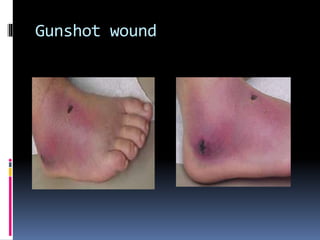
Penetrating wound:- wound involving break in
epidermal skin layer, dermis and deeper tissue or organs.
Eg. Gunshot or stab wound.
Perforating penetrating wounds- wound in which
foreign object enters in exits internal organs.
laceration- tear of tissue with irregular wound edges. Eg.
Knife injury, industrial accidents.
2. According to depth
Partial thickness- confined to the skin
Full-thickness- involving the dermis,
epidermis, subcutaneous tissues and
possibly muscle and bone.
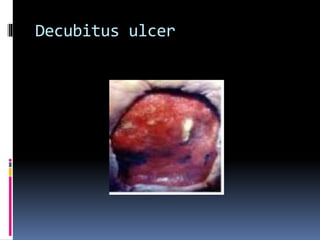
Decubitus ulcer
Gunshot wound
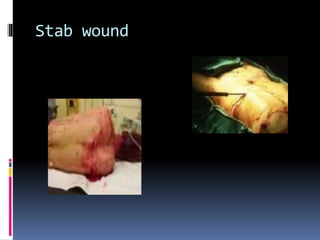
Stab wound
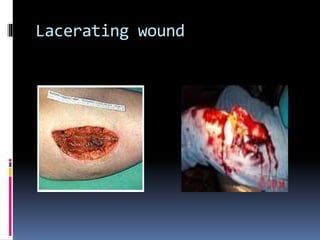
Lacerating wound
3. Degree of contamination
Clean-an aseptically made wound, that does
not enter the alimentary, respiratory or genito-
urinary tracts.
Clean contaminated-are surgical wounds in which the
alimentary, respiratory and genitals or urinary tract
has been entered.
Contaminated- wounds exposed to excessive amount’s
of bacteria. Eg. Open traumatic wound.
Infected wound-wounds containing dead tissues and
with evidence of clinical infection (purulent
discharged).
PHASES OF WOUND HEALING
1. INFLAMMATORY PHASE-starts
immediately after injury and lasts 3-6 days
or 4-6 days.
2 major processes occur during this phase …
HEMOSTATIS AND PHAGOCYTOSIS
Hemostatis- blood vessels constrict,
platelets aggregates and bleeding stops,
scabs forms, preventing entry of infectious
organisms.
 Inflammation-increase blood flow, to
wound resulting localized redness and
edema, attractsWBC and wound growth
factors.
 WBC arrive-clear debris from wound.
2. PROLIFERATIVE PHASE-extends from
day 3 to about day 21 post injury.
collagen synthesis establishment of
new capillaries  creation of granulation
tissue wound contraction
epitheliazation.
3. REMODELLING OR MATURATION PHASE
-final healing stage may continue for I year
or more.
Remodeling of scar tissue to provide wound
strength.
TYPES OF WOUND HEALING
 FIRST INTENTION HEALING-partial
thickness wounds.
- a clean incision is made with primary
closure, minimal scarring.
-expected when the edges of clean surgical
incisions are sutured together, tissue loss
is minimal or absent if the wound is not
contaminated with microorganism.
-e.g.-abrasion or skin tear.
 SECOND INTENTION HEALING-
granulation
-accompanies traumatic open wounds with
tissues loss or wounds with a high
microorganisms count.
-go though a process involving scar tissue
formation a heal slowly because of the
volume of tissue needed to fill the defect.
-e.g.-contaminated surgical wound,
pressure ulcer.
FACTORS AFFECTING WOUND HEALING
 Developmental considerations
(healthy children and adults)
 Nutrition
 Lifestyle
 Medications
 Contamination and infection
 e
COMPLICATIONS OF WOUND HEALING
 1. HEMORRRHAGE
-risk of hemorrhage is greatest during the ist
48 hours after surgery.
-emergency -N@- should apply pressure
dressing to the wound and monitor vital
signs.
 2. INFECTION
-surgical infection is apparently 2-11 days
post operatively.
N@- watched for presence of changed in
wound color, pain or drainage-culturing of
the wound.
 3. DEHISCENCEWITH POSSIBLE
EVISCERATION
-may occur 4-5 days postoperatively.
-involves an abdominal wound in which the
layers below the skin separates.
N@- an increase in flow of serosanguinous
drainage into the dressing can indicate
impending dehiscence.
- If occurs N@ should be quickly
supported by sterile dressing soaked in
sterile normal saline.
-position? Client in bed with knees
bent…why?To decrease pull on the
incision. and? Notify physician……
WOUND MANAGEMENT
 1. DRESSINGS - material applied to wound
with or without medication, to give
protection and assist in healing.
-what are the purposes?
a) To protect the wound from mechanical
injury
b) Splint or immobilized the wound.
c) Absorbs dressing
d) Prevent contamination from bloody
discharges
e.) Promote homeostasis,(pressure dressing)
f.) Debride the wound
g.) to kill or inhibit microorganism
h.) provide a physiologic environment
conducive to healing
i.) provide mental and physical comfort for
the patient.
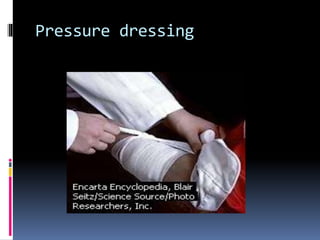
Pressure dressing
What are the types of dressings?
a. DRYTO DRY DRESSINGS
-used primarily for wounds closing by
primary intention.
>adv-offers good protection, absorption &
provide pressure
>dadv-they adhere to the wound surface
when drainage dries.
- when remove can cause pain and
disruption of granulation tissue.
 b. WET TO DRY DRESSINGS
-used for untidy or infected wounds that must
be debrided and closed by secondary
intention.
>how can it be done?
-gauze saturated with sterile saline or
antimicrobial sol’n. is packed into the wound,
the wet dressing are then covered by dry
dressings
>when to changed?
-when it becomes dry
 b. WET TOWET DRESSINGS
-used on clean open wounds or on
granulating surfaces.
>adv-provide a more physiologic
environment (warmth moisture) which can
enhance the local healing processes and
assure greater patient comfort.
>dadv-surrounding tissues can become
ulcerated. high risk for infection.
 2. DRAINS- device or a tube used to draw
fluids from an internal body cavity to the
surface.
-what are the purposes?
a) placed in the wounds only when
abdominal fluid collections are present.
b) placed near the incision site
> wound drainage-drains placed within the
wounds are attached to a portable
suction with a collection container.
e.g. hemovac, jackson-pratt, penrose drain.
 3. BINDERS AND BANDAGES
-what are the purposes?
a) Creates pressure over the body parts
b) Immobilize body parts
c) Reduce or prevent edema
d) Secure a splints
e) Secure dressing
UNEXPECTED OUTCOMES &
RELATED INTERVENTIONS
1. Inflamed and tender wounds which evidence
of drainage and foul odor.
N@ a. Monitor clients for signs of infection
(fever, increase in WBC count).
b. notify physician
c. obtain wound culture as ordered.
2. Increase wound drainage
N@ a. changed dressing frequently
b. notify physician
3.Wound bleeds during dressing change
PAPER AND PENCIL TEST
 PART 1
1. Based on your readings, dressings may be
used for what 6 reasons?
2. During dressings changes, wounds and
surrounding tissues must be inspected for?
3. What will be the assessment data you must
collect prior to any dressing?
4. Describe on how to set-up, prepare
materials needed for dressing thus,
maintaining sterility. Draw a picture to help
explain your answer.
 PART 2
Explain what should be done in each of the following
situations to avoid contamination during wound
dressing.
1. You are in the middle of a sterile dressing change
with the wound exposed and realize that you need
more dressings from the CSR.
2. You begin to sneeze prior to beginning a sterile
procedure.
3. A patient with abdominal wound is walking in the hall
when his dressing falls onto the floor.
4. When removing the cap from any sterile solution
bottle, be sure the cap is placed with the inner side
up.Why is this critically important?
WOUND DRESSING STEPS AND TYPE WITH NURSES ROLE.ppt

WOUND DRESSING STEPS AND TYPE WITH NURSES ROLE.ppt

  • 1.
  • 2.
    DEFINITION:-  Wound, anybreak in the external or internal surfaces of the body involving a separation of tissue, and caused by external injury or force.  A wound is a break or cut in the continuity of any body structure, external or internal caused by external injury or force.
  • 3.
  • 4.
    CLASSIFICATION OF WOUNDS 1.Mechanismof injury Incision- open wound:- Means wound involving break in skin or mucus membrane. Eg. Surgical incision, gunshot wound. Contusion- closed wound:- Means wound involving no break in skin integrity caused by blow by blunt object. Eg. bleeding in underlying tissues, bone fracture or tear of visceral organs.
  • 5.
    Abrasion- Superficial woundinvolving scrapping or rubbing of skins surface by friction. Eg. Fall skinned knee or elbow.  Intentional wound:- Wound resulting from therapy. Eg. Surgical incision, introduction of needle in the body parts.  Unintentional wound:- wound occurring unexpectedly. Eg. Knife wound, burn and pressure ulcer.  Superficial wound:- wound involving only epidermal layers of skin. Eg. Abrasion, first degree burn.
  • 6.
    Penetrating wound:- woundinvolving break in epidermal skin layer, dermis and deeper tissue or organs. Eg. Gunshot or stab wound. Perforating penetrating wounds- wound in which foreign object enters in exits internal organs. laceration- tear of tissue with irregular wound edges. Eg. Knife injury, industrial accidents.
  • 7.
    2. According todepth Partial thickness- confined to the skin Full-thickness- involving the dermis, epidermis, subcutaneous tissues and possibly muscle and bone.
  • 8.
  • 9.
  • 10.
  • 11.
  • 12.
    3. Degree ofcontamination Clean-an aseptically made wound, that does not enter the alimentary, respiratory or genito- urinary tracts. Clean contaminated-are surgical wounds in which the alimentary, respiratory and genitals or urinary tract has been entered. Contaminated- wounds exposed to excessive amount’s of bacteria. Eg. Open traumatic wound. Infected wound-wounds containing dead tissues and with evidence of clinical infection (purulent discharged).
  • 13.
    PHASES OF WOUNDHEALING 1. INFLAMMATORY PHASE-starts immediately after injury and lasts 3-6 days or 4-6 days. 2 major processes occur during this phase … HEMOSTATIS AND PHAGOCYTOSIS Hemostatis- blood vessels constrict, platelets aggregates and bleeding stops, scabs forms, preventing entry of infectious organisms.
  • 14.
     Inflammation-increase bloodflow, to wound resulting localized redness and edema, attractsWBC and wound growth factors.  WBC arrive-clear debris from wound.
  • 15.
    2. PROLIFERATIVE PHASE-extendsfrom day 3 to about day 21 post injury. collagen synthesis establishment of new capillaries  creation of granulation tissue wound contraction epitheliazation.
  • 16.
    3. REMODELLING ORMATURATION PHASE -final healing stage may continue for I year or more. Remodeling of scar tissue to provide wound strength.
  • 17.
    TYPES OF WOUNDHEALING  FIRST INTENTION HEALING-partial thickness wounds. - a clean incision is made with primary closure, minimal scarring. -expected when the edges of clean surgical incisions are sutured together, tissue loss is minimal or absent if the wound is not contaminated with microorganism. -e.g.-abrasion or skin tear.
  • 18.
     SECOND INTENTIONHEALING- granulation -accompanies traumatic open wounds with tissues loss or wounds with a high microorganisms count. -go though a process involving scar tissue formation a heal slowly because of the volume of tissue needed to fill the defect. -e.g.-contaminated surgical wound, pressure ulcer.
  • 19.
    FACTORS AFFECTING WOUNDHEALING  Developmental considerations (healthy children and adults)  Nutrition  Lifestyle  Medications  Contamination and infection  e
  • 20.
    COMPLICATIONS OF WOUNDHEALING  1. HEMORRRHAGE -risk of hemorrhage is greatest during the ist 48 hours after surgery. -emergency -N@- should apply pressure dressing to the wound and monitor vital signs.  2. INFECTION -surgical infection is apparently 2-11 days post operatively.
  • 21.
    N@- watched forpresence of changed in wound color, pain or drainage-culturing of the wound.  3. DEHISCENCEWITH POSSIBLE EVISCERATION -may occur 4-5 days postoperatively. -involves an abdominal wound in which the layers below the skin separates. N@- an increase in flow of serosanguinous drainage into the dressing can indicate
  • 22.
    impending dehiscence. - Ifoccurs N@ should be quickly supported by sterile dressing soaked in sterile normal saline. -position? Client in bed with knees bent…why?To decrease pull on the incision. and? Notify physician……
  • 23.
    WOUND MANAGEMENT  1.DRESSINGS - material applied to wound with or without medication, to give protection and assist in healing. -what are the purposes? a) To protect the wound from mechanical injury b) Splint or immobilized the wound. c) Absorbs dressing d) Prevent contamination from bloody discharges
  • 24.
    e.) Promote homeostasis,(pressuredressing) f.) Debride the wound g.) to kill or inhibit microorganism h.) provide a physiologic environment conducive to healing i.) provide mental and physical comfort for the patient.
  • 25.
  • 26.
    What are thetypes of dressings? a. DRYTO DRY DRESSINGS -used primarily for wounds closing by primary intention. >adv-offers good protection, absorption & provide pressure >dadv-they adhere to the wound surface when drainage dries. - when remove can cause pain and disruption of granulation tissue.
  • 27.
     b. WETTO DRY DRESSINGS -used for untidy or infected wounds that must be debrided and closed by secondary intention. >how can it be done? -gauze saturated with sterile saline or antimicrobial sol’n. is packed into the wound, the wet dressing are then covered by dry dressings >when to changed? -when it becomes dry
  • 28.
     b. WETTOWET DRESSINGS -used on clean open wounds or on granulating surfaces. >adv-provide a more physiologic environment (warmth moisture) which can enhance the local healing processes and assure greater patient comfort. >dadv-surrounding tissues can become ulcerated. high risk for infection.
  • 29.
     2. DRAINS-device or a tube used to draw fluids from an internal body cavity to the surface. -what are the purposes? a) placed in the wounds only when abdominal fluid collections are present. b) placed near the incision site > wound drainage-drains placed within the wounds are attached to a portable suction with a collection container. e.g. hemovac, jackson-pratt, penrose drain.
  • 30.
     3. BINDERSAND BANDAGES -what are the purposes? a) Creates pressure over the body parts b) Immobilize body parts c) Reduce or prevent edema d) Secure a splints e) Secure dressing
  • 31.
    UNEXPECTED OUTCOMES & RELATEDINTERVENTIONS 1. Inflamed and tender wounds which evidence of drainage and foul odor. N@ a. Monitor clients for signs of infection (fever, increase in WBC count). b. notify physician c. obtain wound culture as ordered. 2. Increase wound drainage N@ a. changed dressing frequently b. notify physician 3.Wound bleeds during dressing change
  • 32.
    PAPER AND PENCILTEST  PART 1 1. Based on your readings, dressings may be used for what 6 reasons? 2. During dressings changes, wounds and surrounding tissues must be inspected for? 3. What will be the assessment data you must collect prior to any dressing? 4. Describe on how to set-up, prepare materials needed for dressing thus, maintaining sterility. Draw a picture to help explain your answer.
  • 33.
     PART 2 Explainwhat should be done in each of the following situations to avoid contamination during wound dressing. 1. You are in the middle of a sterile dressing change with the wound exposed and realize that you need more dressings from the CSR. 2. You begin to sneeze prior to beginning a sterile procedure. 3. A patient with abdominal wound is walking in the hall when his dressing falls onto the floor. 4. When removing the cap from any sterile solution bottle, be sure the cap is placed with the inner side up.Why is this critically important?

Editor's Notes

  • #5 I- caused by sharp instrument (knife or scalpel);C-because of the damaged blood vessel;A-cause by surface scrape (intentional or unintentional);P-pointed instrument nail/icepicks
  • #7 L-glass, blunt knife, machniery;P-from bullet/metal fragments
  • #9 Show animated video of stages of pressure ulcer
  • #10 Classified as penetrating wound
  • #11 Classsified as incision
  • #12 Classified as lacerating
  • #14 Are the steps of body’s natural processes of tissue repair, but it also varies depending on factors such as the type of healing, wound location and sizes.
  • #16 Base structural support to wound (it provides wound strength); to feed new tissues; provides surface for epithelization; to decrease the size of defect; resurfacing of wound, wound closure
  • #20 Healthy children and adults heal more quickly than the older adults, basically its because vascular changes associated with aging (atherosclerosis and atrophy of capillaries)- impair blood flow to the wound..changes in immune system, therefore, there would be reduce of the formation of antibodies monocytes necessary for wound healing. NUTRITION-obese cx-@ risk for wound infxn, slow healing b-coz of adipose tissue( minimal blood supply) MEDICATIONS- there are medications that interfere with healing) e.g. anti-inflammatory, heparin, antineoplastic agents
  • #21 Hemorrhage can be caused by blood clots, slipped suture, or erosion of a blood vessel,INTERNAL HEMORRHAGE- can be detected by, swelling and distention at the area of the wound; EXTERNAL BLEEDING-appear under the area or escapes from the dressing and pools under the patient.
  • #22 Infxn-bullet or knife wounds, intestinal surgeries, because the colonizing organisms complete with the new cell for O2 and nutrition and because their by products can interfere with a healthy surface condition, the presence of contamination can impair wound healing and may lead to infxn.