SURGICALWOUND
DRESSING
MODERATOR:- Ms. MADHAVI VERMA
READER
COLLEGE OF NURSING
INSTITUE OF LIVER AND BILIARY SCIENCES
PRESENTED BY:- ANJALI ARORA
M.SC NURSING-1ST YEAR
COLLEGE OF NURSING
INSTITUTE OF LIVER AND BILIARY SCIENCES
CONTENT
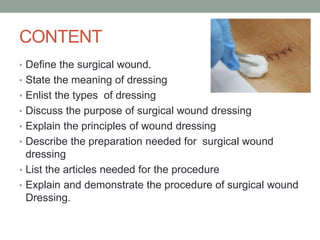
• Define the surgical wound.
• State the meaning of dressing
• Enlist the types of dressing
• Discuss the purpose of surgical wound dressing
• Explain the principles of wound dressing
• Describe the preparation needed for surgical wound
dressing
• List the articles needed for the procedure
• Explain and demonstrate the procedure of surgical wound
Dressing.
INTRODUCTION
The skin maintains our internal environment while
protecting us from the external environment.
A break in the continuity of the skin surface is the first
step in the formation of a wound and provides a potential
portal of entry for infection.
A wound can be as simple as a surface abrasion, or it can
be an extensive, life-threatening destruction of tissue
SURGICAL WOUND
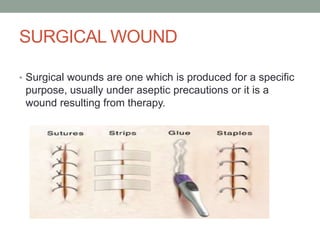
• Surgical wounds are one which is produced for a specific
purpose, usually under aseptic precautions or it is a
wound resulting from therapy.
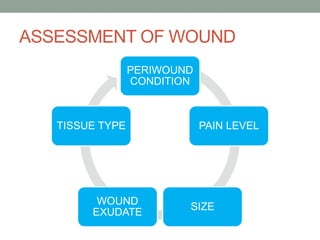
ASSESSMENT OF WOUND
PERIWOUND
CONDITION
PAIN LEVEL
SIZE
WOUND
EXUDATE
TISSUE TYPE
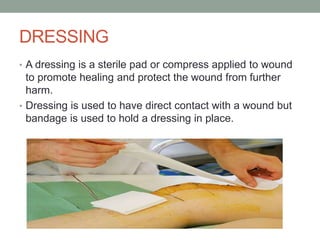
DRESSING
• A dressing is a sterile pad or compress applied to wound
to promote healing and protect the wound from further
harm.
• Dressing is used to have direct contact with a wound but
bandage is used to hold a dressing in place.
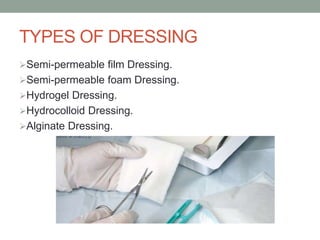
TYPES OF DRESSING
Semi-permeable film Dressing.
Semi-permeable foam Dressing.
Hydrogel Dressing.
Hydrocolloid Dressing.
Alginate Dressing.
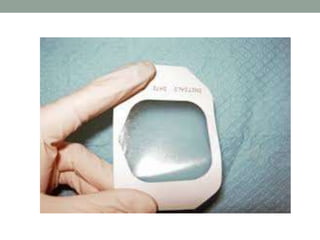
SEMI-PERMEABLE FILM DRESSING.
This dressing is a transparent film made up of
polyurethane.
It allows the movement of water vapour, oxygen, and
carbon dioxide into and out of the dressing.
It also plays an additional role in autolytic debridement
(removal of dead tissue).
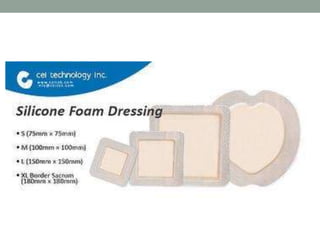
SEMI-PERMEABLE FOAM DRESSING.
This dressing is made up of foam with hydrophilic
properties and outer layer of hydrophobic properties with
adhesive borders.
The hydrophobic layer protects the wound from the
outside fluid contamination. Meanwhile, the inner
hydrophilic layer is able to absorb moderate amount of
discharge from the wound. Therefore, this type of
dressing is useful for wound with high amount of
discharge and for wound with granulation tissue.
Secondary dressings are not required.
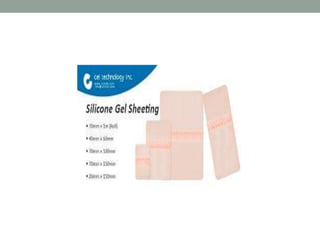
HYDROGEL DRESSING.
• This dressing is made up of synthetic polymers such
as methacrylate and polyvinyl pyrrolidine. It has high
water content, thus provides moisture and cooling effect
for the wound. The dressing is easy to remove from the
wound without causing any damage.
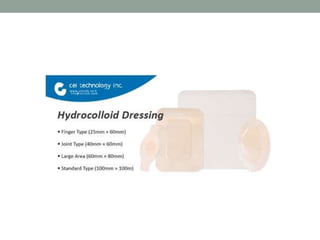
HYDROCOLLOID DRESSING.
This type of dressing contains two layers:
Inner colloidal layer and outer waterproof layer. It contains
gel forming agents such
as carboxymethylcellulose, gelatin and pectin. When the
dressing is in contact with the wound, the wound
discharge are retained to form gel which provides moist
environment for wound healing.
It protects the wound from bacterial contamination,
absorbs wound discharge, and digests necrotic tissues.
ALGINATE DRESSING
This type of dressing is made up of either sodium or
calcium salt of alginic acid.
This dressing can absorb high amount of discharge from
a wound. Ions present in the dressing can interact with
blood to produce a film that protects the wound from
bacterial contamination.
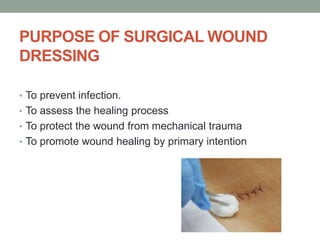
PURPOSE OF SURGICAL WOUND
DRESSING
• To prevent infection.
• To assess the healing process
• To protect the wound from mechanical trauma
• To promote wound healing by primary intention
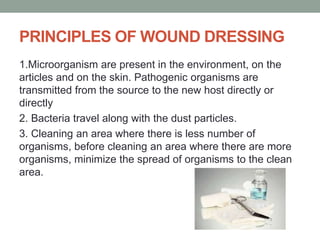
PRINCIPLES OF WOUND DRESSING
1.Microorganism are present in the environment, on the
articles and on the skin. Pathogenic organisms are
transmitted from the source to the new host directly or
directly
2. Bacteria travel along with the dust particles.
3. Cleaning an area where there is less number of
organisms, before cleaning an area where there are more
organisms, minimize the spread of organisms to the clean
area.
Cont…
4) A break in the skin and mucus membrane acts as the
portal of entry for the pathogenic organisms.
5) Respiratory tract harbours micro organisms that can
enter the wound Nutrients and oxygen are carried to the
wound via blood stream and are essential for collagen
formation.
6 )Moisture facilitates growth and movement of
microorganisms
Cont..
7) Fluid moves downwards as a result of gravitational pull.
8) Fluids move through materials by capillary action
9) Unfamiliar situations produce anxiety.
10) Systematic ways of working saves time, energy and
material
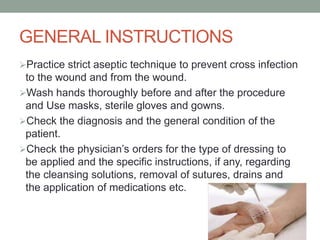
GENERAL INSTRUCTIONS
Practice strict aseptic technique to prevent cross infection
to the wound and from the wound.
Wash hands thoroughly before and after the procedure
and Use masks, sterile gloves and gowns.
Check the diagnosis and the general condition of the
patient.
Check the physician’s orders for the type of dressing to
be applied and the specific instructions, if any, regarding
the cleansing solutions, removal of sutures, drains and
the application of medications etc.
GENERAL INSTRUCTIONS …cont
Check the nurse’s records to find out the general
condition of wound
Dressings are not changed for at least 15 minutes after
the room has been swept or cleaned.
Avoid talking, coughing and sneezing when the wound is
opened.
During the procedure the nurse works carefully to avoid
contaminating the patient’s skin, clothing and bed linen
with soiled instruments and dressings
All the soiled dressings and contaminated instruments
should be carefully collected and disposed safely.
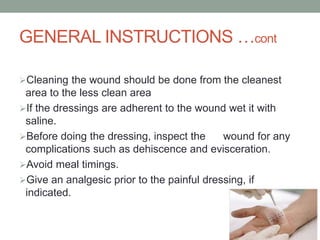
GENERAL INSTRUCTIONS …cont
Cleaning the wound should be done from the cleanest
area to the less clean area
If the dressings are adherent to the wound wet it with
saline.
Before doing the dressing, inspect the wound for any
complications such as dehiscence and evisceration.
Avoid meal timings.
Give an analgesic prior to the painful dressing, if
indicated.
SAFETY CONSIDERATIONS
Perform hand hygiene.
Check room for additional precautions.
Introduce yourself to patient.
Confirm patient ID using two patient identifiers.
Explain process to patient; offer analgesia, Bathroom, etc.
Listen and attend to patient cues.
Ensure patient’s privacy and dignity.
Assess patient’s ABC/oxygen/suction based needs
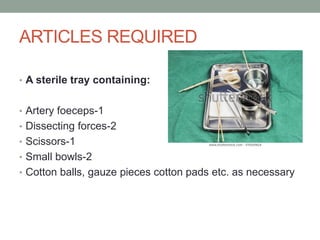
ARTICLES REQUIRED
• A sterile tray containing:
• Artery foeceps-1
• Dissecting forces-2
• Scissors-1
• Small bowls-2
• Cotton balls, gauze pieces cotton pads etc. as necessary
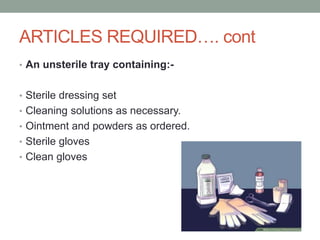
ARTICLES REQUIRED…. cont
• An unsterile tray containing:-
• Sterile dressing set
• Cleaning solutions as necessary.
• Ointment and powders as ordered.
• Sterile gloves
• Clean gloves
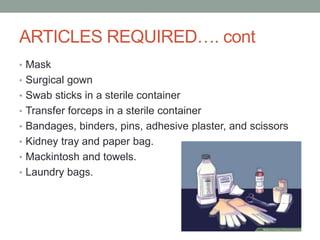
ARTICLES REQUIRED…. cont
• Mask
• Surgical gown
• Swab sticks in a sterile container
• Transfer forceps in a sterile container
• Bandages, binders, pins, adhesive plaster, and scissors
• Kidney tray and paper bag.
• Mackintosh and towels.
• Laundry bags.
PREPARATION OF PATIENTAND
ENVIRONMENT
Identify the patient and explain the procedure to win the
confidence and co-operation.
Provide privacy with curtains and drapes.
Apply restraints in case of children.
Shave the area if necessary to remove the hairs.
Place the patient in a comfortable and relaxed position
depending on the area to be dressed.
Give proper support to the body parts if the patient has to
raise and hold it in position for a considerable time.
PREPARATION OF PATIENTAND
ENVIRONMENT cont…
Adjust the height of the bed for the comfortable working of
the doctor or nurse to do the dressing.
Bring the patient to the edge of the bed.
Call for assistance if necessary e.g., to do the unsterile
procedure, to transfer sterile supplies etc.
Protect the bed with a mackintosh and towel
Untie the bandage or adhesive and remove them.
Turn the head of the patient to one side, that the patient
may not see the wound and so get worried about it.
PROCEDURE
1) Wash hands and observe other appropriate infection
control procedures.
2) Provide for client privacy.
3) Remove binders and tape.
 Remove binders, if used, and place them aside.
 If adhesive tape was used, remove it by holding down
the skin and pulling the tape gently but firmly toward the
wound. Pressing on the skin provides counter traction
against the pulling motion.
PROCEDURE
4) Remove and dispose of soiled dressings
appropriately.
• Put on clean disposable gloves and remove the outer
abdominal dressing or surgical pad.
• Lift the outer dressing so that the underside is away from
the client's face. The appearance and odor of the
drainage may be upsetting to the client.
• Place the soiled dressing in the moisture-proof bag
without touching the outside of the bag.
PROCEDURE
• Remove the under dressings, taking care not to dislodge
any drains. If the gauze sticks to the drain, support the
drain with one hand and remove the gauze with the other.
• Assess the location, type (color, consistency), and odor of
wound drainage, and the number of gauzes saturated or
the diameter of drainage collected on the dressings.
• Discard the soiled dressings in the bag as before.
• Remove gloves, dispose of them in the moisture-proof
bag, and wash hands
PROCEDURE
6) Setup the sterile supplies.
Open the sterile dressing set using surgical aseptic
technique.
Place the sterile drape beside the wound.
Open the sterile cleaning solution and pour it over the
gauze sponges in the plastic container.
Put on sterile gloves.
PROCEDURE
7) Clean the wound, if indicated
Clean the wound, using your gloved hands or forceps and
gauze swabs moistened with cleaning solution.
 Use a separate swab for each stroke and discard each
swab after use.
 If a drain is present, clean it next taking care to avoid
reaching across the cleaned incision. Clean the skin
around the drain site by swabbing in half or full circles
from around the drain site outward, using separate swabs
for each wipe.
Support and hold the drain erect while cleaning around it.
 Dry the surrounding skin with dry gauze swabs as
required.
PROCEDURE
• 8. Apply dressing to the drain site and the incision
While applying the gauze make sure that there is no loose
detached thread getting into the wound, where they cause
inflammation and provide a site for infection.
Apply the sterile dressings one at a time over the drain
and the incision Place the bulk of the dressings over the
drain area and below the drain, depending on the client's
usual position.
.Apply the final surgical pads, remove gloves, and
dispose of them. Secure the dressing with tape or ties.
PROCEDURE
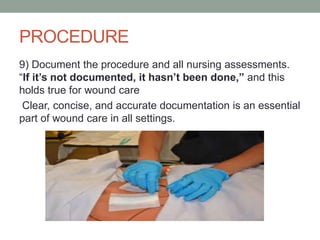
9) Document the procedure and all nursing assessments.
“If it’s not documented, it hasn’t been done,” and this
holds true for wound care
Clear, concise, and accurate documentation is an essential
part of wound care in all settings.
AFTER THE PROCEDURE.
Fold up the dressing/procedure pack and place all
contaminated material in a bag designated for clinical
waste, making sure all sharps are removed and disposed
of in a sharps container.
Remove gloves and place in waste bag.
Wash your hands.
Record (document) on the patient's chart your wound
assessment, the dressing change and the care you have
given.
Provide the patient with some dressing management
education and answer questions before you go.
Report any changes to a senior nurse or doctor
NURSES’ NOTES
• Documentation of the care given includes the following
components:
Date and time
Interventions performed
Wound characteristics, including the amount and type of
drainage
Wound odor
 Patient’s pain level during and after the treatment
 Interventions to relieve pain and the effectiveness of the
interventions
 Patient’s level of anxiety before, during, and after treatment
 Patient’s reported level of comfort with applied dressings
Supplies used .
CONCLUSION
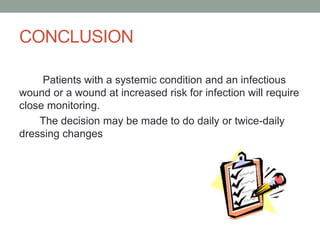
Patients with a systemic condition and an infectious
wound or a wound at increased risk for infection will require
close monitoring.
The decision may be made to do daily or twice-daily
dressing changes
BIBLIOGRAPHY
1. Barbara kozier,Glenora, Audrey Berman,Shirlee Snyder.
Fundamentals of nursing.7ed.Pearson Education;962-967.
2. Potter, Perry. Basic nursing.5ed.Elsevier ; 866-874.
3. Susan C Dewitt. Fundamental concept and skills for
nursing.3ed.Elsevier;789-793.
4. Principles and practice of
nursing.Nancy.4ed.NRBrothers;3-58.
5.http://www.nursingceu.com/courses/491/index_nceu.html
THANK YOU
.

surgicalwounddressing-201022180123 (1).pdf

  • 1.
    SURGICALWOUND DRESSING MODERATOR:- Ms. MADHAVIVERMA READER COLLEGE OF NURSING INSTITUE OF LIVER AND BILIARY SCIENCES PRESENTED BY:- ANJALI ARORA M.SC NURSING-1ST YEAR COLLEGE OF NURSING INSTITUTE OF LIVER AND BILIARY SCIENCES
  • 2.
    CONTENT • Define thesurgical wound. • State the meaning of dressing • Enlist the types of dressing • Discuss the purpose of surgical wound dressing • Explain the principles of wound dressing • Describe the preparation needed for surgical wound dressing • List the articles needed for the procedure • Explain and demonstrate the procedure of surgical wound Dressing.
  • 3.
    INTRODUCTION The skin maintainsour internal environment while protecting us from the external environment. A break in the continuity of the skin surface is the first step in the formation of a wound and provides a potential portal of entry for infection. A wound can be as simple as a surface abrasion, or it can be an extensive, life-threatening destruction of tissue
  • 4.
    SURGICAL WOUND • Surgicalwounds are one which is produced for a specific purpose, usually under aseptic precautions or it is a wound resulting from therapy.
  • 5.
    ASSESSMENT OF WOUND PERIWOUND CONDITION PAINLEVEL SIZE WOUND EXUDATE TISSUE TYPE
  • 6.
    DRESSING • A dressingis a sterile pad or compress applied to wound to promote healing and protect the wound from further harm. • Dressing is used to have direct contact with a wound but bandage is used to hold a dressing in place.
  • 7.
    TYPES OF DRESSING Semi-permeablefilm Dressing. Semi-permeable foam Dressing. Hydrogel Dressing. Hydrocolloid Dressing. Alginate Dressing.
  • 8.
    SEMI-PERMEABLE FILM DRESSING. Thisdressing is a transparent film made up of polyurethane. It allows the movement of water vapour, oxygen, and carbon dioxide into and out of the dressing. It also plays an additional role in autolytic debridement (removal of dead tissue).
  • 10.
    SEMI-PERMEABLE FOAM DRESSING. Thisdressing is made up of foam with hydrophilic properties and outer layer of hydrophobic properties with adhesive borders. The hydrophobic layer protects the wound from the outside fluid contamination. Meanwhile, the inner hydrophilic layer is able to absorb moderate amount of discharge from the wound. Therefore, this type of dressing is useful for wound with high amount of discharge and for wound with granulation tissue. Secondary dressings are not required.
  • 12.
    HYDROGEL DRESSING. • Thisdressing is made up of synthetic polymers such as methacrylate and polyvinyl pyrrolidine. It has high water content, thus provides moisture and cooling effect for the wound. The dressing is easy to remove from the wound without causing any damage.
  • 14.
    HYDROCOLLOID DRESSING. This typeof dressing contains two layers: Inner colloidal layer and outer waterproof layer. It contains gel forming agents such as carboxymethylcellulose, gelatin and pectin. When the dressing is in contact with the wound, the wound discharge are retained to form gel which provides moist environment for wound healing. It protects the wound from bacterial contamination, absorbs wound discharge, and digests necrotic tissues.
  • 16.
    ALGINATE DRESSING This typeof dressing is made up of either sodium or calcium salt of alginic acid. This dressing can absorb high amount of discharge from a wound. Ions present in the dressing can interact with blood to produce a film that protects the wound from bacterial contamination.
  • 18.
    PURPOSE OF SURGICALWOUND DRESSING • To prevent infection. • To assess the healing process • To protect the wound from mechanical trauma • To promote wound healing by primary intention
  • 19.
    PRINCIPLES OF WOUNDDRESSING 1.Microorganism are present in the environment, on the articles and on the skin. Pathogenic organisms are transmitted from the source to the new host directly or directly 2. Bacteria travel along with the dust particles. 3. Cleaning an area where there is less number of organisms, before cleaning an area where there are more organisms, minimize the spread of organisms to the clean area.
  • 20.
    Cont… 4) A breakin the skin and mucus membrane acts as the portal of entry for the pathogenic organisms. 5) Respiratory tract harbours micro organisms that can enter the wound Nutrients and oxygen are carried to the wound via blood stream and are essential for collagen formation. 6 )Moisture facilitates growth and movement of microorganisms
  • 21.
    Cont.. 7) Fluid movesdownwards as a result of gravitational pull. 8) Fluids move through materials by capillary action 9) Unfamiliar situations produce anxiety. 10) Systematic ways of working saves time, energy and material
  • 22.
    GENERAL INSTRUCTIONS Practice strictaseptic technique to prevent cross infection to the wound and from the wound. Wash hands thoroughly before and after the procedure and Use masks, sterile gloves and gowns. Check the diagnosis and the general condition of the patient. Check the physician’s orders for the type of dressing to be applied and the specific instructions, if any, regarding the cleansing solutions, removal of sutures, drains and the application of medications etc.
  • 23.
    GENERAL INSTRUCTIONS …cont Checkthe nurse’s records to find out the general condition of wound Dressings are not changed for at least 15 minutes after the room has been swept or cleaned. Avoid talking, coughing and sneezing when the wound is opened. During the procedure the nurse works carefully to avoid contaminating the patient’s skin, clothing and bed linen with soiled instruments and dressings All the soiled dressings and contaminated instruments should be carefully collected and disposed safely.
  • 24.
    GENERAL INSTRUCTIONS …cont Cleaningthe wound should be done from the cleanest area to the less clean area If the dressings are adherent to the wound wet it with saline. Before doing the dressing, inspect the wound for any complications such as dehiscence and evisceration. Avoid meal timings. Give an analgesic prior to the painful dressing, if indicated.
  • 25.
    SAFETY CONSIDERATIONS Perform handhygiene. Check room for additional precautions. Introduce yourself to patient. Confirm patient ID using two patient identifiers. Explain process to patient; offer analgesia, Bathroom, etc. Listen and attend to patient cues. Ensure patient’s privacy and dignity. Assess patient’s ABC/oxygen/suction based needs
  • 26.
    ARTICLES REQUIRED • Asterile tray containing: • Artery foeceps-1 • Dissecting forces-2 • Scissors-1 • Small bowls-2 • Cotton balls, gauze pieces cotton pads etc. as necessary
  • 27.
    ARTICLES REQUIRED…. cont •An unsterile tray containing:- • Sterile dressing set • Cleaning solutions as necessary. • Ointment and powders as ordered. • Sterile gloves • Clean gloves
  • 28.
    ARTICLES REQUIRED…. cont •Mask • Surgical gown • Swab sticks in a sterile container • Transfer forceps in a sterile container • Bandages, binders, pins, adhesive plaster, and scissors • Kidney tray and paper bag. • Mackintosh and towels. • Laundry bags.
  • 29.
    PREPARATION OF PATIENTAND ENVIRONMENT Identifythe patient and explain the procedure to win the confidence and co-operation. Provide privacy with curtains and drapes. Apply restraints in case of children. Shave the area if necessary to remove the hairs. Place the patient in a comfortable and relaxed position depending on the area to be dressed. Give proper support to the body parts if the patient has to raise and hold it in position for a considerable time.
  • 30.
    PREPARATION OF PATIENTAND ENVIRONMENTcont… Adjust the height of the bed for the comfortable working of the doctor or nurse to do the dressing. Bring the patient to the edge of the bed. Call for assistance if necessary e.g., to do the unsterile procedure, to transfer sterile supplies etc. Protect the bed with a mackintosh and towel Untie the bandage or adhesive and remove them. Turn the head of the patient to one side, that the patient may not see the wound and so get worried about it.
  • 31.
    PROCEDURE 1) Wash handsand observe other appropriate infection control procedures. 2) Provide for client privacy. 3) Remove binders and tape.  Remove binders, if used, and place them aside.  If adhesive tape was used, remove it by holding down the skin and pulling the tape gently but firmly toward the wound. Pressing on the skin provides counter traction against the pulling motion.
  • 32.
    PROCEDURE 4) Remove anddispose of soiled dressings appropriately. • Put on clean disposable gloves and remove the outer abdominal dressing or surgical pad. • Lift the outer dressing so that the underside is away from the client's face. The appearance and odor of the drainage may be upsetting to the client. • Place the soiled dressing in the moisture-proof bag without touching the outside of the bag.
  • 33.
    PROCEDURE • Remove theunder dressings, taking care not to dislodge any drains. If the gauze sticks to the drain, support the drain with one hand and remove the gauze with the other. • Assess the location, type (color, consistency), and odor of wound drainage, and the number of gauzes saturated or the diameter of drainage collected on the dressings. • Discard the soiled dressings in the bag as before. • Remove gloves, dispose of them in the moisture-proof bag, and wash hands
  • 34.
    PROCEDURE 6) Setup thesterile supplies. Open the sterile dressing set using surgical aseptic technique. Place the sterile drape beside the wound. Open the sterile cleaning solution and pour it over the gauze sponges in the plastic container. Put on sterile gloves.
  • 35.
    PROCEDURE 7) Clean thewound, if indicated Clean the wound, using your gloved hands or forceps and gauze swabs moistened with cleaning solution.  Use a separate swab for each stroke and discard each swab after use.  If a drain is present, clean it next taking care to avoid reaching across the cleaned incision. Clean the skin around the drain site by swabbing in half or full circles from around the drain site outward, using separate swabs for each wipe. Support and hold the drain erect while cleaning around it.  Dry the surrounding skin with dry gauze swabs as required.
  • 36.
    PROCEDURE • 8. Applydressing to the drain site and the incision While applying the gauze make sure that there is no loose detached thread getting into the wound, where they cause inflammation and provide a site for infection. Apply the sterile dressings one at a time over the drain and the incision Place the bulk of the dressings over the drain area and below the drain, depending on the client's usual position. .Apply the final surgical pads, remove gloves, and dispose of them. Secure the dressing with tape or ties.
  • 37.
    PROCEDURE 9) Document theprocedure and all nursing assessments. “If it’s not documented, it hasn’t been done,” and this holds true for wound care Clear, concise, and accurate documentation is an essential part of wound care in all settings.
  • 38.
    AFTER THE PROCEDURE. Foldup the dressing/procedure pack and place all contaminated material in a bag designated for clinical waste, making sure all sharps are removed and disposed of in a sharps container. Remove gloves and place in waste bag. Wash your hands. Record (document) on the patient's chart your wound assessment, the dressing change and the care you have given. Provide the patient with some dressing management education and answer questions before you go. Report any changes to a senior nurse or doctor
  • 40.
    NURSES’ NOTES • Documentationof the care given includes the following components: Date and time Interventions performed Wound characteristics, including the amount and type of drainage Wound odor  Patient’s pain level during and after the treatment  Interventions to relieve pain and the effectiveness of the interventions  Patient’s level of anxiety before, during, and after treatment  Patient’s reported level of comfort with applied dressings Supplies used .
  • 42.
    CONCLUSION Patients with asystemic condition and an infectious wound or a wound at increased risk for infection will require close monitoring. The decision may be made to do daily or twice-daily dressing changes
  • 43.
    BIBLIOGRAPHY 1. Barbara kozier,Glenora,Audrey Berman,Shirlee Snyder. Fundamentals of nursing.7ed.Pearson Education;962-967. 2. Potter, Perry. Basic nursing.5ed.Elsevier ; 866-874. 3. Susan C Dewitt. Fundamental concept and skills for nursing.3ed.Elsevier;789-793. 4. Principles and practice of nursing.Nancy.4ed.NRBrothers;3-58. 5.http://www.nursingceu.com/courses/491/index_nceu.html
  • 44.