Pressure Ulcers Assessment and ManagementByAlex Khan RN BSN CWCN CFCNwww.woundcarenurses.orgDEVELOPED FOR
Pressure Ulcer Assessment and Management OBJECTIVESBy the end of the course participants will be able to:Classify pressure ulcers by stage and differentiate ulcers of     non-pressure etiology.Discuss current treatment practices and interventions for    pressure ulcer management.
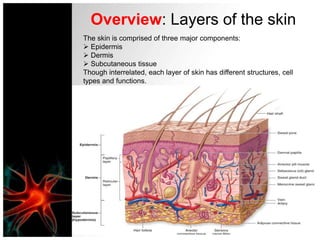
Overview: Layers of the skinThe skin is comprised of three major components:Epidermis
Dermis
 Subcutaneous tissueThough interrelated, each layer of skin has different structures, cell types and functions.
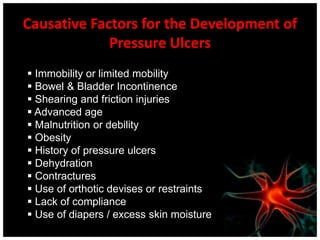
What are Pressure Ulcers?Localized areas of tissue necrosis which develop when soft tissue is compressed between a bony prominence and an external surface for a prolonged period of time.Most pressure ulcers occur over bony prominences, where combined with friction and shearing forces result in skin breakdown.Several factors other than pressure contribute to ulcers including moisture, friction, shear, immobility, sensory loss and some underlying medical conditions.
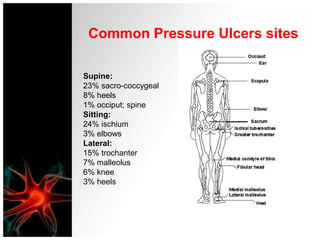
Common Pressure Ulcers sitesSupine:23% sacro-coccygeal8% heels1% occiput; spineSitting:24% ischium3% elbowsLateral:15% trochanter7% malleolus6% knee3% heels
Classification of Pressure Ulcers The staging of pressure ulcers, as defined by national guidelines (NPUAP, CMS), allow for common understandings for healthcare professionals. The staging of a pressure ulcer reflects the amount of tissue damage. STAGE I
STAGE II
STAGE III
STAGE IV
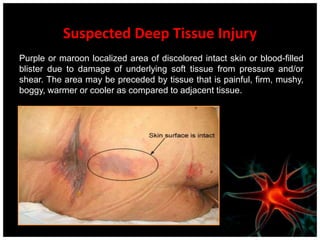
SUSPECTED DEEP TISSUE INJURY (DTI)
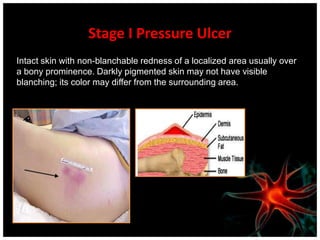
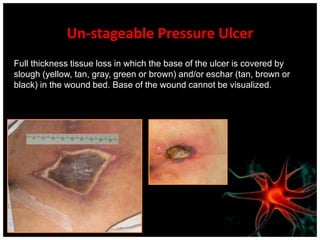
UNSTAGEABLEStage I Pressure UlcerIntact skin with non-blanchable redness of a localized area usually over a bony prominence. Darkly pigmented skin may not have visible blanching; its color may differ from the surrounding area.
Management of Stage- IPressure Ulcers Stage I on Trunk of the Body – Manage incontinence, keeping area clean and dry. Use moisture barrier cream PRN.
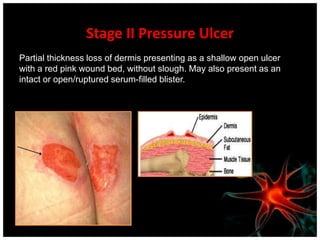
 Off load area of pressure ulcer with  pressure reducing / distribution surface and turning and repositioning schedule.Stage I on Heels – Ensure that heel(s) are floated at all times with frequent monitoring.Stage II Pressure UlcerPartial thickness loss of dermis presenting as a shallow open ulcer with a red pink wound bed, without slough. May also present as an intact or open/ruptured serum-filled blister.
Management of Stage- IIPressure Ulcers Dry Wound Bed Cleanse with normal saline, apply small amount of hydrogel and cover with non adherent dressing, change every day.
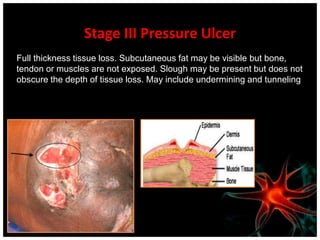
Off load area of pressure ulcer with  pressure reducing / distribution surfaces and turning and repositioning schedule.Minimal DrainageCleanse with normal saline, apply hydrocolloid dressing every three days and PRN soiling or dislodging. Monitor placement every day.Stage III Pressure UlcerFull thickness tissue loss. Subcutaneous fat may be visible but bone, tendon or muscles are not exposed. Slough may be present but does not obscure the depth of tissue loss. May include undermining and tunneling
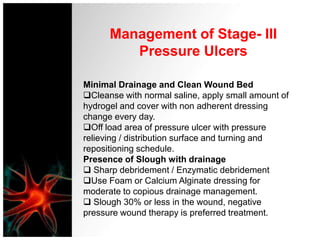
Management of Stage- IIIPressure Ulcers Minimal Drainage and Clean Wound Bed Cleanse with normal saline, apply small amount of hydrogel and cover with non adherent dressing change every day.
Off load area of pressure ulcer with pressure relieving / distribution surface and turning and repositioning schedule.Presence of Slough with drainage Sharp debridement / Enzymatic debridement
Use Foam or Calcium Alginate dressing for moderate to copious drainage management.
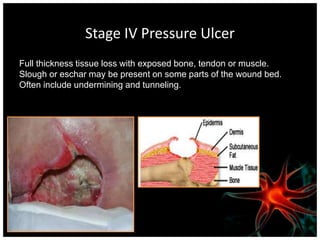
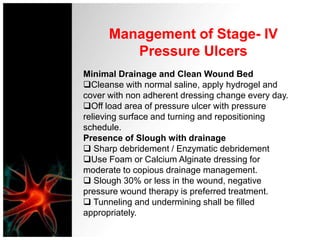
 Slough 30% or less in the wound, negative pressure wound therapy is preferred treatment.Stage IV Pressure UlcerFull thickness tissue loss with exposed bone, tendon or muscle. Slough or eschar may be present on some parts of the wound bed. Often include undermining and tunneling.

Pressure ulcer assessment and management

  • 1.
    Pressure Ulcers Assessmentand ManagementByAlex Khan RN BSN CWCN CFCNwww.woundcarenurses.orgDEVELOPED FOR
  • 2.
    Pressure Ulcer Assessmentand Management OBJECTIVESBy the end of the course participants will be able to:Classify pressure ulcers by stage and differentiate ulcers of non-pressure etiology.Discuss current treatment practices and interventions for pressure ulcer management.
  • 3.
    Overview: Layers ofthe skinThe skin is comprised of three major components:Epidermis
  • 4.
  • 5.
    Subcutaneous tissueThoughinterrelated, each layer of skin has different structures, cell types and functions.
  • 6.
    What are PressureUlcers?Localized areas of tissue necrosis which develop when soft tissue is compressed between a bony prominence and an external surface for a prolonged period of time.Most pressure ulcers occur over bony prominences, where combined with friction and shearing forces result in skin breakdown.Several factors other than pressure contribute to ulcers including moisture, friction, shear, immobility, sensory loss and some underlying medical conditions.
  • 7.
    Common Pressure UlcerssitesSupine:23% sacro-coccygeal8% heels1% occiput; spineSitting:24% ischium3% elbowsLateral:15% trochanter7% malleolus6% knee3% heels
  • 8.
    Classification of PressureUlcers The staging of pressure ulcers, as defined by national guidelines (NPUAP, CMS), allow for common understandings for healthcare professionals. The staging of a pressure ulcer reflects the amount of tissue damage. STAGE I
  • 9.
  • 10.
  • 11.
  • 12.
  • 13.
    UNSTAGEABLEStage I PressureUlcerIntact skin with non-blanchable redness of a localized area usually over a bony prominence. Darkly pigmented skin may not have visible blanching; its color may differ from the surrounding area.
  • 14.
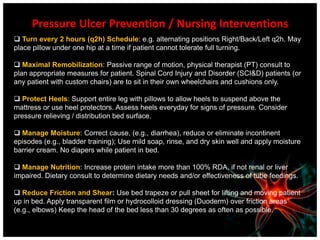
    Management of Stage-IPressure Ulcers Stage I on Trunk of the Body – Manage incontinence, keeping area clean and dry. Use moisture barrier cream PRN.
  • 15.
    Off loadarea of pressure ulcer with pressure reducing / distribution surface and turning and repositioning schedule.Stage I on Heels – Ensure that heel(s) are floated at all times with frequent monitoring.Stage II Pressure UlcerPartial thickness loss of dermis presenting as a shallow open ulcer with a red pink wound bed, without slough. May also present as an intact or open/ruptured serum-filled blister.
  • 16.
    Management of Stage-IIPressure Ulcers Dry Wound Bed Cleanse with normal saline, apply small amount of hydrogel and cover with non adherent dressing, change every day.
  • 17.
    Off load areaof pressure ulcer with pressure reducing / distribution surfaces and turning and repositioning schedule.Minimal DrainageCleanse with normal saline, apply hydrocolloid dressing every three days and PRN soiling or dislodging. Monitor placement every day.Stage III Pressure UlcerFull thickness tissue loss. Subcutaneous fat may be visible but bone, tendon or muscles are not exposed. Slough may be present but does not obscure the depth of tissue loss. May include undermining and tunneling
  • 18.
    Management of Stage-IIIPressure Ulcers Minimal Drainage and Clean Wound Bed Cleanse with normal saline, apply small amount of hydrogel and cover with non adherent dressing change every day.
  • 19.
    Off load areaof pressure ulcer with pressure relieving / distribution surface and turning and repositioning schedule.Presence of Slough with drainage Sharp debridement / Enzymatic debridement
  • 20.
    Use Foam orCalcium Alginate dressing for moderate to copious drainage management.
  • 21.
    Slough 30%or less in the wound, negative pressure wound therapy is preferred treatment.Stage IV Pressure UlcerFull thickness tissue loss with exposed bone, tendon or muscle. Slough or eschar may be present on some parts of the wound bed. Often include undermining and tunneling.