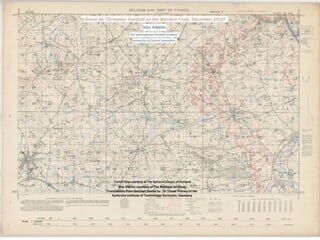
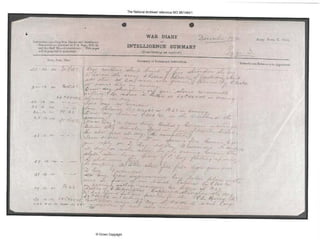
War Diaries courtesy of The National Archives
Translations from German thanks to : Dr Trevor Petney of the
Karlsruhe Institute of Technology, Karlsruhe, Germany
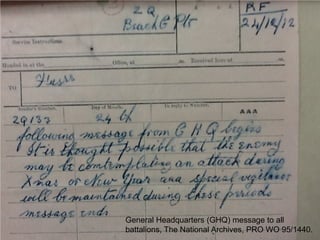
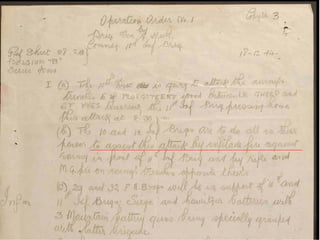
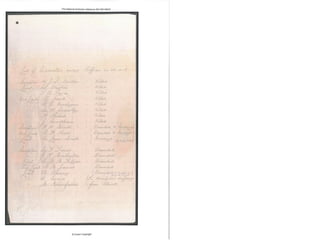
General Headquarters (GHQ) message to all
battalions, The National Archives, PRO WO 95/1440.
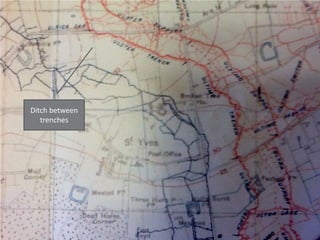
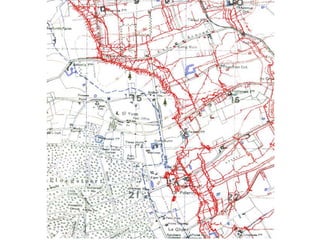
Ditch between
trenches
Private William Tapp wrote:
One of the Ger’s who can speak Eng is shouting over to us to go
over, we shout back “Come halfway”. It is agreed on, our sergeant
goes out their man takes a lot of coaxing but comes at the finish and
we find they have sent two we can hear them talking quite plain they
exchange cigarettes and the German shouts to us a Merry Xmas we
wait the Sergeants return, he gets back and tells us they are not going
to fire tonight if we don’t, they have got lights all along their trench and
also a Xmas tree lit up they are singing so we give them one, it is
funny to hear us talk to one another.
Private William Tapp, ‘Private papers’, Imperial War Museum, Document 18524
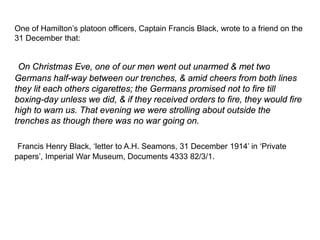
One of Hamilton’s platoon officers, Captain Francis Black, wrote to a friend on the
31 December that:
On Christmas Eve, one of our men went out unarmed & met two
Germans half-way between our trenches, & amid cheers from both lines
they lit each others cigarettes; the Germans promised not to fire till
boxing-day unless we did, & if they received orders to fire, they would fire
high to warn us. That evening we were strolling about outside the
trenches as though there was no war going on.
Francis Henry Black, ‘letter to A.H. Seamons, 31 December 1914’ in ‘Private
papers’, Imperial War Museum, Documents 4333 82/3/1.
On November 18, 1914, Erich von Falkenhayn, the German Chief of Staff ordered:
‘Hold on to what you have and never surrender a square foot of that which
you have won’
Herwig, Holger H (1996) First World War: Germany and Austria-Hungary 1914-
1918, London, Arnold, p249
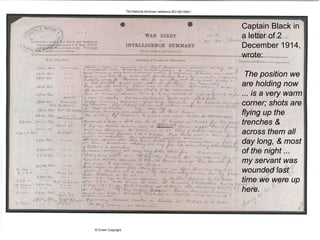
Captain Black in
a letter of 2
December 1914,
wrote:
The position we
are holding now
... is a very warm
corner; shots are
flying up the
trenches &
across them all
day long, & most
of the night ...
my servant was
wounded last
time we were up
here.
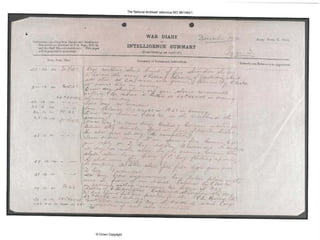
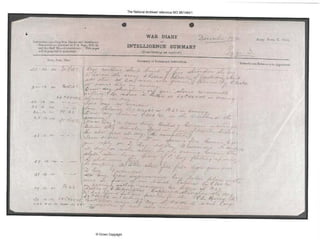
Battalion War Diary:
6 December rain in afternoon. Heavy rain
all night
7 December very heavy rain in morning &
all day
8 December trenches awful. Rain most of
night. Tried to drain trenches but found it
useless
9 December trenches in a very bad state.
Work all night - trying to make them
habitable, 2 killed, 8 wounded
10 December conditions as bad as
possible
In January 1915 2,365 British troops
temporarily removed from the trenches with
trench foot, rheumatism and trench fever
compared to 155 killed and 415 wounded in
action. War Diary, 1st Army WO 95/154
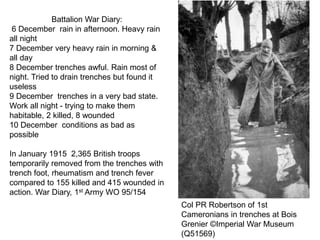
Col PR Robertson of 1st
Cameronians in trenches at Bois
Grenier ©Imperial War Museum
(Q51569)
In December 1914 more rain fell than in
any December since 1876, over 15
centimetres, causing Private Tapp to
write:
… it will take boats to relieve us
Private William Tapp, ‘Private papers’,
Imperial War Museum, Document
18524
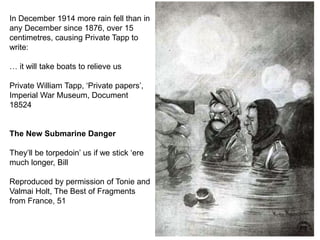
The New Submarine Danger
They’ll be torpedoin’ us if we stick ‘ere
much longer, Bill
Reproduced by permission of Tonie and
Valmai Holt, The Best of Fragments
from France, 51
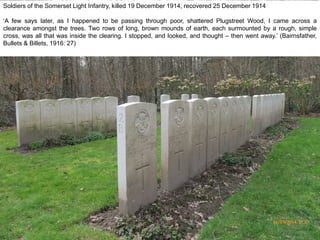
Soldiers of the Somerset Light Infantry, killed 19 December 1914, recovered 25 December 1914
‘A few says later, as I happened to be passing through poor, shattered Plugstreet Wood, I came across a
clearance amongst the trees. Two rows of long, brown mounds of earth, each surmounted by a rough, simple
cross, was all that was inside the clearing. I stopped, and looked, and thought – then went away.’ (Bairnsfather,
Bullets & Billets, 1916: 27)
16/03/2014 17.07
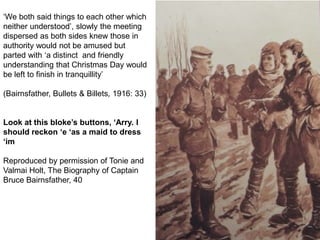
‘We both said things to each other which
neither understood’, slowly the meeting
dispersed as both sides knew those in
authority would not be amused but
parted with ‘a distinct and friendly
understanding that Christmas Day would
be left to finish in tranquillity’
(Bairnsfather, Bullets & Billets, 1916: 33)
Look at this bloke’s buttons, ‘Arry. I
should reckon ‘e ‘as a maid to dress
‘im
Reproduced by permission of Tonie and
Valmai Holt, The Biography of Captain
Bruce Bairnsfather, 40
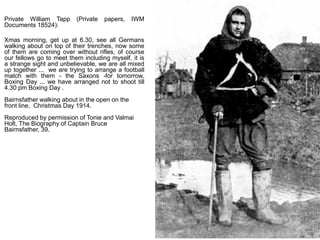
Private William Tapp (Private papers, IWM
Documents 18524):
Xmas morning, get up at 6.30, see all Germans
walking about on top of their trenches, now some
of them are coming over without rifles, of course
our fellows go to meet them including myself, it is
a strange sight and unbelievable, we are all mixed
up together ... we are trying to arrange a football
match with them - the Saxons -for tomorrow,
Boxing Day ... we have arranged not to shoot till
4.30 pm Boxing Day .
Bairnsfather walking about in the open on the
front line, Christmas Day 1914.
Reproduced by permission of Tonie and Valmai
Holt, The Biography of Captain Bruce
Bairnsfather, 39.
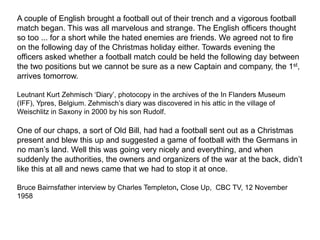
A couple of English brought a football out of their trench and a vigorous football
match began. This was all marvelous and strange. The English officers thought
so too ... for a short while the hated enemies are friends. We agreed not to fire
on the following day of the Christmas holiday either. Towards evening the
officers asked whether a football match could be held the following day between
the two positions but we cannot be sure as a new Captain and company, the 1st,
arrives tomorrow.
Leutnant Kurt Zehmisch ‘Diary’, photocopy in the archives of the In Flanders Museum
(IFF), Ypres, Belgium. Zehmisch’s diary was discovered in his attic in the village of
Weischlitz in Saxony in 2000 by his son Rudolf.
One of our chaps, a sort of Old Bill, had had a football sent out as a Christmas
present and blew this up and suggested a game of football with the Germans in
no man’s land. Well this was going very nicely and everything, and when
suddenly the authorities, the owners and organizers of the war at the back, didn’t
like this at all and news came that we had to stop it at once.
Bruce Bairnsfather interview by Charles Templeton, Close Up, CBC TV, 12 November
1958
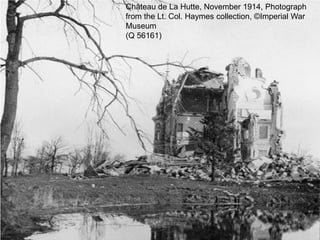
Château de La Hutte, November 1914, Photograph
from the Lt. Col. Haymes collection, ©Imperial War
Museum
(Q 56161)
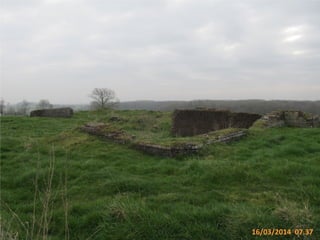
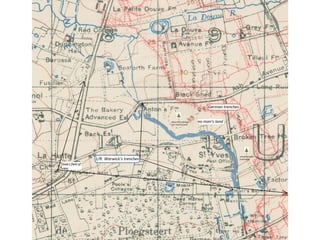
16/03/2014 07.37
16/03/2014 07.40
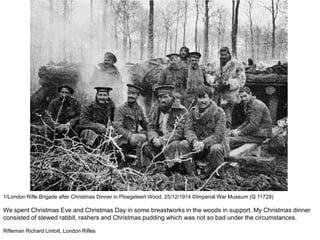
1/London Rifle Brigade after Christmas Dinner in Ploegsteert Wood, 25/12/1914 ©Imperial War Museum (Q 11729)
We spent Christmas Eve and Christmas Day in some breastworks in the woods in support. My Christmas dinner
consisted of stewed rabbit, rashers and Christmas pudding which was not so bad under the circumstances.
Rifleman Richard Lintott, London Rifles
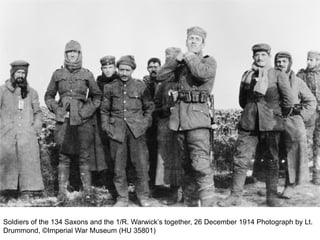
Soldiers of the 134 Saxons and the 1/R. Warwick’s together, 26 December 1914 Photograph by Lt.
Drummond, ©Imperial War Museum (HU 35801)
The probability of football at the Christmas Truces has caught the
imagination and adds some poignancy to the Khaki Chums memorial to the
Truce at the edge of Bairnsfather’s turnip field
To me, it is highly probable that ‘Wie die Kinder rennen sie hinter ihren
seltsaamen Fussballen her’
17/03/2014 11.02
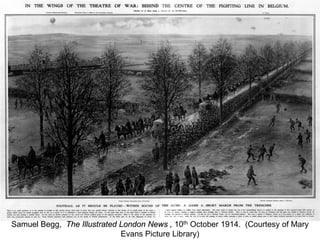
Samuel Begg, The Illustrated London News , 10th October 1914. (Courtesy of Mary
Evans Picture Library)
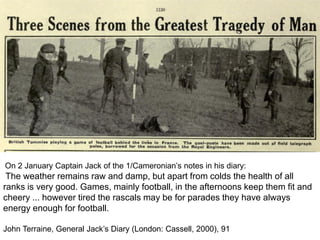
On 2 January Captain Jack of the 1/Cameronian’s notes in his diary:
The weather remains raw and damp, but apart from colds the health of all
ranks is very good. Games, mainly football, in the afternoons keep them fit and
cheery ... however tired the rascals may be for parades they have always
energy enough for football.
John Terraine, General Jack’s Diary (London: Cassell, 2000), 91
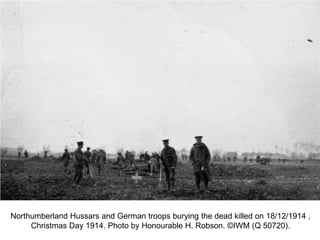
Northumberland Hussars and German troops burying the dead killed on 18/12/1914 ,
Christmas Day 1914. Photo by Honourable H. Robson. ©IWM (Q 50720).
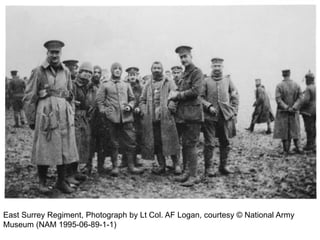
East Surrey Regiment, Photograph by Lt Col. AF Logan, courtesy © National Army
Museum (NAM 1995-06-89-1-1)
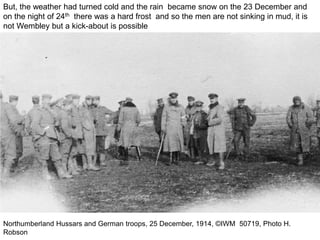
Northumberland Hussars and German troops, 25 December, 1914, ©IWM 50719, Photo H.
Robson
But, the weather had turned cold and the rain became snow on the 23 December and
on the night of 24th there was a hard frost and so the men are not sinking in mud, it is
not Wembley but a kick-about is possible
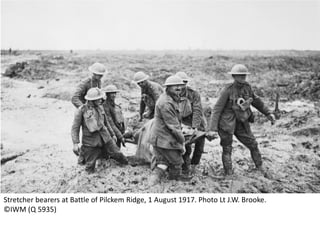
Stretcher bearers at Battle of Pilckem Ridge, 1 August 1917. Photo Lt J.W. Brooke.
©IWM (Q 5935)
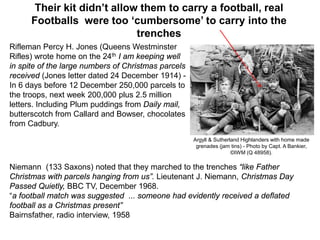
Their kit didn’t allow them to carry a football, real
Footballs were too ‘cumbersome’ to carry into the
trenches
Rifleman Percy H. Jones (Queens Westminster
Rifles) wrote home on the 24th I am keeping well
in spite of the large numbers of Christmas parcels
received (Jones letter dated 24 December 1914) -
In 6 days before 12 December 250,000 parcels to
the troops, next week 200,000 plus 2.5 million
letters. Including Plum puddings from Daily mail,
butterscotch from Callard and Bowser, chocolates
from Cadbury.
Argyll & Sutherland Highlanders with home made
grenades (jam tins) - Photo by Capt. A Bankier,
©IWM (Q 48958).
Niemann (133 Saxons) noted that they marched to the trenches “like Father
Christmas with parcels hanging from us”. Lieutenant J. Niemann, Christmas Day
Passed Quietly, BBC TV, December 1968.
“a football match was suggested ... someone had evidently received a deflated
football as a Christmas present”
Bairnsfather, radio interview, 1958
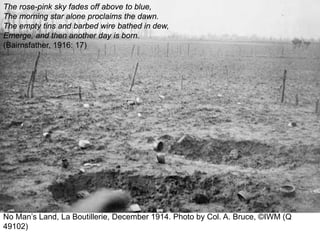
No Man’s Land, La Boutillerie, December 1914. Photo by Col. A. Bruce, ©IWM (Q
49102)
The rose-pink sky fades off above to blue,
The morning star alone proclaims the dawn.
The empty tins and barbed wire bathed in dew,
Emerge, and then another day is born.
(Bairnsfather, 1916: 17)
A London Rifles Officer (on the right of the Warwick’s) -“Its really an extraordinary state of
affairs. We had an inter-platoon game of football in the afternoon; a cap-comforter stuffed with
straw did for the ball, much to the Saxons’ amusement”.
L/Cpl George Ashurst of 2 Lancashire Fusiliers also remembered a make-shift ball “Some of
our boys tied up a sandbag and used it as a football, while a party of Germans enjoyed
themselves sliding on a little frozen pond just in the rear of their trenches”
Private Collier of the 2/Argyll and Sutherland Highlanders wrote an article in the regimental
magazine in 1965 which stated“ Some of the men in the Platoon on our left had made a “ball”
from paper, rags and string and went their “dinger” for about twenty minutes, until the ball fell
to pieces and that was that”.
Private Gilbert of the 13/London (Kensington Princess Louise) participated in football just south
of Armentieres, in 1963 he wrote “soon there were dozens of us fraternizing even to the extent
of kicking a made-up football about in No Mans’ Land.... “
2 Lt Brockbank’s diary records for the 25th “At about 2.30 all firing ceased and the Germans
started shouting to us ‘Come out’ ‘Have a drink’ and then one of them climbed out of the trench
without his equipment on, so one of ours did the same. It ended in a ‘Mother’s Meeting nearly
every man of our trench, except machine gunners, was out, & a huge crowd was between the
trenches. Someone produced a little rubber ball so of course a football match started... it will
naturally sound a very tall story when it gets told in the billets.”
But Lt. Kurt Zehmisch intimates a real ball was used, not only by the Warwick’s
• Private Rivett, ‘C’ Company 1/Lincolnshire wrote a letter to his wife in
Boston which was re-printed in The Grimsby Daily Telegraph. “He wrote that
he was not in the trenches but told by the officers that the men in the
trenches had met Germans in No Man’s Land and “During the day we had
football matches with a new ball sent by some kind friends”.
• Private Mullard also of the 3/Rifle Brigade wrote a letter to parents claiming
his unit agreed to play a football match … on Christmas Day, and we got a
ball ready, but their colonel would not allow them to play, so we had a game
on our own “
• 1/The Buffs (East Kent) Private Deakins remembered “The Germans came
out of their protective holes, fetched a football, and invited our boys out for a
little game. Our boys joined them and together they quickly had great fun,
till they had to return to their posts”
• “An extreme example of the fraternization was a soccer game played
between the Bedfordshire Regiment and the Germans. A member of the
Bedfordshire Regiment produced a ball and the large group of soldiers
played until the ball was deflated when it hit a barbed wire entanglement.”
An account often repeated on the web usually accompanied by the
infamous 1915 photo.
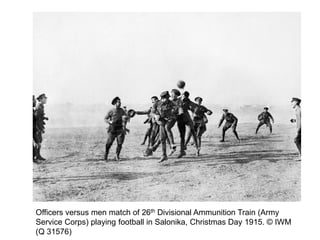
Officers versus men match of 26th Divisional Ammunition Train (Army
Service Corps) playing football in Salonika, Christmas Day 1915. © IWM
(Q 31576)
Captain Jack wrote:
It is interesting to visualise the close of a campaign owing to the opposing
armies – neither of them defeated – having become too friendly to continue
the fight. Anyhow, these incidents seem to suggest that, except in the
temper of battle or some great grievance, educated men have no desire to
kill one another; and that were it not for aggressive National Policies, or the
fear of them by others, war between civilised peoples would seldom take
place.
Terraine, General Jack’s Diary, entry for January 13th, 1915, 94.
To Conclude:
Initially widespread doubt that truces occurred but today it is generally agreed
that some two-thirds of the British line had some degree of truce/ fraternization
Altogether 81 British soldiers died on Christmas Day and on December 26,
there were 62 British deaths.
Probably no football match refereed by the padre, but certainly scores of
games of football played and, for many this was their last Christmas game.
15/03/2014 09.02
16/03/2014 14.24
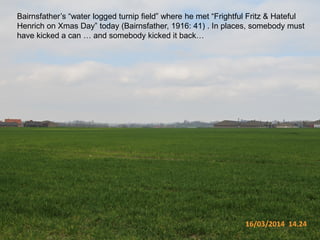
Bairnsfather’s “water logged turnip field” where he met “Frightful Fritz & Hateful
Henrich on Xmas Day” today (Bairnsfather, 1916: 41) . In places, somebody must
have kicked a can … and somebody kicked it back…

A Game for Christmas: Football on the Western Front, December 1914?

  • 1.
    War Diaries courtesyof The National Archives Translations from German thanks to : Dr Trevor Petney of the Karlsruhe Institute of Technology, Karlsruhe, Germany
  • 4.
    General Headquarters (GHQ)message to all battalions, The National Archives, PRO WO 95/1440.
  • 6.
  • 7.
    Private William Tappwrote: One of the Ger’s who can speak Eng is shouting over to us to go over, we shout back “Come halfway”. It is agreed on, our sergeant goes out their man takes a lot of coaxing but comes at the finish and we find they have sent two we can hear them talking quite plain they exchange cigarettes and the German shouts to us a Merry Xmas we wait the Sergeants return, he gets back and tells us they are not going to fire tonight if we don’t, they have got lights all along their trench and also a Xmas tree lit up they are singing so we give them one, it is funny to hear us talk to one another. Private William Tapp, ‘Private papers’, Imperial War Museum, Document 18524
  • 9.
    One of Hamilton’splatoon officers, Captain Francis Black, wrote to a friend on the 31 December that: On Christmas Eve, one of our men went out unarmed & met two Germans half-way between our trenches, & amid cheers from both lines they lit each others cigarettes; the Germans promised not to fire till boxing-day unless we did, & if they received orders to fire, they would fire high to warn us. That evening we were strolling about outside the trenches as though there was no war going on. Francis Henry Black, ‘letter to A.H. Seamons, 31 December 1914’ in ‘Private papers’, Imperial War Museum, Documents 4333 82/3/1.
  • 12.
    On November 18,1914, Erich von Falkenhayn, the German Chief of Staff ordered: ‘Hold on to what you have and never surrender a square foot of that which you have won’ Herwig, Holger H (1996) First World War: Germany and Austria-Hungary 1914- 1918, London, Arnold, p249
  • 13.
    Captain Black in aletter of 2 December 1914, wrote: The position we are holding now ... is a very warm corner; shots are flying up the trenches & across them all day long, & most of the night ... my servant was wounded last time we were up here.
  • 14.
    Battalion War Diary: 6December rain in afternoon. Heavy rain all night 7 December very heavy rain in morning & all day 8 December trenches awful. Rain most of night. Tried to drain trenches but found it useless 9 December trenches in a very bad state. Work all night - trying to make them habitable, 2 killed, 8 wounded 10 December conditions as bad as possible In January 1915 2,365 British troops temporarily removed from the trenches with trench foot, rheumatism and trench fever compared to 155 killed and 415 wounded in action. War Diary, 1st Army WO 95/154 Col PR Robertson of 1st Cameronians in trenches at Bois Grenier ©Imperial War Museum (Q51569)
  • 15.
    In December 1914more rain fell than in any December since 1876, over 15 centimetres, causing Private Tapp to write: … it will take boats to relieve us Private William Tapp, ‘Private papers’, Imperial War Museum, Document 18524 The New Submarine Danger They’ll be torpedoin’ us if we stick ‘ere much longer, Bill Reproduced by permission of Tonie and Valmai Holt, The Best of Fragments from France, 51
  • 18.
    Soldiers of theSomerset Light Infantry, killed 19 December 1914, recovered 25 December 1914 ‘A few says later, as I happened to be passing through poor, shattered Plugstreet Wood, I came across a clearance amongst the trees. Two rows of long, brown mounds of earth, each surmounted by a rough, simple cross, was all that was inside the clearing. I stopped, and looked, and thought – then went away.’ (Bairnsfather, Bullets & Billets, 1916: 27) 16/03/2014 17.07
  • 19.
    ‘We both saidthings to each other which neither understood’, slowly the meeting dispersed as both sides knew those in authority would not be amused but parted with ‘a distinct and friendly understanding that Christmas Day would be left to finish in tranquillity’ (Bairnsfather, Bullets & Billets, 1916: 33) Look at this bloke’s buttons, ‘Arry. I should reckon ‘e ‘as a maid to dress ‘im Reproduced by permission of Tonie and Valmai Holt, The Biography of Captain Bruce Bairnsfather, 40
  • 20.
    Private William Tapp(Private papers, IWM Documents 18524): Xmas morning, get up at 6.30, see all Germans walking about on top of their trenches, now some of them are coming over without rifles, of course our fellows go to meet them including myself, it is a strange sight and unbelievable, we are all mixed up together ... we are trying to arrange a football match with them - the Saxons -for tomorrow, Boxing Day ... we have arranged not to shoot till 4.30 pm Boxing Day . Bairnsfather walking about in the open on the front line, Christmas Day 1914. Reproduced by permission of Tonie and Valmai Holt, The Biography of Captain Bruce Bairnsfather, 39.
  • 21.
    A couple ofEnglish brought a football out of their trench and a vigorous football match began. This was all marvelous and strange. The English officers thought so too ... for a short while the hated enemies are friends. We agreed not to fire on the following day of the Christmas holiday either. Towards evening the officers asked whether a football match could be held the following day between the two positions but we cannot be sure as a new Captain and company, the 1st, arrives tomorrow. Leutnant Kurt Zehmisch ‘Diary’, photocopy in the archives of the In Flanders Museum (IFF), Ypres, Belgium. Zehmisch’s diary was discovered in his attic in the village of Weischlitz in Saxony in 2000 by his son Rudolf. One of our chaps, a sort of Old Bill, had had a football sent out as a Christmas present and blew this up and suggested a game of football with the Germans in no man’s land. Well this was going very nicely and everything, and when suddenly the authorities, the owners and organizers of the war at the back, didn’t like this at all and news came that we had to stop it at once. Bruce Bairnsfather interview by Charles Templeton, Close Up, CBC TV, 12 November 1958
  • 22.
    Château de LaHutte, November 1914, Photograph from the Lt. Col. Haymes collection, ©Imperial War Museum (Q 56161)
  • 23.
  • 24.
  • 26.
    1/London Rifle Brigadeafter Christmas Dinner in Ploegsteert Wood, 25/12/1914 ©Imperial War Museum (Q 11729) We spent Christmas Eve and Christmas Day in some breastworks in the woods in support. My Christmas dinner consisted of stewed rabbit, rashers and Christmas pudding which was not so bad under the circumstances. Rifleman Richard Lintott, London Rifles
  • 28.
    Soldiers of the134 Saxons and the 1/R. Warwick’s together, 26 December 1914 Photograph by Lt. Drummond, ©Imperial War Museum (HU 35801)
  • 30.
    The probability offootball at the Christmas Truces has caught the imagination and adds some poignancy to the Khaki Chums memorial to the Truce at the edge of Bairnsfather’s turnip field To me, it is highly probable that ‘Wie die Kinder rennen sie hinter ihren seltsaamen Fussballen her’ 17/03/2014 11.02
  • 31.
    Samuel Begg, TheIllustrated London News , 10th October 1914. (Courtesy of Mary Evans Picture Library)
  • 32.
    On 2 JanuaryCaptain Jack of the 1/Cameronian’s notes in his diary: The weather remains raw and damp, but apart from colds the health of all ranks is very good. Games, mainly football, in the afternoons keep them fit and cheery ... however tired the rascals may be for parades they have always energy enough for football. John Terraine, General Jack’s Diary (London: Cassell, 2000), 91
  • 33.
    Northumberland Hussars andGerman troops burying the dead killed on 18/12/1914 , Christmas Day 1914. Photo by Honourable H. Robson. ©IWM (Q 50720).
  • 34.
    East Surrey Regiment,Photograph by Lt Col. AF Logan, courtesy © National Army Museum (NAM 1995-06-89-1-1)
  • 35.
    Northumberland Hussars andGerman troops, 25 December, 1914, ©IWM 50719, Photo H. Robson But, the weather had turned cold and the rain became snow on the 23 December and on the night of 24th there was a hard frost and so the men are not sinking in mud, it is not Wembley but a kick-about is possible
  • 36.
    Stretcher bearers atBattle of Pilckem Ridge, 1 August 1917. Photo Lt J.W. Brooke. ©IWM (Q 5935)
  • 37.
    Their kit didn’tallow them to carry a football, real Footballs were too ‘cumbersome’ to carry into the trenches Rifleman Percy H. Jones (Queens Westminster Rifles) wrote home on the 24th I am keeping well in spite of the large numbers of Christmas parcels received (Jones letter dated 24 December 1914) - In 6 days before 12 December 250,000 parcels to the troops, next week 200,000 plus 2.5 million letters. Including Plum puddings from Daily mail, butterscotch from Callard and Bowser, chocolates from Cadbury. Argyll & Sutherland Highlanders with home made grenades (jam tins) - Photo by Capt. A Bankier, ©IWM (Q 48958). Niemann (133 Saxons) noted that they marched to the trenches “like Father Christmas with parcels hanging from us”. Lieutenant J. Niemann, Christmas Day Passed Quietly, BBC TV, December 1968. “a football match was suggested ... someone had evidently received a deflated football as a Christmas present” Bairnsfather, radio interview, 1958
  • 38.
    No Man’s Land,La Boutillerie, December 1914. Photo by Col. A. Bruce, ©IWM (Q 49102) The rose-pink sky fades off above to blue, The morning star alone proclaims the dawn. The empty tins and barbed wire bathed in dew, Emerge, and then another day is born. (Bairnsfather, 1916: 17)
  • 39.
    A London RiflesOfficer (on the right of the Warwick’s) -“Its really an extraordinary state of affairs. We had an inter-platoon game of football in the afternoon; a cap-comforter stuffed with straw did for the ball, much to the Saxons’ amusement”. L/Cpl George Ashurst of 2 Lancashire Fusiliers also remembered a make-shift ball “Some of our boys tied up a sandbag and used it as a football, while a party of Germans enjoyed themselves sliding on a little frozen pond just in the rear of their trenches” Private Collier of the 2/Argyll and Sutherland Highlanders wrote an article in the regimental magazine in 1965 which stated“ Some of the men in the Platoon on our left had made a “ball” from paper, rags and string and went their “dinger” for about twenty minutes, until the ball fell to pieces and that was that”. Private Gilbert of the 13/London (Kensington Princess Louise) participated in football just south of Armentieres, in 1963 he wrote “soon there were dozens of us fraternizing even to the extent of kicking a made-up football about in No Mans’ Land.... “ 2 Lt Brockbank’s diary records for the 25th “At about 2.30 all firing ceased and the Germans started shouting to us ‘Come out’ ‘Have a drink’ and then one of them climbed out of the trench without his equipment on, so one of ours did the same. It ended in a ‘Mother’s Meeting nearly every man of our trench, except machine gunners, was out, & a huge crowd was between the trenches. Someone produced a little rubber ball so of course a football match started... it will naturally sound a very tall story when it gets told in the billets.”
  • 40.
    But Lt. KurtZehmisch intimates a real ball was used, not only by the Warwick’s • Private Rivett, ‘C’ Company 1/Lincolnshire wrote a letter to his wife in Boston which was re-printed in The Grimsby Daily Telegraph. “He wrote that he was not in the trenches but told by the officers that the men in the trenches had met Germans in No Man’s Land and “During the day we had football matches with a new ball sent by some kind friends”. • Private Mullard also of the 3/Rifle Brigade wrote a letter to parents claiming his unit agreed to play a football match … on Christmas Day, and we got a ball ready, but their colonel would not allow them to play, so we had a game on our own “ • 1/The Buffs (East Kent) Private Deakins remembered “The Germans came out of their protective holes, fetched a football, and invited our boys out for a little game. Our boys joined them and together they quickly had great fun, till they had to return to their posts” • “An extreme example of the fraternization was a soccer game played between the Bedfordshire Regiment and the Germans. A member of the Bedfordshire Regiment produced a ball and the large group of soldiers played until the ball was deflated when it hit a barbed wire entanglement.” An account often repeated on the web usually accompanied by the infamous 1915 photo.
  • 43.
    Officers versus menmatch of 26th Divisional Ammunition Train (Army Service Corps) playing football in Salonika, Christmas Day 1915. © IWM (Q 31576)
  • 44.
    Captain Jack wrote: Itis interesting to visualise the close of a campaign owing to the opposing armies – neither of them defeated – having become too friendly to continue the fight. Anyhow, these incidents seem to suggest that, except in the temper of battle or some great grievance, educated men have no desire to kill one another; and that were it not for aggressive National Policies, or the fear of them by others, war between civilised peoples would seldom take place. Terraine, General Jack’s Diary, entry for January 13th, 1915, 94.
  • 45.
    To Conclude: Initially widespreaddoubt that truces occurred but today it is generally agreed that some two-thirds of the British line had some degree of truce/ fraternization Altogether 81 British soldiers died on Christmas Day and on December 26, there were 62 British deaths. Probably no football match refereed by the padre, but certainly scores of games of football played and, for many this was their last Christmas game. 15/03/2014 09.02
  • 46.
    16/03/2014 14.24 Bairnsfather’s “waterlogged turnip field” where he met “Frightful Fritz & Hateful Henrich on Xmas Day” today (Bairnsfather, 1916: 41) . In places, somebody must have kicked a can … and somebody kicked it back…