World War I
There were three types of trench
A Front Line trench – the last line before No-Man’s land from where enemies fired at
each other.
Firesteps
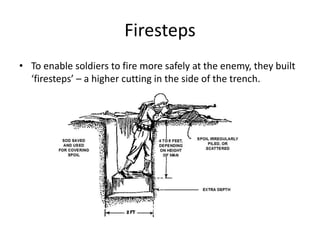
• To enable soldiers to fire more safely at the enemy, they built
‘firesteps’ – a higher cutting in the side of the trench.
Communications Trenches and ‘Saps’
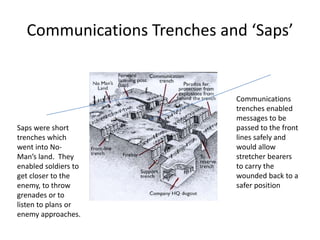
Communications
trenches enabled
messages to be
passed to the front
lines safely and
would allow
stretcher bearers
to carry the
wounded back to a
safer position
Saps were short
trenches which
went into No-
Man’s land. They
enabled soldiers to
get closer to the
enemy, to throw
grenades or to
listen to plans or
enemy approaches.
Stumps of trees were used as look out posts – blown
up, they would be hollowed out and used as
camouflage for spying on enemy trenches.
Trenches were not built in straight lines. This made it
harder to capture them or to send fire down them.
This is a recent ariel photo of the trenches – the holes are left by shells.
What was life like in the trenches?
This is how soldiers would sleep – in dug-out sections of the trench, supported by
sand bags.
What was life like in the trenches?
Hot food in a trench was considered a luxury – the difficulty and danger of transporting it
from a field kitchen to the front line was too great.
Letters from home
Writing to and receiving letters from home was the ONLY way of communicating for
the soldiers. Twelve and a half million letters were sent to the Western
Front every week. In 1914 the Postal Section of the Royal Engineers had a staff
of 250 men. By 1918 the Army Postal Service employed 4,000 soldiers. Letters
only took two or three days to arrive from Britain. Even soldiers in the front
line trenches received daily deliveries of letters
What happened when it rained?
• One of the worst problems for the soldiers was
the endless rain that fell on the battlefields.
These men are standing in deep, wet, freezing mud.
Their feet would be wet all the time.
Rescuing the dead and injured from No-Man’s
Land was made even harder by the mud.
The mud had a dreadful affect on the men’s feet
– known as ‘Trench-foot’.
What was the fighting like?
This was known as
‘going over the top’.
Soldiers would be ordered to ‘advance’ towards the enemy trenches. The enemy, on
seeing them approach would ‘mow them down’ with machine gun fire. Very few of the
advancing soldiers would make it to the enemy trench.
Miners were used to dig tunnels under the enemy lines.
They laid explosives which would blow up without
warning.
This explosion created the
largest crater of the war, at
Boiselle. The noise of it was
heard in England.
This is what it looks like today.
The new weapon used to devastating
effect, was gas.
Soldier who weren’t killed by the
gas were blinded by it.
This is No-Man’s Land
Conscientious objectors – those who would not fight –
were often recruited as stretcher bearers.
Soldier’s crossing No Man’s Land
Occasionally, soldiers were able to visit local villages for
a good meal (egg and chips), a beer and a bath.
Casualties.
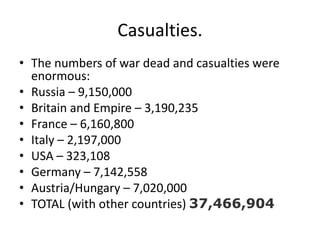
• The numbers of war dead and casualties were
enormous:
• Russia – 9,150,000
• Britain and Empire – 3,190,235
• France – 6,160,800
• Italy – 2,197,000
• USA – 323,108
• Germany – 7,142,558
• Austria/Hungary – 7,020,000
• TOTAL (with other countries) 37,466,904
Most soldiers were not returned to be buried in
Britain. War cemeteries are immaculately
looked after.
This is the cemetery at Tyne Cot.
Life as an invalid and with shell shock .
• After the war, the soldiers returned to Britain,
not always as heroes. The British people were
not used to seeing disability – the blind,
amputees and men with facial injuries, on such a
large scale. They didn’t know how to treat them.
Sometimes they were ignored.
• The returning soldiers did not want to talk about
their experiences as they were so dreadful. Lots
of them suffered terribly from shell shock. There
were no counsellors.
The wounded and the
shell- shocked
Some soldiers’ remains were never identified. One of these was placed in
Westminster Abbey. It is known as the Tomb of the Unknown Warrior. Royal
Brides leave their wedding bouquets here as a
mark of respect.
This is Kate Middleton’s bouquet.

World war i

  • 1.
  • 2.
    There were threetypes of trench A Front Line trench – the last line before No-Man’s land from where enemies fired at each other.
  • 3.
    Firesteps • To enablesoldiers to fire more safely at the enemy, they built ‘firesteps’ – a higher cutting in the side of the trench.
  • 4.
    Communications Trenches and‘Saps’ Communications trenches enabled messages to be passed to the front lines safely and would allow stretcher bearers to carry the wounded back to a safer position Saps were short trenches which went into No- Man’s land. They enabled soldiers to get closer to the enemy, to throw grenades or to listen to plans or enemy approaches.
  • 5.
    Stumps of treeswere used as look out posts – blown up, they would be hollowed out and used as camouflage for spying on enemy trenches.
  • 6.
    Trenches were notbuilt in straight lines. This made it harder to capture them or to send fire down them. This is a recent ariel photo of the trenches – the holes are left by shells.
  • 7.
    What was lifelike in the trenches? This is how soldiers would sleep – in dug-out sections of the trench, supported by sand bags.
  • 8.
    What was lifelike in the trenches? Hot food in a trench was considered a luxury – the difficulty and danger of transporting it from a field kitchen to the front line was too great.
  • 9.
    Letters from home Writingto and receiving letters from home was the ONLY way of communicating for the soldiers. Twelve and a half million letters were sent to the Western Front every week. In 1914 the Postal Section of the Royal Engineers had a staff of 250 men. By 1918 the Army Postal Service employed 4,000 soldiers. Letters only took two or three days to arrive from Britain. Even soldiers in the front line trenches received daily deliveries of letters
  • 10.
    What happened whenit rained? • One of the worst problems for the soldiers was the endless rain that fell on the battlefields.
  • 11.
    These men arestanding in deep, wet, freezing mud. Their feet would be wet all the time.
  • 12.
    Rescuing the deadand injured from No-Man’s Land was made even harder by the mud.
  • 13.
    The mud hada dreadful affect on the men’s feet – known as ‘Trench-foot’.
  • 14.
    What was thefighting like? This was known as ‘going over the top’. Soldiers would be ordered to ‘advance’ towards the enemy trenches. The enemy, on seeing them approach would ‘mow them down’ with machine gun fire. Very few of the advancing soldiers would make it to the enemy trench.
  • 15.
    Miners were usedto dig tunnels under the enemy lines. They laid explosives which would blow up without warning. This explosion created the largest crater of the war, at Boiselle. The noise of it was heard in England.
  • 16.
    This is whatit looks like today.
  • 17.
    The new weaponused to devastating effect, was gas. Soldier who weren’t killed by the gas were blinded by it.
  • 18.
  • 19.
    Conscientious objectors –those who would not fight – were often recruited as stretcher bearers.
  • 20.
  • 21.
    Occasionally, soldiers wereable to visit local villages for a good meal (egg and chips), a beer and a bath.
  • 22.
    Casualties. • The numbersof war dead and casualties were enormous: • Russia – 9,150,000 • Britain and Empire – 3,190,235 • France – 6,160,800 • Italy – 2,197,000 • USA – 323,108 • Germany – 7,142,558 • Austria/Hungary – 7,020,000 • TOTAL (with other countries) 37,466,904
  • 23.
    Most soldiers werenot returned to be buried in Britain. War cemeteries are immaculately looked after. This is the cemetery at Tyne Cot.
  • 24.
    Life as aninvalid and with shell shock . • After the war, the soldiers returned to Britain, not always as heroes. The British people were not used to seeing disability – the blind, amputees and men with facial injuries, on such a large scale. They didn’t know how to treat them. Sometimes they were ignored. • The returning soldiers did not want to talk about their experiences as they were so dreadful. Lots of them suffered terribly from shell shock. There were no counsellors.
  • 25.
    The wounded andthe shell- shocked
  • 26.
    Some soldiers’ remainswere never identified. One of these was placed in Westminster Abbey. It is known as the Tomb of the Unknown Warrior. Royal Brides leave their wedding bouquets here as a mark of respect. This is Kate Middleton’s bouquet.